Belly Fires

A friend recently sent me a story from Smithsonian.com about how Evangelicalism arose partially in reaction to protests against the Vietnam War. Not that they were protesting it, but rather other mainline Protestants protesting drove evangelicals further to the right. Having grown up evangelical, I think I understand their strange reasoning fairly well. It was illustrated, for example, in a meeting of the Nashotah House board of trustees. Now, confidentiality rules—which I support—prevent me from providing details, but as you can imagine board meetings involved differences of opinion. I was a faculty representative (voice, but no vote), and I had a point to make. Being Episcopalian I politely and calmly raised my hand. At the same table one of the student representatives (voice, but no vote) was waving his arm like he had to find the nearest restroom, and quick. The chair called on him, ignoring my learned gesture. “He has a fire in the belly,” the chair said, “let’s listen to him.”

A fire in the belly. Not exactly an empirical—or even rational—reason to select one comment above another in my opinion. It was outward and dramatic gesticulation that caught the chair’s attention. Cooler considerations could be easily ignored. Nashotah House wasn’t exactly Evangelical. It was conservative, to be sure. What this episode taught me, however, is that society responds to those with bellies strangely warmed. Mainstream Protestants, for the most part, want comfortable faith experiences. Reason, after all, suggests decorum. Over 90 percent of the many, many mainline sermons I’ve witnessed have been staid and calm. Back in John Wesley’s day enthusiasm was an actionable offense in ecclesiastical eyes. Was the fire in the heart, or in the belly?
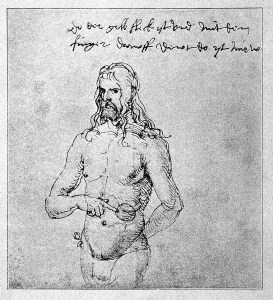
A little to the right…
L0006082 Self Portrait of Albrecht Durer
Credit: Wellcome Library, London. Wellcome Images
images@wellcome.ac.uk
http://wellcomeimages.org
Self Portrait of Albrecht Durer.
Finger pointing to left side of torso.
By: Albrecht DurerPublished: –
Copyrighted work available under Creative Commons Attribution only licence CC BY 4.0 http://creativecommons.org/licenses/by/4.0/

So, what does this have to do with the Smithsonian story? Evangelicalism is driven not by the head but by the midriff. John Wesley’s conversion account was famous for his statement that his heart was “strangely warmed.” An inveterate doubter of his own salvation, Wesley needed to be certain. His thermo-cardiac episode helped to comfort him in the face of the lapping waves of the lake of fire at his feet. Having been evangelical once upon a time, I think I understand this constant Wesleyan concern. The fear of Hell is never easily overcome. The Greek word for strong emotion can be translated “to feel it in the bowels.” Examined more rationally, we know what moving bowels lead to. We see it every day as Evangelicals drive all three branches of government. The fire in the belly wins over cooler heads every time.
Secularcist

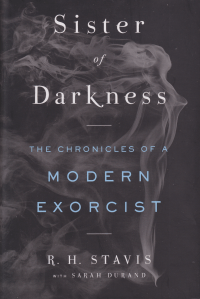
It should be fairly obvious that I’ve been researching demons lately. In the current political climate, it feels like a natural thing to do. Where there are demons, there are also exorcists. Many times those who write books on their experience in this realm will lapse into something along the lines of, “If there are demons, then Catholicism has to be true. All of it.” Or something like that. I have to admit that reading the better written accounts makes me start to think that way. R. H. Stavis’ Sister of Darkness: The Chronicles of a Modern Exorcist is another approach altogether. A secular exorcist, Rachel Stavis doesn’t use the time-worn rituals of movie fame. And her book offers an interesting rationale for her exorcisms—she sees entities.

I have often wondered if “growing up” isn’t largely teaching ourselves to discount what we perceive as children. I’m sure I’m not the only kid who was told there are no such things as monsters but didn’t fully internalize that “fact.” Besides, some things are worse than monsters. In any case, Stavis states that she sees entities and it’s clear from the book that she does indeed believe this. This isn’t for show. She describes various types of demons and how she learned to exorcize them. It’s a fascinating account. Her explanations won’t convince everyone, and her answers of where demons come from remain somewhat vague, but her clients swear by her methods. And she’s upfront about wanting her work to increase the good in the world by banishing evil.

I know many Christians who’d be ready to stone a pagan even for such a good deed as exorcizing a demon. Stavis doesn’t belittle any religion, however, and leans a bit toward Wicca herself. As I read I imagined what a reader convinced of the rectitude of one and only one religions would say. Only Jesus can drive out demons? (Judaism had, and still has exorcists, as do some sects of Islam.) Since a demon is a Christian monster, only a Christian can drive it out? One of the more interesting facts of the history of exorcism is that it was, in the Middle Ages, sometimes an interfaith exercise. The three major religions represented in Europe (the Abrahamic triad) recognized that any of the three could drive out demons. Each welcomed the help of the others. We’ve gone backwards since then. We haven’t again yet reached the stage where we realize that anyone doing good is on the side of good. Even demons, it seems, are conservative these days.


Call It What You Will

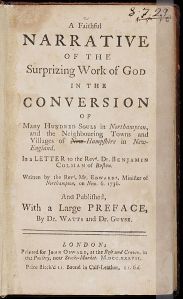
I didn’t even know the House of Representatives had a chaplain. Then Paul Ryan fired him. I wondered once again if evangelicals were interested in religion at all. We all have labels we’d like to claim but lack of legitimacy prevents us from keeping them. My secret wannabe title is rock star, but given that I can’t sing and can’t play any instruments, I have trouble retaining it. Evangelicals, however, have no challengers. They are so flexible they’d make Proteus blush. Such theological promiscuity, traditional religion teaches, will have its comeuppance. If 45 has accomplished nothing else, he’s forced the religious right to show its true, secular colors. Of all the great ironies of the situation none is greater than the fact that “nones” of whatever description hold up the weightier matters of morality better than those most vocal about their faith. Evangelicals, however, control the narrative and claim to do so with God’s own authority. They have few challengers.

Source: Beinecke Rare Book & Manuscript Library, Yale University via Wikimedia Commons

Then, mere days latter, Rev. Patrick J. Conroy was reinstated by the whiplash GOP. Did somebody warn the religious right that “religious” was part of their name? “Hypocrisy” comes from a Greek root meaning to play a theatrical part. As my stepfather used to tell us, “do as I say, not as I do.” He was a secular man, so his hypocrisy could be overlooked. Noble, even, at times. When those who stake their entire identity on WWJD promote, vocally and enthusiastically, an unrepentant candidate for sinner of the year, you’ve got to wonder if even hypocrisy has lost its punch. How can you reason with people who refuse to reason? We used to lock them away in asylums. Now we throw them into the swamp.

Double standards are the new normal, I guess. Nobody really paid any heed when the fall of the towering televangelists showed, decades ago, that the idol they proclaimed as true religion was rotten to the core. Oh, they made the headlines for a while, but their tumble did nothing to dissuade their true followers. Evangelicals control their own narrative. For many decades now higher education and the media have pretty much ignored religion as a force for social change. Once upon a time Evangelicalism meant change based on ideals that more or less fit the recorded words of the carpenter from Nazareth. Now that its inspiration is the ninth circle below, those who have access to the funds of higher education prefer to put their money elsewhere. Why study something that threatens democracy on a daily basis? Why bother trying to understand Evangelicals? Call it what you will—there’s no way to object to anyone claiming whatever name they want. I should know; I’m a rock star, after all.


Strange Passions

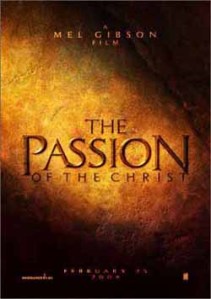
In Holy Horror I make the suggestion that Mel Gibson’s The Passion of the Christ can be considered a horror film. It certainly has more gratuitous blood and gore than many examples of the genre I’ve seen. Really, I had no desire to see it. One of the great aspects of teaching is learning from students. While an adjunct at Rutgers one of my undergrads brought me a copy of the DVD to watch. She said I needed to see it. Obligingly I did so. I knew if I returned the disc to her without watching she’d ask why I hadn’t. Apart from the famously sadistic flogging scene, it was, like any other Bible film, off base quite a bit of the time. This was commentary, not Scripture.

This came back to me reading Bob Cranmer’s account of his haunted house on Brownsville Road in the book about which I blogged a few days ago. Cranmer didn’t exactly follow orthodox methods for driving the demon out of his house. Some of his tactics were improvised. The one I found the most startling was that in the rooms that were most badly affected he played The Passion of the Christ on a continuous loop for weeks at a time. Not only does this suggest demons are capable of watching movies, but that this film can stand in for the actual events that took place in Israel two millennia ago. If the priests involved objected to this method, he didn’t record it. So we have what could be considered a horror movie being used to try to drive out a real life monster (depending on one’s point of view).

Interestingly, this is one of the points behind Holy Horror. Film (and other media) can be a powerful force in our experience of the world. We don’t just go to the cinema because everybody’s talking about a movie. Our experience of watching it is transformative, if only temporary. The same is true of live theater or a concert. Far from being mere entertainment, these cultural events provide a form of transcendence, if they speak to us. In my own case The Passion of the Christ didn’t sell me on Mr. Gibson’s vision. I have no doubts that Roman crucifixion was a horrible spectacle. I also have no doubts that the Good Book indicates that the point of all of this was elsewhere. The Gospels weren’t an effort to traumatize readers. That’s the job of horror movies. Apparently this is something on which even demons agree.


Christian Nationalism

Apparently we’ve forgotten the Second World War. In our touch-screen, never-have-to-get-off-the-couch culture of convenience, we’ve completely disregarded the millions that, yes, died in vain. You see, Christian Nationalism is on the rise, according to a story my wife sent me from the Huffington Post. About as much an aberration from literal “Christianity” as you can get, this movement believes America’s success is tied to its role as a Christian nation. Such believers, if they can even see that such rhetoric leads to war, don’t care. For the fact is that the economy of China is poised to pass, if it hasn’t already done so, the economy of what used to be United States. Call it Confucian Nationalism, but I have the feeling that when two giants try to get into the same compartment things tend to get unpleasant.

Serious thinking is a natural resource of which America has clearly run out. Easy answers, empty of content—junk food of the mind—are easily tweeted out from a personality that declares his own opinions truth. Everything else is fake news. Evangelicals, it’s sorely obvious, need to read The Analects. Don’t claim that its obscure; I’ve read the Bible. If you think you can figure Paul out, well, that’s what I’d call “fake news.” Oh, and by the way, Paul was anything but a nationalist. For all his faults, he knew that Christianity is nothing if it’s tied to nationhood.

Instead we puff out our chests and, ignoring the Bible on this very proverb, become the blind following the blind. If God has a plan he’d better reveal it to his 45th prophet soon because there are some enormous gulfs in the road and he insists on walking without a cane. American exceptionalism is built on the backs of the poor and helpless. They are also the ones most easily swayed by its perverse rhetoric. Nations must separate themselves from their religious beliefs. We’ve seen what happens when incompatible religions become the identifying factors of countries. As long ago as the 1970s I’d learned that nationalism was a powerful force for evil. I hadn’t been alive during the Second World War, but the world into which I’d been born was entangled in Vietnam. We were halfway around the world playing the bully, but it was because of capitalism, not Christianity. The end result, however, was the same. Unimaginable human suffering. Death, pain, and sorrow. And we’ve decided that the Prince of Peace wants us to head down that road again. “Vanity,” I hear Qohelet whisper.


Defining Evangelicals

Like most Americans I have trouble getting over the button-down image of Evangelicals that has now become so distinctive. In reality Evangelicalism has nothing to do with Jesus, but it comes down to basically two things: a conservative haircut and belief in the superiority of males. The latter point is made by Rodney Hessinger and Kristen Toby in an opinion piece on Cleveland.com. Asking the question that’s on all logical minds—how can Evangelicals stand by a president who credibly cheated on his wife just after their child was born?—they come to the conclusion that patriarchy trumps all forms of righteousness. I know this from sad personal experience. The Bible, Evangelicals claim, gives men the headship of the household. They may sin, yes, but even with that their lordship must remain intact. That is the non-negotiable fact of Evangelicalism.

I was a teenage Evangelical. I grew up in a household where my mother refused to divorce her alcoholic husband because it was against Evangelical teaching. Sexual sins were well nigh unforgivable. In fact, adultery, of which 45 has credibly been accused, was a death-penalty offense according to the Good Book. About the only thing worse than sexual sins way lying. I can’t believe I’m getting old school on Evangelicalism, but I have to say Fundamentalism isn’t what it used to be. In college I knew people who believed we should reinstitute stoning for adultery. Instead we now use it as an excuse to elect unqualified presidents. And yes, we’d like to keep the brand, thank you. Commandments have now become negotiable.

Our society is very sick. Unlike the narrative Evangelicals weave, the illness is within them. Divorce rates are higher among Evangelicals than among atheists. Evangelicals are more likely to own guns than Unitarians. Evangelicals will lie more readily than any agnostic. Some of the more extreme want to reintroduce slavery. Through it all they claim to follow the Bible. Their support of Trump has given the lie to what they claim as a religious faith. Even Jesus, meek and mild, had harsh words to say about adultery. This is something you just don’t do. Promise your faith to one woman until a porn star comes to play at your resort—I don’t recall that being in Scripture anywhere. Evangelicalism hasn’t lost its soul, it’s lost its mind. Given what they’re doing in his name, Jesus must be rolling over in his grave.


Hope for the Future

I’m standing in a haunted place. There was an act of violence here this week. Gun violence. A man died in this restaurant where I sat with my wife and had lunch just a couple of months ago. I’m in Princeton for a rally organized by a teenager. We’re here to tell the government we the people want sensible gun control laws. The website said they were expecting 500. Five thousand turned out instead. Princeton’s not the kind of town where you expect gun violence. Affluent and privileged, it’s the kind of place many of us go to get away from real life for a while—they’ve got the best bookstore around and you can still find DVDs at the Princeton Record Exchange. You don’t expect people to be shot dead here.

America’s perverse affair with firearms goes hand-in-hand with its refusal to ensure adequate treatment for the mentally ill. We give them firearms and wonder what could possibly go wrong. We elect the mentally deficient to highest office in the land and instead of reining him in, the GOP reigns with terror. They have shown time and again that they prefer NRA money to our children. They have sold out. And the word appropriately used to describe such a party good manners prevent me from inscribing on this blog. Republicans, true republicans, need a new party. Instead they refuse to call this aberration in Washington what it truly is. Thousands took to the streets yet again this weekend. This was my fourth rally or march since January of last year, and hey, government—they keep getting bigger.

“Woe to the inhabiters of the earth and of the sea! for the devil is come down unto you, having great wrath, because he knoweth that he hath but a short time.” So saith the Good Book. It’s a book the Republican Party has forgotten how to read. Especially the “evangelicals” who’ve betrayed their saintly name. While I’m here in Princeton, a few hours away in the sullied capitol of this once reasonable nation, half a million are on the march. And just as women led the way last January we’re being shown the truth that anyone can lead better then old white men. And the fact that the organizers of these protests are high schoolers, I am inclined to leave the last words to the prophet Isaiah, whom, for any Republicans who might be reading, is in the Bible: “The wolf also shall dwell with the lamb, and the leopard shall lie down with the kid; and the calf and the young lion and the fatling together; and a little child shall lead them.”


Hypocrisy, Defined

Things look pretty Stormy in DC. I suspect my Republican background is showing when I say I don’t condemn sex workers. If they’re not exploited and they like what they do, hey, a job’s a job. The evidence, of course is that Trump had an affair with Stormy Daniels when his wife was recovering from the birth of their son. And hush money was paid right before the election. This is public knowledge. What I find interesting are the responses that Republic congressmen have been giving journalists. In a recent story in the Washington Post, various congressional leaders of the GOP were asked if Obama had been caught in such a situation would they have pursued impeachment. “Of course,” they answered. When asked why this didn’t apply to Trump, they simply shrugged. There’s a word for that.

Hypocrisy may seem like an old-fashioned notion these days. Indeed, when I was growing up I frequently heard it from Fundamentalist pulpits. It was considered, along with lying, to be about one of the worst sins possible. Now Fundamentalists are lined up behind Trump (who’s lined up behind Stormy apparently) and saying all of this is just fine. The Lord’s will is being done. Moderate Evangelicals are scrambling to find a new label for themselves, for their vaunted title has been taken by a party that will condone anything as long as rich white men benefit. Cheat on your wife while she recovering from giving birth? That’s the new Fundamentalist way! Congressmen, it seems, don’t want people to look too closely into such things. My, there’ve been a spate of recent retirements lately, haven’t there?

I grew up and grew away from Fundamentalism. Although it seems counterintuitive, this sharped my moral sense considerably. Poll after poll shows that actual morality, according to Fundie standards, is more often lived by liberals than conservatives. Divorce rates are lower, for example, and we tend not to own guns. So, even when the skies over the Potomac are growing stormy, the elected officials of God’s Own Party smirk and say, “Doesn’t the Bible command you ‘Love thy neighbor’?” They take it literally, of course. And it’s just fine that the leader of the free world exploits women. Many of these same people gathered to condemn Bill Clinton for loving his neighbor in the blue dress. Hypocrisy was a bad thing back then. “I did not have sex with that woman,” became a mark of national shame. Now presidents brag of grabbing women by their private parts and the Republican Party claps its hands and says, “Hypocrisy? Never heard of it.” Does it look like another storm to you?


Just As I Was

It was kind of a game. A game to teach us about important people, living or dead. The fact that we were playing it in high school history class, taught by one of my favorite teachers, made it even better. Everyone wrote a name on an index card—a person in the news or somebody from American history in the past. A student sat facing the class while the teacher selected a card and held it over the student’s head, so we could all read who it was, all except the chosen one. Then s/he would ask questions to guess whose name was written. I remember very well when the teacher picked up my card and read it. He said “that’s really a good choice!” The name led to a bit of joshing. “Is he alive or dead?” the student asked. “How can you tell?” joked our teacher. It was the one name the selected student couldn’t pin down, no matter how many questions she asked.

It’s fair to say that Billy Graham had a profound influence in my life. As a curious—and very frightened—child, whenever his crusades were on television I would watch, transfixed. I responded to his altar calls at home. Multiple times. My emotions were overwrought and I’d awake the next day feeling redeemed, for a while. I had no real mentors in my Fundamentalism. Ministers preached, but they didn’t explain things. Not to children (what was Sunday School for, after all?). All I knew was that when the rhetoric reached Hell, and the possibility I would die that very night, repentance seemed like the only logical option. The reality of the choice—a black and white one, no less—could not be denied. Either you were or you weren’t.

Source: Beinecke Rare Book & Manuscript Library, Yale University via Wikimedia Commons

As my point of view eventually shifted around to that of my high school teacher—I was in college at the time—I began to realize that Graham’s version of Christianity wasn’t as monolithic as it claimed to be. Once you experience other people’s experience of religion, if you’re willing to listen to them, it’s pretty hard to hold up the blackness and whiteness of any one perspective. Over the years Graham tainted his pristine image in my eyes by his political choices. His son now stands as one of Trump’s biggest supporters. Now that Billy Graham has gone to his reward, I do hope that the Almighty doesn’t hold his mistakes against him. He had no way of knowing that his sermons were terrorizing a little boy in western Pennsylvania into a career track that would never pan out. Largely because other followers of Graham’s so decided. It’s kind of like a game.


Ashy Valentines Day

It’s been 73 years since it’s happened. Happy Valentines Day! And depressing Ash Wednesday. This is more of a popular culture conundrum than a sacerdotal one. I noticed in my many years at Nashotah House that Saint Valentine doesn’t make the liturgical calendar. This struck me as odd, but perhaps it shouldn’t have. The church has always had a difficult time with love. At least when it starts to get physical. Even if Valentine was a saint—and nobody knows for sure which Valentine it was—he surely didn’t become beatified because of his amorous inclinations. Nothing helps to put you out of the mood like being told “You are dust, and to dust you shall return.”

As a society we’ve been living in an Ash Wednesday that has been prolonged for over a year now. A government of St. Narcissus, for the only love there is love of self. Yet when I thumb through the liturgical calendar Valentine’s still not there. Ironically evangelicals—the name now belongs to those who support Trump—dismiss love as having anything to do with Christianity. This isn’t about love. It’s about showing hatred to the poor and stranger, the kicking out of those in need. It’s about military parades and “Sieg Heils” and law makers who vote themselves even more power with our tax dollars to fund their insidious schemes. There’s no need to gerrymander around the church—it’s on your side. Is it Ash Wednesday or is it Valentine’s Day? Surely it can’t be both.

Love is valued only in so far as it can be commodified. If you can get people to spend money on cards and chocolates and condoms then you’ve got a holiday worth celebrating. Otherwise you might as well join old Job sitting on his ash heap. The last time these holidays coincided the world was at war. The President had set up safety nets to catch those who were the victims of the greed that led to the Great Depression that is now all but forgotten. Nazis were a bad thing then. Now all we have to do is blubber about “fake news” and declare the truth a lie. Christians prefer Ash Wednesday to Valentine’s Day anyway. I admit to feeling a bit conflicted about this. Patriots and lovers used to be compatible concepts. We’ve been told that America is being made great again, but they called that Depression great too. From where I sit it looks an awful lot like Ash Wednesday to me.


Apologizing for Whatever

Maybe you’ve felt it too. The insecurity of liking something other people don’t. Having grown up an Evangelical, I had to try to explain myself at multiple points for liking scary stuff. I love Halloween. I spent my young Saturday afternoons watching monster movies on our black-and-white television. After losing a long-term job at a decidedly gothic seminary, I began consoling myself with horror films. I don’t know why. I also don’t know why other people shun those of us with this particular habit. It’s not like I’m going to make you sit down and watch them with me if you don’t want to. You don’t even need to buy my book, and if you do (thank you!) you don’t have to read it.

One of the issues I’ve often grappled with is why “Christians” dislike horror. Reading the accounts of the martyrs is way worse than almost anything I’ve seen on screen. Revelation, let’s face it, is a horror show of Schadenfreude and ultra-violence. The Calvinistic idea that God would create the vast majority of people to burn in an eternal Hell of fire for reasons best kept to himself (yup, he’s a guy) is hardly charitable. So why do Christians say you shouldn’t watch horror? One of the observations from this lowbrow viewer is that the message behind horror is often good. Moral. Ethical even. We have trouble getting around the form of the message to see its substance.

I seldom talk about horror movies. Maybe that’s why I write about them so much. But the fear of judgment remains strong, even with maturity. The lurking Evangelical fear is that watching horror will entice the young to become interested in evil. I think it’s fair to say that all Christians are somewhat fascinated by evil—where does it come from? Why doesn’t God stop it? Horror films seldom glorify the monster. The protagonists, often flawed, fight evil and sometimes succeed. Do I really need to justify this interest at all? It’s no exaggeration to say that, although no longer an Evangelical I still feel the weight of both their stares and those of others who can’t understand why a nice guy watches such unbecoming things. My book doesn’t answer those kinds of questions, but it may contain implicit answers within. Of course, you’ll only know that if you read it. Not that I’m asking you to do so—it doesn’t even have a title yet.


A Concept

Pardon me for being perplexed in public. You see, things aren’t as clear cut as they used to be. In the world in which I grew up Evangelicalism was good and Satanism was bad. Very bad. It still has the ability to scare people straight. A recent NBC story my wife sent me titled “Satanic Temple challenges Missouri’s abortion law on religious grounds,” by Corky Siemaszko, shows how the GOP has turned the tables on this equation. The Christian Right has utterly aligned itself with the pro-life camp. Most people would agree, I suspect, that abortion shouldn’t be the first choice of birth control options, but life comes with many unpredictable circumstances. There are times abortion is the most humane option and the burden falls almost entirely upon women. It’s not an issue on which men are competent to decide.

The evangelical posturing on the issue—which has, by the way, changed in recent years—has placed the weight fully on women. A rutting male, like a bull elephant in musth, can hardly be responsible, so the thinking goes. Or, to put it more politely, boys will be boys. Women suffer on the tusks of this tautology; it’s no wonder Satan has horns. Only women conceive, so men can make the laws and feel empowered by a male god who, you know, understands where they’re coming from. Missouri Satanists are striking back. The problem is the state requires women to be presented with indoctrination that says life begins at conception before electing for an abortion. Does life begin at conception? The Bible says “no.”

Biblical science was primitive. Ancients understood there was a connection between sex and pregnancy, but infant mortality rates ran very high. Life, in the biblical view, started at first breath. Spirit, breath—the very word for “soul” in the Bible—was the marker of life’s origin. The Bible may not advocate abortion, but in a world where few children made it past five, there was a shortage of surviving progeny. So it turns out that in Missouri Satanists are actually advocating the biblical view while the Evangelicals are violating the constitution by misreading it. Life begins at conception isn’t a scientific premise, it’s a theological one. A theological one on which Christians disagree. And Satanists. In their efforts to keep men on top of women, the Christian Right has no support from the Good Book on the matter of conception. Of course, why read the Bible when you can get what you want by quoting only your favorite verses? After all, God, they say, is a “he.”


Fool’s Paradise

What with all the Bible-trumping going on these days among the desiccated religions right, I thought it might be helpful to turn back to the Good Book itself. Since we have a self-proclaimed stable genius in house there should be nothing to be concerned about. What, me worry? Right, Alfred? One part of the Bible frequently cited by fundies and others who want to appear chic is the “Wisdom literature.” Although the category itself has come under scrutiny these days it’s still safe to say that Job, Proverbs, and Ecclesiastes have quite a bit in common with each other. Proverbs is a repository of pithy aphorisms. Indeed, it can sound downright modern in many respects (but hopelessly patriarchal and chauvinistic in others, unfortunately). One of the things Proverbs does is condemn fools. The sages of antiquity had no time for stupidity. Remember, we’ve got a stable genius—don’t worry.

Like Laplanders and their many words for “snow,” the book of Proverbs uses several terms for fools. There is, for instance, the innocent fool. This is the person who simply doesn’t know any better. Often it’s because of inexperience. This kind of fool can learn from failures and may go on to better things. Far more insidious is the willful fool. This is the person proud of his or her ignorance. Proverbs goes beyond calling such a thing unfortunate—this kind of foolishness is actually a sin. Not only is the arrogant fool culpable, they will be judged by God for their love of stupidity. As a nuclear super-power it’s a good thing we have a stable genius with the access codes. Otherwise those who thump the Bible for Trump might have a bona fide sin on their hands.

Image credit: Pamela Coleman Smith, Wikimedia Commons

The only kind of fool that’s tolerable in the world of Proverbs is the one that’s able and willing to learn. This means, in the first instance, being humble. Refusing to admit mistakes, forever posturing and preening, this is a certain recipe for incurring divine wrath in the biblical taxonomy of fools. According to biblical wisdom literature, such people get what they deserve. The modern evangelical often has little time for such books. Aside from a misogynistic slur or two, there’s nothing worth quoting from Proverbs that you can’t find in Benjamin Franklin or even in ancient Egyptian records. When you stop to think, however, that the Bible’s said to be inerrant, you’ve must take Proverbs and what it says about fools into account. But then again, what Fundamentalist ever really reads the Bible?


Augustine’s Secret Sin

I’m curious: what do you think of Augustine? Augustine of Hippo was an odd blend of saint and sinner. I don’t mean “saint” in the sense of being so designated by the Roman Catholic Church, but in the sense of having reputable and progressive ideas. For example, Augustine argued that science, such as it existed in his day, had to be taken into account when understanding Christianity. If the Bible’s account of creation didn’t match what we knew of the world, then literalism had to go—that kind of thing. This was quite liberal for someone in the fourth-to-fifth centuries. He believed in reason, to an extent. The sinner side of the equation goes beyond his Manichean days, however. The sins I’m referring to are his dangerous and long-lasting theological assumptions that’ve helped to hold back civilization throughout history.

It was Augustine, for example, who gave us the idea of original sin being involved in sexual reproduction. The church has always been cagey on why we should reproduce when the second coming is right around the corner, but Augustine declared that from our very conception (which he couldn’t understand scientifically) we were tainted with sin. But that’s not the particular sin to which I’m referring. Augustine also spread the persistent idea that curiosity itself was a sin. Christianity, in his view, was a “need to know” religion, and curiosity about the natural world could lead to uncomfortable answers. He held this in tension with his belief that we should accept what science teaches, but there were many questions, he decided, we simply shouldn’t ask.

Religions have often come to this crux. Science has a strong explanatory track record. Religion is frequently based on old texts, written in an age when science was but an infant. As the power of rationality grew, the role of miracles shrank. Over time the proof of theological structures began to crumble. And since life was all about correct theology, those edifices had to be shored up against the onslaughts of reason. If this sounds hopelessly outdated, I’ll have to confess that many of my students at Nashotah House believed reason was tainted by original sin. Augustine had the answers they believed; somehow rationality had stopped with him. Human curiosity, Augustine felt, was a sin. All questions should’ve ended with his arguments. It’s this kind of theological bravado that gets us into the mess we find ourselves in today. Voting blocs that never question what their religious leader tells them. Never curious enough to ask “Why?” Augustine was a brilliant man, in many respects. He was also a sinner of the highest degree.


Kings and Fiends

Martin Luther King Jr. was, and is, a symbol of hope. This day, as we’re encouraged to think of progress, we’re mired under leadership that less than a week ago used derogatory language to describe people that aren’t white enough for his liking. Those who, like King, have a dream, are under attack by a government that has pledged its allegiance to the dollar. The dollar in the hand of the white man. From the days of the prophets on the dream of a just and fair society has been the ideal. Instead we find ourselves under the ultimate party of privilege that likes to quote the Bible but which admires Pharaoh far more than Moses. They claim to see the promised land, and that land belongs only to them.

I was too young, as a seminary student, to appreciate I was walking the same halls as Dr. Martin Luther King. Sitting in the same classrooms. It had all been before my time. Because of the Bible I first took an interest in history—eager to learn how we’d come to this place. Ronald Reagan—who now amazingly seems rather benign—was making it difficult for the poor by promoting “trickle down economics.” We all saw how that worked. The modern-day Pharaohs may not wear the impressive headdress of antiquity, but they’re no less fond of owning slaves. King understood that non-violence comes with a cost. It takes time. Unlike the present administration, he understood the difference between right and wrong.

The Pharaoh in the White House makes it difficult to appreciate any progress at all. We have come to see what it means to be a nation that solely, utterly worships Mammon. The voice of the Bible is weak and shouted down by those who see no gain in it for themselves. There were surely those in Egypt who were poor but who appreciated the Pharaoh. At least he was enslaving those from somewhere else, according to Exodus. According to the Good Book it was God himself who opposed this system, but now, according to the evangelicals, God has blessed it. It is the will of God to rob the poor of their health care so that the rich can add even more to their too much. On this Martin Luther King day we struggle to find hope in such a world. The hope is there, but we have to be willing to dare to dream.