Bible Belts

The Bible’s been back in the news. Specifically the Bible and politics. Like twins separated at birth. Jeff Mateer, Trump’s nominee for a federal judgeship, has gone on record saying Satan’s plan is working. Perhaps even more stridently, Roy Moore down in the Sweet Home state has been quite vocal that the Christian God is the one who makes America’s laws. Standing on “biblical principles” that have nothing to do with the actual Bible, politicians have found a biblically illiterate population a field of white-headed grain ready for the reaping. As sure as the sparks fly upward. The response in the educated class is predictable. Cut any funding for departments studying religion. Haven’t you heard? It’s dead!

Having grown up in a conservative, religious family, and working my way through a doctorate in a closely related field, I’ve been watching in dismay as the past quarter-century has been marked by decreasing positions in religious studies. If you can pull your eyes from the headlines surely you’ll agree that religion is something we just can’t afford to study. Wasting resources, it is, since if you teach economics you have an actual shot at the White House. Yee-haw! Pull out your six-shooter and celebrate! And no, “yee-haw” is not etymologically related to the name of the deity of ancient Israel. It’s only a matter of time before discovery of who’s been uncovering whom’s nakedness becomes public. Then you just need to say the Bible says nothing about divorce. It’s okay, nobody will bother to look it up. Intellectuals will scratch their heads—why didn’t somebody tell us religion actually motivated people?
Universities (consider the name!) used to be places where the value of all subjects was acknowledged. Of course, where there’s knowledge there’s money to be made. Once you’ve gone to the dark side, there’s no coming back. Departments that don’t earn mammon must go the way of the mammoth. Times have become so hard it’a almost like schools want to open Religion Departments just so they have something to shut down. We’ve got to keep those fields that are actually important going. Never mind if your funding depends on a government increasingly elected on the basis of perceived religious faith. Since the Prosperity Gospel is now in vogue, economic departments are always a safe investment. Slap a copy of the Ten Commandments on the courthouse lawn and follow the crowds to DC. Good thing none of this matters, otherwise me might be in real trouble.
Doomsday, Again?

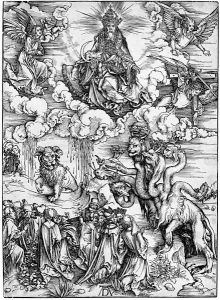
It’s hard to keep a good apocalypse down. Ever since Jesus of Nazareth did his best Arnold Schwarzenegger impression of “I’ll be back” some of his followers have obsessed when just when that will be. Sorry for the late notice, but the current prediction is for tomorrow. If you’ve got any weekend plans, you might want to rethink them. I know traffic in Jersey is already bad enough without white horses breaking through the clouds. An article my wife promptly sent me from NPR, “Is The Apocalypse Coming? No, It Isn’t!” by Marcelo Gleiser, addresses the documentary The Sign. No doubt about it, there’s some impressive astronomical gyrations here, but planets moving through constellations do not an apocalypse make. As Gleiser points out, the real question is why people believe such predictions so passionately.

Larry Norman’s song “I Wish We’d All Been Ready” captures the mood nicely. Growing up in a tradition that believed, as only literalists can, that this world is the center of the cosmos, Norman’s song haunted my teenage years. These were the heady days of Hal Lindsey and a very hot Cold War. I had to register for the draft. There was unrest in the Middle East. Sonny and Cher had split up. The signs were aligned, it seemed. As they had been nearly every year since about 30 CE. Paul of Tarsus was waiting. And John of Patmos. And Timothy LaHaye. True believers all. Conviction begets conviction. Seeing another fully convinced is a powerful incentive.

Even now, if I’m honest, I shudder a little when I hear such predictions. What if, by some odd chance, they are right? Raised in that tradition, it’s nearly impossible to jettison that private fear. Rationally I know that clever people can make all kinds of connections that have nothing to do with the Bible. I know that John’s Revelation isn’t about the end of the world. I know that the views of Paul were bound by the developments of his age. I know the Rapture was invented in the nineteenth century (CE). Still, the chill slithers through me when I consider how it felt as an uncertain teen on the brink of Armageddon. I could envision it clearly. Some who were utterly sure swayed me. Specific dates and times weren’t biblical, but the wait for any moment now was even more terrifying. Tomorrow will begin and end just as any other day on planet earth. And another apocalypse will enter the planning stages, coming soon to a universe near you.


Noah’s Parable

I write a lot about Noah. For those who didn’t know me before this blog, I was once invited to write a book on Noah for a series ironically published by Oxford University Press. I had been researching Noah for years, and I intended to write the book. Then, as the kids are saying these days, life happened. My interest in Noah has never waned, however. And part of the reason is that it is perhaps the most influential story in the entire Bible. I realize I’ll need to explain that, but stop and think about it—Evangelicals seldom talk about Jesus any more. Their concerns are with unborn babies, people making babies outside wedlock, and destroying our environment in the name of capitalism. It is the last of these that brings us back to Noah.

A friend recently sent me a story on Splinter by Brendan O’Connor titled “How Fossil Fuel Money Made Climate Change Denial the Word of God.” O’Connor is looking at the history of how a pro-environmentalism-inclined evangelical movement decided to shift its base to align with climate-change deniers. Behind the scenes are fundamentalist clergy. Oh, we like to laugh at them and their ways, but they are the power behind the throne and we should really not let them out of our sight. You see, as O’Connor points out, they believe that the God of Noah can protect the world from the worst that we can throw at it. It’s perfectly okay to try to destroy the planet because the magic man upstairs can fix everything right back up if he needs to before sending his son back to town on the final business meeting. Laugh if you will. These people are dead serious and many who hold power in Washington believe every lie they utter.

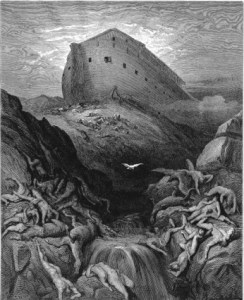
As a nation—perhaps as an entire western culture—we’ve laughed off religion. Secure that there’s no God up there to rain down, well, rain, we laugh and jeer at Noah. It’s a children’s story, after all, isn’t it? Okay, forget about the part where everyone in the entire world drowns, except eight people. And when he gets drunk and lays naked in his tent after it’s all over. Other than that, it’s a kid’s story, right? The story of the flood is one of the oldest myths in the world. It has been part of human story-telling for millennia. We now have very powerful people with smart phones in their pockets and access to vast hordes of money who believe it literally happened. And since God took care of his own once, he can do it again. The educated smirk. The smart start building arks.


Power in the Blood

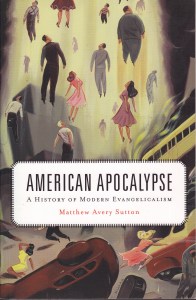
Converts, they say, are often the worst. It matters less what the conversion is to or from, since the zeal of the newly enlightened is impossible to match. The textbook example with religion, especially in America, is Evangelicalism. Those who’ve “found Jesus” are eager and too willing to tell others about it. You don’t often hear, however, of those who grew up Evangelical, but then had second thoughts. Often they disappear quietly. Evangelicalism is a potent force in American life. Intellectuals, embarrassed by it, tend to pretend it doesn’t exist. Or it’s on its way out. No need to approach, with nervous laughter, those who actually believe this stuff. Evangelicals, however, can get presidents elected and their zeal can take away any number of freedoms deemed “godless” by those who may have no more education than the local bartender. Matthew Avery Sutton’s American Apocalypse: A History of Modern Evangelicalism is masterful. Although not comprehensive (the movement is too large for that) this book does not shy from the unifying fact behind radical evangelicalism—the belief that the end is nigh.

Oh, I know. Those of us who are educated have no need to take such nonsense seriously, right? Sutton may change your mind on that. When you realize just how close to disaster after disaster this thinking has led (and continues to lead, under the current administration) us, you might want to take the Fundamentalists a bit more seriously. They constitute the largest religious bloc in the nation. One of the baffling things about them is their protean nature. What’s the difference between an Evangelical and a Fundamentalist? And what’s with the obvious differences between a Timothy LaHaye and a Billy Graham? And where do these people get all their money? (Fundamentalists have always been close to nearly endless, well, funding.) Republican presidents from far before Nixon realized that big business and conservative theology, although strange bedfellows, are remarkably compatible. (Each thinks the other side doesn’t realize it’s being used.)

American Apocalypse is an important book. Written before perhaps the strangest turn in US history last November, it might have helped to show that Trump was a serious threat from the beginning. If only the educated took it seriously. Evangelical antipathy to women’s rights, civil rights for minorities, and socialized medicine run very deep. It’s the Old Boys’ Club with a vengeance. Recent events have shown yet again how important it is to understand these ways of thinking. And those of us with insider knowledge have never been welcome in the academy. That’s okay, though. If I go back to my roots I’ll realize the world’s about to end any day now. Those who’re smart might think about taking equestrian training because I’m sure there will be white horses involved. If only I could get myself converted back.


Fall of the Titanosaurs

If I had it all to do over again, I might well have gone into paleontology. Like most kids, I grew up fascinated with dinosaurs. Then “real life” got in the way and you need to get a job since you can’t spend your time playing with your cheap plastic toys and dreaming Triassic dreams. There’s no future in the past. So I decided to study dead languages instead. Still, the recent discovery of Patagotitan mayorum is exciting. Titanosaurs—the really big dinosaurs—were not even known when I was a child. What we used to call “brontosaurus” was about as big as they got, but we did know that diplodocus was out there somewhere, even a bit longer. We didn’t have to worry about ark space in those days because we knew that extinction happens.

The current evangelical flavor of the day takes a hard line on evolution. Since it absolutely can’t happen and since there’s no denying dinosaurs, they must’ve crowded onto old Noah’s floating hotel along with everybody else. The problem is we keep discovering more and more large dinosaurs. Patagotitan was 122 feet long, without skin. It weighed more than ten elephants, making me wonder about water displacement ratios. Depending on your definition of that fuzzy measure of the cubit, the ark was only 450 feet long. And Patagotitan is only one of the titanosaurs that dwarf the already huge apatosaurus (the correct form of brontosaurus) and brachiosaurus. Even if they hibernated the sheer mass of reptilian tonnage wouldn’t leave much room for the latter ascendant mammals. That is, if mammals had come later and ascended.

Noah, despite being a traveler, never made it to Patagonia. In fact, the ark pretty much stayed still during the flood, coming to rest in Turkey after having been constructed somewhere just east of Eden. And since the Bible doesn’t mention continental drift we can’t even rely on Pangea to have gotten all the beasties to ark central on time. I’m guessing that Patagotitan was probably a slow walker. Since the continents were just like they are today, it must’ve been a fair swimmer as well. And it didn’t mind quarters just a touch claustrophobic for such a massive monster. What with all the home improvement shows these days, Noah might have considered an addition to the ark. But the Bible says God gave him the plan and one thing we know about the Almighty is that what he says he means literally. Dinosaurs or no.


Prophecy of Hezekiah

Maybe my recollection of the Gospel’s a bit hazy. I seem to remember one of the main characters of the New Testament saying something about doing unto others as you would have them do unto you. And turning the other cheek. I may be recalling incorrectly, since Robert Jeffress, one of Trump’s “evangelical advisors” (and since when do Presidents need evangelical advisors?) has said the Bible gives you permission to take out your enemies. Granted, it takes a twisted exegesis of Romans, and twisted exegesis works best in twisted minds, but this runs full frontal in the gospel ideal of love just two books earlier in the Good Book. Forcing the Bible to say what you want it to say is a tactic as old as preaching itself, but still, those of us with training in Scripture shudder.

Pulling verses out of context like the Bible’s a magic book is called “prooftexting.” Not related to the current plague of texting, prooftexting means you can make the Bible say whatever you want it to. The classic example is that the Bible says “there is no God.” Check it out. I’ll even give you the reference: Psalm 14:1. What’s that? I’ve left out the most important part? “The fool says in his heart, ‘there is no God.’”? You see what I mean. The danger here is that a feeble-minded, biblically illiterate world leader could easily be swayed. Nukes, after all, are great for your ego. Who wouldn’t want the Bible to say that it’s fine to take out all your enemies, and horde all the money you possibly can (not it’s not the root of all evil—Paul is dead, after all.) Except Paul wrote Romans. How are we ever to decide?

The Washington Post story by Sarah Pulliam Bailey may not suggest that we should pay attention to Bible scholars—hey let’s not get too radical here!—but the world would be a very different place if we did. The Bible is a complex and difficult holy book. (As most holy books are.) The idea used to be that you had to spend a lifetime in a monastery, or at least a few years in a seminary, to say something intelligent about it. And that training wasn’t reinforcement of literalism. But we live in a brave new world. A world that re-envisions Jesus as the loving God with his finger firmly on the button. And sycophant preachers saying, “Go ahead, make my day.” It’s all there in the book of Hezekiah.


Bible Hobby

Hobby Lobby needs a hobby. Besides the Bible, I mean. The amorphous media has been buzzing about the new Bible Museum set to open in Washington DC soon. The Lobbyists seem to think the Bible will save America. Not the Bible exactly, but their narrow, constricted, and uncritical view of the Bible. Seems a lot to expect from a museum. Museums, the Green family apparently hasn’t considered, are monuments to the past. When I last saw the politically incorrect Elgin Marbles I didn’t feel inspired to run out and build a parthenon. Instead, I simply wondered about the past and how it must’ve been cool back then. I didn’t want to live there though.

I’m sure there are great plans for the Good Book in the Bible Mausoleum. Looking at displays of the same text over and over can surely get a little dull, if we’re being honest with ourselves. I like Bibles as much as the next guy. Actually, I probably like them more than the next guy, but that’s beside the point. I don’t need to go to a museum to see them. There are Bibles all around my office, a mere arm’s length away. Here at home I can take in many of them at a glance—there are Bibles on three sides of me even as I write this from my favorite chair. Saving a nation that’s had the Bible from the very beginning sounds just a touch ambitious to me. But then, I’m no billionaire with nothing better to do with my money. There’s probably a tax write-off in there somewhere.

The thing about the Bible is, once you learn about it you can’t unlearn what becomes clear along the way. Cover your eyes or ears if you will, but we know the Bible had a long and complex history before becoming “the Bible.” It doesn’t have much of a plot without Revelation tacked onto the end—and seriously, that was one of the reasons it made it into Holy Writ to begin with! The circumstances that led to the Bible were often quite profane, in fact. It was the recognition of it as a sacred book that was a religious activity. The next step was to spread it as far as possible. That’s pretty much been done. The end result? The election of Donald Trump. If that’s salvation we’re all screwed. At least when we’re all standing in the bread line we’ll have a museum to visit while we wait. And it will be an encomium to something that was great once upon a time.


On Jordan’s Stormy Bank

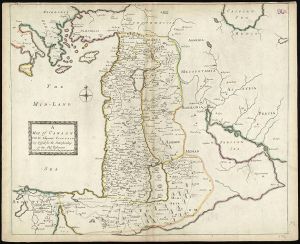
All you have to do is spit in the cup. Well, you have to do it quite a few times, but that’s the basic idea. Then you send the contents to a religiously motivated lab and your genetic ancestry will be emailed back to you. (There will be a fee involved, of course.) Genetics, a science of which Darwin didn’t have the benefit, is capable of mapping out where various “races” originated and ended up. Enter the Bible. One of the most disputed groups among scholars of the ancient Near East is the Canaanites. There was, as far as we can tell, no “nation” called “Canaan.” No people called themselves “Canaanites” but the term was used by others to designate them. Yahweh had a vendetta against them and ordered them wiped out. And, according to parts of the Bible, the Israelites acquiesced. So where are the Canaanites?

Image credit: http://maps.bpl.org, via Wikipedia Commons

According to a Washington Post article by Ben Guarino, DNA sequencing has revealed that they’re still there. This should come as no surprise to most anthropologists. Racial purity is always partially a myth, since “race” is no barrier to love. Or at least lust. And genetic traits don’t lie. Tracing ancient DNA from “Canaanite” (I’m getting myself scared using all these scare quotes) burials, scientists have discovered the biblical nemesis still survives in abundance, especially in Lebanon. Interestingly, on a cultural level, there is no distinction between Israelite and Canaanite. They are virtually identical. This creates one of the many embarrassments for biblical scholars, since the differences should be more than just skin deep. As with so many cases of racial distinction, the reality is mostly imagination.

Literalists, of course, have been in a rear-guard position for well over a century now, so the news should cause minimal shock. The problem will be keeping them from finding new excuses to carry out an extinct mandate. Biblical scholars, that heathenish race, long ago capitulated with the enemy. You’d expect no less from those who would dare use reason when approaching Holy Writ. It’s the real-world application that’s a problem. What do you do when the biblical enemy is found, hiding in plain sight like a purloined Lebanon? The solution might be as old as the story itself. Darwin didn’t have genetics, but he did have the Bible. The issue in the nineteenth century was what to reject when worldviews clashed. The answer was to jettison the godless science. We can only hope that this time-honored technique will prevent future crusades fomented by scientific discovery.


Devonian Dreams

Toothbrush and dental pick in hand, I go at it. Not that I’m a professional, mind you, but curiosity drives me to this. You see, this crinoid before me is at least 358 million years old and anything that can make me feel young deserves all the attention I can give it. Crinoids are also know as “sea lilies,” but they aren’t plants. They’re actually echinoderms, and the fossils I’ve found in the past have only been cross-sections of their “stems,” a stone circle, as it were. This one has tendrils visible, and I can’t believe that it was a chance find on one of my recent walks through Ithaca’s gorges. I’m dreaming Devonian dreams, and I want to brush away the plaque of the eons and see what I’ve actually found.

Fossils are a kind of eternal life. The creature that died to leave this impression lives on as a monument in stone. It reminds me of my unfortunately brief stint as an archaeological volunteer. Scraping away dirt to reveal a piece of pottery that hadn’t been touched by human hands for 3,000 years. Of course, that’s merely a second ago when you’re talking about something pre-Carboniferous. The dinosaurs won’t even show up for another 100-million years. And I think I have to wait too long for the bus. Time, as they say, is relative. Did this medusaized creature before me realize just how terribly long it would take for enlightenment to arrive? And how so very swiftly it could fall one foolish November night? Careful, this fossil’s fragile.

I grew up among the Devonian substrate in western Pennsylvania. The Bible on my shelf told me to disregard the evidence before my eyes. Some clever true believer had declared Noah’s flood the culprit, never bothering to explain how freshwater fish showed up after the deluge. Those we tried to keep in our aquarium never seemed to handle the slightest disturbance of their salinity. The ages of the literalist are by definition short-sighted. 6,000 years seems hardly enough time to account for any sedimentary stone, let alone that riddled with fossils. I’m hunched over my bit of slate, dental pick hovering nervously over what will never come again. The Bible behind me says it’s an illusion. You may be right, Mr. Scofield. You may never have evolved. But as my fingers glance a creature dead before even the crocodile’s grin I have to declare that I have.


Fishers of Cars

The car was drunkenly weaving across lanes in substantial traffic along Interstate 80. Erratic driving that, although not breathalyzer confirmed, suggested impaired operating. It’s something you never like to see. We stayed behind the vehicle, knowing that it was safer to keep such a car in view rather than attempting to overtake it when the driver veered into the left lane. Since the same muted colors recur on vehicles these days, we needed a quick way to identify this driver at a glance. The Jesus fish on the rear served the purpose well. This situation struck me as a kind of parable, although it really did happen. One of my brothers is a driver by profession. He often tells me that if someone cuts him off in heavy New Jersey traffic, more often than not the car bears a Jesus fish. WWFD?

The ostensible purpose of the Jesus fish is to witness to the world “here is what a true Christian does.” While the New Testament, if I recall, indicates that the true believer puts others before him or herself, the rule of the road is somewhat less spiritual than that. None of us are saints when we get behind the wheel. We’ve got places to go and the drive isn’t really much fun with thousands of other cars bunging things up constantly. Still, if you take the extra effort to put that Jesus fish on your car, aren’t you signaling that this driver holds her or himself to a higher standard? Or maybe the fish is a talisman, like “Baby on Board,” that will somehow protect from the careless, aggressive driver thinking only of self.

The irony here is not that the driver is making poor, or aggressive decisions behind the wheel—let the one without sin cast the first stone—but rather that s/he implicates Jesus in the act. There’s a ready, steady market in evangelical paraphernalia. The WWJD bracelet keeps the question within sight much of the time—but keep your eyes on the road! One of the main problems with the Ichthys symbol is that it is generally on the rump of your car. Out of sight, out of mind. As you finish that last drink before climbing in behind the wheel, the fact that your personal Lord and Savior is being announced to the world may just slip your sodden mind momentarily. The real question is whether a car is the best place to announce your religious commitments. It was the the man in front of the fish, after all, who said “do unto others as you would have others do unto you.” Except in heavy traffic, of course.


Scaping By

Failure is a part of life. We don’t like stories about failure, however, unless the protagonist goes out with a memorable bang. So it is that when we fail we start looking for a scapegoat. Now it’s a little too early to tell if Ken Ham’s Ark Encounter can be considered a failure. According to a story on Friendly Atheist, “Ken Ham is Now Blaming Atheists for the Economic Failures of Ark Encounter,” the ark may be loaded with dinosaurs, but not money. People need their myths, yes, but myths that take themselves too seriously often fail to convince. Atheists, even the friendly variety, have always been convenient scapegoats. I wonder how many scapegoat species are in the Ark Encounter.

I don’t know about you, but I’m curious about the Ark Encounter. I don’t want to go because I don’t want them to have any of my money. As I’ve told academic friends who visit—I just can’t see contributing to their cause. Although the Right seems to implode when it reaches power (there are far too many selfish people in the Party, and selfishness leads to easy splintering) one thing that it has is money. Think about it, the extremely wealthy are on their side. If I was given a free pass I might find it worth my while to wend my way back down to Kentucky. Who doesn’t like a spectacle? And I would like to see how they represent scapegoats in their dioramas. Besides, with sea levels rising from “fictional” global warming it might not be a bad idea to get a few tips on how to build an ark, no matter what you believe.

You only fail when you fail to try. That was a phrase a friend used to repeat to me before disappearing from my life. A friend from college once told me that I had to stop admitting my failures if I wanted to move ahead in life. There is a danger in easy appearances of success, however. Failure can be a very noble teacher. There are mornings when I’m walking across Manhattan, passing the homeless in their blankets on the street, and I realize that I would not be where I am were it not for failures. I could hide them, but if I haven’t learned from them they’ll only burst out of the closet again when it gets too full. Is Ken Ham’s Ark Encounter a failure? It’s far too early to tell. One thing we know for sure, however, is that scapegoats will never be an endangered species even if there’s a world-wide flood.

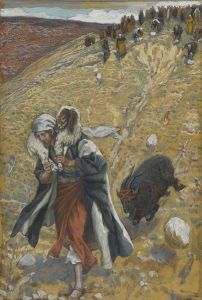
James Tissot,Agnus-Dei: The Scapegoat (Brooklyn Museum via Wikimedia Commons)


Cloaking Device

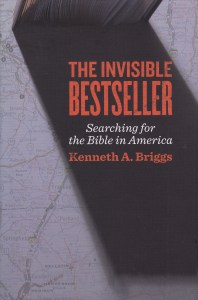
America’s book is seldom read. Those of us who spend an unusual amount of time with the Bible know this from personal experience, but others are starting to notice too. Kenneth A. Briggs’ The Invisible Bestseller: Searching for the Bible in America is a rambling account of the way a variety of everyday people from prisoners to academics and clergy use, read or not read, and perhaps inwardly digest the Good Book. There are moments of stark insight in this book, but with no narrative arc it is somewhat easy to feel like you’re reading about what random people say about the Bible. I don’t need a book to tell me that I’m odd, but much of what I read here was old hat to a guy who grew up Evangelical, went to seminary but never got ordained, completed a doctorate and taught the Bible nearly two decades before being booted out of its company. I’m not sure what I expected to find. Perhaps redemption?

Briggs does provide some useful statistics, and not as maniacally as sociologists do. We learn that few people read the Bible and the numbers are declining. Still, people buy the Bible and tend to have multiple copies in their domiciles. It is cheaper than insurance, after all. Holy Writ, however, is an alien among us. Few people have any idea what it was like to live before smart phones, let alone before the smelting of iron. The concerns and dialogues of the Bible seem so terribly provincial and, to be honest, unenlightened (if one can say such a thing about divine revelation). Still, we won’t accept a president who doesn’t lay his (and it’s always his) hand on the Good Book and swear to uphold America.

The Invisible Bestseller gave me plenty of information to ponder. Some of the tales Briggs tells are interesting. Others are so mundane as to be stultifying. The overarching fact is that the Bible is an established object in our culture. Some take it seriously enough to read it and stick with it—this isn’t easy to do, and I speak from experience here. Such people are rare. After all, apart from getting you a hall pass out of Hell, the Bible doesn’t seem to do much for people these days. Still, when I take a moment to read the Sermon on the Mount, I can’t help but feel we might be missing some wonderful rhetoric by ignoring the Good Book so much. But then again, I’m fully aware that I’m the one that’s odd. Briggs’ book stands as a testament to a couple of testaments that continue to wield enormous power without ever being read.


Good Newsists

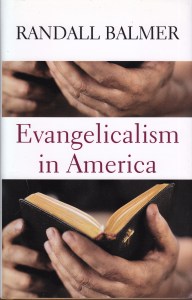
In the interest of avoiding conflict thereof, I cannot yet give a review of Randall Balmer’s Evangelicalism in America. Since I’m writing a review of it for Reading Religion, I’ll use it as a springboard into a topic that should concern all who believe in religious freedom. One of the resounding themes of Balmer’s treatment is that Evangelicalism, after it wedded to the Religious Right, lost its soul. Those are my words, not his, but the sentiment’s about right. For anyone who wasn’t politically aware in the 1980s, it may seem a surprise that religion didn’t enter into politics before that decade. With the exception of the fear of the Catholic in the case of John F. Kennedy, religion wasn’t used as a political wedge until the presidency of Jimmy Carter. The Religious Right, unhappy with the born again Southern Baptist in the White House, moved to solidify the Evangelical bloc.

Evangelicals had been an underground movement for half a century. Many had no idea what being “born again” meant when Carter first claimed the sobriquet. Balmer points out that it was the threat of the withdrawal of tax-exempt status to discriminating Christian schools that led to political action. Bob Jones University, fearful of racial intermarriage, didn’t admit African American students. Leaders of the Religious Right saw the loss of tax-exempt status as a move against their sacred segregated culture and a push that required a shove. Coopting the abortion issue (historically Evangelicals had supported women’s rights, including the right to abortion in many cases), they nailed together a platform for political activism which put women “back in their place,” kept racial “purity,” and romanced a total aberration in Christianity—the “prosperity gospel.” All of this is well documented. And well hidden.

Looking at Evangelical politics today, abortion—the control of women—has become THE issue. It’s hard to believe, as Balmer amply illustrates, that Evangelicalism used to be allied with the Social Gospel. It was a religious view with a conscience and it supported issues that are now polarized as “liberal” and leftist. This shift came about gradually, but not accidentally. There were political players—Balmer names names—who had one goal in mind, and that goal wasn’t Jesus or what he’d do. It was the sweet prize of political power. Evangelicals, you see, are born followers. A leader with a strong voice can lead them just about anywhere. Many Evangelicals today would deny their more liberal history, but it is right there for anyone who’s willing to learn something about who they once were.


Trusting Truth

How do we know what’s true? For many the answer is what your experience reveals. If that experience involves being raised as a Bible-believer, that complicates things. A friend recently sent me a New York Times piece entitled “The Evangelical Roots of Our Post-Truth Society,” by Molly Worthen. For those of us raised in Fundamentalist conditions, this isn’t news. Then again, those raised Fundamentalist assume that everyone knows the truth but others have blatantly decided to reject it. It’s a strange idea, inerrancy. It’s clearly a form of idolatry and its roots can be traced if anyone wishes to take the time to do it. Inerrancy is the belief that the Bible is correct, tout court. It’s right about everything. If it contains one error, so the thinking goes, it topples like a house of cards. (Cards are sinful by the way, so get your hands off that deck!) If that’s your starting point, then the rest of the facts have to fall into place.

As much as I wish I could say that this simplistic outlook may be corrected by education, that’s not always the case. Many children of inerrantists are raised to question what they learn in school. Worse, many are home schooled so that they never have to be exposed to the sinful machinations of others until they try to enter the job market and are utterly perplexed by the fact that they don’t even speak a common language with the rest of society. Key code words don’t mean the same things outside that safe, withdrawn community where everyone knows the Bible and understands that to know it is to love it. Science doesn’t love the Bible, they’re taught. So science is wrong. It’s quite simple really. You already have all the information you need in one book. If science disagrees, then, well, you already have all the information you need.

There’s an internal logic to all of this, and dismissing the heartfelt beliefs of Fundamentalists only gets their backs up. It’s not about logic, but the emotion of belief. Some neuroscientists have been suggesting that we reason not only by logic but also with emotion. That complicates things, for sure, but it also explains a lot. For example, in a world where religion drives nearly all the major issues facing society, logic would dictate that universities would build up religion departments to try to understand this very real danger. Instead we find the exact opposite. Withdrawing into your own little world occurs on both ends of the spectrum. Dr. Worthen is to be applauded for bringing this out into the light. If society wants to benefit from this knowledge, it will need to stop and think about what it really means to be human. Fundamentalists, for all their foibles, illustrate that nicely.


The Scofield Connection

While reading about Cyrus Scofield recently—and that book has stayed on and played with my mind for some reason—I ran across the conferences that he held in preparing his famous reference Bible. Although he claimed the sobriquet “Doctor,” placing D.D. after his name, like many a self-puffer Scofield has no university that will support the claim. (It’s amazing how many high-level CEOs and “important” businessmen pad their résumés with false degrees. Even some government wannabes do it, and then they want to defund education after they get into office.) Perhaps because he had no seminary training, and likely didn’t even graduate from college, Scofield might’ve felt a sense of insecurity when it came to a very large book originally written in languages he couldn’t read. There’s a reason “King James Only” Christians exist. In any case, he set up meetings in a couple of conspicuous places to go over his work. One of those places was Grove City College.

Now, like many small, Christian colleges, Grove City isn’t widely known. Most of the student population—at least when I was there—was fairly local. Pennsylvania, Ohio, and New York, for the most part. Still on the (admittedly rare) occasion when someone asks me where I went for my undergraduate work, they generally haven’t heard of Grove City at all. Even though I spent four years of my life there, I had no idea about the Scofield connection until I read Joseph Canfield’s book. That’s because not all Fundamentalists grow up with Scofield. I’m sure I heard about the Scofield Reference Bible but I didn’t own one and I wondered what the big fuss was all about. After all, the annotations were the work of a man, and I was interested in the words of God. Far more popular was the revision of Scofield known as the Ryrie Study Bible, but I never read that either.

The end result is that many people think that Scofield’s words are “the Bible.” As I used to tell my students, binding pages together within a book makes a statement. If you’re saying “this is the word of God” and part of “this” is Scofield’s annotations, most people can’t distinguish between text and commentary. I eventually acquired a Scofield Bible, not for valid information, but simply for information. I was amazed at how poorly executed it was. Nevertheless, a true believer reading through the first chapters of 1 Chronicles is ready to accept even minimal narrative as divine. So it is that many Americans have come to believe in a Bible that’s not biblical. Religion is full of paradoxes and in this case I’d shared sleeping quarters with one in my more formative years although the connection was unknown at the time.