Alien Jesus

While trawling the internet over the weekend, I came upon an interesting article that ties together religion and paranormal belief. According to ADG, a unnamed woman (already the question marks erupt) in Galilee in 1967 was visited by aliens. Instead of photographing them, as most unnamed women would, she followed their instructions to point her camera at the lake (Sea of Galilee) and snap one for the album. When she turned back around the aliens were gone, and when she had the film developed there was a picture of Jesus and a disciple or two, walking along the sea in earnest conversation. Well, one doesn’t have to be a scholar of Tobit to spot the apocryphal, and this obviously bogus story received far more hits than any of my posts do. People are fascinated by the concept, even though most of the comments show some healthy skepticism.

To me the fascinating aspect is that religion and paranormal topics hold hands so easily. That is not to suggest they are the same thing, but rather that they are both perhaps directed toward a similar goal. We find ourselves in a cold world, often. There are cruelties, atrocities, and a disheartening lack of care for others. We want to believe that somebody out there has got our backs. Is it so different to believe that God dwells in the sky than to believe that aliens do as well? What is more important than the putative fact of such celestial dwellers is the belief in them. Our minds, no matter how we may protest otherwise, are perfectly well aware of their own limitations. We can’t know everything, and so we must believe.

Many of us find ourselves in an uninspiring cycle of work, sleep, and work. Sometimes we actually even do sleep, too. Cogs in a capitalistic money machine, we leave our weekends free (sometimes) to pursue a little meaning. As much as some may castigate religion, we should not forget that without it we would not have the weekend! For a little while we can break the meaningless cycle, the treadmill upon which we heavily thump our way through five days out of every seven. Is it any wonder that so many want to believe that, like Calgon, aliens might come to take us away from our drudgery? If that doesn’t work, there’s always religious services. All you have to do is point your camera and believe.

BurnandJeanPierre


More Fun than a Barrel

To mere mortal eyes, a traffic barrel on a Manhattan street might seem like a pretty gritty object, hardly worthy of religious veneration. Seeing leaflets advertising eternal life taped to these barrels might suggest a profound disconnect—what hath Heaven to do with traffic control?—unless one is familiar with the ardor of religious devotion. And besides, many construction sites in Midtown bear the infamous “Post No Bills” warning. When I spotted a few of these informal fliers over the past few days, however, I couldn’t help but think about religious conviction. As someone raised in an evangelical tradition, it is difficult to convey the fear in which I found myself living. Hell seemed like more of a constant threat than Heaven was ever a promise. And my young experience in a blue-collar setting had taught me that you seldom get what you hope for, no matter how hard you work for it. Somehow, no matter how good I tried to be, Hell seemed more likely than Heaven. And the Bible does suggest that if you don’t try to tell others, you’ll be held eternally responsible.

IMG_1024

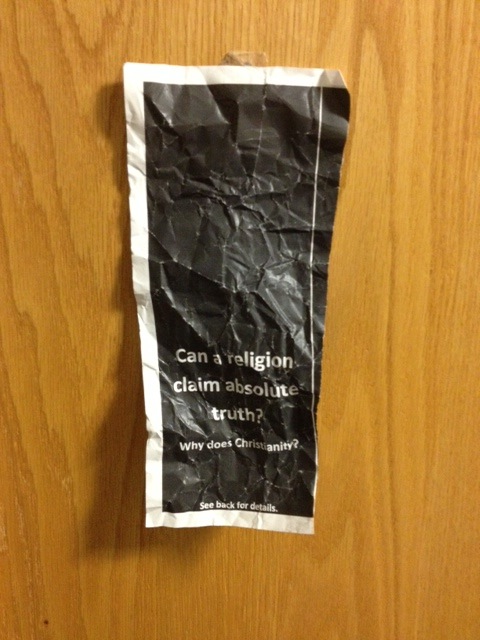
Religious conviction and fear are not far apart. I recently spoke with a Roman Catholic believer who suggested that the fear of God has been under-emphasized of late. I do suspect that it has been parodied quite a bit, but it is difficult to assess if it has truly gone underground. Perhaps among theologians it has. Like most people, I don’t read theology. For the average believer, however, fear probably plays some part in the equation that keeps her/him coming back week after week to hear the same message over and over. My daughter sent me a flier that has been appearing all over her college campus. It is a bit ambiguous, but from my own college days I recall that the young are especially vulnerable to religious coercion. Conviction is like that.

religiontruth

From my own college days I recall the earnest discussions about how far one should go to convert others. The underlying motive was always fear. Getting into Hell is so easy—we were born to it, according to some. If you just live you life as a good person, helping others and trying to improve the world, you’ll still end up there. Such is the power of eternal punishment. One of my friends, when he went to restaurants, would leave a religious tract instead of a tip for the working-class waitresses. “It’s far more valuable,” he explained, without a trace of irony. I wouldn’t be surprised to find one of those tracts taped to a dirty old traffic barrel these days. Sometimes the ardor with which we approach religion simply overlooks the more obvious implications.


Heat’s Up

800px-GISS_temperature_2000-09_lrg

I must admit being perplexed. Days ago, although many of us have long known it to be true, climate scientists announced unequivocal evidence that human activity is responsible for global warming. I have perhaps been naive in my supposition that the “full speed ahead and damn the torpedoes” approach of some fundamentalist groups that welcome anything that speeds along the apocalypse, has played a major role. Maybe it was because so many politicians openly sided with such groups that that I supposed the two concepts to be connected. I suspect, however, that it may be something much more insidious. How can any intelligent person refuse to admit the facts when the consequences are nothing shy of catastrophic? How can elected officials turn a blind eye to the desolation of their own planet? It must be more than simple ignorance. But what?

Those in my generation—however we are currently classed—have been declared to be those attempting to make up for the excesses of the “me generation.” I’m not sure who the “me generation” is, but I know when I see individuals who allow their personal gain to endanger everything that has come along since the Sumerians invented the wheel, I feel a little queasy. What could the Zeitgeist have been that infected so many minds with such a godlike sense of entitlement? We call the younger demographic the “entitlement generation,” but when I taught them in college, they were much more environmentally conscious than many elected officials. They at least could see beyond their own wallets. They take pride in recycling.

It would seem to me that even if (and it doesn’t) the Bible suggested that the world itself would end to bring about a better one, we assume too much divine prerogative when we proactively destroy the only ground upon which we stand. Has any religion ever been so truly shortsighted? And that’s asking quite a lot, if you think about it. Or is religious faith just an excuse to gather wealth at the expense of others? Does God want you to be rich? If so, it would seem, God would also want you to act responsibly. According to a report in The Guardian, there is no longer any question that the climate blame lies with us. Perhaps now that the smoking gun is on the table we will do the right thing. But then again, I admit to being perplexed. Maybe it’s just my generation. Or maybe I’m just hopelessly naive. I’m entitled.


Down the Garden Trail

According to NBC, a new “Christian” alternative to Boy Scouts USA is being launched in (over)reaction to the vote to allow gay teens to “join” the organization. Calling themselves “Trail Life USA,” this redeemed-only organization is supposed to be “safer” than other scouting options. This issue, of course, is all about perception. There have been gay Boy Scouts from the beginning and there will be gay Trail Life members. People are people, and just by saying that a sexual orientation is excluded does not mean that it will be, or ever can be (nor should be). “This is not another church program,” John Stemberger, one of the founders, is quoted as saying. “This is going to be a masculine outdoor program to raise young men.” The subtext is sluggish with irony. I am reminded of the scene in Disney’s Mulan where Yao, Ling, and Chien-Po are about to climb the pillars to the emperor’s palace in drag and the song “Be a man,” starts its reprise. Masculine outdoor program indeed.

Photo by Bruce Anderson, Wikipedia Commons

Photo by Bruce Anderson, Wikipedia Commons

The idea of separating youth from the realities of the world to keep them safe is like taking them into the woods without telling them there may be bears. Those of us who’ve spent nights in the woods know that hating bears is a ridiculous posture to take. Bears, even when gnawing on your arm, don’t hate you. They simply exist. It is the balance of nature. Studies of nature have time and again revealed that homosexuality is far from unnatural. Several species practice various homosexual behaviors and I am certain that the more we observe nature the more we will find ourselves mirrored in it. Nature can be quite encompassing in that way.

Christianity also has a long history of being at a kind of equilibrium with homosexuality. The all-male priesthood of the Middle Ages could hardly be classified as all self-denying heterosexuals. Even some televangelists of the most Protestant stripe have confessed to gay encounters and episodes. New uniforms and solemn promises will not change the way a person is born. Of course, if the child is Jewish or Hindu or Muslim, he will need to abide by a statement of Christian belief. What of Mormons or Seventh Day Adventists? Thankfully lines drawn in the sand are easily washed away. Exclusion may have been the trope of the Christian past, but as Boy Scouts boldly go where every man should’ve gone before, Trail Life, it seems, may have been appropriately named. It’s life John, but not as we know it.


Playing Civil

In a piece written for the Los Angeles Times, Joseph Margulies warns of the potential dangers of civil religion. I first learned about civil religion in college in the early 1980s, when the concept was still relatively young. The idea is as deceptively simple as it is accurate: when nationalism reaches its natural limits, the divine is invoked. Civic ceremonies become religious ceremonies—presidents lay hands on Bibles, whether or not they believe. Civil religion dictates that all presidents be portrayed as believers, but that is something we have to take on faith. Civil religion leads to sculptures of the Ten Commandments on courthouse lawns and the flying of United States flags in churches. The danger with this innocent-looking triumphalism is that some people take it too seriously. It is not limited to Christianity, either. Civil religion is a disguised, albeit thinly, form of nationalism.

The vast majority of people in the world hold religious beliefs without deep reflection. That is not to suggest that they don’t believe deeply, but simply that they don’t lift the edges to peer under the surface much. We are taught what to believe by religious specialists. To question them is to question the deity they represent. Since fear is easily ingrained in the human psyche, the angry god is among the most effective of weapons ever devised. We fear for our eternal peril, and it is easier to believe the clergy have the answers than to divine the truth for ourselves. Those who think profoundly about religion, outside the confines of the professional clergy, are always a suspect lot. What business do we have, poking around the beliefs of others?

Civil religion shocked me when I first learned of it. Like the majority of my peers, I had assumed that public displays of piety were to be taken literally. As I began to hang out with clergy and to see how they often transformed outside the church with a fellow “insider” beside them, I started to understand. The cynical asides whispered outside the hearing of the faithful, the double lifestyles, the on-stage personae. This may not have been civil religion, but it was not always what it seemed. Teaching in an Anglo-Catholic seminary, I saw high mass as carefully choreographed as an off-Broadway production of A Chorus Line. Civil religion relies on its partnership with the unquestioned belief of the Saturday-night and Sunday-morning crowd. It all fits easily together and runs as smoothly as a pink Cadillac. Just don’t look under the hood.

IMG_0088


Personal Dogma

Dogma is a movie that many seminarians discover at some point in their theological education. Smart, funny, and irreverently reverent, the film follows the exploits of a couple of misled angels trying to get back into Heaven and thereby negating all of existence. It is no surprise, given Kevin Smith’s origin myth, that the film opens and closes in New Jersey, but I often ponder the strange coincidence of places in the movie to places I’ve lived since my own seminary career began (and ended, rather like the massacre scene in Red Bank before God cleaned it all up). Nashotah House, where I discovered Dogma, is in Wisconsin. Wisconsin is the state to which Bartleby and Loki, the two angels, have been banished. The means of their escape from this upper-Midwest purgatory is a church in New Jersey. Along their way the angels pass through Illinois and Pittsburgh, before crossing into the very state where God is located throughout the movie (the Garden State, of course!). After having been summarily dismissed from my seminary post in Wisconsin (not for watching Dogma, I’m assured), I too headed for New Jersey. Before that I had lived for a while in Illinois (home of Bethany) and Pittsburgh (home of Moobie). Watching Dogma is in many ways a reflection of a journey that I’ve accidentally undertaken.

YEE.tif

Another kind of dogma seems to be at work in the Eagle Mountain International Church in Newark, Texas. The Associated Press announced that 21 cases of childhood measles had broken out in the church, particularly among the homeschooled and unvaccinated. Fears of inoculating against a pre-medieval faith have led many of those who trust their own knowledge above that of the collective specializations of educators, to put their children at risk for the sake of belief. The belief, perhaps unsurprisingly, is poorly informed. One of the pastors of EMIC (!) has been encouraging vaccination as biblically sanctioned. If not for the sake of your children, for the sake of the scriptures…

Vaccination, in various forms, was developed in both Christian and pagan contexts. The earliest examples come from Asia where the plagues sent by the devil were resisted with human ingenuity. It takes a paranoid twenty-first century, first-world faith to suppose saving our children is some kind of conspiracy. “Let the one without germs,” we can almost hear them say, “throw their tissues away first.” In my Pittsburgh days, I was very much a literalist. How surprised I was to see Lady Aberlin from Mister Roger’s Neighborhood playing an angst-ridden nun, derailed by an exegesis of “The Walrus and the Carpenter” in Dogma. Although the Neighborhood is “anytown” those of us locals knew that Fred Rogers was from Pittsburgh. Lady Betty Aberlin was the niece of King Friday XIII, and only those with no conspiratorial imagination would suggest it is merely coincidence that her cousin is named Kevin. With or without dogma.


Great Caesar’s Cost

College has been on my mind quite a bit lately. Thinking back to my own experience, I chose a school, as a first-generation college student, based on what I knew at the time. It wasn’t much. I chose a school close to home, and safe. A place friendly to, in what I believed to be a world in open hostility to, “Christianity,” by which I meant the conservative, Evangelical variety. The school I settled on, Grove City College, was at the time a selective school. This was the early 1980s and the “Religious Right” was just beginning to appear on the political horizon. Grove City was a Presbyterian college, and the Reformed, although sometimes theologically conservative, have generally been a bit more socially progressive. I recall the admissions numbers being trotted out to the incoming class, about how elite we were (something I’ve always denied and find personally objectionable) at having been admitted to a selective, private enclave such as GCC (“God’s Country Club” as it was locally known). Many of the kids did come from monied families, but I was there on the basis of government subsidized (and unsubsidized, as if I knew the difference) loans.

When my daughter was considering colleges she had been warned about Grove City. One of her friends was contemplating it, but soon wisely cast her thoughts elsewhere. Nevertheless curious, I picked up the Princeton Review’s The Best 376 Colleges, a kind of Bible for the collegiate-bound, to see if my old alma mater rated a mention. Sure enough, Grove City was present. For those wishing to make it in the heartless world of business, it can be a good training ground. What caught my attention, however, was the acceptance rate. According to the 2012 edition, 74% of applicants were admitted. So much for selective! This figure swirled around my gray matter for some months as I started to sort out the implications.

Over the past few decades, Grove City College—which was always conservative—has allied itself closely with the posturing of Tea Party types. Herein lies a true dilemma for the educated bourgeois: how to be intellectually progressive and socially repressed at the same time. To accomplish this difficult trick, a non-negotiable bedrock is required, and since even the earth is spinning crazily on its axis the only true solidity in the universe is religion. Claiming that, despite the 14.5 billion years of this universe’s elapsed lifespan, only one thing never changes and that is a particular interpretation of Scripture, you can go ahead with your science and your arts. But most of all, with your business. Although black holes may exist, and textual criticism may indicate Scripture has its own gray areas after all, nothing counts much at the end of the day if you don’t have capital to back you up. Open admission policies can be interpreted in more than one way, depending on your point of view.

Photo by "the Enlightenment"

Photo by “the Enlightenment”


Grand Delusion

Humphrey_Bogart_in_Casablanca_trailer

“The problems of three little people don’t amount to a hill of beans in this crazy world,” Rick memorably quoted in his once safe haven in Casablanca. Rick had fled his country for moral causes, only to become jaded and callus in an unfeeling universe. So it was with interest that I read the story of the Gastonguay family that my wife pointed out to me. The Gastonguays were stranded at sea when they took their kids and father-in-law and tried to sail away from a US rife with abortions, homosexuality, and “the state-controlled church.” Apart from sailing lessons, and perhaps a primer on US history, the little family had all they needed. They believed that their religion was sufficient to survive on Kiribati, their personal Xanadu, where there aren’t enough people to interfere with free religion. The Gastonguays, however, ran into a series of ocean storms after they set out from San Diego in May, eventually being rescued by a presumably Catholic Venezuelan fishing vessel. Their plane fare home is being footed by the godless government they fled.

Mrs. Gastonguay seems to be the family spokesperson. She notes how the Bible is pretty clear on social issues, according to the story on NBC. I couldn’t help, perhaps a bit naughtily, of thinking of the Bible as well, particularly Ecclesiastes 11.1. “Cast thy bread upon the waters: for thou shalt find it after many days.” That bread may be quite soggy, however, and the government you distrust might just have to bake you some new if you are to eat. I complain about government policies and shenanigans on this blog, but it is because I appreciate the ideals upon which this country was founded. Religious freedom is more or less a reality. Our government doesn’t force you to have abortions or marry a homosexual. School vouchers, which the Gastonguays may appreciate, are about the closest we come to a state-sponsored church.

Shifting genres a bit, I think of the hair band Styx’s hit, “Come Sail Away.” On that mythic journey the unnamed captain sees a gathering of angels swirling about his head. Of course, the angels are really aliens inviting him aboard their starship for an even more dramatic exit from a planet so full of troubles that any good Christian should have trouble sleeping. I can’t say that I don’t dream of escaping every once in a while. The ills that churn my stomach most are a pythonesque capitalism that just won’t let a poor soul breathe free without having to earn an extra greenback or two on the side. If it was up to me, however, I think I’d rather hang with Dennis DeYoung and await the unfolding of the grand illusion. That starship might just be the closest any of us will come to heaven on earth after all.


And the Band Played

One of the more curvilinear sequences of numerals has taken on demonic attributes over the centuries. Even the most secular of people, at least in the United States, can identify 666 as some kind of bad juju. The more literate among them will be able to pin the origins more precisely to the book of Revelation, often likely as not misnamed “Revelations”—something sure to drive your New Testament professor as mad as a beast. Fans of true precision will surely want to add that it is Revelation 13.17-18 that makes the number infamous. The latter verse starts out with “Here is wisdom,” which already spells disaster, for who doesn’t want to think him or herself wise? 666 is said to be the number of a man, and is conflated with the “mark of the beast”—one of the quickest ways to bring evolution and economics into the discussion. In popular culture 666 is said to be effective in invoking the devil. This idea is not found in the Bible, but it sure makes for an easy way to identify the Prince of Darkness in movies and popular culture.

The other day I received a mysterious email at work from a “Dr. Strangelove” with the email username of “camus666ster.” Indeed, the topic was appropriately apocalyptic and it managed to make it through a pretty strenuous spam-filter. Here was something apparently supernatural during the work-day. I’m also conscious that a building visible from the window behind my desk is 666 Third Avenue, but I’m pretty certain that these two sexagesimal cousins have nothing to do with one another. It is only a certain religious sensibility that brings them together. Where else in the world do authorities have trouble with people stealing roadsigns for route 666? And why do I get the feeling that someone is watching me?

IMG_0696

Revelation may have had more impact on our culture than any other single book. Whether it’s checking your iPhone for the weather, or wondering what is going to happen next in the Middle East, we all want a view into the future. It is a view that some suppose old John saw while exiled on Patmos. Others recognize that Revelation was a thinly veiled contemporary account to give hope to persecuted Christians in an era of imperial violence. Either way, the book, despite some effort to keep it out, ended up having the final say in the Christian canon. In a nation where every person possesses several unique identifiers, we still look over our collective shoulders for an anonymous beast who is about to bring down society. Don’t worry, folks, I’ve got his number.


Human, All Too

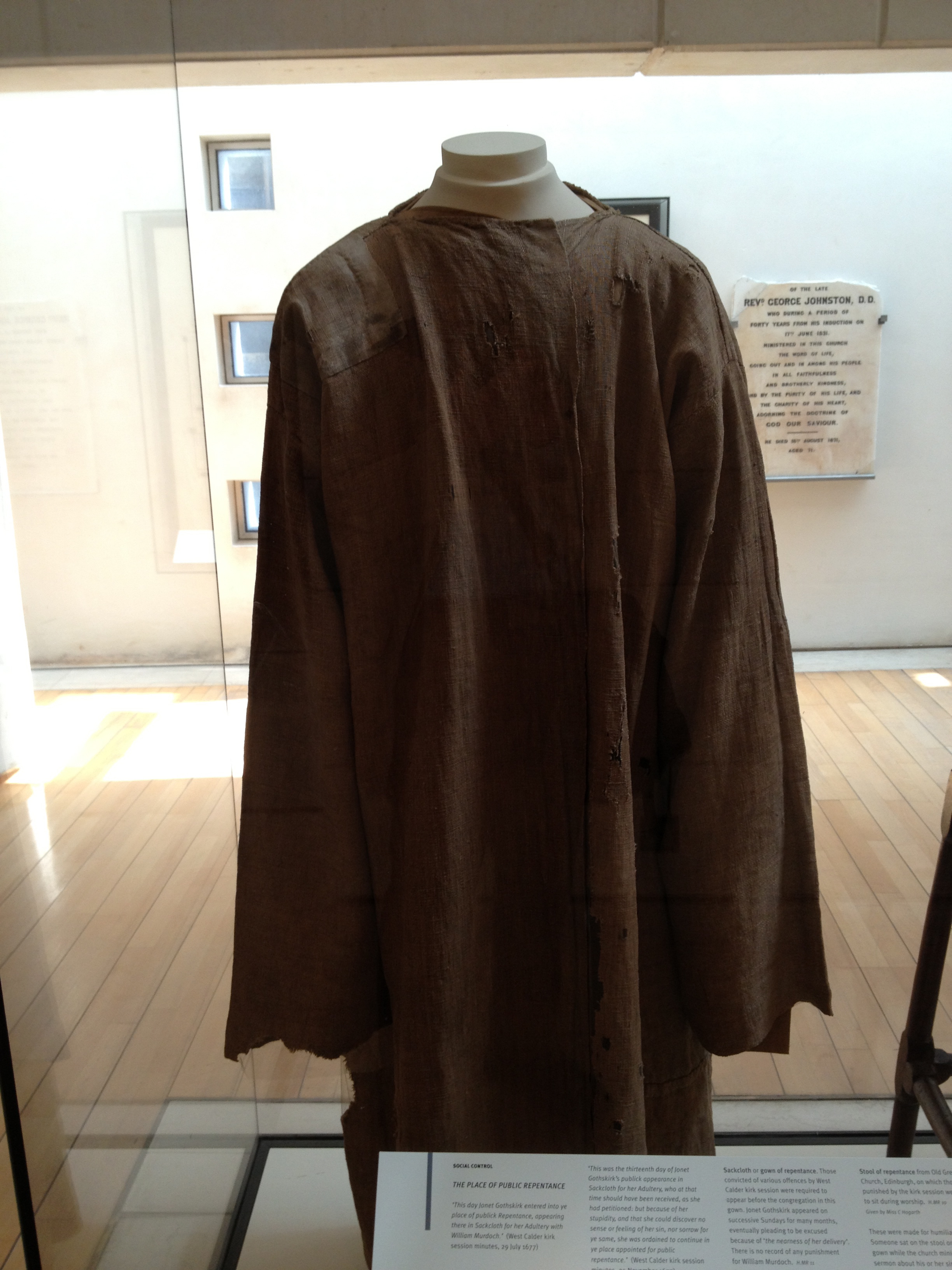
Back in the days of The Scarlet Letter, and before, an even more egregious double standard afflicted the sexual practices of women and men. Our primate nature promotes two conflicting principles: disgust at cheating and the desire to get away with what we can. Unfortunately, biology has often showcased female infidelity with the “illegitimate” child, and religions have stood in line to condemn the behavior that led to such circumstances. I was reminded of this while looking at a “gown of repentance” at the National Museum of Scotland. The Scottish Reformation led to an unusually severe kind of Schadenfreude when it came to pointing out the faults of others. Janet Gothskirk, spiritual kin to Hester Prynne, was convicted of adultery and had to wear a “gown of repentance,” literal sackcloth, to humiliate herpublicly. Her partner in crime, William Murdoch, is not recorded as having received any punishment for the affair, according to the placard.

IMG_0845

Thus it has always been: boys will be boys, but girls will be good. And when it comes time to dole out the blame, well, boys sometimes just can’t help themselves. This double standard is still in widespread practice throughout the religious world today. It shares roots with the same thinking that leads to many major religions denying sacerdotal leadership to women, and to the unfair punishment doled upon women in cultures where their behavior “dishonors” that of the men-folk. And we have all seen where male leadership has steered this ship.

What struck me hardest, staring at the dirty, ratty garment of shame, was that forgiveness seems so far removed from the religion of the Reformation. Christianity has always claimed a basis in the concepts of love and forgiveness, but when it comes to the very real circumstances of human failings, the animal tendency to attack the weak is often the driving force. We deflect because deep down we know that we all have failings. Clergy and braggarts may sometimes claim otherwise, but we share this very common liability of humanness. We should try to help each other through it. We should remember the golden rule. We should remember that sackcloth was meant to be self-inflicted and that the role of the church was to absolve the guilt, not to showcase it. Janet Gothskirk is forgotten to history, save for the garment she once wore to display her weakness for all to see.


The Good Magazine

IMG_0902I saw this magazine in a store recently. The temptation to buy it was compelling, but with international trips and a child about to start college to pay for, it felt a little superfluous. Presumably what was meant by this jaunty title, “The Bible: 50 Ways it can Change Your Life,“ was that by reading and applying the Bible and its precepts respectively, your life will be transformed. The problem is that there is no expiration date. Not to be too entrepreneurial with scripture, but how long do you have to apply all this before the blessings take hold? One of the criticisms atheists frequently bring to the discussion is that in order to explain the truly difficult aspects of the universe, the faithful often resort to laying claim to the divine mystery. God works in a mysterious way. Rationality squirms with discomfort at the thought of unsolvable mysteries. In our cause-and-effect world you might expect a fairly quick turnaround with the almighty. I know the Bible has changed, indeed, shaped my life. In more than 50 ways.

Lest I be accused of being too cynical, I feel obligated to explain that I grew up utterly convinced that the Bible was literally factual. Even working around the contradictions I studiously denied, it seemed that the goal was more to make your after-life better, rather than the one here and now. Too many nasty things attended living by the word. People were dying in the Good Book, in droves. The trade-off was a better world coming. If something transformative, in the prosperity gospel sense, were going to happen, it had plenty of time to come along in my younger years. Instead, the Bible led me to a foreshortened career in teaching it and a job in which applying its principles is a sure path to getting fired. Can the Bible change your life? It sure can.

The ways listed on the cover—live with eternity in mind, embrace your weakness, and love your enemies—all fit parts of the Bible. They are all part of “the secret” that makes for best-selling self-help books. The Bible, however, isn’t a book about making your life better. Taking Holy Writ at face value, you obey because that is what is demanded of you. Commandments have no suggestion of option about them. It’s not that I take the Bible lightly; quite the opposite. Something tells me, however, that if I need a magazine to help me figure it out, I must be missing something. Instead of reading the Bible, this is reading about the Bible. The iconic book is alive and well, even in this secular society.


Liberty and Justice for

Looks like America will be divorcing the self-proclaimed “Defense” of Marriage Act. It’s a small step, but a small step in the right direction. Religious dogma has too long held sway over politics in this land of religious freedom. It must seem astonishing to rational people the world over how a country founded for the very purposes of religious liberty has homed in on a very narrow sect of one religious tradition and used that as the basis for discriminatory laws. After all, even the Bible says very little about marriage—something about taking your main squeeze into the tent with you and voila, you’re married. The Bible never asks what they’re doing in the privacy of their own tabernacle. Now we have a political system that legislates what can legitimately turn you on. Finally we see some light beginning to dawn in the judiciary system.

I don’t take marriage lightly; those of us who are married seldom do. I also don’t take my status as being the only possible way of finding love in a world that sorely needs more of it. Every day I witness acts of uncaring and sometimes outright cruelty, often in the name of the progress of business. And until yesterday I had to live with the knowledge that it was perfectly legal to discriminate against committed couples just because their gender’s don’t fit a preconceived mold. The land of the free? Maybe, just a little bit yes, now.

Our legal system, which pours out its love on corporate culture, protecting business owners more readily than employees, shielding the wealthy whose lifestyles are beyond scrutiny, ends up telling citizens whom they may love and whom they may not. And we complain against countries with arranged marriages. Freedom for some is not freedom for all. Until we as a nation recommit ourselves to life, liberty, and the pursuit of happiness, we’ll have to take the small steps towards freedom when they come. Yesterday, for at least a little while, I was glad to see that the system can work for the good of all, when it puts its mind to it. America, you can be proud. Say it loud!

800px-Joseph_Anton_Koch_006


Just Plain Bible

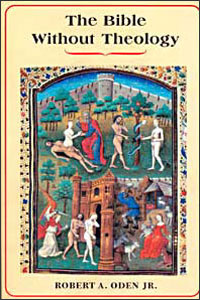
BibleWithoutTheologyBack when I was teaching Hebrew Bible in a seminary for a living, I purchased a book entitled The Bible Without Theology by Robert A. Oden Jr. I had intended to read it as a sanity break from the over-compensatory theological glosses that even the slightest reading of the Bible had in that setting. As the years passed and the book remained unread, I came to think of it as a systematic deconstructing of theological readings of the Bible, which it is not. Instead, Oden has gathered in this useful little book several essays centered on the topic of how the theological reading of the Bible has all but drowned out any other interpretations and has secured the privileged position of the Bible not only in society, but also in academia. Naturally, many people see such privilege as a witness of undisputed truth, even though how that truth is interpreted remains an open question.

Scholars, however, have the obligation not to favor their worldview over the evidence. Oden begins by discussing how history itself is perceived differently among those of various mindsets. History is an important part of the Bible’s theological reading since many Judeo-Christian interpretations revolve around a sense of historical veracity. After illustrating how history and mythology both lay claim to the text, Oden points out that even obviously mythological episodes have been blockaded by a theological reading of the scriptures. With examples from socio-anthropological studies, he demonstrates that parts of Genesis are best understood by investigating how kinship structures work, as well as how clothing serves as a status marker rather than a hidden justification for sacrifice, or chilly nights outside Eden.

Although The Bible Without Theology wasn’t exactly what I’d come to suppose it was, it remains a proper prologue to the issue. When Oden’s book appeared in the 1980s, the Religious Right was just finding its feet, fueled by a hyper-theological reading of the Bible. Since that time, the Bible has been used as theological justification to repress everyone from women to those biologically inclined toward their own gender. Bible scholars have, in general, known this is wrong. However, theologically inclined institutions won’t pay instructors for honestly engaging the text. Bible scholars are expected to throw their expertise behind the theological outlook of their institution in a way that Oden rightly points out, no other academic discipline would accept. In reaction to the biblical abuses of the Neo-Con crowd, many Americans are wondering why this one holy book is so privileged. While it may not have all the answers, Oden’s riposte will help to explain why the Bible deserves better.


Sleepy Jean

Last week in the Chronicle of Higher Education, an article by Cristina Richie entitled “The Scandal of the (Female) Evangelical Mind” appeared. Richie points out that despite great strides being made in employing women in religious studies positions, Evangelical institutions still fall behind. This dynamic is not unexpected, however. Those of us who grew up evangelical know that no matter how much it may talk the talk of equality, evangelicalism walks the masculine walk of deeply seated patriarchalism. For those who literally “believe the Bible” there is simply no way around a male Jesus. Even if you go that dangerously risqué step and suggest that the Holy Spirit is somehow feminine, when the divine couple gets together (and Father is always in charge), the offspring must be either male or female. In any literal reading, women cannot possibly claim equality. For their very salvation they are dependent on a male. A god with testosterone. As in heaven, so on earth.

Evangelical institutions have a difficult time with women leading men. They’re not alone. As early as the first century of the Common Era, Paul had the same issues. Literal religion in a biologically dimorphic world will always be problematic. Either there is one god, or there are three. In either scenario the males outnumber the females. Should we posit a divine couple (as some in ancient Israel appear to have done—please wave “hi” to Asherah for me) we still have a culture that is dominated by men. The divine couple will always have the goddess deferring to the will of the god. And you can be sure that he will never pull over and ask for directions. We already know which way this chariot is going.

Every once in a while, the Chronicle likes to sit back and take stock of the religious landscape. Religious studies is, despite the bad press, a thriving area of academic interest. Surely to those in more quantifiable fields, our little squabbles over whether god is a man or a woman must seem pedantic and a little pathetic. And yet, the evangelical institution has an instruction book. That book, if followed word-for-word, leads to eternal rewards for those who are willing to foot the hardships. And for at least half of those (and likely much more than half) that will mean living on an earth that mirrors that realm beyond the sky. Although you can’t see it with any telescope, if you believe hard enough, it is there. And in that ideal place, the god in charge is a man’s god.

540px-Paradiso_Canto_31


Going In, Coming Out

Being primates, perhaps it is no surprise that we are fascinated by who is doing whom. We, literally, by nature, find sexual alliances fascinating. Despite the fact that close observation of nature has indicated that homosexuality is indeed natural—it has been observed in many species, and isn’t even limited to mammals—we can’t help but make it a deciding factor in what an individual is. Two unrelated news stories over the past week have focused on homosexuality as the overwhelmingly defining trait of a person. In the first story, the Evangelical Lutheran Church of America (ELCA) has elected its first openly gay bishop. (Gay bishops, even in the pre-Reformation church, have not been exactly an endangered species.) The Rev. Dr. Guy Erwin, however, is so much more than a partnered gay man. He is a highly educated person who had held that most rare of positions—a bona fide academic position in higher education. He is also a member of the Osage Nation. His election as a Native American or as an academic would not be newsworthy. His orientation, well, that’s a whole different story.

Meanwhile, across the planet, the Southern Baptist Convention (SBC) is cutting its ties with the Boys Scouts of America because the BSA has decided to make honest men of its boys. BSA has recently voted to allow gay boys to remain in the Scouts, something that the Mormons had no problem accepting. Quite apart from the misguided SBC move, I was saddened to see CNN’s inaccurate headline, “Baptists plan exodus from Boy Scouts.” The story does not indicate that the Baptist brand of Christianity has withdrawn, so to speak, from BSA, but the Southern Baptist Convention. Baptists are much more broad-minded than the SBC brotherhood (I use the phallocentric collective intentionally) would indicate. All Baptists, it seems, are guilty by association.

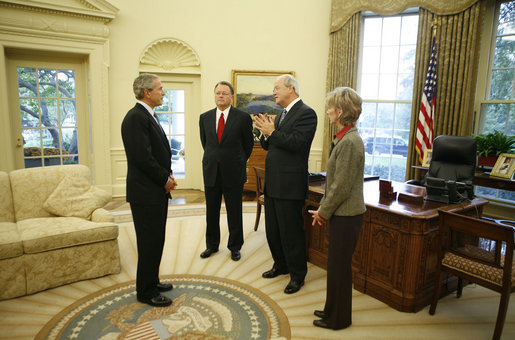
SBC in the White House

SBC in the White House

People are complex. Putting them into neat categories is unfair to who a person really is. The category “gay” is notorious for subverting all other qualifiers for decent human beings. As the National Socialist Party recognized, the easiest way to build a case against a people is to put them together in a class that “deserves” our fear, mistrust, and hatred. Don’t look at the individual beneath the label. You might be forced to change your mind. Did that individual overcome the difficulties of being a “minority” in his or her own native land? Did that individual work hard to climb through the educational system to attain an advanced degree? Did that individual commit his or her life to another person, no matter what the social stigma? None of that matters, as long as we can talk about his or her “orientation.” It is society itself that requires reorientation.