Missing Links

Dinosaurs hold a fascination like few other creatures. Perhaps it is because of their exotic and tragic rise to dominance and their meteoric plummet to obscurity. Maybe it is because of their impossibly creative adaptations to their environment leading to frills, fans, and pointy bits in unexpected places. It might even be that they reveal our own future to us. Whatever the reason, dinosaurs still rule.

In the news yesterday, a man was arrested for stealing a dinosaur. Not a Jurassic Park living model, but a fossil excavated from private land in Montana. A few years back I took my family on a dinosaur-based trip to the west. Trundling across the endlessly flat eastern half of Wyoming, I insisted that we turn down a rutted and washed out dirt road to an obscure site where dinosaur footprints had recently been discovered. Rolling into Red Gulch (seriously!), we were, surprisingly, not the only people there. Staring down at my feet next to the fossilized prints of some ancient carnivore was like feeling the very pulse of evolution. There was no fear of divine retribution here, just a sense of tangible continuity with a long and very distant relative on the tree of life. Creationists insist that dinosaurs and other creatures were each separately created, fearing, I suppose, an interspecies miscegenation, in keeping with their overall fear of sexuality. I was envisioning myself shaking claws with cousin dilophosaurus.

There be monsters here

Over the years we’ve made many dinosaur trips, stopping at dinosaur museums in North and South Dakota, Montana, and Colorado. Once, at Makoshika State Park in Montana, where you can walk along and see dinosaur fossils in situ, we heard a couple exclaim to the flustered park ranger, “but how can that be when the world is only 6000 years old?” Dinosaurs are symbols. They represent the ultimate in stature and environmental dominance, while at the same time hosting brains that struggled to rival a humble grapefruit. As I read the other, more serious, headlines I realize how much we are like our very distant cousins.


Noah in the Underworld

I recently was subjected to the 1940 sci-fi/western film Radio Ranch (a compilation of the series Phantom Empire). This happy-go-lucky story with Gene Autry in his first starring role is a romp through the unbelievable in just about any sense of the word. Based on the premise that there is an underground world called Murania, the film pits Autry against evil scientists who want to get a “bushel load” of radium from Murania, the “Thunder Riders,” or national guard of Murania, and indeed, against his corporate sponsors who will cancel his contract if he ever fails to get to Radio Ranch by 2 p.m. for his singing broadcast! This creative approach to early science fiction will be reincarnated more successfully in The Mole People, a movie that I wrote about a few weeks back.

The connections between the two films do not stop at an underground world with humanoids wearing Egyptian costumes (there is an unmistakable uraeus on the helmet of Argo in Radio Ranch), but go as far as the associations with the Flood Myth. I pointed out the flood connections in my post on The Mole People, and it was startling to note that Radio Ranch begins (and ends) with Gene Autry singing “Uncle Noah’s Ark.” That coincidence is, in itself, barely worth noticing. When the evil scientists invade Radio Ranch, however, they are shown an artifact from the Thunder Riders (whose thunder-producing horses are, admittedly, pretty cool) and they immediately identify it as an “antediluvian” idol. At this point it became clear how deeply embedded the biblical flood story has been in our culture, and how freely it was used in early science fiction films.

At a guest lecture in the Middle East Studies Program at Rutgers on Friday, I mentioned that the flood story goes all the way back to Sumer, making it among the earliest religious stories in the world. Several students had difficulty with this and began asking, “but when was Noah actually alive?” These college students, well educated in science, engineering, or political science, can’t get beyond the biblical literalism they were raised with. It is no wonder that America is falling behind much of the world in science education: we haven’t moved beyond Gene Autry’s overly cheerful belief in a deluge that never occurred.


Book of Eli

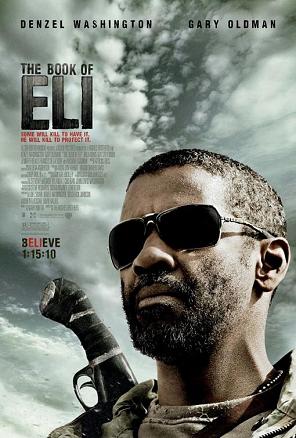
Feeling that it is incumbent on a teacher of Bible to stay current with media presentations of my subject, I went to see Book of Eli yesterday. Not really a fan of violent movies, I was a bit concerned about being subjected to gratuitous carnage, but beyond the expected post-apocalyptic context and its attendant, constant menace, there was not too much to worry about on this score. For several years I have been researching the presentation of the Bible in movies. It is my hope to write this research up into a book one day if I ever land a job that allows such a luxury. Book of Eli will deserve a chapter of its own.

Apart from fundie self-praise fests, few movies present the Bible in such a heroic role as it plays in Book of Eli. Eli, like Jake and Elwood, is on a mission from God: to deliver a Bible to the last repository of education in the United States, namely a famous correctional institution. Along the way Road Warrior-style bandits harass him and Carnegie (a kind of deranged librarian with lofty political aspirations) covets Eli’s Bible, the last in existence. Carnegie wants the Bible because, “it is a weapon” of social control. (All quotes are approximate since I couldn’t take effective notes in the dark.) Eli must keep it because of his mission. Along the way Eli explains why the Bible is important to Solara, a young woman who is drawn to his sense of mission and devotion to the book. Explaining that since the last war, all Bibles have been routinely destroyed and that, “some say it [the Bible] is what caused the war,” Eli lovingly wraps the book in a cloth before secreting it in his ubiquitous backpack next to his machete. At this point I could feel the social commentary pressing hard upon me. The Religious Right would love nothing more than to force Armageddon on the planet so that they might go to their wonderful fantasy-land in the sky. Their misreading of the Bible has caused wars in the past and will likely cause them in the future.

As Eli loses the Bible to Carnegie and continues his mission empty-handed he explains to Solara, “I’ve been protecting it [the Bible] so long that I forgot to do what it says.” Again the social commentary was evident as news headlines continue to push hot-button conservative political issues where the heart has been cancerously eaten from the Religious Right and the Bible as idol becomes more important than what it actually says. When Eli brings his mission to its conclusion, however, the viewer is presented with an entirely positive view of the Bible. It is the symbol of civilization in a world of anarchy and Solara marches off as its acolyte into a hostile world as the sun sets in the west.

What is truly remarkable about this film is that it presents the Bible in a way that would make its study cool again (if it ever was). For those of us who’ve spent a lifetime shying away from telling others that we have spent our lives learning about the Bible, we might now walk into the glaring sunshine and have others step back in reverence for our selfless efforts to benefit the human race. Well, at least once the apocalypse is over.


Proselytizing Phylacteries

Two related stories appeared in today’s newspaper, both of which concern the Bible in public life. A commercial airliner was forced to undertake an emergency landing in Philadelphia while en route from New York to Louisville, Kentucky yesterday because of terrorist concerns. The cause for alarm? A Jewish teenager’s use of his tefillin in public. Often translated as “phylacteries,” tefillin are prayer boxes worn on the arm or forehead during prayer in some sects of Judaism. This idea is not really obscure if someone has basic religious training. People on the US Air flight, afraid that the scripture-bearing artifact might be a bomb, had their lives disrupted while the boy calmly explained what he was doing. After landing, TSA officials came aboard, just to make sure. That’s a comfort! TSA officials seem unable to spot a real bomb but take a more than academic interest in a boy saying his prayers. Perhaps reading a Chaim Potok novel should be required training for TSA service? As my wife observed: what if someone took out a rosary or a crucifix? Would the flight be diverted to van Helsing’s residence? The level of this religious ignorance belies the grumbling in my post yesterday. Religious study is vitally important in an increasingly global society.

Is this phylactery da bomb or what?

The second story, again courtesy of my wife, was first run on MSNBC earlier this week and reprised in the paper today. Trijicon, a major defense contractor for the U.S. military, has for years been stamping Bible verse references on its rifle scopes. Concerned citizens, perhaps after watching sniper Private Jackson quoting the Bible in Saving Private Ryan, have raised concerns that Bible verses on rifle scopes constitute proselytizing. In Muslim countries, after all, those who have been shredded by a bullet before they ever saw their assaultant might be tempted to convert if they ever glimpsed the rifle scope and saw the Bible emblazoned on it.

Today’s story indicates that Trijicon has agreed to provide “Bible verse removal kits” to the military so that the verse references might be easily erased. What is so sad about this situation is that no one seems concerned that the maker of lethal weapons adds Bible citations to their products. The purpose of these devices is the killing of other people. The Bible seems an odd choice of supporting literature for this cause. Well, maybe not. The Bible knows how to call down the wrath of the Almighty on enemies as well. And the Bible gives instructions on how to pray with a phylactery. These stories demonstrate as clearly as possible how selective reading of the Bible leads to hypocritically varying results in an overly religious, but religiously uninformed, society.


Rushing in Where Angels Fear to Tread

As my daughter’s public school undertakes its humble efforts to raise funds for the devastated nation of Haiti, contributing the little that unemployed children can raise, Rush Limbaugh unapologetically proclaims that Americans shouldn’t contribute to the earthquake relief. The New Jersey Star-Ledger notes that on Wednesday Limbaugh declared that Americans already support Haiti through their tax dollars and shouldn’t feel the need to contribute anything beyond that to the poorest nation in our hemisphere. This is true Christianity, according to the Neo-Con gospel.

Rush Limbaugh basks in the limelight as the outspoken representative of the “Gott und Ich” school of religious politics. With an estimated annual salary around the $400 million mark, Limbaugh comfortably sits back and watches the world burn around him. Together with James Dobson, Pat Robertson, and others who support the new, compassionless version of Christianity (Christianity 2.0), they inveigh directly into the ears of high-ranking politicians with coarse voices declaring that God wills for them to be the sole arbiters of what is right. I only hope that Americans are really listening. Really listening.

Religion has always been a form of social control. From earliest times, those who claim to know the will of the gods tell others what they need to do to placate the angry deities that hover all around. Earthquakes are the work of such angry gods. What do they demand? Listen to your local priest. America has been beset with a plague of Religious Right voices that are well-funded and so parsimonious that seldom can the gentle voice of reason be heard. While Limbaugh enjoys his enormous wealth kids who have never known anything like basic comfort are dying in the thousands in a nation right next door. And the people say, “Amen.”


Theodicy Versus Idiocy

Among the leading reasons generally given for atheism in developed countries is the problem of theodicy. Theodicy is the act of justifying God, as implied by the roots of the word itself. In a world where many innocent suffer, as well as many guilty, the question of how a loving God and divine fairness fit into such a warped and corrupted system presents questions often left unanswerable. My class tonight will be reviewing Job, a book steeped in the issue of misfortune. The best that the narrator can offer is that Yahweh made a bet with the Satan and Job came out on the losing end. Not much hope for justice there.

This week’s horrific earthquake in Haiti has elicited high levels of sympathy and support as this poorest of western hemisphere nations struggles to find some kind of balance in a reeling world. The question of where God is amid all this tragedy, perhaps 100,000 dead, pensively teeters in minds sensitive to the human condition. Other minds, however, blare idiotic platitudes that only drive mourning theists closer to the other side. Pat Robertson, a major political player who has been a card-holding member of the Religious Right from its unholy inception, has declared that Haitians are paying the price for an ancient deal they made with the devil. In a theology that makes a mockery of even the Charlie Daniels band, Robertson stated, according to MCT News, that Haiti had made “a pact with the devil.” He said, “Something happened a long time ago in Haiti, and people might not want to talk about it… They were under the heel of the French… and they got together and swore a pact to the devil. They said, ‘We will serve you if you’ll get us free from the French.’ True story.”

This drivel, based on hearsay history and implicit racism, does not justify a loving, or even neutral, God. Instead, the Conservative deity is shown in his true colors: racist, supersessionist, arrogant, and uncaring. This is the deity behind the Religious Right. Some people castigate Pat Robertson for being outspoken and perhaps senile. I applaud him. He shows clearly what intellectual rubbish the Religious Right promotes. He simply has fewer inhibitions to admitting it.

In Job, there was a deal made with the Satan. The perpetrator of that deal was Yahweh. No answer is given as to why the innocent suffer. Job is a most profound book, wrapped in a childlike story of two supernatural beings trying to show each other up. If we look hard enough we can find the Religious Right in the book as well. Their voices are those of the “friends” that Yahweh ultimately condemns when he finally speaks from the whirlwind.


Eager for Eden

In a recent email from the Clergy Letter Project, Michael Zimmerman reports that the movie Creation is shortly scheduled to be released in the United States. To quote from the Project newsletter:

“You may have heard that the film, Creation, about Charles Darwin and his struggle with his faith after his daughter, Annie, died had trouble finding a US distributor because it was seen as being too controversial for the American public, particularly after being attacked on Movieguide.org, an influential site which reviews films from a supposedly ‘Christian perspective’.”

It is disturbing that a non-fiction film has been blocked from American viewers because distributors found the content too controversial. The controversy has nothing to do with sex or violence, but an assault on the fantasy of a literal interpretation of Genesis. Disturbing fact challenges comfortable fantasy.

In a related story, an article on CNN.com explores the sense of depression that several viewers of Avatar felt after the movie ended. While the reasons are deep and complex, the overall theme seems to be that these viewers can’t shake the image of a pristine world that seemed so real for two-and-a-half hours. They long for a paradise that doesn’t exist. A paradise that has never existed. I am not unsympathetic. Although I could not view the film, I left from the theater with a similar, if less intense, feeling. It is a similar emotion to that when a truly special event takes place and the mind plays it over and over like a new and significant song. Impressions and hazy images and euphoria wash over you, and a longing for a moment that can never be recaptured consumes your consciousness. These are some of the most bittersweet moments of life. They are the very heartbeat of fantasy.

There never was an Eden. Human existence has been brutal and harsh since we first stood upright and wondered why we could think. America is a nation in deep denial about this harsh reality. We would rather believe the biblical Eden is a literal paradise and that our aching imaginations are somehow giving us glimpses of a fabled utopia where life was perfect. Well, almost perfect. The movie Avatar presents a paradigm that many Americans can relate to: an electronic world of endless possibilities shielding us from the stark realities of illness, pollution, tragedy, and death. We are insulated in our surreal environment that we have created for ourselves.

The human capacity for wonder is perhaps the greatest asset that consciousness has deigned to bequeath us. We can imagine a world where all creatures live in harmony with their environment and love and peace flourish. But that is not our world. A good corrective to these tempting fantasies is to read some good old classic Greek tragedies. These imaginative explorations of the human condition are as true to life as dreams of utopian worlds are removed from it. It is all a matter of perspective. And the Greeks were writing B.C.E. — Before the Computer Era — when reality had not been hidden behind a haze of ephemeral electrons.


Prosperity Fail

Every so often I receive unsolicited mailings from impersonal churches intimately addressed to “Resident.” Invariably these churches tell me that God wants me to prosper (although he has a funny way of showing it sometimes), offer to send me some totem to make it possible, and assure me of their general goodwill. Yesterday’s mail brought me a packet from Saint Matthew’s Churches offering to help me become wealthy by receiving a free golden cross just for responding — post paid! — to their offer. Clearly such mailings are intended to target readers down on their luck. Since I’ve been without a full-time job since July, I meet their demographic rather well. My response, however, may not be what they hoped for: I plan to send no money.

I wonder how deeply these prosperity clergy consider the impact of an unemployed individual receiving their vain promises. Sometimes when the under-employed receive such hollow promises it feels like a god-slap. Oh! If only I had been wearing this free cross I wouldn’t have had to suffer such bouts of depression and self-doubt! It was just that simple! And the Holy Bible says so too!

Those of us who’ve tried to make a living of studying the Bible don’t just read the cheery bits. The Bible is full of suffering, despair, and difficulty endured by those who tried to do the right thing. So, in fairness to the spirit of empirical inquiry, I’ve decided to respond to this offer. The control will be the last seventeen years of my professional life, during which prosperity has eluded me. It may take another seventeen years, but if I carry my free cross around, things are sure to turn my way. The accompanying literature says so. I’ll set myself a task in Outlook for 2026 to see if, A. the world hasn’t ended in 2012, and B. the magic golden cross really works.


Bible Lite

Over the holiday weekend I listened to an amusing recording my wife gave me as a holiday gift. A comedy troupe known as the Reduced Shakespeare Company produced a recording of their sketches entitled The Bible: The Complete Word of God, abridged. As might be expected from a comedic treatment of sacred writ, there were a few moments that were calculated to make those who take their religion very seriously tremble a bit, but overall the recording was quite funny. While listening to it, however, I became aware of just how much time the Company was spending on Genesis.

Not a sophisticated, exegetical approach to the Bible, a comedy album is not the place to assess the status of serious biblical study. Nevertheless, a deep truth emerges from this lighthearted treatment of the Bible — people today tend to focus too much on the beginning. Every semester I ask my students, “What is Genesis about?” and inevitably the answers begin with, “the creation of the world.” Genesis is not about the creation of the world, despite its unfortunate title. Genesis provides two of the many biblical creation accounts, but its primary purpose is to introduce the Israelites and the special relationship Yahweh has with them. Nearly four-fifths of Genesis deals with Abraham and the next two generations of proto-Israelites. Once Exodus is reached, we are fully within the realm of Israel’s story.

This misunderstanding of how to read the Bible has led to countless uninformed attempts to make the Bible into a narrative of the science of cosmology. Nobody was present for the creation of the cosmos, and the point of Genesis is not to state what actually happened. In borrowing mythic themes from Mesopotamia and Egypt, at the very least, the biblical writers start their account of Israel’s origins with a “a long ago in a land far away”-style introduction. Modern-day readers are trained to latch onto first sentences for vital clues as to what happens further along in the story. The Bible was never intended to be read this way. When we mix ancient ideas of setting the scene with modern attempts to understand our world, it might be better to listen to the Reduced Shakespeare Company than to pundits who claim that earth’s light was created before the sun.

In the beginning was a laugh


Money Driven Life

An Associated Press story this weekend fetes Saddleback Church’s Rick Warren’s ability to raise 2.4 million dollars at his megachurch in an economy where many are suffering because of our national plague of greed. I find the story distressing not because people are willing to put out money for what they believe in — that is human nature — but because what they believe in is so shallow. Oral Roberts is not yet a month in the ground, and megachurches are again begging for money. Worse, they are getting money.

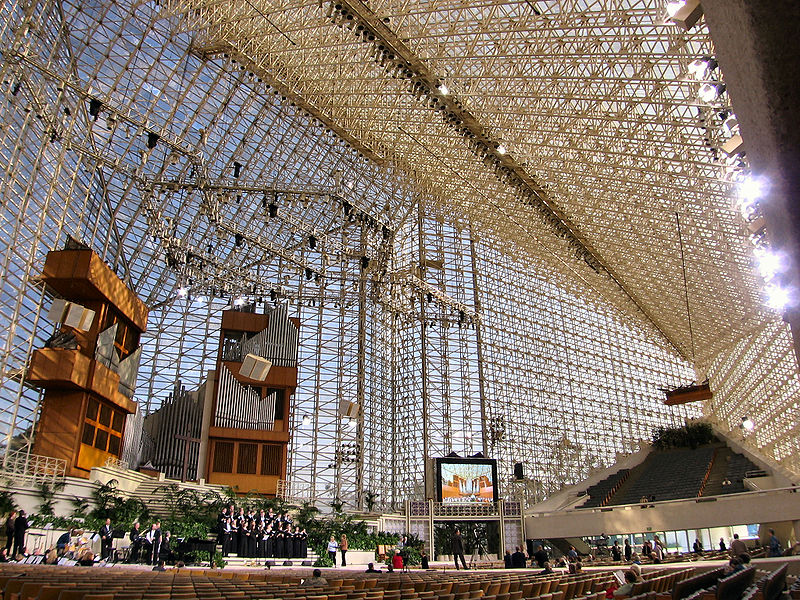
The greatest stumbling block to the humble message of the teachings of Jesus has always been the greed and concupiscence of the church. Whether it be the Vatican or some evangelical Crystal Cathedral, churches that stockpile wealth, although they may indeed distribute some to worthy causes, ultimately become a major part of the problems that create an unjust society. The concentration of wealth into the hands of any religious body will corrupt it. I have known clergy to purchase vestments costing hundreds of dollars per piece while their children were fed with food stamps. I have seen televangelists wearing suits that cost more than a month’s salary for many of their parishioners. I have heard them giving God the praise for their personal glorification.

Glory to God at what cost?

Once the glitz is removed, whether it be priceless Renaissance art or the supreme comfort of a Rocky Mountain resort or southern California ranch, the real purpose behind such driven lives becomes clear. No amount of prevaricating will make the working-class founder of the religion touted by wealthy clergy a friend of the rich as long as the poor continue to suffer.


Decade Fail

In a recent newspaper report on the state of the nation, local journalist Tom Moran cites a Pew survey in which most Americans surveyed rated the current and swiftly ending decade as the worst one of their lives. As a professional academic who was ousted from a highly rated, long-term teaching post this decade after a Fundamentalist takeover of the school where I taught, I am inclined to agree. Five years later I am still searching for any kind of meaningful full-time work, while yesterday I spied an ad for a “Ghost Twitterer” (as if someone is so important that they can’t write their own 140 daily words) and bowed my head in sorrow. Maybe we really have sunk to a new low.

What really caught my eye, however, was the statement of a fellow professor at Rutgers (where I have been an adjunct for nearly three years). Ross Baker noted that “It has always taken calamities of almost Biblical proportions to shake this country out of its smugness and complacency.” While I agree with his assessment, the use of the phrase “biblical proportions” demonstrated once again that my chosen field of specialization has a solid place in the popular imagination. Generally “biblical proportions” is a phrase used to refer to disasters, something along the magnitude of a world-wide flood, the destruction of Sodom and Gomorrah, or the plagues of Egypt. These mythological episodes have left a deep impression on our culture that the message of the Bible is a fitting one for the first decade of the twenty-first century.

Perhaps we are really in trouble if this facile view of the Bible is wedded to a facile misuse of the same book for constructing prejudicial public policies and ill-conceived conservative “reforms.” If the past decade has been a wash in this country, I would attribute it to a conservative evangelical political machine that churned out a president who literally would have been pleased to bring on the mythical Armageddon. During this bushesque reign of biblical proportions, I lost a secure job teaching Bible and haven’t been able to find any other full-time work. I would continue my rant but I have to polish up my résumé, and hone my succinctness skills, and try for a Ghost Twitterer position.


Birds of a Fang Suck Together

It reads like a cross between a Hitchcock movie and a Lovecraft story — paleontologists have unearthed a fanged bird fossil from the Cretaceous Era. Despite the cartoonish images this news flashes into my head, the startling find also suggests that this turkey-sized predator was also venomous. The first known ancestor to the avian family that used poison to immobilize its victims. A venomous bird.

Don’t let the cherubic Sinornithosaurus fool you! (From Wiki Commons)

Martin Luther is rumored to have said that you can’t prevent birds from flying over your head, (but you can prevent them from nesting in your hair). This new discovery suggests that there might be poisonous birds hovering around out there. And of course, Creationists must make room on the ark for this extraordinary creature. Since all critters, according to Genesis, were on the ark, our Sinornithosaurus must have lurked in some dark corner. I wonder how old Noah classified them — were they nestled among the birds or were they roaming about in the dinosaur wing? These toothy pterosaur wannabes were closely related to the velociraptors and microraptors that once served as the tetrapod mosquitoes of the Cretaceous Park world, stealth biters who’d glide down upon you undetected. The Creationists railing against transitional forms are scratching their theologically inclined heads.

I welcome the discovery like an early holiday gift. Although no one will ever see a living poisonous reptilian turkey soaring down from a Cretaceous canopy, we can all wonder and imagine. Fangs bared, venom dripping, it drops into our comfortable world and makes us reconsider. Apparently poisonous birds did not make the evolutionary cut, but I, for one, will be keeping a closer eye on the sky when I’m out in the woods or jogging around town early in the morning.


Oral Octopus

Veined Octopus

Juxtapositions fascinate me. As a former editor I notice the layout of stories on a page knowing that word counts, subject matter, photo sizes, and general interest all play into the placement of material. I recently posted an entry on Sacraments and Sea Cucumbers that had been suggested by such an editorial flourish. Yesterday’s paper wafted another such epiphany.

By now everyone knows that televangelist Oral Roberts died on Tuesday. Although he pioneered much of what is now recognized as televangelism, his true motives were clear when the money began piling up. I’m not the judge of his religious sincerity, but his ministry was a multi-million dollar enterprise, and he even founded a “university” named after himself. Meanwhile, housebound octogenarians on limited incomes gladly sent him their money to continue his good work. There is a very substantial profit to be made in preaching to the choir. All televangelists know that.

Immediately beneath the Oral Roberts story in the New Jersey Star-Ledger was a much more fascinating story about the veined octopus. Biologists have long known that octopi use large shells and other natural detritus for shelter. Octopi had been known to use coconut halves for that purpose as well. What is new in this story is that veined octopi have been observed collecting coconut halves (often discarded by human gatherers), emptying them out, and moving them to a place where two halves can be made into a neat shelter, thereby demonstrating a more advanced brain structure than most televangelists. In short, these invertebrates are utilizing tools. It is only a short step on the way to octopus televangelists, but if they know how to gather their valuables, this development can’t be far behind.


Biblical Science Fiction

1950s science fiction films are perhaps the most parsimonious celluloid genre. Standard Saturday afternoon fare in my childhood, I still have a soft spot for the unapologetic self-confidence of these movies with their painted backdrops and hokey effects. The messages are frequently self righteous and often biblical. So yesterday as I treated myself to a viewing of The Mole People, I went on instant alert as the biblical references began right away for an audience that would have known the Bible well enough to take it all in. Set in “Asia,” the archaeologists are digging for Sumerian artifacts when then discover a stone tablet “below the great flood level.” That makes it at least 5,000 years old, the assembled academics declare. A diffident Dr. Roger Bentley tells his fellow excavators, “in archaeology all things are possible!” When a young boy of the indigenous population discovers an oil lamp shaped like a boat, the archaeologists note, “the flood’s been proven to be a historical fact.” The boat is a model of Noah’s ark, the Sumerian version. The scene of the expedition climbing Mount Kuitara includes footage from the 1955 Fernand Navarra trek up Mount Ararat during which a wooden beam was found, reputedly from Noah’s ark.

If you can stomach the bogus Sumerian you’ll learn that ancient Mesopotamians also survived the flood, a kind of “children of Cain” motif. These Ishtar-worshiping pagans are practitioners of a kind of social Darwinism, killing off their own kind when resources in their underground world become strained. Their great underground civilization parallels that of ancient heathenism while more advanced civilization on the surface of the globe has the benefit of an enlightened Christian worldview. Even the Sumerians whipping the actual mole-men is reminiscent of the Egyptians whipping the Hebrews in the Ten Commandments (released the same year).

Fast forward fifty years. We now live in a technologically advanced civilization where the myths of ancient people have little place. Science provides logical explanations for most of what we encounter in the world around us. Yet there are still otherwise intelligent people seeking Noah’s ark on Mount Ararat. The past is impossible to escape. The Sumerians in the film (whose walls are inexplicably decorated by Egyptian artwork and hieroglyphics) represent those who hold onto a confused religion that has become a form of terrorism in the eyes of the more advanced archaeologists. Perhaps the paradigm has shifted, and those who use religion today to gain political power and personal gain have become the self-righteous Sumerians of The Mole People.


Hadad in Copenhagen

Let us talk plainly about the weather. Global warming is a reality, and yet the issue is clouded by religious conservatism. To be precise, it is difficult to determine whether it is really greed or the religious right that stands so firmly behind free-market capitalism that is driving this chariot of the sun. The strange and unholy alliance between religious and political conservatism, however, has become a force daily striving against reality and its proponents want to be on the top of the pile when the whole thing collapses.

I can not speak to the political end of this continuum; I am not a political scientist or economist. As a “religionist,” however, I recognize a deeply disturbing trend that I have followed since my youth. Fundamentalists have consistently taught their young that the “Second Coming” is only minutes, possibly seconds, away. Undaunted by the two-millennium delay in wish-fulfillment, they suppose the words supposedly uttered by Jesus indicate a kind of divine “I’ll be right back” just before pushing off from the Mount of Olives. The signs of the times given in the Bible describe the then current condition, yet modern-day Fundamentalists wish to force the almighty hand, call the bluff of the Texas Hold-‘em expert above. If the general in the sky said wars would come, well, we’ll make wars. If the only way to get his attention is by destroying the planet around us, so be it. Deny global warming for the sake of the religious right, since their world is about to end.

Baal in Copenhagen?

The rest of us might want to stick around for a while. Ancient meteorologists believed that particular gods controlled the weather. At Ugarit Baal, or Hadad, took responsibility for drought and plenty. If there was a problem, they knew just to whom to offer a sacrifice. In our monotheistic western world, we’ve pared the gods down to a single man. Not everyone agrees on his mood or character, but some are convinced that he has his bead trained right on this planet and they want to help from here below. Others believe — o the heresy! — that natural processes control the weather and that we can do something to make our situation better. We might be in a better place if those who believe the gods control the weather were relegated to theology classes rather than political offices.