After Effects

Every once in a while you find a book you wish had been published sooner.  The Exorcist Effect, by Joseph P. Laycock and Eric Harrelson is one of those books.  Although it covers many of the same films I talk about in Nightmares with the Bible, it does so with a different target in mind, and a lower price point.  Drawing on the observation that human recall is often accompanied by “source amnesia,” they explore the idea that famous horror films (and some less famous) get remembered as “facts.”  This seems to be a greater danger to those who don’t actually watch horror or who watch it uncritically.  Movies such as The Exorcist become the basis for what individuals believe about demons.  But it’s far more dangerous than that, because in a culture where everything’s politicized, horror movies become “the truth” for groups like QAnon.

Considering Rosemary’s Baby, The Exorcist, and The Omen as prime examples, they then move on to consider the fascinating, if weird, lives of Ed and Lorraine Warren, and Malachi Martin.  Popularizers such as these three influenced both horror films and general public opinion about demonic possession and exorcism.  The study moves on to the Satanic Panic of the eighties and nineties and how heavy metal music both utilizes and ties into the Exorcist Effect.  This important book ends by discussing the very real dangers of a society that elects presidents and others based on this Effect, which confuses reality and movies.  The book shows how many of the ideas behind conspiracy theories either misremember, or intentionally misuse, horror films.

Back in the days when I started Nightmares with the Bible there was comparatively little published in readable terms that discussed demons or, specifically, the portrayal of exorcism in movies.  Laycock and Harrelson’s book would’ve been a welcome contributor to that dearth of resources.  As someone who works on the fringes of the fringe, I don’t always hear the discussions other scholars have and I’m often left to my own devices when it comes to finding and reading information on horror films.  Without library privileges, it often means having to purchase the books to access them.  I was thrilled when I first learned about this book and I’m glad to have finally had the opportunity to read it.  I’m sure I’ll be coming back to it on occasion.  After writing Nightmares, I took a bit of a break from demons because being in the dark for too long can do odd things to a person.  But not knowing about them, as this book shows, might cause even greater problems.

Who’s Knocking?

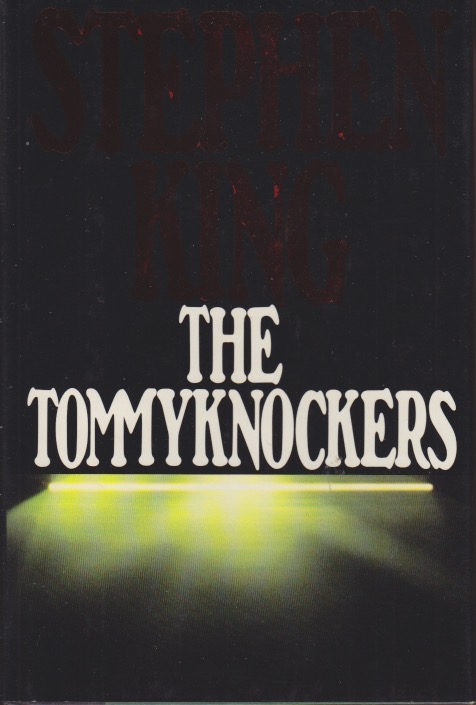
I’m by no means alone in enjoying Stephen King novels.  I’ve read a fair number over the years.  I was put on alert for The Tommyknockers by a scholar who pointed out some of the religious elements in it—again, not rare in King’s oeuvre—but I’d never heard of it before that.  I’m not really a good fan boy, I guess.  In any case, I saw a copy with the shiny copper of King’s name worn off at a library book sale for a buck.  It sat on my shelf for many months because, well, it’s long.  I finally pulled it down in October only to discover that it wasn’t my favorite King story.  For one thing, it’s simply too long.  For another, the characters aren’t the easiest to cotton onto.  If you’ve not read this one and you plan to, a spoiler of two might slip out but I’ll do my best not to ruin the ending.

I think horror when I think King, although I know it’s unfair to typecast authors like that.  Tommyknockers is more King’s hand at science fiction.  Well, at least it has a space theme, which is generally a cue for sci-fi in my book.  Bobbi Anderson discovers a buried flying saucer on her Maine property.  With the help of an alcoholic friend (Jim Gardener) she begins to excavate it.  The saucer, which has been buried for millions of years, is reactivated by their interaction with it and soon the entire town of Haven, except those with a lot of metal in their bodies—like Jim, are under its power.  They invent advanced gadgets (and weapons) using power from the ship and standard batteries.  They begin physically transforming into something less than human.  Jim, mostly immune, tries to help Bobbi out but he, along with a fairly extensive cast of disposable characters, are powerless to stop things.

Like most King novels, it’s well written.  Like some of his other material, it’s over-written.  Having had my own written work chopped down  (and, let’s face it, I’m now an editor), I see places where cuts could be made.  As with any long book, however, I’m left feeling a bit lonely now that characters I’ve read about nightly for many weeks are gone.  Even though I really had a difficult time evoking much empathy for them, hey, they’re people too.  Or so it seems.  Such is the magic of fiction.  Besides, there are bits of the old King horror still present in the book.  I know it won’t ever be my favorite King novel, but it won’t stop me from reading another, when I have the time.  Hopefully the next one will be a few pages shorter.


New Gremlins

I haven’t seen the movie Gremlin in years.  I’m adding it to my Christmas list this year, however.  Probably because I watched Shadow in the Cloud recently.  And although that gremlin wasn’t cute, it led me on a journey of discovery, and that counts for something.  I have to admit, first of all, that I’d never heard of Roald Dahl before a kind family member sent us some of his books when our daughter was young.  We became rather hooked.  His novel The Gremlins was among those we read but there was something I didn’t know (one of trillions of somethings, of course).  And that is that Roald Dahl was probably the reason anyone outside the Air Force knew about gremlins at all.  Dahl was a pilot with the Royal Air Force.  His first children’s book was the aforementioned Gremlins.

Image credit: US Government, public domain, via Wikimedia Commons

I first learned about gremlins from The Twilight Zone.  “Nightmare at 20,000 Feet” came close to giving me literal nightmares.  (And Nope reminds us that there may be things in the atmosphere that we really know nothing about.)  That particular episode was based on a short story by Richard Matheson.  It was also incorporated into the 1983 Twilight Zone movie which I have, unaccountably, never seen.  Of course, I saw Gremlins in a theater back in my college days.  That was before I understood, or really had any interest in holiday horror.  This is one of those instances where the birth of a monster can be traced and its lore can be watched to grow, in real time.

Dahl took something he’d heard about—gremlins weren’t believed to exist by anyone—and made it literal, in the form of a children’s book.  Soon after, other vendors, such as cartoon creators, picked it up.  In the Twilight Zone it began its transition to horror.  Then a regular horror movie was made of them.  All of this has taken place since World War II and there are plenty of people alive who were around at the time.  Shadow in the Cloud was a reboot of a monster generally underused.  There are few times people feel as vulnerable as when they’re flying.  Heck, climbing a tall ladder is enough to give me the willies.  And the movies have shown us that even on the ground we’re not really safe from the monsters of our imagination.  That’s why it seems like a good idea to me to watch Gremlins again.  And to dream of the monsters we invented.


Not Quite Christmas

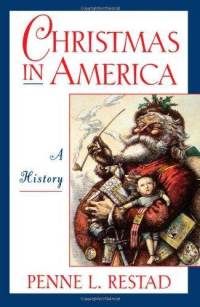
Holidays have always fascinated me.  Although we grew up poor, I always have cozy memories of childhood Christmases.  It was a combination of things—being out of school for a couple of weeks.  Presents.  Christmas trees.  Time outside ordinary time.  I’d read Penne L. Restad’s Christmas in America: A History years ago.  So many years, in fact, that I forgot that I wrote a blog post on it before.  That was back in 2012, in my early days of commuting to New York City, and early days of blogging.  Sometimes I have to come back to a book, however, and rereading this one reminded me of why.  There’s a lot of good stuff in here.  It mostly focuses on the nineteenth century, but it does go back before that and steps into the twentieth century (when it was written) toward the end.  I’d forgotten a lot of what I’d learned before.

This time through, having worked as an editor for a decade and a half now, I could tell that it was originally a dissertation.  It’s pretty hard to remove that completely from any book project.  Nevertheless, it’s engagingly written and full of facts.  I’d forgotten that Santa’s red clothes were not, in fact, Coca-Cola’s invention.  And that Washington Irving played quite a role in introducing Americans to the holiday.  And just how interconnected Christmas is with Thanksgiving, New Years, and yes, even Halloween.  Of course, no book can be adequately summarized in a brief blog post.  My previous one highlights some of what I found here, but this reading brought out other interesting features.  I spend quite a bit of my energy anticipating holidays.  Some years they’ve been minimized due to circumstances, but they are definitely the fixed points around which my life revolves.

One of the interesting things I noticed this time, introduced literally on the second-to-last page, was that the book mentions holiday horror.  Restad’s focus is on America so she doesn’t really delve into the British tradition of telling scary stories at Christmas.  (I do discuss this in The Wicker Man, I would note.  Although set on May Day, it was released in December, fifty years ago.)  These kinds of interconnections fascinate me.  Our culture reflects who we are and American culture includes Christmas for any who want to take part in it.  In fact, the book makes the point that becoming secular helped Christmas spread goodwill to people of all religious persuasions, or none at all.  It’s not really even a Christian invention.  It’s a blending of traditions that bring light to the darkest time of year.  And here I am like a kid, eagerly awaiting it again.


Buy Books

It’s funny how the bad guy can become the good guy in new circumstances.  I’m thinking in the bookstore context.  Now, I love independent bookstores.  I shop in them whenever I can.  Still, I had a genuine fondness for Borders.  My wife introduced me to Borders when I moved to Ann Arbor to be with her.  Borders was headquartered in Ann Arbor and it was our go-to for browsing.  (This was before Amazon, of course.)  Compared to Barnes & Noble it was intellectual and inviting.  B&N had gone for the corporate stodgy aesthetic that drives me frantic.  We literally mourned when Borders closed, spending hours in the New Jersey stores as they were selling off stock.  There was a long time when Amazon seemed the only game in town.  Our part of New Jersey had no indies, but the B&N sat on the hill.

Then B&N started having trouble.  By now I worked in publishing and seeing the only brick-and-mortar outlet crumbling was scary.  We need to fight the ebook invasion.  To do this we need bookstores!  (Fortunately we have a few good indies where we live in Pennsylvania, but even so, at least two of them have closed in the last five years.)  Then something happened.  James Daunt bought Barnes & Noble.  Daunt was known as an innovative British bookseller.  His stores (I’ve only seen pictures) are the thing of dreams.  Could he steer this corporate stodgy ship into open waters?  It seems to be working.

A piece in a recent New York Times praises the new B&N effort.  Instead of stamping “one size fits all” all over his business, Daunt wants his stores to take on local flavor.  Not look like every other B&N.  And it seems to be working.  I still prefer my indies, but the last time I was in the local B&N I noticed subtle changes that can come when a corporate overlord hands a local manager a bit of autonomy.  The stores are looking better.  And folks, let me be frank here.  Christmas is coming and books, real books, need your help.  Silicone Valley is trying to force us onto our screens for even more hours of the day.  I get off work and pick up a paper book to read.  To look at something real.  To connect with the actual world.  Support your indies, but don’t feel guilty about ducking into B&N.  It may not be the place you remember.


Biggest Book

As a bibliophile it’s kind of embarrassing to admit that I’ve only just learned about the world’s largest book.  If you’re like me you’re probably imagining an enormous tome that required acres of trees and fifty-five-gallon drums of ink to print.  But that’s not it at all.  This particular book is located in Mandalay in Myanmar.  If I say it’s a religious text you might be clued in that it represents the Tripitaka, or Pali Canon.  These are Buddhist scriptures.  They are extensive, as scriptures tend to be.  I’m certainly no expert on religions in that part of the world, but it’s clear that the world’s largest book, as a monument, required a massive amount of effort to put together.  Housed at the Kuthodaw Pagoda, the texts were inscribed on stone housed in 729 stupas that are stunningly beautiful.  (Take a look for other photos online—it’s impressive!)

Photo credit: Wagaung at English Wikipedia, published under GNU Free Documentation License

The monument was completed in 1868.  When the British invaded southern Asia, however, there was much looting and damage was inflicted on the shrine.  It was eventually repaired and still stands as the largest book in the world.  It’s no real surprise that this honor would be relegated to a religious text.  Bibles of all sorts become symbols and their symbolic nature often supersedes what’s written inside.  The idea of the sacred book has an unyielding grip on the human psyche, whether we think the book comes from God or an enlightened human being.  Indeed, the sacred itself is an integral part of being human.  When one group wants to dominate another, it often goes for its sacred artifacts.  Cathedrals as bombing targets in the Second World War demonstrate that well enough.  Ironically, we’ve ceased paying much attention to the sacred but we still revere it.

Books represent the best of our civilizing nature.  They’re ways of coming to see the point of view of others.  It really is a privilege to read.  Banning books is, in its own form, a crime against humanity.  Those who ban almost inevitably end up promoting yet more sales of the offending book.  I often see books that make me angry or upset.  My knee-jerk reaction is to want to deface them—this is a human enough response.  But taking time to reflect, I realize that these writers are entitled to their opinions, benighted though they may be.  A civil exchange of ideas is essential to getting along in a world with billions of different opinions.  Every nation should have a monument that shows its love for books.


A Century of Horror

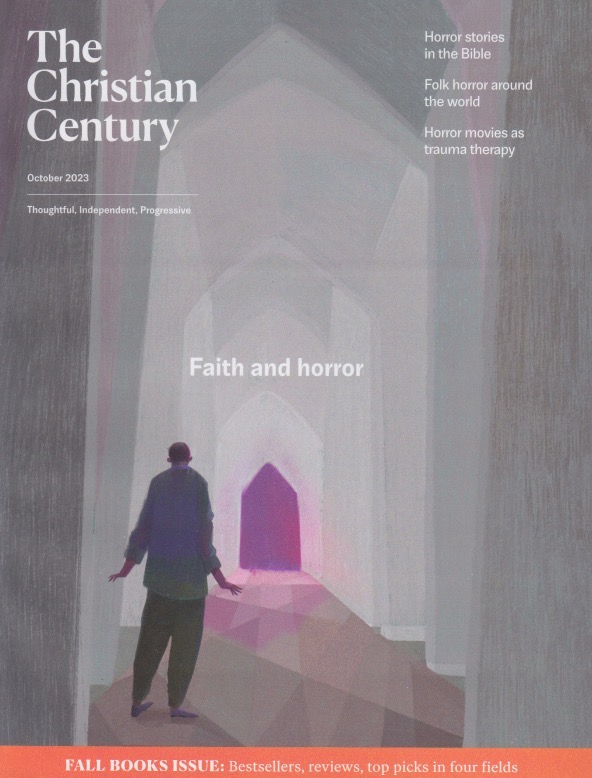
I’m not a magazine reader.  When I go to a waiting room (which is quite a bit lately), I tend to take a book.  The October issue of The Christian Century, however, caught my eye.  As a more mainstream/progressive Christian periodical, CC used to circulate in the office of one of my employers since it features books, the way progressives generally will.  This October, however, it featured five articles on “faith and horror.”  I had to take a look.  I know three of the five authors, one of them without realizing he was a horror fan.  An article by Brandon R. Grafius, “The monsters we fear,” discusses the commonalities between fear and religion, ground that he treats in Lurking under the Surface.  “The wisdom of folk horror” was written by Philip Jenkins—I didn’t know his horror interest—and it engages, briefly, The Wicker Man.  He’s making the point that folk horror is often about somebody else’s religion.

It was “Horror movie mom” by Jessica Mesman that really hit me.  Mesman was traumatized in her youth, and like many of us who were, has turned to horror for therapy.  This is a moving piece and is worth the cover price of the magazine.  Gil Stafford’s “A theology of ghosts” also gave me pause.  Stafford is an Episcopal priest who considers ghosts to be more than just woo.  In this very personal piece he thinks about what that means.  The last feature, “God’s first worst enemy,” is by Esther J. Hamori, one of the colleagues who talks monsters with me.  The piece is adapted from her recent book, God’s Monsters.  Taken together these pieces are quite a mouthful to chew on.  While numbers in mainstream Christianity are declining, Christian Century is still a pretty widespread indication of normalcy.

When I wrote Holy Horror I only knew about the work of Timothy Beal and Douglas Cowan as religion professors writing on monsters and horror.  That book admitted me to a club I didn’t know existed—the religion and monster crowd.  Since I’m not welcome in the academy, I’m particularly drawn to pieces like Mesman’s since she’s writing from the heart (as is Stafford here).  I’m just glad to see this topic getting some mainstream coverage.  I know I’m a guppy in this coy pond, but I do hope they’ll consider, over at the Century, turning this into the theme for their October issues in coming years.  If they do, they can count on at least one extra counter sale.


Mystery of Poe

I’ve read my fair share of books on Edgar Allan Poe, but I have to say that Mark Dawidziak’s A Mystery of Mystery: The Death and Life of Edgar Allan Poe is perhaps the best.  Like Dawidziak, I realize that writers, as well as other historical figures, come to be who we need them to be.  This book, which pinwheels around the unsolved cause of Poe’s death, is probing of his life as well.  His younger years and his likely psychological profile as a child who never felt he received the love and affirmation that he required, really spoke loudly.  This explains much of his behavior, which was often contradictory and didn’t serve his own best interests.  Today Poe is an icon of horror, but as this wonderful book explains, Poe was so much more.

People are often typecast.  We have limited time and our own lives are so crowded with stuff we have to do that, as a matter of survival, we need to “profile” others.  I’m constantly reminded of this when I spend time with people (which is not often), particularly those I know well.  I leave realizing that I don’t know them as well as I think I do.  I’ve only seen the surface, or just below, if I managed to engage with any depth.  My own involvement with Poe goes beyond memory.  As in a dream, I don’t know when I was first exposed to him or his writing.  Still, I know that I’ve had a lifelong “parasocial relationship” with him.  I suspect that many of us who appreciate his writing do.  Well, back to the book.

A Mystery of Mysteries begins near Poe’s death, setting the stage.  The chapters then alternate, going back to a chronological treatment of his early life, and then picking up the narrative of his death.  Along the way, a compelling portrait is painted.  Like the majority of us who write, Poe didn’t find much recognition in his own lifetime.  Of course, he died young, but his lifestyle might well have created that situation, regardless.  Jealous of others who received more attention, Poe knew he had a special intelligence that was unappreciated.  It still is.  Yes, Poe has many, many fans, but many, I suspect, don’t have a good idea of who he was as a human being.  For as much as he wrote, Poe didn’t really give us reliable details of his own life.  Dawidziak ends with some well-reasoned speculation of Poe’s cause of death.  But I won’t tell you what he suggests because I want you to read this excellent book.


Witching Season

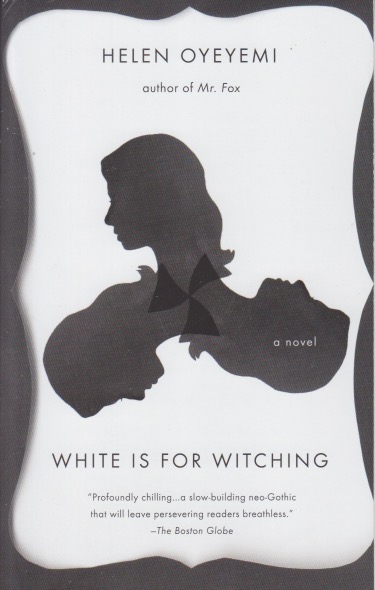
I can’t be sure I understood White Is for Witching, but Helen Oyeyemi’s novel grew on me once I started to piece together what was happening.  A long sit in a waiting room finally got me hooked.  This is an odd story that’s quite a bit about atmosphere.  Miranda Silver and her twin brother Eliot, live in the Silver family house (through her deceased mother’s side) with their father.  They run it as a bed and breakfast, but Miranda’s ill.  She suffers from pica—a disorder where a person eats indigestible items rather than food.  Her mother, who died young, and her mother, and grandmother, continue on in the house, but not as ghosts proper.  They are more a controlling presence guiding the way for the lost daughter who, it seems, is destined to join them.

Miranda’s not an unreliable narrator because she’s never the narrator.  Sometimes it’s her brother, other times it’s her girlfriend, and other times it’s the house itself.  Oyeyemi’s writing is compelling, and she’s great when she takes the narrative thread and runs with it.  The fault is entirely mine, of course, but I prefer a straightforward story where I’m not confused from the start.  I recently put a book down because I was confounded about the issues raised.  I’m flummoxed enough by life itself so that when I want to sit down and read I prefer something that makes sense.  Or that I can follow.  The novel has a wonderful gothic atmosphere and the tragic young woman definitely has shades of Poe.

My compulsion to read appropriate books in October led me to White Is for Witching.  It’s set in England, however, and having lived in the United Kingdom for three years I know autumn there is not the same as fall in North America.  That’s not the fault of the story, of course.  The tale is textured and complex, exploring avenues of madness and isolation (it’s set in Dover and Cambridge).  The part where Miranda falls in love with Ore, at college, becomes quite gripping.  There’s some confusion as to why her twin brother acts as he does, with one of the narrators suggesting that he’s unreliable.  There are speculative elements but no ghosts seen clearly.  And race is obviously an issue.  It’s not the central issue (beyond the author perhaps suggesting something by the title).  There’s a lot going on here.  Normally I don’t read synopses before reading fiction, but this is a case where that might be helpful before indulging in this moody, thoughtful tale.


Something Wicked

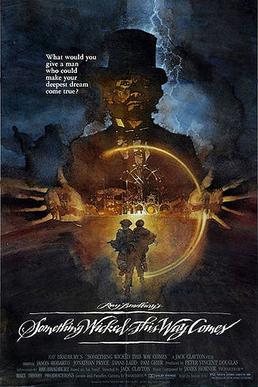
There comes a morning each year, pre-dawn, that it happens.  I crawl out of bed and things feel slightly chilly.  The furnace hasn’t been turned on yet, and ever sensitive to cold, I put on long sleeves and slippers to do my morning writing before the sun.  I start getting a powerful hankering to watch my autumn movies.  This year when that happened, in September, I finally watched Something Wicked this Way Comes.  Now, Disney isn’t a studio known for its horror films.  Over the years, however, they’ve produced some family-friendly efforts toward the scary end of the spectrum.  I tried to make the case in Holy Horror (and a list on IMDb agrees with me) that Pirates of the Caribbean falls into that gentle horror category.  I’ve read established writers on horror claim that The Watcher in the Woods was the movie that frightened them most.  I don’t think Something Wicked falls into that category, but I can say I liked it better than the novel.

And that’s saying something, because it was written by Ray Bradbury.  Bradbury’s stories were an integral part of my childhood.  In fact, much of my fiction writing is modeled on his work.  I didn’t really care for the novel Something Wicked this Way Comes, which I read last year.  The film is an improvement.  And it had a tortured way to the silver screen.  It began as a short story.  Bradbury himself adapted it into a screenplay anticipating a role for Gene Kelley.  This was in 1958.  When that didn’t pan out, he wrote it as a novel.  Filmmakers began to show an interest in the early seventies, but the movie didn’t come out until 1983, after Disney bought the rights and took over production.  The screenplay is mostly Bradbury and the soundtrack rips off Star Wars more than once.

Bradbury could get a little too nostalgic about boyhood.  His yesteryears seem far too innocent to me.  Although, having a few scenes where Jim shows curiosity about sex was a bit racy for Disney, I should think.  Jonathan Pryce does a fine job as Dark, and the mood isn’t bad for family-friendly fare.  I was never much of one for carnivals.  I can’t do rides and it’s easy to see through the games you can’t win and even if you do your prize is cheap.  Other entertainments always appealed to me more.  Still, the film sets a mood, and that’s generally what I’m after when the mornings begin to feel chilly and I’m looking off into another winter.


Frightening Legacy

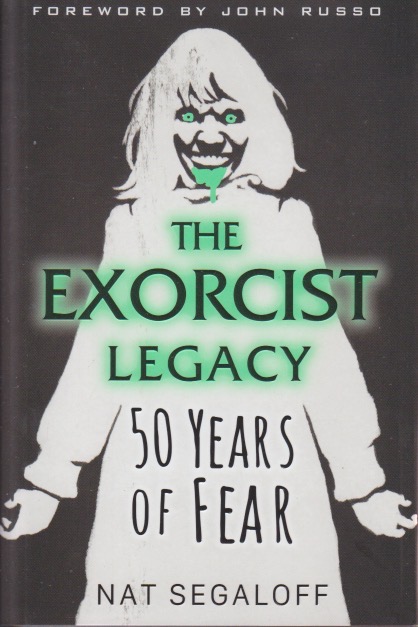
Like The Wicker Man, The Exorcist also turns fifty this December.  I was caught up in this half-century mania and so I got ahold of Nat Segaloff’s The Exorcist Legacy: 50 Years of Fear right away.  The reading was disrupted by life events, but I’d been enjoying it, as time permitted.  Written by a movie insider (as opposed to an ex-academic wannabe), this is a fairly full treatment of the film.  It’s actually not unlike what I tried to do with Nightmares with the Bible, but it is yet another testimony of the importance of The Exorcist to our understanding of demons.  Although one book can’t really be one-stop shopping for any worthwhile movie (there are plenty of books out there on the subject), this one is well worth reading.  For those who enjoy learning about cultural phenomena with a bit of horror tossed in, this is a very good introduction.

One of the things I’ve learned as I’ve tried to break into film reading is that a lot more goes on in making a film than most of us imagine.  And when we see a movie we miss an awful lot.  I’m no shill for Hollywood, but watching a movie multiple times brings out things that writers, directors, and producers didn’t even notice.  Think of the Bible, for comparison.  Readers two thousand years later are still finding new things to say about it.  The Exorcist has influenced religious outlooks in extremely important ways.  Our modern ideas of demons and possession largely go back to this film.  Details may change over time, but even the church has had to respond to it, and actual exorcists reference it.  The Bible says little about demons (again, Nightmares), so we have to pick such knowledge up from elsewhere.

The one part I found somewhat thin was, not surprisingly, parts of the final chapter, “The Mystery of Faith.”  It tends to show when a writer really knows religion.  William Peter Blatty, who wrote the novel and screenplay (the latter at least partially), knew Catholicism cold.  One of the things I’ve been yammering on about for years is that understanding religion enhances our understanding of horror movies.  I’m certain that the connection goes even deeper than that, but books written on horror mention religion often in amateur ways.  If we want to get at what’s really going on here, it’s going to be important to listen to those who understand religion as well.  None of that detracts from this fascinating book that will throw new light into shadowed corners.


Starting October

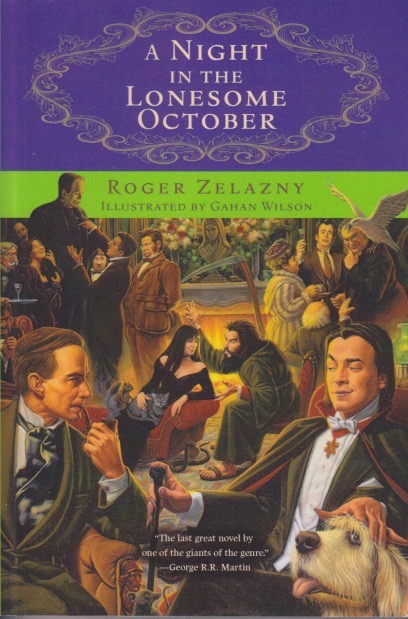
October’s a difficult month to quantify.  When it rolls around I get in the mood for certain books and movies, but I like to see and read new things.  I check lists to see what others recommend for what I hope is a similar mood.  A book that kept coming up was Roger Zelazny’s A Night in the Lonesome October.  Published thirty years ago, it’s not exactly new, but it was new to me.  It’s a humorous story, told by Snuff, a dog.  But not just any dog—he’s a player in a game that takes place when the full moon lines up with Halloween.  There’ll be spoilers hereafter.  The game involves two sides deciding the fate of the world, and each has the usual monsters lined up.  Dracula, the wolf man, Frankenstein’s monster and others are involved.  One side tries to awaken Lovecraft’s Old Gods and destroy the world while the other side tries to stop them.

Each chapter is a day in October and what the game is is only slowly revealed.  The antagonist for all of this is really the parson.  It turns out that he’s a minister for the Old Gods’ true believers.  Various monsters or players are killed and Sherlock Holmes is hanging about, trying to solve the mystery.  The story’s really a mash-up of several characters from yesteryear.  It’s not scary, nor is it particularly moody.  It’s a good example, however, of how religion and horror, even if it’s comedy horror, work together.  The Old Gods are an existential threat and require clergy to perform the correct rituals.  Roger Zelazny was fond of using characters from existing mythologies in telling sci-fi-ish stories, and this fits that writing mode.

This is an enjoyable story, but my October mood isn’t only a monster one.  Set in England, A Night in the Lonesome October doesn’t really have the leaves, pumpkins, and ghosts of my melancholy season.  Also, the humorous aspect is fine, but acts as a distraction from what I generally seek.  This is a magical time in northern climes.  Of course, I read a good deal of this while traveling to and from South Carolina, so getting the right mood was tricky when it’s beach weather and the flowers are still in bloom.  October means different things to different people, I know.  I’m still looking for the novel that manages to encapsulate my experience of it.  There’s something difficult to quantify about it, and that’s perhaps what I need to define.  


Beautiful Vampire

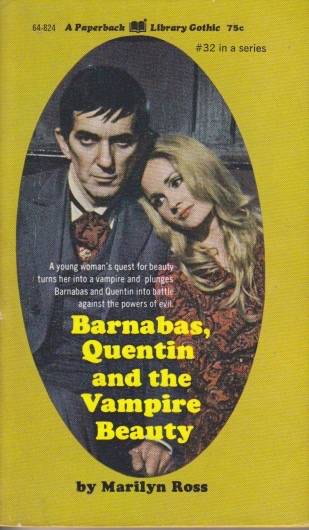
It’s been a quest years in the making.  I first found the Dark Shadows novels by Marilyn Ross at the Goodwill Store in Seneca, Pennsylvania.  The series had recently finished its television run and, as this was a used book bin, and limited in size, you could never tell what you might find.  My teenage self, fascinated by vampire lore, eagerly read those I could find.  I got rid of the volumes I had when I attended college and began to miss them when I was old enough to admit such things.  It took at least fifteen years to locate all of them, and now, for the first time in my life, I have read the entire series.  Barnabas, Quentin and the Vampire Beauty isn’t always easy to find.  I certainly hadn’t read it before.  Not that it’s high art—the campiness shows through the gothic setting from time-to-time—and yet it’s an accomplishment.

This particular story again shows some development from what had gone before.  The vampire beauty is a young woman tricked into having weight reduction surgery in Switzerland.  The surgery, naturally enough, transforms her into a vampire.  She needs help so she seeks out Barnabas Collins, which leads her to Collinwood.  From there a set of adventures head toward the typical climax of this series of books.  Nevertheless, W. E. D. Ross seems to have shown some improvement over the thirty-two novels in the series.  This story seems less similar to others in the series as a whole.  Quite a bit of effort is spent on trying to find a vampire cure, but for Adele Marriot rather that Barnabas Collins.

I have to wonder if Ross knew this would be the last Dark Shadows book he would write for the series.  He did write other gothic fiction, and even a novelization of the movie, House of Dark Shadows, but the initial series ends with a kind of knowing that we’ve reached the end of something.  Was he told by someone at Paperback Library, “Hey, we’re pulling the plug on the series” or did he simply run out of steam?  The daily television show ran for about 1225 episodes.  This original novel series had far fewer.  Still, the thrill of hunting all of them down, lining them on my shelf, and then reading them in order was a rare pleasure.  It was a recapturing of, perhaps even a completing of, part of my childhood.  It may have taken decades to accomplish, but an accomplishment is an accomplishment.


Banned Monk

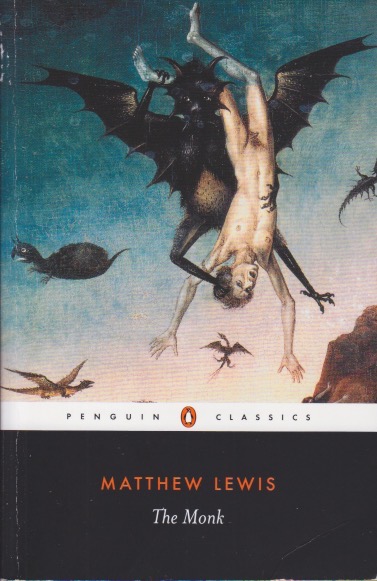
One of the strange things about gothic fiction is that, although often set on the continent, the early practitioners—inventors, if you will—were English.  Three names among them stand out in many treatments of the genre: Horace Walpole, Ann Radcliffe, and Matthew Lewis.  I’ve read the former two and have long supposed I should read the latter’s The Monk.  This 1796 novel made the author famous, but it is long.  And written in the often florid style of the age.  Still, there are plenty of swoons and thunder-plagued nights.  Set in Madrid with a cast of closely related characters, the novel has a twist ending that I did not see coming, which is pretty amazing considering that the book has been out for over two centuries.  (I may have read about the ending before, but had forgotten, if that was the case.)

The novel intertwines two stories that revolve around Antonio, the eponymous monk.  A paragon of righteousness, he heads an abbey in Spain and all are in awe of his piety.  Until sex breaks through his vanity (so we are told; his piety was based on too high a self-regard).  Once seduced, he can no longer maintain his status as chaste, and this sets in motion a tragedy that will leave innocent people dead and lives ruined.  Lewis, it’s famously known, used the novel to critique excesses of the church.  Its power, the novel demonstrates, corrupts.  Still, at the end I was left feeling sorry for Antonio.  He was set up by the Devil and his chances of winning were quite slim from the beginning.

Although PG-13 by today’s standards, the novel scandalized English society when it came out.  The sex scenes were too explicit for the day, especially since they involved the clergy.  The story has quite a leisurely layout, and only after 200 pages (in the edition I read) does the supernatural enter the picture.  Once it does the pace begins to pick up.  The weird thing is, despite its length, this story works.  It’s considered a classic—although often dismissed because gothic literature generally is—it nevertheless delivers.  Antonio is shown to be subject to weakness, and while vain, not inherently evil.  He’s a victim of human vulnerability.  Readers in the late eighteenth century couldn’t see beyond the sex, but there is a tragic human story here.  Castles, abbeys, ghosts, and subterranean passages, murder and torture, it’s gothic through and through.  Although it took most of September to get through it, it feels like I accomplished something worthwhile.  And I finished just in time for Banned Book Week.


Early Ghosts

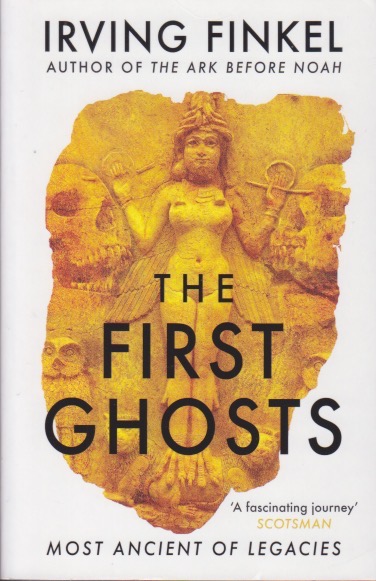
I’m not the most impulsive person in the world, but certain books I know, as soon as I see them, I will read.  Irving Finkel’s The First Ghosts was one of those books.  This wasn’t an easy book to get.  I’m guessing it was some minutiae about transAtlantic rights or some such nonsense, but it was announced a couple of years before it became available in America.  Then, of course, it had to wait its turn on my reading pile.  For those of you who don’t recognize his name, Finkel is a well-regarded Assyriologist who works at the British Museum.  Assyriology (which encompasses Babylonian and Sumerian studies as well) is, perhaps unavoidably, a highly technical field.  The languages are complex and a lot of that has to be explained before a reader can figure out what’s going on.  Some parts of this wonderful book are, unfortunately, technical.

The idea, however, is brilliant.  Ghosts have always been with us.  Finkel is well-placed to open the cuneiform world and he presents the earliest recorded ghost stories in history.  They’re not exactly modern horror, be warned.  Nevertheless, they demonstrate that from as soon as people figured out how to write, ghosts were one of their favorite topics.  Or at least, ghosts were assumed to exist and were written into many myths and legends.  Non-judgmental books like this are rare from academics; indeed, it’s difficult to imagine anyone else having written this particular book.  Even in the small world of academia not too many people read these languages and those who do are busy trying to impress tenure committees and businessmen deans.  (The reboot of Ghostbusters demonstrates this in a comical but too serious way.)

There are plenty of takeaways from this book.  A good general point in that myths do not reflect the everyday beliefs of individuals.  It’s easy to forget that.  Another striking idea occurred in his one chapter on the Bible where Finkel notes that the Good Book tends not to dwell on things considered “detestable,” such as foreign gods or demons.  That makes it an outlier concerning everyday information from antiquity.  After looking through that one window for so long, I suppose that’s why I focused by doctoral work on a “foreign” goddess.  If you can handle the technical bits and try to keep in mind multiple multi-syllabic names from forgotten languages, you’ll find a lot of really surprising and fascinating information here.  I’ve known for years that I’d be reading this book, and as autumn approached the time felt right to seek ancient ghosts.