The Hardest Part of Nightmares

In the process of writing a book, there comes the long time between when everything’s submitted and you hear nothing.  In fact, writing a book is often about waiting.  You spend years pounding your thoughts through a keyboard, send them off to some editor (guilty, as charged) who takes months to read and think about it.  If they like it they’ll send you instructions on how to change it and you start banging the keys again.  When it’s finally ready you submit it and wait while it gets transferred to production.  This handover is a complicated process and can itself take a month, easily.  Then the manuscript has to be copyedited.  I’m at the post-copyedited phase of Nightmares with the Bible, and this is, it seems, the longest wait.

There were only a few changes to the proofs I received.  These days your Word files (converted from Pages files for Mac users) get loaded directly into the production software.  What you see is your own words, in a different format.  You type your corrections directly onto the proofs.  Hit submit.  Then wait.  In my head I know that my book is one of many waiting in a queue to be printed.  I’m also a realist so I know the initial printing will likely be about 150 copies.  (When I first started in the publishing world academic books routinely sold 300 copies, but those days are long gone.)  At some point before then I’ll receive an email telling me the cover’s ready.  That’s what I’m waiting for at the moment.

We’re constantly told, in the business, that electronic books are what people want.  I can’t speak for others who write, but when I think of a book I think of a physical object.  Not some electrons sharing a screen promiscuously with any number of other books.  I haven’t published until I hold the printed object in my hands.  That’s still at least a weeks away.  Unless your book is anticipated to be a big seller, this is a period of absolute silence.  You just wait, nervously checking the publisher’s website every other day to see if your page has been updated, all the while working on your next tome.  Although it is priced expensively, I’m hoping Nightmares with the Bible will do reasonably well because of the subject.  Maybe some people will even get curious about Holy Horror, which was the precursor for it.  But for now, I sitting here with Tom Petty, waiting.

Unintentional Patterns

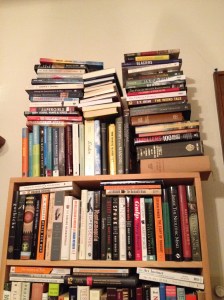
Time, they say, is what prevents everything from happening at once.  I’ve noticed something about my reading life (is there any other kind of life?).  One of my favorite topics on this blog is books.  Both reading and writing them.  When I wake up and try to clear the cobwebs of sleep from my head to think about the day’s post, I always feel relieved when I have a book I’ve just finished because that’s an eager and ready topic.  When I’m in the middle of a large book, it seems like a long time until I’ll be able to jot down some thoughts on it, and the ideas don’t always flow.  It’s here that I’ve noticed a strange kind of pattern and it has to do with the way I read.  Interestingly, it isn’t intentional.  It goes back to my post-commuting literary lifestyle.

I read nonfiction in the mornings.  I awake early and after about an hour of writing I try to get in an hour of reading before thoughts turn to work and its unraveling effect on the fabric I’ve been weaving before the sun rises.  The nonfiction I read depends, to a large extent, on my writing projects.  Not exactly the kind of research that time and libraries afford academics, but still, research in my own way.  Often these nonfiction books are large—400 pagers seem to be the trend.  I’m a slow reader, so they take some weeks to finish.  At night (or actually evening, for I retire early) I read fiction.  It isn’t unusual for my fiction choices to be briefer than the nonfiction books of the morning.  It always seems, however, that I finish two books very near the same time.  Then I have two book posts in a week and many days without any.

Since we married over thirty years ago, my wife and I read to each other.  Usually she reads while I wash dishes.  Those reading choices are by mutual consent.  They sometimes make their way into my research, but more often they show up in my fiction writing.  In any case, they also seem to fit this same pattern.  When I finish a large nonfiction book in the morning, the same day, or the next day, I generally finish my fiction book.  Shortly after that our dishes-reading book finishes.  I’ve noticed this happening over the past couple of years and I always wonder about unexpected patterns that I find.  It doesn’t always happen this way, but it does often enough to make me wonder.  If I intentionally set out to do this it would be understandable, but as it is, it simply happens.  As they say, things tend to occur in threes.


Belief and its Discontents

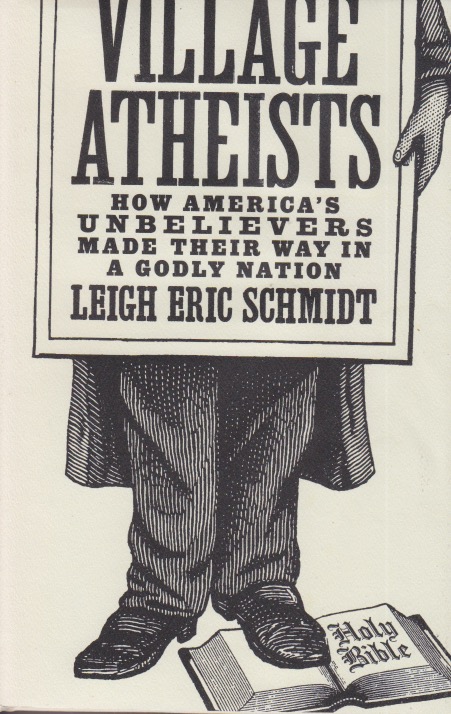
In this day of self-driving cars and instant, world-wide video conferencing, it is difficult to believe we still prejudice belief in God.  Village Atheists: How America’s Unbelievers Made Their Way in a Godly Nation isn’t exactly what I thought it would be.  Leigh Eric Schmidt is an historian, so this is an historical treatment.  Specifically focusing on four characters from the nineteenth (to early twentieth) century (Samuel Porter Putnam, Watson Heston, Charles B. Reynolds, and Elmina Drake Slenker), Schmidt focuses on a term I’d seldom heard before his book, “the village atheists.”  These men and women objected to the preferential treatment accorded to Christian believers in a nation founded on religious equality.  In the epilogue Schmidt shows that we are still not a nation committed to fairness.

The only crime these people committed (and two of them were clergy) was honesty in their search for the truth.  This was an actionable offense into last century.  Such was the hold of biblical religion in America that holding public office, being on a jury, or even protection under the law was disallowed for those who questioned the existence of the Almighty.  For sure Schmidt has picked out some colorful characters to sketch, but their common theme was that they were simply following where reason led.  In America this was a crime.  Secularists today who claim it’s not still haven’t come to terms with the power of religious ideology.  A deep distrust of the unbeliever remains, even after the four horsemen of earlier this millennium.

For me the question comes down to honesty.  Belief shifts over life, depending on your circumstances and your outlook.  Most people unreflectively stay with the religion into which they’re born.  Those who study it learn to ask questions and the result is belief that may shift over time.  Making what you believe a measure of your integrity is therefore a temporary thing.  This is well illustrated in Village Atheists; some of these people began as fervent ministers.  They, however, were honest about their thought process and were counted criminals.  You have to wonder about a religion that punishes honesty.  Perhaps it’s no wonder that evangelicals have no trouble with Trump’s incessant lying.  To be honest is to be vulnerable.  The people profiled in this study, tried for things we would have trouble believing count as a crime (consider what 45 has been able to get away with), came out of their trials with integrity.  It would be great if the same thing could have been said about their accusers.


Behind the Exorcist

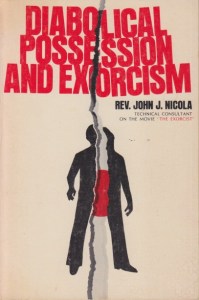
Some books from the 1970s are difficult to locate.  Since that was some half-century ago I suppose that’s not at all unusual.  One of those that I had been anxious to read since working on Nightmares with the Bible was Diabolical Possession and Exorcism, by John J. Nicola.  The main reason for my desire was that many people involved in the narrative about demons in the modern world are difficult to document, at least on the internet.  For academics, or even journalists, with budgets and release or research time, there’s the possibility of travel and interviews and archive searching.  I have none of those things, and I was curious about Nicola’s book since he wrote a forward to The Amityville Horror, vouching for its authenticity, and he was also technical advisor for The Exorcist.

I didn’t locate a copy of his book until after Nightmares was well into production, but research, even as I conduct it, is never-ending.  The book is kind of a memoir and kind of a “you should listen to your priest” lecture.  What’s fascinating about it is Nicola has no difficulty accepting both the paranormal and the standard Catholic teaching in matters of faith.  He does come across as somewhat credulous, and somewhat academic in this book.  His chapter on his role in The Exorcist is quite informative.  One of my main questions regarding both the man and his book was what his particular expertise is/was (even finding out if he’s still alive, via the web, is difficult; he is on the 2017 honor roll of giving for a Catholic charity).  The book provides a partial answer, but it also raises many questions.

This book is rare enough to have given rise to its own kind of mythology.  I would classify that in the same category as the various stories about The Exorcist production being plagued with curses and strange phenomena.  They’re all part of a culture of creating a belief structure that allows the supernatural back into an overly materialist worldview.  Kind of like Einstein’s “spooky action at a distance,” it causes pleasant shivers because it doesn’t really explain anything.  The book itself is though-provoking, but like the books of Gabriele Amorth, expends pages on the wonders of the Virgin Mary and building up a Catholic outlook on the spiritual world as the basis for combatting evil.  Nicola, correctly in my opinion, points to the (then impending) influence of The Exorcist movie.  This is a topic that I take up in Nightmares, for those interested in knowing more.


BBW

It’s a measure of how busy I am when Banned Book Week has started before I realize it.  Most years I make it a point to read a banned book at this time, but my reading schedule is so crowded that I seem to have missed the opportunity this year—I didn’t see it coming.   I’ve read a great number of the top 100 banned books over the years, and I’m sure I’ll read more.  I’ve recently been reading about America’s troubled history with free expression.  Probably due to a strong dose of Calvinism combined with Catholicism, many of the books challenged and banned, as well as prevented from ever seeing the light of day, have to do with bodily functions.  Sex, especially.  In American society, as freely as this is discussed, we still have a real problem when someone writes about it.

Why might that be so?  Many religions recognize the privacy aspect of sexuality without condemning the phenomenon itself.  The Bible (which is on the list of Banned Books) talks of the subject pretty openly and fairly often.  Our hangups about it must be post-biblical, then.  Much of it, I suspect, goes to Augustine of Hippo.  Although he had a wild youth, Augustine decided that nobody else should be able to do so guilt free, and gave us the doctrine of original sin.  Add to that the legalistic interpretation of Paul and his school, and soon the topic itself becomes difficult to address.  Victorian values, obviously, played into this as well.  Literature, which explores every aspect of being human, is naturally drawn to what is a universal human drive.

Banned Books also treat race—another topic that haunts America—or use coarse language.  Some challenge religious holy grails, such as special creation or Christian superiority.  It seems we fear our children being exposed to ideas.  The wisdom of such banning is suspect.  The publishing industry has many safeguards in place to create age-appropriate literature.  Banning tends only to increase interest by casting the “forbidden” pall over something that is, in all likelihood, not news to our children.  American self-righteousness tends to show itself in many ways, making much of the rest of the world wonder at us.  We seem so advanced, but we fear a great number of rather innocuous books.  The reasons are similar to those behind why we can support tax-cheating, womanizing, narcissists as leaders: our faith blinds us.  I may be late in getting to my banned book this year, so I guess I’ll just have to read two next time.


In Black

When autumn rolls around my hankering for gothic literature ratchets up.  It’s really my gothic sensibilities that make me watch horror films, seeking some kind of transcendence.  Some time ago I heard about the movie The Woman in Black, but I’ve never seen it.  I learned about the novel by Susan Hill, on which it’s based, and decided to check out the written form.  (I almost always like the book better than the movie anyway.)  The story is indeed moody, set in, as these stories often are, a remote part of the coast of England.  A lonely house cut off by the tide.  A hidden past full of secrets.  The plot is one of a vengeful ghost, and therefore the whole is somewhat supernatural.

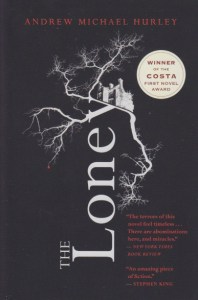
I couldn’t help comparing it to Andrew Michael Hurley’s The Loney, which is also set on the coast of England, and also features a house cut off by the tides.  The storylines are quite different beyond that, but it is often the setting that makes gothic tales so, well, gothic.  The Woman in Black builds up the story slowly, intimating that something is wrong near the start, but not really giving too much away until near the end.  It isn’t really the conclusion, however, that a gothic reader is after, as much as the feeling.  Being immersed in a spooky setting where you’re not sure what’s going on.  There’s a kind of release in that.

I’ve often tried to figure out why this type of story appeals to me.  It’s certainly something to do with my childhood.  We didn’t live in a very gothic place.  My hometown was working-class normal, it seemed to me.  When we moved into the first apartment I remember, the setting did become gothic to an extent.  It was an older building that still had gas jets jutting through the walls from the days before electricity.  One of the bedrooms was painted black.  There was a huge crack in the linoleum in the hall that had the potential to trip you if you weren’t paying attention.  It was there that I first became aware of liking gothic settings.  It was the place I discovered Dark Shadows and began to find it strangely homelike.  Many of us, even with less-than-ideal childhoods, often look back to them with a kind of happiness that we just can’t seem to attain as adults.  Mine included some gothic elements, and reading novels like The Woman in Black takes me back there, if only for a little while.


Secretly

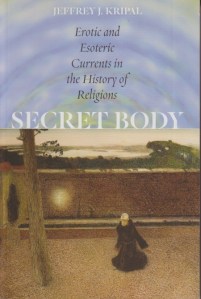
There are not too many books that I would call epiphanies.  I always lay down Jeffrey Kripal’s books with a sense of wonder and awe.  His Secret Body: Erotic and Esoteric Currents in the History of Religions is one book I initially skipped over due (as usual) to not being able to afford even modest academic pricing.  (Hey, my books are even worse in that regard, so that’s not a criticism!)  I’ve met Kripal a few times and have had some conversations with him that always leave me feeling strangely empowered.  That’s the place this book left me.  I’m a slow reader and it isn’t a small tome, so it took me some time.  Also, I didn’t want to rush it.  Doing so would’ve been like trying to jog across a boulder field.  I hardly know where to begin.

Kripal is an historian of religions.  His own experiences in the academy are narrated in this book, so I urge the curious to look.  Many people who know me think that I’m a biblical scholar.  My training, however, is in history of religions.  It’s a fool’s errand to try to classify a doctorate, but my focus was on how ideas appeared in several ancient cultures, with no real expectation of evolution beyond what appeared later in time than something else.  As many who study ancient texts know, this translates to “biblical studies” in the academy and so for many years I taught Hebrew Bible.  Friends in the academy suggested I should shift my research to Bible (as I did in Weathering the Psalms) in order to get a solid placement in academe.  It backfired in my case.  This isn’t a pointless digression.

Secret Body is a trippy book.  It deserves to be read widely and engaged with by academics (among which I no longer count).  It is a ground plan for the study of our field.  Kripal understands, better than just about anyone, why religious studies is foundering.  He’s also brave enough to delve into the unspoken areas that we all know are terribly, terribly significant.  And he isn’t a materialist.  There’s much in this book to give the reader pause.  Indeed, it’s more than a stop sign on the superhighway of the academic business.  It’s the kind of book you need to keep at hand in case “the real world” gets you ensnared in its ropes and chains.  It makes me believe that I need to go back to school all over again.


Large Projects

Now, where was I?  I suspect it’s the same with you.  We’ve got so many things going that it’s difficult to keep up with them all.  When one big project comes along—say reading book proofs for a deadline—everything else gets displaced.  After a week of intense concentration you emerge from a daze and try to remember where you left off with other projects.  What was so dreadfully important before the large project began?  I’m used to deadlines at work, but there aren’t too many in my personal life.  I have goals and targets, to be sure, but due dates slip and slide with the slings and arrows.  When the big project’s done there’s relief, but also a kind of reboot that has to take place.  I’m afraid to look at the news.

The corrected proofs of Nightmares with the Bible have been submitted, along with the index, and now all I can do on that front is wait.  Which of my many other projects, neglected for an entire week, should I take up now?  Part of the difficulty is knowing whether to work on fiction or non.  Given my work-life commitments, fiction is easier.  I enjoy writing it, but I have trouble getting published.  Nonfiction, on the other hand, is simpler to get published but brings in very little remuneration.  I know as an editor that we distinguish between academics (who already have a good paying job) and, say, journalists, who write nonfiction trying to earn a living.  What about an editor who isn’t paid like an academic, but has a regular job nevertheless?  (When talking to an independent, nonfiction publisher a few years back, I heard him respond to the question of if he was non-profit with, “Well, that’s not how I intended it…”)

I have two nonfiction books well along at this point.  I also have several fiction projects, including an eighth novel and a short story collection.  I also have some essays underway for sites beyond my own blog.  A week seems like a long time to put all these things aside and then to pick them up again.  That week wasn’t vacation either.  Nor did it suggest topics for me to address on my blog because if you want to know about Nightmares with the Bible you’ll read the book.  The evening I finished the proofs I had a dream that seemed to stretch through the entire night that I had come up with a complete college curriculum all by myself.  As much as my weary mind wanted to go on to other things it was fixated at that stage.  I awoke to wonder where I’d left off on real life projects, none of which are very near the finish line.  Now, where was I? 


Index Fingers

I’ve occasionally written about how authors obsess over indices, or indexes, for their books.  These days most things are looked up electronically, but this entire week my reading, writing, and relaxing time have been taken up with the index for Nightmares with the Bible.  Creating an index is an odious yet perversely enjoyable task.  Most publishers (at least among the academic crowd) foist this duty onto the author since a freelancer can easily add $4,000 or $5,000 to the book’s budget.  After preparing an index you can understand why.  At least I get to work with searchable PDFs, but I remember doing indexes on paper and having to sort through printed proofs and hoping that you’d catch every instance or a word or phrase.  The searchable PDF helps, but it depends on the material you’ve got to work with.

The Bible, for instance.  Not only are many book names short—Job, John, Mark, James—they are also common.  People have named their kids after biblical characters, or with biblical names, for millennia.  Not only that, but Job can be job.  Unless you put the quotes around it “Eve” will show up on just about every page, believe it or not.  The real strain on the eyes comes from those terms that are important and show up throughout the book.  Words like “Israel,” or “monster,” or “priest.”  I’m not one of those people who writes a book about demons and puts “demons” in the index, though.  Hey, if you know that’s what the book is about, why look in the index?  Just read it!

Meanwhile, the cover copy came this week for my approval.  I haven’t seen the cover proof yet, but last time I actually had time to check (several days ago now) other media outlets had picked up on the imminent arrival of a new book.  It wasn’t on Goodreads the last time I looked, but there’s time for that.  Right now there’s no time for anything, however, other than indexing.  It actually takes longer to do this than it does to read the proofs for the book.  And indexing helped me discover a spelling error that had gone past both me and the copyeditor.  So this is a valuable exercise, but there are many other things to do as the weather turns cooler and other projects are aching for attention.  Four days of intensive indexing and I’m only up to the “p”s.  I’ve been away from it too long, so I’d better mind my “q”s as well.


Proof in the PDF

The proofs of Nightmares with the Bible are sitting right here on this laptop.  If I’ve seemed distracted, now you know why.  My life is unaccountably busy for a mere editor, and I’m afraid my September is being consumed by proofreading and index-making.  I had some fiction I wanted to submit this month, but proofs are a necessary part of writing and for those who take nobody’s word for it, reading them is important.  I have books on my shelves from very reputable publishers literally littered with typos.  I fear that.  I try to read proofs with as much concentration as a busy life will allow.  And yes, proofs come with hard and fast deadlines.  I only wish they’d been here in July.  Or June.  But still, Nightmares are on their way.

Since this was a “Halloween season” book, the goal was to have it out in September or October.  That won’t happen now, but there were a couple of things that transpired along the way: one was a pandemic.  The other was another paper shortage.  Strange as it may seem, both of my last two books came out in a time of paper shortages.  In 2018, the industry had supposed ebooks would wipe out print.  That didn’t happen, and when Michelle Obama’s Becoming took off, well, let’s just say academic books weren’t a priority.  Printing schedules across the industry got bumped and books from small publishers targeted for a specific date just didn’t match the demand.  This year the paper shortage is due to the Covid-19 outbreak.  Paper suppliers shut down for a while and, guess what?  Print came back!

In any case, hoping against hope that we can make the November publication date, I’m trying to read the proofs with record speed (and care).  That means other daily activities may suffer for a little bit.  Those of us who write think of our books as something like our children (not quite literally that high, but not far from it).  We want them to be launched into a world that will be receptive to them.  And so my morning writing (and reading) time has been dedicated to Nightmares with the Bible.  And indexing said book.  I’m not good at many things, but one talent I do have is concentration.  Until these proofs are submitted (hopefully ahead of deadline) there won’t be much else to which I can pay attention.  I’ll continue to post my daily thoughts, of course, and if you can click that “share” button on Amazon’s book page it’d be much appreciated.


Preorder Alert

Although you can buy most anything from Amazon, the book industry is particularly under its hegemony.  I have to admit that I enjoy browsing there, and often dream of the books on my wishlist.  I suppose that’s why I was pleased to see that Nightmares with the Bible is now available for preorder on Amazon.  I like to give updates for those interested, and the proofs have just arrived.  There’s kind of an inevitability to seeing your book on Amazon, a prophecy almost.  It now exists out there somewhere on the internet.  I do hope that it might stir some interest in Holy Horror, but like that book it will miss its sweet spot of a release before Halloween.  That means it also misses the fall catalogue.  The next one comes in spring, and who’s thinking of horror then?  Something all publishers of horror-themed books know is that minds turn toward these topics in September and October.  Just look at the seasonal sections of stores.

Horror films come out all year long, of course.  Halloween, however, serves as an economic lynch pin.  People spend money on being afraid in the early fall.  By mid-November thoughts have moved on to the holiday season and the bright cheer of Christmas.  Holy Horror arrived days after Christmas two years ago, and although I was delighted to see it, I knew we’d missed the boat for promotion and by the time it was nearing the backlist at the next Halloween it was old news.  That doesn’t dampen my enthusiasm for the books, of course.  It just means they won’t get the attention they might have had.

Nightmares with the Bible is about demons.  Primarily demons in movies, but also a bit of a history of how they develop.  There’s a lot of academic interest in the topic at this point in time, so hopefully it will get checked out of academic libraries that will make up its primary home.  According to Amazon you get five dollars off the exorbitant price if you order it there.  Although it’s standard practice in the industry, I’ve always disagreed with “library pricing.”  It comes from presses publishing too many books, I suspect.  Since few of them are pay dirt they have to recoup their costs by overcharging for the rest.  Nightmares with the Bible is reader friendly.  It’s non-technical and, I hope, fun to read.  Amazon seems excited about it (it’s an illusion, I know, but one for which those of us who do this kind of thing live), and is happy to take preorders.  Have your library order one, and if you do, be sure to check it out.


Setting the Mood

I can’t recall how I learned about Andrew Michael Hurley’s The Loney, but it was one of those books I knew I wanted to read.  One thing I do recall is that I didn’t know it had anything to do with religion until I started it.  It became quite clear that the story—which is difficult to classify—revolves around religion and a kind of gentle horror of things not being what they seem.  Set on a lonely stretch of English coastland where strange things happen, a family takes their mute son to a shrine to have him healed.  The younger brother, not mute, narrates the events.  There are many creepy suggestions of what may be happening, but a full explanation is never given.  That’s kind of like religion itself.

While I don’t normally read the discussion points or classroom/book group discussion material after most modern novels, I found Hurley’s included essay on “Nature, Faith, and Horror” to be of interest.  Several of us, it seems, find the combination of religion, or faith, ties in well with fear.  That was a large part of what I was trying to get at in Holy Horror.  Hurley goes in a different direction with it.  A family under the overbearing religion of the matriarch does her bidding in the hopes of either keeping peace or participating in the healing her son.  We learn from the opening pages that her son Hanny develops into a minister, and therefore has some degree of normalcy.  Hurley is a master of revealing important factors only gradually.  It keeps the tension rising as the story goes along.  There’s no bloodbath, but there is unsettling mystery.

The story is probably best characterized as gothic.  That’s rare these days, and it is the sub-genre of horror that most attracts me.  The mood it casts is kind of a spell and it’s difficult to break.  The Smith family insists on the sacredness of place and on strict religion of the Catholic species.  Evangelicalism could easily lead to horror, and not infrequently it does.  The Catholic variety, however, feels older.  More arcane.  There are things only a priest knows.  And that knowledge can be a challenge to both the knower and the seeker.  The Loney will leave the reader with questions ticking away about what really happened.  These are things we’ll never know.  Those of us who’ve ever entertained religious vocations understand this feeling well.  It stands behind certain kinds of horror and in front of religion, tying them together.


Addenda

One of the perceived advantages of electronic publication is the possibility of corrections.  I say “perceived” because this casts us into the deep sea of uncertainty when it comes to citing sources.  If you read an article, and something really struck you, then the author revised that very thing later, you would be “misquoting” if you quoted that fact you found so stunning.  In our mania for keeping up-to-date you would need to constantly recheck your sources to ensure that you were working with the latest version of your resource.  This level of change speed isn’t conducive to academic practice.  When I was young I was taught that a book of the same edition, published under the same title, by the same author, would be the same across printings.  That’s no longer true.  Due to the ability to insert corrections, the same ISBN can result in two very different books.  Call it the hang-up of an ex-literalist, but this bothers me.

Back in the old days it was common to publish books with a “addenda et corrigenda page that listed the known errors.  Beyond that you just had to suck it up and admit that there might be errors in your book.  You had to face with fortitude when someone pointed them out.  Now you can go back to the publisher, particularly if the book is in electronic form, and have your errors corrected.  The only ones to be confused will be your readers.  Why are we so bad at owning up to our mistakes?  Electronic reading can lead to a slippery slope of confusion about what publishers call “the version of record.”  Your permanent record, it turns out, can be changed after all!  Mistakes can be erased.  Sins can be forgiven.

In publishing the set standard had been that you had to wait for a new edition to change the interior text of your book.  The International Standard Book Number (ISBN) was your guarantee that the contents would be identical to any other copy with the same ISBN.  That’s no longer true.  If you don’t pay attention to which printing you have (which is never cited in footnotes or bibliography) you could be citing in error.  This practice has deep and worrying implications.  It has come to a crisis under Trump, a president who constitutionally lies.  Truth is what he says it is.  And if you want to check the facts, well you better be sure that you cite your printing because any of your critics could easily stick a [sic] next to your words if they find any “error” at all.

No longer “Standard”?


Nightmares’ Progress

Ironically for someone who works in academic publishing, I have my own issues of how books are priced.  I understand why, however, because I can see sales trends.  When it comes to authoring my own books I’ve learned how to write for general readers.  Not all publishers know how to price for that.  Already I’ve had one friend blanch at the price of Nightmares with the Bible and the hope is that it does well enough in the library market to earn a paperback.  I also know paperback sales seldom reach the level of hardcover sales from academic presses.  Much of it is driven by demand.  If people know about the book and ask their libraries to buy it, and this is key—check it out—that has a way of sometimes snowballing enough to convince a publisher that there’s an individual market.

Since I’m plotting the progress on Nightmares here on this blog, I’ll point out that the book has its own page on my website (located here).  Actually, all my books have their own page, but since my website is in the low-rent district of the internet not many readers venture here.  Yesterday I added the back-cover blurbs to the page.  I did so with fear and trembling.  Life has taught me not to take well to compliments.  They make me uncomfortable, like strangers entering my house without masks on.  Since I have no institution backing me, however, I need the praise of colleagues to convince others to buy this book.  In my long-term thinking on the topic, I’m hoping Nightmares gets reviewed and people will get interested in Holy Horror, which didn’t get reviews but which is half the price.

In the biz we call this “platform building.”  Those with healthier egos than mine hire their own publicists who boost their number of Twitter followers and get their names out there on the internet.  My own platform building has been of the budget kind.  I’m active on Goodreads to get followers.  I’ll engage with any comments I get on social media.  But I’m also a working stiff hoping desperately not to lose my job during this pandemic.  The blurbs on Nightmares are very nice, and they note that I write for non-specialists.  This blog is open to all comers, after all.  Likes, shares, and comments all help.  My thanks to my endorsers—you know who you are!—you made my day with your kind words.


The Birth of Nightmares

It’s often said that it takes a village to raise a child.  A similar idea lies behind the writing of a book.  Sure, the lion’s share of the research and writing are done by the author—the person who gets credit for the work—but publishing is an industry.  That means other people’s livelihoods are based on the end result as well.  The author often doesn’t know what’s going on when the book is in production.  It was a pleasant surprise, then, to find the publisher’s website for my book is up.  You can see it here.  My own site for the book has been up for months (here; go ahead and take a look, there’s not much traffic).  Those who only read these posts on Facebook, Goodreads, or Twitter may not realize there’s a whole website out here that addresses things like books and articles.  (I think the CV part requires updating, though.)

In a writer’s experience, seeing a book’s website—receiving an ISBN—is like the quickening of a baby.  You’ve known for some time that it’s there, but the proof is in knowing that other people can find out.  I only learned of this because a friend wanted a link to the book page.  If you google the title without quotation marks you’ll find lots of websites about Christians and nightmares.  (Who knew?)  People of my generation still often don’t realize that, much of the time, searches with quotations marks are increasing necessary on a very, very full internet.  I’m still not sure of a publication date for Nightmares with the Bible, but you can preorder it.  (Sorry about the price.)

Once a friend asked me why we do it.  Writers, I mean.  Unless you’re one of the few who are very successful you don’t make much money off the project that has taken years of your life to complete.  I’ve never earned enough in royalties even to pay for the books I had to purchase to research the topics on which I write.  It’s not an earning thing, although that would be nice.  For some it’s an expectation of their job.  For some of us where it’s not, writing books is perhaps best thought of as monument building, a long and intensive “Kilroy was here.”  You notice something you think other people might find interesting, and so you write it down.  Chances are the number of other interested people will be small.  Family (maybe) and a few dedicated friends will lay down the cash for an academic book.  But still, there’s a village behind it, and I need to thank them here.