The Birth of Horror

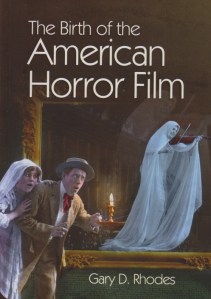
In both Holy Horror and Nightmares with the Bible I concern myself with horror films that have appeared since 1960.  I’m not enough of a cinema studies type to argue eloquently about the various stages of the horror genre on celluloid, but the many histories I’ve read settle on 1931, the year Universal’s Dracula and Frankenstein both appeared.  Dealing with more contemporary fare, I often use that as a mental benchmark.  Gary D. Rhodes has changed  that perspective, however.  The Birth of the American Horror Film is a somewhat sprawling treatment of a subject that’s more involved than I had supposed.  Early films didn’t suddenly appear, of course, and Rhodes spends some time surveying what came before the film that eventually produced what we recognize as cinema.  One of the things he notices is that which we call “horror” was pretty much there from the beginning.

Call it morbid curiosity.  While not everyone admits it, it is a pretty widespread human condition.  After surveying literature, theater, and visual culture, Rhodes moves on to consider many different genres of pre-1915 horror.  Some of them don’t strike every reader as horror today, but that’s a point I tried to make in Holy Horror.  The definition depends on the viewer.  Rhodes suggests throughout that American viewers tended to prefer non-supernatural horror.  While statistically this may be true, he devotes several chapters to genres that fall into the supernatural category.  These were, in the opinion of this reader, the best in the book.  One of the reasons is that horror and the supernatural naturally go together.  Many of us working in this field have noticed, some with embarrassment, that the two are closely related.

What might strike other readers as starkly as it did me, is just how terribly prevalent “horror” films were before there was a proper genre.  Rhodes makes the point that even if we like to think otherwise of ourselves, if there hadn’t been a substantial market for such movies they wouldn’t have thrived.  Some of them, like murder mysteries and other dramas, we might cast more as “thrillers” today.  I included a few of them in Holy Horror.  The real terror, however, often arises from subjects that were somewhat taboo in the late eighteenth and early nineteenth centuries.  Religion was handled with all seriousness.  I wonder if this might be one of the reasons that the supernatural didn’t appear, in the early days, as much as it would later.  This is one of those books that raises many questions such as this, and that makes me glad that the author is working on a sequel.
More than Kids’ Stuff

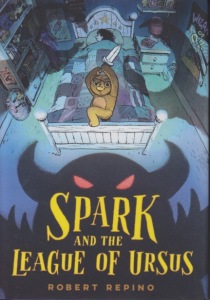
Children and Young Adult literature (which has its own Library of Congress acronym!) has come a long way since I was a kid.  Don’t get me wrong—I enjoyed the books I read as a young person, but there are many more choices that use a lot more imagination these days.  I’ve been reading Robert Repino’s books since Mort(e) appeared in 2015.  Spark and the League of Ursus is his latest and it continues his trademark use of animals (and stand-ins) to get at very human situations.  Spark is a carefully crafted story based on the idea that teddy bears do more than provide cuddles at night.  They are, in fact, a force for good, protecting human children from monsters.

As usual when I discuss books, I won’t give too much away.  I’m one of those guys who doesn’t even like to read back-cover blurbs because I’m afraid they’ll spoil the story.  Instead, I’m going to applaud the use of imagination in a world that seems stuck on a limited number of plot points.  Books like this, which stretch the imagination of the young without talking down to them—why does it cost us so much effort to admit that kids are smart?—are a great addition to CYA literature.  I was exploring this concept with another friend who writes when I read Hank Green’s An Absolutely Remarkable Thing.  A story’s intended audience is often signaled by the age bracket of the protagonists.  I’d suppose ‘tweens might be about the age here, based on that metric.  (Green was more like New Adult, a category that lasts until about age 30.)

Reading material written for younger readers makes me feel younger myself.  I read Ransom Riggs first three Miss Peregrine novels (also published by Quirk, the house that publishes Spark).  You see, I’m really encouraged by this growth in younger readers’ material.  If we can get kids into books with such engaging stories I suspect there’ll be less chance that they become unimaginative, straight-laced adults who want to keep things just like they were when they were kids.  Imagination has that kind of liberating ability.  Besides, who doesn’t want their teddy bear to come to their rescue once in a while?  It’s not just children that can take a lesson from imaginative story-telling.  Repino’s War with No Name series was intended for adult readers but it is good preparation for getting a sense of the possibilities for readers who might, in all hope, never have to face wars at all.


Marching down the Middle

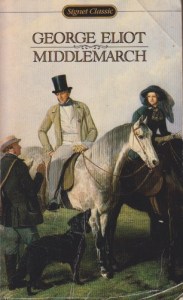
It is true that I have a fondness for nineteenth-century British novels.  Even though they often lack a strong speculative element they tend to be gothic, at least if written by one of the Brontë sisters.  I’d only ever read one of George Eliot’s novels before, and that was in ninth grade.  Middlemarch has been on my list for many years, but due to its intimidating size I’ve kept putting it off.  Now that I’ve read it I feel like I’ve accomplished something.  I had no idea what the story was about in advance, and no idea how it ended.  Unlike many pieces of literature of its time it hasn’t made a huge impact in pop culture, so this was the opportunity to lose myself for a few months in a world completely unknown.

I’m not foolhardy enough to try to summarize an 800-page novel here, but one aspect that the reader can’t help but notice is the prominence of clergy.  And not only prominence, but prestige.  In a world built around the solid belief in different classes of individuals, where pride takes a place in marriages that are supposed to be within class, the clergy are minor nobility.  Since this is the Church of England the vicars can marry and indeed, one such marriage sets off the tension that lasts throughout the hundreds of pages to come.  The clergy of the time were often gentleman scholars—the role that was envisioned for Charles Darwin as a young man.  Eliot plays on that idea with some of her preachers being amateur scientists.

The conflict—that now feels inherent—between science and religion has less to do with older forms of Christianity than it has to do with evangelicalism.  A relatively new expression of Christianity, evangelicalism set itself against modernity and its science.  Quite often today when commentators rail against “religion” it is really evangelicalism that they have in mind.  In the world Eliot sketches, she sees no difficulties between a rational view of things and an ecclesiastical one.  Clergy are often seen at the whist tables and taking long walks down country lanes.  The distinction between them and the average citizen is that they have been to university to study.  Today, in mainstream Christianity anyway, clergy are educated at least to the master’s level.  They’re no longer among the minor nobility, however.  Middlemarch has more than a hint of nostalgia to it, and the clergy roles show that clearly.


A Slice of Childhood

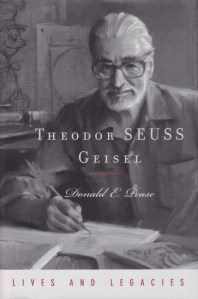
Few names from childhood are as well known as Dr. Seuss.  When my wife and I read Theodor Seuss Geisel, in the Lives and Legacies series, we realized that neither one of us had learned to read with his books.  It’s not that they hadn’t been written and widely adopted yet (they had by the time we started school), but rather that our districts had gone with other fare.  I learned with the famous Dick and Jane series, and I think there must’ve been some Seuss thrown in here and there.  We didn’t own any of his books, but I remember my mother reading from library copies of Hop on Pop.  When our daughter was born we read to her daily and Dr. Seuss was a large part of our informal curriculum.  Before reading this book, however, I knew very little about who Theodor Geisel was.

The series Lives and Legacies features short books, so this is a quick and no-frills way to meet the man.  Although Geisel was born into a middle class family, he experienced (ironically) the trauma of being in a German family during the First World War.  What we would call hate crimes today were committed against German-Americans during the war, even though there were sizable populations of Teutonic Americans by that point (including my mother’s family).  Not only that, but Prohibition put his father’s brewing company out of business.  Still, Seuss was accepted at Dartmouth and, like many who make it to the Ivy League, his connections helped him to a successful career in advertising and then in writing children’s books.

Geisel was a successful man, but wasn’t driven by money.  He was an artist both with images and words, and as Pease makes clear he approached his craft seriously.  As he matured he began to address social and political issues in his larger formatted books.  He eventually became the most successful children’s book author in history.  Reading to my daughter when she was young we discovered that, unlike the often idealized times of the fifties (followed by the sixties into which I was born) there is a wealth of quality children’s literature available.  It’s easy for middle-class kids to be raised loving reading.  Dr. Seuss knew that the pretensions of adults often created the seriousness with which we face life.  Children enjoy fun and the ridiculous.  He never lost sight of that simple fact.  We live in times when it is readily to be wished that many of the adults in power would go back and read a little Seuss and perhaps, just perhaps, learn their lessons.


Fiction

All writing is fiction.  I suppose that requires some unpacking.  One of the first things we do when we approach a piece of writing is answer the question “what kind of writing is this?”  We may not do this consciously, but we wouldn’t benefit much from reading if we didn’t.  If your significant other leaves you a note stuck to your computer monitor or the refrigerator door, you know at a glance that it likely contains pithy, factual information.  If you pick up a newspaper you know what to expect the contents to be like.  It’s quite different if you pick up The Onion.  Or a romance novel.  These categories are extremely helpful, but they can also be problematic.  Any writer knows that you write and others decide on your genre.

I read a lot of nonfiction.  It is a kind of fiction, however, since it follows a narrative and it contains mistakes, or perhaps faulty assumptions.  Moreover, nonfiction is a reflection of its own time.  Geoffrey of Monmouth’s England had giants in its past.  It simply did.  Today we question his working assumptions just as surely as future people (if we long survive) will ours.  This current generation doesn’t really excel at critical thinking.  Many academics, as critical as they are in their own fields, fall into standard assumptions once you get beyond their expertise.  They accept the fictions of their era just as readily as does everybody else.  In reality our nonfiction is not the naked fact we like to think it is—it is the narrative of one perspective.  It is perhaps the truth as it is perceived in its own time.

This may seem to be a subtle distinction, but it is an important one.  Genres are very convenient handles that we use to classify what we’re reading.  Very often they become straightjackets that constrain what writing has the potential to be.  The word “genre” is related to the concept of genus, the classification about species.  Zonkeys and other, perhaps rare, but possible cross-breedings show us that hopeful monsters of the literary world are also possible.  We would soon suffer without genres in a world as full of words as this one is.  We also suffer from simple distinctions that somehow become iron-clad over time.  Think about the narrative that comes out of the White House.  We’re accustomed to it being mostly nonfiction.  At least we were until recently.  Watergate broke our trust in that, and now we live in a world of fiction masquerading as reality.  Critical thinking is, perhaps, the only way to make sense of any of this.


Back in the Zone

In general I’m a fan of reading the book before seeing the movie.  In some cases, however, the written version comes later.  A few months back I started to have a hankering for stories written by Rod Serling.  I’m aware that he mainly wrote scripts, but I also know he had a rare talent for doing so and most of the books I’d collected as a child were collections connected to Serling but not written by him.  He had, during his lifetime, “novelized” three volumes of Twilight Zone scripts into books of short stories.  The second of those books, More Stories from the Twilight Zone, is one I’d not read before.  I remembered some of tales from episodes I’d watched while others were new to me.  All that they have in common is that something isn’t as it “should be.”

This “oughtness” is an illusion, as we’ve learned over the past four years.  Each day has an incredible sameness even as everything changes radically, almost daily.  To me that’s one of the comforting aspects of the Twilight Zone in these days.  Not only does it take me back to my childhood, but it also prepares me for the unexpected.  Rod Serling was a great metaphorical writer.  Quite often on this blog I try my hand at it, writing posts that are apparently about one thing but that are really about something else.  I think most of us tend to be literalists when we read (thus the crisis literalism has wrought when it comes to the Good Book).  Unless we know to shift our focus we take things at face value.  These stories try to teach us otherwise.

Some of these stories anticipate Stephen King.  Others reflect Ray Bradbury.  They are eclectic but unified by a voice that was able to see that the world could actually stand some improvement.  People could treat each other better.  Without being preachy, they are often like morality plays.  Of course that is my experience of reading them.  Readers differ in their responses.  The Twilight Zone was an influential series in a world open to new experiences.  If the twentieth century has taught us nothing else it has shown us that we can take nothing for granted.  To go deeper than the surface, that’s as it should be.  What are the stories really about?  A large part of it will depend upon what the reader takes away from them.  All of this is very helpful, at least to this reader, in times like these.


Update on Nightmares

Progress continues on Nightmares with the Bible.  Despite pandemic conditions, I received a happy email last week telling me that the manuscript had been transmitted to production.  If you don’t work in publishing that probably sounds like a pretty simple step, but in reality it’s immensely complicated.  The job of many editorial assistants is often just making sure books get through the transition from author to publishing engines safely.  Since Lexington/Fortress Academic is short-staffed at the moment (publishing is a “non-essential” business), they ask authors to take on additional responsibilities.  One that they passed on to me was to find people to endorse my book.  Fortunately I’ve got star series editors who agreed to take on the task, sparing me from going to someone and saying, “Um, hi.  Would you like to say nice things about my book?”  I’m shy that way.

That doesn’t mean that I’m not excited about the book.  It came about in an odd way, but like any parent an author loves her or his books, even if they aren’t quite what you expected.  Getting a fourth book published is kind of a hallmark for me, especially since I spend a lot of time on the websites of successful academic colleagues older than me that haven’t reached that benchmark.  Publishing books, for me, is a kind of validation.  The original ideas of editors aren’t much valued, either in publishing or in society at large.  Who cares what an editor thinks?  Put that same person in a college and s/he’s a superstar, eh, Qohelet?  So I sit here like an expectant parent, wondering what the book will look like although I already know what I’ve put into it.

Nightmares was never meant to be a research book.  Indeed, Holy Horror was written with an eye toward trade publication.  I’ve been working on my next book project (which I’m keeping under wraps at the moment for fear that someone with more time might get to it first, since there’s no getting the genie back in the bottle).  Before too many weeks have passed I’ll need to brush off my indexing skills (in as far as I have any), and get proofs submitted.  I’m afraid I’ll miss the coveted Halloween launch yet again with this book.  “Scary topic” books always sell best in September/October, but if you miss it, the next year you’re old news.  Like an anxious parent I sit here and wait because at this point things are literally out of my hands.


Enough

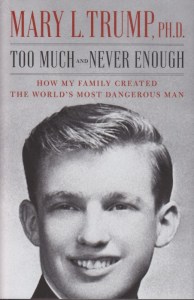
Stories of the wealthy never interest me unless they have a mysterious, ageless cousin who’s really a vampire.  Unfortunately fantasy can’t save us from the reality of a once great nation that’s now crumbling.  As I wrote earlier on this particular book, we already know, at some level, what it says.  Mary L. Trump, who alone has courage among her family, exposes quite a lot in Too Much and Never Enough: How My Family Created the World’s Most Dangerous Man.  There’s no point in ascribing blame for deeds done.  I also fear there’s no hope that justice will ever be served in this case.  Dysfunctional families are all too real and all too common.  Some of the traits (but none of the money) from Fred Trump’s cruelty were as familiar to me as my own childhood.  A powerful, overbearing stepfather riddled with a sense of his own inadequacy, taking it out in his own empire within the walls of his house.  The damaged children it leaves behind, each struggling to cope in their own way.

The family Fred Trump raised was bound to become damaged goods.  It is to the everlasting shame of the Republican Party that it could come up with no other viable candidate for the highest office in the land.  Not so long ago I would’ve written “world,” by that day’s gone past us.  Not only did “the party” accept his nomination, it has enabled him, as Mary Trump shows, every step of the way.  Knowing that something is deeply wrong—that more people will have to die in this country of Covid-19 than anywhere else, just to stoke one man’s ego—and refusing to act should be a sin in anybody’s book.  Who still emerges as his defender?  The Evangelical.  This mess is so convoluted that it will take historians (presuming anyone survives it) decades to try to unravel it.  That’s because nobody in the GOP has any empathy for those already born.  Strange form of “Christianity,” that.

This book is a depressing read.  Still, I’m glad I did it.  Not that it will change much.  Those who are psychologically like Trump, incapable of distinguishing truth from fiction, will say it’s all lies.  You can always play that card.  There are facts, however, and they are recorded.  Those who are able to weigh evidence know (and already knew) that a dangerous man had been coddled by a dangerous party that puts self-interest over nation.  You know, I think there may be a vampire in this story after all, but I just don’t have the heart to look any further.


Wolves? Where?

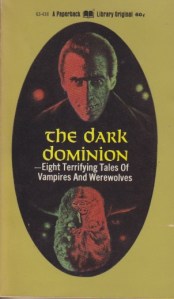
One of the oldest tricks in the capitalistic playbook is to make something look like a more successful product.  Trademarks and copyright laws prevent too close a similarity—for money is sacred—but we all know “brands” that try to look like other brands in hopes of picking up some of the business that attends success.  The same feature was apparently at operation behind The Dark Dominion: Eight Terrifying Tales of Vampires and Werewolves.  This is a book that I picked up in a used bookstore because its cover design—a dull olive green with a picture oval on the front—was clearly based on the Dark Shadows book series.  While the latter are still available, they’re increasingly difficult to find in used bookstores, so when I come across one I don’t have I tend to buy it.  I knew this wasn’t part of the series but the cover suggested to me it might be similar enough, like store-brand breakfast cereal.

Werewolf stories, it turns out, shouldn’t hunt in packs.  There’s no surprise since it’s pretty clear that one of the characters is a shapeshifter and it’s pretty obvious which one.  Six, or maybe seven, of the eight stories concern werewolves while one outlier has a vampire menace.  Some of the stories in the book are clever, but most follow the same trajectory: attacks are made, the villagers suspect something, one of them turns out to be a werewolf.  Time for the next story.  I noticed a long time ago that unlike vampires and Frankenstein’s monster, the werewolf doesn’t have the definitive novelistic origin.  Others wrote vampire tales before Bram Stoker’s Dracula, but that telling set the stage for those that followed.  The olive green cover suggests Barnabas Collins, but in reality is more in Quentin’s territory.

Interestingly, The Dark Dominion, like occasional collections before and after, doesn’t list an editor.  Modern books use the stature of volume editors to reinforce that what’s contained within has quality.  Otherwise who knows whether someone with good taste has picked the stories by authors you’ve never heard of and wrapped them together in a package meant to move?  That’s not to say that some of the stories aren’t good.  A couple are quite clever.  One is a translation of a medieval German tract.  Another comes from medieval Ireland.  The remainder are stories from the nineteenth and early twentieth centuries.  Perhaps it’s the burden of an editor to wonder what the selection criteria might have been.  What’s entirely obvious, however, is that making something look similar to a recognized book series still has the power to sell.


No So Innocent

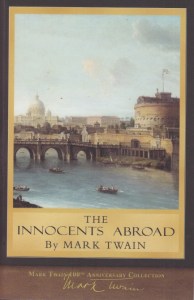
Mark Twain’s best-selling book in his own lifetime was his first commercially produced one: The Innocents Abroad.  Originally a set of letters sent during an excursion to parts of the Mediterranean basin with stops in Europe and the Levant, it’s difficult to read today.  Although satirical with much of it clearly for fun, Twain’s humor about those other than Americans embodies an attitude that would fit into Trump’s America a little too comfortably.  Other religions are strange and therefore wrong, for example.  People in the regions visited did not bathe frequently enough and were often singled out for their looks.  There’s something rascally about the behavior of the American visitors, chipping away at monuments so that they might take a piece of history home with them, yet never failing to feel superior.

I had to remind myself constantly that this is a period piece.  It contains much of the gritty humor for which Twain became justly famous.  Travel broadened him also.  A southern abolitionist, Twain nevertheless never overcame some of the racism into which he was born.  My wife and I were reading the book because of its early description of western visits to Palestine (there was no Israel at the time).  Keeping in mind that travel to much of that part of the world was expensive (his trip was sponsored by the newspaper for which he worked) and difficult, his account is actually one of the early modern travelogues on what would eventually become a fairly common pilgrimage.  Twain, like all of us, was a product of his time.

Twain’s diary famously reveals what he came to believe about religion.  There are inklings of it here.  Although he refers to the manner of dress of the ship’s passengers as “Christian,” and although he casts aspersions on Islam frequently, he reserves his most biting humor for his own brand.  During their visit to Smyrna (one of the seven cities of the book of Revelation), for example,  he writes, “Thick-headed commentators upon the Bible, and stupid preachers and teachers, work more damage to religion than sensible, cool-brained clergymen can fight away again, toil as they may” (page 327 from the 2018 SeaWolf Press edition).  Still, the assumption of the rightness of Christianity is something that he would eventually come to question.  His humor does often fall flat in an era of government support of racist, sexist tropes.  And the impressions made on those they met was summed up in his contractually-obligated note to the paper: “Many and many a simple community in the Eastern hemisphere will remember for years the incursion of that strange horde in the year of our Lord 1867, that called themselves Americans, and seemed to imagine in some unaccountable way that they had a right to be proud of it” (page 526).  Some things, it seems, haven’t changed despite the time elapsed.


Fear Writing

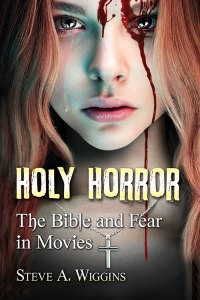
Unless your publisher is good at marketing, that book you spend years on will remain unknown.  That “share” button in the right hands can make all the difference.  The other day while searching for reviews on Holy Horror I came across Scriptophobic.  The website had started a column titled “Holy Horror,” and so I contacted them asking if they’d like to review my book that shared the title.  They graciously accepted.  I want to drive traffic (in as far as I can drive anything) to their website, so I’ll simply say the review may be found by following this link.  It’s too early to tell if it will raise much awareness, but I’m glad to see a review at last.  I suppose I should let the publisher know.

Reviews are one way to get notice about a book out there.  It may not help that the idea behind the volume is a strange one: what can we learn about the Bible by watching horror?  (Or, as the reviewer points out, some not-quite horror.)  I’ve always had a bit of an issue, I suppose with strict genres.  Movies I consider horror may not be so for someone else.  I’ve read enough theory to know that even the experts have a difficult time pinning it down.  The real unifying factor behind the book is actually the Bible.  If I’d waited a little longer to write it I would’ve had more material to use, but I’m not getting much younger, and I needed to get the ball rolling or continue to wish I had.  Holy Horror really falls into the category of reception history, and more specifically as the study of iconic books.  Many biblical scholars, I’m discovering, have no interest in horror, or pop culture.

Books that bring unusual ideas together have always appealed to me.  Were I in a university department I would’ve asked colleagues to comment and critique, but this was a book done solo.  Appropriate to horror, perhaps, I was pretty much isolated when I wrote it.  Still, all things considered, I’m pleased at how it turned out.  No reviews have appeared on biblical sites, and I’ve always found the horror community to be so much more welcoming anyway.  That should be saying something right there.  Think about it.  In any case, if you’re interested in what intelligent horror fans think of a book like my humble effort to start a discussion, I encourage you to take a look.  Don’t wait for the biblical studies reviews unless you care to wait a very long time.


Who Watches You

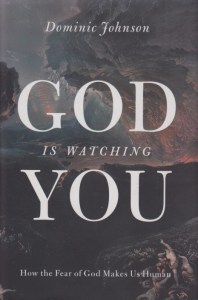
When my wife saw Dominic Johnson’s God Is Watching You on the top of my pile she said “Are you sure you want to be reading that?”  Her question was justified, of course.  I was raised in a religion where the punishment of God was very much on the surface.  Heaven’s carrot was nothing next to Hell’s stick.  I still suffer from that religious outlook in innumerable ways.  Johnson’s subtitle, however, is How the Fear of God Makes Us Human.  Johnson, who holds doctorates in evolutionary biology and political science, is well placed to try to untangle what those of us with just one doctorate in religious studies deal with constantly: what is religion?  The main idea of the book is deceptively simple—we have evolved the way we have because we feared (and continue to fear) supernatural punishment.

Johnson establishes that sociological and anthropological studies have shown that humans respond much more readily to punishment than reward.  Reward is like icing—you can eat a cake without it and still enjoy it—while punishment is like the threat of all food being removed.  You see the difference?  One has a far greater motivating factor than the other.  This idea spins out into many aspects of religion, and even perhaps hints at the origins of religion itself.  I have often written on this blog that animals exhibit religious behavior.  We don’t speak their language so we can’t know for sure, but some of what various animals do seems very much like what we do in church, synagogue, mosque, or gurdwara.  Accusations of anthropomorphism fall flat, to me.  We evolved, did we not?  Then why do we resist pointing out in animals where that behavior sticks out like a sore opposable thumb?

Human societies worldwide share the fear of divine punishment.  Interestingly, even a significant portion of atheists admit fearing it too.  Often those who know me ask about my preoccupation with fear.  It sometimes shows in my writing about horror, but I think Johnson may well have the key in his pocket.  Religion is about fear.  It’s not just about fear, but it clearly is about avoiding divine (however defined) wrath.  Lose a job or two broadly defined as religious and disagree with me.  Am I sure that I should be reading this book?  Now that I’ve finished it I can definitively say “yes.”  While I don’t agree with everything in it Johnson has clearly hit on something that all people who study religion should know.


Too Close?

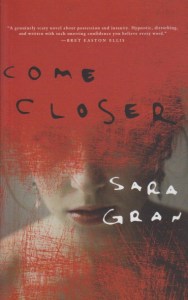
Some time back I did a Google search on something like “best novels about possession,” like one does.  I was in the midst of writing Nightmares with the Bible at the time.  One of the titles that came up was Sara Gran’s Come Closer.  I hadn’t heard of it before, but I started to look out for it.  I finally found and read a copy.  It is a page-turner.  A first-person narrative, it is a story about how a woman became possessed and how her life changed because of it.  Creepy and moody, it isn’t your typical Exorcist-type story.  What it highlighted for me (I don’t want to give too many spoilers) is the dilemma of those who a) live in an era when such things are routinely dismissed, and b) who have no religious background on which to fall.

While there are some quasi-religious characters in the story, there are no priests.  There’s no Catholic Church with its reassuring, if disturbing ritual.  Nobody seems to know how to handle a powerful demon.  One of the features that fuels exorcism movies (and presumably many novels on the subject) is the uncertainty of success.  Will there be deliverance or not?  I’m not going to tell you the answer here for Gran’s novel, in keeping with the spirit of the genre, but the dilemma of where to turn is believably laid out.  Amanda, a well-employed professional, lives without religion.  She acknowledges that strange things happen, but when she gets an inkling that a demon is after her, she doesn’t know where to turn.  As the story builds the loss of personal control is convincingly portrayed.  What do you do without the church?

I often ponder the particular power of The Exorcist narrative.  The threat to a young woman (as I discuss in Nightmares) is part of the key.  Another is the knowledge that the Catholic Church has packed away a powerful ritual that is only brought out in what are clearly extreme circumstances.  Like Amanda, the MacNeils aren’t church-going individuals.  The difference is that they live near Georgetown University where help may be found.  Unveiling this ancient rite was perhaps the greatest brilliance behind the story.  We live in a different age, however.  Simultaneously both more religious and more secular.  With the old certainties now under question, people wonder what they are to do when the impossible happens.  That is the driving pathos behind Come Closer.  It is a scary story on many levels.


Everybody Knows

One of my favorite Leonard Cohen songs is “Everybody Knows.”  On a related note, the best-selling book in America last week was Mary Trump’s Too Much and Never Enough: How My Family Created the World’s Most Dangerous Man.  With the publisher citing 900,000 copies sold upon release, it produced numbers that most publishing houses only dream of.  I’d preordered it on Amazon but for the first time ever I did not have a copy on the day of release.  There were a lot of people ahead of me in this line.  That’s even more remarkable than it sounds because we all pretty much know what the book says.  We also know that its subtitle is true: we have a very dangerous man (daily rising Covid deaths show this to be true) given free rein by Republican senators.  Even adults without high school educations that I talk to know there is something seriously wrong.  Indeed, anyone who knows how to fact-check can see it.

A very popular way to deal with inconvenient truths is to posit a conspiracy theory.  Evangelicals (now defined as Trump supporters) have long used conspiracies as ways of explaining how facts simply don’t support their views.  From the moment “alternative facts” left the lips of the administration in January 2017 I knew we were in deep, deep trouble.  Funny thing is, many Evangelicals had to read Orwell in school, like the rest of us.  How they could support anyone that had such a long, long track record of criminal cases against him before placing his hand on the Bible and swearing to uphold a constitution he’s been daily dismantling since is anybody’s guess.  Daily life, it seems, is now a conspiracy.  

One of my favorite Leonard Cohen songs is “Everybody Knows.”  The lyrics suggest that whatever it is we want to keep secret everybody, well, knows.  That’s what’s so distressing about America’s current decline.  Everybody knows that being president is a very difficult position and that it’s only handled adequately by well-trained and smart people who, despite their faults, put country above self.  With the election of 2016 it was clear from even before day one that ego was the driving factor behind 45.  Americans love their outrageous television personalities and somehow think that appeal on the small screen somehow translates to leadership ability.  We’ve learned before that this isn’t true.  I haven’t read Mary Trump’s book yet—it just arrived in the mail—but when I do I’m sure I’ll find out what everybody knows.


No Smoking

I have never smoked anything in my life.  As a kid with chronic bronchitis few things scared me as much as being unable to breathe.  I have not assassinated anyone or consorted with aliens—at least not that I know of.  Otherwise I think I understand the Smoking Man.  As far as my X-Files rewatching saga goes, I recently reached “The Musings of a Cigarette Smoking Man.”  I remember the first time I saw it I found it improbable that the assassinations of the 1960s were the work of a single man.  What hit me this time around, however, was the Smoking Man’s real frustration in life.  He wants to be a writer.  Having completed several novels myself, none published, I have received pin-head letters very much like those he does in this episode, only in greater quantities.  When he finally finds a publisher, he writes his resignation letter to whomever hires assassins and those who change the course of history.  I know just how he feels.

You’d think that by the logic of any reasonable system that those who work in an industry might have some inside tracks.  Some, no doubt, do.  Others of us in publishing are just like the average, uninformed person on the street.  Publishing is a cliquish place.  A friend with some success getting novels published advised me to look at the names of editors and editorial boards on the literary journals that get noticed.  “You’ll see the same ones coming up over and over,” he said.  It is, as the Smoking Man discovered, a kind of cabal, which is, I suspect, the point of making him out as a frustrated novelist.  He can set the course of history, but he can’t get a legitimate novel published.  Cue the X-Files theme. 

I know many academics who write fiction.  My second novel (depending how you count these things—this one was never finished) was a pet project while I worked at Nashotah House.  I knew I wouldn’t be able to publish it when I worked there.  In fact, my first fiction publication only came three years after being shoved out of the nest of academe.  I’ve completed seven novels now and I’ve managed to get some short stories published.  Then again, I don’t have clandestine knowledge from a lifetime of access to the truth about alien-human interaction.  I don’t shoot people for a living.  I’m not even a professor any more.  Still, I think I can begin to understand why someone might turn toward a more interesting career, given the situation when it comes to getting published.