A Scream or Two

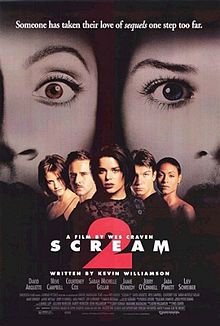
Scream2A few weeks back, for my weekend fix, I watched Scream. I hadn’t seen the movie when it came out in 1996, but having seen so many references to Ghost Face I felt I was missing out on something. I was disappointed, however, at the relative lack of religious imagery or dialogue in the film. Such motifs are so common in horror films that I’ve come to depend on them. In fact, there was nothing supernatural in the movie at all. This weekend I decided to follow it up with the sequel that many claim is better than the original, Scream 2. It is the same self-aware exposé of horror gimmicks and tropes, providing several clever frights along the way. But this time there was more religion. Not that it was overt or central, but it was clearly there. My thesis was bolstered a little bit since the storyline felt the need to come back and pick up what was mostly lacking from the first film.

Sidney draws first blood in the sequel by comparing a sorority to a religion. Not much, but a start. We find out that Sid has taken up drama in college, where she has been cast in the role of Cassandra, the prophet of Troy cursed with never being believed, although always being right. In the truly disturbing scene from the play we’re shown, Zeus himself comes down and points a godly finger at the frightened girl. The real religious imagery, however, comes toward the end of the movie when Derek is tied up, cruciform style, by his frat brothers for giving away his letters. He plays the role of the sacrificial lamb as Sid comes face-to-face with the Ghost Face duo, and when his dead body is lifted up on the stage prop, the camera angle reveals either an angel or an ascending deity, arms spread out as if on a cross. Life has been laid down for life, a distinctly religious theme.

What would horror be without resurrection? The villain always comes back from the dead, having easy access to that which is denied the regular mortal. This factor alone suggests that most horror films are transmuted religious fulfillment wishes. We live in a time when religion seems to have lost its transcendent power, and yet we long for resurrection. Horror movies tell us it is available, but at a very steep price. Perhaps it is an unintentional motif, but it is a pattern that occurs so often that it feels integral to the very conception of the scary movie. That which we long for the most is the most terrifying. Horror films aren’t for everyone, but their popularity shows, on some level, that our society hasn’t given up on religion just yet. Scream 2, the resurrection of a wry, witty, and somewhat gory original, brings fear and religion together once more. Religion, like the horror villain, never really goes away.


Gods in Spandex

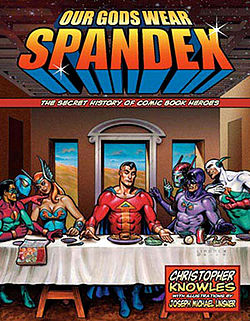
OurGodsWearSpandexOne thing leads to another. Reading Jeffrey Kripal’s Mutants and Mystics stirred an interest in comic books that I hadn’t felt since before my college days. Often excoriated as puerile, escapist doggerel for pre-pubescent boys, comics have grown to be respected members of adult society. I often wonder what the draw might be. Hollywood has certainly cashed in on it with any number of blockbuster flicks each year coming from the brains of the comic book writers and artists. So I picked up the quirky book by Christopher Knowles and Joseph Michael Linsner entitled Our Gods Wear Spandex: The Secret History of Comic Book Heroes. Reading it was kind of like looking in a mirror that has been buried in dust for a few decades. I hadn’t realized that my tastes in childhood comics was a reflection of a longing for the divine world with healthy doses of science fiction, and even H. P. Lovecraft, thrown in along the way. Knowles ties in a remarkable breadth of material to demonstrate that our superheroes are, in the final analysis, gods. That point may be taken in any number of ways.

The academic world suffers from a fear of respectability. That may seem a strange assertion, but I’ve spent a great deal of my life among academics and I know that many of them are insecure and tentative. Does all this reading, writing, and analysis ever get read by anybody? Does anybody take me seriously? Academics are haunted types. So when a subject as vulgar as comic books arises, scholars are reluctant to touch it. It might look like we actually enjoy reading the funnies. Still, popular culture has demonstrated an unexpected depth to much that we read in the strip world. As Knowles points out, a deep undercurrent of the occult and esotericism runs through many hero story lines. Several heroes began their lives as classical gods, only to assume the spandex and become incarnate humans with special powers we long to have ourselves. We would fly, if we were given the chance.

Our Gods Wear Spandex may never be viewed as an academic book by most. It has too much visual interest and not enough recondite footnotes. All the same, it is a profound look at what people really desire. We worship gods because of their special powers. If God were one of us with our humiliating weaknesses and limitations, would we ever worship him or her? Of course not. We only seek to appease those who are stronger than we are. Entire governments and ecclesiastical bodies are built on that very principle. Heroes are like us. Mortal, and yet, with something more. They die. But like the gods, they can come back. Reading Knowles it becomes clear just how much religious thought pulses through the veins of the comic book world. We may be grown up and sophisticated. We may have left behind childish things. But when our backs are to the wall, who doesn’t secretly wish they were Wonder Woman or Superman? And maybe that wish is a prayer.


True Heroes

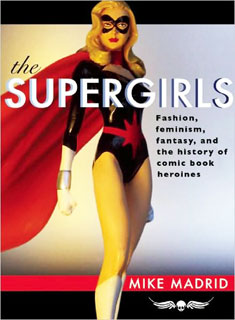
supergirls As a guy with a healthy sense of the weird,it strikes me as odd that rational people can suppose that we’ve solved all of life’s great mysteries. As a student of biology, chemistry, and physics in high school—and a reader of non-technical aspects of the same throughout my adulthood—it always seemed that there was an undefinable “something more.” Reading Jeffrey Kripal’s Mutants and Mystics led me to an interest in comic books. As a child I did not have many of them since we didn’t have much money to spend on luxuries. The few I had, however, were read and reread and reread, assaulting my imagination with endless possibilities, many of which defied everything I was to learn of biology, chemistry, and physics. My interest in feminism and new-found appreciation of the proto-graphic novel, led me to read Mike Madrid’s The Supergirls: Fashion, Feminism, Fantasy, and the History of Comic Book Heroines. As a boy surrounded with brothers, I clearly knew which comic books were for males. Madrid’s book delves into this super-hero world with the question of why females have always struggled to be taken seriously in this fantasy land.

Many of the characters explored in Supergirls were heroines I’d never encountered before. Madrid’s analysis often appears spot-on as he traces their histories through the decades as they mirror, and occasionally lead, society’s expectations of what women should be. The one that I had no trouble recognizing was Wonder Woman. And the reason for that was she used to have a TV show. Not mentioned by Madrid was the mighty Isis, also a heroine from television. She began as a character opposite Captain Marvel, and did not have her origin in a comic book. Isis was, of course, an ancient goddess, and as I learned from Supergirls, Wonder Woman was not far behind. The way that women could be as strong as men was to be divine. For human females, life was much rougher.

Wonder Woman, Madrid notes, was one of the Trinity of early, lasting comic book heroes. Superman, Batman, and Wonder Woman are cast as the Father, Son, and Holy Ghost, respectively. Like her theological counterpart, Wonder Woman is the most amorphous, least understood of the three. Her career and persona change over time, almost losing any kind of supernatural ability. Her origin story, however, began as a helper of oppressed women everywhere. Today we see Superman and Batman on the big screen, but Wonder Woman has fallen behind. Despite great strides, our society still isn’t ready to accept rescue of men at the hands of a woman. More’s the pity, because we clearly see the mess that masculine leadership has spawned. Mike Madrid has discovered a secret identity for our old foe, sexism. And it might take the world of comic books to help us see clearly that which mainstream analysis still denies.


Peculiar Mythology

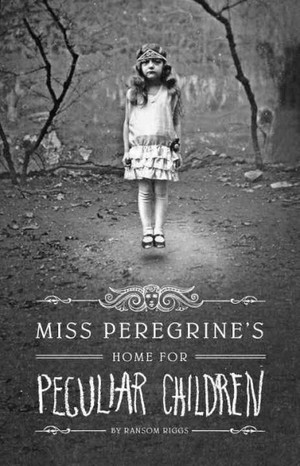
Peregrine Confession: I love books like Ransom Riggs’ Miss Peregrine’s Home for Peculiar Children. Ambiguity in fiction is under-appreciated at times. Of course, I’m not formally trained in fictional literature outside the confines of ancient mythology, but I do know what I like. This wondrous story of paranormal children in an alternate universe could almost have been drawn from Celtic mythology, and indeed Riggs provides a mythology to explain how things got this way. And every mythology is a kind of religion. In this world there are peculiars—not far removed from real life, for those willing to accept it—who have unusual powers. Miss Peregrine’s home, one where the children are under the guardianship of ymbrynes, houses those with special gifts. Some ymbrynes, however, wanted their godlike powers to make them into actual gods and in addition to causing the Siberian explosion, gave birth to hollowgasts, a kind of living damnation monster. “Rather than becoming gods, they had transformed themselves into devils.” Sounds a touch like Lucifer’s fall, n’est-ce pas?

It might be supposed by cynical readers of this blog that I select my reading based on the potential for finding religion in fiction. If that is true it is so only on a subconscious level, I assure you. I read about religion for many hours every day and I taught the subject for nearly two decades. When I turn to fiction it is generally for escape. I have found, however, that there is hardly any escape from religion. When I find it in fiction, therefore, I ponder some of its implications. Religion is so much a part of our lives that it can’t help working its way into popular culture. Maybe I just see it everywhere. That doesn’t mean that it’s not really there. But back to our story…

Hollowgasts, like Ugaritic devourers (sorry, couldn’t help myself), are powerful hungry. They must constantly feed their voracious appetites. Their favorite food, which actually transforms them a slight step back toward humanity, is the blood of peculiars. Blood is their salvation. The depth of this idea trickles down to the very roots of religion itself. Transformation is not possible without somebody paying the cost. Religion is bloody business. I won’t throw any plot spoilers in because I want to encourage you to read this strangely moving book. I will say that it is a strikingly well executed mythology for a world where God is not present, but where monsters and peculiars both partake in their own kind of divinity. And the strange photographs are real.


Avenge This

Recently rewatching The Avengers I noticed a subtext that had escaped me the first couple of times I saw it. When Loki explains to his victims why he is spreading his chaos, he uses a concept that many of us have been spoon-fed since 9/11—that freedom is not free. When he is asked from what he is setting humans free he replies, “Freedom.” He further explains that people really don’t want freedom, but they want to be led. This sounded so much like Bush administration rhetoric that I was put on alert for the remainder of the movie. Indeed, in the climatic scene much of Midtown is attacked, and who launches the nuclear device at Manhattan? The shadowy government figures who wish to remain anonymous. “Freedom is not free,” they seem to say, “support your government without question.” The scene of police and firefighters herding frightened citizens out of harm’s way looked an awful lot like footage from near ground zero.

Comic books, I have often reflected, are already story-boarded and some make excellent movies. Some are funny and some are serious. As a child I had only a handful of comics, but they were like movies for kids with modest means. Like an adult going back to the old Warner Brothers cartoons, you see many things that escaped you as a child. Comics may not be high literature, but comic book movies, at their best, are not far from it. The X-Men movies likewise introduce themes that rivet adult attention: prejudice, discrimination, the ambivalence of evil. The stories are didactic as well as entertaining. In the case of The Avengers, the characters, while overblown, all have their own agendas but government has only one: compliance.

Sometimes I read about the early days of the American experiment and wonder what went wrong. Yes, there are certainly times and issues that demand strong centralized government for survival, but when did those who castigate such strong control decide that they should take over? Who gains here? It certainly doesn’t seem to be the average citizen. Looking over the landscape after the last laissez-faire government, the only one who ended up hands-off were the very wealthy. Left with no social responsibility, they reign, resisting any taxation so that the burden of the increase trickles down to those who, in the words of Loki, really don’t want freedom. That’s perhaps the only thing we have in common here; no matter how long ago our ancestors arrived, they were searching for freedom. Or so they believed. Like a comic book, it has become mere fantasy for most, while Richie Rich happily continues on his gilded, but vapid way.

Mårten_Eskil_Winge_-_Tor's_Fight_with_the_Giants_-_Google_Art_Project


Stonefaced

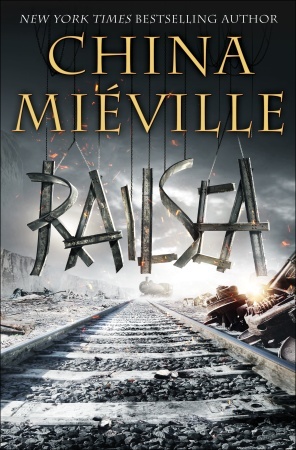
Railsea Imagine, if you will, life on the open sea. Back in the whaling days. Days before enlightenment really took hold. Transpose that thought onto railroads. In a day of huge moles and other underground creatures. Days when no one can imagine where the rails end. That might give you the slightest glimpse of China Miéville’s Railsea. I haven’t read too much of Miéville’s fiction, but I have read enough to know to expect a reality distorting romp through very interesting places. In this take on Herman Melville’s Moby Dick, Miéville takes some noteworthy risks in providing his characters with a native religion. Fiction authors sometimes find religion a constraining topic. Consider Salman Rushdie. More often the restraint appears to be a lack of imagination on the writer’s part—although we can’t define religion very well, we all know what it is and what it’s supposed to look like. Miéville, although in backstory, provides a new religious world where the gods are called Stonefaces and everybody believes in angels, and the explanation of where the railways came from is “theology.” Even our erstwhile Captain Ahab is chasing after her “philosophy” in the form of a giant mole that seems to have taken her arm.

With a sensitivity I’ve rarely found (the fault could well be entirely mine), Miéville utilizes religion, particularly Christianity, to construct an alternate universe. The gospel therefore appears as godsquabble, and to suggest there is anything beyond the sea of rails is literally heresy. Our protagonist Shamus ap Soorap on his voyage of discovery ends up riding to heaven on the rails only to find that there is yet even more beyond. Although religion itself is not central to the story its adjuncts are, creating an entire mythos of life on the railroad. It this world it is clear that wood and trees are related, but no one quite knows how; some suppose an evil god planted false evidence to deceive them. There’s even a healthy dose of the Odyssey thrown in, with the Medes having to pass through a mountain dwelling monster, the siller, and the Kribbis Hole.

But aren’t we really on the ark once more? For surely the bedeviled Pequod was a shadow of the same. In Miéville’s fantasy world, the open ground unpopulated by islands is dangerous. All kinds of innocuous creatures burrow out and will eat the traveler who is not safely ensconced on a train. As if to underscore the Noahic connection, Sham ends up on an actual boat on an actual endless sea. I’m pretty sure Homer never read Genesis, but the parallels between Greek mythology and the Hebrew Bible were long ago recognized by Cyrus Gordon and his colleagues. Miéville continues the tradition. Stranded on an island, Sham tries walking on the rails (read walking on the water and you’ll get the picture) until his faith fades. There are many who declare that religion has outlived its usefulness, but if an author can bring Melville, Homer, and the Bible into an intensely creative story, I think I’ll have to beg to differ.


Priests, Queens, Goddesses and Fruit

“And when the woman saw that the tree was good for food, and that it was pleasant to the eyes, and a tree to be desired to make one wise, she took of the fruit thereof, and did eat, and gave also unto her husband with her; and he did eat.” So Genesis 3.6 summarizes the most expensive meal in the history of eating out. For centuries the literally minded have wondered what the exact species of fruit might have been. The apple was long favored because its Latin name sounded suspiciously like the word for evil. In the Bible the fruit with the most theological freight, however, was the pomegranate. The high priest’s robes were designed with dangling pomegranates alternating with silver bells along the hem. Some have speculated—and it can only be speculation—that the tree of life, rather than the tree of the knowledge of good and evil (the latter better abbreviated Totkogae) was a pomegranate. For the Greeks, however, the self-same fruit led to Persephone’s entrapment in the Underworld for half the year.

Although the Bible doesn’t specify this, the apparent reason for the pomegranate’s privileged religious meaning seems to have been its numerous edible seed casings, or arils. Over time it acquired the association with fertility—not surprising with its numerous seeds. Indeed, my first experience of pomegranate was in seminary, which, like its name implies, is a place of great fertility. It is one of the more labor-intensive fruits, however, having a tough skin and plenty of inedible membrane. Even with Christianity’s inimical disdain for all things reproductive, the pomegranate survived in Christian art and symbolism, becoming a symbol of—what else?—resurrection.

Today, POM Wonderful has claimed the life-giving qualities of the pomegranate as its signature for good health and long life. This California company even has a history lesson on its website, tracing the pomegranate back to the Early Bronze Age. Interestingly, the initial picture used to illustrate this early period is a goddess, Kubaba, who was perhaps an historical remembrance of the queen by that name. The Sumerian King List gives Kubaba, the only queen on this list, a reign of a century. Well-chosen for advocating the fruit! In a relief of her eponymous goddess from Carchemish, Kubaba is shown with a pomegranate in her right hand. POM Wonderful’s website does not show, nor even mention the pomegranate on the relief. Perhaps like the pomegranate itself, this is worthy of digging in a bit deeper. Any food website that draws attention to ancient Near Eastern goddesses is doing its job exceptionally well. Who would suppose that one fruit could unite an ancient queen, an obscure goddess, and an Israelite high priest shuffling around the temple? And of course, our mother, Eve.

IMG_0540


Jolly Saint Nicholas

StNick

Each December the Princeton University Chapel Choir performs a free holiday concert in the impressive university cathedral (actually, it is a chapel, but given its size I’ll stick with cathedral). This year’s concert was Benjamin Britten’s “Saint Nicholas.” The association of Saint Nicholas with Christmas, not really a major holiday until relatively recent times, was an aspect that developed long after his death in the fourth century. The date of his death, December 6, and his association with the giving of gifts, made him an obvious model for Santa Claus (who still bears his name). Most of the gifts I’ve received from bishops involved losing a livelihood and personal dignity, so it is little wonder that Nicholas is venerated. Few bishops of his generosity exist today.

The stories of Nicholas of Myra, however, are full of mythical accounts that bear less resemblance to history than to legends of old. Eric Crozer’s lyric for Britten’s piece invokes several of these miraculous tales. Saint Nick, it seems, stilled a storm at sea, multiplied food and walked on water like Jesus. The lyric also tells the legend of how he raised three pickled boys from the dead, although I have to admit I couldn’t get my mind off zombies after that. This story seems to owe something to the myth of Tantalus, who, like Nicholas, was from Anatolia. In real life we do know that at the Council of Nicaea Nicholas punched Bishop Arius in the ear for his heresy. Theological discussions are like that sometimes. And I wonder if that might not be the origin of another curiosity of which a friend recently reminded me—Saint Nicholas doesn’t travel alone.

Our modern version of Santa Claus takes its roots mostly from germanic traditions. In that culture the saint is accompanied by a more sinister character who doles out punishment to the naughty. He is known by many names: Krampus, Ruprecht, Schmutzli, Zwarte Piet, or simply the Devil. Instead of using their diabolical fists, they generally carry rods to smack the not-so-nice, kind of the Republican side to the liberal Santa. This dark figure does not appear in Britten’s “Saint Nicholas” where a (mostly) kinder, gentler saint appears. A saint who raised briny boys from the beef barrel also belted another theologian upside the head. Life, even for saints, is full of contradictions.


The Hunter

Orion seems to have tripped in his journey across the sky last night. I can remember being told of generals falling in battle, and now I hear how they fall in bed. Nobody really expects Sunday School behavior from an aging warrior, but the brass is used to issuing orders and expects unquestioning obedience. Now we delve into their personal lives and are surprised to find, what? Sex? Sex scandals have become a major source of “news” over the past several years and General Petraeus is only the most recent in a long line of politicians and power-mongers who’ve been caught in compromising positions. How very primate of us. I often think how in the categories of sin we include getting caught in affairs among the most horrible. But also among the most common.

Given the other activities of generals—waging wars and ensuring that enough of the enemy die to gain compliance—you might think that keeping them safely between the sheets might be the best thing for the greatest number. I don’t know the ins and outs of the story, but with the scandal running across the headlines it is pretty obvious that we’re all past the shock of Sandy and election night. Time to find other peccadilloes to amuse us.

If we cast a wide enough net, however, it won’t haul in generals only. No, we find politicians of all orders, televangelists, football coaches and all kinds of other leaders entangled in it. The thing that they seem to have in common is lack of commitment. Or restraint. That worries me a bit when it comes to leaders. None of us is perfect, I realize, but certain activities are taboo and those who ride the trajectory to fame violate those taboos at their own peril. It is the story of David and Bathsheba. I am, however, reminded of the mighty hunter Orion. The various myths tell it differently, but in one popular version it was the jealousy of Artemis that felled him. Perhaps that is why he seemed off-balance as I watch him fleeing the rising sun outside my window.

Till Credner’s Orion from Wikipedia Commons


Star Tract

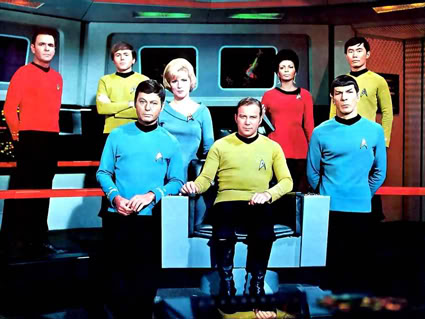
Over the past few years my wife and I have been watching the episodes of Star Trek (original series; please, we are connoisseurs). As a religious child watching Star Trek I had noticed that some of the episodes had biblical titles or themes, but now that I’ve been watching them systematically, if not swiftly, I have noticed a general trend towards more biblical themes as the series goes on. I suspect most readers know that Star Trek had only three seasons. During the first season references to the Bible were a bit vague and indistinct. Episodes 23-25 (“A Taste of Armageddon,” “This Side of Paradise,” and “The Devil in the Dark”) make reference to biblical motifs in their titles, but nothing too explicit. Paradise and the Devil are, after all, in the public domain.

Season two stepped up the ante a bit. In “Who Mourns for Adonais?” the pagan god Apollo appeared, but in “The Apple” the Enterprise was transported back to Judeo-Christian themes in the paradise genre again. “Journey to Babel,” episode 10, brought a biblical place into the title, and “Bread and Circuses” (episode 25) famously put the crew into the world of the Roman Empire where the rebels were found to be sun worshippers. But no! Worshippers of the son of God, we learn. The move away from Apollo is complete, we have come back to a comfortable, Christian world.

The third and final season delved even further into the biblical repertoire. Once again, “The Paradise Syndrome” (episode 3) brings Heaven to the heavens, but episode 4 also has a biblical title “And the Children Shall Lead.” Episode 16, “The Mark of Gideon,” takes considerable thought to unpack the biblical parallel, and episode 19 is entitled “Requiem for Methuselah.” Paradise, obviously a favorite theme, returns in “The Way to Eden,” or episode 20. Each season goes boldly further than the one before.

Quite apart from the titles of episodes, Star Trek, despite the technology and unflinching logic of Mr. Spock, is an extremely biblically literate show. Even as the 1960s were fading into the 70s it was a safe assumption that watchers would pick up on the many biblical motifs and themes. Now when younger people mention Star Trek, they inevitably mean one of the various spin-off series that have grown from this original root. Biblical references are surely there, but like the times themselves, I suspect they aren’t nearly as overt as they were when I was a kid. For many even paradise has lost its shine.


True Myth

A friend of mine, I am glad to see, has started a blog. I’ve mentioned K. Marvin Bruce (“Marvin”) before on my blog, but his situation is such that job and blog don’t mix too readily and so he writes under a pseudonym. While Marvin knows a fair bit about religion, his blog focuses more on writing—he started his blog to announce his forthcoming novel. For those who are feeling adventurous, please stop by. His site is called Reinsurrection, and is located on Blogger.

I don’t envy Marvin his task of trying to make a writing voice heard in this overly noisy world. The decibel level of the internet is deafening for those with any artistic sensitivity. Marvin’s an academic in a poet’s skin, a dangerous combination in these days driven by cash and commodity. His novel, which he permitted me read before sending it off, is called The Passion of the Titans. It’s a fun send-up of Greek mythology told through the eyes of Medusa. For those of you who like off-color parody and classical mythology, I’m pretty sure you’ll enjoy it. It’s due out this summer.

Classical mythology is boxed, academically, in a compartment hermetically sealed away from religion. In fact, mythology is religion. (I wouldn’t look for too many religious ideas in Marvin’s book, though!) What it comes down to is that universities in the “Age of Reason” determined that mythology was fictional and religion—or at least one religion—was factual. Western society has tended to romance fact while jilting fiction as a way of understanding reality. Our obsession with the factual may be our eventual undoing. As for me, I can’t wait for Marvin’s book to appear. Hopefully it won’t be his last.


Puny Windstorm

Nothing says wrath of God like a hurricane. Those of us along the Mid-Atlantic coast of the United States are hunkered down wondering what’s to become of daily life when the storm is over. Responses to the situation have been, well, religious. Store owners spraypaint prayer-like sentiments to Sandy on their plywood protection, urging the storm to be kind. Interviews are laced with language appropriately placating to a deity. The storm named after a mythical monster has become a god. Such responses are not limited to Hurricane Sandy, of course. In fact, when death is expected pleading with the powers that be is routinely recognized as Elizabeth Kübler-Ross’s bargaining stage of the dying process. We always hope that forces stronger than us might be willing to make a deal, cut us a bargain. The storm, given a human name, is personified as a deity. It is such a very human response to any phenomenon that forces us to realize just how small we are. Our egos may reach to the ends of the universe, but in reality we are fragile, scared children begging for the protection of a supernatural parent.

Last night as we were sitting here waiting to be hit, my family watched The Avengers. The juxtaposition of deities and heroes in the Marvel Universe fascinates me, and, of course, the movie has to explain that Thor and Loki are really only aliens perceived as gods. Compared with their human companions, they are immeasurably strong but they do not decide the outcome of the cosmic battle that devastates New York City. No, it is Tony Stark who flies the atomic bomb through the portal to the invading ice giants, saving humanity. Thor is too busy battling flying metal dino-whales. Humanity is responsible for its own salvation. The gods may help, but they alone cannot deliver. Against his protests of divinity, the Hulk bashes a protesting Loki into the floor of Stark Tower with the grunted huff, “puny god.” His only line in the movie. The portal, swirling hurricane-like over Midtown is forced closed and human technology, in the form of Iron Man’s admittedly cool armor, saves us all.

Hurricanes remind us that our technology can’t save us all. The advance warning may very well have spared many lives by the time this all blows over. As early as Thursday I was wondering if work would be called off or if I’d have to battle the rain and winds and storm surges to get to my office (which would have provided an awesome view of the final battle in The Avengers, facing, as I do, the Chrysler Tower and Grand Central). We have been warned. Our technology, however, can’t stop the force of the storm. Sandy may not be divine, but she is massive—much larger than any person who believes that there is some trace of divinity within him or her. As I sit here listening to the wind and the rain, I wonder what the weather is like in Asgard today.


Seeing the Dark

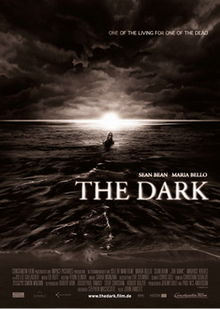
The Dark may be a movie that tries to do too much, but it does illustrate an idea that has been lurking around my head for a few years. That which we fear and that which we worship are never far apart. Since The Dark was pretty much panned, in brief it goes like this—a separated couple gets back together in Wales to draw their troubled teen daughter back. While there she drowns and the ghost of a girl from the past shows her mother how to get her daughter back. The film is notable as being the first I’ve seen that could make sheep scary. Skulking in the back story is a minister, “the shepherd,” the father of the ghostly girl, who started a new religion over the ocean cliffs of Wales half a century ago. When his daughter died, he convinced his flock to leap off the cliff to reach a place that is a combination of Heaven and a Welsh mythical afterlife called Annwyn. The shepherd, however, is really using their sacrificial deaths to bring his daughter back from the dead. The story is complex and the darkness of the narrative is at times overwhelming, nevertheless, it is a showcase of how religious conviction can be more frightening than consoling at times.

Some years back I researched the Welsh mythology of the Mabinogion. Having been a student of ancient religions, however, I knew there was only so far I could go without the lexical support of learning Celtic languages. (This is a fact of mythological study often overlooked by popular treatments; if you really want to get what is going on there is no substitute for reading texts in their original language. I was too busy learning Ugaritic and the time, and struggling with Akkadian, to pick up Gaelic as well.) Nevertheless, the mythology struck me as particularly compelling. Some of the roots of the Arthurian legend lie deep within this lore, and although often uncredited, it still influences our society today. Mythology is simply religion dressed to go out for the evening. The concepts form the basis of much that we still believe and that which still has the power to terrify.

Although the critics didn’t care for the film, the dense interweaving of misplaced religious devotion, Welsh mythology, and basic human longing make The Dark in many ways a classic horror movie. It may be hard to find the characters sympathetic, but they are in some ways archetypal. With a sinister minister driven by personal loss turning to pagan folklore to bring his daughter back, we have a secondary character who curses the fate of an all-too-human condition. The concept of sacrifice becomes a tool for selfish gain rather than a means of helping others. Possibly those who panned the movie did so without an appreciation of the mythology that pulses just beneath the surface here. And while sometimes horror films are simply puerile escapism, at other times they should give us pause to think, and maybe even learn.


Charon’s Obol

One of the concomitants of spending time with religion is a non-morbid fixation on death. As a college student I was surprised to learn that other people my age did not think about death nearly every day. Perhaps with a typical college student’s obsession with the other end of the life cycle this is only natural. Ever since I was a child, however, I felt frustrated by the lack of permanence that characterized all of the striving involved with life. We work very hard and then we die. I suppose that is one of the reasons religion appealed so strongly to me—it had an answer to this dilemma. Science, as I began to experience it about the same time, suggested a radically different conclusion: we have no souls, and so it is best to accept the fact that death is the end and get on with life. No wonder Ecclesiastes has always been my favorite book of the Bible.

While reading about–shhh!–death recently, I came across an interesting tidbit. Pope Pius IX was buried with a coin. I’ve read that even John Paul II was buried with coinage, but I’ve not been able to find credible sources on that. What is fascinating about this practice is that no matter how it is vested, burial with money is a form of Charon’s obol. With movies like Clash of the Titans, many modern people are aware of the need to pay Charon to cross the River Styx. (Back in the radical days of traditional education just about everyone would’ve learned this in the course of studying the classics. In any case…) The gifting of the dead with money represents the survival of a pagan custom that likely stretches back well before ancient Greece. Even before money was invented people buried the dead with goods that the living would never be able to use again. They may not have considered this payment to a ferryman, but the principle is the same.

This idea has a strong grip on our psyches. Not one of my favorite movies, I have watched Ghostship a time or two. What initially brought me to the movie was the fact that it is a horror-movie built around the character of Charon. The mysterious stranger who lures the crew of the Arctic Warrior onto the Antonia Graza laden with gold is named Ferriman. The salvage crew quickly forget the tons and tons of metal that they came for in exchange for the a few dozen bars of gold. Of course, a sole survivor lives to tell the tale. The thing about Charon’s obol is that once he is paid, death is inevitable. Thus death and money are inextricably twined like earbuds carelessly tossed into a backpack. It seems that no matter how you measure it, the only winner is Charon. Maybe the Greeks have something to teach us yet.

Charon’s got ahold of our Psyches


Holy Grand Central

Staring out over 42nd Street is the massive triumvirate of Mercury, Minerva, and Hercules. Once the largest group sculpture in the world, the famous facade of Grand Central Terminal is photographed daily, and the number of tourists thronging the concourse make it perhaps the sixth most visited tourist destination in the world. While visitors’ shutters clatter away, photographing the statuary and starred ceiling, I wonder how many stop to consider the religious nature of much of this New York City icon. Mercury, of legendary speed, seems an appropriate mascot for a transportation hub. Along with the remainder of the Greco-Roman gods, however, he has been pigeon-holed as “mythology” and is considered a quaint, if picturesque, archaism. How easily we forget that the religions of the classical world were serious attempts to make sense of their universe. Mercury was borrowed from Hermes, a god who had the task of being a psychopomp—a guide to the underworld. (Somehow very appropriate for the immense subterranean world of Grand Central.) In our monotheistic supersessionism, we recast other faiths as myths, forgetting their gravity.

Over on the east side the terminal passageway leads through the Graybar Building onto Lexington Avenue. The external friezes are of art deco vintage and show what appear to be angels flanking two of the entrances. My limited architectural knowledge prevents me from finding an actual description of what the figures represent, but it is safe to say the wings upon the back generally qualify a character as somewhat more than human. Graybar eventually became Western Electric and the original company is on the Fortune 500 list (again, I tread in unfamiliar and somewhat scary territory here). Angels watching over the common person? If so, perhaps we need to seek an upgrade. William Henry Vanderbilt, president of Central Railroad, once famously declared, “the public be damned,” in a moment of unexpected candor, showing where the common person stands in the Weltanschauung of the wealthy.

Back inside Grand Central, the famous celestial ceiling always draws considerable attention. Those who know the stars have noted that there is a backwards nature to the array—it does not match any actual outdoor sky. Explanations vary, but it is said to be a “God’s eye-view” of the stars. As we stand below, staring up, we gain a divine view on the celestial sphere. Many thousands of people pass through Grand Central every day. Few, I suspect, stop to consider its role as a monument to the influence religion has in the secular world. Certainly there was no religious motivation behind getting the working public to the city on time. We are the chattels of the wealthy, showing up to our jobs on time. As usual, we are unaware of the power of that which tends to carry on, unobserved. The mythologies of different peoples blend here, but perhaps the greatest myth of all is that the wealth from the gods will trickle down to the average human passing through this sacred edifice.