Palms and Thorns

“Holy Week” affects only some. That thought may be disturbing to those who still think of religions as a one-size-fits-all phenomenon. So, although today is Palm Sunday for many, for others it’s just Sunday. Not even all Christians recognize the same Palm Sunday. The question that interests me, though, is the one regarding which religion is the right one. I personally suspect this is the behind the rise of the Nones, but I’m getting ahead of my story. How did we come to this impasse? How did we come to believe that only one winner takes it all, spiritually speaking? The answer may lie in evolution.

I don’t mean biological evolution. Borrowing a principal for how this factual occurrence works, however, may help to understand the diversity of religions. For species to differentiate, they must be isolated from each other somehow. Groups that are available for interbreeding will do precisely that. When populations are separated, subtle changes add up over the passage of time so that when they come together down the road mating’s simply an impossibility. Religions behave the same way. The difference, apart from biology, is that many religions allow multiple gods. They aren’t so different from each other. In fact, we’re not even sure if gods are sufficient to define “religion.” People from diverse cultures in ancient times, the evidence seems to indicate, tried to match up their gods. Your Zeus is our Odin kind of thing. Monotheism—the main form of religion that has a problem with evolution—is the ultimate exceptionalist belief system. Our one deity is the only deity and everybody else is wrong. When populations come together we can’t even agree that the God who’s historically the same is in reality the same. Ours is slightly better.

Amid all the chaos created by religions, academics have decided they’re a phenomenon not worth studying. Academics often lose sight of the larger picture. What happens outside the classroom or laboratory is real life too. And outside the walls of the ivory tower the faithful are gathering. Some today are doing it with palm branches in hand. Others are looking on, bemused. The important thing is we don’t talk about it because talking might lead to understanding. And understanding might make us concede that others have some good points to make with their religion as well. How can you feel special in the eyes of your own god when other people suggest other truths might also apply? No wonder someone will end up crucified by the end of the week.


Crossing Beowulf

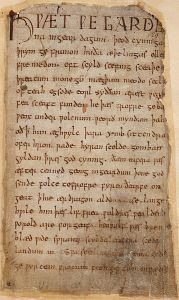
Beowulf, from Wikimedia Commons.

Slaying dragons is costly. In much of the western hemisphere the ultimate metaphor for the perils that await humanity in a world imperfectly understood, dragons were the bane of the medieval imagination. And earlier. Dragons are mentioned in the Bible and were stock creatures in the bestiaries of the Mesopotamian imagination. And, of course, it is a dragon that causes Beowulf’s fall. Almost a type of a latter-day Gilgamesh, Beowulf likewise holds an early, if non-negotiable place in the western canon. In this month’s Atlantic, James Parker discusses the dynamic of this pre-Christian poem in our post-Christian context. Specifically he addresses how modern renditions, perhaps inadvertently, Christianize the story. A popular subject for movies and graphic novels, Beowulf is a monster-hunting story that begs for baptism.

The story itself is familiar to most alumni of American high schools. Perhaps before we’re ready to be exposed to Old English, we find ourselves assigned a story of drinking, rage, and violence. Make no mistake—Beowulf is a hero. A deliverer like the judges of old. Grendel, after all, is the spawn of Cain, the evil seed that continues into a moody world of stygian nights and dismal swamps. Parker’s brief article demonstrates the reception history of the poem nicely. It also raises the question of what’s going on when heroes fight monsters. When the Christian imagery that’s deeply embedded in our culture comes to play Beowulf can’t help but become a Christian monster slayer just as Grendel becomes the enemy of God. All of this may be quite unintentional. What we see, however, isn’t imaginary. That’s the way reception history works.

Parker suggests that, although Beowulf is a pre-Christian poem, the cosmic order laid out in the tale is a Christian one. Even today in a post-Christian America it’s vital to understand how important religion remains. It’s not so much that churches are overflowing (unless they’re mega-churches stating that you can get rich by attending) as it is a recognition that centuries of Christian identity can’t help but leave their mark on culture. We see crosses in the handles of swords. Or even in the grid patterns laid out in city streets. Telephone poles. What’s so remarkable is that we see such things naturally and think nothing of it as we go on our secular way. There may be monsters out there. What may not be so obvious is that in slaying them we’re engaging in a religious activity as old as Gilgamesh, if not as obvious as a crucifix held up to a vampire in the present day.


Classic Fiction

The Epic of Gilgamesh is one of the ancient documents still widely recognized, at least by name. Many introductions to literature, or the western canon, refer to it. It is, in some senses of the phrase, the world’s first classic. I’ve read Gilgamesh enough times not to know how many times it’s been. During my doctoral days I was focusing on the literature of neighboring Syria (long before it was called “Syria”). As an aside, Syria seems to have gotten its name from the fact that non-semitic visitors had trouble saying “Assyria” (which was the empire that ruled Syria at the time). Leaving off the initial vowel (which was actually a consonant in Semitic languages) they gave us the name of a country that never existed. In as far as Syria was a “country” it was known as “Aram” by the locals. Back to the topic at hand:

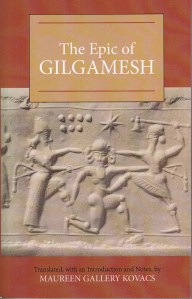
Although the story of Gilgamesh may be timeless, translations continue to appear. It won’t surprise my regular readers that I’m a few behind. I finally got around to Maureen Gallery Kovacs’ translation, titled simply The Epic of Gilgamesh. Updating myself where matters stood in the late 1980s, it was nevertheless good to come back to the tale. For those of you whose Lit 101 could use a little refreshing, Gilgamesh was a Mesopotamian king who oppressed his people. (And this was well before 2017.) The gods sent a wild man named Enkidu as a kind of distraction from his naughty behaviors. In an early example of a bromance, the two go off to kill monsters together, bonding as only heroes can. They do, however, offend the gods since hubris seems to be the lot of human rulers, and Enkidu must die. Forlorn about seeing a maggot fall out of his dead friend’s nose, Gilgamesh goes to find the survivor of the flood, Utnapishtim, to find out how to live forever. He learns he can’t and the epic concludes with a sadder but wiser king.

The fear of death is ancient and is perhaps the greatest curse of consciousness. When people sat down to start writing, one of the first topics they addressed was precisely this. Gilgamesh is still missing some bits (that may have improved since the last millennium, of course) but enough remains to see that it was and is a story that means something to mere mortals. Ancient stories, as we discovered beginning the century before mine, had long been addressing the existential crises of being human. Thus it was, and so it remains. No wonder Gilgamesh is called the first classic. If only all rulers would seek the truth so ardently.


Devil of a Time

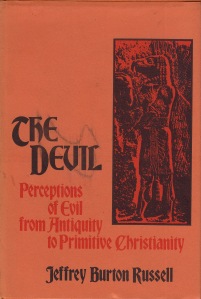
thedevilOne might be excused for thinking so much about the Devil these days. Displays of lies and evil intentions are on pretty obvious display at the highest levels. Indeed, the current political situation has me reassessing my skepticism about the Antichrist. One of the truly well thought out books on the subject is Jeffrey Burton Russell’s classic, The Devil: Perceptions of Evil from Antiquity to Primitive Christianity. The first in a series of books Russell wrote on the topic, The Devil opens with evil. Noting that the Devil defies easy definition, Russell begins rather disturbingly with literary descriptions of acts that can only be described as evil. This allows him to point out that real life events often surpass those that authors can get us to read, intimating that something is seriously wrong with the world.

Having noted that, the emergence of the Devil is not an easy one to trace. Evil has been recognized in many cultures and it has been explained in many ways. Some have personified it, but even that took a long and circuitous route to the dark lord we know today. Bits of Greek philosophy and Zoroastrian cosmology combine with an emerging monotheism among the Israelites and their kin until eventually we have an embodiment of evil appearing. Even so, the Bible has no clear image of who “the Devil” is. This took further developments beyond the New Testament and the image that eventually won out, so to speak, borrowed heavily from classical mythology. Eventually Old Scratch emerges in a recognizable form.

Belief in the Devil still runs high in American culture. I suspect it will run even more so in months to come. At the end of Russell’s well researched study, the Devil comes down to the blatant disregard for the suffering of others. One might think of the mocking of the disabled or the favoring of the wealthy over the poor. Evil may be known by many names but it is easily recognized by those not caught up in its worship. This became clear in the biblical quotations sprinkled throughout the book. “Woe unto them that call evil good, and good evil,” for example. Or “when an ungodly man curses Satan, he curses his own soul.” Mirrors may serve multiple purposes. The vain look into them and see only beauty. Those who believe in the Devil can’t help but know who it is that stares back.


Where Arthur?

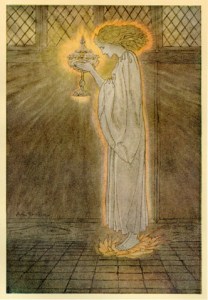
Arthur Rackham - "How at the Castle of Corbin a Maiden Bare in the Sangreal and Foretold the Achievements of Galahad," Wikimedia Commons

Arthur Rackham – “How at the Castle of Corbin a Maiden Bare in the Sangreal and Foretold the Achievements of Galahad,” Wikimedia Commons

We’re all grail hunters. It doesn’t matter what religion, if any, you claim. We want to find that grail. If I was as rich as Donald Trump I wouldn’t bother with the presidency. I’d spend all day on Atlas Obscura. A friend recently sent me one of their stories, “6 Stops on the Hunt for the Holy Grail” by Meg Neal. As the story points out, the grail may not be real, but many places claim it. We want it not because it’s real, but because it’s magical. Midas’ touch without the consequences. Blessings in this life and bliss hereafter. You can have it all.

Nobody knows where the legend of the holy grail begins. One thing’s for certain: it’s not the Bible. The Gospels merely state that at the “last supper” (not a biblical phrase) Jesus took the cup. That definite article implies a certain cup, not just any cup. While speculation has it that this meal was a Passover seder we can’t be sure even of that. If it were that wouldn’t tell us much about this cup in any case. Since the tale is especially prevalent in Celtic lore (many grail sites are in regions loaded with Gaelic influence) some have suggested that the story comes not from ancient Palestine, but from Hibernian traditions of the caldron. This would send seekers back to the mythology of Bran and his life-giving cauldron. In other words, it would share some roots with a modern kind of grail—that of Harry Potter fame. Bran, I once argued in an academic paper, has echoes of some ancient eastern tales. Scholars, of course, are not convinced.

The grail doesn’t come into prominence until the Arthurian legend. Arthur seems to have been an historical person, but facts about him are as rare as they are about Jesus. How he came to be associated with the grail is anybody’s guess. Both Arthur and the grail share a place in Celtic legend and it is perhaps here that the two were brought together. A more crass form of the cauldron is the pot of gold associated with leprechauns—those Gaelic sprites. The grail represents our wishes fulfilled. It’s seldom the spiritual journey that’s sometimes portrayed. The grail represents power. If Indiana Jones has taught us anything it’s that where there’s power, there’s also abuse of power. Then again, we don’t need fiction to know the truth of that.


O Brother

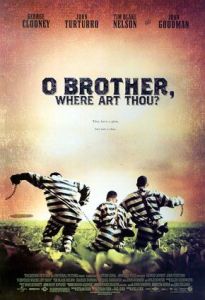
o_brother_where_art_thou_ver1When teaching mythology at Montclair State University, I had students watch O Brother, Where Art Thou? Based on Homer’s Odyssey, the movie follows a trio of convicts during a election campaign through depression-ridden Mississippi. The populist candidate, Homer Stokes, runs his campaign with a little person (but as a true Republican, he can call him a derogatory name and nobody blinks). Both Stokes and “the little man” are members of the Ku Klux Klan and even Mississippi of the 1930s won’t have that. How things have changed!

The movie comes to mind because of Friday’s march on Washington of women in favor of anti-abortion legislation. Look for the numbers to grow as the White House inaugurates comments about it. A few thousands gathered after last weekend’s 1.2 million—yes, a million more than expected—Women’s March on Washington. I respect these folks’ right to protest, of course. They might’ve done well to watch O Brother before heading out the door, however. The incumbent in Mississippi is Pappy O’Daniel. His clueless campaign managers have no ideas how to counter the populist Stokes. Junior O’Daniel suggests they could get an even shorter “midget.” Pappy, as if speaking to Friday’s marchers says, “Wouldn’t we look like a bunch of Johnny-come-latelies, bragging on our own midget, doesn’t matter how stumpy.” With apologies for the insensitive terms, size does matter. The First March had world participation of nearly 5 million. And that’s just those who were free that day.

I’ve been drawing quite a bit of wisdom from cinema lately. Maybe because it is often in harmony with vox populi. If it weren’t the industry wouldn’t be thriving. I think of O Brother and how the south in the 1930s makes us look regressive today. The good, Christian folks of Mississippi wouldn’t have a racist for their governor. When they saw what he really stood for, they voted for the lesser of two evils. Today we have a president that would’ve had a hard time being elected in that past. The tide has shifted to a more selfish and shortsighted instant gratification without benefit of education. “And our women, let’s not forget those ladies, y’all. Looking to us for protection! From darkies, from Jews, from papists, and from all those smart-ass folks say we come descended from monkeys!” Homer Stokes preaches in the light of a burning cross. Instead of booing him out of the town hall, we’ve asked him to lead the free world.


The First Weak

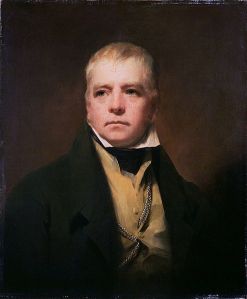
“Oh, what a tangled web we weave. When first we practise to deceive!” I always thought this couplet came from Shakespeare, but in fact it’s from Sir Walter Scott’s poem “Marmion.” The quote has been in my head all this first week of the new administration as alternative facts, lies, and statistics have flooded out of the White House. Along with gag orders slapped onto federal agencies. I’ve worked for people who rely on gag orders. This obvious lack of transparency signals loud and proud that they have facts to hide. Then they will feed the public alternative facts and later claim they never did. Mission accomplished. Sir Walter Scott may not have been William Shakespeare, but he sure got that web analogy right. At times like this we need our writers. Of course, Trump bragged in pre-inauguration interviews that he didn’t like to read.

Since last weekend sales of George Orwell’s 1984 have spiked. From the first words out of Sean Spicer’s mouth (or any words out of the mouth of Kellyanne Conway}, many of us knew the only thing Orwell got wrong was the date. Frankly I’m surprised the government hasn’t tried to ban 1984 yet. It was required reading when I was in high school and that date was still in the future. The press—what still exists of it anyway—passed along stories that Trump had ordered photos of the inauguration day crowds hung in the White House in his first week. Such pressing matters of state! The photos had the wrong date on them. Facts are cheap. This should be good for the economy. You can get them in any flavor you like—true facts, false facts, alternative facts, statistics. Arachne has returned to her loom.

Although “Marmion” wasn’t written by Shakespeare, I can still say it was because I need a segue to Harold Hecuba. Hecuba was a Hollywood producer who accidentally landed on Gilligan’s Island. After he insulted Ginger the castaways put on a performance of Hamlet to showcase her acting skills. Hecuba, the unelected president of the island, awoke during rehearsal and, like other narcissists we know, took over. He says that Shakespeare was a hack and that if he were alive he’d have him working on a complete rewrite. Of course, he doesn’t know what Hamlet’s about. Or “Marmion.” Actors only mouth the words. They make us believe what is not true. We’re in for a period when we’re going to rely on the authors for the true story. I suggest we all start with 1984.

William Shakespeare

William Shakespeare


We Are an Island

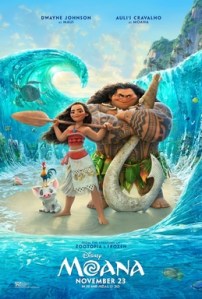
moana_teaser_posterApropos of both building your own deity and Disney, my family went to see Moana. Now, I have to admit up front to being a bit behind on my Polynesian mythology. Scholars of the history of religions feel terribly insecure if they don’t read the languages or haven’t spent time with the culture first-hand. I’ve seen the Pacific Ocean a few times, but never from the point-of-view of an islander. In fact, one of the areas of growing interest in biblical studies is the interpretation of Holy Writ by islanders. Their perspective, it seems clear, is different from others in more populated land masses. So Moana, which delves into Pacific islander mythology, was a brand new world for me. More than hearing about the demigod Maui, it was a chance to consider what destruction of our ecosystem looks like to those who have more limited resources at hand. Those who, when global warming really kicks in, will be the first to become homeless.

One of the strange things about living in the post-truth world (defined as the world after 11/9) is that many movies, novels, and other creative explorations I encounter seem to underscore the demon we’ve invited in. Moana is about a girl who saves her people, but she only does so by defying the man in power. Had she not journeyed beyond the reef, her people would’ve starved on their island. Meanwhile the big white man prepares to assault the White House and all that our founders held dear: an educated leadership. Progress. Fair treatment for all. Someone needs to remind these short-sighted individuals that every landmass is an island.

As we approach the end of 2016 it’s time to think of where we’ve been. At the theater, an ad by Google showed the newsworthy events of the year. There could not have been a better rendering of the high hopes with which we began and the sorrow with which we’ve come to an end. Our scorn of education has caught up with us and we’ve asked “the man” to please destroy our world and enslave our women and deport anyone who’s different. We need a lesson in how to build better deities. We need to be willing to admit that a girl might know more than her father. We need to learn the wisdom of the islanders.


The Wicked Man

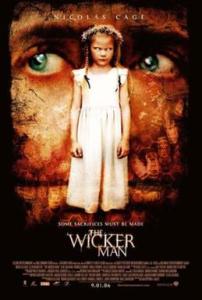
I confess, it was a moment of weakness. Or I could say that it was dedication to research. In either case, I subjected myself to watching the remake of the 1973 classic, The Wicker Man. The reviews that I’ve read over the past decade since its release had warned me not to subject myself to it. Not only did I, but I had my wife gamely watch it with me. If you plan to watch the flick but haven’t, I’ll first of all beg you to save your time and secondly warn you of spoiler alerts. So here goes.

By Source, Fair use, Link

By Source, Fair use, Link

In a movie that may be either pro-feminist or misogynistic, depending on which way you look at it, this version of The Wicker Man takes place in the United States. We’ve got all kinds of New Religious Movements in this country, so that much is believable. The film has a group of women who mute, deafen, and enslave their males moving from Salem, Massachusetts, across the country to Puget Sound where they can find an island to be left alone with their rituals. Superfluously adding an “s” to the original’s Summerisle, they come up with the sloppy-sounding Summersisle where they can raise bees. They worship the great mother-goddess, which is cool enough, but their religion appears to be cobbled together in a way that suggests those responsible for the movie didn’t do their homework. Although Sister Summersisle (five “s”es—count ‘em!) claims this to be a Celtic religion there are merely the weakest echoes of such.

To make matters worse, Edward Malus goes around beating up women when they get in his way. Yes, he is the unwitting victim—we’ve seen the original and know how this plays out—but it makes the viewer uncomfortable watching this unsympathetic protagonist punching, kicking, and even bicycle-jacking with a gun, the women of the island. A man comes ashore and the first thing he does is try to take over. Were there evidence of a deeper plot here it might suggest that this was intentionally written into it. As it turns out, however, as we enter a fearful era of the rich white man’s revenge, such scenes only suggest that Mr. Malus had it coming. Perhaps the movie is prophetic after all.

I really don’t recommend spending your time on the remake of what has become a horror classic. If you’ve seen the excellent original, you already know how it ends. And despite his brusque manner Neil Howie didn’t shout invectives at women or punch them in the face. In short, he took his fate in what might be a way that is also prophetic.


Foundation Myths

Foundation myths are some of my favorite myths. If you’ve got to believe in something, it may as well be something fun, right? Usually before I travel to a place I do some research on it. For some reason November of this year has proven to be under a kind of shadow and I wasn’t thinking clearly in the run-up to this year’s AAR/SBL meeting in San Antonio. I’d traveled here once before, and when I raise that occasion with anyone the automatic response, like so many automatic sprinklers, is “that was the year it rained.” This may be the year of the flood, but at least the skies have been dry. I decided to make up for my lack of knowledge by taking in the markers along the River Walk. There’s quite a lot about saints and the founding of this city. I learned that it was named for Saint Anthony of Padua. The site of the first mass, in 1691 (just a year before hell broke loose in Salem) is marked with a granite slab along the green river with its endless supply of ducks.

We’re fond of naming cities after saints. San Francisco, Saint Louis, Saint Paul, San Diego, Saint Petersburg. Perhaps we’ll soon be adding Leningrad to that list. I suppose we like to compare our communities to our better angels. We’re all trying to be good, after all, aren’t we? With all these saints looking over us these ought to be very kind cities indeed. We have yet to name a major city after Jesus, but that doesn’t stop the saintly communities from trying to cash in on the big name.

img_3051

Conversion has become a somewhat problematic concept. In current doublespeak we would all be better off if we were the same. If what I’m hearing is correct that means Caucasian, male, pseudo-Protestant, and rich. Well, we don’t want too many to be rich—it’s hard to feel special if too many join the country club. Our saints are those that know how to shuffle the money and make it all look above board. Meanwhile we can sell our Jesus tee-shirts and have those admittedly Catholic saints stand guard over our walls and bless our rifles and condos. It’s pleasant to live in the new promised land. Too bad the good Lord made some kind of error the first time around, but to forgive is divine, after all. I think we can afford to be magnanimous when we’ve got the saints on our side. Myths are so much fun to believe.


Big Dreams

giants_and_freia

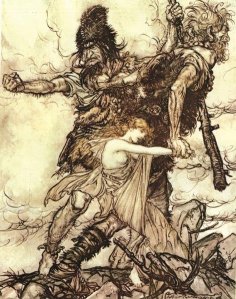
The giants are back! Or at least they were here. According to the internet, and we know that that never lies. Every now and again a story breaks that some discovery of giants has been found in some archaeological or paleontological context. A little poking around, maybe a visit to Snopes, and I go home disappointed. It’s the Cardiff Giant all over again. Still, the stories are fun. A friend sent me a piece from Ancient Code entitled “A GIANT footprint has been discovered in China.” The pictures look impressive until we get to the one where the footprint is as large as a fully grown man. We are back in the land of modern myth.

The idea of an era of giants is strangely compelling. The Bible isn’t the only ancient document to suggest this scenario. In fact, Holy Writ seems to have borrowed the idea. Fast forward just over a millennium and Geoffrey of Monmouth will tell us there were giants in Britain before the more civilized genus of our own arrived and treated the giants to a Brexit. Such tales permeate history with the fanciful period of really big guys from the past. We’re not half the men we used to be. Literally. Just don’t look too close at the Photoshopped evidence. We live in a world where “Photoshopped” is actually a word. A world where visual evidence is like a cow plop. It’s there, but what you want to make of it is up to you. I was never a big newspaper reader, but at least you knew if a reputable rag paid to have millions of copies printed the story had a good chance of being true. I wish there had been giants. Reading the news today, we seem very petty indeed.

Any number of explanations have been proffered for why ancients believed in giants. Perhaps they found fossilized dinosaur or mammoth bones. Admit it, except for to a biologist, a femur looks pretty much the same whether it comes from a giant reptile or a moderate-sided primate. Economics of scale. Or look at those Egyptian pyramids. Sure looks like they had a hand from a really big brother. But in our strangely less and more gullible age, lingering doubts remain. The Bible says there were giants on the earth in those days. The mechanics of gods mating with human women are blamed, no matter which laws of physics have to be broken. For the literalists way down along the Paluxy River in Texas we were walking with dinosaurs back in the day. Too bad no fossilized cameras have yet been discovered.


Scary Pictures

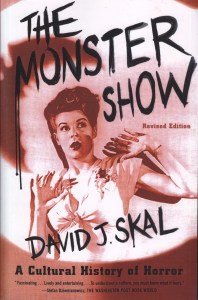
monstershowThroughout its history, until quite recently, one of the most serious natural enemies to the horror movie was the religious establishment. At times this antagonism seems well placed as horror films often take theological concepts and stand them on their heads. Within the last few years, however, thinkers of religious thoughts have come to an uneasy accord with some horror movies as vehicles for the kind of thinking promoted by traditional religions. The first half of this dynamic appears clearly in David J. Skal’s The Monster Show. Written before any kind of detente had been reached, his book chronicles skirmishes between the Production Code, religious groups, and even women’s collectives, against what was considered indecent and degrading. We have come to realize, however, that we are the monsters. We are the degraded. And seeing these films can lead to a strange sort of solidarity.

Most classic monsters, after all, have their origins in religions. Even the most recent of the lasting undead—Frankenstein’s monster and zombies—have origins in religious thought. Mary Shelley’s novel was subtitled The New Prometheus, a reference that anyone in the early nineteenth century would have understood. Zombies, on the other hand, are a product of vodou. Religion can’t get along very well without its monsters, and despite their less-than-stellar looks, their screen appeal is undeniable. Maybe it’s just we don’t like our dirty liturgical laundry being hung out where anyone might see it.

Skal’s treatment doesn’t stop at the cinema. He has a chapter on modern vampires, and Stephen King has earned his own chapter (or at least most of one) as the poet laureate of the novelistic form of the genre. More often than religion, Skal traces what’s happening in the monster world to the larger social issues of the day. Quite rightly so, as scary movies go nowhere without a receptive viewership. Looking around these days it’s easy to be scared. Even what was once a grand occasion of debate over higher principles as we ponder our next leader has become a farce in one of the parties that could make its own horror movie. Hitler, it is said, was a huge fan of King Kong. Large apes manhandling women never seem to go out of style. Some call it horror. Others try to get away with saying it’s politics. While the daily commute grows more and more dangerous, and the rhetoric grows even worse, is it any wonder we like to dim down the lights and watch monsters that we know really can’t get us at all?


Enter the Labyrinth

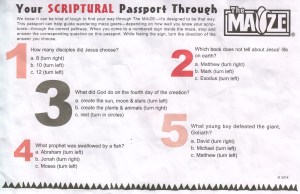
Trying not to think too much about Children of the Corn, I visited a corn maze over the weekend. This particular autumnal activity highlights just how much detail a human mind can pick out in a mass of sameness. You can tell if you’ve been to this particular juncture before—that oddly shaped leaf, or that peculiar stone, or that specific ear with the missing teeth will give you the clues. This particular maze, however, also uses printed clues. Before you enter the labyrinth, you may choose your species of guidance. There were 4-H clues, Girl Scout clues, history clues, and more. One of my companions handed me the scriptural clues. Although it may have been an obvious connection, I thought about it in terms of salvation. A corn maze is not unlike life in the real world; confusion, false leads, and aimless wandering. Having a guide—in my case, knowing the Bible—will lead you out.

corn-maze

Of course, the point of a corn maze is the fun of getting lost. This particular farm had eight acres dedicated to fall fun, and our party did get hopelessly mired in one location and had to ask for help from the corn cop who wanders like a friendly minotaur, or maybe a personal Daedalus or helpful Ariadne, directing those who’ve lost their way. The idea is that once you enter the maze, you look for numbered clues at various junctures—only a few crossroads have them—and answer the question for instructions about which way to go next. Even with the Bible in hand, or in head, we managed to lose our way. Baptized by a sudden cloudburst, we sought shelter in an open field. The only way ahead was to press on.

Those who’ve been with this blog for any length of time know that it is intentionally kind of a labyrinth, often using metaphor. In the case of the literal corn maze and its clues, minimal biblical knowledge was required to figure out the correct way to turn. The trick was even after getting all the hints, there was still some distance to go. Wet, confused, and having only our wits to go on, by trial and error we made it through. Our instructions—for we each had a different set of questions—only got us so far. My biblical guide was damp and see-through with the soaking we received. Metaphors were falling as fast as the rain. After all, the point of a corn maze is that you don’t get your money’s worth unless you get well and truly lost.


Finite Gods

Just how many gods are there, anyway? Well, that’s not really a fair question. For one thing, do I mean “real gods” or gods that people believe in? Do I mean “believe in” or made up? Do I mean “made up” or intentionally fabricated? And the nesting questions could go on and on. Over the years in my professional capacity as an erstwhile teacher, I accumulated books listing the deities of various cultures with brief descriptions. I once even argued that using “god/goddess of” (the divine-genitival construct) as a phrase distorted ancient concepts of divinity. The fact is people have believed in many gods in many different ways. As modern scholars of religion we’ve only begun to reach the heavens (or underworld, or anywhere in between, for deities may be found anywhere). This issue comes to mind because a friend recently shared a story from IFL Science about a new Etruscan goddess. The piece by Ben Taub mentions a stone recovered from Poggio Colla, a site in Italy, written in Etruscan. The stone seems to mention a new “fertility cult” goddess. And once again religion and science have met, but not quite kissed each other.

Photo credit: Jastrow (2006), Wikimedia Commons

Photo credit: Jastrow (2006), Wikimedia Commons

Let’s begin with the Etruscans. Before the Romans, Etruscans lived in Italy, giving Tuscany its name. We know very little about them, as their language (Etruscan) is rarely found and imperfectly understood. Some of the classical gods may go back to Etruscan originals, and the Etruscans seem to have known of at least some of the cultures of the ancient Near East, or ancient West Asia. We have no idea how many deities the Etruscans recognized. Polytheism, for all its heathenish exuberance, never had a problem with adding more gods. Interestingly, the “new” goddess mentioned here, Uni, is someone I used to talk about in my Rutgers classes on ancient Near Eastern religion some five-plus years ago. Pardon my crowing—I seldom get to suggest I was ahead of my time.

What really interests me here is that websites that advocate science still take an interest in religion. Although belief is relegated to inferior minds (generally) science does admit, from time to time, that it’s interesting. The study of religion, in at least some schools, is a scientific enterprise. No, we don’t put gods under microscopes (telescopes might be more useful) but we use the same techniques as empirical studies of nature use in order to try to draw some conclusions about religion. Despite the fact that the vast majority of humans on the planet are believers, higher education has consistently under-funded or disbanded departments who apply rational thought to religion. We suppose that someone else can pick it up and study it, coming to useful conclusions without putting in all the homework. Don’t mind me, though. I’m just basking in the light of having known about Uni years before she was discovered.


The Canine Mystique

BlackDogAnyone who spends long enough in the United Kingdom will hear about them. Not everyone believes in them, but reports of their presence are pervasive. Some call them ghosts while others call them protective spirits. They are the black dogs. As Mark Norman points out in his new book Black Dog Folklore, the tales of these spectral canines go back centuries and they also appear in other parts of the world. The majority of the lore comes from the British Isles and even there they are concentrated into certain parts of the country. Norman isn’t setting out to prove that they exist, though. This book is an exploration of folklore and the question of the reality of the phenomenon isn’t the point. The fact is people have reported encountering similar kinds of black dogs that vanish in similar ways frequently enough that secondary characteristics can be described and the accounts can be treated as lore.

Dogs were the earliest domesticated animals. Long before cattle and sheep could be tamed, humans and dogs had learned the mutual benefits of each other’s company. This very long association between species has, however, not always been smooth. Dogs retain something of the ancestral wolf in their nature, even as we harbor our inner ape. Some people fear dogs, and indeed, dogs are still used for security and can be trained to attack, or even kill, people. Their millennia-long association with humans, however, has assured them a place in our mythologies. Ancient cultures frequently mythologize dogs, making them prime candidates for an afterlife in folklore.

Traditionally, dogs are chthonian creatures. That word tripped me up the first time I encountered it. “Chthonian” is literally something like “of the earth,” but in mythology it is used to designate that they are associated with the underworld. As in life, dogs may act as guides in mythology, and one of their regular associations is with the realm of the dead. It’s no wonder, then, that dogs came to be associated with ghosts. As Norman demonstrates, the lore was pervasive enough to engage Sherlock Holmes in The Hound of the Baskervilles, and perhaps even Bram Stoker used the image in Dracula. Winston Churchill referred to his depression as a black dog. Norman’s book won’t convince the reader that such things actually exist, but what it does do is draw the tales together to determine what there is to analyze. Since dogs have been our companions for so long, they have become part of our narrative tradition, participating in what it means to be human. As with all good folklore, there are those today who still swear these spectral dogs still haunt those who are willing to believe.