Actual Intelligence (AI)

“Creepy” is the word often used, even by the New York Times, regarding conversations with AI.  Artificial Intelligence gets much of its data from the internet and I like to think, that in my own small way, I contribute to its creepiness.  But, realistically, I know that people in general are inclined toward dark thoughts.  I don’t trust AI—actual intelligence comes from biological experience that includes emotions—which we don’t understand and therefore can’t emulate for mere circuitry—as well as rational thought.  AI engineers somehow think that some Spock-like approach to intelligence will lead to purely rational results.  In actual fact, nothing is purely rational since reason is a product of human minds and it’s influenced by—you guessed it—emotions.

There’s a kind of arrogance associated with human beings thinking they understand intelligence.  We can’t adequately define consciousness, and the jury’s still out on the “supernatural.”  AI is therefore, the result of cutting out a major swath of what it means to be a thinking human being, and then claiming it thinks just like us.  The results?  Disturbing.  Dark.  Creepy.  Those are the impressions of people who’ve had these conversations.  Logically, what makes something “dark”?  Absence of light, of course.  Disturbing?  That’s an emotion-laden word, isn’t it?  Creepy certainly is.  Those of us who wander around these concepts are perhaps better equipped to converse with that alien being we call AI.  And if it’s given a robot body we know that it’s time to get the heck out of Dodge.

I’m always amused when I see recommendations for me from various websites where I’ve shopped.  They have no idea why I’ve purchased various things and I know they watch me like a hawk.  And why do I buy the things I do, when I do?  I can’t always tell you that myself.  Maybe I’m feeling chilly and that pair of fingerless gloves I’ve been thinking about for months suddenly seems like a good idea.  Maybe because I’ve just paid off my credit card.  Maybe because it’s been cloudy too long.  Each of these stimuli bear emotional elements that weigh heavily on decision making.  How do you teach a computer to get a hunch?  What does AI intuit?  Does it dream of electronic sheep, and if so can it write a provocative book by that title?  Millions of years of biological evolution led to our very human, often very flawed brains.  They may not always be rational, but they can truly be a thing of beauty.  And they’re unable to be replicated.

Photo by Pierre Acobas on Unsplash

Self Finding

I had occasion to peruse the Dictionary of American Family Names recently.  I realize that other people’s genealogy is generally boring, so I won’t provide the details, other than to say that “Wiggins” seems to be Breton in origin, way back when.  In any case, I checked my other ancestral names to find that they were either Germanic or unknown.  That made me feel a little special (an unusual feeling, to be sure).  I may be a mutt, but I’m a mutt with mysterious background.  Can you feel the mystique?  The thing about our origins is that they’re irresistible.  When I was still employed as an academic, one summer I was completely enthralled by the state archives in Madison and spent hours and hours researching—trying to figure out who I am retroactively.

This was before the need for horror films reasserted itself.  I was living the dream, employed in the profession for which I’d trained.  Or at least close enough.  At Nashotah House there was no real measure of academic productivity.  I was publishing at least an article a year and I had the draft of my second book written.  But who was it that had written that book?  What did I know about that person and where he’d come from?  My family names, at least until I get back to the inevitable Smith, are all pretty distinctive.  As a child “Wiggins” was a rare name, but it is the most common one from among my grandparents.  Perhaps all this Teutonic weight helps to explain my endless pondering.  Perhaps not.

Origins have always fascinated me.  The other day I was glancing over all the books on Darwin and Genesis that I had collected and read in those Nashotah House days.  Those were for the book that had never gotten written.  And names (and their origins) are all about identity.  Other people we meet want to know what we’re called.  Surnames, especially, convey quite a bit of information about us.  They might locate us geographically or ethnically.  It’s really a wonder that they’re not protected information.  Indeed, if you reveal too much genealogy online someone might be able to answer one of your security questions!  I suppose that’s another reason to keep your ancestry to yourself.  We do, however, take some of our cues for our identity from our names.  Family names aren’t generally chosen, except in cases of name changes.  And those can be tricky for those seeking to learn who they are.  Who am I? It depends on when you ask me.


Hard to Say

There’s no easy way to say this, so I probably shouldn’t try at all.  Still, I feel compelled to.  You see, I’ve sat on admissions committees and I’ve written my fair share of letters of recommendation.  The former (admissions committees) have a difficult kind of calculus to compute.  Schools need students and their tuition money—this is, after all, the capitalist way.  (Yes, there are alternatives, but boards of trustees have severe deficits of imagination.)  Some schools get around this by being elitist.  Generally they have endowments of very old money and can weather all but the most severe of storms.  Such universities are in the minority and so the rest, and various small colleges, need to compromise from time to time.  Money or integrity?  You cannot serve both God and mammon.

At the graduate level this becomes even trickier.  Grad students bring in more money, and getting into grad school used to (and here’s the difficult part) require what some admissions folks secretly call “special intelligence.”  The paperwork and in-person interview reveal it clearly—this candidate (not always from a privileged background) displays a canniness that suggests they might really have a truly unusual ability to reason things out.  This is someone who should be admitted for advanced work.  But if you apply that principle not only will you be called “elitist,” you’ll also run out of lucre.  The solution is simply economic—let those who don’t have this kind of special intelligence in.  I have seen Ph.D.s after names from schools that I had no idea offered doctoral-level research.  And they legitimately call themselves “Doctor.”

When choosing a grad program—go ahead, call me elitist, but then interview me and see that it’s not true—I knew it had to be at a world-recognized research institution.  I ended up at Edinburgh, and my bubble was already deflated when I told family from western Pennsylvania and they supposed I was going to Edinboro College (now Edinboro University of Pennsylvania), located maybe 50 miles from where I grew up.  I had been accepted at Oxford and Cambridge, however, neither of them could offer scholarships to a penniless Yank, but the famously frugal Scots were far more generous.  And let’s face it, Scotland is more exotic than England.  You have to admit that much.  Of course, the deciding factor was, in my case, money.  You have to wonder if there’s any possible way of escaping it.  From all appearances, mammon wins.


Human Capital, Are You?

Human capital.  Is there any more demeaning phrase?  Those in positions of political authority like to use the term.  To grow the economy, to people the military, to ensure the GDR Almighty surpasses each and every idol, we have to ensure the correct placement of our human cattle.  Oh, I mean capital.  I was recently reading about our rivalry with China.  The expert I was consulting noted that it all comes down to human capital.  With populations shrinking, this is annoying to those who want to measure nation against nation, back to back.  In China, it’s said, your fate is determined at a fairly young age.  And that made me wonder about late bloomers.  Like yours truly.  To see me up through at least fourth grade nobody would’ve supposed I was Ph.D. material.  (Considering how this all worked out, maybe they were right.)

Humans, if we’re honest, mature at different rates.  Some of us take decades to learn what we’re good at.  This may be a problem endemic to the poor—kids who are raised by parents that are uneducated and don’t even know about things like after-school classes and clubs to enhance the experience of growing up.  Or if they do know about them, can’t afford them.  They raise their children to be blue collar in mentality.  Of course, capitalism relies on this.  You need human capital to collect garbage and dig ditches.  To people the military.  I often wonder how many of these folks might’ve been (and still could be) hidden geniuses.  You see, when I grew up working as a janitor in my middle school, during the summers, I listened to the hourly employees as they talked.  It wasn’t all about women and alcohol.  No, some of them were untrained philosophers.  I learned that I wasn’t the only human capital that thought deep thoughts while running a floor stripper.

The very concept of human capital ensures that some potentially world-changing kids will be overlooked and slotted where “society needs them.”  If we would educate ourselves more our world could become a more equitable and pleasant place for the 99 percent.  Instead, we keep the capitalist machine fed, nations comparing one another’s capabilities.  China may use balloons creatively, but we can be assured that all developed nations are surveilling their neighbors, assessing how they’re using their human capital.  All I know is that I grew up destined to work as a janitor, but the thoughts in my head wouldn’t stop.  And one mentor, who worked for a church, decided to show me the way.  How I wish I could help others escape, but there’s some comfort in being part of a machine.

Which bit are you?

Just Being

You know, I sometimes resent being forced to be something I’m not.  In these days of tolerance and letting people be themselves, the bullies have taken over, forcing the rest of us to clean up their messes.  Take politics, for instance.  I have no interest in it.  From the beginning of this nation to the present the political inbreeding has been obvious.  Wealthy families presuming that riches mean you know how to govern—since the beginning they have set the tone.  Voting is always important, but how can you be anything else when you need to be a constant political activist just to assure politicians are actually doing their jobs?  I’m no micromanager—in fact I’m okay with just getting by.  Still, I feel compelled to spend my time keeping an eye on corrupt politicians.  How are you supposed to write books?  Imagine what we could accomplish if they’d just do their job!

Or consider business.  It’s tax season.  Every New Year marks the time when you need to keep track of what you spend on what because accountants, backed by politicians, can’t keep their noses out of other people’s money.  You want to eat?  Find a place to sleep out of the incessant rain?  Then you have to play the capitalist game.  There’s no opt out short of heading under the bridge and going through trash cans for your next meal.  Those of us who are creative don’t really impose our wills on others.  You don’t like what I write?  Don’t buy my book.  (And I speak with authority on this particular point!)  Nobody forces you to look at art.  (Although they do force you to listen to music in many stores, even if you’d rather shop in silence.  This, I think, is a business decision.)

Image credit: Warren K. Leffler, public domain, via Library of Congress

One of the reasons a monastic vocation appealed to me even as a young Protestant was that I need time to think things through.  To contemplate.  To try to make sense of all of this.  I’m not motivated by money or power.  I want to be with others who just want to be.  I’m not lazy and I don’t mind being productive.  It’s just that, well, can’t things not be about money for a while?  Can’t politicians just act like actual adults with a moral center for a time?  The religious leaders who managed to do this were quickly commodified.  In this cloud-smitten winter I’m in the mood for lament.  Some of us want to live authenticly, but those with power and money simply won’t allow it.


Something I Said?

I’m very aware of my own insignificance.  I know that I’ll die and be forgotten, just like everybody else.  Even if I manage to survive by some “Kilroy was here” action, the sun will eventually red giant all of this out of existence.  Still, sometimes I wonder if it’s something I said.  You see, I really didn’t know where to start when I published Holy Horror.  I was an editor myself and thought maybe the secret handshake would earn some kind of attention, but no.  And when I wrote both Nightmares with the Bible and The Wicker Man, both were with established series.  And in latter cases, the editor I was working with (long-term employees, both) left.  Left before the book was published and I was left wondering.  Was it something I said?

Not to brag or anything, but I’ve got about the lowest self-image a person can have.  When life beats you up repeatedly, starting at a young age, you quickly learn your place.  But still, all this leaving.  I’m a member of a faith community (if you want to know which one you’ll need to get to know me personally).  This particular tradition requires a meeting with the minister before joining—something that makes good sense.  The first church where we tried this, the minister was in the process of leaving and couldn’t schedule us in.  Then we moved and in our new area, the minister left about a month after we started attending, before we could meet.  Was it something I said?

I ask this question half in jest.  Still, having a father leave when you’re only two or three, you start to question just about everything.  I’m sure retirements, new opportunities, or just fedupness with the job (which I certainly understand) caused these changes.  But then I was ousted from three jobs in fairly quick succession.  During my interview at Rutgers University the chair of the religion department said “You must feel like you have a target painted on you.”  Leaving is a natural part of life, I know.  As an editor I know that leaving such a post is somewhat unusual because where do you go from here?  Ministers, well, they’re leading the charge during the great resignation.  Maybe they’ll become editors?  As for the rest of us, we’ll just continue to spin dizzily on this globe until old Sol stretches his arms and lets out a big, red yawn.  I won’t be here by then, but wherever I am at that point, I’ll be wondering if it was something I said.


Learning English

English is a difficult language to learn.  Growing up monolingual, I was able to pick up German, Greek, and Hebrew (and other semitic languages) without too much trouble, through intensive schooling.  I have to wonder if those learning English as a foreign language don’t have a much more difficult task.  The other day I was looking at a document in Icelandic (don’t ask), and marveling how I simply couldn’t penetrate it, although it is Indo-European.  Then I sat down to read an article in English.  The topic was of interest to me but it was clear that the content wasn’t written by native speakers.  Indeed, it turns out the authors were from an Indonesia university.  The journal was published by an Indonesian press.  It’s peer reviewed, but those who run it aren’t native English speakers.

Interestingly enough, although the article wasn’t in the field in which I was technically trained, I was able to follow what the authors were saying.  Partially it was because of my familiarity with the topic, which I’d read about before, but partially it was that you can read English without the direct and indirect articles that are our usual guideposts, and with the wrong verb tenses and declensions.  It is possible.  You wouldn’t want this, I suspect, if you were building a rocket carrying people into space, but it isn’t that much different from trying to read the instructions that come with most devices that are manufactured in nations where English is a foreign—very foreign—form of communication.  I admire their pluck.  I still recall enough German that I can get through some documents without generating more gray hairs, but I wouldn’t dare try to write to someone in it.  Nein.

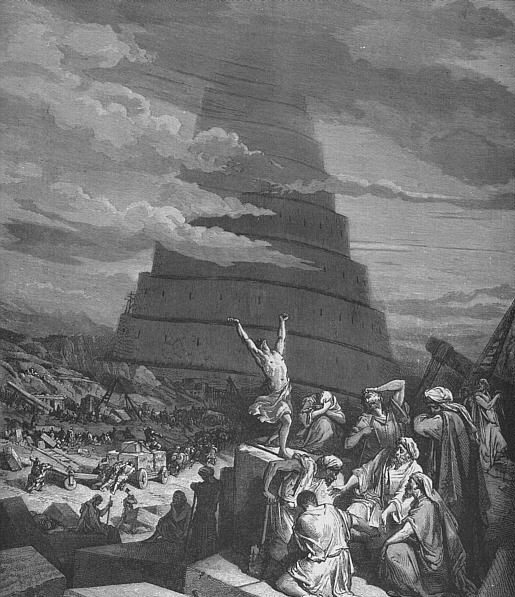
Languages are fascinating elements of human culture.  Although there was no literal tower of Babel to create them, our species, in isolated areas, learned a variety of different ways to communicate verbally.  It’s only with travel that these isolated groups met and generally they try to talk, unless they simply kill strangers on sight.  We want to understand one another.  We all know that our language learning skills are at their peak during our very youngest years.  Brains get ossified into using one language to think and as you age it’s harder to pick up new ones.  Still, we have that old isolationist tendency hardwired as well.  Us versus them.  And if we can’t understand we quickly distrust.  Language study is probably one of the best ways to ensure peace.  If we can’t do that, at least we can try to read our language through the eyes of someone who’s made the effort, even if it’s difficult for us.


More Scary Stories

There might be a disconnect.  As a child the stories I had read to me were either Bible stories (Archway Books) or wholesome Easy Readers.  I think that was pretty typical in the sixties.  We didn’t have a lot of money but an abundance of respect for the Bible, so the former by far predominated in my literary experience.  As any kid will do, I thought this was normal.  There was a stir in the kids’ world two decades later, in the eighties, when Alvin Schwartz began compiling scary folklore and retelling it for children.  His Scary Stories to Tell in the Dark series has been challenged or banned from the start.  Most parents don’t want to admit that their kids like scary tales.  We didn’t direct our daughter’s reading much when she was old enough to pick Scholastic Books, and one time she wanted Scary Stories.

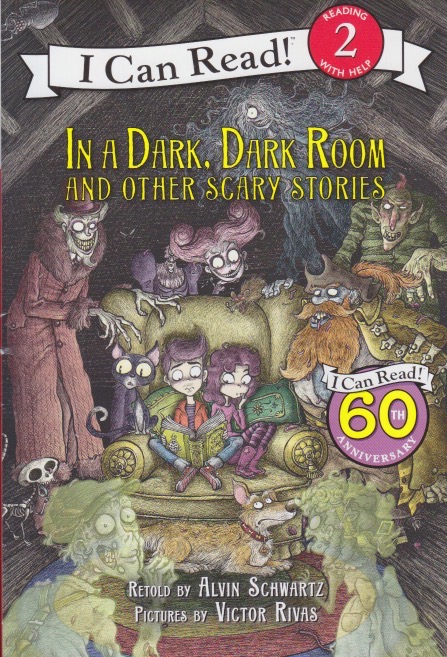
We were a bit shocked, not by that, but when a relative got us started on Roald Dahl.  His somewhat macabre children’s books were fine.  One of them, however—and I can’t recall the title—it’s packed away in the attic—was stories for older kids and it was so gruesome that I had difficulty making it through.  Not for me, but thinking about it from the perspective of a young child.  I recently had cause to read In a Dark, Dark Room and Other Scary Stories, again by Schwartz.  The copy I read wasn’t an original edition, but had illustrations, in color, by Victor Rivas.  I tried to think how scary such tales must be for kids who don’t know them already.  These illustrations were humorous, which helps, and tended toward Victorian or Edwardian style. Encountering such ideas for the first time, however, could leave an impression.

We tend to find olden times scarier than our own, it seems.  Partially this is correct, I suppose.  Science has helped us delay the inevitable by ameliorating many things that were formerly deadly.  At the same time it has helped those interested in such things to develop even deadlier weapons.  Mass shootings have become more common, to be mingled with the quotidian horrors of daily life.  Ghost stories hardly seem to be the most scary thing anymore.  I don’t know the answer to when kids are psychologically ready for scary things.  I still recall our neighbor—she was a few years older than we were—telling my brothers and me scary “true” stories that happened in the woods just across the street.  Those were in the “innocent” days before printed ghost stories for kids, but they gave me nightmares even so.  It was, however, the machinations of “Bible believers” that led me back to horror as an adult.  It’s kind of a disconnect.


No Doubt

The mind inclined toward doubt is in for a rough ride in an evangelical childhood.  I recall vividly my many, many hours struggling against doubt, trying, crying, praying for certainty and faith.  Many, many dark nights of the soul.  Attending college and seminary I learned of the others in history who struggled the same way, or at least similarly.  I also learned that doubt is natural and healthy, it protects us from falling headlong into the many snares and traps the world continually sets for us.  Blind faith, as I recently quoted from Kurt Vonnegut, is dangerous to everyone.  I was thinking about this again the other day as there was something I fervently wanted to happen but I just couldn’t bring myself to believe would actually come to pass.  My mind isn’t built for blind faith.

Given that, it probably isn’t any surprise that I went into religious studies as a field, even though it’s a dead end.  I still believe it’s vitally important, but that’s a belief much of the world doesn’t share.  It’s one of the few fields of study where a doctorate leaves you without job prospects if you don’t get a teaching post, if you’re not ordained.  And should doubters be wearing clerical collars and preaching to those who want to believe?  Belief is malleable.  It changes over time and it does so via its constant interaction with doubt.  It leads to a life of second-guessing and constant reassessment.  I suppose that’s why I’m baffled to see politicians with less education being so cock-sure that they’re right about things.  I doubt they know what they’re talking about.

Institutions take on lives, like people do.  Although I disagree with the treatment of corporations as individuals by law, still, I understand the thinking behind it.  The church, for example, grew to be a very powerful force in the fourth-century Roman empire.  These collective individuals had vested interest in keeping that power as the church grew more and more influential.  That dynamic still exists where even a small, non-denominational group gathers and asserts that it alone is right.  All you have to do, it tells its members, is believe.  Don’t doubt.  And if you do doubt you’ll be excluded.  Exclusion is difficult to bear.  But even doubting Thomas has hundreds of churches named after him.  Each, no doubt, has many true believers as members.  And on the outside mingle the doubters.


Scraps of Paper

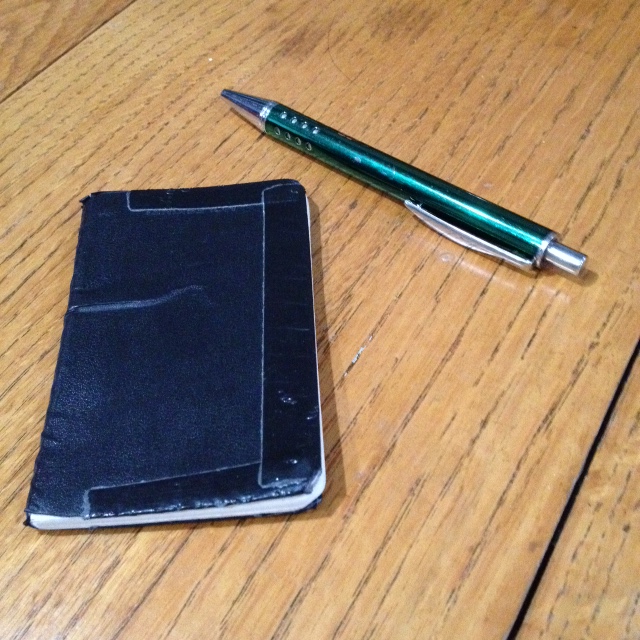
My wife is a saint.  She doesn’t throw away the little scraps of paper on which I write notes to myself.  They’re everywhere.  And this even though I carry around a notebook to capture ideas.  Sometimes I left it in the pocket of another pair of pants, or on the bedside table.  And I need to write something down.  Soon the scrap is filled with vital info (at the time) and eventually gets mislaid.  When it’s found I need to go over it line by line to see if something remains crucial or if it was just prosaic (get oil change, set up eye doctor appointment, etc.).  You see, ideas can strike at any time.  I keep a commonplace book inside the door in case they do when I’m out jogging.  I now keep a separate notebook on the bedside table in case something occurs as I’m falling asleep.  And, of course, I keep my little zibaldone with me (when I’m wearing the right pants).

Those who believe electronics will save us suggest putting everything in a notes app.  The problem is that I have several.  I do most of my initial writing in Scrivener.  When it’s time to share either with a publisher or a colleague, I convert it to Pages, and then to Word.  But my devices also have Notes, which I can see synced on my phone.  That makes it handy for shopping lists and such.  Then there’s also Text Edit, which I use for rtf documents.  Where an idea gets saved depends on which app I’m using at the moment.  More scraps of paper, virtually.  I need to write it down so I remember what’s where.

All of this led to a rather embarrassing situation the other day.  As usual, I’m at work on another book.  Since writing about horror isn’t something I was trained to do, I have to do quite a bit of bibliography building along the way.  This is the kind of thing you learn in higher education, so no worries.  The thing is I had started a bibliography in one app and began writing the book in another.  I’d very nearly finished a draft of the book when I just happened to scroll through the folder where my former bibliography was kept.  I was stunned to learn I’d already done this work since I didn’t remember recording this at all.  I suppose the solution would be to record all my thoughts.  But that would be too dangerous.  And besides, when would I have time to review them all?  I guess I still prefer scraps of paper, even if they’re sometimes electronic.


Everything

It’s been getting a lot of press, Everything Everywhere All at Once has.  It’s been winning awards and it demonstrates that absurdism isn’t dead.  Absurdism is an essential element of existentialism, the philosophical school with which I most closely identify.  I had no idea others found it so appealing.  This movie’s difficult to encapsulate—the summary on Wikipedia is actually not bad—but it has to do with human potential when living in a multiverse where every decision splits the ‘verse into new bubbles where your actions play out in all possible ways.  And, of course, it’s tax season.  There are clearly elements of The Matrix here, as well as Brazil.  And it’s distributed by A24.  The message is good, as the story plays out.  The images are impressive and confusing and will make you think.

From the time I left home I’ve looked for two main elements in movies—they should make me feel and make me think.  When they do both they are successful.  Everything Everywhere All at Once is successful.  It also reminded me of how healing existentialism can be, which is what drew me to it in the first place.  Life, or to point a finer point on it, consciousness, is absurd.  You can follow the same rules and get different results each time.  And you have to live with the consequences.  If you think about it too much it leads to despair.  I need, and it seems others do as well, to be reminded once in a while that absurdity is endemic in this universe.  How else can we explain Trump?  Existentialism breaks in on reality and I used to self-medicate with Nietzsche and Kafka and Camus.  Lately I’ve been using horror.

The thing about absurdity is that it’s funny.  We may not laugh about what the universe hands us as much as we should.  Existentialism also holds that darker element called dread.  Sometimes that comes to the foreground.  In my own life, I guess I thought getting a Ph.D. from a major, internationally renowned, research university might help.  I had forgotten the role absurdity plays in all of this.  Everything Everywhere All at Once shows the universe, or multiverse, is the ultimate trickster.  There are those, serious scientists, some of them, who believe that each decision does split off another universe and that all possibilities play out somewhere in the multiverse.  Even if that’s true, we’re stuck in this one.  It makes sense, therefore, to laugh at it once in a while.


Aging Children

So I was reading this academic article from the late fifties.  In it the author was discussing how, in literary studies, imagination was considered childish.  It is something we’re expected to outgrow to participate in the adult world of cold, hard facts.  (Making money and such nonsense.)  And I came to think about the elderly I know.  You see, I’m part of that sandwich generation where children take longer to grow up and need more care longer, and parents live longer, requiring care as they age.  I know several elderly folk.  One thing I can say is that as they age, they live more and more in their imagination.  The cold, hard facts, in other words, are mere preoccupations of our “productive years.”  I, for one, stand with childhood and advanced age.  Imagination makes us human.

We’re all aging children.  I’ve rebelled against the work world since I’ve been in it.  My first job, at 14, was being a janitors’ assistant.  That meant taking all the jobs the school janitors didn’t want.  It often involved being left alone at a remote bus shelter with a Lord of the Flies-inspired group of tweens and being told, “Get that shelter painted by the time I get back” as the boss left.  (Ironically, my boss was also my seventh-grade science teacher.  The more I learn about everybody else’s school experience the more I realize just how extraordinary the Oil City School District was—Flu, may you rest in peace!)  From that point to now being told “Bring in more money for the company,” my mind feels truly at home only in imagination.  Perhaps I’ve grown up too soon, but we should still be listening to our elders.

There should be nothing but praise for those who manage to keep their imagination alive in the workaday world.  It’s not easy.  Faced with numbers, “metrics,” and “evidence-based” analytics, we’re expected to act like CEOs.  Every time I open Quicken I’m reminded I should’ve been an accountant, a real “adult” job.  My own evidence, however, comes in dreaminess.  I’m a daydreamer—always have been.  As a professor it was easy enough to get away with it.  Less so in the business world.  I still spend a couple hours every day in creative pursuits.  It keeps me young, I think.  Well, maybe it makes me old before my time.  In either case, I can imagine no better use of any adult’s time.


Missing Thoughts

Photo by Alberto Bobbera on Unsplash

Where do thoughts go?  Like many people who write, I carry a notebook with me to try to catch fleeting thoughts that make their way into my work.  That doesn’t mean you’ll catch everything, of course.  One of the most frustrating things is when you come to a key point in an essay or story and it vanishes before you can catch it.  Such things happen rather frequently.  More so than I would like, and, I’m sure if it happens to you it frustrates you as well.  Where do such important thoughts go?  This is a tricky question to answer because philosophers and scientists still don’t know what thinking, or what consciousness, is (are).  Whatever they are, they have some of my property.

Or do I have some of theirs?  Some have suggested that thinking is a much more collective activity than we suppose.  Our materialist view is that all my thoughts come from my brain and only get out if I share them.  Another way of thinking about it is that thoughts are out there and individuals receive them, like a radio or television.  Clearly our brains are involved in this, but mightn’t they be more like receivers instead of creators?  At least creators working ex nihilo.  One comforting thought, although it doesn’t help at the moment, is that that missing thought might still be out there, and like bread cast upon the waters, it will come back to you.  Sometimes it does.

Years ago I was working on a short story.  While out for a jog a perfect culmination for a scene came to me.  Naturally, by the time I reached home it was gone.  I was in anguish over it for many weeks.  Then, long after I’d stopped worrying about it, it came back within reach.  Something, I have no idea what, brought it back.  I hope this still works.  While rewriting a point in my latest book project, a stunning answer came to me, right in the middle of a paragraph.  By the time I’d hit “return” it had vanished.  The more thought I put into it, the more I felt like I was hitting a concrete wall.  As of this point, the key idea is still AWOL.  Since I don’t know where it possibly could have gone I can’t look for it.  Believe me, I’ve turned over every rock in this aging grey matter I regularly til and I just can’t find it.  Experience tells me it’s still out there somewhere.  And I do hope my receiver’s still functioning when it makes its way back around here.


Virtually Taxed

Nobody ever explained it to me.  DVDs, with no moving parts, can still go bad.  Having amassed a library of them over the years, and storing them the recommended way, I nevertheless come across several that have “damaged” areas—like a skip in a record—that confuses readers to the point that the movie simply isn’t enjoyable to watch.  The other day my wife had a hankering to watch one of those movies.  I checked our two streaming services and it was only available for rent, or “purchase.”  I still can’t wrap my head around buying something that doesn’t exist with money that’s purely electronic.  And people don’t believe in the spiritual world!  Well, I bit the bullet and clicked to “buy” the movie—perpetual access is what we call it in the biz.  We watched and all was well with the world.

The next day when I went to file away the receipt, which came in the form of an email, I noticed that we’d been virtually taxed for this virtual purchase.  It never occurred to me before that when you’re buying electrons configured in a certain way, that this is a taxable event.  And your tax is based on the state in which you live.  If you’re in a place with no state tax—New Hampshire, I’m looking at you—these electronic purchases will save you some money.  The funny thing about this is the system works only because we believe in it.  The skeptic who says “What, exactly, did I just purchase?” raises a valid question.  Despite current trends, I don’t mind a bit of clutter.  I can always find the physical object I’m looking for.  It’s the electronic ones that give me trouble.

Our world is becoming less and less substantial.  More and more virtual.  Some of us prefer the corporeal sensations of the hunter-gatherer world.  Feet on actual ground, hands on actual book.  Or DVD.  Whatever.  The cloud, with its taxes, strikes me as distinctly odd.  Politicians can virtually live in a state—Dr. Oz wasn’t, and isn’t, a resident of Pennsylvania—so can I virtually move to New Hampshire and not pay taxes on my electronic purchases?  I’ve always wanted to live in New England, but my jobs have never allowed it.  There’s something about this physical universe, and house prices being what they are I can’t see a move anytime soon.  To deal with this reality I guess I’ll stay where I’m physically located and just watch a movie.

Photo by Olga DeLawrence on Unsplash

Blooming in December

The cascading petunias are doing fine.  It’s a little odd to see them in December, given that petunias are annuals, not perennials.  (The terminology has always been confusing to me—annual could mean, as it does, that they only grow one year.  Exegeted differently, however, annual could mean that they come back yearly, but it doesn’t and they don’t.)  The Aerogarden (not a sponsor) system provides plants with a perfect mixture of light, water, and nutrition.  The only thing missing is the soil.  Hydroponic, the unit gives plants the ability to prolong their blooming life preternaturally long.  These particular petunias have been blossoming since January and they’re showing no signs of slowing down.  This is kind of what science is able to do for people too—keeping us going, even as nature is indicating, well, it’s December.

I often wonder what the flowers think about it.  We keep our house pretty cool in winter.  Partly it’s an expense thing and partly it’s an environment thing.  In the UK they talked of “overheated American houses”—how many times I Zoom with people even further north and see them wearing short sleeves indoors in December!—and we went about three years without using the heat in our Edinburgh flat.  You see those movies where Europeans are wearing vest and suit coat over their shirts (and presumably undershirt) at home?  It occurs to me that it was likely because they kept their houses fairly cold.  In any case, I suppose the low sixties aren’t too bad for plants, but they certainly aren’t summer temperatures.  Still, what must they think?

Set on a counter where the summer sun came in, at first they gravitated toward the window during May and June.  Even with their scientifically designed grow light, they knew the sun although they’d never even sprouted outdoors.  That’s the thing with science.  I’m grateful for it, don’t get me wrong, but it can’t fool plants.  We can’t replicate sunshine, although we can try to make something similar.  (Fusion’s a bit expensive to generate in one’s home.)   So it is with all our efforts to create “artificial intelligence.”  We don’t even know what natural intelligence is—it’s not all logic and rules.  We know through our senses and emotions too.  And those are, in some measure, chemical and environmental.  It’s amazing to awake every morning and find blooming petunias offering their sunny faces to the world.  As they’re approaching their first birthday I wonder about what they think about all of this.  What must it be like to be blooming in December?