Asking Questions

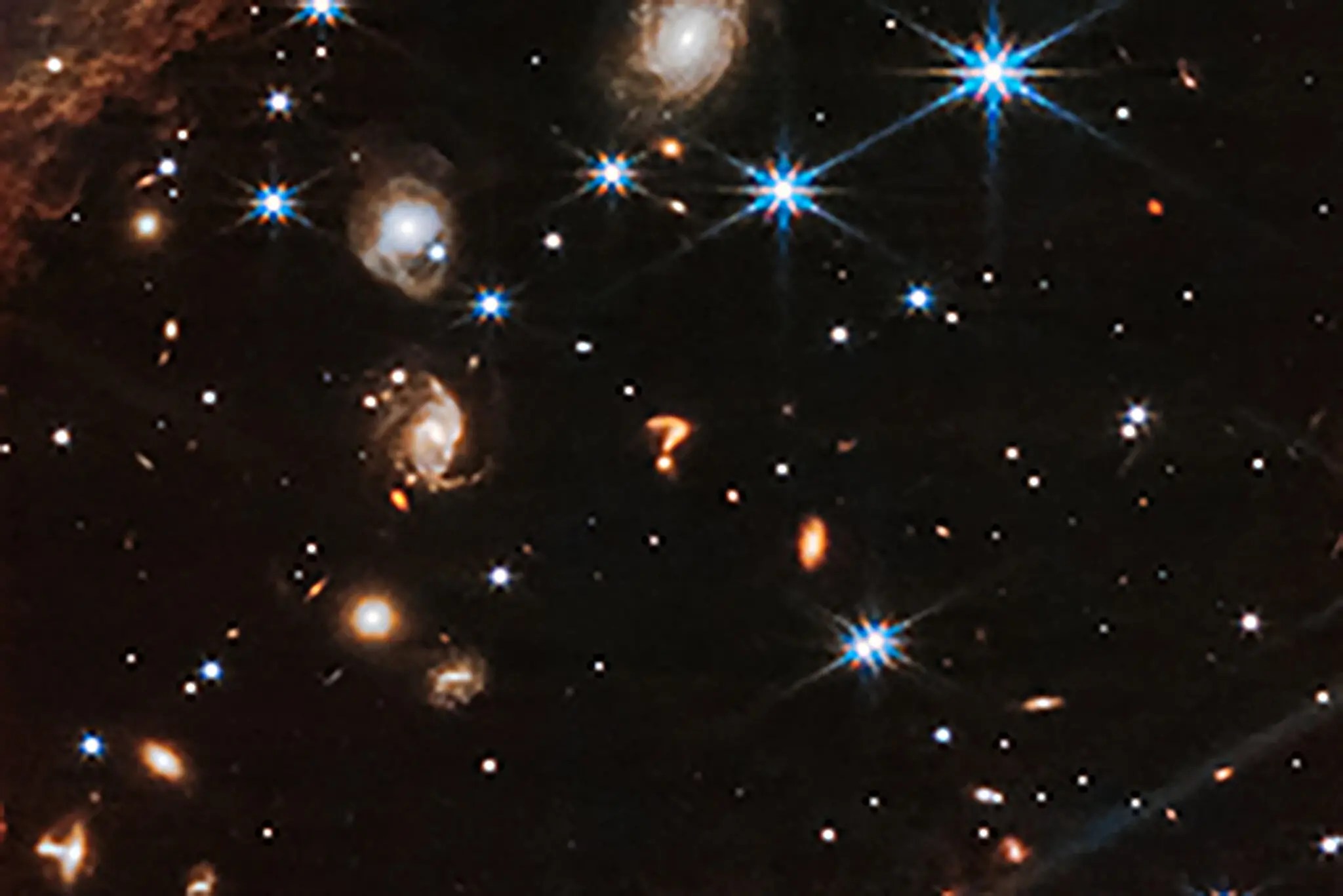
Strangely appropriate pareidolia is one of those oddly specific things that generates a lot of internet interest.  I was late to find out about the “question mark” in space photographed by the James Webb Space Telescope.  Okay, a couple of things: photographs, like the one below, taken by U.S. Government agencies are in the public domain (thanks, NASA!).  This one can be easily enlarged on the James Webb Space Telescope webpage.  To see the “question mark” you need to start from the center red star and look down to the two bright blue stars just to the left of center.  The image I’m using has been enlarged so that it’s obvious.  Serious news outlets have discussed this, but it’s clearly a case of pareidolia, or the human ability to attribute specific meaning, or design, to something that’s random.  We see faces everywhere, but question marks are somewhat less common.

Photo credit NASA: public domain

Given the state of the world—people like Trump able to continue scamming millions of willing believers for his own benefit, hurricanes hitting California, Putin going to war against the rest of the world, capitalism, war in the Holy Land—it’s no wonder that people like to think a big question mark is hanging over everything.  Looking into the sky we expect to see God.  Isn’t it a little disconcerting to see a huge query instead?  I, for one, think it might be best if we learn to recognize false signals rather than seeing some giant message tucked away in some small corner of the universe in the hopes that we’ll turn our seeing-eye telescope that way.  What font is it anyway?  Does it violate some cosmic copyright?

Some signs are, I’m convinced, for real.  I think they tend to be on a much smaller scale.  Way down here where  we can see them.  What appears to be, from our viewpoint, a question mark may be seen as an exclamation point from a different angle.  It’s all a matter of how we look at things.  One of the most important lessons of life is that people see the same thing from different points of view.  If we can accept that, others don’t seem so threatening and strange.  In a small planet plagued with xenophobia, it’s important to discover strangely appropriate pareidolia every now and again to get us thinking about the deeper issues.  We may not find the answers, but often asking the question is the more important thing to do.


Learning too Late

Threads of this, crumbs of that.  My life has been a grasping at small bits.  I know the things I like, but which circumstances keep me from.  Nobody is paid to read only, and writing brings in so very little money.  I’ve read Edgar Allan Poe since I was a child, but I haven’t read all of his written works.  (The same is true of the many other writers I admire.)  When I wrote Nightmares with the Bible, I tried to tie the theme of demons to Poe.  I began a chapter with an epigram from “The Raven”—“And his eyes have all the seeming of a demon’s that is dreaming.”  At this point in my life I had not read, or if I had I’d forgotten, “Alone.”  Not published in his lifetime, Poe wrote the poem at 21.  It ends with words that would’ve been appropriate for my Nightmares venture:

From the lightning in the sky

As it pass’d me flying by—

From the thunder, and the storm—

And the cloud that took the form

(When the rest of Heaven was blue)

Of a demon in my view—

Some printed editions end the poem with a period.  The ambiguity of that final em-dash, however, would’ve made particularly well the point I was struggling to convey.  Demons are not what we think they are.  As I continue to read about The Exorcist and its impact, it becomes clear that media mediates reality.  That view of demons has become canonical, but many, from Poe both backward and forward, have wrestled with them.  Not every entity with which we struggle through the night ends up blessing us in the morning, disjointed hip or not.  “Demon” is a very slippery word.  And concept.  In a materialistic world we boldly claim there are no such things.  As Poe wrote, “Of a demon in my view—”

There’s more going on beneath the surface than most people would be able to guess.  This is perhaps why I have a penchant for staring at the ocean.  Misunderstood, certainly.  But never, I hope, shallow.  There are great depths to be explored, but as the ocean teaches us, humans can’t stand the immense pressure at the bottom of the sea.  No, our lives are more like the bits and pieces of seashells plucked from beaches.  We don’t have the whole picture.  All writing reflects a stage on a journey.  Those who embark must earn their keep as they go.  And finding validation after the fact is one of the small joys of life that keep the traveler moving forward.


Don’t Stare

Having people just outside your window all day is a bit unnerving.  We don’t have central air and I keep my windows open when possible in the summer.  My office overlooks the porch roof but the porch was converted into two interior rooms over the years.  (The house was build about 1890.)  With the extreme weather we’ve been getting (rain storms that routinely dump three or four inches of rain in a short period, especially), leaks have developed.  As of this summer, after five years of ownership, we finally have a completely new roof—we had to have it done in parts because it’s not like we have professors’ salaries.  That meant that roofers were outside my office window all day back in August.  Now this is weird.  I was literally six feet away from some of them some of the time, sitting at my laptop, trying not to watch them instead of working.  The roofers, meanwhile, completely ignored me.  Never once when I glanced up did I see any of them looking in the window.

By the end of the day I was freaked out.  You see, as much as I like performing (as any good teacher does), I don’t like being looked at while I’m working at a desk.  I deeply dislike desk jobs and my posture throughout the day becomes, well, idiosyncratic.  Being forced to act as if I were in a sea of cubicles again was difficult.  Of course, I work longer hours now than I did as a commuter (one of the reasons, I expect, many employers don’t insist on people coming back to the office).  Knowing that someone could be watching you, even if they’re not, makes me uncomfortable.  

I considered how it must be for a zoo animal.  Yes, they’re given some privacy, but it’s often limited.  Animals don’t like to be stared at.  (Despite what materialist tell us, we all know what that  feels like and it makes us fidgety.)  When I’m out jogging I find that if I don’t look directly at them, I can get pretty close to many animals.  If you make eye contact, however, they more quickly scurry away.  Those in zoos must eventually become inured to the staring over time, or at least come to realize that nobody’s going to hurt them.  Still, given their druthers, I expect most of them would rather be in the wild where they can do what they do, no matter how boring, without being watched.  And no roofs over their heads at all.


Small Bits

A doctorate in the humanities involves learning as much as possible about a limited subject and being able to demonstrate that you know it intimately.  Interestingly, unless you continue the rest of your life in that vein, you’ll realize that you know things only in bits.  Let me use some personal examples, since they’re the kind I know best.  One of my favorite musical artists is Alice Cooper.  To this day he’s the only secular rock act I’ve seen in concert.  I thought I knew Alice, but Spotify taught me that I knew only a very small bit of his oeuvre.  My sense of him as favorite was based on a fragment of what he’s done.  The same applies to fictional characters.  I was a young fan of Barnabas Collins without having watched nearly all Dark Shadows episodes (and neither of the two series related movies), and having read only a handful of the novelizations.  Still, I felt I knew Barnabas.  I suspect I could go the rest of the way through the alphabet with no difficulty.

As facetious as it may be, the “million hour rule” has a grain of truth in it.  That axiom states that to be a true expert in something you have to spend a million hours doing it.  Simple mathematics reveals that means well over a century doing nothing but one thing would be required to fulfill the time.  In other words, no-one is a true master of anything.  We’re all practitioners.  I feel a little better about my recognition that my knowledge, such as it is, is based on small pieces.  What I write in my books are simply entries into conversations started by others.  This is true even if they remain unread.

I’m always encouraged by the neophyte that sets the experts back on their heels.  It’s beautiful to watch knowledge progress that way.  Our institutions are important, but they all become prisons when we suppose they represent the only way to do it.  Life has so many fascinating elements that the truly curious can’t possibly be an expert in them all.  The big picture benefits from stepping back once in a while and considering the small bits that make up the whole.  I can’t claim to be an expert on this, and my knowledge—such as it is—only comes in small bits.  But small bits, when there are enough of them, add up.  The whole picture, however, will never be completed by those of us with only small bits of it.

Photo by Hans-Peter Gauster on Unsplash

Simple Arithmetic?

Arithmetic progressions.  They can boggle the mind.  I think I’ve noted before—I’ve been doing this so long that it’s difficult to be sure—that the exponential increase of ancestors is astounding.  We have two parents but by the time we add ten greats to the grandparents we’ve got a crowd larger than the small town I grew up in.  Typical of a child of an alcoholic, I have no idea of what normal is, but I’ve had a rare and precious gift more than once in my life, and that has been finding that I had hidden family.  My father, unable to afford child support, made his way back to his family to survive.  Nobody in my household knew that he’d done that.  In fact, I had no idea he had siblings and I had unknown cousins.  It was a gift to discover that just as I was graduating from high school.  My mother encouraged me to stay in touch with them.  That was the reason behind my recent brief trip to South Carolina.

A few years back I learned that I had a cousin on my mother’s side that nobody in my family knew of.  People drift apart, even in families, and some people have to be rediscovered.  Call it redemption.  That’s what it feels the most like.  This cousin made the effort to travel across the country, in part to see me.  Kinship is like that.  Families feel for each other.  Being long apart can raise questions of motivation.  It’s awkward when, due to circumstances, you can’t see someone for some time.  I have a half-sibling in that boat and have recently re-connected.  I can only say that it feels like being a prodigal coming home.

I suppose that in a perfect world families would have no dysfunctional members, and everybody’d live next to each other in harmony and good will.  Right, Pangloss?  Economic circumstances would never force someone to live near where jobs might be found, and nobody would ever marry someone from another state, let alone half-way across the country.  And marriages sometimes double the arithmetic progressions, sometimes perhaps triple or more.  Families are complex and complicated, in reality.  I’ve seen pain in more eyes, and heard it in more voices than I would care to.  And I have a very difficult time letting such things go.  Charlie Bucket, according to Tim Burton’s version, says that families make you feel better in an imperfect world.  A world in which family reunions take place with individuals not being notified.  A world in which arithmetic progressions are mere fictions. Never in a perfect world like ours.


Reflecting Spirituality

I always find undergoing anesthesia a spiritual experience.  It’s too bad the the prep for things like colonoscopies is so stressful that it’s difficult to appreciate the fasting and how it changes your perceptions.  This is followed by the delicious blackness of a complete loss of consciousness.  If death’s like this we have nothing to fear.  I’ve written about this before, but chemical sleep is not like nighttime sleep.  You hear the anesthesiologist say, “You’re going to sleep now.”  Then you wake up, disoriented because no time has passed.  I blinked a few times, saw my wife’s coat on the wall, and thought it was a nurse.  I started to say “Stop, I’m waking up!”  But then I focused on my wife and wondered why they’d let her into the procedure room.  “Are they done already?”  I asked.  Where had I been for the last hour?

Spiritual experiences are sometimes only seen in retrospect.  They jar us out of ordinary time into an alternative time.  It doesn’t make up for the nasty taste of prep medicine, or the unpleasantness associated with it, but emptying yourself is a spiritual practice.  I need to try to remember that next time around.  I know people who are afraid of anesthesia.  I’ve only had it three or four times—oral surgeries, and my first such procedure as this—but there’s something mystical about it.  I don’t use drugs (never have) so perhaps I’m a neophyte, but looking back on the experience I know that something extraordinary happened.  Coming out of it is coming into a new world that is somehow strangely the same as the one I left.

Religion has always, at least partially, been about altered states of perception.  Organized religion succeeds in making it rote, but those who experience the naked phenomenon never forget it.  Anesthesia is, I know, potentially dangerous.  It so like a light being switched off that I’m always left in awe of it.  Mystical experiences are rare, which is one of the things that makes them so valuable.  I’ve had them—widely spaced—since childhood.  Sometimes it’s evident in the moment, but often some reflection is necessary.  I suppose few people look forward to any kind of surgical procedure, but there can be benefits beyond the physical health that we hope will result.  That’s the way spiritual events often take place.  Perhaps advanced practitioners (not always clergy) can bring them about intentionally, but any of us might recognize them afterwards, upon reflection.


Quick Writing

On the very same day I saw two emails that began with phrases that indicated they were clearly sent by text.  One began “Hell all.”  This was a friendly message from a friendly person sent to a friendly group and I’m pretty sure the final o dropped off the first word.  The second seemed to have AI in mind as it read “Thank you bot.”  It was sent from a phone to two individuals (or androids?).  There’s a reason I don’t text.  Apart from being cheap and having to pay for each text I receive or send, that is.  The reason is that it’s far too easy to misunderstand when someone is trying to dash something off quickly.  Add to that the AI tendency to think it knows what you want to say (I’m pretty sure it has difficulty guessing, at least in my case, and likely in yours, too) and errors occur.  We write to each other in order to communicate.  If we can’t do it clearly, it’s time to ask why.

Those who email as if they’re texting—short, abrupt sentences—come across as angry.  And an angry message often inspires an angry response.  Wouldn’t it make more sense to slow down a bit and express what you want to say clearly?  We all make typos.  Taking the time to email is no guarantee that you’ll not mess something up in your message.  Still, it helps.  I think back to the days of actual letter writing.  Those who were truly cultured copied out the letter (another chance to check for errors!) before sending it.  There were misunderstandings then, I’m sure, but I don’t think anyone was suggesting someone else is a robot.  Or cussing at them from word one.

The ease of constant communication has led to its own set of complications.  Mainly, it seems to me, that since abbreviated communication has become so terribly common, opportunities for misunderstanding increase exponentially.  I’m well aware that I’ll be accused of being “old school,” if not downright “old fashioned,” but if life’s become so busy that we don’t have time for other people isn’t it time to slow down a bit?  Technology’s become the driver and it doesn’t know where the hello we want to go.  The other day I forgot where I put my phone.  I signed on for work but couldn’t get started because it requires two-step authentication.  Try to walk away from your phone.  I dare you.  Thank you bot, indeed.


Little Bang

I’ve always been interested in the sky.  At times it feels like I’m in love with it.  Having attended a Sputnik-era high school—a rural high school with an actual planetarium!—I took the offered astronomy course.  Buoyed up by this, I also enrolled in a college astronomy class only to discover that that career track involved far too much math for my humble abilities.  Still, I learned a lot about the nighttime sky.  I’ve also been a lifelong reader of lay science.  I very much appreciate scientists who write so that nonspecialists can understand them.  So it was that I was glad to see a New York Times letter by Adam Frank and Marcelo Gleiser titled “The Story of Our Universe May Be Starting to Unravel.”  I’ve mentioned Gleiser here before because I’ve read a couple of his wonderful books.  But this article was mind-expanding.

Frank and Gleiser suggest that the Big Bang Theory may, eventually, need to be replaced.  They point out that small inconsistencies have crept into it over the years (keep in mind that it was really only “confirmed” within my lifetime, back in the sixties).  Most of these have been patched up with quilt-work astrophysics, but the James Webb Space Telescope is making some of those past patches strain a bit at the seams.  Fully formed galaxies are being spied too far back in time (for stargazing is looking into the deep past) for the standard model.  They shouldn’t be there, but they are.  The letter interestingly raises the point that the scientific study of quantum physics, as well as that of consciousness, also strain the standard models.  Perhaps it’s time for a rethinking of reality?

Image credit: NASA, public domain

Isn’t this breathtakingly exciting?  To be alive when a major leap of understanding the universe we call home may be discovered?  The authors point out that cosmology and philosophy often have to interact.  Our understanding of the universe is a human understanding, not sacred writ.  The scientific method is built to be falsifiable.  If it’s not, it’s not science.  (This often separates it from some religions which declare themselves unfalsifiable, and therefore likely wrong.)  New scientific discoveries are made daily, of course, but new paradigms only tend to come on the scale of lifetimes, or several generations.  We don’t see them all the time.  I guess it’s heartening to see that the system works.  When science becomes orthodoxy, we run into similar problems that we encounter with religions.  A bit of humility and a ship-load of wonder can go a long, long way.


Self-Correcting

A comment by a friend regarding Wikipedia recently got me thinking about self-correcting systems.  When I was teaching, I didn’t eschew Wikipedia like many of my colleagues did.  In case you’ve been living in a cave the last two decades, Wikipedia can be edited by anyone.  When I had more time than I do now, I used to correct errors I found there.  The thing is Wikipedia shouldn’t be used as the final word.  It’s a good place to start and, if you’re concerned about the truth, you’ll follow up by checking footnotes and looking up the references.  (Standard operating procedure for academics.)  Readers always need to keep in mind that what they’re reading may have been manipulated and distorted, which is why you want to check with established sources—some of us still prefer print, which isn’t so easily altered.  Still, Wikipedia is self-correcting and it works fairly well.

This got me to thinking about other self-correcting systems.  Those who know me know that I take criticism pretty hard.  That’s because I was raised with a crippling fear of Hell that let me to self-correct whenever I discovered an error.  And to scan my thoughts and motivations constantly for mistakes.  Sensitive bosses know that I only need to learn about an error I made, even obliquely, and that I don’t need to be told to fix it.  Of course I don’t!  Hell awaits those who let mistakes fester.  I’m not sure this is a good kind of self-correcting system, but it keeps me on my toes, and at times, even on my toenails.

The human body is often a self-correcting system.  We need the help of physicians when disease or injury occurs, but healing is part of a self-righting system.  (I’m indebted to an episode of Northern Exposure for reminding me of this recently.)  On an even larger scale, life on earth is self-correcting.  We humans have done more than our fair share of damage, and the self-correction (e.g., extreme weather because of global warming) may not be to our liking, but it is a system doing what it does best—righting the ship.  This kind of self-correction is inspiring and inspirational although we often take it for granted.  If healing didn’t occur none of us would be here to notice just how remarkable it is.  I don’t dismiss Wikipedia just because we can’t be sure everything’s written by experts.  Self-correcting systems are often the way of the world.


Not Resolved

Some movies are intentionally mind-blowing.  Knowing the kind of movies I like, a friend suggested Resolution with the enticing note that it is free on Amazon Prime.  Since anything free is worth saving up for, and since I was having trouble staying awake on a warm, wet Sunday afternoon when the lawn couldn’t be mowed, I gave it a try.  Even after it was over I wasn’t sure what I’d seen, but I was glad that I had.  Part of the draw is how convincing the acting is.  Another is the bizarre nature of the threats.  Like Sinister (also released in 2012), Resolution involves found media that tell a disturbing story.  Only in the case of Resolution it’s set in a remote part of an Indian reservation and it involves a drug addict and his friend who’s attempting an intervention.

With the addict handcuffed to a pipe, his rescuer encounters a strange set of people in the area and has bizarre media delivered to him by an unknown party.  In fact, he goes to his friend because of a video emailed to him by the addict.  Only the addict didn’t send it.  The media (records, color slides, video tapes, computer files) tell increasingly strange stories until the media also begin to show the two friends almost instantaneously.  A stoned French researcher tells the rescuer that there might be some time-space dislocation here, or there may be a monster.  Reluctant to release the addict until he has several days to get the drugs out of his system, the friend attempts to figure out what all this means.  Then the media begin to show their short-term future.

I won’t say how it ends, but I will say that the title Resolution is well-chosen.  This is a very creepy movie.  A remote location where things just don’t seem right and the conviction that just a few days will save a friend’s life but only if they stay in place is a great concept.  In many ways it’s a movie about stories.  The resolution is the end of the story and that’s something that’s successfully kept up in the air throughout.  Anyone who writes stories knows the feeling of writing yourself into a corner.  Playing around with space-time opens up possibilities, however, corners or not.  I can’t say that I understood everything that was going on here, but it was edgy enough to keep me alert, even on a muggy, drowsy Sunday afternoon.


Middle Ground

It’s the real poison Trump baptized.  Polarization.  The idea that there is no middle ground.  It’s a shame since the middle ground has been what’s kept America stable over the years.  Now it seems to be eroding rapidly.  While my sympathies have always been on the left, I realize that radical change tends to dirempt societies.  As much as I deeply desire justice and fairness for all, I know it will take time.  In my way of thinking that “all” includes animals.  That’s why I’m vegan.  Now, I know being completely vegan is likely not possible since who knows what everything is made of, and who has the time to find out?  I do the best I can and I don’t eat animal products and I try not to wear them either.  I know there are those who don’t share my outlook and they’re entitled to their point of view.

For nostalgia’s sake, and to get out of the house, we attended a 4-H county fair.  An annual event when we lived in New Jersey, it’s now a rarer treat.  So I put on that scarce recording of Bruce Springsteen’s song “County Fair,” not on any of his studio albums, and headed for New Jersey.  This county fair is the kind with animals rather than rides, and we stopped in to see the sheep, goats, cows, and alpacas.  It was in the cattle tent that I saw the following poster, claiming “There’s no such thing as vegan.”  Well, I don’t go around saying there’s no such thing as omnivores (thus the polarization) but this poster convinced me that we need to try even harder to stop raising animals to exploit. I understand, I think, the intent of the poster—cattle aren’t just meat.  The thing is, I think of them as conscious beings.

I miss the middle ground.  People no longer want to compromise or negotiate.  Since Trump it’s become “my way or the highway.”  I think I prefer the highway.  That highway takes me far from industrial feedlots where it’s illegal to document the cruelty that these animals undergo daily.  It’s quite a different thing for Bessie to lay down with a fan blowing on her under a tent with a small farmer caring for her, but that won’t feed a nation.  Small farms aren’t the problem. I don’t insist everyone be vegan.  I would like it if we could sit down and talk about it, however.  Cattle raising is the industry that generates the greatest amount of greenhouse gases that are causing global warming.  If we keep dividing ourselves and refusing to change we’ll be having this polarizing argument under water before too many years have gone by.  My highway is middle of the road.  Even slow change can benefit many.  The goal is to get “many” to “all.”


Creepy AI Doll

We’ve all seen the killing doll horror movie before, of course.  Who hasn’t?  What makes M3GAN different is the whole artificial intelligence angle.  Okay, so you understand it’s about a killing doll, but unlike Chucky or Annabelle, M3GAN has a titanium frame and a super-advanced, wifi-connected brain.  Like generative AI, she’s able to learn on her own and even able to use her own reasoning to get around her basic programming.  Now, you’re likely smarter than me and I didn’t catch what the critics call the “campiness” to the film.  Yes, there are places that made me snicker a little, but although the killing doll premise made the results somewhat predictable, I watched it seriously.  Some websites list it as horror comedy, while others prefer sci-fi thriller.  Nevertheless, it isn’t really that funny.  And there’s a cautionary element to it.

Funki, a Seattle-based toy company, is always trying to stay ahead of the competition.  Animatronic toys are the rage, and Gemma (brilliant choice to have a female mad scientist here) is a visionary programmer.  She wasn’t expecting, however, to become her niece’s guardian after Gemma’s sister was killed in an accident.  The M3GAN prototype was already underway, but Gemma kicks it into high gear to help make up for her own lack of parenting skills.  M3GAN becomes her niece’s companion—soulmate, even—and since the two are bonded with biometrics, her protector.  Bullies, lend me your ear; you don’t want to mess with a girl who has an android as a bestie.  And nosey neighbors, fix that hole in your fence.  Or at least curb your dog.

Instead of I, Robot this is more like You, Robot.  There is a wisdom to the othering that goes on here because none of us know in what kind of reasoning generative IA might engage.  In real life computers have been discovered communicating with one another in a language that their programmers couldn’t read.  We’re all biological, however, and thinking, as we know it, involves many biological factors.  Logic is part of it, but it’s not the whole story.  So techies who idolize Spock and his lack of emotion feel that they can emulate thinking by making it a set of algorithms.  My algorithms lead me to watch horror films out of a combination of curiosity and a need for therapy.  Where does a computer go for therapy?  The internet?  Well, you might find some good advice there, but don’t be surprised if it comes at you with a paper-cutter sword in the end.  You’ve been warned.


Mystical

I would never have experienced Tibetan singing bowls were it not for a family member’s cancer diagnosis.  Something you quickly learn is that many resources are available to help you cope.  One of those local to this area was/is Tibetan singing bowls.  I had no idea what to expect, but as a lifelong explorer of religion, I had gathered that the session would likely involve ways of thinking more common in East Asian cultures.  I was taken, however, on a spiritual journey.  In a darkened room with twenty-to-thirty cancer survivors, on our backs on the floor, we experienced sound.  Now, my musical training and ability are quite limited.  I could not identify most of the instruments (I kept my eyes closed), apart from the singing bowls which I had heard in other, western religious contexts as well.  I’ve had mystical experiences before, but I don’t know you well enough to tell you all about them.

Photo by Magic Bowls on Unsplash

The first thing I noticed this time was the color blotches in my closed eyes.  Everyone sees those kinds of things, but as the sounds increased the colors began to range outside their usual purple into whites and yellows.  It was almost like a segment from Fantasia.  The colors then began to take shape, some forming into flowers.  I knew my imagining mind had taken hold when images began to appear.  Although it was my usual bedtime by this point, I was fully cognizant of being awake.  There was no real storyline, but I was conscious of losing my sense of individuality and becoming part of the greater whole, which is what being a being on a small planet is all about.  As the sound meditation wound down, I realized that it had been many years since I’d put myself into such an environment.  It took some time to reorient myself.  When we arrived at home I was, paradoxically, too relaxed to fall asleep.

One of my college professors warned me against mysticism.  Mystical experiences are rare, in my life anyway, but unforgettable.  If you live long enough and pay the right kind of attention, however, you can find them.  They leave you with a profound sense of hope.  I’m not about to go off and join a Buddhist monastery, but Thomas Merton reminds us that Buddhism and Christianity are perfectly compatible.  This particular college professor was afraid, I surmise, that spiritual experience might outstrip dogged devotion to a single book.  Mysticism can take you to places that convince you what passes for reality is not all that’s real.  Being with lovely people who’ve had to face cancer is a spiritual experience in its own right.  Why shut out the light inside?


Creating Light

I spend a lot of time awake when it’s dark out.  I try to limit the number of lights on, both for the environment and not to wake family members who sleep on a more normal timetable.  But this schedule makes me reflect a lot about light.  For example, the other day I glanced at a mirror that happened to be reflecting a light.  By reflecting light you create more light.  Think of the moon.  A full moon on a clear night can make a massive difference in how well you can see.  Farmers used to know this as harvest moons gave the possibilities for longer light-time hours to get seasonal work done.  And that light reflecting in my eye in an early morning mirror made me wonder what would happen if you set up a mirror facing a mirror with a light in the middle.  Wouldn’t you have just created more light in the world?

I’m almost always awake before sunrise.  I don’t recollect the last time I awoke to find the sun in the sky.  There are so many subtleties to morning light.  You can see it coming a long way off.  I try to jog at first light, when it’s just light enough to see where I’m going.  It’s important to seek light in the dark.  There’s a kind of spirituality to it.  Often when I’m jogging I’m amazed at how far even a small light carries.  When I see the stars at night and think how terribly, terribly far away they are, I marvel that their light still reaches us.  Light can be blocked out, but unless it is, it stops at nothing.  Light persists.  

Bioluminescence fascinates me.  We now know that our very genes have the ability to create their own light.  Fireflies and deep-sea creatures have figured out how to do it, and, I suspect, scientists could engineer a glowing person.  We have it within ourselves to create our own light.  Science wouldn’t disagree.  Sometimes such things are best seen by walking around in the dark.  The contrast helps that inner light show through more clearly.  Those who are afraid of the dark haven’t spent the time to truly become acquainted with it.  The dark is a very capable teacher and the rhetoric that it’s evil is based on mistaking, as the Buddha said, the finger pointing at the moon for the moon itself.  But it’s starting to get light out—time for me to go for a jog to seek even more of it in the semi-dark.


Hopeful Flowers

Our front yard is a bit of a wreck this year.  You see, none of us are natural gardeners and with two chronic illnesses among the three of us we’ve had some multi-day hospital visits and shifting of priorities.  The front yard hasn’t been one of them.  I’m able to get out around 6 a.m. on a Saturday, however, to do some weeding.  My philosophy this year is that if it’s not something people would consider an “ugly weed” and if it stays under six inches tall, I’ll let it grow.  We’ve planted some deliberate ground cover that doesn’t seem very deliberate, but it’s slowly taking hold.  And, of course, there are the ubiquitous dandelions.  I don’t really have a problem with dandelions but others think of them as weeds and they do, admittedly, have no sense of personal space.  They’ll grow right up under some intentionally planted flower and crowd it out.

If you’ve dealt with dandelions, you know they have deep roots.  Well, it rained yesterday and the ground was soft enough that I was actually able to gentle one out the whole way today.  It was impressive.  Usually the root breaks off (a brilliant, if frustrating adaptation) less than an inch beneath the surface.  I thought to snap a picture before tossing this one on the compost pile (in the back yard, of course, inside the fence where it can’t be seen).  Talk about depth!  These yellow wildflowers with edible leaves and wine-making potential, are tenacious.  They have a very strong will.  Dandelions are perhaps the most strong-willed of plants.

With chronic illnesses, hope is essential.  Instead of getting angry at “weeds” I look at them as examples of just how mighty hope can be.  They find cracks that are so small that we overlook them.  The soil can’t always be great there, but they carry on.  Dandelions can reach impressive sizes (trust me on that one—I’m no gardener) and they don’t take “no” for an answer.  Such resilience gives me hope.  Were they more conscious (I’m sure they are at some level, but I surely hope it’s beneath the threshold of pain degree) they might well be dominant among the plants.  I missed mowing the lawn last weekend for being in the hospital with family, and it’s clear the dandelions have designs on taking over the place.  I see them and I find a deep peace.  Life finds a way, in spite of difficulty.