
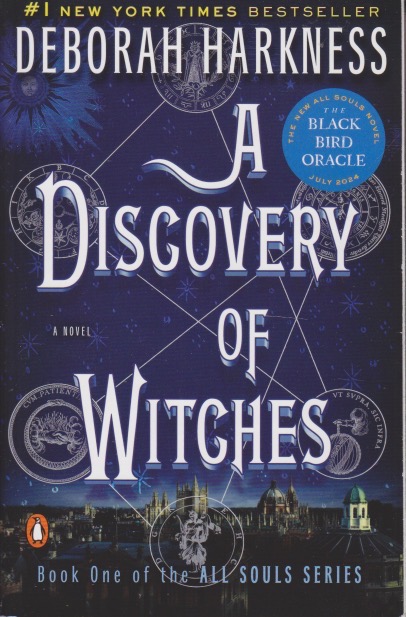
On a number of best of dark academia novel lists, A Discovery of Witches was a book I knew I had to read. Frightened by the size of the tome, I put it off. Although it says it on the cover (by which I don’t buy a book) that it’s part of a trilogy, I was hoping it’d be self-contained. Of course, it ends without resolving what happens to the main characters, more or less coercing the reader into the remaining two volumes. Now, this is not unique. Many authors do it. Publishers especially like books with series potential—assured sales. My eight novels (none published) are stand-alone. One is over 200,000 words, but the rest are reasonably svelte. Big books take a large commitment of time and, well, at my age you have to make some choices. This one took me nearly a solid month of daily reading, sometimes multiple hours at a stretch, to finish. I have some decisions to make.
Set initially in Oxford, this world created by Deborah Harkness contains three kinds of humanoid creatures besides humans: witches, vampires, and daemons. The daemons aren’t really defined, but they don’t seem to be the kind that possess girls like Regan McNeil. The witches seem pretty traditional and the protagonist/narrator is one. The vampires are quite different than the Hollywood version, as well as the traditional sort. Vampires can be out in the sunlight, they aren’t affected by crucifixes, and, indeed, can be quite religious and Christian. They can eat things other than than blood. The protagonist, Diana Bishop, is a witch who doesn’t use her powers. A professor, she’s doing research at Oxford where she meets, and eventually falls in love with Matthew Clairmont, a vampire. An ancient pact between witches, vampires, and daemons forbids them from consorting closely, and herein lies the tale.
The dark academia aspect comes in a couple of guises. One is that much of the first part of the novel takes place at Oxford University, and even in the Bodleian Library. Also, vampires seem to be quite compatible with dark academia as a whole. The dark aspect comes not only from the creatures, but their situation. There is ancient animosity and tension that results in murders. The novel ends with a war starting and Diana and Matthew taking a risky journey. I may be content to let this state of affairs stand. From the look of things, the sequel is also a long book and I am content to let my imagination fill in the blanks. I’m glad to have read it, but I’m going to look for a novel with a little less time-commitment next.


 Steve A. Wiggins