God has Left the Theater

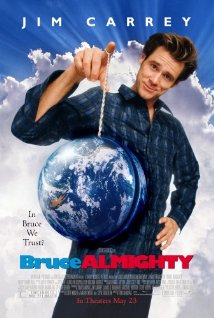
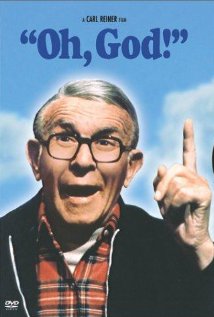
When teaching religion at the University of Wisconsin Oshkosh, I realized that an effective way to engage students was through popular culture. I could assign them just about any choice of movie and have them look for the religious themes of whatever class in it for a short paper. Of course, most went for the low-hanging fruit, over my teaching years, and I eventually had to ban movies with obvious religious themes or premises. One of those movies was Bruce Almighty. In a fit of nostalgia, I recently rewatched it. Never a big Jim Carrie fan, I nevertheless always enjoyed Bruce Almighty—it was such an improvement over those truly dreadful Oh, God! movies that were so popular in the late 70’s and early 80’s. I never found George Burns funny, and he made for an awfully feeble God. Everyone was buzzing in the new millennium when God was portrayed by a black man, Morgan Freeman. Still, we await a director who dares cast a female God. Patriarchy runs deep.
BruceAlmighty

One of the features that movies portraying God run up against is showing a believable omnipotence. The powers granted to mortals always seem so petty. Theodicy is always raised in these kinds of movies—why people suffer if God is good and all powerful—and since movies rely on directors and writers rather than theologians, they often leave the answer at the doorstep of free will. Human suffering is our own fault. In our society we can’t have a movie that actually pins the blame back on the divine, because that wouldn’t be funny. And movies where people meet God are almost always comedies. But Bruce Almighty is actually a bit more sophisticated than it seems at first. That is best seen in the outtakes perhaps, where Morgan Freeman seems to care more about people than George Burns did. Of course, my memory on the older movies is hazy. They were considered slightly blasphemous three-and-a-half decades ago. Today they seem tame.
OhGod

Why do movies with God in the cast rake it in at the box office? A couple of reasons suggest themselves. As humans, we like to place ourselves in the role of the divine to consider what we would do with unlimited power. Who wouldn’t, like Bruce Nolan, at least include their own satisfaction in the package? I think, however, there is a deeper, more serious reason. We do genuinely wonder about God’s motivation. Most of us don’t have the training to know how to grapple with the often incomprehensible arguments that theologians make. Even when we do, they still make no sense. Our movie gods appeal to us because they are so terribly Freudian—made in the human image. We can’t conceive of a god who’s not like us, so we at least make the situation funny. If we can’t achieve omnipotence, at least we can hope for a few laughs.

Holding out for a Hero

Over at Religion Link, a story about superheroes and spirituality was posted recently. I guess it should’ve been clearer to me as a child with his head in the clouds that the superheroes buzzing around up there were really gods. Well, in an ultra-thou-shalt-have-no-other-gods setting, that wasn’t really a possibility my young mind could even comprehend. They were just guys (almost always) with super powers. In the Bible they would have been miracle workers. I dared not think of Samson in the same thought as the Incredible Hulk. Heroes, after all, are about wish-fulfillment. We all want to be more than we are—I can imagine a better me (speaking strictly for myself), so why not present that self in the form of a hero? The Greeks, and before them the Mesopotamians did it. Heracles was a Europeanized Gilgamesh, perhaps through the mediation of a Levantine Melqart, after all.

Gods or heroes?

Gods or heroes?

The brief article on Religion Link points out that young people identify with gods in popular culture more than a God in the pew. A veteran of many, many hours in church, I think I can understand that. What adults say is going on in the service is arcane and not prone to any empirical verification. What child sitting in church hasn’t wanted to be home watching real superheroes fight evil on television instead? The movies of the past decade or so have shown us flawed gods. Heroes with troubles. These are the gods for the twenty-first century. Omnipotence isn’t all that it’s cracked up to be.

Scholars of religion are beginning to pay serious attention to superheroes. Books are beginning to appear offering analyses of these god-men, and a few god-women, among us. Funnily enough, some people find them more believable than the traditional gods. Perhaps that is the draw of heroes from the very beginning. Gilgamesh, after all, is asking the very human questions we still ask today. Where can I find a true companion? Why can’t it last forever? Why must we die? To find the answer Gilgamesh is sent off on an impossible task. He has fought monsters, he has defied the very gods. And when he finds the plant that offers a kind of immortality, it is stolen away by a snake. The story clearly influenced the tale of Eve and Adam in Eden. It has also inspired the more recent incarnations of superheroes, and we are beginning to realize that they often fly in the face of the divine.


Lovecraft in the Woods

CabinintheWoodsYou know the basic plot: five college students—always an uneven mix of genders—travel to a remote cabin in the woods during a break. Extreme bloodshed ensues. The Evil Dead? Cabin Fever? Blair Witch Project 2? This time it was The Cabin in the Woods. With the exception of Cabin Fever, all of these films have a religious origin for the horror unleashed on our protagonists, with varying degrees of seriousness. The premise of getting away into the woods is overtly sexual in nature, often with the added vice of drinking or drug use far from the eyes of watchful society. Something inevitably goes terribly wrong. Were they a tad less graphic, most of these movies could pass for morality plays in their adherence to the convention, made obvious in The Cabin in the Woods, that the virgin is the sole survivor. Of course, this is done with tongue deeply embedded in cheek. Joss Whedon, who brought us Thor and The Avengers, knows all about gods, and they are the driving motivation behind the evil lurking in this contrived cabin in an artificial wood.

In this parody of the splatter film, the blood of the archetypal teens is collected to appease a Lovecraftian pantheon of unseen “ancient ones.” These are the gods of old, hidden deep beneath the earth in a slumber, placated by the ritual sacrifice of the whore, the athlete, the scholar, the fool, and the virgin. The sacrifice is orchestrated by techie priests who wear white shirts and lab coats, in a hermetically sealed laboratory under the cabin where they are set to unleash any variety of monsters on the kids, leading to their gruesome demise. First the protagonists must “sin”—not a difficult prospect, given the arrangements—and be punished. If the ritual fails, the world ends when the “evil, giant gods” are released; echoes of Cthulhu are rife.

Horror movies offer more than scares. If done well, they provide catharsis as well—a kind of celluloid redemption. Writers and directors, however, have moved toward self-parody to distort the horror film into a kind of comedy. Even as early as The Evil Dead, the humor is evident. Joss Whedon, however, effectively wields the evil gods, just as in The Avengers. Deities are revered less for their goodness than for their sheer power. H. P. Lovecraft, an atheist, gave us the old gods. Hollywood has run with them. Instead of catharsis, viewers are left with an undefined unease—something is not quite right with this universe that has been created. Gods, whether holy or horribly profane, demand much of humanity. The response may be abject devotion or laughter. The sins remain the same as human vices of old. It is the gods that have been transformed.


The Triumph of Lovecraft

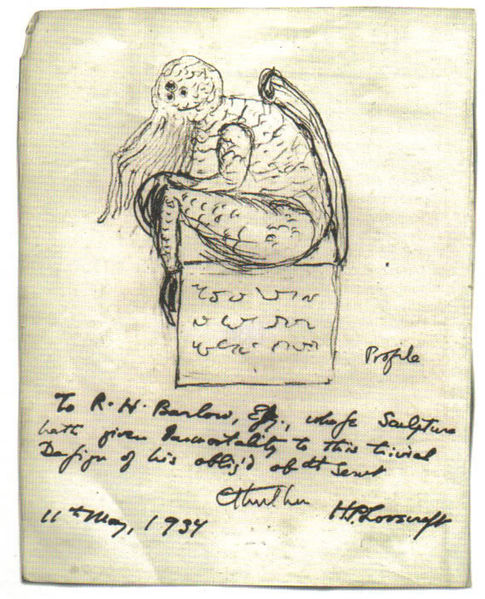
The deeper you peer into the mouth of nature, the more Lovecraftian the world becomes. Just days after I had posted a little meditation on Cthulhu, the great old god of H. P. Lovecraft’s unholy pantheon broke into the mainstream news. No less a source than NBC ran the headline “Tiny Cthulhu ‘monsters’ discovered in termite guts” only a few days ago. The microbe with the scientific name Cthulhu macrofasciculumque lives in the digestive system of termites, helping them in their destructive work. True, Lovecraft described Cthulhu as a bit bigger than that, but the first appearance of the microbes, according to Megan Gannon, reminded the discoverers of the eponymous terror of the Cthulhu mythos.

From microbes to the major football leagues such as the Baltimore Ravens, writers of the macabre have left their mark on our culture. The darkness they describe so richly is something we all feel at some level, but that we sublimate most of the time so that we can get on with our lives. Cthulhu macrofasciculumque may be very, very small, but the super-viruses and bacteria that we are encountering have the ability to destroy us just as surely as the chimerical colossus of Lovecraft’s nightmares. When we look for a way to describe these terrors, we have brave literary heroes from whom we might draw. We would be lost without them. They make it safe for us to venture into that darkened room, for they have been there before us. Lovecraft gave the world its first scientific description of Cthulhu, and although that description defies adequate reconstruction, we recognize it when we see it.

As Lovecraft saw him.

As Lovecraft saw him.

Science has brought us so very far. We can now see to almost the brink of an infinite universe and delve into the guts of termites. We have the ability to prolong life and increase physical comfort for those who can afford it, and we can annihilate entire nations at the press of a button. Drones can fly overhead and do the dirty work, and we don’t even have to step outdoors. Yet when we meet something that shivers our scientific spines, we turn back to the old gods to name it. Yes, religion may be the bête noire of science, but the dark night of the soul is not illuminated by LED’s or lasers. To see in this dark you need to have the night vision of literary perception. And those lenses, according to Lovecraft, reveal that the old gods are dead but still dreaming.


A Weird Resurrection

Driving through an unfamiliar city doesn’t allow for much time to appreciate what you’re seeing. Back in February when I was visiting Austin, Texas for the first time, it was 65 degrees outside. Given the irascible temperatures in New Jersey this year, that felt like summer. Of course, the locals were bundled up since it was, for Texans, unseasonably cool. The weather has been off this year. Of course, we know who to blame. Cthulhu. As I was trying to find the University of Texas with an impatient GPS as my co-pilot, I spied someone walking down the street wearing a Cthulhu ski mask. I can’t express how badly I wanted to pull aside and snap a photo, but pulling aside in a strange city can lead to unwanted adventures. Especially when your co-pilot is an opinionated GPS. I’ve been to north Philly and the south side of Chicago. I didn’t want to take any chances that Austin might hide such districts.

Cthulhu mask

H. P. Lovecraft, like most original thinkers before the computer age, was ignored in his lifetime. I wonder what he would have felt if he had divined that the internet would one day bring him world-wide fame. His writings, of course, had been appreciated before the computer was invented, but the web has nearly as much Cthulhu as it does LOL Cats. Even those who’ve never spent a dark night curled up with the Necronomicon recognize Cthulhu’s octopoid visage when they see it. Davy Jones of the Pirates of the Caribbean fame borrowed his unforgettable face from the Old Gods discovered by Lovecraft. Cthulhu has become a cultural icon of the chaotic, the cosmic, and the somewhat comic.

In a strange way Cthulhu stands for resurrection. In Lovecraft’s mythological world Cthulhu lies under the sea, dead but dreaming. A dying and rising god of utter terror. Lovecraft, an atheist, built his fiction nevertheless around a series of gods. Today his stories are noted for their moody portrayal of improbable worlds, and his storytelling has had an incredible influence on many of those who attempt to generate worlds that are fantastic but somehow still believable. Cthulhu’s resurrection, however, is not to be desired. Even if these he represents life anew, it is a life humans could not bear. In a deeper sense yet it is Lovecraft himself who has experienced a kind of resurrection. A writer forgotten in his lifetime, but rediscovered when it was too late for him to realize just what he’d created, the true master of Cthulhu, I like to believe, lies dead but dreaming, and he has already revealed that he will rise and the masses will tremble.


Palming the Truth

For some today is Palm Sunday. For others it is not. And I’m not referring to those outside the Christian camp. For many Eastern Orthodox Christians, Lent is just beginning as others prepare to celebrate Easter. Such divisions in the priesthood of all believers. The message was brought home to me when a friend emailed me an article from Archon News headlined “For the first time since the Great Schism, Ecumenical Patriarch to attend Pope’s inaugural mass.” For those of you outside the thrill-a-millennium Catholic-Orthodox drama, it might help to know that about the middle of the eleventh century, Christianity experienced its first major schism. The issues were insignificant to all but those who had far too much time on their hands, but the list of grievances grew and festered for centuries until a clean-shaven Pope and heavily bearded Patriarch stopped inviting each other to one another’s parties. It seems that Pope Francis may be seeing the beginning of the end of that particular tiff.

Christianity is one of the most fragmented faiths in the world. Tens of thousands, yea, myriads of denominations exist. And if some of them got together and compared notes, I suspect they’d be shocked to learn that they are just the same as some of the others. Religious belief is deeply personal and highly individualistic. Belonging to a religious body is more a matter of commitment than it is a full agreement on every point—rather like a marriage, I suppose. The funny thing is people join religions that they like, suspecting that these copacetic beliefs will somehow save them from Hell. You can literally write your own ticket to Heaven, based on this system. No religion is right because all religions are right. And we wonder why people are eager to kill one another over matters of belief.

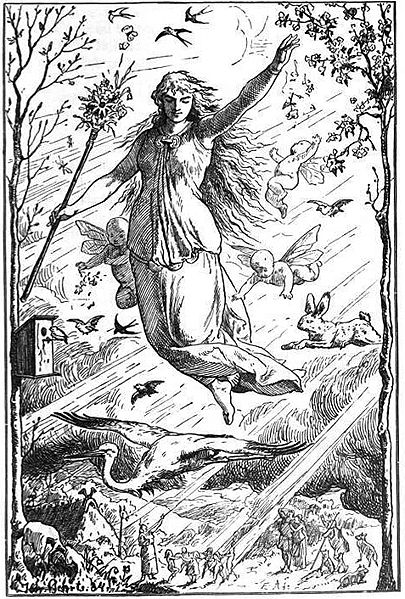
So, is it Palm Sunday or not? It depends entirely on your point of view. Roman Catholicism, followed by many Protestant groups, considers the first Sunday after the first full moon after the Vernal Equinox to be Easter. Never mind that all this equinox stuff smacks of its Pagan forebears—even Easter is named after the Germanic goddess Ostara. I can’t pretend to know how various Orthodox groups calculate their Easter, but the fact is that both dates can’t be right. Unless, of course, one of them is really a celebration of Ostara. Or maybe both are. And if it comes to a matter of debate, it will mean the birth of even more denominations.

Ostara laughs to see such sport

Ostara laughs to see such sport


Gods in Spandex

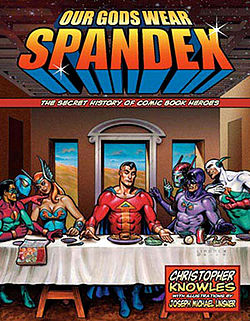
OurGodsWearSpandexOne thing leads to another. Reading Jeffrey Kripal’s Mutants and Mystics stirred an interest in comic books that I hadn’t felt since before my college days. Often excoriated as puerile, escapist doggerel for pre-pubescent boys, comics have grown to be respected members of adult society. I often wonder what the draw might be. Hollywood has certainly cashed in on it with any number of blockbuster flicks each year coming from the brains of the comic book writers and artists. So I picked up the quirky book by Christopher Knowles and Joseph Michael Linsner entitled Our Gods Wear Spandex: The Secret History of Comic Book Heroes. Reading it was kind of like looking in a mirror that has been buried in dust for a few decades. I hadn’t realized that my tastes in childhood comics was a reflection of a longing for the divine world with healthy doses of science fiction, and even H. P. Lovecraft, thrown in along the way. Knowles ties in a remarkable breadth of material to demonstrate that our superheroes are, in the final analysis, gods. That point may be taken in any number of ways.

The academic world suffers from a fear of respectability. That may seem a strange assertion, but I’ve spent a great deal of my life among academics and I know that many of them are insecure and tentative. Does all this reading, writing, and analysis ever get read by anybody? Does anybody take me seriously? Academics are haunted types. So when a subject as vulgar as comic books arises, scholars are reluctant to touch it. It might look like we actually enjoy reading the funnies. Still, popular culture has demonstrated an unexpected depth to much that we read in the strip world. As Knowles points out, a deep undercurrent of the occult and esotericism runs through many hero story lines. Several heroes began their lives as classical gods, only to assume the spandex and become incarnate humans with special powers we long to have ourselves. We would fly, if we were given the chance.

Our Gods Wear Spandex may never be viewed as an academic book by most. It has too much visual interest and not enough recondite footnotes. All the same, it is a profound look at what people really desire. We worship gods because of their special powers. If God were one of us with our humiliating weaknesses and limitations, would we ever worship him or her? Of course not. We only seek to appease those who are stronger than we are. Entire governments and ecclesiastical bodies are built on that very principle. Heroes are like us. Mortal, and yet, with something more. They die. But like the gods, they can come back. Reading Knowles it becomes clear just how much religious thought pulses through the veins of the comic book world. We may be grown up and sophisticated. We may have left behind childish things. But when our backs are to the wall, who doesn’t secretly wish they were Wonder Woman or Superman? And maybe that wish is a prayer.


Pope Springs Eternal

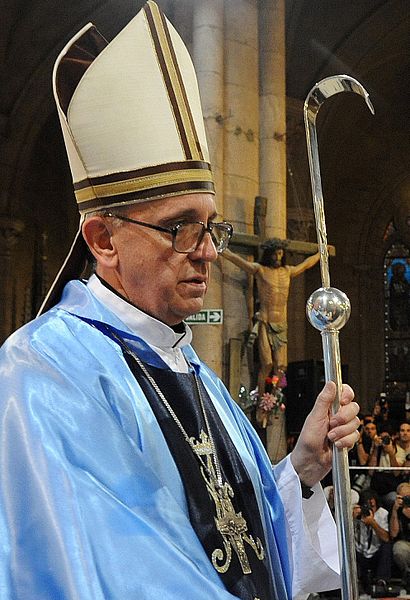
All channels lead to Rome. In a world where Christians lament their public influence, we can’t seem to get enough of the pageantry, the mystery, and the stylish drama of electing a pope. The secrecy is key. If cardinal debates were held in an open forum, by cardinals in business suits, the media would have trouble covering its yawns. In a conclave deep within the classical architecture of Rome, privileged men in expensive gowns meet and whisper in hushed tones until a puff of smoke rises though a sacred chimney and the world either hitches its collective breath or sighs in deep contentment. No wonder the election of a pope is such a big deal for Protestant and Catholic alike.

We would be mistaken, however, to limit such docu-drama to Rome. Religions, from the earliest institutionalization of their practices, used drama and showmanship to add to the draw of the sacred. Ancient Mesopotamians and Egyptians kept statues of deities hidden away in the deepest recesses of temples, and brought them out periodically to great public fanfare. The laity would watch in astonishment as an actual god was paraded among them—the popemobile had yet to be invented—and lapse back into ordinary time as the sacred statue was swallowed once again in the darkness of its great house. Even the aniconic Israelites maintained ceremony and mystery, for they had an invisible god who raised all kinds of questions in the naturally curious human mind.

The papacy is, after all, a recognized authority structure. Some nations recognize the Vatican as a sovereign state, a little bit of the City of God among the Rome of Humanity. For the time being at least, the Roman Catholics outnumber any other branch of Christianity. It is the most successful trader in the marketplace of religious commodities among Christian consumers. Its draw has always been tied closely to a sense of mystery and awe. There is a magic to the mass that the televangelist sermon splashed on the big screen somehow lacks. It is old and arcane. Few believe in its literal transubstantiation, and yet it stands as the outward and visible sign of a deeply occluded reality that takes place behind closed doors. Men in red, debating on the virtues of a new CEO for the vicar of Christ. No wonder all channels are tuned to Rome.

From presidencia.gov.ar, via Wikimedia Commons

From presidencia.gov.ar, via Wikimedia Commons


True Heroes

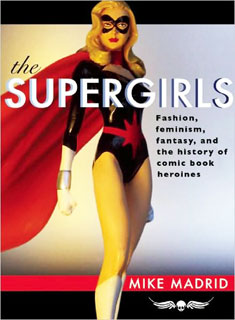
supergirls As a guy with a healthy sense of the weird,it strikes me as odd that rational people can suppose that we’ve solved all of life’s great mysteries. As a student of biology, chemistry, and physics in high school—and a reader of non-technical aspects of the same throughout my adulthood—it always seemed that there was an undefinable “something more.” Reading Jeffrey Kripal’s Mutants and Mystics led me to an interest in comic books. As a child I did not have many of them since we didn’t have much money to spend on luxuries. The few I had, however, were read and reread and reread, assaulting my imagination with endless possibilities, many of which defied everything I was to learn of biology, chemistry, and physics. My interest in feminism and new-found appreciation of the proto-graphic novel, led me to read Mike Madrid’s The Supergirls: Fashion, Feminism, Fantasy, and the History of Comic Book Heroines. As a boy surrounded with brothers, I clearly knew which comic books were for males. Madrid’s book delves into this super-hero world with the question of why females have always struggled to be taken seriously in this fantasy land.

Many of the characters explored in Supergirls were heroines I’d never encountered before. Madrid’s analysis often appears spot-on as he traces their histories through the decades as they mirror, and occasionally lead, society’s expectations of what women should be. The one that I had no trouble recognizing was Wonder Woman. And the reason for that was she used to have a TV show. Not mentioned by Madrid was the mighty Isis, also a heroine from television. She began as a character opposite Captain Marvel, and did not have her origin in a comic book. Isis was, of course, an ancient goddess, and as I learned from Supergirls, Wonder Woman was not far behind. The way that women could be as strong as men was to be divine. For human females, life was much rougher.

Wonder Woman, Madrid notes, was one of the Trinity of early, lasting comic book heroes. Superman, Batman, and Wonder Woman are cast as the Father, Son, and Holy Ghost, respectively. Like her theological counterpart, Wonder Woman is the most amorphous, least understood of the three. Her career and persona change over time, almost losing any kind of supernatural ability. Her origin story, however, began as a helper of oppressed women everywhere. Today we see Superman and Batman on the big screen, but Wonder Woman has fallen behind. Despite great strides, our society still isn’t ready to accept rescue of men at the hands of a woman. More’s the pity, because we clearly see the mess that masculine leadership has spawned. Mike Madrid has discovered a secret identity for our old foe, sexism. And it might take the world of comic books to help us see clearly that which mainstream analysis still denies.


Portrait of God as a Young Man

Famed swing state Ohio is back in the news with Jesus in the front lines. It was an unlikely setting to notice such a thing. I was sitting in a conference room at work, awaiting the start of a meeting. A laptop was set up with a projector, and the homepage cast upon the screen was msn.com. There, on the wall at work was Jesus’ name.

The story has to do with a public school in Jackson City. A student group had donated a portrait of Jesus to the school in 1947, but in a multicultural world the constitution sometimes has to take on the Prince of Peace.

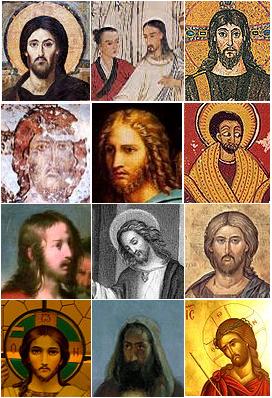
CompositeJesus

While the legal issues are thorny, I have an even more probing question to ask. What makes a portrait a religious object? There is a fair bit of dispute about the historical Jesus—who he really was, where he was from. Despite the sangfroid of the New Atheists, there is little reason to doubt that there was a historical person Jesus. If that is the case, what makes his picture any different than that of Woodrow Wilson or Ronald Reagan? Or Churchill, with his religious-sounding name? One could argue that we don’t know what Jesus looked like—and this is true—but neither could we really identify many historical figures before the advent of photography.

The making of a picture into a religious object comes down to intent. Intent on the part of those who hung it, and on the part of those who view it. The 1940s were a different era. The Second World War was just ended, America was proudly Christian after fighting for the cause of truth, justice, and, well, the American way. Could the school group have donated Jesus in that era as the portrait of a great man? Without supernatural implications? I suspect we all know the answer to that.

Fast forward a few decades. The world has changed drastically. We are multicultural. The internet entertains us with such stories as this. If not for the internet, and a casually chosen homepage, I would never have even heard of Jackson City, Ohio. Is it possible that we could look at a picture of Jesus in our day without religious adoration? Quite possibly. But the furor raised by the religious right every time a perceived slight stirs up the dust would seem to make such an association impossible. Any prominently displayed picture of Jesus in a government location, no matter how local, is perceived as a religious act. It seems that we’ve lost our ability to appreciate the wider realm of possibilities. And that is sad. Who was Jesus, really? Historians and theologians come to no consensus on the issue. One thing is for certain, he’s sure to set people against one another wherever he appears.


Invoking Imbolc

As the year continues her eternal circle, we find ourselves once again at Imbolc, the cross-quarter day between the winter solstice and the vernal equinox. Imbolc is an ancient fire festival, and given how chilly our apartment has been these last few weeks, I think I could be downright pagan about it. Dividing the year into eighths, the pre-Christian calendar emphasizes the seasonal aspect of nature. The festival was originally dedicated to the goddess Brighid who became, in her later years, St. Brighid. Naturally, when the Celtic lands were converted, Imbolc was supplanted, somewhat, by the following day—not yet Groundhog Day—Candlemas, or the feast of Mary of the Candles. Diametrically apposed to Samhain, or Halloween, Imbolc celebrates the rekindling of light in a dark time of year. Some have suggested that the festival has roots as early as the Neolithic Period.

One feature of the old religions that was lost with the more transcendent interests of monotheism is the dedication to the earth. Religion, in its earliest forms, grew out of a profound awareness of human connections to the planet that was their home. Without our planet we do not thrive. Even though we’ve learned to catapult ourselves into space, our bodies don’t work so efficiently in zero gravity. (Read Mary Roach’s Packing for Mars for the gory details.) We evolved on and are part of the earth. Early peoples knew that instinctively. Their religion reflects that implicitly. Kindling a fire in winter is a small way of encouraging the light and warmth to return.

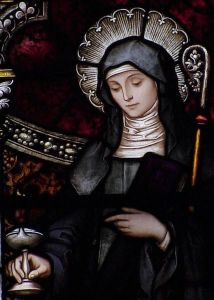
Stbrigid

Brighid, a goddess who represents the return to fertility with the earliest beginnings of spring, may also represent the earth. It will be at least another month or two before many of us will begin to see the hints of crocuses breaking through the wan grass, but Imbolc is all about turning that corner. The earth that seems to have forsaken us in the desolate winter is now about to welcome us back into the growing time. It is no wonder that, despite efforts of the missionaries, elements of the old religion remained. Whether with candles or bonfires, the pagan goddess Brighid, or the Christian Saint Brighid, ushers in February, our last full month of winter. And tomorrow, the groundhog will remind us once again that we are merely part of the earth.


Mercurial Monotheism

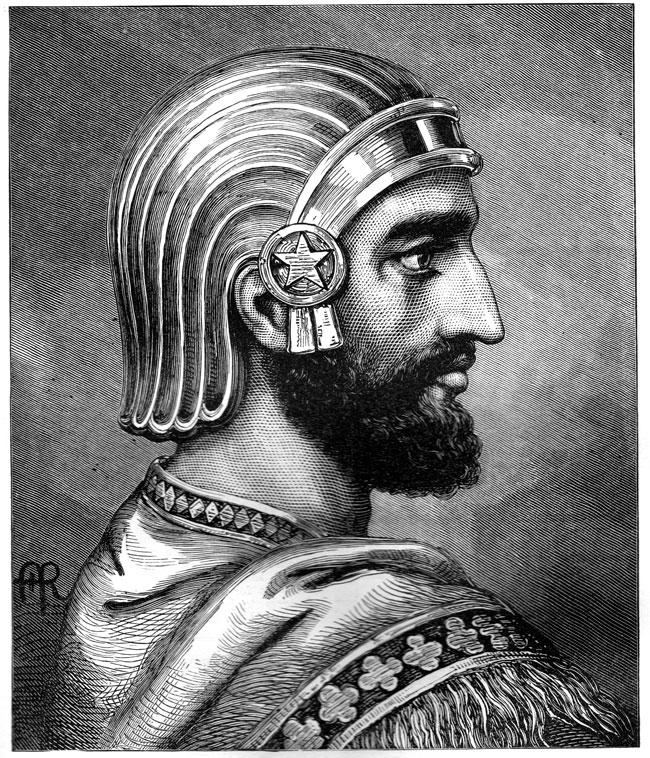
A friend recently asked about Isaiah 45.7, “I form the light, and create darkness: I make peace, and create evil: I the Lord do all these things.” I remember as a college student how professors tended to translate the problem away. Perhaps I was too young to understand the truth of the Italian phrase, “Traduttore, tradittore”—if I may betray myself—“translators are traitors.” I eventually did come to learn that those who’d already decided what the Bible meant could translate troublesome passages according to their biases. In this case the connotations aren’t even necessary to raise hackles, for the denotations do so fine just by themselves. Let’s put Isaiah 45 in context first. This remarkable chapter is an oracle from the beginnings of the Persian period that show Yahweh doing things in unexpected ways. It begins by calling Cyrus the Lord’s anointed—yes, that is the Hebrew word for “messiah”—the people of Judah had been in exile a long while and Cyrus, king of Persia, was their deliverer.

Back then, as even today, some would’ve been scandalized at this turn of phrase. The Judahites were beginning to develop the idea that the messiah would be a mystical deliverer, someone who would free them from the sad lot of being deportees. Some thought the messiah might be a divine figure. Here Yahweh is declaring a non-Jew, a foreign king, as a messiah. You can be sure there was some questioning of the prophet’s words. Second Isaiah, however, throws a well-timed curve in verse 7: God can do this because God creates both good and evil. This is a consequence of emerging monotheism. In a polytheistic world, you could have a plethora of deities. Monotheism, however, quickly runs afoul of the question of evil. If there is one god, where does it come from? Deutero-Isaiah shows Yahweh is capable of surprising things. The verse’s plain sense is blatant. Bald. Obvious. Yahweh creates both good and evil. Otherwise monotheism would be making false claims.

In college professors tried to insist that “evil” here wasn’t that really bad kind of evil, but rather something milder—a filtered cigarette rather than a Cuban cigar. They were prevaricating, however, as I learned when I too took up Greek and Hebrew. Evangelicals like to read monotheism into the Bible from the beginning, but the Bible itself fights against them here. Monotheism, like everything else, evolved. By the time Isaiah 45.7 was being penned, it was necessary to show that Marduk, and Enlil, and Ishtar had nothing to do with Jerusalem’s destruction and the fate of the deportees. No, this was Yahweh’s doing. And there was no apology for it. Monotheism had come, but at the cost of Yahweh’s innocence. According to this part of the Bible, the origin of evil is no mystery—it is the same as the genesis of all good things.

Who's your messiah now?

Who’s your messiah now?


Priests, Queens, Goddesses and Fruit

“And when the woman saw that the tree was good for food, and that it was pleasant to the eyes, and a tree to be desired to make one wise, she took of the fruit thereof, and did eat, and gave also unto her husband with her; and he did eat.” So Genesis 3.6 summarizes the most expensive meal in the history of eating out. For centuries the literally minded have wondered what the exact species of fruit might have been. The apple was long favored because its Latin name sounded suspiciously like the word for evil. In the Bible the fruit with the most theological freight, however, was the pomegranate. The high priest’s robes were designed with dangling pomegranates alternating with silver bells along the hem. Some have speculated—and it can only be speculation—that the tree of life, rather than the tree of the knowledge of good and evil (the latter better abbreviated Totkogae) was a pomegranate. For the Greeks, however, the self-same fruit led to Persephone’s entrapment in the Underworld for half the year.

Although the Bible doesn’t specify this, the apparent reason for the pomegranate’s privileged religious meaning seems to have been its numerous edible seed casings, or arils. Over time it acquired the association with fertility—not surprising with its numerous seeds. Indeed, my first experience of pomegranate was in seminary, which, like its name implies, is a place of great fertility. It is one of the more labor-intensive fruits, however, having a tough skin and plenty of inedible membrane. Even with Christianity’s inimical disdain for all things reproductive, the pomegranate survived in Christian art and symbolism, becoming a symbol of—what else?—resurrection.

Today, POM Wonderful has claimed the life-giving qualities of the pomegranate as its signature for good health and long life. This California company even has a history lesson on its website, tracing the pomegranate back to the Early Bronze Age. Interestingly, the initial picture used to illustrate this early period is a goddess, Kubaba, who was perhaps an historical remembrance of the queen by that name. The Sumerian King List gives Kubaba, the only queen on this list, a reign of a century. Well-chosen for advocating the fruit! In a relief of her eponymous goddess from Carchemish, Kubaba is shown with a pomegranate in her right hand. POM Wonderful’s website does not show, nor even mention the pomegranate on the relief. Perhaps like the pomegranate itself, this is worthy of digging in a bit deeper. Any food website that draws attention to ancient Near Eastern goddesses is doing its job exceptionally well. Who would suppose that one fruit could unite an ancient queen, an obscure goddess, and an Israelite high priest shuffling around the temple? And of course, our mother, Eve.

IMG_0540


The Santa Myth

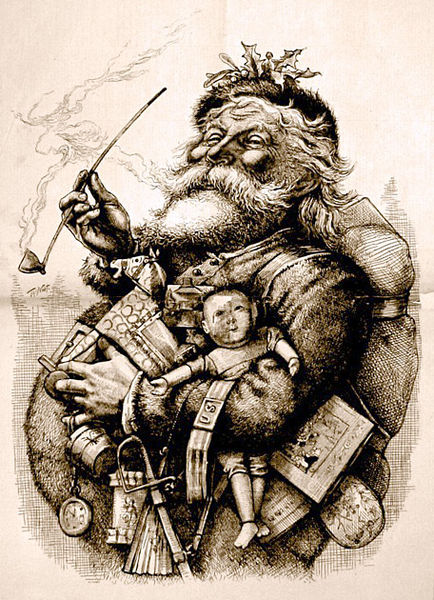
The North American Aerospace Defense Command, or NORAD, devotes its resources on Christmas Eve to track the path of Santa Claus across not only across the northern skies, but also around the world. The idea of what must be a devoted group of very serious defense professionals programming the flight track of a fictional character is strangely bemusing. I have an app on my iPhone called Star Walk—it is an astronomy program that I wish i had as a kid standing under the winter skies trying to identify constellations. On Christmas Eve my clumsy fingers slipped, accidentally turning on the program. Although I was indoors, and it was cloudy outside, I glanced around the virtual universe to see what was happening, when what to my wondering eyes should appear? Indeed, the self-same Santa Claus was flying through the night sky on my phone. Do doubt such lighthearted antics put smiles on faces of children and adults alike. They also show how deeply embedded the myth of Santa has become.

Santa Claus is a relatively new deity in the pantheon of cultural gods. Many children earnestly believe in him and some parents use him as a source of moral guidance: you’d better be good for goodness sake. Santa’s watching. Even in a pluralistic world, Santa visits Mecca and Jerusalem and Djibouti, no matter the religion of the people—and my source on this is no less than NORAD, guys who scan the skies for nuclear missiles. If they can’t be believed, who can?

Now as we wade through the discarded wrapping paper and face the inevitability of returning to work, it seems as though something really did come on Christmas. It may not have been a man in a fuzzy red suit, tracked through the atmosphere by fictional computer programs, but we can hope that it was at least a fleeting moment of peace. After all, NORAD’s Santa crossed international borders with impunity, neglecting trade sanctions and sometimes open hostility. Unlike other major figures of the Christian pantheon, Santa does not spawn wars and hatred. He encompasses no strict, dogmatic belief. Maybe it’s because we admit he’s a work of fiction, and nobody really ever lives up to the standard of always being nice. Yet, at least according to NORAD, Santa visited every person on the globe with a sense of peace, a gift that fits no matter what your size.

SantaClaus


The Religion of X

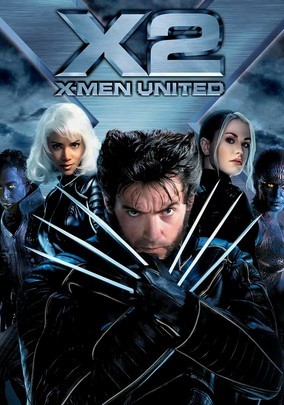
X2While I never considered myself comically deprived as a child, as an adult I have come to understand that I missed quite a bit. Much of this comes through the Marvel Universe that I discovered through various superhero films that have captured the interest of the movie industry. Initially I felt a little silly looking for profundity among all those bulging biceps and impossible pecs, but I’m beginning to understand that just because a book is illustrated doesn’t mean it’s facile. All of this is a way of saying that I watched X2: X-Men United over the weekend. With my understanding of evolution and genetics, minimal though they be, I always find the “mutant” explanation a bit hard to swallow. Nevertheless, these heroes have such a multiplicity of gifts, and the movies are dark enough to suggest something deeper than guys running around in tights. All I know of the X-Men I learned through the first movie, and I’ve never watched the extras. X2 introduced a new character (to me) that seemed to have been designed for a blog like this.

Nightcrawler is portrayed as demonic in shape and coloration, resembling Iblis more than anything else, is the most religious X-Man I’ve so far encountered. His hideout in the movie is an abandoned church in Boston, and when he is discovered he is in the midst of praying. During the course of the movie he prays the rosary and recites Psalms, making him a truly conflicted character—demonic in form and devout in soul. Comic book writers have long drawn on religious themes, but the shaping of “profane” characters as “religious” would appear a venial kind of blasphemy to many. If cartoon characters, however, are to resemble the real world at all religion must play into the Marvel Universe. After all, it plays into the fantasy world of the Tea Party on a regular basis. The concept of a religious demon is biblical, as James notes in his epistle, “the devils also believe, and tremble.”

There is something deeper going on here, however. Nightcrawler not only believes, but worships. The issues of prejudice and racism are clearly present throughout the movie(s). And as the story comes to its climax, Phoenix—whose name already suggests resurrection—rescues her X-compatriots in an act of self-sacrifice. Religion, as it plays out in X2 is messy and ragged around the edges. But it is clearly present. In the Marvel Universe gods and humans mix with unnerving ease, and the gods aren’t always the most powerful of the heroes we meet. After seeing the movies I’ve come to realize that a developed backstory exists for this universe and some scholars of religion have begun to notice. And once that happens, a theology is never far behind. I suspect it will remain a matter of debate whether the book is better than the movie or vice-versa. In the meanwhile, I’m thinking I’ll need to find the third member of this trinity and see how the story ends.