Hic Sunt Dracones

Even a visionary like Thomas Edison can’t know the directions in which an invention might be taken. The idea of the moving picture has immersed human beings in an alternate reality that is sometimes difficult to separate from the physical world we daily inhabit. As soon as movies were invented, producers and directors began to explore the depths of fear with the monster movie. What they were really exploring was the mystery of religion. I frequently write of the nexus of religion and the monstrous, and Timothy K. Beal wrote a book on that subject a decade ago in which I found another affirmation of my suspicion. Forthrightly titled Religion and its Monsters (Routledge, 2002), Beal’s playful yet serious exploration of the scary traces the origins of monsters to Genesis, and even earlier. Taking on Leviathan, the biblical sea serpent, Beal demonstrates the pre-biblical pedigree of this fierce monster and shows that, like most truly frightening entities, it began as a god. Indeed, what we call religion today grew up around fear of those forces beyond our control, a nature so harsh it could be none other than divine. The writers of the Bible clearly knew this story as Beal traces it from Genesis to Job, from Psalms to Jonah, from Leviathan to Devil.
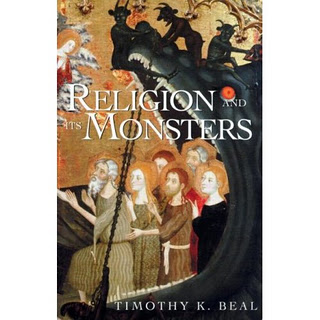
In a shot/reverse shot formation, Beal takes us to modern-day monsters and shows their religious origins. Those things that frighten us on the big screen crawl there from their origins in the temples, shrines, and chapels of religions that don’t manage to subdue evil completely. The claims are made that the gods are stronger than the chaos that surrounds us, but they are still fighting nevertheless. From Dracula to Godzilla, the monsters have the gods on the run. And when the human protagonists finally get their monster pinned down, they discover that it is often God wearing a mask. Our monsters are gods gone bad. How else could they revive from the dead at the end of the reel? They never truly disappear. And if they do, there’s always more where they came from. The reason, Beal concludes, is that we are, in fact, the monsters.

According to the analysis of W. Scott Poole, Timothy Beal, like myself, falls into the “monster kid” generation. As I grew up, I quickly learned that to confess my interest in monsters was to risk the labels of juvenile, naïve, and immature. Grown ups are interested in money and sex and power. Only kids have any interest in dinosaurs, mythology, and monsters. An epiphany of sorts, however, seems to be unfolding. Scholars of religion in my generation are peeling back the rubber masks of our movie monsters and are discovering the face of the divine. Perhaps we are all adolescents at heart, fixated on the weird and bizarre because the paths to money, power, and temptations of the flesh are blocked to us. Or perhaps we are the Magellans charting a course for regions off the map. It is those regions, as Beal reminds us, that are illustrated with sea serpents and inscribed hic sunt dracones, “here be dragons.” Doubt it? Read your Bible and find out for yourself.
Tebow or Not Tebow?

It is time to bow to the inevitable. I am not now, nor have I ever been, a sports fan. Every web page I open, however, seems to feature Tim Tebow, as if the media had never seen an evangelical before. Where have people been? What is even more amazing is that this athletic kid has invented an entirely new human gesture, “the Tebow.” Incredible what young folks can accomplish these days. And as Saturday Night Live has showed us, Jesus really isn’t that much of a football fan after all.

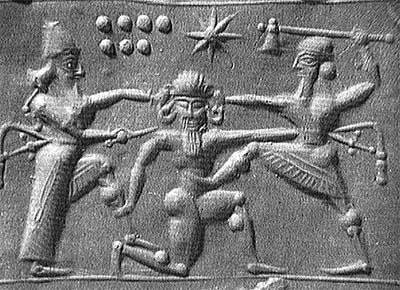
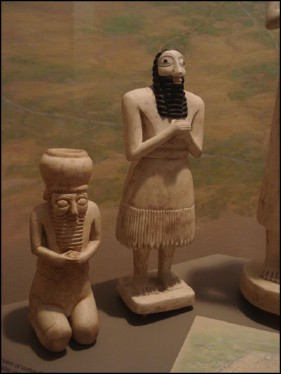
Ashamed at my naiveté, I decided to research the history of tebowing. What I found shocked and amazed me. Like so many modern day marvels, Tebowing seems to have been invented by those prescient Sumerians. Even before humans perfected the Tebow, semi-divine characters showed them how. This cylinder-seal depicts the monster Humbaba illustrating the correct posture to Gilgamesh and Enkidu. They do not, apparently, take kindly to his correction.

In the example below we see a rare double-kneed Tebow performed by an Asian football god while a hopelessly underchurched Joe Paterno looks on, hopelessly standing.

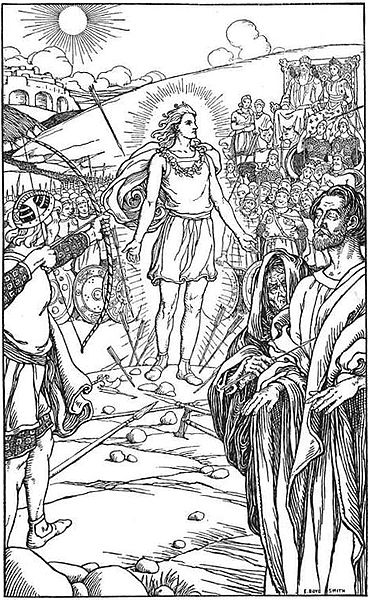
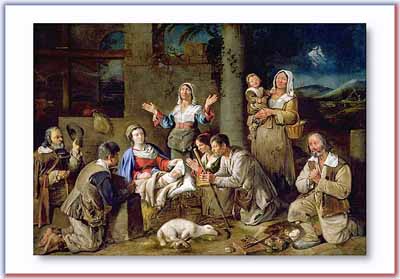
Fast forward a few centuries to a seasonal scene and we find shepherds tebowing to some baby. It is a fair guess that they suppose the baby to be a football incarnate.

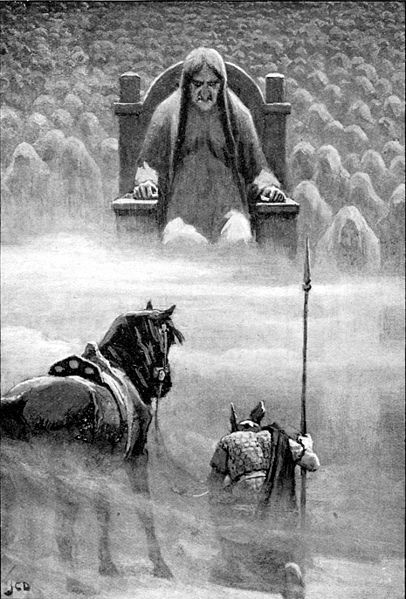
Lest we think the Tebow has been coopted by the Christian crowd, we must remember that no religion has a copyright on humility. In this scene from Norse mythology, a clearly pagan Hermod tebows before the goddess Hela. She does not look amused.

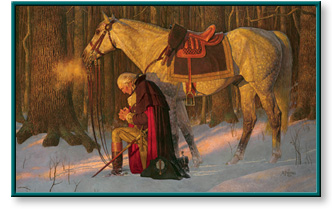
Americans, who after all claim to have invented the Tebow, can trace the gesture back to our founding father himself. In this famous painting of George Washington at Valley Forge, just after the crucial touchdown, the great man can be seen tebowing in the snow.

The snow is a great segue to the Cold War. Here, in a government photo, we see Soviet naval infantry tebowing as they contemplate the big game. They are not now, nor have they ever been, Broncos.

Now, none of this resembles the education I received during my three degrees in religious studies. No matter. ‘Tis the child becomes the man, as they say. And since a little child shall lead them, we can all learn to tebow as if there were no tomorrow. If the actual Tebow is as bright as the sports-scholarship students I taught at Oshkosh, Rutgers, and Montclair, the education of the future will include a lot lower academic expectations and, I suspect, lots and lots of Levis with holes in the knees.


Darkest Night

One of the more endearing of human weaknesses is our fear of the dark. For those who live north of the equator, we have just experienced our longest night. It is no coincidence that the religious holidays that occur in winter feature light. In our helplessness against the encroaching darkness, we light our Christmas trees and Hanukkah candles, adding just a bit more light to the world. Among the oldest of all holidays is the day that marks the birth of light’s resurrection. One need not be a pagan to appreciate the solstice and the inherent hope it bears for the return of the sun.

In this season we often see signs and hear laments about the absence of Christ from Christmas. Jesus was not born in winter, according to our best reckoning. One of the carols that drives me mad with distraction is “In the Bleak Midwinter” with its maudlin description of “snow on snow on snow”—clearly written by someone with limited experience of winters in Israel. Christmas falls near the solstice because people have from earliest memory recognized the sacredness of this season. When Jesus was born nobody knew he was to become so famous as to have one of the most popular Facebook pages ever, and so nobody thought to write it down. Even the Gospels the disciples never give a rousing chorus of “Happy Birthday” while on the dusty highway. What we’re celebrating is that night will not reign forever.

Having evolved to favor our eyesight, but lacking the standard mammalian nocturnal nature, we feel vulnerable in the dark. Even if Jesus hadn’t been born we’d be celebrating at this time of year. It might have been the re-living of the mythic Golden Age of humanity under Saturn that the Romans called Saturnalia, or it might have been the rejoicing over the resurrection of the beloved god Balder among the Norse. We might have had to wait until the days were noticeably longer to fete the goddess Brigid with the Celts at Imbolc, but we would have marked the occasion. Instead of cursing the pagan darkness, as the saying goes, we would light our feeble candles as a sign of hope. The reason for the season is the fact that the longest night is over and once more our days will slowly return light to our lives.

Here comes the sun


Old Myth

The Greek gods are in the ascendant again. They seldom disappear completely, but the big movie studios have rediscovered the special effects boon that only gods can deliver. When I first began to teach my Mythology course at Montclair State University, the Clash of the Titans remake and Percy Jackson: The Lightning Thief were both released just as the class was getting underway. It seemed like interest had been lost since the original Clash of the Titans back in 1981 when I was still a student. Special effects then meant Ray Harryhausen. Now they are measured in terabytes and whatever is larger than that. So Immortals was released recently, but I haven’t seen it yet. Picking up on the sometimes forgotten hero Theseus, the Athenian answer to Hercules, the movie promises to bring the divine into the theater.

In the spate of movies showing gods, America is not yet ready for a movie featuring Yahweh. Oh, certainly there have been films where the god of Israel has loomed very large behind the scenes, but with a prohibition of making images—no paparazzi need apply—it seems unlikely that we’ll see a special effects extravaganza featuring the Almighty. Besides, few Americans have reconciled themselves with the mythic nature of many Bible stories. As politicians and televangelists insist, these stories are fact, not entertainment. GCI Yahweh always stops at the somewhat comic George Burns or Morgan Freeman figures. Charleton Heston, where have you gone? Yahweh of the Bible is a gun-toting, hard-talking, pestilence-slinging, American-style deity. And action is where it counts.

Critics say Immortals suffers on the side of story-line at the expense of gore and action. A factor that is often overlooked, however, is mythology’s inherent mutability. “The Classics,” as we grandly call them, do not derive from a super-Scripture of literalist myths. Each writer told his (less often, her) story in his (her) own way. Although there were those who took such stories literally, as Socrates will silently confess, I suspect not a few knew these were stories told to make a point. There is no right way to tell a myth. From Harryhausen’s Jason and the Argonauts to Disney’s Hercules to Singh’s Immortals, mythology transcends the mere mortals telling it. This is the greatest shame of the modern world—we have traded the beauty of myth for a paltry handful of literalism approaches to religion. And the literary (and cinematic) world is much the poorer for it.

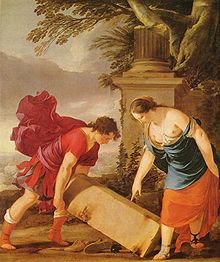
Theseus looking for immortality


Cthulhu’s Revenge

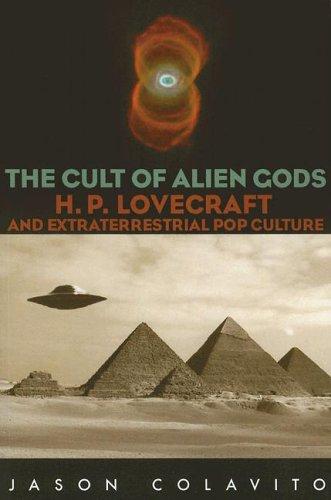
H. P. Lovecraft. Monsters. Aliens. UFOs. Ancient Egyptians. Sumerians. Is there nothing this book doesn’t have? Having read many of H. P. Lovecraft’s stories over the years, I have always been taken by how, as a writer, Lovecraft disappeared from public attention only to spring back in the 1990s. I discovered Lovecraft while doing research on Dagon, the putative “fish god” of the “Philistines.” Every time I typed the name of the deity into Google, I came up with pages and pages of Lovecraft. In my lonely room on a gray Wisconsin campus, I began to read his stories and shiver with fear as I walked across a dark parking lot to my car. Jason Colavito obviously has a great appreciation for Lovecraft as well, and his book The Cult of Alien Gods: H. P. Lovecraft and Extraterrestrial Pop Culture is a fun read for a November night. Colavito suggests that the “ancient astronaut” craze that has informed many a young mind stems back to Lovecraft’s fiction. Cthulhu and his ilk.

I’m not sure that Colavito convinced me that the ideas of ancient aliens began with Lovecraft, but he does an excellent job of exposing the foibles of many theorists who build houses of cards on shifting sand. One of the most interesting connections Colavito makes is that Creationism and Ancient Astronaut-ism are not dissimilar. “Both are, in essence, a concession that science is the ultimate arbiter of truth, and both seek to (mis)use science to give absolute authority to their beliefs” (331-2). This is an aspect of Creationism I hadn’t considered before. In the uncompromising desire for scientific respectability, the only option open is to bend science to the will of religion. This distortion must be carefully executed, convincing the followers that true science has validated a religious ideal. Rhetoric and occluding argumentation must be utilized carefully here. It seems Cthulhu has world domination in his squishy mind again.

Lovecraft famously gave us fantasy worlds where ancient space creatures left their impressions as gods upon a vulnerable humanity. Mysteries of the past—and Colavito doesn’t deny there are mysteries—are so easily explained by dei ex machina, and working with fantasy is so much easier than working with physics. To approach the mysteries with an answer already in hand, however, is to deny science its glory. As a civilization we owe much to a scientific understanding of the universe we inhabit.


Dead Sea Souls

The Dead Sea Scrolls are coming to Times Square. Times Square is the kind of place where you know your being sworn at, but you’re never really sure in what language. It is a place of the people. So the sacred meets the profane. Mircea Eliade would be scratching his great head with his pipe firmly in hand. The Dead Sea Scrolls are the sexiest of ancient documents. Their story has it all: mystery, intrigue, conspiracy, romance—well, maybe not romance. A chance discovery by dirt-poor Bedouin in a desert, ads being taken out in the Wall Street Journal, clandestine meetings with ancient texts being viewed through a hurricane fence in a forbidden zone. And do those scrolls ever get around! I first saw them (those that are accessible to the public) in Jerusalem. The next time was in the Field Museum in Chicago. Now I’m feeling a bit blasé about the whole thing.

Those of use who’ve spent much time (too much time) with ancient documents relating to the Bible know that the Dead Sea Scrolls require no introduction. The far more interesting (and sexy–yes, literally sexy) Ugaritic tablets still receive slack-jawed stares of unrecognition, despite their importance. Those who read the stories of Baal, Anat, El and Asherah wonder why the “Classics” only begin with Homer. People have been creative with the gods since writing began. The theme of the human race might be summed up as, “if the gods are so powerful, what am I doing in a dump like this?” Fill in the blanks—that’s religion. From the beginning, once we’d come up with gods, we began to wonder why they treat us so. People are on the receiving end and so many things can put gods into a bad mood. It’s your basic dysfunctional family.

No doubt the Dead Sea Scrolls are important. We have learned much about the context of early Christianities from them. They provide the earliest manuscript evidence for the Hebrew Bible. And they’ve got that Dead Sea mystique. When I read the story of their discovery, I understand why crowds will flock into a tight room to stare through the glass at a bit of shriveled parchment that most of them cannot read. It’s like standing next to someone famous and powerful; maybe Moses or King David. Or more famous and powerful, like George W. Bush. I know, that was the last administration. But the Scrolls come from an even earlier one. I just hope somebody will give me a call when they find one that tells what happens when Baal meets Astarte. That will be worth the price of admission! And, who knows? It might even fit in with the spirit of Times Square (pre-Disney, of course.)


Expanding Universes

If you’re one of those people who has trouble finding your car keys, it looks like things are only going to get worse. We all knew the universe was expanding, but now that the smoke has cleared from this year’s Nobel Prizes (there was smoke, wasn’t there?) it is now common knowledge that instead of slowing down, the expansion is actually accelerating. Kind of makes you wonder who’s driving. Being somewhat of a science news junkie, I already knew of the increasing rate of expansion, but seeing it in the news again made me ponder the theological implications of it all (despite not being a theologian). Where do we locate Heaven in a rapidly expanding universe that is ripping itself apart? Why didn’t the prophets in the Bible see this coming? What is anybody doing about it?

Physicists have had to postulate a new culprit in this unexpected scenario. Dark energy must be driving the expansion and the universe most be mostly composed of dark matter. Besides apparently being the substance between the ears of Tea Partiers and certain public officials, nobody really knows what dark matter is. The darkness of the name here is to be understood as “unknown.” We can’t see it or sense it, but it can be weighed—at least on a universal scale. Not only are we not the center of God’s universe, we are vastly outnumbered by something that we can’t even see.

Of course, it will only be a matter of time before some religious specialist suggests that God is the dark matter or the dark energy of the universe. Classic god-of-the-gaps thinking. If we can’t explain it, it must be God. That God, however, suffers the embarrassing phenomenon of shrinkage. At one time that Gog (God-o’gaps) was in control of the weather, until NOAA came along. At one time that deity held the nucleus of atoms together, until the strong and weak nuclear forces were discovered. At one time that God knocked off the dinosaurs. Well, maybe the jury’s still out on that one. The danger of conflating God with science is the inevitable effacement of divinity. Our universe has proven unfriendly to deities. Depending on how medieval we’d like to get, we might suggest that dark matter must be all those angels dancing on the heads of pins. While you ponder that one, I’m going to look for my car keys while I still can.

There it goes...


Lamp of the Gods

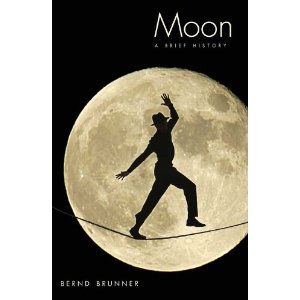
Long venerated as a god, the moon has fallen to such a declination that it scarcely attracts the notice of most people anymore. While some governments are busy making plans to reach the moon—notably those with the largest populations—the rest of the developed world looks to the nighttime sky and lets out a yawn. The poignant little book called Moon: A Brief History, by Bernd Brunner, offers a moving tribute that is part science, part history, and part whimsy. Very few heavenly bodies have undergone the dramatic plummet in interest as our familiar old moon. It remains the proximate cause for werewolves and the occasional harvest-season horror movie, but since the Cold War has ended and we no longer need to prove ourselves to anybody, attention has shifted toward more distant and abstract targets. Maybe Mars, or one of Jupiter’s moons holds the fascination we so long for. The moon, apart from a brief flare of interest when water was discovered there, has died a slow death in the human imagination.

In ancient times, the moon was often considered superior to the sun. Sure, it’s not as warm—downright cold at times—but its light is more gentle, more forgiving. The traveler’s companion, the moon illuminated the way before headlights were invented. The god of the moon (its gender was slippery in parts of the ancient Near East) sometimes topped the pantheon. Even today in Islam, the memory of the high god’s crescent moon can be found atop mosques throughout the world.

What happened to the moon? Famously Carl Sagan, himself an astronomer, wrote about The Demon-Haunted World. In this book he decried the human tendency to look for supernatural causation; the universe is entirely natural. Many have used his reasoning as a nail in the coffin of God. Clearly he was right in many cases, but, as Brunner shows, science can rob even a deity of its shine. Writes Brunner: “Its significance and roles have always varied across cultures and eras—from heavenly god to symbolic guardian or judge, to the scene or stage of spectacular visions and visits, to being ‘just’ and object of scientific investigation.” Once we’ve been to bed with the moon and look at it scientifically, its luster is lost. “Maybe we should try sometimes to un-think our scientific knowledge of the moon,” Brunner opines.

I was one of those thousands planted before the television on 21 June 1969 to watch the first men on the moon. Amid the turmoil of earth, it was a sublime, even a religious moment. In the end a dozen men walked on the moon before it was forgotten. Like the dozen disciples, they alone have been near the truly sublime. With Brunner I too would suggest that we not be too quick to forget our constant companion.


Ezekiel’s Equinox Paradox

Like the great celestial wheels of antique imagination, the seasons continue their wearisome roll across the earth. On a day long marked as a holiday among those more closely attuned to nature than most modern people in developed nations, we face the beginning of autumn. Change is in the air and already the gray skies that have predominated the eastern seaboard over weeks since Irene seem to have winter on their minds. Changes always call to mind how the human mind tends to divide what it sees into categories. The Bible is one place that this tendency is crucial. The whole scheme behind clean and unclean comes down to the need to make discrete that which nature shamelessly blends. When it comes to deity, the party line has always been (at least in the monotheistic religions) that God is like one of us. We can’t imagine human very well without gender, and so God becomes a guy. Notwithstanding protests to the contrary, early religions did take that distinction literally; divinity and masculinity were of a piece.

This fact makes it all the more intriguing when the Bible itself offers a few passages that call this orthodoxy into question. A few verses explore the trope of God as female, but they quickly back away and revert to the male God when taking on more literal terms. Hebraic culture was monistic, not dualistic. God as “spirit” was not really a possibility in the Hebrew Bible. God as a big man fits the picture better. One of the voices that claims dissent is that of Ezekiel. No surprise there—Ezekiel has been analyzed as everything from a dreamer to a dropper. Ezekiel’s understanding of God, however, is deeply imbued with temple imagery. Ezekiel was a priest without a sanctuary, and so his view of God suffered from temple vision. Nevertheless, the strange account of Ezekiel’s vision of Yahweh coming to Babylonia that opens his book demonstrates a startling lack of clarity when it comes to divine gender.

When two people meet, as psychologists have long noted, the first bit of information they attempt to discern is gender. Perhaps it’s the old fight or flight reflex from our reptilian brains, or maybe it is the opportunistic mating behavior that so obviously characterizes our species, but we are very uncomfortable when we can’t make a gender assignment. It is the whole premise behind Saturday Night Live‘s old sketch of “It’s Pat.” When Ezekiel first espies God he describes the deity in terms of glowing metal. But notice that he begins, “And I saw as the colour of amber, as the appearance of fire round about within it, from the appearance of his loins even upward, and from the appearance of his loins even downward, I saw as it were the appearance of fire, and it had brightness round about” (1.27). Beginning at the loins the prophet looks the deity up and down and concludes God is like fire. This image does not long survive the vision, for Ezekiel quickly reverts to masculine imagery for God. Even in the face of evidence that God is not gendered, the faithful must make him so, for the age-old appurtenance of male superiority suffers immeasurably without the camaraderie of God.


Material Whirled

With the moon and Jupiter waltzing slowly so high in the sky, radiating such brilliance early in the morning over this past week, it is understandable how ancient people came to see the gods as material objects. The course of progression seems to have been physical gods to spiritual gods: the earliest deities ate, drank, made love, fought. They were of the same substance as humans, or at least of the same psychological makeup. The Egyptians, Zoroastrians, and Greeks all toyed with ideas of beings of “spirit”—non-corporeal entities that did not participate in our material world, but were able to influence it. In the world but not of it. The tremendous gulf between great goddess and material girl was born. Today that concept is taken for granted, especially in western religions. We are locked into physicality while God is free to come and go.

Many religions respond to this by suggesting that we should look beyond the physical to the majesty hidden from biological eyes. And yet, physical creatures that we are, we are drawn back to material means to demonstrate our spirituality. One of the perks of working for a publisher is the constant exposure to new ideas. At Routledge I have been learning about the rising interest in material religion: the manifestation of religion through physical objects and rituals. This aspect of religious life easily devolves into a cheapening of faith into mass-produced, religious knickknacks and kitsch. Some mistake this for the real thing. While living in Wisconsin, my family used to visit the spectacular Holy Hill, the site of a Carmelite monastery atop a large glacial moraine. On a clear day you can see Milwaukee from the church tower. It is a large tourist draw.

No visit to such a shrine would be complete without the obligatory stop at the gift shop. Even the non-believer feels compelled to buy some incredibly tasteless artifact to keep them grounded in reality. Many of the items—giant glow-in-the-dark rosaries, maudlin mini-portraits of the blessed virgin Mary (BVM as the insiders call her, not to be confused with BVD) and the crucified Lord on all manner of crosses, line the walls and shelves. This commercialization is not limited to the Catholic tradition. Evangelical groups realize the importance of branding as well, passing out cheap merchandise (or better, selling it) with Bible verses emblazoned on it. These signs of faith sell themselves, but they blur the sacred distinction between human and divine. Does religion point to a reality behind the physical? This is its claim, but what is the harm in making a bit of cash on the side, just in case?


A Peculiar Resurrection

Although it is not my regular practice to splash melodrama across my blog, my recent experience with losing the Internet for four days prompts me to consider resurrection. After consulting with three technical agents and giving my laptop a kind of electronic enema, I am now once more able to access that mysterious nirvana called the world-wide web (and even the www2, whatever that is). This experience has taught me something about the human craving for resurrection. I began this blog in July of 2009. Since then I’ve added new entries almost daily. Even in places as remote as the northwoods of Idaho, if my laptop receives a signal, I can post my unorthodox thoughts for the world to read (at least the very small cross-section of the world that stumbles upon my pages). Being forced to go without Internet connectivity in New York City, of all places!, was itself a surreal experience. I literally wept in frustration. No one could help. This morning the Verizon tech assistant had me connect via an Ethernet cable and with his omnipotent hand remotely guiding my cursor, brought these dry bones back to life. Praise the landline!

The writers of the Hebrew Bible did not believe in resurrection. The book of Daniel, written just before the death of Antiochus IV Epiphanes (“the manifestation” as he humbly called himself) in 164 BCE, is the earliest hint that Jewish thinkers were beginning to consider the resurrection concept. The Egyptians had, many centuries earlier, played with the idea. They eventually developed it into a national pastime—building pyramids to ensure the king got to live again—but other ancient people were more pragmatic. Death was the end, so live this life to the fullest. As far as we can tell, Jesus taught his followers about the possibility of life beyond life. Some take that to mean a literal reconstituting of life after death while others understand it metaphorically. Both ideas can be, broadly speaking, labeled “Christian.” Some Jewish thinkers accept resurrection, others do not. Other religions, as mentioned earlier this week, go for the cyclical approach of reincarnation.

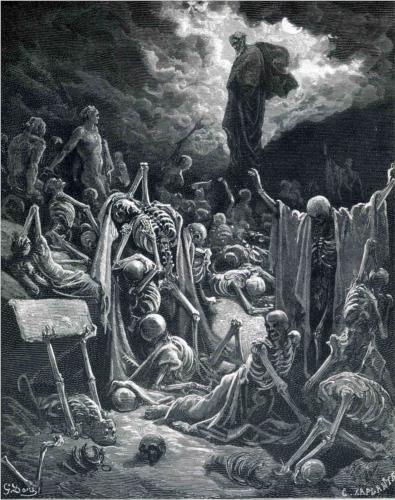
Ezekiel, according to chapter 37 of his surreal book, saw a valley of dry bones. These people were, as the Munchkin coroner croons, “really most sincerely dead.” Ezekiel did not believe in resurrection. If he had the miracle would have been lost on him. Reviving the dead was considered the most extreme, impossible feat in his entire (if limited) universe. The people of Judah, defeated by Babylonia, carried into exile, their temple—God in their midst—destroyed, believed it was all over. There was nothing to bring home into such a desolate landscape. Some suggest Ezekiel was schizophrenic or perhaps addicted to psychedelic mushrooms. In reality, I believe, he owned a MacBook that could not connect to the Internet. Once that divine signal from on high penetrated the arid air of exilic lassitude, he rebooted and without the aid of any drugs, saw God in all his/her glory. (Ezekiel refuses to give God a gender, but that is a topic for another post.)


Bad Eggs

Over the past few months I’ve discovered Jasper Fforde. While my leisure reading tends toward heavier material, Fforde has an amazing sense of wit that makes his writing nearly irresistible. I recently read The Big Over Easy, a gritty detective novel about the case of Humpty Dumpty. Throughout the story nursery rhymes are presented in literal and improbable ways, juxtaposed with the daily life of a down-on-his-luck cop. The reason that I mention the book on this blog, however, has to do with the character of Prometheus (some mythological characters also make their way into the story). Having taught Classical Mythology over the past two years, I’ve had occasion to read quite a bit about Prometheus. He is one of the more intriguing mythological characters posited by the Greeks. The creator of humans, Prometheus has a soft spot for our development that angers the other gods, jealous as they are of their privileged places.

In The Big Over Easy, Prometheus is explaining to the protagonist and his family why he thought it was worth having his liver pecked out daily in order to give humanity fire. He then tells them that he also gave people the fear of death. When asked why, he declares that the fear of death makes mortals appreciate life. There are the negative side effects such as war, hate, and intolerance, but Prometheus maintains, “I’ve seen the alternative. Eternal slavery under the gods.” Greek creation myths leave no doubt on this point; people were created to serve the gods. If we challenge that decree that we simply inherited, we are guilty of hubris, stepping over that line that separates them from us. Gods appreciate no such challenges.

It is ironic that nations based on the ideal of freedom so readily bind themselves to the strictures of the divine. The latest aggressions in which our nation has involved itself purported to be in the cause of “liberty,” “freedom,” and “democracy.” These sentiments were uttered by politicians who believe such principles ought to be bound by archaic instructions handed down through a mythological lawgiver. Our freedom ought to be circumscribed by mythology. The irony is so thick here that it is difficult to believe anyone can take such rhetoric seriously. Perhaps Prometheus brought us fire in vain. Not to worry, however. Jasper Fforde is an author of fiction only, and the arbitrary storms of Zeus no longer strike us when the gods are angry. Unless, of course, you have forgotten Hurricane Irene. Old myths never die, and, like bad eggs, once encountered they are not easily forgotten.


A Summer Fright

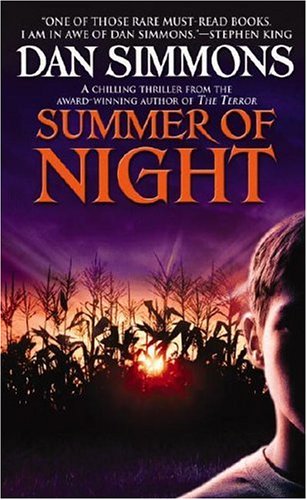
Although primarily known for his science fiction, Dan Simmons has also strayed down the dark path of horror fiction as well. During the depths of winter I found Simmons’s A Winter Haunting a moody and appropriate concomitant to the season. Not realizing that it was a sequel, when I saw his Night of Summer while at a Borders going out of business sale, I wondered if the same effect might work in warmer times. Both books rely on Egyptian funerary cult to move the story along, although in Night of Summer it is difficult to determine if the real menace is Osiris or the Judeo-Christian devil. Simmons has characters refer to Osiris as the power behind a haunted bell, but the climax of the story bears little resemblance to Egypt and quite a bit to standard monster flick tropes. “The master” of the reanimated dead is not explicitly identified. The use of Anubis in A Winter Haunting is quite effective, but the infernal characters were intermixed a little too much for my liking in Night of Summer. Better the devil that you know…

Perhaps it is simply that summer represents a time of relative ease and recovery from the frenetic pace of the remaining three quarters of the year. Although the heat and high humidity often make the season feel unbearable, the blush of abundance is all around. It is not easy to be afraid. When the air begins to chill and nature seems prepared to shut down production in the autumn, we naturally turn towards the desolate and constant struggle that will see us through the winter. Ancient people needed reassurance that warmth and relative ease would return. New Year’s rituals frequently marked autumn or spring, sometimes both. The death or life of the crops symbolized things to come.

Osiris, the god of the dead, also served as a god overseeing the renewal of crops for the ancient Egyptians. Death and life were knotted so tightly together that to unravel them was to fray the essence of the divine world itself. Among the cultures of the ancient world the Egyptians boasted the most developed concept of an afterlife. Even Paleolithic human burials contain grave-goods, demonstrating a belief in some kind of continuity beyond death. Simmons plays on that primal fear by resurrecting the dead in his novel. Beliefs about death and what might come thereafter have been one of the constant identifiers of religion from antiquity to the present. When evil pollutes the process the genre shifts to horror: witness the current fascination with vampires, zombies, and other undead entities. Religion and death are inextricably bound. Although Night of Summer may not live up to its sequel, the correlation between religion and fear meets the expectations of the genre, even during the long days of relative ease.


Demonic Beginnings

A friend recently asked me what seemed like an innocuous question: what is the origin of demons. I typed out an answer on the basis of my outdated reading on the subject only to realize that this is a very complex question indeed. While teaching my Ancient Near Eastern religions class over the past three years I regularly told students that there is no regular word for “demon” in Akkadian, the language of ancient Mesopotamia. Mesopotamian religion was the dominant system of belief in sheer size of area and antiquity in the Ancient Near East. There are characters recognized as demons: Pazuzu of The Exorcist fame among them. Their origin, however, is murky. In Mesopotamia demons are generally a mix of human and animal components supposed in some way to be responsible for misfortune. They are not evil, but they carry out the punishments decreed by the gods. In the first millennium BCE demons were understood to inhabit the Underworld, paving the way for Hell, once Zoroastrianism contributed the necessary duality for the region.

The Hebrew Bible contains no uncontested word for “demon” either. The words generally translated that way do not indicate evil spirits in the sense that the Christian Scriptures seem to depict them. In the Hebrew Bible they appear to be associated with the worship of “false gods” and the inhabitants of deserts and wastelands. In neither the Mesopotamian nor Israelite concepts do demons appear to “possess” people. By the time of Christianity, with its Zoroastrian-fueled dualism, we have an anti-God (the devil) and his anti-angelic minions (demons). One purpose here seems to have been to clear the monotheistic God of charges of originating evil. If there is only one God where does evil come from? Better to posit a devil than take that one where logic leads.

Back in the days when I was still in school, demons were regularly cast as the explanation for various mental illnesses and epilepsy. In a society that had trouble understanding the sudden onset of an epileptic fit or a sane individual growing insane, such misfortunes could appear supernatural. In a supernatural realm where evil is mediated by the devil, demons naturally volunteer for their old role as purveyors of divine punishment. Eventually the mythology of a revolt in the world of the gods emerged, probably based on the dualistic outlook of Zoroastrianism, and we soon have verses referring to the king of “Babylon” being reinterpreted as literal episodes on a spiritual plane. Once Jesus utilized this language to describe the suffering souls of his day, it became heresy to think of demons in any other way than as physically, or at least spiritually, real. In the modern day they are still with us as “spiritual entities that have never been human” according to Ghost Hunters. They do, however, resemble people in significant ways more than they resemble their mythic forebears. Where do they come from? The dark recesses of the human psyche. Their mythic origins, however, remain obscure.


August Ancestry

Lugh

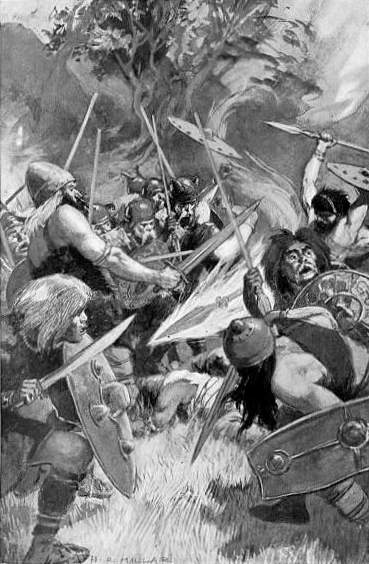
Now that August is in full swing, it is appropriate to think of Lugh. It would have been more appropriate, I suppose, to have considered him on Lughnasadh (August 1) but I’m afraid I missed the deadline. August is the only month with no officially recognized holidays, either lighthearted or serious, in the United States. Back in Celtic Britain the first of August was one of the quarter days, or days when the rent was due and religious festivals were celebrated. When Scotland was Christianized, Lughnasadh was kept under the name Lammas-mass, a festival of the first harvest of the year. The Christian correlation became the deliverance of Peter from prison or Saint Peter in Chains.

Lugh was, without doubt, one of the most important gods of the Celts. It has been suggested that the Celts understood their gods not to be transcendent beings of a different order than humans, but rather as their own ancestors. They apparently believed that gods came from great humans. Lugh is a warrior god, and occasionally god of the sun. His favored epithet is “long arm” or “long hand,” indicating his felicity with spears and swords. So widely was he known that many important cities were named after him, including Lyon in France, Vienna (known by one of his epithets), and perhaps even London itself. When Romans conquered the Celtic lands, the festival in August was that of the Caesar from whom the month takes its name, Augustus. Apart from the minor Christian festival of Peter in Chains, the month of August was simply forgotten as the seat of holy days.

The origins of gods differ in diverse cultures. The assumption of most people today seems to be that gods exist as an ontological reality and we reverence them because of their factual existence. The Celts, on the other hand, grew their own gods in the tradition that a noble human was worthy of veneration and full of undying power. Lugh may have been one such person. If he was, he has been lost in the heavy haze of hoary antiquity. He comes to us today in August, but more often in March. The word leprechaun is an Anglicized version of the Irish phrase “Lugh the cobbler” (one of his many associations). As such he is remembered every time we pour ourselves a bowl of Lucky Charms.

Part Lugh, part Potter