Philistines in Midtown

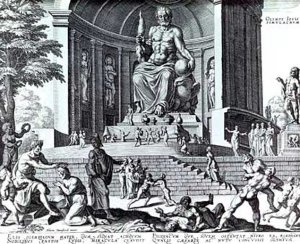
It’s an old story. In fact, it’s in the Bible. The enemies of Yahweh perish. Since Israel’s god could not be represented iconically, the story goes, an iconic ark stood in for the divine presence. After a certain unpleasantness with the Philistines, the ark was captured and taken to the temple of Dagon. There, the statue of Dagon fell down in worship before the ark. Philistine priests, embarrassed for their deity, set the statue upright again only to come back the next morning to find their god not only toppled, but decapitated. I’ve always found this story intriguing. I wrote an academic article about it some years ago, which, as far as I can tell, has been ignored by subsequent scholars of Dagon. Of course, the Philistine god eventually went on to fame at the hands of H. P. Lovecraft. Today most scholars are far too parsimonious to care about that, so I’m left to follow my imagination when it comes to the old gods.

IMG_2671

This past week, on my way to work, I spied a mannequin fallen in the Garment District. There used to be hundreds of fabric stores around here. I’m always interested in those that remain. Cloth is so basic to human needs. The mannequin was behind glass, behind a chain fence. She’d clearly fallen in the night. She was decapitated. Of course, Dagon came to mind. I’m sure that others walking by the store had the same thought. Fallen before the invisible almighty, an idol meets its end.

Once upon a time, I’m told, biblical literacy was common. I don’t mourn its passing because I believe society has become sinful, but I do mourn it because the stories are timeless and important. There is something very poignant about the idea of a foreign deity falling, headless, before an even more powerful, invisible foe. That foe these days is the equally omnipresent and omnipotent dollar. After all, I am standing in Midtown Manhattan where the only language that everyone can speak is that of Mammon. Writers of fiction and erudite scholars beyond the reach of mere mortals ponder the great mysteries of ancient gods. The rest of us walk the streets to our assigned places so that we may participate in its endless worship.

Footprints in the Snow

A friend keenly aware of my interest in the unusual sent me a story about the “Devil’s Footprints” that sometimes occur in snow. The article focuses on an instance in England in 1855 but which was reprised in 2009. The prints, made by a bipedal, cloven-hoofed animal, surmount tall barriers and occur on rooftops as well as on the ground. Such a phenomena is not limited to England. Associated with the Jersey Devil, similar unusual trails were reported during the flap of sightings in the early part of the last century here in New Jersey. As the piece on Mental Floss states, this is most assuredly not diabolical work, but it does make me wonder why people associate the unknown with the Devil.

IMG_2654

As a character in world religions, the Devil can trace his (and, like God, he is almost always a male) origins to the Zoroastrians. Zoroastrian theology is a dualistic outlook: ultimate good versus ultimate evil, Good God versus Bad God. The idea synced particularly well with the burgeoning of apocalyptic thought that hovered in the air during the time that the people of ancient Judah came into contact with Persian thinking. The idea was toned down, of course, to a being with lesser powers than God, but still a real foe with which to contend. By the time of the New Testament, the Devil was ensconced and associated with the Persian accuser known by the title of “the Satan,” or the divine prosecuting attorney. How this character came to be associated with strange footprints in the snow traces an odd trail indeed. The key is the cloven hooves.

No description of the Devil exists in the Bible. The best evidence suggests that the horns, goatish bottom, and cloven hooves come from an association with the Greek demigod Pan. Why Pan was singled out as a particularly bad god is not known. He was popular in ancient Greece. It is certain that the Jews of Jesus’ time would not have recognized a cloven hoofed beast as devilish. The livelihood of too many relied on sheep and goats. Once the transformation took place in the imagination, unexplained cloven footprints appearing in the night suddenly became those of the Devil. As Stacy Conradt points out in her Mental Floss post, several suggestions have been made for creatures of the natural world and their snowy markers. We don’t know what makes the footprints, however, and winter is all the richer for it.


The Bottom Line

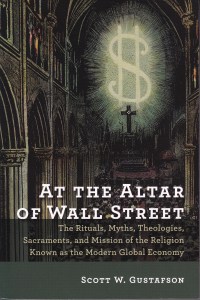
AltarWallStUnderstanding, or even caring about, economics has been one of my abiding weaknesses. I suppose growing up poor, excess money was a foreign concept—at least on a quotidian basis—the possibility of acquiring much of it remote. The poor know their place. Still, I was intrigued by Scott W. Gustafson’s At the Altar of Wall Street: The Rituals, Myths, Theologies, Sacraments, and Mission of the Religion Known as the Modern Global Economy. It has turned out to be one of those very important books that could be world-changing, if enough people read it. The basic idea is simple enough: Economics is a religion. Immediately many people will put the book down. Economics may be the dismal science, but at least it’s a science, right? Not so. Not completely. While economics uses scientific principles (as does theology), it is a belief system based on an underlying myth that has pushed us to the place where the rich are far too rich and we’re convinced that the plight of the poor is simply a reality with which we must live. It’s all based on a myth of barter.

There are places I quibble with Gustafson, but he makes a very compelling case that the Global Economy, through a series of historically discernible steps, has come to be money making money for money’s sake. As he clearly demonstrates, developments in stock trading have made this an enterprise where people are completely left out of the equation and understanding what has happened impossible. As long as money has been made, the Economy is happy. This way of thinking, which is de rigueur for business schools and presidential wannabes, believes with the conviction of an evangelical that as long as money circulates everything will be fine. Those who believe this walk down Fifth Avenue with blinders on.

Step by step Gustafson demonstrates that Economics has all the trappings of any religion: a priesthood, mythology, rites and rituals, and an overarching theology. And this belief structure, like that of many religions, persecutes heretics. Indeed, human sacrifice is an innate part of this religion called Economy. It has sent missionaries out to the far reaches of the world to convert other ways of living to that of the Global Economy. And in this religion, it is safe to say, those who make it to Heaven are remarkably few. This book does offer potential solutions. They are solutions the wealthy and powerful will not like, so they are probably not going to be enacted any time soon, if at all. So while the rest of us are standing in line at the soup kitchen, I would suggest some reading that will make far more sense than you think it might. At the Altar of Wall Street could change the world for the better, if the Economy allows it.


Act of Balance

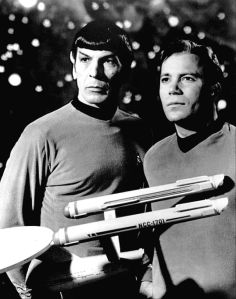
They call it the green-eyed monster. Jealousy. Under its weightier name of envy, it becomes a deadly sin. I often wonder if envy isn’t behind the debate that seems to have atheists and believers in religion talking past one another. Each seems to want, it appears to me, what the other has. Atheism has emerged in this new century as the current brand of intellectualism. Those who rely on reason alone don’t require comforting ideas such as God or salvation to get along in a world that has learnable rules and no magic. On the other hand, as an article by Barbara J. King on NPR points out, some religionists (Alister McGrath, while good for illustrative purposes, may not be the most representative choice) insist that atheists miss out on the meaning of life. Goal-oriented behavior, which we all understand, in a traditional monotheistic context is a divine mandate. We want to get to a better place either here on earth or after we die, and God has given a set of rules to follow to enable us to get there. Along the way, nature veritably drips with the dewy beauty with which God has infused the universe. Those Mr. Spocks among us miss it all, for their non-nonsense approach to reality.

Leonard_Nimoy_William_Shatner_Star_Trek_1968

It’s pretty clear, as I’ve traced it out here, that the believers envy the reputation of solid rationality readily claimed by scientists. We all would like to be able to prove we’re right. Pointing to a law of physics and declaring, “this law can never be broken” carries a satisfaction that is rare in the theological world. Still, I wonder if some atheists aren’t just a little jealous of the teleology of having a goal set by someone else. Heaven and Hell may be passé, but you have to admit that having challenging rules laid out is somewhat invigorating. Doing something because you “should” can infuse a sense of meaning into life. Some people, if they could just do what they wanted, would opt for no more than eating, sleeping, and meeting biological necessities. They sometimes claim religion gives them the motivation to do more. It can make a difference if a deity takes the initiative.

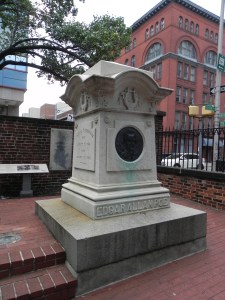
You’ll never, however, be able to prove a religious point empirically. Gravity pulls things downward as surely as sparks fly upward. And we can send a person into space to prove it’s true. No astronauts, as far as we can prove, have ever seen God in space (RIP, Edgar). Reason and emotion, religion and science, thought and action—these things need each other in order for a balanced life. Problems arise, it seems to me, if we take an extreme position. Life is complicated, and simple answers just don’t apply. Perhaps if we allowed for a bit more balance, we might all find life just a bit more satisfying.


Digging to Look up

Ancient technology is a growing field of interest. A couple years back I gave a talk about ancient technology at a local Steampunk convention. The smallish audience that attended had lots of questions about how ancient people accomplished marvels such as the Antikythera Mechanism, or even the pyramids of Egypt. As new discoveries continue to show, our antique forebears had access to knowledge we have always assumed to be beyond them. An article in Gizmodo tells the story of how Matthieu Ossendrijver, an astroarchaeologist (and hey, this was simply not a job description I ever found in a college catalog, for the record!) at Humboldt University, has been studying an Akkadian clay tablet (the article doesn’t specify which one, beyond “text A”) that demonstrates that the Babylonians understood one of the principles that led to calculus. Tracking the movement of Jupiter, the Babylonian priests knew that measuring the area under a curve could provide the distance traveled by an object. This principle, in the annals of science, wasn’t discovered until about 1350, C.E. Babylonians knew it over a thousand years earlier.

Jupiter_and_its_shrunken_Great_Red_Spot

Although we marvel at the engineering of the ancients, we tend to think of them as superstitious. After all, they believed in gods and things like that. As Maddie Stone points out in her article, however, priests were also astronomers. Believing that messages from the gods existed among the stars, peoples of ancient times kept careful track of the heavens. Apart from romantic couples looking for time alone, how many people spend an evening under the stars, looking up at a universe that is so much larger than the internet that it can actually made you shudder? There is a wonder out there that can’t be replicated electronically. People knew that the sky and the gods somehow belonged together, and they knew this millennia ago.

Given that many of us hold doctorates in reading ancient, dead languages (too many, perhaps), you’d think all the clay tablets found would’ve been read, catalogued, and neatly stacked away by now. This is far from the truth. Tens of thousands of tablets were excavated back in the days before archaeology became an endangered practice in places like Iraq and Syria. Crates full of these tablets were shipped to museums and few have been transcribed, let alone translated. There is ancient knowledge stored away among the receipts and chronicles and myths of people who lived in the cradle of civilization, and now that information remains buried in museum basements because it is deemed not worth the money spent to provide jobs for those who can read them. As is often the case, however, when we are willing to listen to others, even long dead, we are amazed at what we can discover.


Not Your Father’s Demon

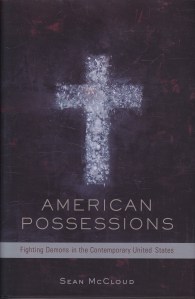
AmericanPossRegan MacNeil is a name that can still send shudders up and down stout spines. Despite advances in CGI and special effects, The Exorcist is consistently rated among the scariest movies of all time. Demon possession, clearly, is a very troubling thing. American Possessions, by Sean McCloud, is not a place to go to find Catholic priests expelling the forces of darkness. Subtitled Fighting Demons in the Contemporary United States, the book, one might suspect, is saying more than it seems to be letting on. This is a book about Third Wave evangelicalism and its demon-fighting manuals. Although the term “Third Wave” may be unfamiliar, the next time you go to a Tea Party you’ll know you’re among them. These born again uber-capitalists believe in a literal demonic world. In fact, demons are so common that Jesus would’ve had a hard time keeping up with their exponential economic growth. These demons are more frightening than those that possessed Regan. The are more akin to a different Reagan.

Especially popular among Pentecostals (the fastest growing form of Christianity) this modern day belief in demons sees them in places Jesus didn’t think to look. Family curses (at places ruled out in the Bible, but still, apparently, possible), addiction, depression, sexual urges—these are all demonic. And once these modern demons are cast out, unlike that of Regan, they can come back. And if they don’t possess you they will oppress you. And they can live in your material goods, your house, and even the land it is built upon. They are everywhere, and they have to be fought against constantly. They also, apparently, vote Republican.

This view of the world, strange as it is to many people with a basic education in science, motivates a large sector of the United States population. Expelling these demons requires a specific view of Christianity—a view that absolutely excludes Catholics. And it is a view that promotes free market economics, blaming the victims of poverty for allowing themselves to be oppressed by demons. Many aspects to this belief system will strike the reader as completely unbelievable, all the more for being so seriously believed. At the same time, we are told, we should pay no attention to religion, at least as educated people. The problem with this is that these true believers vote. And the kingdom they would have come on earth is, in a way they would certainly deny, possessed.


Illusions

While out driving one winter evening, the sun was setting below a distant horizon that I couldn’t see. Trees lined the sides of the road and, while creating not exactly a tunnel, they blocked the actual view of the orb itself. The day had been partly sunny with cloud forms shifting between layers of the atmosphere. Even though I had studied weather pretty intensely for a number of years, I couldn’t readily identify the cloud types. Thin, smooth lengths of cloud seemed to be suddenly rising up into cumulus banks, heavy with snow. Not far away, the sky was clear. As the sun was going down, these dramatic clouds were lit with the colors of fire: yellows, oranges, and reds. Further to the west, a high, broken bank of clouds glowed a rosy red against a twilight sky. Since the highway we were on was straight, I had a fairly consistent view of the warm tones of the sun highlighting the impressive clouds. My camera couldn’t hope to catch the intensity of the palette revealed to my eyes. When the sun finally fell beyond the range of the clouds, they appeared gray and prosaic against a darkening sky. They had been alight only moments ago, and now they were dull, and not even white.

IMG_2657

What I’d learned of physics reminded me that even these colors were not inherent to the clouds—colors are simply reflections of light rays and the range that we see depends on our eyes. An object’s color, in other words, is a kind of illusion. It’s an illusion we share, and although some people are color-blind, we make the conventions of color part of everyday life. Red means stop, and green mean go, for example. Objective reality is simply the fact that objects reflect different wavelengths of color. Depending on the light source, they appear a specific color to us. While we take colors for granted, they are actually a way of conveying meaning that isn’t entirely real.

Ancient people looking at the colors in the sky could only understand them as caused by the activity of the gods. Bright hues in the clouds suddenly diminished to gray could be the basis for a myth of heavenly conflict. A rainbow, according to Genesis, is a sign that such a conflict is finally over. I don’t know what the gods might have been doing overhead that night, but as the sun disappeared and a full moon rose, throwing soft, but pervasive light from the broken clouds that have only moments before had appeared red, another reality seemed to be taking over. I suspect that we have lost much by no longer watching the sky. My daily work generally involves sitting in a windowless room, and in Midtown the sky is occluded with human attempts to climb to heaven. When I can see the sky for an extended period of time, it seems that the gods are putting on a show, if only we’d watch.


Swamped

The word “venerable” is often applied with the connotation of age. Although the word in its own right really means to “adore,” or “worship,” objects of extreme age evoke that response. Perhaps the fact that “time-honored” is used as a synonym helps create that impression. As human beings, many of us experience an awe at being in the presence of something much older than ourselves. When I read about the Great Swamp Oak, then, I knew I would eventually need to see it. Reliable indications of a living tree’s age are difficult to assess for a non-botanist. Websites don’t give much thought to checking out the oldest tree in the state (although I did discover The NJ Big Tree Registry), but there are those who give that honor to the white oak of Basking Ridge, not far from the Great Swamp Oak. Others seem to indicate that the swamp denizen is older—somewhere in the range of 700 years. In the state of New Jersey, where things are constantly being reinvented and reconstructed, it is a source of comfort to find something so old leaving peacefully in a swamp.

DSCN6148

Now that I’ve used the words “tree” and “worship” together, I am inevitably brought back to the conceit of Asherah. As my academic writings have adequately demonstrated, I have doubts about the goddess’s association with trees. Nevertheless, there is something venerable about an ancient tree. If the Great Swamp Oak is 700 years old, it was already alive well before the “Age of Exploration” began. The only people to know of it, when there was as yet nothing to know, were First Nations inhabitants of the region. It was a time when, to American Indians, Europe did not even exist. Meanwhile across the ocean the plague could have been raging. A century or two later, Europeans would bring their plagues to these shores, forever changing the landscape. And not in a good way.

Trees, without human interference, can have tremendous life spans. In our short-sighted way, however, we have often understood them as nuisances in the way of some great shopping mall or industrial site. The “lungs of the planet,” trees have been wantonly destroyed in the name of progress. It is amazing that, especially on the East Coast, a few of them managed to avoid the axe and saw. Looking up into the branches of this great oak, I marvel at the changes that have taken place that, in its own way, this tree has “seen.” The world outside this swamp would be completely unrecognizable. Whether an asherah or not, I find myself reacting to the venerable nature of this sentinel of the ages. If only we could learn to keep our hands off young trees that nature plants, who knows what wonders future generations might experience in places even more unlikely than a swamp.


Free Words

Just over a couple of centuries ago on this date, Edgar Allan Poe was born. That auspicious moment is an inspiration for those of us who write, and not just those of us who like scary stories. Poe was one of the first Americans to try to support himself by his writing—an occupation that has remained difficult to replicate and attain, even centuries later. There had, of course, been earlier writers. Mostly they wrote as an avocation to their jobs or they had family wealth, but Poe knew his own talents well enough to believe that writing was his occupation. He still stands out as an icon to those who are hopefully of making some kind of mark in the literary world. The surface is, however, much harder than we anticipate. It is like diamond, which may be marked only by another diamond. It is worth stopping to think of literature today.

DSCN2335

Over the long weekend, celebrating the human spirit in the person of Martin Luther King, Jr., I decided to read William Shakespeare’s King Lear. Probably not the source of as many famous quotes as some of the Bard’s other plays, it was nevertheless fitting as a tribute to writing. King Lear is sometimes cast as Shakespeare’s most thoroughly tragic works. The mood of misfortune hangs over the entire play. And although Lear is likely a fiction from the mind of Geoffrey of Monmouth or his sources, his name recounts the Celtic god of the sea, Llyr. Historians and grammarians tell us that Lear is not directly derived from the god’s name, nevertheless, there is a divine madness about the drama that unfolds as love and power vie for control in ages long past. In the present day the tragedy is that love seems no longer to be part of the equation and raw power is left to mark those who would be kings.

IMG_0969

The holiday weekend afforded the opportunity to visit a local bookstore and to ask the owners what to read. It would give Poe, I’m sure, some hope to know that despite the difficulties there are those who still strive to live by their words. Indeed, it is difficult to conceive of a better way of celebrating freedom than to indulge oneself with the written word. Words lead to liberty. Although Poe’s life was short, and often tragic, Martin Luther King, Jr. lived to about the same age, and through his often tragic life, changed the world with his words. In this day of money hunger and electronic stimulation, it is good to set aside some time to reflect on the words that have made us who we are. Words are our ultimate freedom.


Excuse Me, Mammon

An article in the New York Times back in December explored the use of God in adverting. The piece, by Michael McCarthy, suggests that religious viewers are not very forgiving of commercials using God, unless they are respectfully done. The occasional spot will score points for being funny, but overall the issue is whether the deity is treated well or not. I always find it interesting when the media seems surprised that people don’t like to have their religious beliefs belittled. When I was growing up it was common sense that you didn’t talk about religion or politics in polite company. Now, of course, both topics are open for constant debate in the media, and few ever treat religion as one that deserves respect. That’s odd since most people in the world claim to be be committed to their religious traditions. It’s almost as if someone personally isn’t religious they can’t understand why anyone else would be.

Amos5

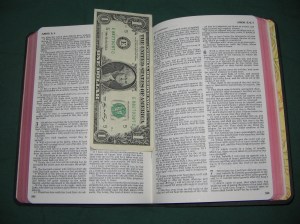
Quite apart from that, I wonder about the larger question of the purposes of advertisements. Ads are intended, as we well know, to make money. They are a marketing ploy. We appreciate the extra effort for a funny commercial on nearly any topic. Religion may be an exception. And one might wonder, is there a natural objection to using a religion to earn money for a non-religious cause? Maybe mammon and religion simply don’t mix. It may be difficult to convince marketers, however, that there are issues that lie outside the purview of the purse.

This past week I found myself in the waiting room of a local clinic for a while. Such places always make me uncomfortable in the best of circumstances. I was waiting in a room where the commercials for all the things that could possibly go wrong with me edged my blood-pressure up a bit, I’m sure. It occurred to me, however, that medical ads have the same intention as religious ones, namely, getting more business. If you can’t be made aware that something is “wrong,” how can you know to ask your doctor for their product? Is there anything mammon can’t buy? Our physical health is up for bids, it seems. Why not throw in the spiritual as well? But that will have to wait; I’ve got to talk to a doctor about a new condition I’m just sure I’ve developed here. I’m sure money can fix it.


Who’s Driving?

Technology has been kind to civilization. At least in some aspects. I often think how easy communication has become. When I was just starting out in the professional world, email was new and not trusted by some academics, and now if you can’t be reached by email you’re not a real professor. Professors are the ones, at least in some sectors, who write books. They share ideas—sometimes quite intricate and entangled—using the delimiters of language that has developed to serve communication. Technology, however, has reached a point where it limits what can be said. I have heard experts say that authors must learn to write in XML, a mark-up language that doesn’t recognize things like pages, or even such simple prepositions as “above” or “below.” We must get away, they say, from outmoded ways of thinking. Or think about this blog. When I list tags, they are “comma separated values” (CSV, but not the pharmaceutical kind). If a book title has commas, it is broken up into separate units, some of them nonsensical as tags. They are, however, what the brave new language demands.

Language is how we express what we mean. Since meaning is often of our own making, it seems that language should allow us to formulate our thoughts, commas and all. We take this incredible tool of language and degrade it in our constant drive to find bigger and better superlatives. Lately I’ve noticed the trend toward calling recognized experts in a field “gods.” I wonder what we will do when that gets old and threadbare. What trumps a god? A Titan, perhaps? Do those who call other human beings “gods” ever stop to think through the implications? The comma represents a pause. I recommend a comma or two before using up the highest superlative the language can support.

Idle worship

Idle worship

As someone who spends a great deal of time writing, as well as reading what others write, I think it is time to push back at those who would limit language. H. P. Lovecraft often utilized intentionally unpronounceable names for his “gods.” Cthulhu has become the best recognized among them in popular culture, but here is a case of a writer having the last laugh from beyond the grave. While those who declare “there is no such thing as a page number” insist that writers hyperlink themselves, those who make their very cosmos what it is do so by breaking the rules. And they did so without having had to become gods.


Riding a Cycle

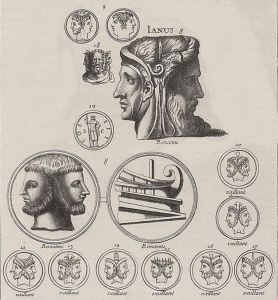
Spare-ribs and sauerkraut. My step-father always insisted on these for the turning of a new year. The old year was to end on something sour while the new was to begin with something sweet. So his reasoning went. It is this Janus-faced aspect of the new year optimism that we anticipate with such high hopes every twelve months, only to come back to another gray December. Time, since antiquity, was considered something cyclical. Today we think of time as linear—a line stretching from there to here, nobody really knowing where it might end. New Year’s Day reminds us of that obscure hope that things might indeed get better.

Since I’ve been cast into the role of someone dependent on business for a living, I’ve become keenly aware that, although the fiscal year doesn’t end for another three months, and the school year doesn’t begin for about six more after that, we open each year on the hope for better profit than the previous one. In a way that I’ve always felt earned economics its sobriquet of the dismal science, constant increase in a world of limited resources is sure to disappoint. What is really sought, it appears, is more for me, which means less for you. Born an idealist, I find the whole concept baffling. If I have too much to use, shouldn’t I share it with those who don’t have enough? Those who read about the behavior of apes would recognize this basic altruism as deeply embedded in the primate genome. Unless, of course, that primate is a human being.

Janus.xcf

I wish that a New Year celebration could be more universal than just fiscal success. It is always my hope as a new year begins that by the end of it we will all be in a place we would prefer to be. Those of us who live under the law of greed and personal gain have long felt the frowning aspect of Janus’s face. As the year turns over in the month named for this deity of thresholds, we hope that a smile might beam down upon us, and that a new year might truly be new. Knowing this is an election year, however, has come to cause increasing anxiety. Those who can command public attention are those with the deepest coffers. Those most unworthy to lead. We do, however, love our entertainment. The Force has awakened, and what might we anticipate for 2016? For me, no animal has ribs to spare, but the symbol has become increasingly apt. Let’s hope the Force is good and will awaken peace.


Mother Divine

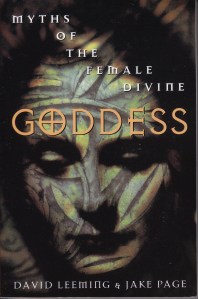
GoddessReligions, by nature, exercise a distribution of power. That power is perceived to be on several axes at once, the “vertical” is intended to represent the power of deities over humanity, and the “horizontal” is that of humans over humans. Historically all we can know is the latter dimension, and during the time of written records, that has been a male-dominated plane. Several years ago a theory developed which would be wonderful, were it true. The goddess hypothesis suggested that before male dominated civilizations took over, culture was run in a more egalitarian way and the goddess was the main deity. Since this theory sets itself before recorded history, artifacts had to be interpreted as evidence, and certainly such bits and pieces of past times have emerged. The goddess interpretation has, however, has faced severe criticism, and not just from male scholars. There are still those who find it tenable, and one such pair is David Leeming and Jake Page. Goddess: Myths of the Female Divine was a book intended to demonstrate the commonality of goddesses, but it didn’t always rise to the challenge.

No doubt, the motivation behind the book was noble. It is important to show that goddesses have been just as important as gods in the history of mythology. The problem emerges when the evidence is forced into a mold it doesn’t fit. “Goddess” is not a singular figure, any more than “woman” implies that all women are the same. Each chapter retells stories of various goddesses, and again this is problematic. Specialists in any one tradition are sure to spot errors and oversimplifications that suggest descriptions of other goddesses may not be completely trusted. There’s an overcompensation here. Men, at least some men, wish to show their support of women by suggesting that women once held esteemed places in the cult as well as in the throne room. What we know of history, however, gainsays this concept since, in one form or another, might has always made right.

Goddess is one of those little reference books whose main value lies in bringing previously disparate characters together to show some commonality. There is utility in placing goddesses side by side to form a phalanx of resistance to a hierarchy that has established itself as normative, backed by a more powerful male deity (or deities) in the sky. Goddesses have been part of religious thinking from the beginning. The early abstractions of natural powers, reason would seem to dictate, would have involved both masculine and feminine powers. We don’t know how such societies were organized, but the divine female was clearly present. By consciously acknowledging what we know, and creatively applying such knowledge, there may be a hope for the future of religions that is far more certain than a reconstructed past.


All Go Down Together

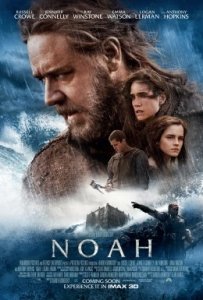
Noah2014PosterWhile the rest of the world was watching Star Wars: The Force Awakens, I was rewatching Noah, trying to find some profundity there. Like many curious people, I went to see the movie in the theater last spring expecting great things. While the story has some interesting elements, it just doesn’t live up to expectations. Noah is a hard character to like. In the biblical versions of the story, based as they are on older Mesopotamian prototypes, Noah (and his analogues) is a sympathetic character, at least in the reader’s mind. When we read we tend to identify with the main character, and since the builder of the ark is trying to preserve humanity from what seems to be an overly wrathful deity, we can sympathize at some level. What believer hasn’t felt put upon by the divine at some point or other? In the movie, Noah’s decision to end humanity after the flood is based on the silence of God. Indeed, that is one of the more profound aspects of the film—God never speaks to anyone so any action seems entirely human led. We’d expect someone who builds a floating zoo to be sympathetic to the human zookeepers at least.

Evolution, or something deriving from it, encourages species to protect their offspring. Some animals, of course, do this through over-compensation—producing more young than the world could bear if all survived to maturity. Mammals, however, care for and nurture their young. Noah’s ad hoc decision to end the human race, apart from being heavy-handed, is unreasonable and cruel. Who could look at their sons and say, “I’m going to let you age and die alone,” and yet feel that they are doing the will of the Almighty? Indeed, if humanity is made is God’s image, which Noah admits, isn’t this a form of deicide? Is Noah striking back at a silent God?

The movie does give the viewer much to ponder, but writing missteps plague the film throughout. Although wicked, Tubal-Cain is a more sympathetic character than the protagonist. He, at least, wants humanity to thrive. Noah, seeing how women are mistreated in Tubal-Cain’s kingdom, declares he will kill Ila’s children only if they are girls. There is a profound misogyny in the movie, it seems. Not that Darren Aronofsky intends for the story to be misogynic, but the implications speak loud and clear. To clear the world of violence, Noah proposes the most violent action of all. Like Noah, while everyone else was crowding into theaters with their fellow human beings to watch the force awaken, I was sequestered in my private ark waiting for a special message that refused to come. I wonder which is the more spiritual movie?


Who’s God?

There shall be wars, and rumors of wars. The Bible says nothing about being able to declare what future people might have to say about God. According to a story on the Washington Post website, Larycia Hawkins, a political science professor, was suspended from Wheaton College for claiming that the God of Islam is the same as the Christian God. Administrators felt this was one of those cases where the famous statement of faith required of Wheaton faculty was violated. Seems to me the administration might want to sit in on a class in history of religions. Everyone knows that Wheaton takes great pride in its Evangelical heritage, bordering on a kind of extreme conservatism. Even so, this seems extreme.

There is much we don’t know about the early history of most religions. Probably one of the resons for this is that, apart from the founder, we’re never sure if a new religion will take off. Many religions have started and then quietly (or not so quietly) died away. At the earliest stages nobody really knows which way it might go. We do know that by about the time of the Exile, the early Jewish faith was fast becoming monotheistic. Christianity, although disputed by some, also followed in that mold, accepting the God of Jesus of Nazareth (himself a Jew) as the one God. Here many Evangelical histories grow a little weak when focus is shifted to Arabia. The cultural context that led to Islam involved a world of pantheistic worship, but Mohammad was well aware of, and appreciative of, Judaism and Christianity. Recognizing that his faith shared the same books as the other two, his understanding of Allah was clearly the same God as the one worshipped by the Jews and that Jesus had called “Father.” The three monotheistic religions of that region, historically, have always shared the same God.

IMG_2472

Disowning a deity, I suspect, comes with some anxiety. As Islam expanded and Christianity itself became an imperial religion, clashes were bound to happen. Invective included calling the enemies “pagan” or “infidel” (technically two separate things), and as so often happens, rhetoric became mistaken for fact. Since Islam and Christianity were different religions, so the thinking went, they must recognize different gods. Triumphalism is seldom subtle. Fact checking wasn’t so easy back in those days. Suspending a professor for stating the truth is, I fear, nothing new. Some schools require statements of faith so that they may ensure academic freedom is a myth. Ironically, they seldom have trouble with accreditation. The ideology of a war between religions offers a doleful prognosis for a world where religions really need to try to understand each other and where obvious historical facts should count for something.