Bes Leave It Alone

One of the constant enjoyments of teaching is the interactive learning that takes place. I tell my students that I learn from them just as they learn (hopefully) from me. One place this has been happening regularly is in an Ancient Near Eastern Religions class I teach. Students have to provide weekly class reports on somewhat obscure deities that I chose for them to research. One of the groups was assigned Bes, the minor Egyptian protective deity, and their research had uncovered the suggestion that Bes may have originally been a cat-deity. As Halloween approaches with its plethora of black cats, I found this connection to be fascinating.

The Egyptians domesticated the cat, and revered it. The nimble catcher of vermin (although, in all fairness, vermin are only doing what vermin have evolved to do), the cat was seen as a protector. When in need, why not call upon a deified cat, an everlasting cat, if you will? It makes sense that Bes with his stubby proportions and bewhiskered face, often portrayed poking his tongue out, might have evolved from a feline original. His iconography often features leonine imagery as well. We may never know his true origins, but Bes was widely recognized in the ancient world as an effective protector.
Bes

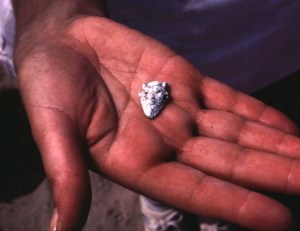
Back in 1987 I volunteered as a digger at Tel Dor in Israel. This was my first exposure to archaeology, and I loved every bit of it. The digging, the expectation of discovery, the honest physical work, the endless bouts of Herod’s revenge — well, some parts were better than others. One of the artifacts I discovered was a sky-blue faience head of Bes intended, apparently, to be worn on a necklace (there is a hole drilled through his head). I also found two bronze seed-beads that went with the necklace in the same matrix. Often I have wondered who, in an Israelite context, wore that amulet of Bes and what fate befell the wearer nevertheless. Bes is paradigmatic of our trust in help from beyond, but every once in a while even Bes ends up being dropped in the dirt only to be dragged out again by some future cat.
Evolution of Egyptian Cats

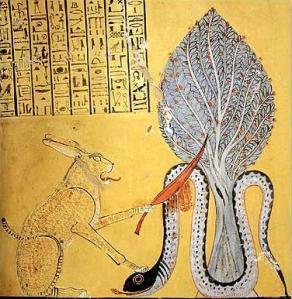
The Egyptians were the first people to “domesticate” cats. Perhaps taking their cue from their pets, they very early venerated cats as divine. Cats were, however, working animals that controlled vermin and poisonous creatures that violated the principle of stability that the Egyptians so valued. From the earliest records of the Old Kingdom we find the goddess Mafdet portrayed as a cat. Her name translates to “swift runner” and she was protector of Pharaoh, and thus of all Egypt. She was also associated with justice, a role reprised by Puss-in-Boots in Shrek 2. The hearts of evildoers were ripped out by Mafdet and brought, like a dead bird or mouse, to the Pharaoh.

Mafdet? (Don't give your kitty knives!)

Mafdet? (Don't give your kitty knives!)

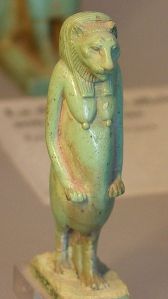
Mafdet’s fame declined with the rise of Bast, or Bastet. Bast (“devourer”) was also an early goddess, associated with the sun, and like Mafdet, she was a fierce protector. Her cult was centered in Bubastis, a city named for her. The guardian of Lower Egypt, she kept the kingdom safe from cobras, scorpions, and presumably hair-balls. Unlike the gentle kitties of today, she was also represented as a lion, a goddess of war.

Bast, all grown up

Bast, all grown up

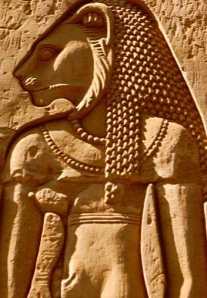
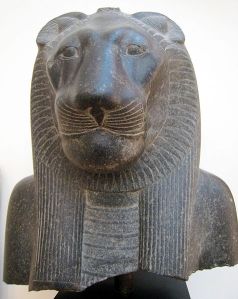
Bast’s fortunes faded with the rise of Sekhmet, the warrior goddess of Upper Egypt. With a name translating to “powerful,” Sekhmet was yet a third feline protector. She was also a lion-shaped goddess whose breath created the desert. (I have worked for human beings who could justifiably make that same claim.) Like Bast, she wore the sun on her head and became Egypt’s version of the violent goddess. Ancient peoples all feared the raging goddess, no matter what name or shape she took. Perhaps they always expected bad behavior from men, so when female deities got in on the act it was all the more powerful.

Sekmet with the breath that sank a thousand ships

Sekmet with the breath that sank a thousand ships

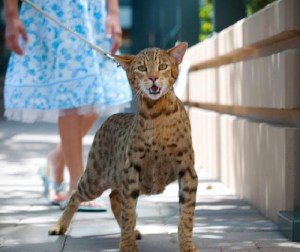
Where does evolution go from there? Is it merely coincidence that the Ashera Cat is part African Serval (as was perhaps the original Mafdet) and that it is being billed as the royal cat? I think not! Cats have a long pedigree with the divine, and from what I’ve been reading, Ceiling Cat has a very wide following. Evolution of the Egyptian cat, it seems, takes us from the Old Kingdom right up to Lolcats.


Sex and the Single God

In my Ancient Near Eastern Religions class we have been discussing Egypt. Students have been giving their deity reports and have been shuffling their feet in an embarrassed way when they have to discuss some of the gods’ various sexual activities. I have to assure them that this is not “dirty talk” or pornography — it is simply a pre-Victorian way of looking at the world. Understanding of the mechanics of conception and fertilization, involving, as they do, microscopic gametes, has only fairly recently emerged. Ancient people knew that sex led to kids, but they didn’t know how. When you can’t explain it, pass it along to the gods and forget about it!

Ancient Egypt is often where this disjunction appears most clearly. Various gods in a constellation of creation myths (Atum, Ptah, with others probably standing in line) onanistically generated the matter that makes up either other gods who reproduce sexually or the very stuff of the universe itself. This explanation of the world was not profane or vulgar; indeed, it was the very sacred act that brought all of this into existence.

When we look judgmentally on earlier religions we are condemning our own ancestors. It has become abundantly clear in recent years that ancient religions freely borrowed from each other and developed their own distinctive traditions without wholesale rejection of the earlier cultures they knew. It has even been suggested the Psalm 8 might reflect this very form of creation as an echo in the Hebrew Bible! So instead of looking nervously at our feet, or trying to find a big stone to throw at the heathen while our eyes are down there, it is best to recall that religions grow out of unions and parturitions of other religions. Unless they are created single-handedly — and this is what originates the concern in the first place.

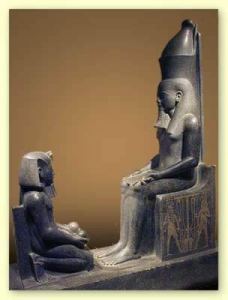
Atum teaches Horemheb the facts of life

Atum teaches Horemheb the facts of life


Banned Bible?

Florian b.'s 2005 image

Florian b.'s 2005 image

It’s Banned Book Week again. Each year the American Library Association promotes free thought by raising awareness of books that have been, or currently are, banned. Having just exited ABE books’ Weird Book Room (among the currently featured: Paint it Black: A Guide to Gothic Homemaking, The Bible Cure for Irritable Bowel Syndrome, and Is Your Dog Gay?), it is easy to see how the morally squeamish might wish that some books had never been written, but being a firm believer in personal expression, I give them a rousing cheer. Odd ideas are also among the Lego blocks that build our world.

I also ponder the texts with which I have spent so much time, and wonder what the ancient censors would have done with the great classics of antiquity. History’s first great novel, the Epic of Gilgamesh, would certainly have been on their crushed clay list. On only the second tablet we read, “Enkidu sits before the harlot. The two of them make love together… For six days and seven nights Enkidu came forth, mating with the lass. Then the harlot opened her mouth, saying to Enkidu: ‘As I look at thee, Enkidu, thou are become like a god” (Speiser’s rather tame translation). A sex scene with the first woman Enkidu ever met? We can’t have our kids reading that! Where do you put the V-chip in this tablet?

Perhaps the people of ancient Ugarit would have fared better? Their epic tale, the story of the trials and ultimate triumph of Baal, includes his unfortunate defeat at the hands of death. Baal is ordered to the underworld. “Mighty Baal obeyed. He loved a heifer in the pasture, a cow in the steppes of death’s shores, seventy-seven times he laid with her, she let him mount eighty-eight times.” Whoops! Hope the kids weren’t reading that. Surely this is some kind of sacred marriage ritual with Anat and not a cow? Good thing we never figured out where KTU 1.10 fits into the cycle! There’s another one for the rock crusher.

It’s a good thing the Egyptians were more civilized. Their culture would never allow for such liberal, naughty writing, would it? Well, maybe if we ignore the Memphite Theology. Not for the shy, here we are told how Ptah brought the Ennead into being using just his fingers.

I started reading the Bible as a child. To my surprise, it would not have gotten away with a G rating either. It seems to me that books deal with the greatest complexities human beings face. Sacred books as well as secular delve into the darker grottoes of the mind, and here the Bible is clearly among them. If we had systematically destroyed all written work that had offended others throughout history, we wouldn’t even have the Good Book left to argue about.


Of Cats and Goddesses

During one of my periodic forays into current Asherah lore on the web, I discovered a new breed of cat. Well, actually, I didn’t discover it, I just became aware of it. Because of a misspelling on a website I learned that the Ashera (trademarked name!) is the most expensive cat in the world, retailing for $22,000. A blend of three species (the mind boggles), the African Serval, Asian Leopard, and domestic cat, this feline comes in at least three varieties, including the especially appropriate Royal Ashera. If you’ve come into an inheritance and want to waste a few grand, take a look at Lifestyle Pets to see the wonder.

According to Kirta she has a temper!

According to Kirta she has a temper!

Curious, I searched to find if anyone would tip a hand as to where the name of the cat was derived. Choosing the name of the queen of the Ugaritic divine world seemed a little too much coincidence for me, but then again, homophones happen. When the Prince of Egypt, Dreamworks’ answer to The Ten Commandments, was released, I had several people ask me why the Israelites were singing about “Asherah” after they crossed the Red Sea. I had to watch the movie very closely, but I figured out that they were singing “I will sing,” which, in Hebrew, sounds suspiciously like “Asherah.” I never did discover Ashera’s origins.

Cats, however often maligned as associated with witches and vampires and other creatures of the night, are certainly among the most divine of domesticated pets. If I were free to purchase an animal companion the Ashera would be in the ranking (after I’d won the lottery, of course). Whether intentional or not, who would not want to own a cat named after the only goddess to be mentioned in connubial relations both to El and perhaps even to Yahweh? (The latter association, like the naming of the cat, is entirely open to question!)


The Lady or the Lion

Ancient West Asian society utilizes a striking image that causes no end of confusion — the lady and the lion. Although not always identified, the lady generally appears to have been a goddess. Pairing a female figure with the most ferocious predator known in that society ripples with significance; there can be no question that the cultures involved were patriarchal, a fact of life in that part of the world at that time. If it was a man’s world, why depict the glorious lion with the feminine? Because we fear what we cannot control?

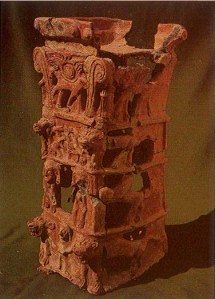
The infamous cult stand from Taanach

The infamous cult stand from Taanach

Ostensibly the rationale for this correlation may be traced back to Ishtar, the goddess sine pari of ancient Mesopotamia. The exact reason for her leonine associations is unknown yet she is among the fiercest females connected to warfare and strife in the ancient world. Her lion companions ranged over the realms of the Levant where other goddesses also assimilated her imagery. Curiously, one goddess who has no specifically leonine attributes is Asherah, the consort of the god most high, El. In Egypt the fierce goddess associated with war was Sekmet, often portrayed with a curiously male lion head.

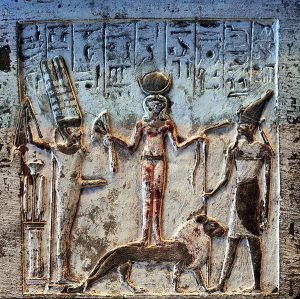
Min, Qedeshet, and Resheph — a ménage à trios?

Min, Qedeshet, and Resheph — a ménage à trios?

In an earlier post I suggested that the biblical prophet Amos may have known that lionesses generally make the kill. Could it not be that although most women were locked out of public power structures in the ancient world they still may have retained the utmost respect and reverence of the populace? Long before male monarchs claimed titles such as “Lionheart” even gods would tremble before an enraged goddess. Morphed through time and continued patriarchal culture, the connection once again recurs in Frank Stockton’s The Lady or the Tiger where the metaphor has lost its teeth and the lady is no longer the source of destruction, but of male desire. Has the male prerogative once again usurped feminine independence? If only Ishtar or Sekmet could have been behind door number three!

Behind door number 3

Behind door number 3


Bosnia Jones meets Egypt Jones

Scholarship is a remarkable human achievement; so many people from countless backgrounds sparring over ideas with comparatively little bloodshed should be applauded. In the political and religious worlds where armaments are often thrown into the mix, well, the results are colorful but often less kind. I was reminded of this when one of my students recently showed me a copy of a letter regarding a somewhat outlandish claim by Sam Osmanagic (see Momma Maya: Is It the Apocalypse Already? for more on him). Osmanagic, who is studying for a doctorate, has recently added another hapless cause to his dossier of unlikely mysteries of the human past. Investigating Visocica, a hill in Bosnia, Osmanagic has concluded that it is really a pyramid.

The letter to which I referred, written by the irrepressible head of the Antiquities Council of Egypt, Dr. Zahi Hawass, is very gentle. Hawass, a kind of self-styled Egyptian Indiana Jones, notes in a letter to Archaeology magazine, “What was found there is really just a mass of huge stones, evidently a natural geologic formation.” He does, however, also note “His [Osmanagic’s] previous claim that the Maya are from the Pleiades and Atlantis should be enough for any educated reader.” Interestingly enough, Osmanagic is a self-styled Bosnian Indiana Jones, and he has written a book arguing for the pyramid option. Meanwhile, most serious scholars are more circumspect about the claims of any Indiana Joneses. After all, to quote Raiders of the Lost Ark, “archaeology is not an exact science.”

I am sometimes challenged by those who discover that I read such things as Drosnin (see Edoc Elbib Eht) or Osmanagic, but despite my objections to their conclusions that I inevitably reach, I want to hear them. Scholarship suffers from silencing the maverick voices. I have never ascribed to the principle that a person has to have a Ph.D. to be credible; often the reverse is true. I have met many Ph.D.s barely worth listening to while some of the most profound thoughts I’ve encountered came while I was working as a janitor’s assistant, listening to my boss. He was a man who engaged in physical labor that afforded him time to think. No, I do not buy Drosnin or Osmanagic’s conclusions, but I applaud them. Scholarship would be dull if not for those willing to take chances out there on the edge of credibility. (And wearing cool hats while doing it.)


Ortho-right or Ortho-wrong?

As a child reared in a seriously religious household far, far away from anything with even a whiff of orthodoxy about it, my first encounter with this traditional form of Christianity involved more curiosity than fear. What was this religion that claimed to go back to the very earliest apostles? Did Jesus wear one of those unusual hats? I never recalled seeing paintings of Peter, or Mark, or even Thomas wearing a medallion of the theotokos. Apparently I’d been routinely misinformed. The haunted, deeply spiritual grimaces on the faces of orthodox students my age were almost intoxicating. It was all new and exotic to me.

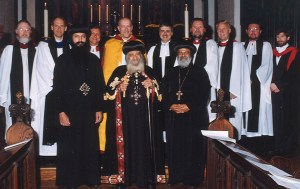
Several years later I find myself having been subjected to a variety of orthodoxies and the only thing they seem to have in common is the conviction that all the others are wrong. I once had a boss who was enamored of Greek Orthodoxy. (I later learned that this is the gateway orthodoxy, leading to more foreign strains.) Presently his interest shifted to the Russian variety and I eventually found myself cowering in the glare of the Coptic Pope Shenouda III’s eminence. How had a kid from humble beginnings come so far? A couple jobs and a few hundred miles later, my new boss turned out to be Syriac Orthodox. Phone calls to the office would come in languages I’d never even heard before. Being a northern European mutt, maybe I was simply jealous of the pride of ethnic purity. No fancy traditional dress to haul out for exotic dances at annual celebrations of mutthood (Lederhosen and stuffy tweed, anyone?)

Basking in the eminence of the Coptic Pope

Basking in the eminence of the Coptic Pope

All of this exposure to orthodoxy has led to heterodox thoughts in my heretical brain. It seems that the basic premise of orthodoxy is that the final truth was revealed just once, up front, and it left no room for growth. The expectation that Jesus would shortly be back didn’t leave much space to consider what complications would set in once people developed nuclear weapons, landed themselves on the moon, or devised genetic engineering. Complexities and complications that early Christianity could never have foreseen chaw like ravenous beavers on the stilts propping up this edifice. I am a firm believer in religious freedom and have never urged anyone to change her or his personal faith. But I do seriously wonder how any religious system, in the light of our limited brains, could ever expect anyone to believe that it had comprehended the whole of all truth for all time. It is all too wonderful for one condemned by a birth outside of ethnic Christianity.


Everlasting Cats

“The mystical divinity of unashamed felinity, round the cathedral rang ‘Vivat!’ Life to the Everlasting Cat!” I’m not sure if this is T. S. Eliot, Andrew Lloyd Webber, or a chimeric mix of the two, but it is an interesting bit of mythology. My daughter is the consummate Cats fan and has been asking me to write a post on Cats and religion. When I read (or hear) the above lines of poetry, I must confess, my mind wanders to Xenophanes who stated that if horses could draw they would draw their gods like horses. Ditto for cats.

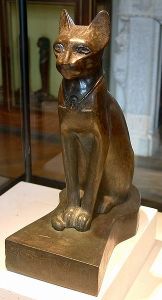
Everlasting cats, however, have their roots deep in religions of the ancient world. Although the word “cat” never occurs in the Bible (“dog” is there plenty of times, with even a “bitch” or two) cats are certainly within the biblical culture. Eternal Egypt knew of an everlasting cat — Bastet, the “cat goddess.”

Bast to see this as an everlasting cat

Bast to see this as an everlasting cat

Hailing from Bubastis, Bastet (I just can’t call her Bast, since it sounds like slathering meat with some kind of ambiguous liquid, something I can’t stomach as a vegetarian) seems likely to have some connection with the sun. Regarding yesterday’s post, the ancient Egyptians had a plethora, a veritable superabundance even, of solar deities. Bastet was called the Eye of Ra. She was also associated with war, appropriate enough to anyone who’s read Erin Hunter’s Warrior series. As a goddess, Bastet qualifies as an everlasting cat.
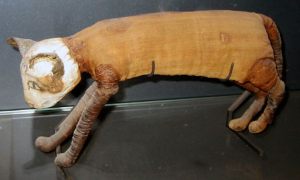
Little Bastie doesn't seem so playful any more

Little Bastie doesn't seem so playful any more


So do the numerous cat mummies from ancient Egypt. Preservation of the body was an aspect of realizing life beyond life for the Egyptians. It would also obviously help to keep the mice out of heaven. T. S. Eliot was C. of E. (Church of England, not Copt of Egypt) and had a savvy sense of wit. Ignoring the biblical snubbing of cats, he named the wisest and most respected of Old Possum’s Practical Cats with a biblical name — Old Deuteronomy. Although I am not a cat owner (is anybody really a cat owner?), I do have great respect for felines, mystical or not. And I am not alone as long as the ancient Egyptians kept a mummy or two around and an Eye of Ra to keep that solar barque on its course.