Planet A

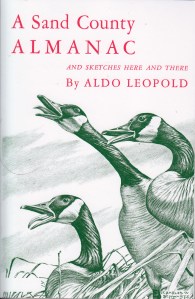
Two of the classics of ecology, A Sand County Almanac, by Aldo Leopold, and The Sea Around Us, by Rachel Carson, were published by Oxford University Press. In its present-day iteration the press has a Green Committee, on which I’ve sat from very nearly the beginning of my time there. As a committee, we’re reading these classics to see what we might learn some half-century-plus after they were published. I’d never read A Sand County Almanac before. It’s a pity, since I lived in southeast Wisconsin, from which the book takes its genesis, for about a dozen years. The writing is poetical prose, but the ideas are solid science—the land on which we’ve evolved knows how to take care of itself. When one species becomes too greedy, all suffer. Leopold ends his book by suggesting a land ethic should be put in place. Now, a human lifespan later, has it?

Hardly. Watching the Trump Administration doing everything it can to commodify any aspect of the environment that might make a buck—or at least a buck for the wealthy—is alarming in the extreme. There is no soul in the land, to this way of thinking. They believe that because they themselves lack a functional soul. A soul cannot exist without ethics. What we do to this planet is one of the largest ethical issues imaginable. No species, rational or not, destroys its own habitat. Except our own. Arrogant to the point of supposing ourselves divine, we think we can take what we want and give nothing back. And everything will be just fine. I wonder that we’ve had this inexpensive, readable guidebook this last seven decades and have continued to ignore its sage advice. Maybe we’re too busy making money to read something that sounds suspiciously like poetry.

One of the observations I had about the Almanac was how attuned to the philosophy of nature it is. Philosophy has many enemies these days, from prominent scientists to Republicans. Nobody seems to value the capacity for deep and thorough thinking through of a problem that is unbeholden to any orthodoxy. The philosopher can ask “what if?” without regret. When it comes to the environment, humans aren’t the only philosophers. We’ve convinced ourselves so completely that we’re more advanced than other species that we suppose they can’t teach us anything. One thing they do, however, without our interference, is create balance in nature. It’s an ethic to which even our species might aspire. If only we would listen to the wisdom of those who pay attention to the world that has given them life.


Noah’s Parable

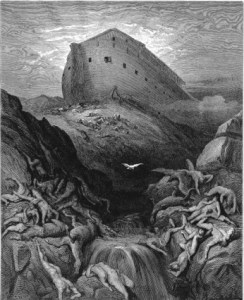
I write a lot about Noah. For those who didn’t know me before this blog, I was once invited to write a book on Noah for a series ironically published by Oxford University Press. I had been researching Noah for years, and I intended to write the book. Then, as the kids are saying these days, life happened. My interest in Noah has never waned, however. And part of the reason is that it is perhaps the most influential story in the entire Bible. I realize I’ll need to explain that, but stop and think about it—Evangelicals seldom talk about Jesus any more. Their concerns are with unborn babies, people making babies outside wedlock, and destroying our environment in the name of capitalism. It is the last of these that brings us back to Noah.

A friend recently sent me a story on Splinter by Brendan O’Connor titled “How Fossil Fuel Money Made Climate Change Denial the Word of God.” O’Connor is looking at the history of how a pro-environmentalism-inclined evangelical movement decided to shift its base to align with climate-change deniers. Behind the scenes are fundamentalist clergy. Oh, we like to laugh at them and their ways, but they are the power behind the throne and we should really not let them out of our sight. You see, as O’Connor points out, they believe that the God of Noah can protect the world from the worst that we can throw at it. It’s perfectly okay to try to destroy the planet because the magic man upstairs can fix everything right back up if he needs to before sending his son back to town on the final business meeting. Laugh if you will. These people are dead serious and many who hold power in Washington believe every lie they utter.

As a nation—perhaps as an entire western culture—we’ve laughed off religion. Secure that there’s no God up there to rain down, well, rain, we laugh and jeer at Noah. It’s a children’s story, after all, isn’t it? Okay, forget about the part where everyone in the entire world drowns, except eight people. And when he gets drunk and lays naked in his tent after it’s all over. Other than that, it’s a kid’s story, right? The story of the flood is one of the oldest myths in the world. It has been part of human story-telling for millennia. We now have very powerful people with smart phones in their pockets and access to vast hordes of money who believe it literally happened. And since God took care of his own once, he can do it again. The educated smirk. The smart start building arks.


On the Rocks

This universe is indeed a mysterious place. You don’t have to believe in the paranormal anymore to see it. A look at the headlines makes my point. There are those, however, who do look at the genuinely strange, and once in a while this realm crosses paths with that of religion. A friend pointed me to a story on Mysterious Universe about floating rocks. Apparently this story is going to be on the mainstream Travel Channel, so it’s not completely bonkers. It caught my attention because it’s about rocks. While of decidedly poor qualification to be a rock-hound, I have more than a passing interest in geology. Itinerates shouldn’t collect rocks, but I can’t help myself. Anyway, I’ve been known to go to publicly open mines and tap away with my rock hammer hoping to find some not-so-hidden treasure.

According to the story, there is such a publicly open mine in Arkansas. Crystals (I expect quartz) are available for surface excavation, for a fee. Then the owners, the Murphys, noticed the anomalous rocks. Since they are conservative Christians (this is Arkansas after all) they feared what powers might be behind rocks that don’t obey the laws of gravity. The mine didn’t get closed and hushed up because of an unusual source of inspiration. An article by Billy Graham on divine mysteries led them to keep the mine open and to allow for investigation. Once the Travel Channel comes out with its program Crystal Mine is sure to experience an influx of business. Mainstream scientists, one expects, will not be among them.

The universe is vast. We haven’t explored all of our own planet yet (we’re kind of busy destroying it at the moment, so if you don’t mind…) and yet we gleefully claim what’s impossible. I don’t know if there are levitating rocks in Arkansas, but I do think we’ve been a bit hasty about some of our conclusions. We may yet find things that will force the concepts—the laws—to change. Consider gravity, which seems particularly relevant in the case of floating rocks. Sir Isaac Newton (devout theist that he was) ending up having to relinquish the “correct” explanation to Albert Einstein. Some have been so bold as to suggest that maybe even Einstein might not have gotten the whole skinny on gravity. We continue to learn. Levitating rocks are indeed strange. Not so strange, however, as Billy Graham being the one to rescue an anomaly for the world to see.


Water Bears

Since we should all be busy planning on alternatives to planet earth, my mind has turned to tardigrades. Known as “water bears” these very simple animals are amazingly complex. Don’t go looking for them in your drinking water, however. They’re microscopic. So why am I thinking about tardigrades at a time like this? Because they’re one of the few organisms that scientists believe could actually survive the destruction of the planet. Who knows? They might even be able to survive in Washington, DC. Maybe that’s why they’re in The Washington Post.

You have to look closely to see one.

Able to cling to life at the cusp of absolute zero, in conditions with no oxygen, and at doses of radiation that would leave the human race—among most other species—fried, these micro-organisms are truly remarkable. No wonder scientists are playing with thought-experiments as to how to wipe them out. Hey, scientists are only human after all. Don’t worry—nobody’s really trying to kill these little guys off. The question behind Ben Guarino’s story seems to be what makes these tiny creatures so amazingly resilient. It raises an issue that I often ponder. The will to survive. Evolution is, according to standard theory, without purpose. Natural selection works in a “logical” way: the most successful organism survives long enough to breed and its traits become standard options in the next generation. Nobody needs to want anything (except to mate) and chance takes care of the rest. But that doesn’t explain the will to survive. The “eye of the tiger,” if you will. I’m sure this wasn’t what the Washington Post was intending to trigger, but doesn’t it seem strange that even “non-conscious” micro-organisms “want” to survive?

The desire to exist is dangerous territory. It has a whiff of the divine about it. One of the characteristics of life, if my high school biology isn’t completely outdated, is the ability to reproduce. What it didn’t address, for fear of teenage snickers, I’m sure, is the desire to reproduce. Why does life insist on its own continuation? Is it truly just an eons’ long succession of one-night stands that results in creatures capable of even asking that question? Or is there something more to it? Tardigrades have segmented bodies, legs, and claws. All at less than 40,000 cells per individual. They lack a neocortex (which doesn’t necessarily disqualify an individual from being president). They can’t answer the questions we put to them. As individuals they are remarkably easy to kill. As a species, however, their resilience carries the answers to some very deep questions. If only we had the will to ask them.


Brick in the Wall

Kids. You never know what’ll come out of their mouths. Not bounded by logic or the rules of physics, they come up with some of the most truly creative ideas that grace our species. The growing up process usually includes filters that separate the real from the imaginary. But not always. In a recent statement, Donald Trump said that his proposed wall between Mexico and the United States should be invisible. His concern, according to a Washington Post story by Christopher Ingraham, is that catapults could be used to launch drugs over the wall. Somebody could get hit in the head. (It sounds like somebody has been already.) So the wall should be see-through. This wall, which the majority of Americans don’t want, and which will have to be deconstructed at great expense after his presidency (such as it is), will be a technological marvel. It’ll even have solar panels, added by old king coal himself.

I can’t help but think of Star Trek IV: The Voyage Home. Earth is being destroyed—not by Trump in this scenario, but by aliens looking for whales that we’ve driven extinct (there’s the Trump part). The crew of the Enterprise, in a Klingon warship, have to transport humpback whales from the 1980s into the future. The problem is see-through aluminum does not yet exist. Scottie, posing as a professor from Edinburgh—back in the days when my alma mater bore some cachet—gives the formula to a San Francisco manufacturing firm in return for enough of the metal to make a holding tank for the aquatic mammals. They slingshot around the sun back to the future just in time to save earth from a catastrophe worthy of Trump Enterprises. Problem is, see through aluminum is fiction.

Photo credit: George Louis, Wikimedia Commons

In my daydreams I often picture this wall. My thoughts inevitably go to Berlin and shortsighted solutions. History (which most American presidents have made a point of studying) teaches that walls don’t work. The technology is ancient. As is the technology of how to get around, under, and over walls. In fact, basic career counseling will often use the wall as an exercise to get you thinking of ways to overcome obstacles in your path. Dealing with walls is one of the most time-honored of human pastimes. You see, walls were originally built to keep us safe especially from non-human threats. We didn’t want toothy big cats or cave bears wandering in during the night and making snacks of us. We built walls. Then we wondered what was going on over on the other side. Just now, it seems, that idea has begun to dawn on a man who might benefit from trying to understand The Voyage Home.


Berrying Perspective

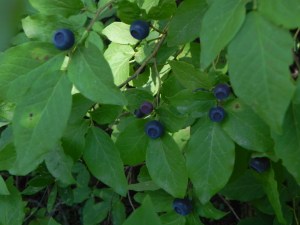
Two people looking at the same thing see something different. Since we’re living with a government of distorted perspective this truth appears refreshed daily. I was reminded of this while picking huckleberries. Huckleberries, according to the local edible berry guide, are called many different things. In this part of the country you know them when you see them. And if you see them you pick them. They appeal to the frustrated hunter-gatherer left in us city-dwellers. As I was trying my best to fill my bucket, I kept thinking of those who only see nature’s bounty as a means of turning a profit. In my mind they’re meanies—those who take all the fun out of the few freedoms we have left—although I realize that it’s a matter of perspective. Consider the huckleberry.

I’m a mere seasonal visitor to these parts. Since not too many of my own species make this location their permanent domicile, that’s perfectly natural. Many of the berry pickers I’ve encountered have been seasonal guests as well. There are the more “industrial” pickers, though. In a good year huckleberries can command fifty dollars a gallon on the local market. Unless you know an unfrequented secret site, a gallon can take several hours to pick even in a promising location. Overall, you need to arrive before anyone else and get the most productive bushes so that you don’t have to wander around the mountainside in search of a more lucrative locale. Not to mention that, like most berries, they have a limited shelf life. Nature prefers sharers to hoarders.

While I’m picking I generally think of bears. Unlike my species they don’t have the grocery store option. These berries are their survival, I suppose. Nature does provide. That’s how evolution works—we form symbiotic relationships with our environment. The meanies, however, can’t see beyond the self. What nature provides must be accumulated for my own benefit and not that of others. There are never enough huckleberries to go around, the industrial mind thinks, and so I’d better control the availability and set my price. You don’t even have to like huckleberries to do it. Ironically we call this having a gift. Standing here on this isolated mountainside, bent over a bush offering nature’s abundance, I believe that I’ve found a gift. I have to remind myself, however, that this too is a matter of perspective. It is a perspective that tastes right to me.


Nature Watching

Whenever I travel in the northwest, I keep an eye open for what one colleague calls “charismatic megafauna.” You know, the big animals that are so rare to see that they develop a charming, if imaginary, persona. Not that I’ve ever seen much of it here. It’s rarity is part of the charm. My usual hope is to see a moose—something that happens every three or four years. Black bears are even rarer. Grizzly bears, which still inhabit this area, and mountain lions I’ve never seen. I know they’re there, but their agenda is not to be seen. My first full day here I was sitting outside working on an academic paper. My time off work is rare, and when I get a moment, even in the wilderness, I try hard not to waste it. I had the feeling of being watched. Not the creepy kind of feeling, but the kind where you think an animal might be keeping a wary eye on you.

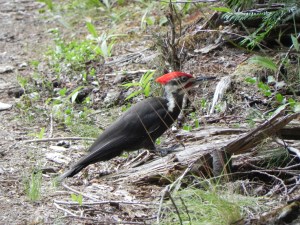
I looked over the top of my book. Several yards distant I could see a head bobbing up and down. Then I noticed a black patch on a nearby lodgepole pine. It took a few seconds for the red head to register. A mated pair of pileated woodpeckers. Not exactly huge, but they are large birds. And since they are the personality behind Woody Woodpecker, well, I guess you can call that charismatic. Charismatic enough for me to put down my Ugaritic mythology and go inside to fetch a camera. Of course they were gone by the time I’d returned. I decided to take a walk down the track in a vain hope of finding them again. Once in a while charismatic megafauna cooperate. There they were, one going after ants on the ground, the other perched above pecking wood.

Most of our large fauna we’ve driven to near extinction. Humans can’t stand not to be the biggest thing around. The megafauna remain, however, hidden though they may be. An online site for this area posted a photo of a cougar snapped last summer. I’m not sure when the last time a grizzly might’ve wandered down from Canada, but since last November I’m not sure why they’d even bother. Even the moose seem coy. Animals don’t do what we want them to do. Those that we can’t domesticate follow their own agendas and calendars we can’t hope to comprehend. As they flap away I can swear these woodpeckers are laughing at me.


Photographic Evidence

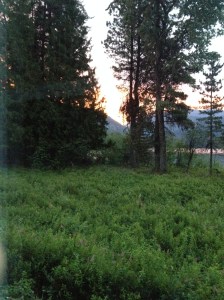
All photographs are lies. That moment preserved, formerly on celluloid but now with electrons, is gone for good as soon as the shutter is snapped. The camera doesn’t see as the eye sees. I was reminded of this during a mountain thunderstorm. I awoke early, coated with jet lag and the residue of my regular early morning schedule. It was still dark, but the reddish sunlight soon wrestled through a valley fed by a creek across the lake. The color was impressive, but my camera washed it out to a diluted Creamsicle orange. In reality the clouds were roiling overhead and lightning was streaking through a thunderhead like synapses firing violently in a massive brain. Thunder in the mountains can’t be photographed. Nor can it be forgot.

My work used to require quite a bit of travel. Before I would visit a campus I would spend some time on faculty pages, trying to put faces together with names. Impressed with how young these professors were, I’d knock on doors armed with foreknowledge of who might greet me. I wondered who these older people were when the door actually opened. It’s disconcerting to see someone age before your eyes. I would think back to the photographs online that had assured me this person would be much younger. The picture was a fossil. A moment frozen in time. The very next second after the photo capture that smiling face had changed. The best that we can hope for is a gross approximation.

Perceptions of reality, as all religions teach us, contain a healthy dose of illusion. While it contains ethereal beauty, this vision I’ve captured in my lens is only part of the picture. There is something deeper, more meaningful behind it. Photographs enhance memory. In the days before Photoshop they could be submitted as proof of an occurrence. They are a form of art. Whatever else they may be, they are also lies. Lies need not be of evil intent. Religions try to explain what some privileged individual realized was the truth. These who found a way of looking behind the photograph. The streaking lightning outside evades the slowness of my finger on the button. The thunder rolling and re-echoing through these valleys will remain in my head long after the sound waves cease to reverberate. Reality is more than it seems. Even my experience of this mountain thunderstorm is that of a single individual seeking enlightenment. Elsewhere others are up early, observing it too. What they experience may be something very different from me indeed. I have a photograph to prove it.


Sky Blue

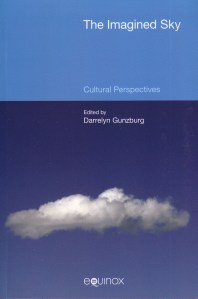
How do you capture a true and abiding fascination in words? That’s a thought that comes to me once in a while when I think about the sky. It’s so hard to define, yet it’s always there. To quote myself: “To understand the weather is somehow to glimpse the divine” (used with permission). I waited for The Imagined Sky: Cultural Perspectives, edited by Darrelyn Gunzburg, for years. I think I first saw an ad for the book two years in advance of publication (yes, scholarly presses can do stuff like that). I kept stopping by the Equinox booth at AAR/SBL to see if it was available. It was the same kind of drive that led me to write Weathering the Psalms. That hope of grasping the intangible. To hold the sky itself. One of my early creative writing club stories was about a boy who wanted the sky. I wanted this book.

Like all books of essays from different authors, it’s a mix of fruits and nuts. There’s some very interesting pieces in here while others seem to have been made to fit only with some difficulty. Still, the sky. I admit to being somewhat disappointed as I read along. This wasn’t for research—my book on the topic is already done—it was for pure intellectual curiosity, what passes for pleasure among academics. Many of the pieces were mired down in detail. Written bout the sky, they refused to soar. Then I came to Tim Ingold’s essay. Here’s what I’d been looking for. Someone who knew the sky could only be approached in terms that contradict themselves at every turn. There is something to say about the daytime sky. It has to do with the nature of light. And of the sky seeing us.

The sky, by definition, is larger than this rocky substrate we call home. It encompasses everything above us. I work in a cubicle with no access to outside windows. I wilt daily like a plant deprived of sun. (Although the wonderful article on light pollution by Tyler Nordgren gave me pause over even that.) I need to see the sky. When clouds block my view, my outlook begins to suffer. It’s that ethereal cerulean I crave. Without it I am but a troglodyte eking out a minimal survival on toadstools and lichen. The sky is our orientation. It is our timepiece. It is eternal. Of the things we do that are evil, polluting the sky is one of the most unforgivable. The key may be in the word “imagined,” but if we could only understand the sky we will have found true religion. They’re called “the heavens” for a reason.


Scaping By

Failure is a part of life. We don’t like stories about failure, however, unless the protagonist goes out with a memorable bang. So it is that when we fail we start looking for a scapegoat. Now it’s a little too early to tell if Ken Ham’s Ark Encounter can be considered a failure. According to a story on Friendly Atheist, “Ken Ham is Now Blaming Atheists for the Economic Failures of Ark Encounter,” the ark may be loaded with dinosaurs, but not money. People need their myths, yes, but myths that take themselves too seriously often fail to convince. Atheists, even the friendly variety, have always been convenient scapegoats. I wonder how many scapegoat species are in the Ark Encounter.

I don’t know about you, but I’m curious about the Ark Encounter. I don’t want to go because I don’t want them to have any of my money. As I’ve told academic friends who visit—I just can’t see contributing to their cause. Although the Right seems to implode when it reaches power (there are far too many selfish people in the Party, and selfishness leads to easy splintering) one thing that it has is money. Think about it, the extremely wealthy are on their side. If I was given a free pass I might find it worth my while to wend my way back down to Kentucky. Who doesn’t like a spectacle? And I would like to see how they represent scapegoats in their dioramas. Besides, with sea levels rising from “fictional” global warming it might not be a bad idea to get a few tips on how to build an ark, no matter what you believe.

You only fail when you fail to try. That was a phrase a friend used to repeat to me before disappearing from my life. A friend from college once told me that I had to stop admitting my failures if I wanted to move ahead in life. There is a danger in easy appearances of success, however. Failure can be a very noble teacher. There are mornings when I’m walking across Manhattan, passing the homeless in their blankets on the street, and I realize that I would not be where I am were it not for failures. I could hide them, but if I haven’t learned from them they’ll only burst out of the closet again when it gets too full. Is Ken Ham’s Ark Encounter a failure? It’s far too early to tell. One thing we know for sure, however, is that scapegoats will never be an endangered species even if there’s a world-wide flood.

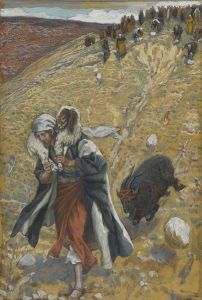
James Tissot,Agnus-Dei: The Scapegoat (Brooklyn Museum via Wikimedia Commons)


Ammonia Avenue

It’s 7:00 p.m. I’m still sitting on a bus, in unmoving traffic a mere three miles from home. I stepped out of my front door over 13 hours ago and I have only another hour before retiring to start it all over again tomorrow. My phone’s down to a charge level that the effort of getting a non-wifi connection will only drain it completely. I have no idea why I’m being rerouted. Later I’ll learn that we’ve been instructed to shelter in place because of a N-Aminoethylpiperazine spill. Better living through chemicals. I’m sheltering in place, all right. This bus is my ark.

There’s much about this complex world that I don’t understand. I readily admit that I don’t know much. One thing I do know is that I live my life trying not to impact others negatively. I’m reminded of this every time someone blows a cloud of smoke into my path, plays their music so loud that even they can’t really hear it, or spills Aminoethylpiperazine all over the place. I don’t haul corrosive chemicals (beyond what may be trapped in my gray matter) through anybody’s hometown. I think of that scene from Close Encounters of the Third Kind—a dangerous chemical spill. Evacuate Devil’s Tower. There’s nothing to see here, folks. It strikes me that this is a larger ethical issue. The right to use, and potentially destroy, somebody else’s space. If you inhale Aminoethylpiperazine fumes, it can be fatal. It may take longer, but the same is true of second-hand smoke. The things that go beyond our own personal self-abuse into the realm of harming others. Somebody call an ethicist!

Commuting isn’t really a lifestyle choice. There may be a few stalwarts on this bus that really enjoy it, but from hearing the weary conversation of the regulars somehow I doubt it. We’ve been rerouted to New York City for our jobs. Our free time is consigned to an aluminum lozenge on wheels. Sometimes it actually moves. Have you ever tried to read a book when the head of the snoring guy next to you keeps falling into your lap? I think about those animals on the ark. Life is more than eating and breathing. You’ve got to have some space to move about. Even when I wake up I’m not in the same position as when I went to sleep. Of course, ethics demands I look at it from the other’s point of view. Someone needed a truckload of Aminoethylpiperazine, and they’re disappointed that it never arrived. Just don’t breathe too deeply. This flood can’t last forever.


Sea Around Us

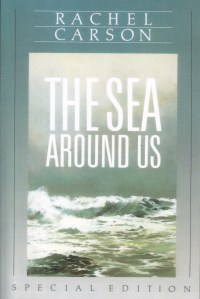
Re-reading books is something I do somewhat too infrequently. One of the obvious reasons is that I won’t possibly finish everything I want to read in my lifetime as it is, and once something’s in the vault I tend to move on. I keep books, however, because I frequently go back to them to refresh my memory. Wholesale re-reading takes commitment. I just finished re-reading Rachel Carson’s The Sea Around Us. It’s difficult to describe the impact this book had on me when I first read it, years ago. Even though modern editions state that it retains its authority (broadly it does) I couldn’t help but be struck by a number of things this time through. Carson thought of herself as a writer. In her day that meant adhering to the conventions of language, which was, I admit, embarrassingly masculine. The assumptions of the 1940s and ‘50s against which Carson struggled set the very frame for the discussion. I recall being told in school, by female English teachers, that the only proper pronoun to use when the subject was of indeterminate gender was the masculine. I raised my eyebrows, but being good at following rules, I didn’t raise my hand.

Not that this takes away from the poetry and mastery of The Sea Around Us. It is a wonderful book. It also made many people stop and think about the ocean for the first time. Really think. And that’s a second observation about my re-reading. Hearing the recitation of how, historically—or prehistorically—the oceans covered much of North America. Thinking about how my hometown, far, far inland would’ve been underwater for eons really made me ponder. We’ve built our coastal cities rapidly, and with typical human short-sightedness. Even without our generous input, global warming has been ongoing for centuries. Sea-levels have been rising. Our desire for wealth, settling as close as possible to the water to facilitate trade, didn’t take into account what would happen in the perhaps foreseeable future. Even now when the warning is loud and clear the businessmen of the White House are in full denial.

There’s a kind of strange justice to this. You see, one of the other features of The Sea Around Us, and one of the most compelling aspects of the book, is Carson’s narrative of how we came from the sea and our desire is to return to the sea. Our blood evolved from ocean water. We rely constantly and in significant ways on the oceans. They, for example, are the powerhouses and condensation points for almost all of our weather. They separate us and bring us together. The very origin of life itself basks in pelagic profundity. Indeed, the ocean supplies the very concept of “profound.” The deeps. Although it had a beginning, it seems the world ocean will outlive our tribal little race. Damaged and poisoned by our greed, in eons it will recover. And those beings that survive will find their own wisdom beneath the waves.


Light and Dark

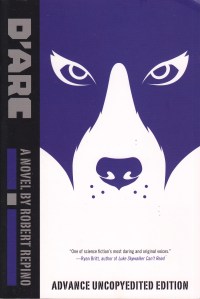
Prophets, mothers, messiahs. A new religion for a new world. While these may not be main themes of Robert Repino’s new novel D’Arc, they’re clearly there in the background offering verisimilitude to a world turned upside down. Continuing the diegesis created in his previous two novels Mort(e) and Culdesac, Repino again shows an uncommon awareness that when survival becomes difficult people (and animals) turn to religion. Many fiction writers create worlds under stress and pretend that characters simply forget the religious option. That may be realistic on an individual level, but as history shows, not on a societal one. People—and mutated animals—are meaning-seeking beings. D’Arc doesn’t shy away from this fact. In a wildly integrated world of different species coping with consciousness and opposable thumbs in various ways, religion naturally arises.

If you haven’t been initiated into Repino’s universe, it begins with a virus and/or a plot—themselves religious—which allow animals to become bipedal and to grow human hands. They can talk and reason and they show us a true reflection of who we are. D’Arc, the female companion of Mort(e), finds her way in a world under threat. Planning to speed up global warming in a dramatic way, the aquatic antagonists conspire to melt the ice caps to flood the entire world. Repino knows the value of the flood story and uses it to full advantage. Along the way we meet beavers who’ve developed a religion that functions between water and dry land. Indeed, as a species their religion defines them as much as their engineering skills. This is a world that’s just been through war and instead of reconciling all species, there remain those (most notably humans) who can only live with their own superiority. This is a complex universe.

The hero of this tale, D’Arc, is sympathetic to the religious sensibilities that have sprung up around her. She herself is a character prophesied in this world where Mort(e) is messianic. There’s a scripture in the background somewhere and theirs is a world without embarrassment about it. There’s also plenty of action and adventure—the war with no name is really not over—but there’s a subtlety to the narrative as well. When things go awry many people do assume they’re alone in the universe and try to find their own way. It’s equally true that many look for meaning in a structured form of belief where all of this has been foretold. Such worlds, to me, seem to be more honest to the human condition, even when the characters are cast as talking animals.


See Around Us

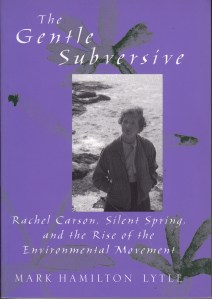
There aren’t too many people that I consider personal heroes. Those that I do have earned the sobriquet in odd ways, I suppose. That makes them no less deserving. Rachel Carson became a hero because of The Sea Around Us. Published over a decade before I was born, it was a book that I treasured as a teen—or even as a tween, had the word existed then. I was no literary critic, but her style and lyrical writing drew me in and my own love of the ocean I’d never seen was kept alive through her words. Mark Hamilton Lytle, I think, shares my evaluation of Carson as a hero. The Gentle Subversive: Rachel Carson, Silent Spring, and the Rise of the Environmental Movement brought out much of what I admired, and still admire, about her. A woman in a “man’s world,” she became a scientist with a gift for literary finesse. She struggled, she believed, and she died far too young.

Lytle’s book builds up to the publication of Silent Spring, which appeared just two years before Carson’s untimely death. I picked up Silent Spring as a tween as well, but only read it within the last few years. I knew this book had nearly singlehandedly launched the environmental movement, but as the shame of modern life constantly reminds me, I’d been too busy to read it. Born the year it was published, and not terribly far from where Carson herself was born, I had an affinity with the book that strangely kept me from it. It isn’t easy to read, even today. Especially today. With a government ignorantly rolling away all the environmental safeguards that six decades of careful thought have put into place, we need Carson now as much as we did in the 1960s. Her modern critics, as might be expected, tend to be men.

Carson showed that a woman can change the world. Those who disparage her stunning work claim that her following is a religion, not science. Carson was a rare scientist who saw that everything is interconnected. There may be some mysticism to this, but for those willing to admit it, we feel it to be true. On the eve of environmental degradation that will, in a perverse kind of justice, possibly wipe us out, we need to return to the fine words and clear thinking of one woman who took on industrial giants to give a voice to the people. We do have a right to determine what happens to our planet. Lytle makes the point that Carson was like a prophet. For me the comparative preposition can be removed altogether.


Weather Vain

The other day I was awakened by a severe thunderstorm. It’s been quite a while since that’s happened. Unlike when we lived in the Midwest, thunderstorms in New Jersey tend to be widely scattered and somewhat uncommon. (It’s all a matter of perspective, I know.) My basis of comparison is how often I notice such storms. I’ve never been able to sleep through one. Thankfully this one came at around 4:30 a.m., past when I’m usually awake on a weekend. I’d forgotten the raw power of just how loud and bright such a storm can be. Danger seems all around. The feeling is primal and urgent. As I got out of bed and walked into the dark kitchen, windows filled with electric blue followed by and tremendous blast, I thought once again of Weathering the Psalms and the story behind it.

By the way, when I speak to young scholars about publishing I tell them this isn’t the way to go about finding a topic. That having been said, my book was born in the Midwest. Life at Nashotah House revolves around required chapel twice daily. Weather does not stop it. In fact, holding the daily office by candlelight because a storm had knocked out the power was not uncommon. Morning and evening prayer—indeed, all of the canonical offices—are built around the recitation of the Psalms. Reading the Psalter in slow, stately tones while thunder raged outside, rattling the ill-fitting stained-glass windows, left an indelible impression. It was only natural in such circumstances to notice how often the Psalms mention the weather. Thus a book was born.

I’m currently at work on a new book. I can’t say the topic just yet because someone might be able to beat me to it. (Knowing the way I come up with book ideas, however, I doubt it.) Sitting in my darkened living room, in my writing chair with the fury just outside, I was strangely inspired by the storm. Then it was over. Silence followed by birds singing, just like in Beethoven’s sixth symphony. The thunderstorm is one of nature’s psalms. As at Nashotah House, in the Midwest we had perhaps too many of that particular kind of psalm. Nevertheless, in the silence that followed I was left strongly in touch with my muse. These are the states that lead to poetry and song. Every great once in a while they might even lead to a book idea. As I tell students, just don’t expect that anyone else will get it.