Showing Gratitude

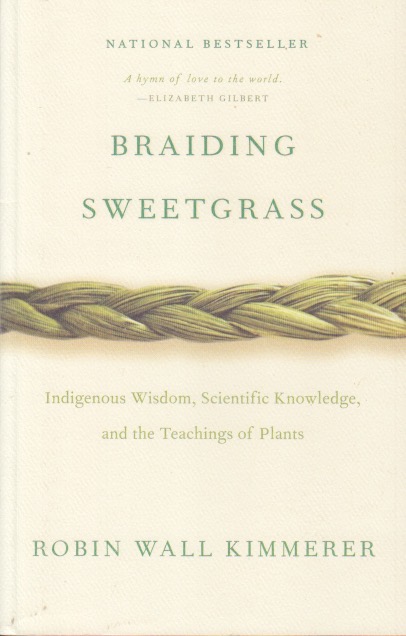
Stealing is something that we all, except some capitalists, know is wrong.  I think quite a lot about the land that was stolen to make America possible and I know that simply giving it back isn’t an option.  Nevertheless, I do believe that we should listen, and listen attentively to those who’ve been here longer than Europeans.  Robin Wall Kimmerer’s Braiding Sweetgrass is an important reflection of this dilemma.  Kimmerer is Potawatomi and she’s also a professor of Environmental Biology.  The book is a series of essays that focus mostly on plants and what we can learn from them.  It also brings in indigenous teaching, contrasting the outlook of gratitude against that of greed.  By turns sad, funny, and profound, Braiding Sweetgrass contains a message that is vital to counter climate change.  To correct our attitude before it’s too late.

There’s so much in this book that it’s difficult to know what to touch on in this brief notice.  Throughout, Kimmerer notes that the First Nations viewed life as a gift.  The earth is constantly giving and the native way was to be thankful and to accept the responsibility of being given a gift.  Seeing how the European attitude was “take until there’s no more to take,” she points out that taking what you need and leaving for others is a way out of our current dilemma.  She does this, most strikingly, by the story of the windigo.  The windigo has become popular among monster fans as a consuming beast, but Kimmerer shows how the story has a profound point.  If all you do is consume you become a monster.  You stop a windigo by showing gratitude.

Perhaps the most striking thing, to me, was how Kimmerer describes her own experience becoming a scientist.  How standard academics refused to believe they had anything to learn from Native American outlooks, especially when borne by a woman.  How she was told she couldn’t be a scientist, not with that outlook.  And how she learned the European way but didn’t give up her native understanding.  How she brings two worlds together and does so with a sense of urgency and hope.  Things have gone too far simply to turn back the calendar and say that our ancestors had it all wrong, but it’s not too late to learn from those who lived for millennia on this land and were untainted by ideas of private ownership.  Those who knew how to live sustainably with nature.  Those who knew, and still know, how to defeat monsters.


Sticky Thoughts

It’s a common problem.  You need to stick two things together.  Perhaps you don’t have welding or soldering equipment lying around the house so you buy some glue.  Now, I don’t know if you’ve been in an adhesives aisle recently, but the choices are overwhelming.  Not only that, but ephemeral.  I mean the bonding action has improved since I was a kid, but the problem is I can’t use glue fast enough.  Like the old-fashioned White Out, you open a container and use it as quickly as possible because it’s going to dry out.  I was reminded of this when I needed to stick some fabric to plastic (don’t ask).  I tried some Elmer’s left over from when my daughter was in middle school sometime in the second Bush administration.  That didn’t work.

Then I found a bottle of Gorilla glue.  The problem is that it sticks to itself.  So much so that I couldn’t get the bottle open.  I could see there was some liquid life in there, but the top half of the contents seemed to have congealed and clung to itself.  That wouldn’t work.  I eventually found a tube of plastic glue and since one of the pieces for my project was plastic, I figured that’d work.  Still, it made me wonder about the conscience of those who make adhesives.  Surely they must know the mindset of, “oh, I’ve got lots of stuff to fix, so I better buy a reasonable size bottle.”  Only, the fixing comes at widely spaced intervals and the glue can’t last that long.  Various Crazy Glues are the worst.  They’re one-time openers, just like White Out.

My most recent trip to the adhesive aisle brought a moment of clarification.  Although I try to reduce waste, one company (not a sponsor), was selling little, tiny tubes of Crazy Glue.  Single-use units.  And you get six/eight per shot.  That works for quite a few applications.  Still, I’ve got a number of half-full (I’m an optimist) bottles of various glues that can’t seem to get over themselves.  I guess the lesson we’re to take home is buy in small quantities, even though the unit cost is higher.  You can always buy two, no?  Things don’t break at convenient times, unfortunately.  You run to the closet to see what glue you’ve got.  Then you drive to the store to get some that’s not all gummed up in the bottle.  It’s a dilemma.  Just like that nagging question of why someone’s trying to stick cloth on plastic.


Bugging Out

There’s a scene in Disney’s Hercules where Thebes has just been through a bunch of unnatural disasters sent by Hades to lure Hercules into the open.  The people, visibly shaken by the tragedies are talking about their need for a hero.  Then a locust hops in.  An old man says that does it, he’s moving to another city.  So with yesterday’s super soaker around here—we’ve had our roof completely replaced—water was still getting in.  I’m no expert, but it looks like it was condensation rather than roof leaks proper.  The air was saturated and cold, while inside it was at least a few degrees warmer.  I got up to find buckets scattered around that my wife had set up after I’d fallen asleep.  Then a boxelder bug appeared on the curtain in my study.  The insect on top of other misfortune.  It’s classic.

That’s because insects swarm.  We live in an older house (the only kind designed with space that can be used for books).  It doesn’t have wooden siding, but boxelder bugs like to overwinter in the walls.  I really can’t figure out why because in nature they winter in, well, boxelder trees.  Or a maple.  There are no boxelder or maple trees near our house, but they seem to like it nevertheless.  The problem is they get inside, in numbers.  We try to run a catch and release business.  It seems decidedly unfair to kill a harmless bug for doing what human-altered climate tells it to do.  When the heating kicks on, their insectoid brains tell them it’s spring and they crawl out looking for food.  Well, we don’t have any trees they like growing inside, so they wander about aimlessly.  I catch them and take them outside, figuring maybe they can find, I don’t know, a tree?

Usually when winter’s serious chill sets in, they go dormant.  This year we’ve been hovering between freezing and not, and when the sun comes out—which it sometimes does—they awaken.  They must be confused.  Somehow they don’t realize that the world has changed around them.  Going about their daily bug business (nothing seems to eat them—apparently they taste bad) the climate has broken their hibernation into segments of a few days at a time.  Perhaps they’re cranky when they crawl up the curtains, or across my desk (they pretty much stay in my study).  At least they don’t sting.  They’re not bad enough to make us leave Thebes, but it would be wonderful if they’d wise up to global warming, and maybe plan in advance.  Or maybe they’re waiting for a hero.


Could Have Understood Differently

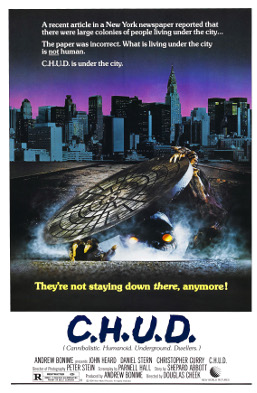
A lesson many authors need to learn (and I include myself here) is that titles matter.  Cutesy, clever titles may work for well-known writers, but something that describes your book, or movie, is essential.  And avoid acronyms.  I avoided watching C.H.U.D. for years, put off by the title.  I’d read a few books where it was discussed, but finally decided it was something I should see.  If you’re as put off by acronyms as I am, C.H.U.D. has a double meaning.  Initially Cannibalistic Humanoid Underground Dwellers, but more importantly, Contamination Hazard Urban Disposal.  I suppose that’s a bit of a spoiler, but since the movie’s been out since 1984 I’ll let it stand.  Although largely panned, I think C.H.U.D.’s a perfectly serviceable monster movie and despite what the critics say, it has a larger message.

Set in a gritty New York City, the film focuses on the homeless who live underground.  Although it’s not preachy about it, the underlying message is that these are people too.  Until, of course, the contamination hazard mutates some of them into C.H.U.D.  Then they start looking for human victims.  In a city the size of New York, they don’t have much trouble finding them either.  A government cover-up is behind all the mayhem.  Nuclear and other hazardous waste is a very real problem, and none of us really knows what happens to it.  With much of government boiling down to political theater, I’ll take my chances watching movies and wondering.  The good guys in this movie are those who actually care about the homeless.  They are a rather unsympathetic photographer and his wife, a police captain with a missing wife, and a guy who runs a soup kitchen.  They learn something isn’t right beneath the streets but can’t get the authorities to admit it.

This isn’t a great movie—there are gaps in the plot all over the place—but it’s not a horrible movie either.  Sympathetic portrayals of the poor are, in my experience, rare.  These are people who’ve organized themselves into a society that’s come under threat because of those who dwell in the light.  Some classify C.H.U.D. as science fiction,  but that’s a very loose use of the term.  It’s actually a low-budget horror film with a bit of heart.  Unfortunately the title obscures that this is a little gem of a monster movie.  I really had little idea of what it was about when I started streaming, but ninety minutes later I was glad I’d done so.  And I went down to the basement afterwards, you know, just to check.


Old Oak Tree

Trees have much to teach us, if only we’ll pay attention.  They are fascinating plants in their own right, living longer than just about anything else.  During our years in New Jersey we made pilgrimages to two ancient trees in that state: the Basking Ridge White Oak (unfortunately cut down in 2017), and the Great Swamp Oak in Lord Stirling Park, also in Basking Ridge.  Naturally enough, then, when in Charleston last month we had to visit Angel Oak.  Our Charleston visit was not a solo venture, therefore our timing was somewhat off.  Our flight to South Carolina was delayed by about three hours, cancelling our plans for that Saturday afternoon, one of which was to see Angel Oak.  When we arrived at the oak on Sunday we discovered the venerable tree had visiting hours that started after we had an engagement on Sullivan’s Island.  We had to see it through a fence.  (In our defense, several others arrived at around that time, equally surprised to learn they couldn’t get in.)

Regardless, there’s something awe-inspiring about being next to a being four-or-five-hundred years old.  Unlike its departed cousin, the Basking Ridge White Oak, Angel Oak is of the live oak variety.  (Live oak is the rather awkward name for a type of oak tree, not necessarily a designation that the tree is alive.  People sometimes have strange ideas about naming things.)  Like many ancient things, folklore has accumulated around this tree.  Although the name derives from former estate owners, lore has it that ghosts of slaves appear at the tree in the form of angels.  Folklore has a way of saying something important in this materialistic era.  There can be something spiritual about trees.

Although we had only a few minutes outside the fence to appreciate what we were seeing on John’s Island, the experience is one that sticks.  One of the most hopeful things a person can do is plant a tree.  Back at Nashotah House I planted an apple tree that I’d grown from a seed.  I planted it the year my father died (2003) and I often wonder if it’s still there.  After buying our first house we planted a scarlet oak.  A local nursery indicated that oaks help the environment by providing the habitat for the highest number of species here in Pennsylvania.  We used A Tree to Remember after my mother’s passing to plant a memorial.  (Other trees I’ve planted have been snipped off by squirrels before they can live on their own.)  Although outside the fence, I reached up and touched some of the outer leaves of Angel Oak and connected, if only for a moment, with something great.


Swamp Things

If I have time, before I go on a trip I like to consider what different flora and fauna I might see.  People from southern states traveling north to Pennsylvania would likely not see too much that they can’t see at home, I expect.  South Carolina, however, is far enough south to hold what seem (to me) to be exotic species.  These are things that are probably pretty quotidian here, but to a traveler they really stand out.  My family had hoped to see an alligator, in a safe way, as long as we were here.  That’s why we ended up at the Audubon Swamp Garden on the Magnolia Plantation just outside Charleston.  Although it’s October, it’s still warm here and although it took some time we eventually spotted a fair sized gator sunning itself many yards away.  After seeing the first one you kind of know what to look for and we ended up spotting four more.

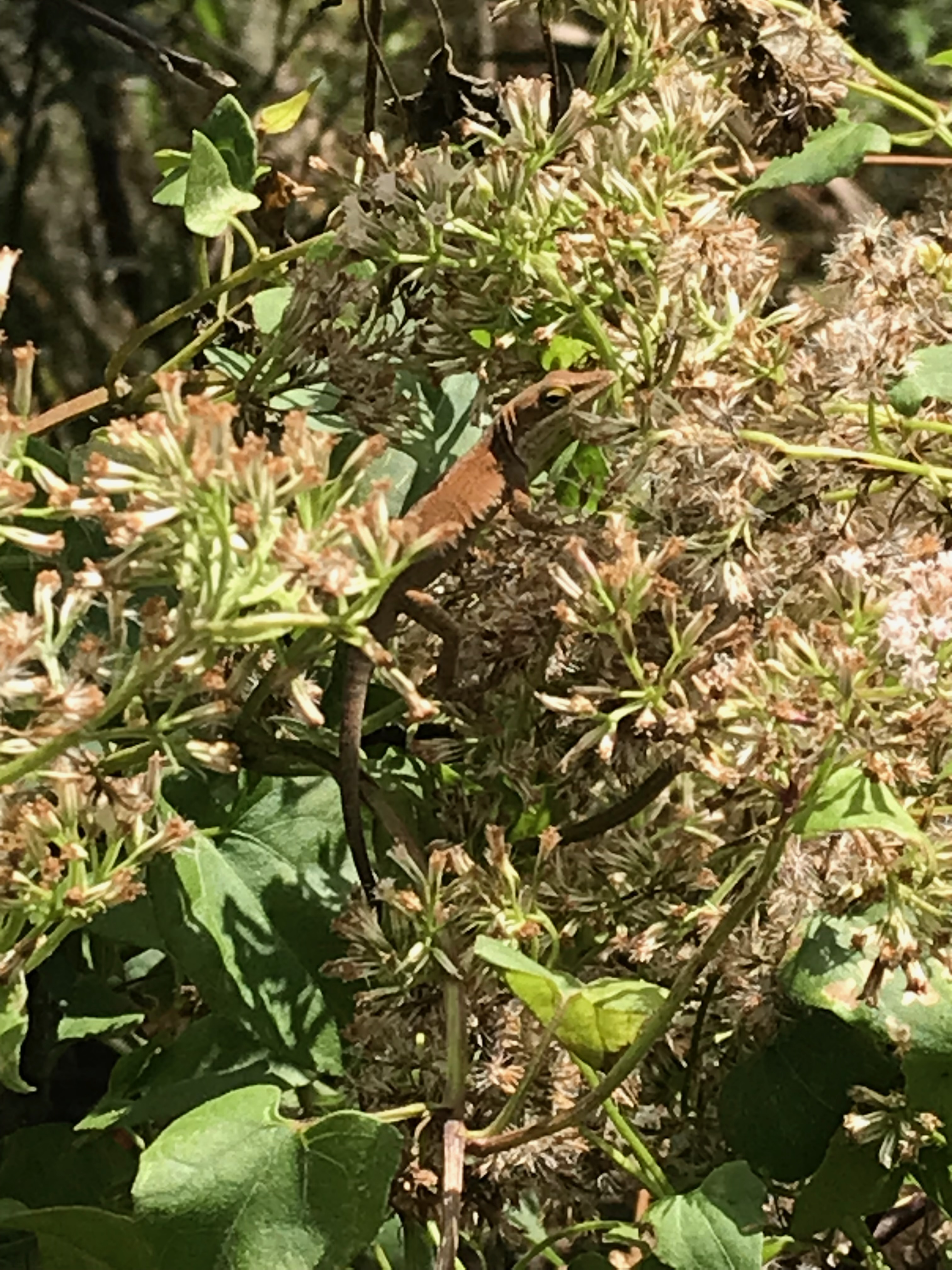
This swamp has a walkway intended to keep visitors safe, so we followed it through the facility.  You have to pass a kind of Jurassic Park entry gate to get in, and it may be best to reflect later that alligators have been around since the dinosaurs.  There were plenty of other animals too.  Our first encounter was a snowy egret.  This was followed shortly by an anole, but my lizard species identification isn’t very developed, I’m afraid.  There were dozens of turtles sunning themselves—several quite large—and a blue tailed skink.  And spiders of apocalyptic size.  My phone camera didn’t zoom in much on the gators, so I’ll put the anole here for you to enjoy.

This iconic swamp was used in the filming of Swamp Thing (I couldn’t resist), and is rumored to have been the inspiration for Shrek’s swamp in that movie.  The most poignant aspect to me, however, was just how much beautiful diversity the world allows if people aren’t constantly trying to improve it.  When a field in my native Pennsylvania is left to its own devices, it will likely become a forest and all the usual suspects will come back.  We do still have elk in some northern counties.  Yes, I suspect if we left swamps run wild mosquitos and other less fun species would also proliferate, but still, there are places that are transcendent for not having been improved upon.  The Audubon Swamp Garden is one such place, although the sunning platforms allow us to see some of the creatures, and with an alligator just a few yards away, I am grateful for this raised walkway.


Driving Complexity

It should be a pretty straightforward thing, buying a car.  Unless you live in a city like New York you need one, so the process should be simple since it affects many.  But no.  Nothing is simple any more.  We had a two-decades old car that had quite a few health issues in its long life.  Besides, we wanted a hybrid to help with the environment and to cut down on gas costs.  A Toyota Prius seems a good choice so we tried to buy one in February.  We had to wait, however, since dealers can’t keep them in stock.  Initially they estimated three or four months, which turned into eight.  When it arrived unexpectedly we had to drop everything to go get it because they don’t want them sitting around on the lot.  Fortunately the day was Saturday, when schedules are a bit more flexible.

Unlike other stores, where you walk in, hand over your money, and walk out, the car dealership involves immense complications, too great to comprehend.  Insurance is a big part of that.  It turns out that now they want you to go with their insurance.  And since car insurance is bundled with homeowners’ insurance you have to answer questions about when your house was last roofed when you buy a car.  Facts and figures that I don’t keep at my fingertips were necessary.  And you have to download apps because they want you to do everything by phone.  If you’re buying a Prius they want to tether your phone to the car, like a Navi to its beast, and you have to let it monitor where you are at all times and how you’re driving, otherwise your rates will go up.  Driving a Prius is like steering a computer on wheels.

You see, I get overwhelmed.  My mind evolved for a simpler world.  Finally arriving home after several hours in a bustling showroom, I had a dozen emails about this and that related to changing insurance and registering for new systems so the car can take to me, and all I want to do is run to the store to pick up some groceries.  There are no entanglements there.  Pay for your goods and walk out of the store.  No insurance, no requirements to change anything.  Not to mention that Saturday’s the day for mowing the lawn and the hundreds of other chores you can’t get done during the work week.  I’m sure I’ll enjoy my new wheeled computer.  It is much better for the environment.  It may take a few years, however, before I find the time to learn how to drive it.  And to disentangle myself from all the other complications involved.  Pardon me, but I’ve got more car-related emails to read.


Middle Ground

It’s the real poison Trump baptized.  Polarization.  The idea that there is no middle ground.  It’s a shame since the middle ground has been what’s kept America stable over the years.  Now it seems to be eroding rapidly.  While my sympathies have always been on the left, I realize that radical change tends to dirempt societies.  As much as I deeply desire justice and fairness for all, I know it will take time.  In my way of thinking that “all” includes animals.  That’s why I’m vegan.  Now, I know being completely vegan is likely not possible since who knows what everything is made of, and who has the time to find out?  I do the best I can and I don’t eat animal products and I try not to wear them either.  I know there are those who don’t share my outlook and they’re entitled to their point of view.

For nostalgia’s sake, and to get out of the house, we attended a 4-H county fair.  An annual event when we lived in New Jersey, it’s now a rarer treat.  So I put on that scarce recording of Bruce Springsteen’s song “County Fair,” not on any of his studio albums, and headed for New Jersey.  This county fair is the kind with animals rather than rides, and we stopped in to see the sheep, goats, cows, and alpacas.  It was in the cattle tent that I saw the following poster, claiming “There’s no such thing as vegan.”  Well, I don’t go around saying there’s no such thing as omnivores (thus the polarization) but this poster convinced me that we need to try even harder to stop raising animals to exploit. I understand, I think, the intent of the poster—cattle aren’t just meat.  The thing is, I think of them as conscious beings.

I miss the middle ground.  People no longer want to compromise or negotiate.  Since Trump it’s become “my way or the highway.”  I think I prefer the highway.  That highway takes me far from industrial feedlots where it’s illegal to document the cruelty that these animals undergo daily.  It’s quite a different thing for Bessie to lay down with a fan blowing on her under a tent with a small farmer caring for her, but that won’t feed a nation.  Small farms aren’t the problem. I don’t insist everyone be vegan.  I would like it if we could sit down and talk about it, however.  Cattle raising is the industry that generates the greatest amount of greenhouse gases that are causing global warming.  If we keep dividing ourselves and refusing to change we’ll be having this polarizing argument under water before too many years have gone by.  My highway is middle of the road.  Even slow change can benefit many.  The goal is to get “many” to “all.”


Hopeful Flowers

Our front yard is a bit of a wreck this year.  You see, none of us are natural gardeners and with two chronic illnesses among the three of us we’ve had some multi-day hospital visits and shifting of priorities.  The front yard hasn’t been one of them.  I’m able to get out around 6 a.m. on a Saturday, however, to do some weeding.  My philosophy this year is that if it’s not something people would consider an “ugly weed” and if it stays under six inches tall, I’ll let it grow.  We’ve planted some deliberate ground cover that doesn’t seem very deliberate, but it’s slowly taking hold.  And, of course, there are the ubiquitous dandelions.  I don’t really have a problem with dandelions but others think of them as weeds and they do, admittedly, have no sense of personal space.  They’ll grow right up under some intentionally planted flower and crowd it out.

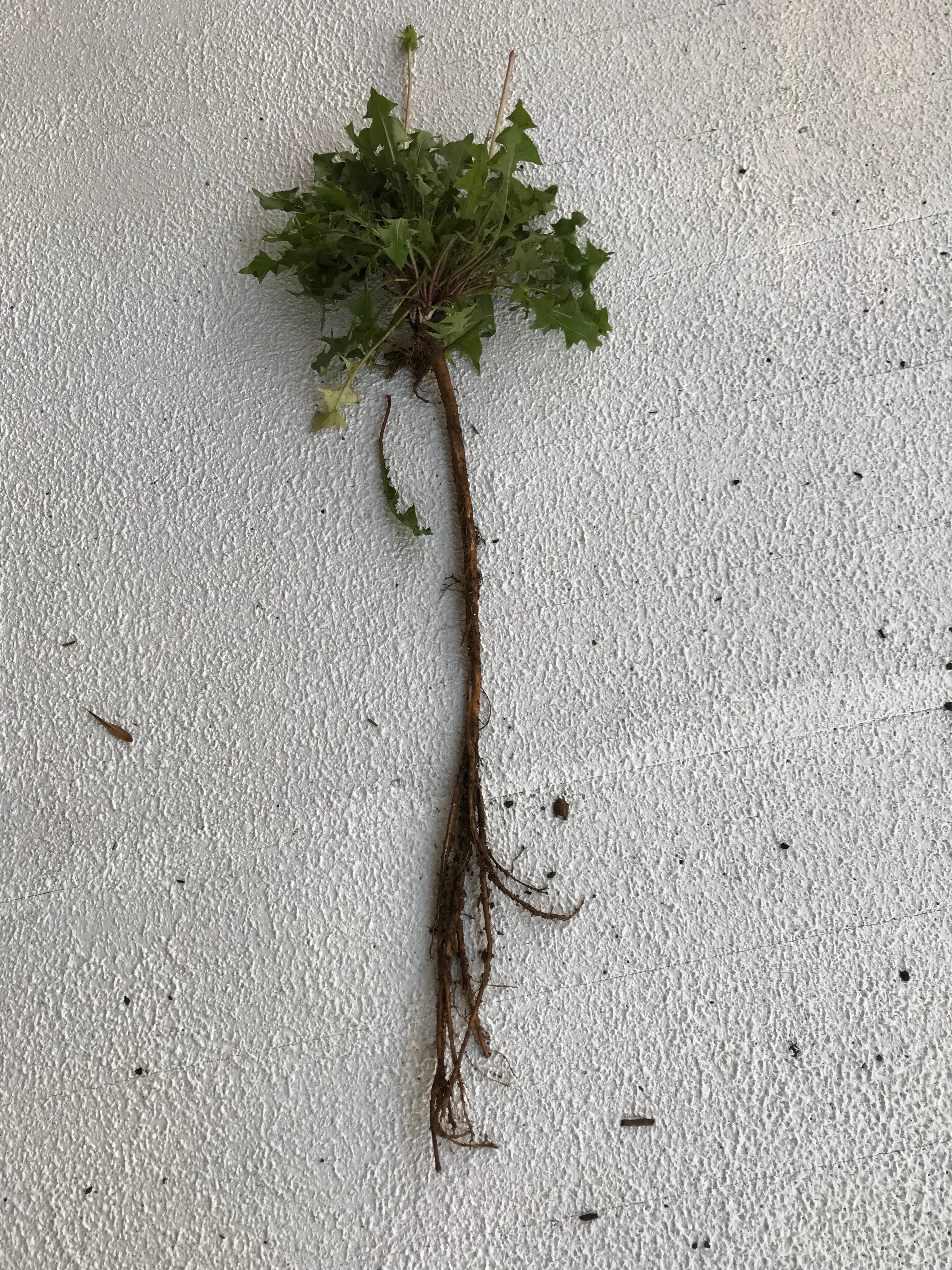
If you’ve dealt with dandelions, you know they have deep roots.  Well, it rained yesterday and the ground was soft enough that I was actually able to gentle one out the whole way today.  It was impressive.  Usually the root breaks off (a brilliant, if frustrating adaptation) less than an inch beneath the surface.  I thought to snap a picture before tossing this one on the compost pile (in the back yard, of course, inside the fence where it can’t be seen).  Talk about depth!  These yellow wildflowers with edible leaves and wine-making potential, are tenacious.  They have a very strong will.  Dandelions are perhaps the most strong-willed of plants.

With chronic illnesses, hope is essential.  Instead of getting angry at “weeds” I look at them as examples of just how mighty hope can be.  They find cracks that are so small that we overlook them.  The soil can’t always be great there, but they carry on.  Dandelions can reach impressive sizes (trust me on that one—I’m no gardener) and they don’t take “no” for an answer.  Such resilience gives me hope.  Were they more conscious (I’m sure they are at some level, but I surely hope it’s beneath the threshold of pain degree) they might well be dominant among the plants.  I missed mowing the lawn last weekend for being in the hospital with family, and it’s clear the dandelions have designs on taking over the place.  I see them and I find a deep peace.  Life finds a way, in spite of difficulty.  


Hoppy Fourth

Today is the one of the relatively rare summer holidays.  Modern industrialized nations tend to take a more relaxed view toward summers without having to give out too many prescribed company holidays.  This seems to follow on from school schedules because the kids are out in summer and adults need some flexibility when work demands collide with family needs.  The internet has made work-life balance a little tricker to achieve since work is always just a click away.  Some more generous employers gave yesterday as part of an extended four-day weekend, which is rejuvenating in a way that’s easily forgotten until you start to feel it.  The sense of obligation takes a couple of days to wind down, and then on Monday you realize “I’ve still got another day off!”  It’s a sublime feeling.  Why not watch holiday horror on it?

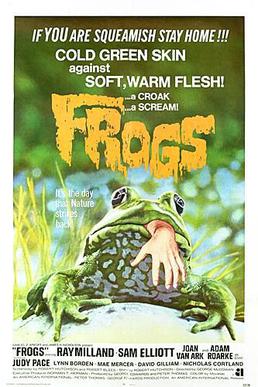
The Wicker Man is a holiday horror movie.  One of my arguments in the book is that holiday horror has to derive its energy from the holiday, and not just be set on it.  For example, I Know What You Did Last Summer and Return of the Living Dead are both set on or near Independence Day but the movies don’t really draw their horror from the holiday itself.  It falls into the same category.  Frogs?  Well, maybe.  Perhaps holiday horror, it’s definitely in bad movie territory.  A rich southern family is dominated by a Trump-like grandfather who controls the money and measures everyone by loyalty to him personally.  On his birthday, the fourth of July, nature revolts and his adult children and grandchildren (apart from one granddaughter), are killed by animals in this eco-revenge groaner.  But is it holiday horror?

One scene may suggest that perhaps it fits the category, but the real significance of that day is that grandpa won’t let it be celebrated any way other than by his prescribed plan.  Even as the estate is overrun by frogs (mostly), snakes, lizards, alligators,  tarantulas, and even some birds (thank you, Mr. Hitchcock), he insists that everyone do what they always do on the fourth of July/his birthday.  The only scene that suggests holiday horror is where the eponymous frogs hop onto a cake decorated like an American flag.  I normally like nature-revenge films, and this one starts out well but quickly goes downhill.  The environmental message is there, but underplayed.  There are some firecrackers and a number of dead rich folks, but otherwise the film seems to have no message at all.  It’s a bad movie.  Holiday horror?  Not really.  Something to watch for a day off work?  Definitely.


All Connected

The physical world is interconnected.  It’s not the only world, I’m convinced (there’s simply too much evidence that it’s not), but it’s certainly entangled.  We’re clearly part of a planet-wide system.  More than that, perhaps life is endemic in the universe.  We like to think our planet is exceptional, but what if it’s quite common (as the stats would seem to indicate)?  Sometimes physical objects can influence the spiritual world.  We don’t really know what the spiritual world is, so how the physical and spiritual interact we can’t always say.  My brother, knowing we needed some hope, sent my family some small gifts.  Things like this can cross worlds.  What he sent me was the replica of the famous “alien nickel” reported in the news last June.  (He knows me.)

A coin collector in Michigan was going through a roll of quarters in 2022 looking for any that might contain some silver.  You see, until 1964 US dimes and quarters were still manufactured with a portion of silver.  I very seldom use cash any more, but I always used to glance through my change to see if there was anything unusual before putting it in the coin jar.  In any case, the Michigan man found a buffalo nickel that, instead of the American Indian head on the obverse, it had an alien head.  “Experts” (numismatists, presumably) declared it a “hobo nickel,” as the homeless used to redefine currency to their own liking, apparently.  The interesting thing about this news story is that it disappeared from attention soon after the coin was found although the pictures indicate a high degree of artistry for a homeless person etching with a penknife.  It’s not alien currency, I know, but I do wonder from whence it came.  With hope.

For all the advances our society has made, we still defer to ridicule to explain the unexplained.  This is wrong-headed.  I have my own theory about why it is so, but in part it’s because science as we know it, in its Enlightenment form, was born in a Christian context.  Scientific thinking has been around for as long as humans, but the Enlightenment marked the point when the interconnectedness of the world began to be dropped from discussion.  Why?  Because science grew in cultures based on the biblical view of humans as exceptional.  If biblical events occurred here, on this planet, to us, we must be pretty special indeed.  Even as science has become more materialistic, its cultural matrix remained largely unchanged.   Ironically that matrix now excludes the interconnected world.  Life is pervasive, and who are we to say that stones, or this entire globe, are excluded from the party?  We’re all connected and there is wisdom in rocks and metal, if only we could see it.  If we believe.


Feathers and Flight

Bird identification must be one of the trickiest activities known to humankind.  My office window overlooks a small segment of a porch roof that is popular with birds.  Whether it’s pecking at some invisible specks on the shingles or dipping a sip from the gutters, they stop by often during the day.  Maybe my brain wiring is odd, but since I was a child I wanted to be able to identify correctly any animal I saw.  We had a few of those Zim Golden Nature Guides that I poured over like a second Bible.  I would study page after page, repeatedly, until I could identify just about any critter I came across.  It seemed, in those days, that all birds were sparrows, starlings, or robins.  There was the occasional blue jay or cardinal, but usually it was the more ordinary, less colorful variety.  Birds are symbols of hope.  Their lightness and ability to fly are what human dreams are made of.

I’m not an avid bird watcher, but I do try to identify them.  I see bald eagles occasionally, several times a year usually, and plenty of red-tailed hawks.  Once in a while, however, a smallish bird hops by that resembles nothing in my field guides.  In frustration I turn to Cornell University’s bird identification app, Merlin.  Almost never can they find anything like what I saw.  Maybe it’s because the app asks the wrong questions.  Never do they say “was the tail long, medium, or short?” for example.  Things you’d actually notice.  They do ask where you saw it, and “on the roof” isn’t an option, let alone “on the roof overlooking my porch.”  I saw an interesting bird the other day that was all gray.  Bill and all.  I saw it next to a starling, from which it was clearly distinct.  It wasn’t in my book and it wasn’t on Merlin.  What could it have been?

This isn’t the first time this has happened.  Strangely, bird color isn’t always a reliable indicator of species although this is what the viewer tends to notice first.  To make positive identification takes close observation of details most people don’t immediately catch.  The more common species are seldom an issue, but the less showy kind are often more difficult to identify.  This strikes me as a life lesson.  We may all know who the showiest are, but those more modest of our avian friends likely live lives of greater satisfaction without people constantly chasing after them.  At least I imagine it so, since I can’t find a write-up about them in my identification guides.  But I can still watch them and gain hope.


Parthenogenesis

It’s only a matter of degree, isn’t it?  I mean between reptiles and mammals.  While our common ancestor was quite a bit older than Lucy, we’re still fam, right?  I’m not the only one, I’m sure, who read with interest the New York Times story about the female crocodile who recently gave birth without the help of a male.  It’s called parthenogenesis and, according to the article, it’s not as rare as we might think.  Birds and amphibians do it.  Some fish even change gender under reproductive pressure.  And if you’ve seen Jurassic Park you know the implications might be larger by an order of magnitude or two.  My mind, however, wanders to mammals.  Then primates.  Then humans.  If our distant cladistic cousins can do it, can we?

The key appears to be males leaving females alone long enough.  As Malcolm says, “life will find a way.”  Life amazes me.  While we can’t count on it happening for each individual, life has a way of reemerging when you think it’s gone.  Previous owners of our house neglected a green ash tree growing in a location far too close to the house itself for many years.  Granted, it was on the north side where you seldom have any reason to go, but that tree sent out progeny that I’ve had to try to eradicate for five years now.  As much as I love trees, when they’re growing into the foundations of your house, they’re a bit of a problem.  I snip off the water shoots whenever I find them but they keep coming back.  I’m sad to cut them but I admire their persistence.  Life’s persistence. It’s will to carry on.  It continues even when we think it can’t.  Never forget the water bears!

Just a few days later the Times ran an article about the strong possibility of life on Enceladus, one of Saturn’s moons.  Personally, I wouldn’t be surprised.  I’m absolutely certain there’s life elsewhere.  It makes no sense for it not to be.  Life evolves to a point, it seems, where the “intelligent” variety seems to become arrogant.  I embrace our reptilian and amphibious and piscine cousins.  Even our insect and arthropod family.  Our plants and fungi.  Life is amazing and we seldom stop to ponder just how wonderful and mysterious and resilient it is.  A lonely female crocodile decides to have a family.  Phosphates spewing from an ice-cold moon whirling around a colossal planet that wanted to be a star.  Life!  How can we not be stunned into trying to admire it in its many, many forms?


Solstice Wonders

It’s difficult to tell where summer begins and spring ends.  Transitions are like that.  Today’s the summer solstice.  Since I’m an early riser I keep track of when the sun comes up so that I can go for a jog.  Actually, I tend to get out just before sunrise when twilight is enough to see by.  You see, the solstice is a day of hope.  My jogging path is on the edge of town and it borders some woods that, all things considered, are quite shallow.  There’s development on the other side of the river, although you can’t see it from here.  As I’m out before most other crepuscular exercisers I often see critters along the trail.  I’m not sure I can catalogue all the animals I’ve seen but a partial list includes fox, coyote, raccoon, bald eagle, raven, ducks, herons, and the ubiquitous rabbits, squirrels, and deer.  Last month I saw a doe giving birth as I jogged by, something I felt it inappropriate to watch beyond a passing glance.

At times when it’s too dark to go before work I have occasionally gone on a slightly later schedule.  Then I’ve seen groundhogs, a snapping turtle, and red efts (newts).  The thing is these woods are rather thin and they support (along with the towns, I’m sure) a variety of creatures, many of which I don’t see.  Appearances can be deceptive.  Things that appear certain are often wrong.  Those who wake later and don’t spend their evenings on the trail (and animals, I expect, are shy after people have been out all day) may not believe there is so much fauna in the area.  I know there’s even more: opossum, bear, and frogs among them.  I believe they are there.  And believing is just as important as knowing.

Summer is thought of as a more relaxed time, but that’s really only an appearance as well.  It’s actually quite a busy time—what’s relaxed is our capitalistic drive for work.  We realize the warmer days (hopefully not too rainy) afford us the opportunity to do the things the long, dark, cold months prevent.  And those of us in northern latitudes tend to think of it as a magical time.  Shakespeare’s A Midsummer Night’s Dream captures the traditions of fairy activity during this short night with long, sunny days either side of it.  A family member recently reminded me of this connection, and it seems to me that we should be reminded once in a while of the miracles that surround us.  The solstice is one of them.  It’s a matter of believing and a cause for hope.


Sailing Away

Out on the open water on a sailboat large enough to be categorized as a sloop.  We’re on the Hudson River learning about both sailing and the environment.  I’m here with a a Girl Scout troop, otherwise I wouldn’t have known about the sloop Clearwater at all.  The origins of the Clearwater go back to Pete Seeger, who, apart from being a famous folk artist, was also an environmentalist.  Based in Beacon, New York, the Clearwater is used in educational programs and it represents the only time I’ve been on an actual sailing ship.  Call me Ishmael.  Or not.  You see, I was there as a volunteer.  Specifically, a driver.  My daughter’s troop had scheduled the trip and I was afforded free passage as chauffeur.  I’d pretty much tucked this away into old memory banks until recent reading brought it to the surface.

Photo by by Anthony Pepitone; under the Creative Commons Attribution 3.0 Unported license, via Wikimedia Commons

I support environmental causes in the ways a guy in my position can.  We compost in our back yard.  We recycle anything that we can figure out how to.  We throw away one thirteen-gallon garbage bag every two weeks, and that’s sometimes half-empty.  Being vegan helps.  We don’t have a lot of money to give away, but lifestyle is the biggest way to try to help the planet.  So I’m out here soaking up my Melville vibes on a river wide enough to be a lake.  The Hudson, like all rivers, is worth saving.  I used to cross under it daily through the Lincoln Tunnel, trying not to think of all that water flowing above my head.  There was a reason I read on that long commute.

This blog, I guess, has become a repository for much of my past.  I’m grateful to you indulgent readers who find any of this interesting.  Still, I find human connections to places fascinating.  While I’ve never considered the Hudson home, some of my early relatives likely did (more likely Hessians than Dutch, but I’m told we fought on the right side during the Revolutionary War).  When I’ve had the opportunity to gaze out over the river without being in a rush, I’ve always felt a sense of belonging.  An artwork I made from artifacts I gathered awaiting our turn to board the Clearwater now hangs in our front hall.  Suddenly those twenty-something years feel like so long ago.  Even so, the Hudson suggests something homey to me.  Maybe it’s time to hire out a sloop again, go out on the river, and dream about belonging.