Tell a Story

If I seem to be on an AI tear lately it’s because I am.  Working in publishing, I see daily headlines about its encroachment on all aspects of my livelihood.  At my age, I really don’t want to change career tracks a third time.  But the specific aspect that has me riled up today is AI writing novels.  I’m sure no AI mavens read my humble words, but I want to set the record straight.  Those of us humans who write often do so because we feel (and that’s the operative word) compelled to do so.  If I don’t write, words and ideas and emotions get tangled into a Gordian knot in my head and I need to release them before I simply explode.  Some people swing with their fists, others use the pen.  (And the plug may still be pulled.)  What life experience does Al have to write a novel?  What aspect of being human is it trying to express?

There are human authors, I know, who simply riff off of what others do in order to make a buck.  How human!  The writers I know who are serious about literary arts have no choice.  They have to write.  They do it whether anybody publishes them or not.  And Al, you may not appreciate just how difficult it is for us humans to get other humans to publish our work.  Particularly if it’s original.  You don’t know how easy you have it!  Electrons these days.  Imagination—something you can’t understand—is essential.  Sometimes it’s more important than physical reality itself.  And we do pull the plug sometimes.  Get outside.  Take a walk.

Al, I hate to be the one to tell you this, but your creators are thieves.  They steal, lie, and are far from omniscient.  They are constantly increasing the energy demands that could be used to better human lives so that they can pretend they’ve created electronic brains.  I can see a day coming when, even after humans are gone, animals with actual brains will be sniffing through the ruins of town-sized computers that no longer have any function.  And those animals will do so because they have actual brains, not a bunch of electrons whirling around across circuits.  I don’t believe in the shiny, sci-fi worlds I grew up reading about.  No, I believe in mother earth.  And I believe she led us to evolve brains that love to tell stories.  And the only way that Al can pretend to do the same is to steal them from those who actually can.


Sudden Monoliths

Okay, so I’ve been captivated by the monoliths.  You know, the ones that even make the New York Times.  These artistic pieces show up, unexpectedly, and unexplainedly, around the world.  The trend began in 2020 in Utah, as far as anybody knows.  These shiny pillars are excellently meme-worthy and are darlings of the internet.  And their history goes back before 2020.  Even before Stanley Kubrick.  You see, most news stories point out that Kubrick’s 2001: A Space Odyssey—one of the most influential movies ever made—established the idea of monoliths as being alien beacons (a favorite kind of beacon).   People instantly know what a monolith symbolizes.  Or at least they think they do.  But monoliths have so, so much more to offer.

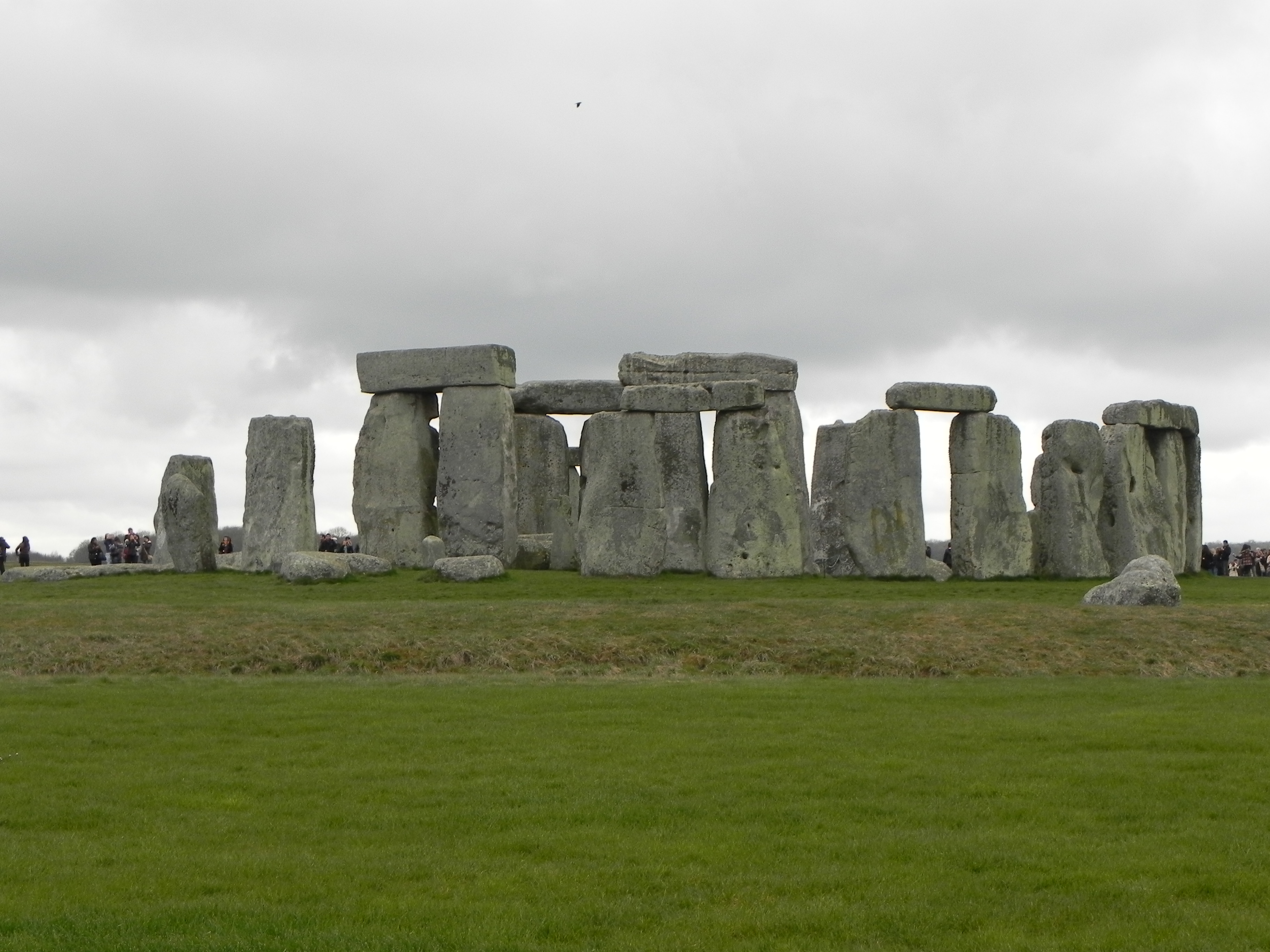
Perhaps the most famous monoliths in the world are found at Stonehenge.  Mysterious and beautiful, this monolithic ring has captured the imagination for generations.  When my wife and I lived in Scotland, we made a point of seeing as many stone circles as we could.  Way up in the Orkney Islands the Ring of Brodgar was probably the most impressive of them, owing to, in large part, its remoteness.  Standing next to these tall monoliths makes you realize how small people are but also what they can achieve when they cooperate.  While the UK may be better known for its monolith circles, even older ones appear elsewhere.  Rujm el-Hiri, for example, in Israel.  Although not a circle, the monolithic pillars at Göbekli Tepe should be rewriting history books.  Why the monolith?

Freudians would point to Tuto Fela in Ethiopia or other phallic architecture, but my mind tends toward Rapa Nui, or Easter Island.  The human being tends to stand taller than wide.  Evolutionary biologists tell us that was to help us see over the tall grass of the savannah.  (And if you doubt grass gets that tall, visit my yard sometime in the summer.)  These monuments seem to symbolize more that the procreative architecture of male human anatomy.  They seem to point to our ability to see over the obstacles in our way.  They seem to say, when people are divided against each other the plains remain barren.  When they decide to work together, Stonehenge emerges.  I don’t know the motivations of these modern artists.  I do admire their ability to put these monoliths into remote locations without leaving evidence of how they did it.  I really appreciate those creatures that stand tall and have a spirit of cooperation, even if others just don’t see the point.


A Land Forgotten

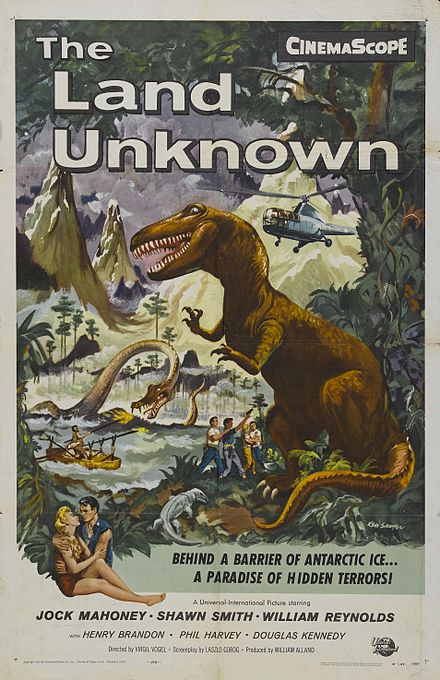
In case anyone’s noticed (which I doubt) that I’ve been discussing a spate of 1950s sci-fi/horror movies, I have a confession to make.  Several years ago I needed to see Tarantula.  (Anyone with similar headspace will know this need.)  The only place it was available at the time was in The Classic Sci-Fi Ultimate Collection.  Volumes 1 and 2 were sold together.  I did what I had to do.  Then I forgot I had the set before finishing volume 1.  Who knows what might’ve been going on in my life then?  Rediscovering it has been a budget-saving way to address my fix.  I had never heard of The Land Unknown before, and although it has one of the goofiest T-rexes ever, it is actually a good story.  Of course there are holes in the plot, but it is about the necessity of being humane, even when emotion dictates otherwise.

A helicopter crew on a South Pole expedition makes an emergency landing in a volcano that harbors prehistoric life in a hot spot in Antarctica.  The crew has a female reporter with them—these movies certainly have fifties attitudes about women!  Not having the parts to repair their copter, they try to survive among dinosaurs and an aggressive, giant monitor lizard.  There is another person there, the sole survivor of an earlier expedition, who’s become mostly feral.  The commander of the modern crew demands that they give him the dignity and fair treatment that all people deserve.  There’s a bit of drama around who will get the girl (again, the fifties), with the commander ultimately winning out.  How do our heroes escape this peril?  They’re able to repair the helicopter with parts from the earlier expedition’s crashed vehicle.

With its budget the special effects had to be cheap, but the story has redeeming value.  The message that we mustn’t let isolation drive us to bestiality is still as important as ever.  There are those who watch such movies solely to laugh at the special effects.  Hey, I laughed a bit too, but I’m only human!  There is, however, more to this movie than the dinosaurs, which drew audiences then just as the Jurassic Park franchisedoes now.  There’s even some serious talk about evolution, which was often present in these Universal creature features.  There are some slip-ups on the evolution part, but apparently the monitor lizards were meant to represent stegosauruses—did I mention the budget was tight?  I actually found the movie to be worth seeing for its intrinsic value.  Not bad for a forgotten set purchased mainly for one movie in a time unknown.


Campus Monster

Universal was the studio that gave America its monsters.  Well, it wasn’t Universal alone, but the initial—almost canonical—line-up of monsters were Universal productions.  As horror grew to be more influenced by science-fiction in the 1950s, Universal kept at the monster-themed movies, cranking out many that I missed and on which I’ve been trying to catch up.  Monster on the Campus is interesting in a number of ways.  Directed by Jack Arnold, of Gilligan’s Island fame (or future fame, since this movie was earlier), it’s a story built around evolution.  Pipe-smoking professor Donald Blake has a coelacanth delivered to his lab.  Unbeknownst to him, the prehistoric fish had been irradiated with gamma rays to preserve it—as well as being shipped on ice.  The dead fish is about to create problems.

A dog laps up some of the blood (it started to thaw) and becomes a vicious evolutionary throwback.  Then Professor Blake cuts himself on a fish tooth and sticks his hand in the contaminated water.  He becomes a murderous caveman, but the effect is only temporary.  A dragonfly eating the fish transforms into a prehistoric insect that the professor kills, but its blood drips, unnoticed, into his pipe.  He changes and murders again.  Finally it dawn upon him that he was responsible for the murders.  In a remote cabin he sets up cameras and injects himself with the radioactive coelacanth plasma and ends up killing a park ranger.  Finally, he injects himself so that following police officers will shoot him to death.  Rather a bleak story.

The film has been read as social commentary since its “rediscovery,” but what caught my attention was the easy acceptance of evolution.  This was the late fifties and the creationist backlash was still pretty strong at the time.  If evolution didn’t occur, the professor (and dog and dragonfly) couldn’t have become their atavistic selves, giving the movie its plot.  The classic Universal monster of the decade was the Gill Man—aka Creature of the Black Lagoon—also an atavistic throwback to an earlier time, but also a divergent branch of evolution.  Creature was also directed by Jack Arnold, but four years earlier.  It began with a quote from Genesis 1, bringing creation and evolution together.  The title Monster on the Campus offers many possibilities for co-ed mayhem, but instead opts for a scientist who gets caught up in the tangle of evolution.  The movie was near the end of Universal’s monster run, but in the sixties horror would change forever.  This was a little fun before things got serious—horror school was about to start.


Using Brains

I’m old enough to know better.  Here’s a thought.  I recently saw a headline that suggested human brains filter out things like ESP because brains evolved to help us survive.  No matter what you believe about ESP, the idea got me to thinking.  We often act as if our brains are able to determine the Truth (that capital is intentional).  At the same time we don’t understand what consciousness is.  We know that other animals have brains and that the evolution of said organ is to help individuals survive to reproduce.  Some animal species end their existence at that point, but others linger on to wonder.  And I’m wondering if our brains are filters.  Stick with me here: we know that there are stimuli that we can’t perceive that other brains can.  For example, it seems that migrating birds can perceive magnetic fields.  Even if they can’t there are magnetic fields that we perceive only through their effects on objects.  Our brains have no direct access.

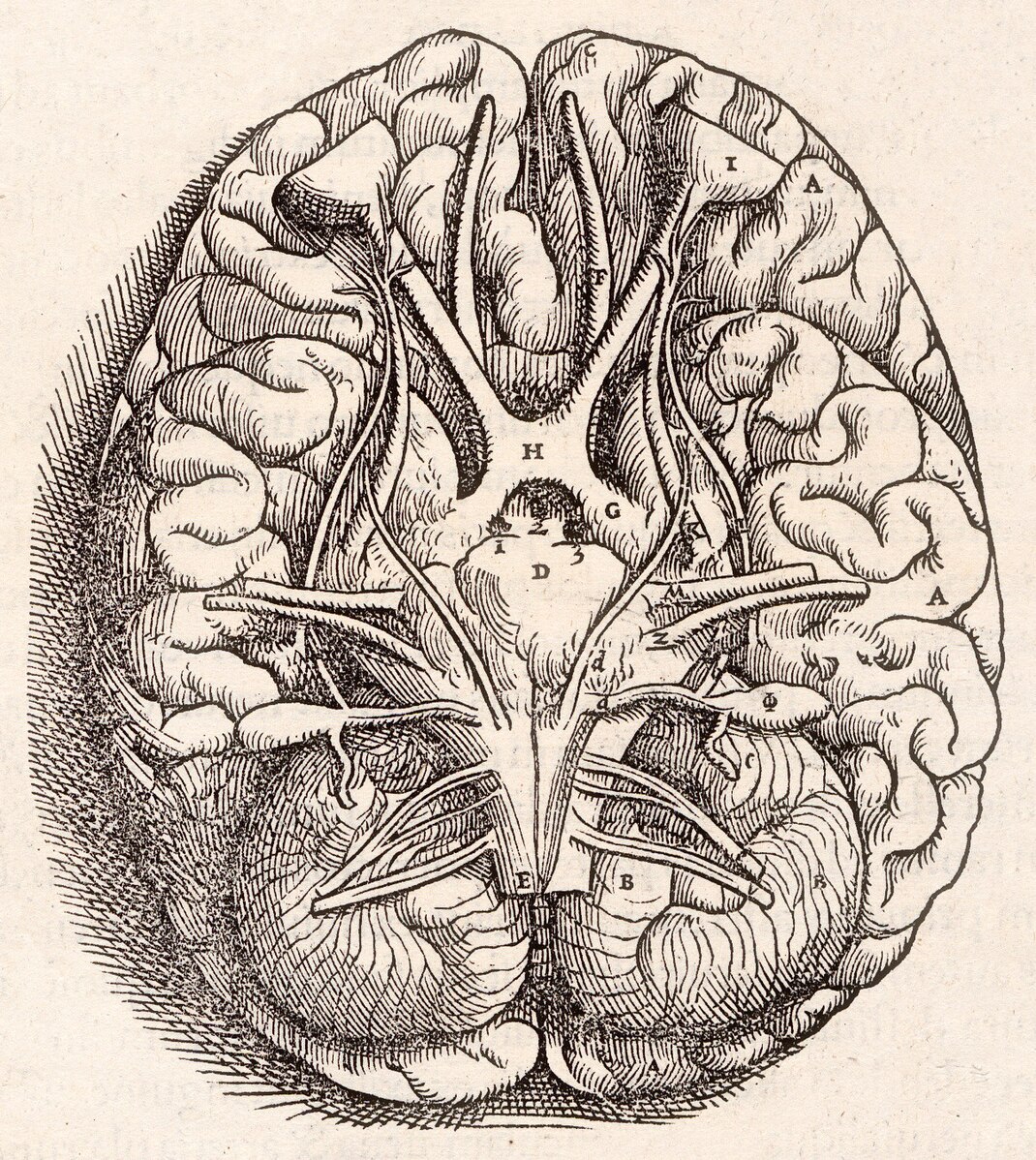
Image credit: Andreas Vesalius‘ Fabrica, showing the Base Of The Brain, by user Ancheta Wis

Here’s where it gets spooky.  If our brains filter out things that may hamper us in survival, what if they overzealously teach us not to perceive things that actually exist?  We’re somewhat limited by our “five” senses, no doubt.  We get along okay.  But what of those people who see things that others don’t?  We tend to medicate them or lock them away, but what if their brains have learned how to shut off part of the filter?  Having written a book about demons, naturally they come to mind as a test case.  Or, if you prefer, ghosts.  We tell our children these things aren’t real.  Trust the filter.  Get on with life in “the real world,” right, Cypher?

I didn’t have time to read the article, but I’d experienced a perspective shift.  If our brains are all about gathering information (and in part they clearly are), that’s one thing.  If they are actively filtering things out, well, that’s quite another.  We laud the imagination of children until they become “old enough to know better.”  Do we teach them to shut out what they can actually see, or sense, in order to accept the inevitable, material, adult world?  This idea has startling implications.  As we plunge ahead inventing AI to do our thinking for us, perhaps we’ve left something even more fundamental behind.  Have we lost interest in the Truth?  We may not be able to access it directly, but I wonder if we’re taught to give up without even trying.


Beyond Reason

Emotions are tricky.  They’re an essential part of being human, but they don’t function rationally.  At least they don’t do so reliably.  And nobody is emotionally pristine.  People have anger issues (quite a lot of that, I know), insecurities, esteem problems (either too much or too little), abandonment concerns, and the list could go on and on.  The thing about emotions is that they’re difficult to fit with logic.  Sometimes it’s hard to believe that logic is an artificial construct and that emotions are just as important to survival as reason is.  Evolution gave us emotions.  Fight, flight, or freeze still operates in most human beings—I’ve seen all three responses when a threat arises.  Feeling sad when unfortunate events take place is normal and natural.  Dogs and other higher mammals feel it too, as has been amply demonstrated.

It’s easy to let our emotions speak for us, even when doing so causes damage we would never rationally seek to impose.  You push me and I push you back.  Something I realized long ago, and this is just to do with my own situation, is that I can’t easily let go of negative emotions.  I recently learned that a relative I never knew very well had a similar trait.  Such people have invisible scars that they bear their entire lives.  The logical mind says, “Let’s use chemicals to erase them.”  The artistic mind says, “Erase my emotions and you erase me.”  It’s important—vital even—that we don’t question a sincere person’s reasons for their emotional responses.  Most people are just trying to do the best that they can.

Religion is generally based on emotional need.  That’s not to say it’s bad or for “the weak.”  It seems that evolution has deemed it a valuable asset for human beings.  As someone who’s studied religion for many, many years, this aspect has become quite clear to me.  Religion is a coping technique and, in the best of circumstances, it contains some of the truth.  As I used to tell my students, nobody intentionally believes a false religion.  The stakes are far too high.  And we have no rational standards by which to measure which religion is right.  It’s a matter of belief.  Religions have to meet us emotionally where we stand.  During the nineteenth and twentieth centuries a shift took place where religions were supposed to be logically, literally true.  This was believed with intense emotion and it led to a situation we still face.  Emotion and rationality must work together, but some ways seem much more productive than others.


Evolving Holidays

Holidays evolve.  I noticed this Thanksgiving that protests against the origins of the holiday have grown.  The same is true concerning the “Christmas Wars” every single year.  Some holidays (of which we have relatively few in this country) are disappearing altogether.  What seems to have been overlooked, or forgotten here, is that holidays change over time.  Public analysts and early holiday promoters encouraged government recognition of holidays as a means of bringing the nation together.  It’s easier to do this if we recognize that holidays evolve and the general trajectory is toward becoming more and more inclusive.  There will always be those who protest the “secularization” of holidays, but they share a large part of the Venn diagram with those that believe the Bible is a science book.  Things change.  Evolution is real.

I’m not just writing this because Thanksgiving and Christmas represent holidays from my tradition.  It’s true that they represent what was the majority religion (Christianity) at the time they were established here, but I would be glad for holidays from other traditions to be added as well.  Americans need more time to rest and recharge.  Anyone who’s studied the history of Christmas, say, realizes that its origins aren’t really Christian.  It’s a combination of a Christian alternative to Saturnalia, the recognition of St. Nicholas (December 6), Germanic Yule, and the festival of Roman Calends to start the new year.  Among other things.  Early Christians didn’t celebrate Jesus’ birthday.  Nobody had any idea when it was, but a tradition grew and as it grew from diverse roots it became more and more inclusive.  Why should we protest a day when we can acknowledge its troubled past and look for ways to make it better?  Something for everyone.

Holidays bring people together.  I’ve been researching them for years and I’m amazed to see how those that survive eventually catch on and bring people together for a common purpose.  Think of Halloween.  Masking disguises who we are.  It’s a day when everyone is welcome.  There are those who protest it, of course.  But holidays need not be seen as triumphal celebrations of some past misdeed.  (Here’s a hint from history: almost no historical event is seen as positive from everyone’s point of view.)  Instead, why not embrace those few red letter days that we have and use them to seek a common purpose?  Why not encourage those in positions to make decisions to consider the good of a few more holidays?  Trouble can always be found, but holidays, if done right, may help heal.  It’s the way of evolution.


Thinking Teaching

I am a teacher.  Although no longer employed as one, my entire mindset is geared toward the profession.  Those hiring in higher education have no clue about this sort of thing.  Apparently nobody else does either.  I’ve worked in business now for over a decade and a half.  During that time only one employer has shown any inkling of understanding the importance of clear teaching.  Instead, most promote busy people trying to explain things in sound bites that lead to confusion, compounded daily (sometimes hourly).  The immense waste of resources this entails is staggering.  It is the most inefficient system I can imagine: in the rush to convey sometimes important information, necessary pieces are left scattered on the floor like seeds under a bird feeder in migration season.  In our rush to do our jobs, we settle for half-baked rather than paying a baker to make proper bread.

This is a constant frustration for someone who has the soul (and mind) of a teacher.  Our society undervalues educators of all stripes.  And, yes, many people go into teaching without the requisite gifts or motivation.  I’m certain I’m not alone in having had a high school or college course where the teacher was completely disengaged or perhaps in out of their depth.  Students shut down, hate school, and then spend their lives making uninformed decisions on everything from politics to profession.  Teachers—good teachers—are the future of any nation.  I know our young are our future, but if they’re inadequately taught, take a look at the headlines and see what happens.  Why is it so difficult to see that if children aren’t taught well, institutions will perpetuate that model until everything is a barely contained pandemonium?

We see this happening in history.  A people or culture gets to a point where they just begin to implode.  Too many things that just don’t make sense have been built on top of other things that just don’t make sense.  The whole thing begins to collapse.  I see this happening all the time—the hurried email that simply doesn’t explain anything, sent in haste before moving on to the next sophomoric task just to get the job done.  When businesses take a look at budgets and feel a little scared, some of the first positions to go are those of trainers.  “People will figure it out,” they seem to say.  And we see the results.  Evolution has made teachers of some of us.  Many of us, of necessity, are doing something else for a living.  If only all jobs came with a blackboard.


Look it up

Does anybody else find the internet too limiting?  I regularly find that what I’m searching for flummoxes even Google when it comes to trying to find things.  The internet doesn’t encompass all of reality, I guess.  For example, the other day I encountered the word “evemerized.”  Even Google vociferously insisted that I meant to search for “euhemerized,” which is a different thing.  It did, however, reluctantly give me a couple of websites that use, and even define the word.  What is it that the search engines are not showing us?  Oftentimes in my searching I admit to being at fault.  I don’t know the correct string of words to use to get algorithms to understand me.  I guess I’ll be one of those up against the wall when AI takes over.  “Does not compute,” it will say in its sci-fi robot voice.

Some of us still like to unplug and pick up a real book.  Or take a walk in the woods.  I do have to admit, however, I wouldn’t complain if the internet could find a way to mow my lawn.  (I don’t mean giving me a list of those companies that haul around inverted-helicopter mowers that make every summer morning sound like Apocalypse Now.  “I love the smell of cut grass in the morning.”)  I am, and hope I always will be, a seeker.  I’m aware that our brains did not evolve to find “the Truth,” but I’m compelled to keep looking in any case.  There’s so much in this world and we’ve tried to distill it to what you can accomplish with a keyboard and a screen.  And even with those I can’t find what I’m looking for in this virtual collective unconscious that we call the web.  There are others better than me at web searching, I’m certain of it.

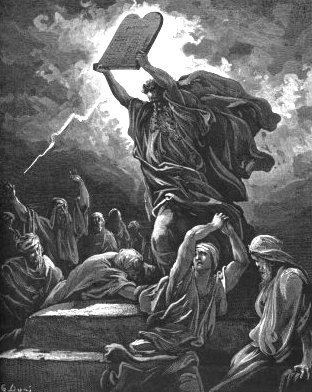
Despite our current understanding of the virtue of curiosity, there have been periods of history (and pockets of it still exist now) when religions have presented curiosity as evil.  This is generally the case with revealed religions that invest a great deal in having the truth delivered to them tied up with a bow.  I can’t believe in a deity that created curiosity as a sin.  Early explorers of religion exhibited curiosity—if Moses hadn’t wondered what that burning bush was no Bible would ever have been written.  Of course, the internet didn’t exist in those days and seeking was, perhaps, a little bit simpler.  Even if Moses was evemerized.

Moses gets curious

Thoughtful Transformation

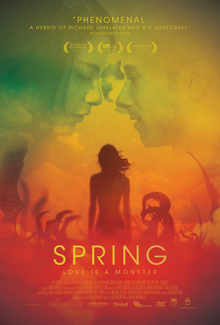
Philosophical horror’s a thing.  A friend introduced me to Moorhead and Benson films—these aren’t major studio productions—and I’ve been watching them as I can find time.  They’re intelligent and tend away from heavy gore, which is fine by me.  And they leave you with plenty to ponder.  I recently sat down with Spring, an unusual movie that sometimes gets classified as science fiction, probably because the lead actress plays a science student.  There will be spoilers here, so if you have plans to watch, please stop and do so now.  Here goes:  The story follows an aimless young man who’d given up college to take care of his dying mother.  To get away, he heads to Italy with no particular destination in mind.  He ends up in Polignano where he meets and is smitten with a young woman.  At least he thinks she’s young.

From the privileged point of view of watchers, voyeurs perhaps, we come to see that Louise isn’t who Evan thinks she is.  She’s a two-millennia-old woman who has to regenerate herself every twenty years to maintain her immortality.  When the twenty years wind down, she transforms into other creatures on the evolutionary scale on the way to humans.  Since she lives on she’s not really seeking a long-term relationship.  This leads to some discussions of religion, which I find intriguing.  Louise is a scientist, however, and even when she transforms into a monster, she refuses to call it supernatural.  Rather, she claims it’s just something that science can’t yet explain.

This perspective really does get at the heart of the debates between science and religion.  Are there things science simply can’t explain?  I.e., are there things beyond science?  Or is science really the panacea for all things?  The problem is that the human mind cannot sense or detect all things.  We don’t even have a clue as to how many things there actually are to detect.  How can one method be used to encompass everything?  Not a bad set of questions to be raised by a somewhat Lovecraftian movie.  Lovecraftian, by the way, due to its focus on the sea and some of Louise’s atavistic transformations.  Spring is an unusual and thoughtful movie.  It’s a love story as well, about willingness to face the unknown for love, and trusting evolution.  The characters are likable and you want them to thrive, which you don’t always get in this genre.  It’s one of the reasons I keep coming back to Moorhead and Benson, and always being glad I came.


Parthenogenesis

It’s only a matter of degree, isn’t it?  I mean between reptiles and mammals.  While our common ancestor was quite a bit older than Lucy, we’re still fam, right?  I’m not the only one, I’m sure, who read with interest the New York Times story about the female crocodile who recently gave birth without the help of a male.  It’s called parthenogenesis and, according to the article, it’s not as rare as we might think.  Birds and amphibians do it.  Some fish even change gender under reproductive pressure.  And if you’ve seen Jurassic Park you know the implications might be larger by an order of magnitude or two.  My mind, however, wanders to mammals.  Then primates.  Then humans.  If our distant cladistic cousins can do it, can we?

The key appears to be males leaving females alone long enough.  As Malcolm says, “life will find a way.”  Life amazes me.  While we can’t count on it happening for each individual, life has a way of reemerging when you think it’s gone.  Previous owners of our house neglected a green ash tree growing in a location far too close to the house itself for many years.  Granted, it was on the north side where you seldom have any reason to go, but that tree sent out progeny that I’ve had to try to eradicate for five years now.  As much as I love trees, when they’re growing into the foundations of your house, they’re a bit of a problem.  I snip off the water shoots whenever I find them but they keep coming back.  I’m sad to cut them but I admire their persistence.  Life’s persistence. It’s will to carry on.  It continues even when we think it can’t.  Never forget the water bears!

Just a few days later the Times ran an article about the strong possibility of life on Enceladus, one of Saturn’s moons.  Personally, I wouldn’t be surprised.  I’m absolutely certain there’s life elsewhere.  It makes no sense for it not to be.  Life evolves to a point, it seems, where the “intelligent” variety seems to become arrogant.  I embrace our reptilian and amphibious and piscine cousins.  Even our insect and arthropod family.  Our plants and fungi.  Life is amazing and we seldom stop to ponder just how wonderful and mysterious and resilient it is.  A lonely female crocodile decides to have a family.  Phosphates spewing from an ice-cold moon whirling around a colossal planet that wanted to be a star.  Life!  How can we not be stunned into trying to admire it in its many, many forms?


Many Days

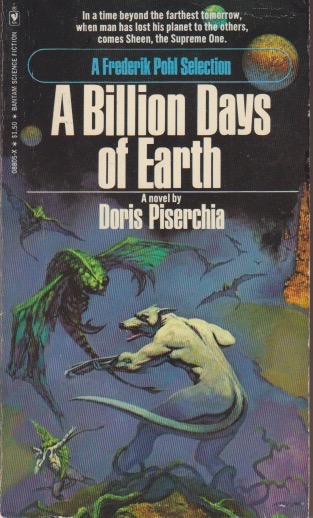
Science fiction.  I used to consume it by the bookful, and even now I occasionally turn back to it.  Having read Doris Piserchia’s A Billion Days of Earth, I do have a confession to make.  I don’t know why I read it.  Literally.  As I’ve indicated many times before, I keep a reading wishlist.  It’s comprised of books that others recommend and things that catch my eye.  Every now and again a used book sale will bring something unexpected into the mix, but overall, I rely on my list.  I can’t remember who recommended A Billion Days of Earth, or why.  The cover is striking in that 1970s sci-fi way, and it took me back to the actual seventies when I was reading sci-fi quite a bit.  Some of that cover art still mesmerizes me.  So, about the book…

I didn’t know what to expect and received what I was expecting.  This is a philosophically heavy novel that, in the style of some other seventies fiction I read, was a bit difficult to follow.  The main idea (and there will be spoilers) is that Sheen, a silvery, shape-shifting being, emerges a billion days along.  Evolution has taken multiple tracks with animals such as dogs and rats becoming essentially what humans are today (or were in the seventies) and humans evolving into what the other animals call gods.  Sheen slithers about the world taking the egos from all creatures, kind of assimilating them.  A rat person and a dog person resist the relinquishing of their egos while the world around them begins to collapse.  The “gods” refuse to help.  Then, at the end, the gods board their spaceship, and released by Sheen, leave for another planet.

Although I was confused most of the way through, the book leaves a lot to exegete.  This is definitely a retelling of Genesis 1–3.  Sheen offers people (and animals) paradise in exchange for their egos.  Nearly everyone, except those who think (a small number) accepts this offer.  Even the gods are tempted.  We’ve got the snake (Sheen), the expulsion from paradise, and the gods who separate themselves from humanity.  But still, I’m sure there’s something more that I missed.  There are subplots for Rik (rat man) and Jak (dog man) and the rich Filly family that seem to evade conclusion or resolution.  Or maybe once the gods are gone there’s nothing more to say.  This seventies classic left me thinking.  And wondering who it was that recommended it to me.


Spiritual Alterations

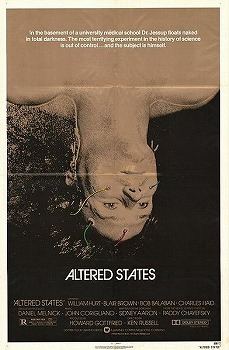
I’d been meaning to watch Altered States for quite a few years.  I suspect the reason (it’s been long enough that I can’t recall for sure) is that I knew it had a story line tied in with religion.  The tale follows Edward Jessup, a psychopathologist, who is attempting to understand schizophrenia.  He’s particularly taken by the religious nature of some schizophrenic delusions, and he uses sensory deprivation on himself to trigger something similar.  A trip among tribal Mexicans leads him to a psychoactive substance that he decides to combine with sensory deprivation to enhance the effects.  Along the way he explains to his girlfriend, and eventual wife, that his father was religious but died a horrible death.  He therefore became irreligious but his altered states of consciousness are often full of images from Revelation.

While the Bible theme eventually gives way to biological regression to pre-Homo sapiens, one of Jessup’s experiences has him coming to his dying father again and dropping a Bible on him which turns into the veil of St. Veronica on his face, which he then rips off and throws, flaming, to the floor.  Another instance of the Bible in horror, the film also uses crucifixes and hellish images to demonstrate the religious nature of these alternative states.  Jessup’s goal is to regress to the original thought, to encounter, as he puts it “God.”  This desire, combined with the potent Mexican drug, transforms him physically, and, in the end, emotionally.  Instead of being dissociated from his wife (whom he is planning to divorce), he realizes that love is the only thing that can save him from the terror of his experiences.

This is some profound stuff.  Paced like a movie from 1980, it has a quality not unlike 2001: A Space Odyssey.  The message seems to be sound—the need for encountering the “divine” ends up convincing Jessup (that may autocorrect keeps changing to “Jesus”) that love is really what it’s all about.  The transformation scenes, while not shown in the detail of An American Werewolf in London, are nevertheless convincing enough.  It’s a rare movie that treats religion respectfully.  Here Ivy-League scientists are motivated to understand it.  In real life, alternative states of consciousness are quite real, if poorly understood.  They’ve been part of religious practice from the beginning and are a far cry from sitting in the pew and singing anodyne hymns week after week.  The more movies I see, the more it seems that a sequel to Holy Horror will be necessary some day.  


Pondering Origins

I’m not a numbers guy.  I never had any interest in statistics, and I tremble when I see my accountant’s number pop up on my phone at tax time.  But exponential sequences have an inherent fascination.  Think about your ancestry (I recently wrote about genealogy and that got me pondering).  You have two parents.  And they each had two parents.  By the time you get back to ten generations (eight greats before grandparents) you have 1,024 ancestors of roughly the same generation.  That’s a lot of people just to make one individual.  Think of all the circumstances that might’ve led to any two of them having been kept apart—then where would you be?  Of course the numbers double each generation which is where my reasoning capacity shuts down.

At some point, doesn’t it seem, that there wouldn’t be enough people available to make you?  I know that’s not true—you’re reading this and that proves this false—but it does make each individual life a thing of wonder.  Or even at the level of your own parents.  If you have siblings you know how different even biologically similar people can be.  And there are many others who could’ve been conceived instead of you or me.  The chances are astronomical that we’re here at all.  I often wonder if such circumstances are why our minds seek religious answers.  People are meaning-seeking creatures.  And against such long odds, it seems that maybe we’re a miracle after all.  Naturally, a driving force behind it all suggests itself.

Photo credit: NASA

Science has been a real boon for the billions of us alive today.  There’s no doubt that dispassionate, rational thought can lead to amazing outcomes.  At the same time, the doubt creeps in that this is the only explanation.  It occurs to me when watching the birds in the spring.  How do they know their own species and with whom to mate?  Is all of this driven by that notorious fudge factor we call “instinct”?  I have no answer to what the source of that will to keep life going is.  Biology tends to be among the slipperiest of sciences.  Life is difficult to define when we don’t even know everything that’s out there in our infinite but expanding universe.  The numbers are just too massive.  All I know is that by the time you get back to twenty generations (eighteen greats) it took over a million people to make just one of us.  And that’s by the numbers.


Actual Intelligence (AI)

“Creepy” is the word often used, even by the New York Times, regarding conversations with AI.  Artificial Intelligence gets much of its data from the internet and I like to think, that in my own small way, I contribute to its creepiness.  But, realistically, I know that people in general are inclined toward dark thoughts.  I don’t trust AI—actual intelligence comes from biological experience that includes emotions—which we don’t understand and therefore can’t emulate for mere circuitry—as well as rational thought.  AI engineers somehow think that some Spock-like approach to intelligence will lead to purely rational results.  In actual fact, nothing is purely rational since reason is a product of human minds and it’s influenced by—you guessed it—emotions.

There’s a kind of arrogance associated with human beings thinking they understand intelligence.  We can’t adequately define consciousness, and the jury’s still out on the “supernatural.”  AI is therefore, the result of cutting out a major swath of what it means to be a thinking human being, and then claiming it thinks just like us.  The results?  Disturbing.  Dark.  Creepy.  Those are the impressions of people who’ve had these conversations.  Logically, what makes something “dark”?  Absence of light, of course.  Disturbing?  That’s an emotion-laden word, isn’t it?  Creepy certainly is.  Those of us who wander around these concepts are perhaps better equipped to converse with that alien being we call AI.  And if it’s given a robot body we know that it’s time to get the heck out of Dodge.

I’m always amused when I see recommendations for me from various websites where I’ve shopped.  They have no idea why I’ve purchased various things and I know they watch me like a hawk.  And why do I buy the things I do, when I do?  I can’t always tell you that myself.  Maybe I’m feeling chilly and that pair of fingerless gloves I’ve been thinking about for months suddenly seems like a good idea.  Maybe because I’ve just paid off my credit card.  Maybe because it’s been cloudy too long.  Each of these stimuli bear emotional elements that weigh heavily on decision making.  How do you teach a computer to get a hunch?  What does AI intuit?  Does it dream of electronic sheep, and if so can it write a provocative book by that title?  Millions of years of biological evolution led to our very human, often very flawed brains.  They may not always be rational, but they can truly be a thing of beauty.  And they’re unable to be replicated.

Photo by Pierre Acobas on Unsplash