Merry X-Man

XMenComic books were hard to keep up with for a kid of limited means. Consequently, I never heard of the X-Men until the movies started coming out. Since I suppose I fit the profile of the guy whose life has devolved into day after long day in the office, superheroes are burdened with living life for me. I’ve watched the X-Men movie a few times, but after reading Jeffrey Kripal’s Mutants and Mystics my latest viewing took on a different angle. Of course, Mageto is presented as being separated from his parents at a concentration camp in Poland as the film opens. A child on trial for his ethno-religious heritage. That, and the fact that he’s a mutant, lends him a perspective on evolution not shared by many. His scheme to transform world leaders into mutants is premised on his understanding of evolution. He tells Senator Kelly, however, that God is too slow. That apparently minor line may bear more weight than it seems at first.

I can’t see the title “X-Men” without thinking of Xmas. Probably the fact that it is now mid-December has something to do with it, along with the bumper crop of Keep Christ in Christmas media this year. Yard signs, church marquees, bumper stickers. People who don’t know the history of their own holiday fear that they’re losing its meaning. Already by the twelfth century the abbreviation Xmas was in use—this is a centuries old tradition that predates American white Christmases by several hundred years. The X is not a substitute, but rather a symbol. A religion that has lost its appreciation of symbols has become just another set of onerous laws.

Maybe we can learn a lesson from our X-Men and their too slow deity. Not having read the X-Men when I was young, and even now noting that there are just as many X-Women as Men, I had to puzzle out the name on my own. Of course, it wasn’t too hard to see the connection of Charles Xavier with his clan of adopted mutants, and therefore the origin of their X. It is a symbol and no one disparages Cyclops his sight or Storm her lightning (miracles all) for having an apocopated title. I think, too, of how the Grinch stole, and returned, Christmas. Dr. Seuss created a tale that captured the essence of Christmas without so much as a religious vocable in the the book. And his eponymous character has come to represent all those who refuse to celebrate when occasion calls for it. So when God is too slow, X-Men, or even a Grinch in a pinch, can keep the X in Xmas.

Theology of the Apes

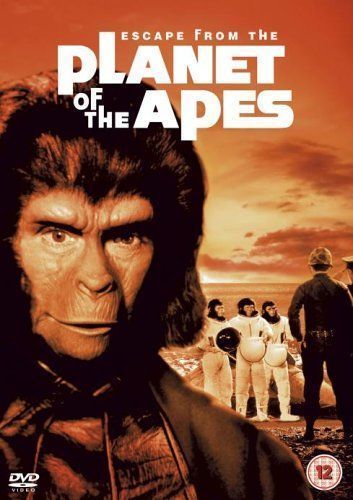
“Alter what you believe to be the course of the future by slaughtering two innocents, or rather three now that one of them is pregnant? Herod tried that and Christ survived.”

“Sir President, Herod lacked our facilities.”

So the conversation between Dr. Otto Hasslein and the President goes in the 1971 continuation of the saga, Escape from the Planet of the Apes. Few probably pondered the weighty theological significance of this dialogue; it is not represented on IMDB’s quotes page from the movie. In fact, many critics aver that the Planet of the Apes movies devolved as they went on becoming less and less original. Nevertheless, the number of serious issues thoughtfully addressed in Escape made it one of the most well received pieces in the series. The world was a scary place in the early 1970’s, as I experienced it. It was easy to believe that we were on the brink of our own destruction—there were enough nuclear warheads to assure mutual destruction, and even a little boy in Rouseville, Pennsylvania could believe that his small town was significant enough to be a target. That message I’d heard as early as the final scene of the original movie.

The Planet of the Apes series is profoundly theological. I rewatched Escape from the Planet of the Apes recently, and was struck by just how many social issues were addressed. Consumerism, abortion, racism, espionage, the arms race, and even eugenics. In each instance the humans are inferior to the apes who had not even developed the combustion engine before learning to fly a spacecraft back through time. The conservative fear of Dr. Otto Hasslein drives the plot; he is ambivalent about the apes and what they portend. It is the destruction of his own comfortable way of life. He suggests quietly killing the apes, succeeding where Herod failed. (Think through the implications!)

“Before I have them shot against the wall I want convincing that the writing on the wall is calculably true,” the President biblically insists.

“How many futures are there? Which future has God, if there is a god, chosen for man’s destiny? If I urge the destruction of these two apes, am I defying God’s will or obeying it? Am I his enemy or his instrument?” Otto Hasslein does not know. His science which tells him there is no God also worries him that he is the very enemy of the non-existent deity. No, the Planet of the Apes movies are not the most profound films ever to escape the camera, but there is, as in any good theology, the raising of questions. And like any theology worthy of latter-day Herods, there will always be far more questions than answers.


Prayers in Space

Science with heart. That’s one way to characterize Mary Roach’s writing. Uninhibited is another. I began reading her books when I saw Spook on the science shelf at Borders some years back. The nexus between what science teaches us and the magisterium of religion (ghosts certainly, by definition, fall into the “spiritual” category) has intrigued me all my life. I posted on both Spook and Stiff earlier in this blog. Her current work that my wife and I have just finished reading is Packing for Mars: The Curious Science of Life in the Void. The message that has rung loudly in my ears throughout the reading is that humans are evolved for this planet—space is not our native environment (well, at least not in a non-metaphysical sense). So many of the troubles she documents stem directly from the fact that we are biologically programmed to keep our feet pretty firmly on the ground. Weightlessness atrophies our bodies, cosmic radiation destroys our tissues, and there is always the difficulty of finding fast food in space.

One of the most telling points Ms. Roach makes, as is frequently the case, comes in a footnote. The note could, with some imagination, have been expanded into an entire chapter. “Religious observations are even tougher in a real spacecraft,” she begins. She points out specifically the difficulties of taking communion on a moon trip or praying five times a day aboard the International Space Station that renders a day a mere 90 minutes in length and staying Mecca-oriented is difficult when moving so far so fast. Religious leaders have to make special dispensations for those who take their religion beyond the bounds of earth-evolved faiths.

All of this raises a question that religions are reluctant to ask directly—what are we to make of petty observances that our belief systems demand when they are clearly based on outdated information? Judaism, Christianity, and Islam all developed in a flat world in a geocentric universe with a dome-like sky above them. The regulations were drawn up for just such a fictional world. When the religious become astronauts they leave that world behind them in a way that must stretch the credibility of a doctrine developed without the input of an astrophysicist. How does an astronaut hope to go to Heaven when some missions take her or him far beyond the realm of the gods into the cold reality of outer space? Looking down on Heaven must be disorienting indeed. If Mary Roach had an equal in the world of religion writing, I would hope that she would ask that very question. In any case, we are fortunate enough to have the one and only Mary Roach to raise the question for us and to keep us oriented toward our true home.


Bedrock

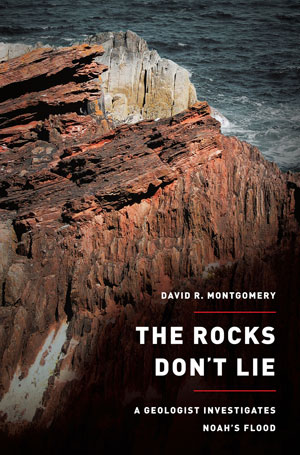
Sadly it is a rare occasion to read a truly stupendous book. There are lots of wonderful books in the libraries of the world, great and small. When I read a tome that brings two of my favorite subjects together in a genteel cotillion, subjects which are generally portrayed as aiming heavy weapons at each other from deeply sunk trenches, it deserves the epithet of stupendous. David R. Montgomery’s The Rocks Don’t Lie: A Geologist Investigates Noah’s Flood is one of those books. By page 8 I was thinking that Montgomery was someone with whom I’d feel comfortable raising a glass and sharing a story. He is a rare, serious scientist who considers that maybe religious stories have something to tell us about being human. The book, as the subtitle indicates, is about the Noah myth. Geology is the science that has taken the brunt of (the relatively new religion of) Creationism’s umbrage. Still, like a rational scientist, Montgomery doesn’t get mad or fly off into hyperbolic denunciations. He takes his rock hammer and taps until the flood myth crumbles.

Unlike many sober writers on the subject, Montgomery considers the possibility that folklore may in fact give clues to science. Those cultures that have flood stories, he patiently explains, probably has reasons to tell such myths. In this one book we are taken on guided tours of the Grand Canyon, bits of the Himalayas, “ancient” Mesopotamia, the scablands of eastern Washington, and even the Creation Museum in Petersburg, Kentucky. At each station, we learn a bit about floods and rocks and fantasies. Although not a biblical scholar, Montgomery obviously did his homework and gives a fresh view of how Christians went from non-literalists in the first centuries of the church, through the scientific revolution, only to become literalists in the geologically very recent twentieth century. Creationism has nothing to do with real floods and quite a lot to do with personal insecurities.

It must be easy for scientists to trumpet bravado throughout the infinite universe. The scientific method is our best testable explanation for the physical world. Montgomery resists that temptation, realizing that religion does count for something after all. Religion evolved for a reason. Maybe it isn’t scientific, but it helps people to make sense of their world. Instead of characterizing religion and science as combatants in a war, Montgomery likens the opposition to a dance where the partners sometimes step on each other’s toes. I read his book dreaming my geological dreams, lost in deep time, and thinking that the world is maybe even more wondrous than miracles could ever convey. And we have occasional floods, and floods sometimes give us reasons for going on. There’s perhaps something religious about that.


Lessons from Sandy

While many are still without power and school is cancelled for an unprecedented sixth day in a row, the eastern Mid-Atlantic states are still recovering from Hurricane Sandy. As I noted in my first post-storm blog post, one of the largest disorientations I experienced was being cut off from the internet. An article in Friday’s New Jersey Star-Ledger gives a name to this phenomenon: “nomophobia,” the fear of being left without access to an internet-connected device (specifically a mobile device, but in a pinch even a desktop will do). An article by Allan Hoffman suggests that two-thirds of the population suffers from nomophobia and that there are actual treatment programs available. A decade ago no such phobia existed and some of us were only just beginning to hear about the World Wide Web. This is a fear born of our own engineering—the virtual world of our making has come to haunt us.

No doubt life is somewhat easier with the internet. One word will suffice to illustrate it: phonebook. When is the last time I looked something up in a phonebook? While pulling open a drawer beneath the accumulated phonebooks on the phone stand, I noticed how thick with dust they were. Even the cordless phone with its answering machine appeared just a little bit medieval to my cyber eyes. If this is evolution, we may be in trouble. Technology was envisioned as the liberator from labor, but we’ve clearly become its slaves. Don’t worry about the food spoiling in the refrigerator, get me back onto Facebook—now! My smartphone has a flashlight, several email apps, and can soothe me with its music. It is my rod and staff.

On a short drive to run an errand this weekend, I went by one of the few stores with power in the area. Their electronic marquee read “cell phones charged here.” The greatest service that could be offered to a cold, hungry population living in the dark.

One of the hallmarks said to have ended the Dark Ages was the printing press. Literature, on paper, could now be spread (mostly in the form of the Bible) from person to person until all of Europe would have access to sacred knowledge. That knowledge (and a great deal of nonsense) is now worshipfully cupped in the palm of my hand. As Hoffman notes, even the librarians were telling patrons not where to find books, but where to locate outlets. Robots fight our wars remotely, and wireless networks link us in a web far more valuable than that of the silk moth. And we have realized that even the creator of an entire universe can be held in a child’s hand.

In the valley of the shadow of death, I will fear


Silent Fright

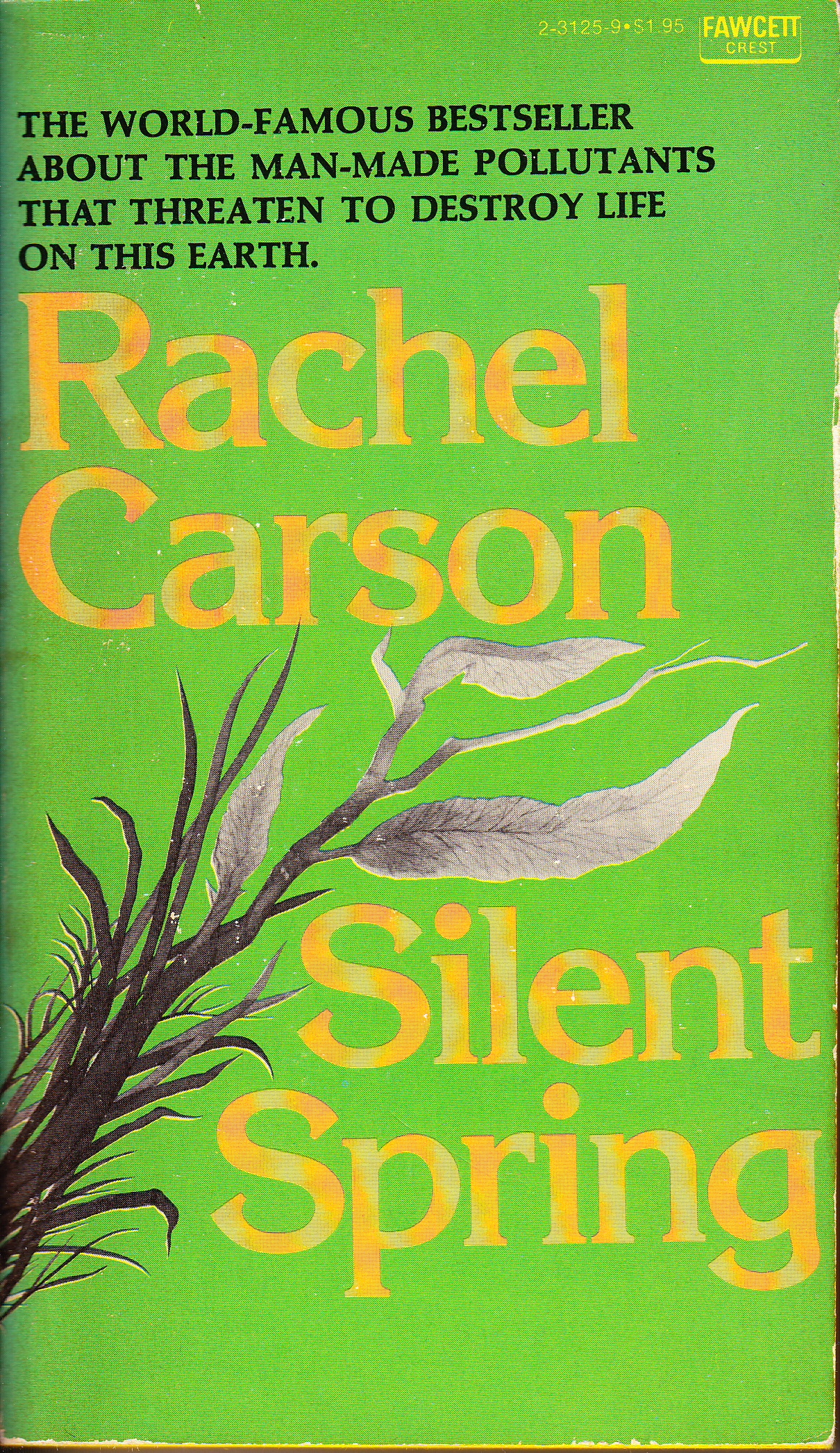
“[A] sight to be endured with one’s mind closed to thoughts of the sterile and hideous world we are letting our technicians make,” is how Rachel Carson described the indiscriminate use of herbicides fifty years ago. Silent Spring, although clearly dated, remains a chilling book for a number of reasons. One of the most obvious is that although the book is half-a-century old, the breakdown of some of our toxins released into the environment before it was written is still not complete. And perhaps more frightening still is the fact that we continue to stumble forward without giving enough thought to where our actions against our planet might lead. The quote above presses urgently at the heart of the matter: those with the destructive interests are almost always those who set the agenda. As Carson noted fifty years ago, the right of the nature lover to enjoy an unspoiled part of nature is just as valid as the right of the greedy to rape the landscape for “resources.” But we all know who eventually gets their way.

On a finite planet with finite resources, one of those that cannot be replaced is the beauty that nature has spent billions of years evolving us to appreciate. Desire for beauty reaches down to our most primal and basic levels. In the United States how many people drive hundreds or thousands of miles just to see Yellowstone every year? And yet, last time I was there I spied an empty can carelessly tossed into one of the stunning blue hot pools that require a delicate balance of nature to maintain. Those who appreciate the glory must always be those who pay the price. The fancy name for this is aesthetics, and some writers have suggested that the violation of beauty is a deeply disturbing problem on a philosophical or theological level. The basics are easily comprehended: we mar the planet at the cost of not only our own, but of every future generation.

Silent Spring warned those empowered to make laws that a dangerous road had already been selected. The radioactive fallout from bombs detonated to indicate national superiority continues to render some locations uninhabitable, and all of us carry traces of toxins that others have spread in our bodies. Humans, as Prometheus represents, have the ability of forethought. It is not always easy; in fact, it is often very hard. Somewhere back in a cave somewhere, long, long ago, even before our species emerged, future humans realized how. We teach. We teach our young of the dangers we’ve discovered, and instruct them to avoid them. As society evolved, money—the ultimate poison—crept into the environment and education became devalued. Even now, higher education—established for the joy of learning—has become economically driven job training. And people we’ve never met, and companies we’ve never heard of, pay off those who make laws, and another piece of our pristine environment disappears. Silent Spring remains in print, but how can we convince the disinterested to read it?


Fall Silent

Some books impact an individual profoundly. Others are powerful enough to influence an entire society. Rachel Carson was the author of both. Tributes to the fifty year landmark of the publication of Silent Spring have appeared this month, and although the players have changed, the plot remains the same. Bryan Walsh’s tribute in Time a few weeks back captures the essence of the situation: an environmental danger is discovered, “industry” will at first deny it, then attack the science, and then try to frighten the population with the inevitable escalation of costs. Sometimes common sense wins, but only after a long tantrum by those whose main desire is personal enrichment.

Silent Spring is credited with starting the ecological movement. Until the early 1960s the world seemed vast enough to absorb our filthy, toxic run-off. We were only on the cusp of understanding that the world is much smaller than we had ever imagined. Disney had not yet published the theme song that would get through to the American imagination. We had yet to stand on the moon and look back at just how tiny our troubles were in an infinite universe. Using pseudo-religious backing, industries often claim the planet was made for us. In truth, we evolved to adapt to this planet. The sad story after sad story of those who’d figured out how to line their pockets at the expense of the health, and often the lives, of others constitutes an ignoble hall of shame. Rachel Carson, who truly deserves the title of prophet, was considered the enemy of progress. Better living through chemicals—who hasn’t heard the phrase?

The science behind DDT, which nearly drove the bald eagle to extinction, is not the culprit. The radium that rotted the teeth, mouths, and jaws of young women employed to paint it on watch hands, had always been radioactive. The coal still burning under Centralia suffers from properties properly discovered by science. In case after case we find greed running away with the science. Science unlocks the secrets of our universe, but it also gives ideas to those who are always looking to make a buck. It may be that Rachel Carson knew she was slinging stones at giants when Silent Spring was published. This one biblical metaphor might come in useful for those who are able to see the larger picture. We’ve only got one planet and if we want it to survive we’ve got to make it last. Giants should come to fear the disadvantaged who know how to use slings, whether with rocks or words.


Where is it?

When I step outside to pick up the morning newspaper, I always look at the sky. I think this is a very early evolutionary trick. It may be because there was a time when primates were smaller and birds of prey larger, or it may be because some big cats like to drop on prey from trees. It may be simply that we don’t like to get wet, especially unexpectedly. For whatever reason, the sky is a source of endless fascination. Helen T. Gray, in a piece written for the Kansas City Star yesterday, ponders the place of Heaven in the space age. 80 percent of Americans report believing in Heaven, she points out, and she describes how Heaven has shifted from an improbably physical place to a transdimensional or neurologically embedded place. We, as a people, believe that there must be a better place than this. No matter where we locate it, Heaven is always a decided improvement on this place where too many people suffer too much and all of us suffer some of the time.

I once considered astronomy for a career. My high school, built in the fretful days of the Cold War, had an actual planetarium as the space race was burning over the red line. I took a high school class in astronomy and when I got to college I followed it up with an undergraduate course in the same. While I enjoyed learning about all the strangeness of space, it soon became clear that astronomy was simply another word for mathematics; the class involved intensive equations stressing a regularity that Metamucil would be proud to claim. And, of course, since we live on a sphere every direction is up. The belief in a better place is nothing if not resilient. It survived the knowledge that “up there” is either nowhere or everywhere, depending on your point of view. Most theologians after Galileo’s day finally admitted that. When I go for the paper, I still look to the sky, however.

In Hebrew the word translated “heaven” is the same word that is translated as “sky.” The Hebrew Bible knows no separate place called Heaven, but the latest parts do indicate a life restored after death. I wonder if Rick Nowels and Ellen Shipley might not have gotten it right when they wrote the song that would help solidify Belinda Carlisle’s solo career. Maybe Heaven is a place where love prevails. Not just the erotic love of pop music, but the love that sees not a Muslim, an African, a Hindu, or an Oriental, but human beings. That stranger experiences those same feelings, hopes, aspirations that all of us do. He or she should not be left shivering, hungry on the street corner begging for quarters to buy his or her next meal. If it’s clear outside I linger as I gaze at early morning stars and planets, feeling deep yearnings I can’t hope to express. No, Heaven may not be a Mormon planet where you get to become God after you die (ahem). Heaven is not a mansion in the clouds (I’m sure some satellite would’ve picked it up by now). Heaven is not where I get to go and you don’t. Heaven is here and now, but we all have to work for it.


Science Friction

What hath CERN to do with Jerusalem? It might seem that the House Committee on Science, Space and Technology would be a reasonable place to look for members of Congress with a grip on science. But then, I often live in a fantasy world where things make sense. It is with some sadness, but no real surprise, that I read about the words of Georgia Representative Paul Broun, lambasting evolution and the Big Bang as theories from the Devil. Broun is a medical doctor who, under conviction of his Fundamentalist faith, has rejected the basic tenets of science. According to the Associated Press, he told a Baptist church congregation, “All that stuff I was taught about evolution and embryology and Big Bang theory, all that is lies straight from the pit of hell. And it’s lies to try to keep me and all the folks who are taught that from understanding that they need a savior.” Sounds like Satan had a very busy pre-history.

Anyone who knows me knows that I begrudge no one their personal religious beliefs. Someone who does not believe in embryology, however, might have selected a career more commensurate with his religion than medicine. Election year does tend to bring out the shock value statements in politicians. Having to convince their constituencies that they are just simple folk, they deny what their faith belies every time they accept an inoculation. If evolution is a lie, so is vaccination—something most medical doctors would have to have understood before facing medical school examinations. In the United States, however, such wrong belief is a generally apt qualifier for Congress. Especially among the Tea Party. Broun hails from the ironically named Athens, Georgia.

Over the weekend I watched the Star Trek (original series—please, I’m a connoisseur) episode, “The Mark of Gideon.” It is one of the episodes I don’t recall from childhood, but then, with Kirk and all that “mushy stuff” of being alone on the Enterprise with a woman, well, maybe it just didn’t stick when I was in my tender years. In any case, the symbolically named Gideonites have overpopulated their planet to the point of disaster by good clean living. They attempt to hijack themselves a disease “inadvertently” to reintroduce population control. Captain Kirk asks why they don’t use safe methods of birth control, even volunteering the Enterprise to be a kind of inner-galactic condom-dispenser. The Gideonites explain that they believe all life is sacred, and that preventing life is a great crime—regardless of the misery it causes. I had to smile to myself. Sounds like the people of Gideon may have had been lectured by a Georgia medical doctor who had gone off on a peculiar flight of fancy.


Dracula’s Dinosaur

It must be October when a dinosaur with a parrot’s head, porcupine quills, and fangs is announced. Yesterday’s issue of Time online featured a drawing of the creature and a nifty animation of reconstructing the aptly named Heterodontosaurus. Well, that’s actually the genus name. The species goes by the delightful name Pegomastax africanus. Last I checked, however, space on the ark was filling up. Dinosaurs create a unique embarrassment to Creationists. One suspects that if they didn’t have kids they’d dismiss dinosaurs all together, but the troublesome fossils just won’t go away. What’s more, although they’ve been extinct for 65 million years, they keep producing new species for us to recover, describe, and name. When I was growing up (and I have it on good authority that the argument is still used) Creationists told us that no transitional forms had ever been found. Therefore evolution simply could not have occurred. This was generally followed up by a reference to Genesis. Excuse me, a fanged porcupine-parrot? If that doesn’t count as a transition, what does?

Religion loses nothing by admitting to an ancient earth. Nothing but literalness. One of the joys of reading is the exploration of metaphors, similes, and hyperboles—writing delights us with its constant surprises. Even those who claim to read a text literally are engaging in a form of interpretation even earlier than the first wedge mark pushed into clay. Written texts give us something to ponder, to think about, and occasionally, to obey. Just when it looks like the cover has slammed shut on the black book we find a new set of dinosaur tracks running across our clay tablet. The literal-minded might not see these as being a message from God, but surely the endless variety of creatures that have walked this planet more than make up for it.

We used to have a pet parrot. His name was Archie, named after Archaeopteryx, the feathered dinosaur. Although Archie was cut off by disease in the prime of life, he was a curious bird and when I reached into his cage to try to get him on my finger he would dole out what he meant as a painful bite. I always took it as a sign of affection. Had our little friend had the fangs of Pegomastax africanus, I would’ve thought long and hard before risking the finger-perching trick. I like to think it would have reaffirmed my fascination with the amazing adaptability of nature. Evolution, unlike God, has no purpose. An endless tinkerer, it gives us thousands of differing dinosaurs that had been gone many, many millennia before Moses ever even thought of Noah. Pegomastax is safely extinct now, and the only ones who have to worry about this perfect Halloween dinosaur are those who think that one particular view of one particular book is the only way to find truth.

We still miss you, Archie.


Bretz v. Noah

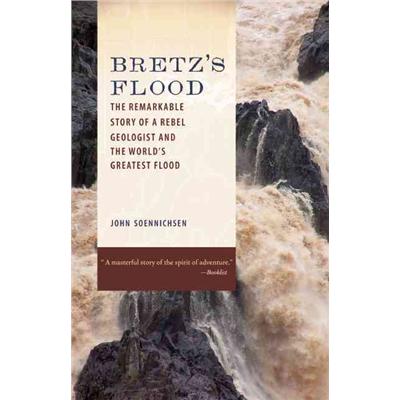
Until I met my wife I’d never been west of the Mississippi. Or even Ohio for that matter. Together we’ve traveled, in a fashion broken by years, from coast-to-coast and even overseas. Nothing in my life had prepared me for seeing the American West. No, I’ve not seen cowboys, but the landforms are so different from the weathered, ancient Appalachians among which I grew up. Eastern Washington is a fascinating landscape and with my occasional flirting with geology, I recently read John Soennichsen’s Bretz’s Flood: The Remarkable Story of a Rebel Geologist and the World’s Greatest Flood. Within the last couple of years I’d read about Glacial Lake Missoula, a juggernaut of an ice age lake that had flooded parts of Idaho and Washington thousands of years ago when its ice dam gave way. J Harlen Bretz was a turn-of-the-(previous)-century geologist who defied convention and insisted that the evidence of eastern Washington proved that a massive flood washed over the area, giving distinct shape to the region that empties into the Columbia River basin. For much of his career he was ridiculed by other geologists. The reason? The Bible.

Geology was the science that gave Darwin the idea for his evolutionary theory. The factor that had been missing from science, before geology, was time. The 6000-year-old earth just wasn’t old enough to account for the slow changes required for one species to morph into another. As scientists came to realize that billions of years were available, it became clear that change occurred even more slowly than the GOP is happy with. For geologists, anything that happened quickly was anathema. As Bretz’s Flood makes clear, a sudden flood sounded far too much like old Noah to be science. Catastrophism had been cleanly rejected by geologists because even if the evidence supported it, it looked like a return to mythology and superstition. Interestingly Bretz began his academic life among the Methodists of Albion College, and continued to quote the Bible to his last days. He was, however, an atheist.

The Bible has shaped our culture more thoroughly than Noah’s putative flood has shaped geology. I’ve read many geological studies over the years and any that are written for non-specialists never mention great floods without at least a nod to Noah. In fact, as Soennichsen points out, Bretz has ironically become a hero of Creationists who see the Missoula flood as Noah’s event. A large portion of Bretz’s career, however, was dogged by geologists duty-bound to deny a sudden flood just because the Bible tells us so. Sudden events are smeared with the residue of the divine.

J Harlen Bretz is hardly a household name, but his career is a microcosm of American culture. Glacial Lake Missoula did exist, as geologists now accept, and long before Noah was a twinkle in Moses’ eye. When the dam burst, the fable did fall, and down came the ark, Noah and all.


Assaulting Pepper

“I’m a Pepper, he’s a Pepper, she’s a Pepper, we’re a Pepper,” so goes a jingle that is still in my head decades after I last heard it. Early in my marriage I learned that Dr. Pepper was my wife’s favorite, and we sometimes purchased it by the case when we felt daring. I seldom drink soft drinks anymore, having converted to a more juice-oriented penchant with the increase of years and poundage. I always found it to be a pleasant flavor, however, and it was a frequent choice in those halcyon days when I could eat or drink without much regard for potential tonnage. My wife resurrected my interest in the cola with a link to Time’s NewsFeed announcing that some Creationists are boycotting the soda because of an ad that looks like evolution. The ad campaign shows the evolutionary progress chart we’ve all seen with the tipping back of a Dr. Pepper making the ape human. Creationists aren’t known for their sense of humor, but boycotting a drink because of implied heresy implies a fascinating study.

Boycotting companies that offend moral sensibilities is not an unreasonable response to ethical dilemmas. I haven’t shopped for some products for years because I don’t like what the company does. My choice, I’m sure, has little impact but it makes me feel better about myself. Sometimes the choice is religiously motivated—if I don’t want to support a particular group I won’t buy a product they offer. Secular companies, however, seldom offend theological sensitivities. I, for one, would seldom know the guilty party: the founder of the company? The current CEO? Someone in upper management? An advertising director? Do all employees have to agree with my religious outlook? Ahh, but then there is the political angle.

This is a presidential election year and the first one since 1980 without a Republican candidate who is a darling of the Religious Right. Not to suggest that Reagan or Bush the First were really as religiously orthodox as they were presented, but the perception of their friendliness to conservative Christian causes went unquestioned. With a “liberal” in the White House and the only viable alternative a mysterious Mormon, frustration must be building. On top of it all, Dr. Pepper is showing a funny image that might be interpreted as suggesting a simian forebear to those who drink the stuff! I think I understand the anxiety, and it might help if they just had a drink to calm down. After all, “wouldn’t you like to be a Pepper too?”

Dare to evolve


Believing is Seeing

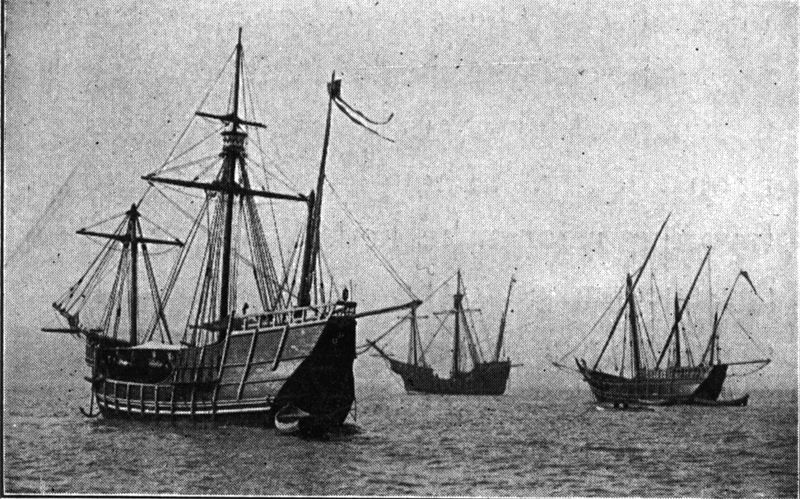
A story has long circulated that as Christopher Columbus approached the coast of the “New World,” Native Americans staring out at the water—straight at his ships—could not see them. This instance of perceptual blindness has been adequately explained, of all places, in the Fortean Times. The best explanation: the natives could see the ships but did not have the referential framework to know what they observed at first. The story still circulates, however, that to them the ships were invisible. An interesting analogue arose when I was reading about Thomas Edison recently. The phonograph was first developed for speaking voices, not music. It was not an immediate success. One of the observations that Edison made also applied to the telephone: when people first heard it, not knowing what it was, they could hear voices but couldn’t make out what they were saying. Once it was explained to them what was going on—a voice had been recorded and was being played back, or a person’s voice was being carried over a distance through a wire—they immediately comprehended what they heard. Not exactly perceptual blindness, but very human indeed.

When people encounter something completely unexpected, surprising, they don’t quite know what to make of it. So we see anthropological pictures showing natives replicating airplanes from grass and twigs, ascribing to these strange birds some kind of divinity. Imagine an iPad in the hands of Moses. Neuroscientists are rather new to the coterie of specialists trying to explain the origins of religion, but a gap remains between perception and science. Active areas of the brain can be traced, but what the experiencer feels remains utterly subjective. It is a realm into which science cannot go. Perception, it is supposed, is simply an evolutionary tool to find food while avoiding being eaten, oh, and also to reproduce. The experience of the perceiver is much more profound. Consciousness, a sense of selfhood, why some are poor while few grow rich, these are facets of life that add dimension to perception and make me wonder just how far down the rabbit hole it goes.

Religion is all about perception. The problem is not that no one tells us how to interpret our experiences, but rather too many interpreters are only too eager to step forward. Perception, it is said, is reality. When encountering the unknown our best road-guide is our senses. In the case of religious phenomena, that guide is supplemented by tradition. What do you see when you look out on that horizon? The answer will indicate what you believe.

I saw three ships?


Five Century Hypothesis

More than likely it is simply an oddity of history, but roughly every five hundred years a new major religion appears.  The newcomers sometimes grow into a serious concern for conservatives in the older traditions, but at other times they are simply ignored until the two (or more) come into inevitable contact.  Peering far back into history, the roots of the earliest religions of lasting durability are sometimes lost.  For a very rough starting point, we can consider Hinduism.  With roots going back to about 1500 BCE in the “Pre-Classical” era of the religion, Hinduism developed independently of the monotheistic traditions that would appear in the western half of Asia.  Although some would credit Judaism with equal (or even greater) antiquity, we get an idea that some of the basic thought that would coalesce into Judaism seems to have, very roughly, begun around 1000 BCE.  About five centuries later, Buddhism appeared.  At the turn of the era, Christianity had emerged from Judaism.  About five centuries later, Islam appeared.  Countless other religions, of course, existed concurrently with these early exemplars, but each of these has grown into a major world religion. 

Around about 1000 of the Common Era, Christianity began to fragment.  The first major, official split was between Orthodoxy and Catholicism. Christianity’s penchant for fragmentation would eventually lead to Protestantism—a religious form quite distinct in many ways from traditional Christianity—and that happened roughly five centuries later.  The most obvious split took place around 1500 with the Reformation, but it was also around that time that Sikhism appeared.  The new religions of the common era often involve irreconcilable differences within an established religion. In the western world we tend to overlook Sikhism, but in sheer numbers it is one of the largest religious traditions. And of course, there are many, many others.

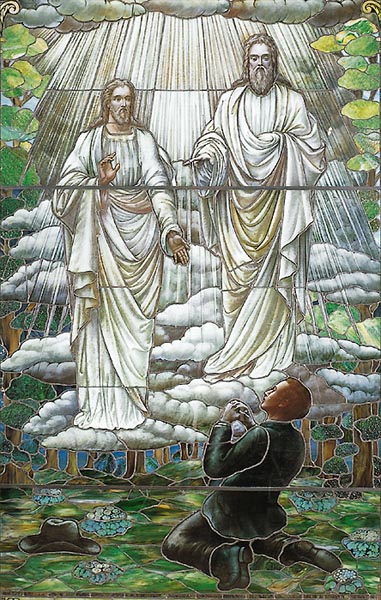
As with any over-simplified scheme that tries to make sense of history, I am certain that no historian will be convinced. To me it seems obvious. Once every five centuries or so, some new religion will be born and will flourish. Perhaps it is already among us. We are about due. Like the evolution of new species, some new religions are poorly adapted to survival: one thinks of Branch Davidians or Heaven’s Gate, or Jonestown. Others, however, quietly thrive until someone looks around and says, “Where did Mormonism come from anyway?” Some will argue that it is just another sect of Christianity. Those who study its theology will realize that its conceptual world is vastly different. But anyone with a long enough calendar can see that it began about five centuries after Sikhism and the Protestant Reformation occurred. And anyone with two cents can sense its enormous bankroll—no surer sign of a religion’s viability can be offered.


The Skinny on Kansas

Perhaps it was just a slow news day, but Monday the Associated Press ran a story about a year-old skinny-dipping episode involving Kevin Yoder, US Representative from Kansas, and, by extension, Jesus.  Given that I’ve just posted on the skinny-dipping priest in A Room with a View, this seemed an apt place to consider what is being shown to the public. First of all, Yoder did not go au naturel in the swimming hole behind his house. The incident took place last August in the Sea of Galilee, the very body of water Jesus putatively walked upon.  Here’s the rub: with or without a boat, because of the association of Jesus of Nazareth with the Sea of Galilee, many people consider it a holy site. Even an Israeli police spokesman seemed a little put off by the mental image that, even if a year old, is a bit disturbing.  (The thought of any politician undressed is a bit jarring to the puritan imagination of the United States, and, one imagines, in many cases it is a reasonable phobia.) Yoder was reportedly in Israel for a trip funded by the American Israel Education Foundation. They were traveling to discuss international relationships, apparently.

As much fun as it is to catch a big player with his (less often her) pants down, I do wonder at the fuss. During my time in Israel—granted, many years ago and fully clothed except when in the shower—I noticed that American standards were not completely in force. A stroll down the beach in Natanya would easily prove my point. We like to hold our public officials to a higher standard that the average citizen, and given what they take from the system, rightfully so. Nevertheless, I wonder what harm is really done by a bit of juvenile fun. Obviously I wasn’t there, and I don’t have the context with which to judge such behavior accurately.  The Israeli police representative stated that public nudity is forbidden at the Sea of Galilee, so I suppose the legality of the act was an issue. American sexual mores, in addition to having been tempered by Victorian attitudes, are largely based on religious prejudices. The Bible is not shy on nudity, however, and people in the early Christian centuries participated in that world.  According to the Gospels, Saint Peter went fishing naked on that very same lake.  Progress obviously involves putting a cover on it.

Ironically, in trying to explain himself, Yoder said that the jump in the lake was spontaneous, a moment of joie de vivre, “just to have the experience.” He conceded that the Sea of Galilee is a special place.  And, he avers, drunk diving was not involved in the incident. No matter your level of tolerance, the emerging picture is an odd one. A group of government officials, one of them naked, standing around the Sea of Galilee at night.  A 30-something from Kansas jumps in for 10 seconds and it seems as if a storm arose over the feted Sea of Galilee just like New Testament times. One wonders how well our government represents the puritanical interests of their constituency.  Kansas, as we all know, is immune from evolution and provides a home for Fred Phelps and company. And it’s also a land-locked state. If you want to run around naked, and you’re a public official, it looks like you—like Dorothy—have to get out of Kansas.  Even then you might find yourself rocking the boat. Let’s just hope that if Peter’s inside he has the sense to pull on at least the girdle of righteousness before company comes.