Supernaturally Selected

Things are seldom as simple as they seem. Religion, for example, is frequently cast as the villain or the hero of human society, when, in truth, like most human institutions, it is a little of each. I’ve read many theories on the origin of religion, and none has been completely convincing but most contain persuasive aspects while I’m reading them. After having read several books proclaiming the end of religion in the last several months, I just finished Matt J. Rossano’s Supernatural Selection: How Religion Evolved. Many books with a similar goal begin with the suggestion that religion may have had some biological utility for people at one time, but that we’ve outgrown our need for it and we should classify it with other obsolete, arcane concepts that have no further purpose. Rossano suggest that religion grew out of the need for social bonding and that we could not have become human without it.

Basing his ideas on genetics and anthropology, Rossano notes that even with our genetic similarity to chimpanzees there remain striking differences. Mostly they are social in nature. Many of the differences are reflected dimly in our primate cousins, but the human penchant for gathering in groups with ritual behavior to offset overwrought emotions applies only to us. That ritual behavior includes healing rites, something that Rossano suggests might be the earliest, shamanistic, religion. Back in my teaching days I’d been telling students that the earliest evidence for religious behavior dated to the paleolithic period. This is something I’d reasoned from the artifacts found in pre-historic communities. I was happy to find confirmation in a more competent scholar than myself.

While I’ll no doubt revisit some of the fascinating hypotheses of Supernatural Selection over the coming days, one point especially stood out on my initial reading. Religion is a communal phenomenon in what is a largely individualistic society. In other words, religion itself continues to evolve. Even the hermit in his or her cave is only considered religious in comparison with his or her less dedicated, secular compatriots living la vida de fe. Since religion is communal, Rossano suggests, it is impossible to argue someone out of their religion—based on perceived relationships as they are. Indeed, it seems that his hypothesis predicts a behavior we find only too evident when we prepare to line up at the polling booths, but which will immediately fall into the background again once the level is pulled.


Father Abraham’s Faith

Okay, so this is the scene: Abraham is old and he has just one son to whom a promise has been made (this is the biblical version, by the way). God had promised him that he’d have as many descendants as the stars in the sky, so it seem that Isaac has a long way to go. And the boy’s not married yet. Abraham calls in his trusted servant and gives lengthy, detailed instructions on how to go back to ancestral Iraq and find a wife for Isaac. Just to make sure the servant understands just how serious this is, Abraham says, “Put, I pray thee, thy hand under my thigh,” (I can’t help thinking he added a big wink) and instructs him to swear to obey the instructions precisely. Readers of the Bible since at least the Middle Ages have recognized that “thigh” here really means genitals. The more we’ve learned of the ancient world the more we’ve discovered that men touching each other’s privates was a sign of a most serious oath—it’s a touch that can’t be taken back, and any promises made in this way must be kept.

I’ve been reading about monkeys. More precisely, about evolution. When reading about how baboons show intent to form an alliance, I was surprised to learn that males utilize scrotum-grasping. Since all’s fair in love and war, when baboons fight ripping off another guy’s jewels is considered perfectly acceptable. That means that allowing another male to fondle your testicles is a sign of ultimate trust. Baboons, it seems, have been doing it long since before Abraham showed up on the scene. I wonder if this then is a case of convergent evolution of whether Abraham’s oath goes back to nature in its most basic form. Once castrated, especially in antiquity, a man had no choice about going back. To invite another man to put his hands “down there” was a serious matter indeed.

The only requirement really given to Abraham by God was circumcision. Again, from what we know of ancient times this was not unique to Israel, but the theological freight associated with it was. For a man who’s been promised as many descendants as the sand on the sea shore, allowing another man to cut away part of your reproductive organs is a sign of ultimate trust. This is a behavior that seems not to go back to nature, however. Not even chimpanzees have quite figured out how to make knives or use them to carve up sensitive areas. This has none of the marking of evolution. An act like that seems to have come directly from the gods. Abraham, in a way most modern believers would find incomprehensible, was the paragon of faith.

Contemplating the ineffable


Coexistence

Sometimes I think I’m a punching bag. Not uncommon among scholars of religion, I suppose. I have read my fair share of overt attacks on religion: Hitchens, Dawkins, and even Jillette, and sometimes limp out of the ring wondering why I even bother. Still, science doesn’t completely explain the universe I inhabit either. Thus is was with some glimmer of hope that I read a story in Monday’s Chronicle of Higher Education entitled “Does Religion Really Poison Everything?” There can be no doubt that religious behavior has a track record of some execrable atrocities—some very bad behavior has been engendered by fervent religious belief. At the same time, those who despise religion have a hard time explaining it. As the Chronicle piece points out, religion is likely an evolved trait. There is some survival value in it, otherwise it would, by natural selection, disappear. Religion is seldom a rational enterprise. That doesn’t mean that it can’t be rationally studied, but rather that religion is primarily experienced as an emotional phenomenon. We find ourselves motivated by feelings, although reason will often drive us to do things we don’t feel like (like going to work). And emotion is necessary to be truly human.

It is often difficult to respond to those who castigate religion as an evil or poison, not for lack of reason, but because of feelings. Having spent most of my life with religion, it is not surprising that attacks on it often leave me feeling ashamed. But ah, that is an emotional response! It seems rational on the surface, but really, shame and embarrassment are typical emotional responses. This is the realm of religion. Reason may indeed indicate with great accuracy the way the universe works—of this I have no doubts. At the same time, I’m not sure the entire universe is something that humans can adequately comprehend. I have a hard time remembering what’s on a short shopping list if I accidentally leave it at home. Our brains aren’t equipped to the task of comprehending universes. Feel overwhelmed when facing a physics test? That overwhelmed feeling is an emotional response. With considerable cheek, might I suggest it might even be a little bit religious?

The Chronicle is a high-profile source for academic rectitude. I am pleased to see Tom Bartlett pointing out that the line-drawing in the sand between religious Fundamentalists and pro-science New Atheists will not solve anything. Religion is often guilty as charged. It is not, however, pure evil. There is enough evidence out there to suggest that religion is a tremendous coping mechanism for billions of people. And coping is not a bad thing, all things considered. Wisdom that is often attributed to the Greeks suggests that “all things in moderation”—the golden mean as it’s known—is the way to human happiness and success. The idea is older than the Greeks, and indeed, can even be found in the Bible for those who are willing to look. One need not be religious to see that, like most human inventions, religion has both good and evil uses. Evolution gave us religion, and it gave us science. It also gave us brains divided down the middle and strong reasoning that must dance with creative emotion in a tango that frequently makes abrupt shifts of direction. Our job, as humans, is to learn the steps to the dance.

Different, but equal.


Digging Deeper

A propos of apes, I’m not sure whence derives the draw of Planet of the Apes on me. I watched the movie with fascination as a child—since the obviously satanic delusion of evolution was impossible this had to be pure fantasy (and perhaps just a little dangerous). The movies just kept on coming, Beneath the Planet of the Apes, Escape from the Planet of the Apes, and Battle for the Planet of the Apes, each with their new twist on the theme that we are the beasts. Recently I watched the second installment, Beneath the Planet of the Apes. It had been years since I’d seen it, although I remembered the terrible mutants and their possession of an atomic bomb. Although the geography is badly distorted, it is made amply clear that the church where the bomb is stored is St. Patrick’s Cathedral on (beneath?) Fifth Avenue. As Brent makes his way into the partially intact cathedral he finds a priest praying to a missile with the letters alpha and omega inscribed on one of its fins.

Since last seeing the movie I spent a lengthy stint among the Episcopalians. Naturally I became thoroughly acquainted with the liturgy and therefore could appreciate subtleties in the movie I had missed before (nothing is ultimately wasted, it seems). As the mutants prepare to set off the doomsday bomb that will obliterate the entire planet—both apes and humans—they recite many prayers from the mass, substituting the word “bomb” for “God” and “Holy Fallout” for “Holy Spirit.” Okay, so maybe “subtleties” was the wrong word. Of course, back in the early 1970’s this was a very real concern, the arms race was well underway. Despite the overacting and forced script, the movie did offer considerable social commentary. Ironic and iconic Charlton Heston condemns the unadulterated praise of such a lethal weapon (or was it just missile envy?), even as he falls, shot, onto the controls, accidentally destroying the earth.

The fascinating aspect of this social critique is that the players may have changed, but the drama remains the same. Those who protest evolution praise the build-up of native strength so that the true Christians might obliterate their enemies first and better than they will obliterate us. One gets the feeling that destruction is not so bad a fate as being proven wrong. Somewhere along the millennia religion slipped its mooring from being an ethical way of life to become an extreme way of believing. And yet people are still the same. And the Planet of the Apes movies continue to appear, ever evolving. When it comes down to the final scene, however, it is not the evolved apes who destroy us. No, it is the utterly self-righteous humans who decide that if they can’t have it all, nobody will have any of it. In the name of the bomb, and the holy fallout, amen.


The Times they are a’Chanin

Across from Grand Central Terminal in Midtown Manhattan rises the Chanin Building. Named for Irving S. Chanin, the tower is no longer easily picked out among Manhattan’s dizzying skyline, but the building is a monument to the humanistic spirit that was beginning to flower in the 1920s between the harsh realities of the world wars. Outside the building, above the ground floor shops, runs a bronze frieze that still catches the breath of visitors who stop to stare for a moment or two. Interestingly, the frieze is a monument to evolution, showing the development of “lower” life forms among the water flourishing into birds and fish. Although prosperity gospelers would object to its inherent Darwinian message, they would appreciate a huge monument to the triumph of capitalism in Chanin’s dream, as much of Manhattan reflects.

Antipodes are a fact of geography and human understanding. It would seem that they are also a paradigm for those who “want it all.” Perhaps it is ironic in coming from a Disney movie, but I’ve always found Mary Poppins’ maxim apt: “enough is as good as a feast.” Indeed, leaving the table after eating more than I need I feel miserable and disgusted. There is only so much that people can have, and this is a matter of physics as well as biology. If God wanted us to be wealthy, why didn’t he make us that way? (Surely the God who promotes personal wealth must be male.) Evolution and capitalism could be a dangerous mix should we forget that evolution is not goal-oriented. Natural selection works by trial-and-error, only the trial isn’t planned or intelligent.

This dialectic reminds me of that old chestnut, Beneath the Planet of the Apes. Ursus, the gorilla warlord, gives a jingoistic speech concerning the Forbidden Zone. “It is therefore our holy duty to put our feet upon it, to enter it, to put the marks of our guns and our wheels and our flags upon it.” Of course, this second, lesser installment of the Planet of the Apes movies raises the entire specter of nuclear war to a disturbingly sacred level, but that’s a topic for another post. What I notice is the full circle of evolution here—not just human to ape, but human to capitalist ape. Apes that wish to own and control their entire world, including that region where, in the original movie, both ape and human fear to go. It should not surprise me to see talking apes in Manhattan, but then again, it might just be the bright sun reflecting off the bronze of Irving Chanin’s monument to economic growth.


Scotland’s Cryptic Evangelist

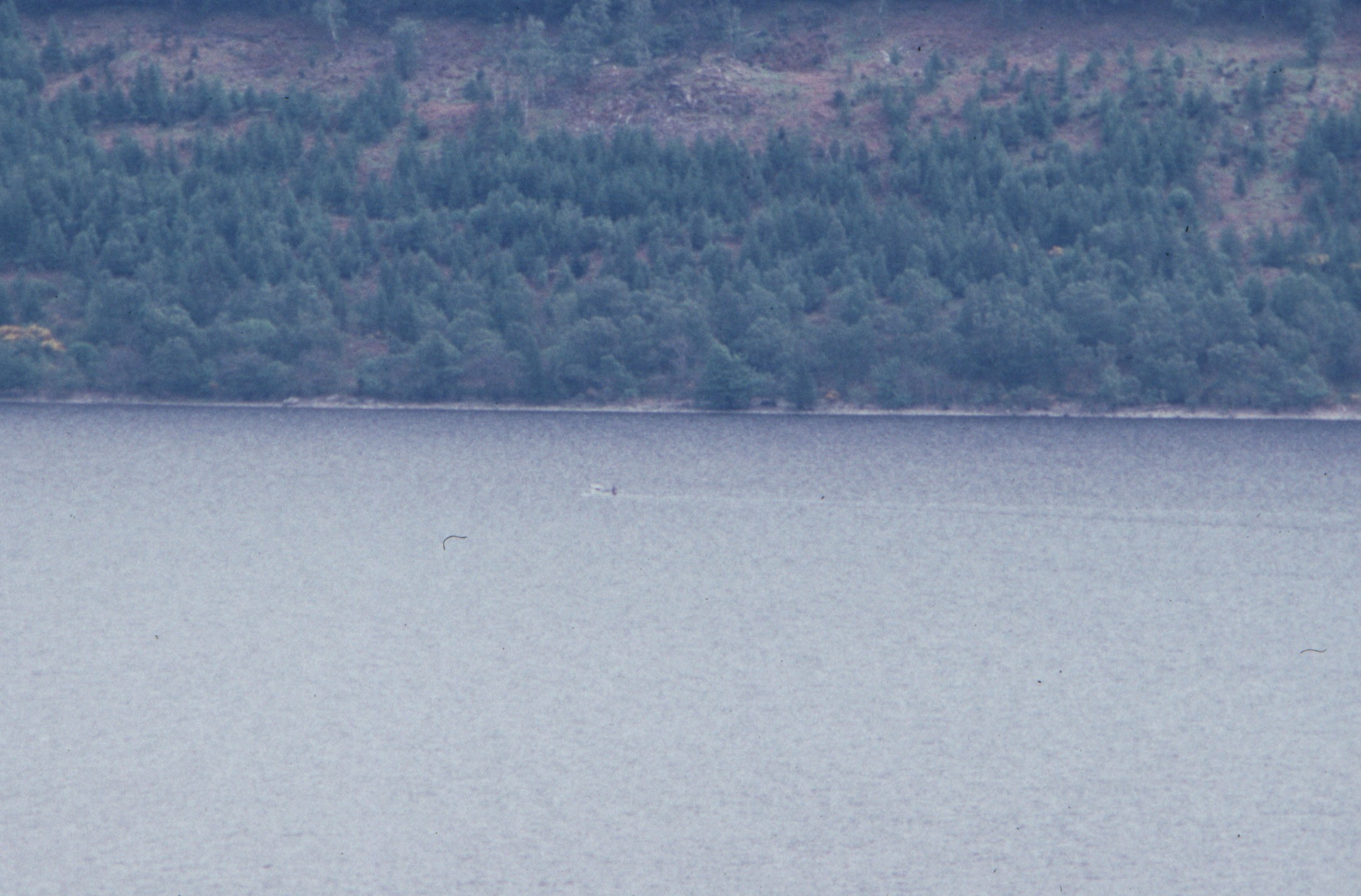
Many years ago it was now, on a Victoria Day bank holiday weekend, my wife and I were on a camping trip with friends in the Scottish highlands. Pitching our tents on the banks of Loch Ness, we joked about the potential danger—after all, Nessie had reputedly attached St. Columba, therefore even the pious had no refuge. Early the next morning, our party still intact, we drove to Urquhart Castle, arriving before it opened. Out on the loch we saw something moving through the water, leaving a wake. It was breaking the surface but was too small to be a boat and it was not a bird. It moved at constant speed until it was out of sight. This was in the days of actual film, and slide processing was “dear” as the Scots say, but I snapped off a photo anyway. The slide is too indistinct to make a diagnosis, but our friends, who had a better camera, came to the conclusion that it was a small boat. After looking at their enlargement, I still have my doubts. I’ve always sat on the fence for the Loch Ness monster. Certainly it seems improbable, but we have only a cursory knowledge of sea creatures and Loch Ness is deep and long and isolated. Is there a Loch Ness monster? Maybe yes and maybe no.

Of course, Nessie has been in the news, as my wife pointed out, backed by the considerable creativity of the creationist camp. Seizing a living dinosaur as the death knell of evolution, Fundamentalist schools in several states are using textbooks that argue Nessie’s existence proves that dinosaurs didn’t evolve and that they still walk (or at least swim) among us. An excellent corrective to this “either evolution or special creation” is Victor Stenger’s book God: The Failed Hypothesis, that I reported on a few weeks back. With apologies to the late Stephen Jay Gould, this tactic puts an entirely new spin on the concept of the hopeful monster theory.

Religion and monsters are thoroughly intermeshed. Often this intermingling comes as the result of revulsion against the unclean or impure aspects of life that monstrosity represents. Numerous analysts have shown that monsters tend to be unholy mixes of elements that religions prefer to keep widely separated—animals that would never have made it onto the ark, yet somehow have arisen since the deluge. Human fear at contamination has an excellent basis in evolution; those who never developed the sense to stay away from the sources of contamination grew sick and died off. Monsters, in this sense, serve as useful reminders for avoiding the “strange fire” that so displeases the Lord. Reading how good Christians are now reaching out the right hand of fellowship to their monstrous brethren, I wonder if a long-held belief is being imperiled. Those who would swim with monsters must be very cautious indeed, for above all things, monsters are notoriously unpredictable.


Ancient Wisdom

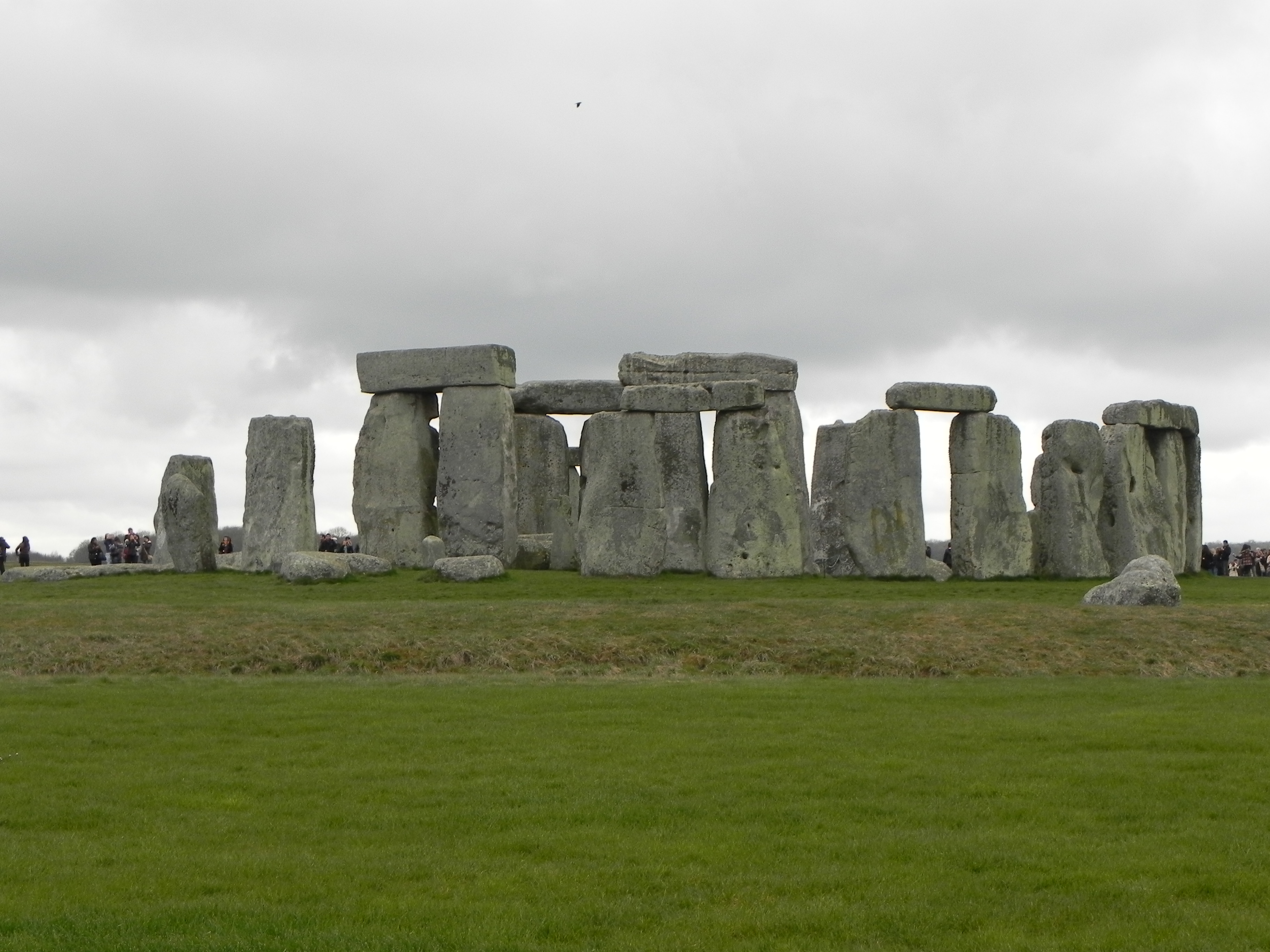
The Huffington Post recently ran a story on Stonehenge. Part of the endless fascination with the ancient monument is that no one really knows why it was constructed. Given the tremendous amount of effort the building represents, it is clear that this was important to the cultures constructing it. The article in Huffington cites archaeologist Mike Parker Pearson as suggesting that Stonehenge was a monument to the unification of Britain. While not as sexy as explanations that draw on human sacrifice, precision astronomy, or alien visitation, something rings true about it. In the long course of human development, we’ve had to overcome many, many hardships. At one time humans were relatively easy prey animals for large predators. Our evolution didn’t endow us much in the way of body armor or built-in weaponry. Our eyesight and other senses pale next to various other animals. Even with all these deficiencies, our biggest challenge hasn’t been nature, but other people.

Archaeologists have also been discovering that a peaceful prehistory to humanity does not match the facts. Warfare and strife have been as much a staple of human behavior as the perennial hunt for food and safe shelter. Civilization involved cooperation at unprecedented levels. People had to trust one another and work to maintain the infrastructure that allowed diversification of talents and abilities. Fighting and wars still occurred, of course, but less frequently and with less brutality. With economies of surplus, however, capitalism also eventually evolved. It is an aggressive organism. It is visible in the greed embodied in the thought process that the only good in life is financial and the only worth of humans can be calculated in dollars and cents. It is this thinking that has erected the monuments more familiar to us today in our cities and centers of civilization.

Stonehenge could never have been a money-making venture (not until the development of capitalism at least). It is in the middle of nowhere, in a sense. The Salisbury Plain is fairly empty—no large cities nearby, no grand scenery as one might find in Cornwall or the Grampians. According to the theory, its location has to do with it being in a very rough middle between various regional cultures. Building impressive monuments is very difficult to do if one has to watch constantly over one’s shoulder. I suppose in my Romantic notions Stonehenge will always represent a mysterious past suffused with unanswered questions. For the present, however, Pearson’s explanation seems more than likely—it sounds absolutely vital in a world so dangerously divided as ours. Perhaps it is time to start a truly monumental building enterprise involving every nation. It will give future generations something to wonder about.

Time to build another henge.


Lies, Damn Lies, and Statistics

“The fear of the Lord is the beginning of wisdom,” so the books of Psalms and Proverbs agree. It must be true. Religion and fear walk happily along hand-in-hand. Some have suggested that religion began as a human response to fear. So this week I felt a little conflicted as I read Daniel Gardner’s The Science of Fear: How the Culture of Fear Manipulates Your Brain. The book had been recommended to me by one of my brothers. As a child fear defined me—it seemed that in a world where God was meant to be feared (for I was a literalist) that fear was the basic operating system for life itself. Gardner’s book is a fascinating exposé of the culture of fear. Gardner doesn’t really suggest that fear should be eliminated, but he does show how many of those in power manipulate fear into a faulty perception of risk management, for their own advantage. Beginning with 9/11 he demonstrates how the irrational responses of people to the tragedy led to even more deaths that quickly became buried in the white noise of everyday society. Comparing Bush’s response to FDR’s “the only thing we have to fear is fear itself,” Gardner demonstrates that the United States emerged from the depression and Second World War weary but confident and strong. After Bush’s two terms, the country is cowering and weaker. Why? The Bush administration heavily mongered fear.

Funnily enough, the release from fear comes from two main sources: statistics and psychology. Statistics reveal the true odds of common fears—these can be inflated so as to create an atmosphere of threat. People, as herd animals, will gladly give more power to the alpha male when serious treat is perceived (don’t kid yourself, politicians have long known this). Psychology enters the scenario because people think with both reason and emotion. Our immediate, visceral response (the “gut reaction”) is instantaneous and powerful, developed from millennia of evolution. It is, however, irrational. Reasoned responses, often better for us, take longer and people do not like to force themselves to think hard. We have a whole educational system to prove that. Faced with hard thinking or quick solving, which do you prefer? Be honest now!

Ultimately The Science of Fear is an optimistic book. Being made aware of the problem is half the struggle. Garden-variety fear is fine. Systemic fear paralyzes. Religion is often defined as one of the building blocks of culture. Instead of offering release from fear, religions frequently add their own ingredients for recipes of even greater fear. The concept of Hell is a great example: think of the worse thing you possibly can. Multiply it by several orders of magnitude. Repeat. And repeat. You’re still not even close to how bad Hell is. There’s your motivation right there. Place that religion in the midst of a society rich with natural resources and led by schemers who know that xenophobia increases power, and voila! Paradise on earth for some, a life of fear for the rest. Manipulation characterizes both the evolution of religions and societies. Gardner doesn’t directly address the religious side, but that’s the beauty of reason: he doesn’t have to. The cycle can be broken; think of Mark Twain’s words I’ve selected as a title. Think hard.


Sleeping with Darwin

Although I’m hardly capitalism’s biggest fan, it would be difficult to overestimate how much the closing of Borders last year has affected my life. It is formidable to explain, as I sometimes must, to friends who don’t find books as irresistible as I do, how the simple pleasures of knowing a friendly bookstore was in town could make the world seem a little less cruel. There were towns that I instantly identified with the Borders located within their borders. Towns I rarely visit any more. All of this is by way of preface to explain the book I just finished. As the last desultory books lugubriously lined the shelves, my wife and I went through picking up titles we supposed we might have not found any other way. One of those titles was the little travelogue Darwin Slept Here by Eric Simons.

My admiration for Charles Darwin began when I realized that the Creationist venom I’d been bloated with from early days had been misguided. There was a fascination with this “evil” of evolution I’d been taught to shun. As I began to read more objective accounts, I realized Darwin possessed a keen, if tortured, mind that could not rest with half-truths and theological figure-fudging. In his account of following Darwin’s tracks in South America, Simons’ narrative not so much takes evolution any further, but presents a portrait of a world that has continued to evolve. In lives filled with uber-capitalism, where would a young person find five years to sail off on a voyage of discovery? Where would the health insurance come from? The 401K? The dental? As a species, humanity has been utterly domesticated.

Once in a while I dream of the Galapagos. I think of Easter Island and smile. So many places I will never be able to go. I spent three years specializing in Ugaritic studies and I will never make it to Syria—not on an editor’s salary. Not as an American. The world that we’ve constructed opens travel to the young who rarely have the resources to enjoy it. After seminary I spent six weeks in Israel. Young and healthy and heavily in debt, I at least glimpsed the sun setting over Jerusalem before getting hog-tied into the economy. Simons’ little book will not make him a millionaire, but as I read his reflections of rainforests, youth hostels, and rental cars on the Pampas, I thought where our world would be now had Darwin not been of a family of means. So much of our health care is based on understanding evolution. We would not be chained to our desks by threats of a slow, painful, and perfectly legal death without health insurance. We would be subject to biblical literalists who rejected the tenets of science— Come to think of it, perhaps we’d all better make tracks while we still can.


After Before the Dawn

Apropos of reading Nicholas Wade’s Before the Dawn, as a sometime scholar of religion a number of points struck me. According to both material artifacts and DNA, several changes took place among human beings some 50,000 years ago. Having just read P. W. Singer’s Wired for War as well, the early coalescence of war and religion in human history was unavoidable. Wade ties the emergence of both with the development of language. It is only when we can speak that we can begin to express our theological speculations and, as history continues to teach us, despise those who disagree with us. It becomes clear quite early in the tome that Wade has an interest in explaining religion. Like many science writers he struggles with the issue of why religion persists, despite the explanatory value of science. We know how multiple aspects of our world work, yet we still defer to a divine that no one has ever seen or registered in any empirically verifiable way.

Not only does this tendency stretch back to our distant, distant relatives. The Natufians, about whom I generally lectured my students (itself ancient history), are marked as well by the dual achievements of religion and war. Wade is one of the few scholars I’ve discovered who concurs with my assessment that religion was among the earliest of human behaviors. In my mind, it is tied to consciousness and its evolution. Once we begin to realize that we are not in control of our destiny, we start to seek explanations from above, and hope that God loves us. Otherwise the picture isn’t so pretty. Indeed, Wade suggests that religion evolved as a socially cohesive force. Tying the concept to ethics and trust, he suggests early people had to learn to get along with strangers and religion cemented that bond.

I’m not a scientist, so I cannot assess whether this explains religion or not. It does seem clear, however, that if Wade is right religion itself has evolved into a more aggressive beast. Sure, religions still serve to bind people together—but only so far. As populations separated, their various religions evolved and led them to distrust one another. Instead of bonding humans together, religion began to put them into competition for the truth. Here, Wade’s analysis is sadly true—religion and war evolve together. Our small planet is yet too big for everyone to get along, to know and trust the stranger. Religion had helped us at the critical stage when we needed social bonding, and now it has naturally evolved into the opposite—a socially divisive force of orthodoxy and heresy. If Wade is correct, we all need religion to take on its most ancient role and bring people together instead of giving us excuses for war.

Waiting for the dawn


Convergent Evolution

Back when my opinion mattered—in higher education, you must realize, a scholar’s outlook only matters when s/he has a teaching post, no matter how abysmal the school. Once that post is gone you just become another guy with an opinion—I was invited to a conference. This is quite an honor for someone consigned to the bargain basement of academia, and for my paper I read from a burgeoning book that died a sudden death along with my academic career. In that stillborn tome I argued that many aspects of ancient mythology—including some in the Bible—made better sense in the light of science. I suggested that some of the infelicities in ancient texts might be the signs of continuing evolution of the human brain. Ancient people were able to believe what we find troubling. By the end of the conference many respectable scholars were looking askance at me when I stepped into the room. Honestly. I heard the word “Wiggins” uttered as if it were an archaic curse. Shortly after that I found myself working out of some guy’s basement for a salary fit for a knave.

Imagine my delight, then, at finding a reputable scholar who argued that the human brain indeed continues to evolve. In fact, it has speeded up the pace as new challenges have emerged. Before the Dawn: Recovering the Lost History of Our Ancestors by Nicholas Wade was recommended to me by my brother-in-law. As I was updating myself this week on how we became human, I was surprised to see Wade suggesting what I had suggested in my paper—the patterns of human behavior (we both have an interest in religion, it seems) are tied to the evolutionary state of our brains. Sitting on a bus next to many other drones commuting like ants to New York City, I felt strangely vindicated. I had an idea scorned by my colleagues that is being suggested by science. Not that everyone will accept Wade’s conclusions. Many scholars of ancient religions will never even read them. When I explained my thesis to a colleague after losing my academic status, he said, “I don’t give much credibility to science.”

Convergence is the phenomenon of two species evolving an adaptation independently. Often it is difficult for people to believe that a trait shared by two populations is simply nature’s way of trial and error that happened to work twice, in different situations. Nicholas Wade and I experienced convergence on this point. He, of course, is a famous writer and I am nobody. Nevertheless, my unpublished idea was presented at a conference the year his book must have been in production. We had both been reading about evolution and wondering what its effect on religion might have been. I will comment more on Wade’s specific ideas about religion in the book in another post. He, of course, went on to write The Faith Instinct, which was widely acclaimed. At that time I was struggling to find work and it seemed that natural selection hadn’t selected me at all. I am glad, however, that my idea made it into print, even if it was evolved by someone else who is far more fit for survival.


Stormy Weather

The privileging of one literature over others is problematic. Of course, the entire industry of biblical studies is built around such preferential treatment. And so is a large share of Christianity. I’ve just finished reading William H. Jennings’ Storms over Genesis: Biblical Battleground in America’s Wars of Religion. For someone who has taught Genesis before there wasn’t too much new material in here, but it strikes me as a very good primer for those who wonder about why the issues of gender inequality, global warming, and evolution remain firmly entrenched in evangelical minds, and therefore, our society. Just the first three chapters of Genesis, as Jennings points out, have led to the much of the irrational, at times inane, arguments that just won’t go away. Tea Party kinds of issues.

At the base of it all is the concept that Genesis somehow represents the way the world is supposed to be (rather than the way it actually is). As if seconding my choice of bus reading, The Economist recently published an article on Glen Rose, Texas. I’ve known about Glen Rose since I was a child. There, in a bizarre twist on the Flintstones, locals claim human and dinosaur footprints intermingle in a nearby creek bed. As the article points out, some locals see this as evidence of young earth creationism—seems Fred and Wilma missed the ark along with Dino. For decades paleontologists have tried to explain that the “human” tracks are actually dinosaur tracks as well. Given their size and stride, if they were human Adam must’ve been a giant. Despite the science, the myth persists. Even the article in The Economist doesn’t give the scientific answer.

It would be difficult to find a book more influential than Genesis. It would also be difficult to find one that is less scientific. Anyone who has studied ancient societies knows that they delighted in telling outlandish stories to explain the origin of the world. After all, there were no eyewitnesses. No channel 11 helicopters hovering overhead to bring you the story live. It all comes from mistaking a good story for a good book. In an era when evidence of evolution literally abounds, we still have nearly half the population of this technological nation trying to make room for the Valley of the Gwangi. Jennings may not hold the answers to all the problems Genesis raises, but if people would read Storms over Genesis, we might be able to afford a little more energy to solving global warming rather than running from dinosaurs in Texas.


Fighting God

Quoting Orson Scott Card, P. W. Singer notes in Wired for War that two of humanity’s “primary occupations” are war and religion. These two aspects of life are simultaneously very distant while abutting each other. While analysts cite many causes of war, there is no agreement concerning why we seem to be constantly belligerent. As a species we are keenly aware of small differences, perhaps like ants, and use those minor points to excuse the exercise of violence. Yet we are also a profoundly religious species as well, believing in supernatural powers that sometimes deliver us from, sometimes into, war. The Bible, just by way of example, contains many accounts of war. Often they are undertaken at the behest of deity. Religion and war coexist a little too comfortably.

Although Singer’s purpose in this book is to analyze the impact of robotic technology on the practice of war, he also finds indications about the origins of war itself. In today’s affluent world, dominated by technology, we should expect that armed conflict would be on the decline. Instead, it would be difficult to find any historic era when unfair distribution of basic goods has been more pronounced. As Singer notes, social disruption today tends to begin in cities, places where those in squalor daily see the opulence of their neighbors’ lifestyles. Our culture awards the aggressive—those with bigger houses, bigger cars, bigger payrolls. To these we defer. At the same time, the vast majority have difficulty finding enough to survive, let alone thrive. Still, we offer tax breaks to those who don’t need them and remind the poorest of their social obligations. This is often done in the name of religion. God is the ultimate capitalist.

The sum result, it seems, is not to lessen human hopes for religious deliverance. The belief in fairness, biologists inform us, is deeply embedded in primate evolution. We believe in fairness, and when it is elusive we thrust it toward the heavens, trusting in divine justice. Millions have died awaiting that justice that isn’t forthcoming. Again, another quote from one of Singer’s sources, “Amid galaxies of shining technologies there is a struggle to redefine human meaning… Half the world is looking for God anew, and the other half is behaving as though no god exists” in the words of Ralph Peters. Although the reference here is to technology, it could just as easily be to money or war. It appears as though we have an actual trinity of casus belli that are inseparable: technology, money, and God.

Some of our earliest technology


Living with Art

A day spent among art can be more spiritual than a month of Sundays. Few become rich by being artists—in fact the opposite is society’s expectation. The masterpieces artists leave behind then become among the most valuable of all human creations when their often tragic lives end and it is recognized that no more genius is forthcoming. As a lifelong dabbler in the arts, I know that nothing like a perturbed state of mind serves to bring about the pieces I like best. Seeing the art of others, however, is a deeply satisfying experience. In a pre-Mother’s Day celebration, we met friends yesterday to revisit Grounds for Sculpture in Hamilton, New Jersey. We’ve grown accustomed to gray skies this spring, so the fact that it was sunny and warm came almost as a divine sign that this was a day to spend outdoors among the artwork of both humans and nature.

As rational as we strive to be, emotion remains our main motive force. Psychologists and neuroscientists, approaching the human mind rationally, inevitably conclude that emotion and reason are hopelessly entangled in the psyche. Not only does this explain the persistent draw of art, but also of religion as well. If possible, pull back and try to listen to someone, anyone, describe their religion in rational terms. How quickly it breaks down! And yet, reactions against a purely scientific—and doubtlessly empirically correct—explanation of the origin and development of life on earth lead to very hostile reactions. For many such explanations are not emotionally satisfying. We need a little more magic in our imaginative diet. Art allows us to indulge without embarrassment in our need for emotional expression. In the art galleries I’ve seen, whether Edinburgh, London, Paris, New York, Milwaukee, Corning, or Hamilton, there have always been hundreds of others seeking something there as well.

What we are seeking can’t be purchased with money, and it can’t be grasped by greedy hands. It can only be held in receptive and hungry internal places—the space pre-scientific individuals called the soul. And there it will remain. The first time I saw the Mona Lisa and the statue of winged Nike will never leave me. Yesterday, wandering the acres of art called Grounds for Sculpture, once again artistic expression claimed another willing victim. In our money-fevered world where “real life” is squandered chasing material goods to outstrip everyone else, art, the spiritual quest, lies quietly awaiting the weekend. The time people value most. And those who spend that time among art will be the most blessed of all.


Same Sex Sanity

When the people speak, sometimes it’s just nonsense. So the people of North Carolina believe in the exclusive rights of dysfunctional heterosexuals over committed homosexuals. And President Obama makes a powerful statement. As Americans we are reared to respect personal freedom. And what freedom could be more personal than the open expression of love? The reasons given for exclusivity of heterosexual marriage are spurious—certainly the Bible considers marriage in purely pragmatic, not sacred, terms. As citizens of their own time they were as much programmed by their environment as are people today. Marriages were arranged and the concept of sexual orientation simply did not exist. It is not that I castigate marriage—having been married nearly a quarter of a century myself I would be a fool to do so—but I in no way feel threatened by anybody falling in love with anybody else. Nor is it the right of any loving Christian to stand in anyone else’s way.

A God who created gender-changing fish to fry in Hell (particularly on Fridays) seems unnecessarily cruel. (Yes, such fish do exist.) A God who created other animals that exhibit homosexual behavior (bonobos, penguins, elephants, lizards—at least 450 animal species have been caught in the act) and then condemns it is surely working at cross-purposes with the nature he (always he) created. It has become quite clear from nature that sexuality is far more than procreational activity. If your kit is for kid making only, why do so many good, Christian couples have trouble conceiving? And don’t say “God only knows” because Fundies have no monopoly on questions that demand a verdict. What is God playing at here?

Intelligence and sexual behavior seldom go together. Religions, however, have a hard time keeping themselves out of the bedroom. Loving, committed relationships hurt no one. For a religion claiming to be based on love, declaring various expressions of love wrong is diminishing the good in the world. The Bible has very little to say about homosexuality. Good, Bible-believing Christians often turn blind eyes to the many more stringent passages about divorce and remarriage, but single out the very few that mention specific same-sex acts. Do they not see how such cherry-picking makes a mockery of calling anything holy? With all the excised bits, it might be more appropriately called the Holey Bible. For me, it seems they might find it more instructive to observe the moray eels rather than trying to cover their wrasses.