Supernatural or Supernormal?

For anyone who’s honest, a person has to confess to doing weird things every now and again. Often we don’t even know why we do them. Those who write about our animal cousins after observing them closely offer a storehouse of explanations. Much of our behavior derives from our evolutionary heritage. In Supernormal Stimuli: How Primal Urges Overran Their Evolutionary Purpose Deirdre Barrett presents a most cogent case for why humans take things to the extreme. Everything from sex to overeating to television to our attraction to the young to why we kill each other in conflicts may be explained by the incredible attraction of supernormal stimuli. Beginning with the bird and bee studies of Niko Tinbergen, Barrett explains how we are often simply acting out eons’ old patterns that sometime prove to be destructive when left unchecked. The way to escape from them, she notes, is to become aware of them.

A bird will often favor an exaggeratedly large and crudely patterned egg over her own. Leopards will sometimes attempt to raise baby monkeys after eating their parents, because the babies are so cute. Thousands of citizens will prefer to watch athletes on television while eating unhealthy food rather than exercising themselves. Why? Supernormal stimuli have an immeasurable biological draw, and humans are in no way exempt. Tinbergen, the eventual teacher of Richard Dawkins, saw this as one of the dangers of Christianity. By separating humans radically from animals, religion presents us with false reasoning as to why we act the way we do. Science explains, religion makes up excuses.

The most poignant aspect of Barrett’s fascinating study has to do with war. Territorial animals make frequent displays of force that, in humans, translates to war. There does seem to be a biological basis for the male predilection for aggression. As Barrett notes, “Women throughout history have said—as do contemporary ones in Israel and Palestine—that a group of mothers could sit down and hash out in one afternoon an agreement that has eluded male rulers for years.” If men could lay down their posturing and be willing to let others have a fair share of the goods, life might be more amenable to all. It’s not all bad news, however. Nature endows us with endless curiosity as well. Is that not what brought you to this blog? I hope that curiosity extends to Deirdre Barrett’s Supernormal Stimuli and we will all learn to overcome the baser parts of natural selection.
Secret Life of Clouds

As April showers linger into May, I am reminded of April’s issue of Discover magazine. I picked up a copy on my way to Santa Barbara, and although much of it is beyond me, the article about microbes causing rain seems apt on days like today. Although I move in small circles, I hear many people commenting on how weird the weather has been this year. Mornings cold enough as to require a winter jacket, and evenings where a light sweater is almost too much. And the rain. Now, I realize that weather is always a decidedly local phenomenon, but apart from the rare reader in Antarctica or the Atacama Desert, we all know rain. In the biblical world the rain, as with so many inexplicable things before the birth of science, was in the provenance of providence. God sent the rain as a kind of blessing to a parched land. Thunder and hail, however, we sure signs of his displeasure. Discover suggests that maybe the answer lies in some being that is tiny rather than astronomically large.

The question that has frequently eluded answer among meteorologists is why some rain clouds rain while others don’t. No one really knows what the trigger might be—thus cloud seeding has often been a hit-or-miss proposition. Douglas Fox explores the possibility that, in his words, “The Clouds Are Alive.” Scientists can now measure the microbial life that survives in the sub-frigid temperatures high in the atmosphere above us. Amazingly we continue to discover that where we once thought conditions were too hostile, life manages to thrive. When I was a child scientific orthodoxy declared deep ocean trenches near volcanic vents far too acidic for anything to survive. Now we look at the clouds and see life. Not exactly the angels some theologians expected to find hovering above, but life nonetheless. And if the microbes are there, they might survive on a world as chilly as Mars (which, I hear, is even chillier than our apartment in winter).

One of the favorite gaps for the famous God-of-the, is the weather. As a symbol of what is beyond human control, indeed, the largest perceptible environment in inner space, the sky remains aloof from our tampering. Even so we’ve found ways to pollute our firmament. And now we’re discovering we’re not alone up there. The idea that the clouds are full of microbes sounds more like a Stephen King plot than an intelligent design. Actually, it is good old evolution in action. Life is surprising in its ubiquity. We’d once convinced ourselves that it was rare and could only thrive in environments similar to ours. Now we know that even on a terrestrial scale of survival, we are wimps. Every cloud, they say, has a silver lining. Little did they suspect that the light might be shining off of microscopic life.

The life from above


Random Science

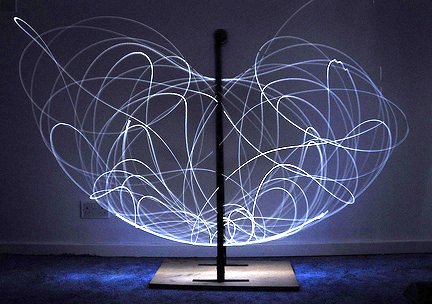
Our world is defined by science. Empirical method demonstrates again and again and again that physical properties follow the same tired pattern without any divine intervention. Saturday was Rutgers Day. Instead of our usual visit to College Avenue to sample French cheeses, we went to the Busch Campus of science and engineering. There we were treated to a 90-minute physics lesson that consisted mostly of demonstrations for the kids with things blowing up, glowing, and being broken after being dipped in liquid nitrogen. Outside the building we watched a chaos pendulum which a grad student explained never followed a predictable pattern. Back in the day when I was subjected to religious rules stricter than any laws of physics at Nashotah House, I used to read about chaos theory. It is the most biblical of scientific ideas. As anyone who’s watched Jurassic Park knows, it means that ultimate predictability is futile. Well, there’s more to it than that, but I’m merely an amateur.

Returning home, I read an interview with Matthew Hutson, about his new book The 7 Laws of Magical Thinking: How Irrational Beliefs Keep Us Happy, Healthy, and Sane. It is now on my wish-list, but I haven’t read it yet. Despite the fact that Hutson is an atheist, he recognizes that magical thinking is both healthy and unavoidable. A door creeps open for the scholar of religion here. We are able to see that non-rational thought is human, so very human. We don’t often think about how driven we are by our emotions. When we see a friend we ask, “what do you feel like doing today?”, not, “what do you think like doing?”. Visiting someone recovering from hard times we ask how s/he is feeling, not thinking. Emotion is, after all, built on the root of “motion”—it is our motivating factor. Seldom is it scientific.

Not to demean science. I have read science books and magazines on my own since I was a teenager. The truths that have been revealed through science are endlessly fascinating and pragmatic. They work in a way religions seldom do. Nevertheless, I became a scholar of ancient religions, studying them scientifically. In the Middle Ages it was said that philosophy was the handmaid to theology. Truth was revealed, not discovered. Reason, thankfully, began to show the way forward. The epithet Dark Ages gained currency for a reason. Science is our means of comprehending our universe, and yet, superstition is hardwired into our brains. I am glad for the scientific worldview even when the chaos pendulum still swings crazily, unpredictably before me. Seldom do those in my field get to consider themselves Renaissance women and men. The pendulum swings where it will.

George Ioannidis' chaos pendulum


Planet of the Monkeys

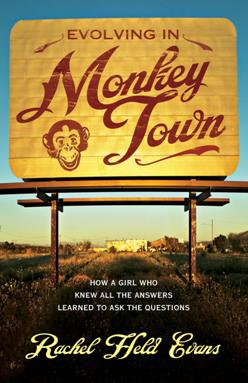
“If salvation is available only to Christians, then the Gospel isn’t good news at all. For most of the human race, it is terrible news.” That may not be Rachel Held Evans’s choice for the final word on the subject, but it is the privilege of all writers to be misinterpreted. I read Evolving in Monkey Town because of an odd confluence. Evolution always tastes like forbidden fruit to me, although there can be no real doubt concerning its factuality. Also, the spiritual journeys of women continue to fascinate me. Even if the women are young enough to be my daughter. I first learned about the Scopes Monkey Trial in Mr. Pierce’s tenth grade history class. In eleventh grade I argued the Fundamentalist side of an epic, three-day debate on evolution in current issues class. I set a reputation that I’m still attempting to live down. (Studying religion for the next ten years probably did me no favors here.) The end result is that I feel a personal connection to what happened in Dayton, Tennessee, although I’ve never been there.

Evolving in Monkey Town is a memoir of a struggling, skeptical fundamentalist. Reading it at times made me squirm a bit, seeing childhood worries and frustrations coming back to me through someone else’s experience. Some of Evans’s remarks could have come from me, had I the courage to write up my past so that others might view it. At the end of the book it was obvious that I could not agree with many of the author’s personal convictions, but she earned my respect. Under the constant pressures of pleasing a deity that can’t be seen, or empirically verified, Evans sees clearly the disconnect between the teachings of Jesus and Fundamentalist Christianity. She has a wonderful knack for clear sight and forthright comment. Like me, she has become aware that a Fundamentalist upbringing is something no one ever truly escapes.

The crisis that seems to have sparked Evans’s angst was the recognition that no matter how you arrange it, an exclusive religion cannot coexist with a just deity. The world is just too big for that. Any scenario in which God sets the rules and makes it impossible for the vast majority of humanity to attain those rules does reflect rather poorly on this pater familias. We are all reduced to a diabolical game of charades as we march merrily toward perdition. Theodicy is an insurmountable problem in this live-a-day world we inhabit. Reading about the altruistic traits of the primates most closely related to us reveals something about being a monkey’s uncle. When we look at the shenanigans religions enforce on people to make them more worthy of heaven, I think we would all have to admit to living in Monkey Town.


Darwin’s Descendents

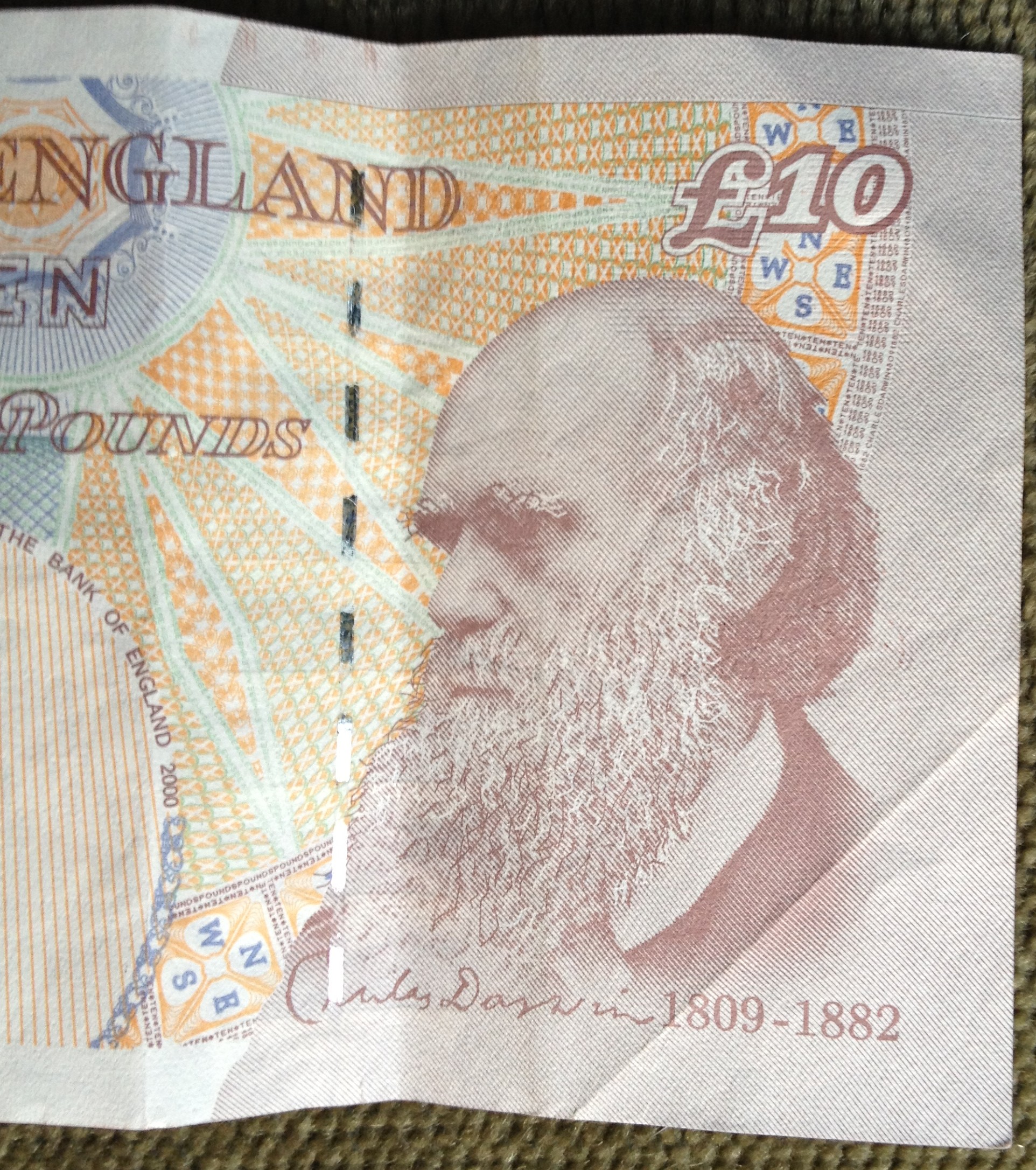
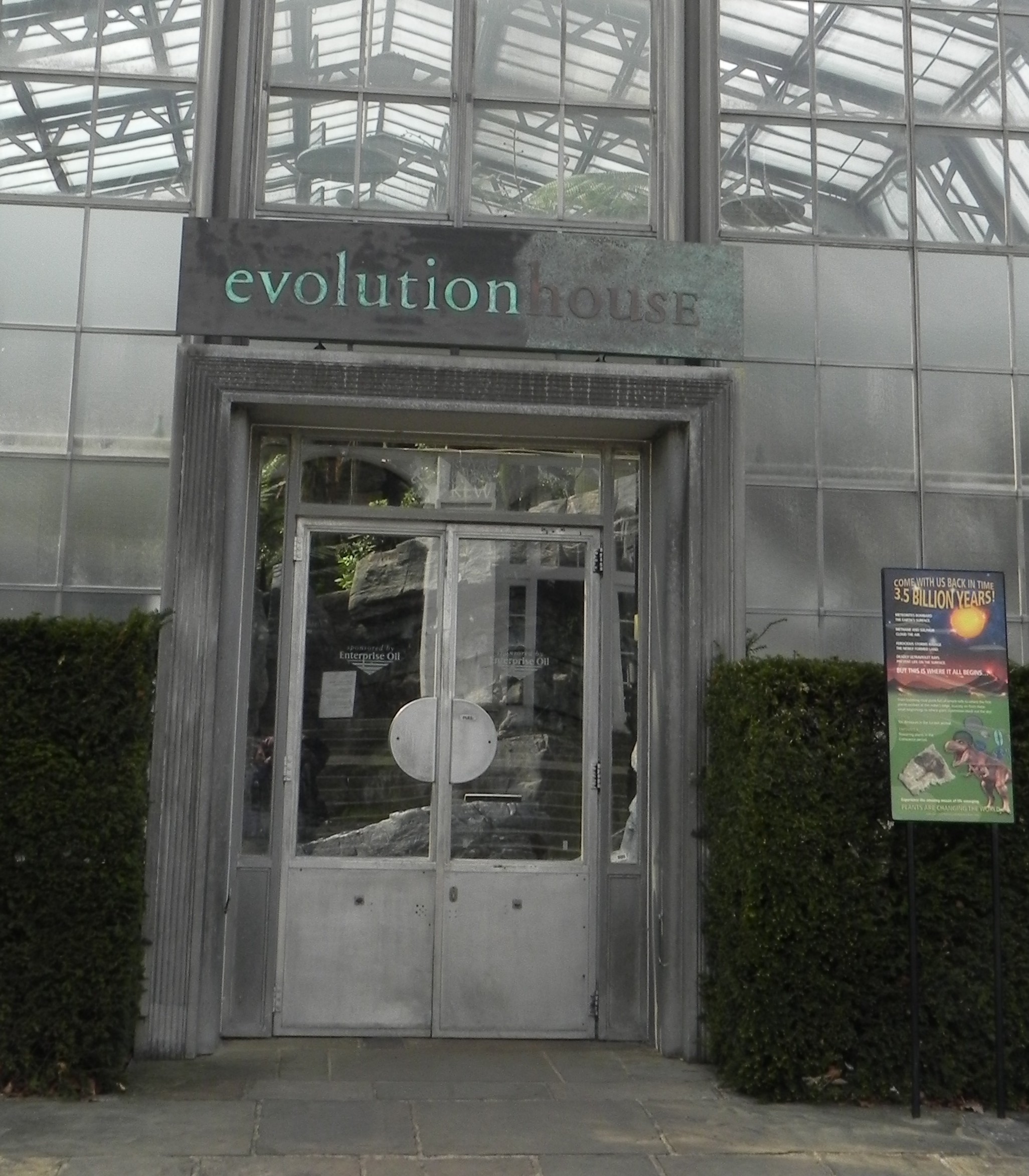
The plague that goes by the name of Creationism has been attempting to spread its reach to the shores of Britain. Proponents of a biblical literalism, whether overt or covert, have championed the idea that the world is terribly young—a mere cosmic toddler, in fact—compared to the vast geological ages of actual fact. When I unfolded my first ten-pound note and found Charles Darwin on the back, I smiled. England may claim a lion’s share of the heritage of one of the great unifying theories of science. In my brief jaunts between bouts of work I came across the tombstone of Herbert Spencer, the man who coined the phrase “survival of the fittest.” On a visit to Kew Gardens I strolled through the Evolution House. When I paid for my lunch, Darwin passed hands as the common currency of the realm.

Ten pound note

A school of thinking exists among many religious believers that insists that if science makes its claims justly then God cannot condemn them. Evolution runs as close to fact as does atomic theory. Those who doubt the latter should visit Hiroshima. Or Three Mile Island. Our literalist companions certainly don’t doubt nukes, but then, the Bible is mum on the subject of what things are really made of. Well, almost. According to Genesis 1, everything is made of chaos and divine words. The Bible doesn’t describe the origin of chaos—it is the natural state of things. God’s word, when it generates uranium, can be very deadly indeed.

Evolution House

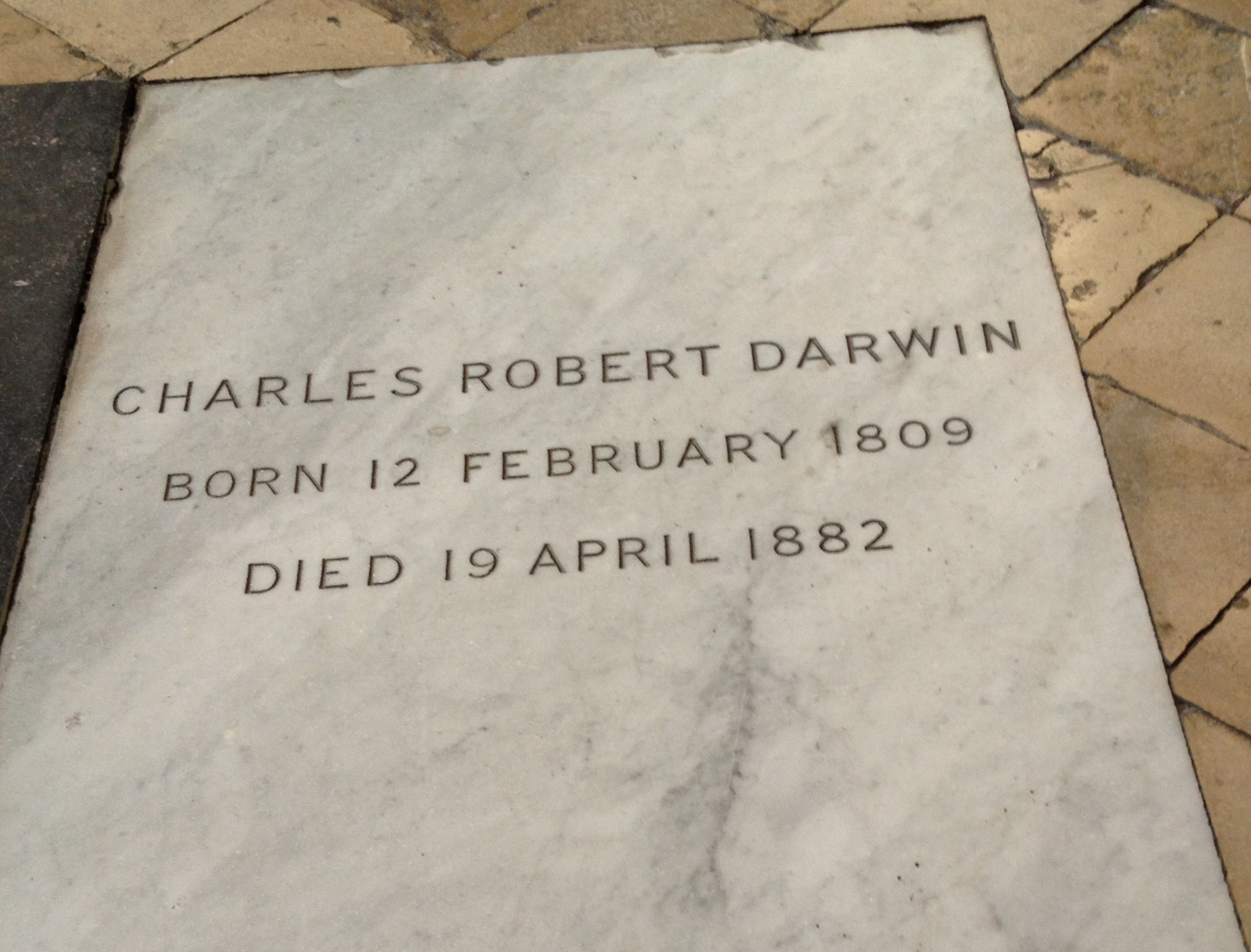
Creationists selectively choose which science to believe and which to reject. Fundamentalism can trace its origins to Britain, but the culture rather quickly outgrew these childish fantasies. In America literalism sank deep roots, roots deep enough to withstand the hurricanes of reason that would otherwise clear the air. Can an American imagine Darwin sharing the money which reads “in God we trust”? And yet, Darwin lies scarcely two meters from Isaac Newton in England’s holiest shrine of Westminster Abbey. Science and religion have here embraced one another. Perhaps when we put all the monkey business aside, we will come to realize that we may still have a thing or two to learn from the nation of our founders. Literally.

Darwin at rest


Sh*t Apes Say

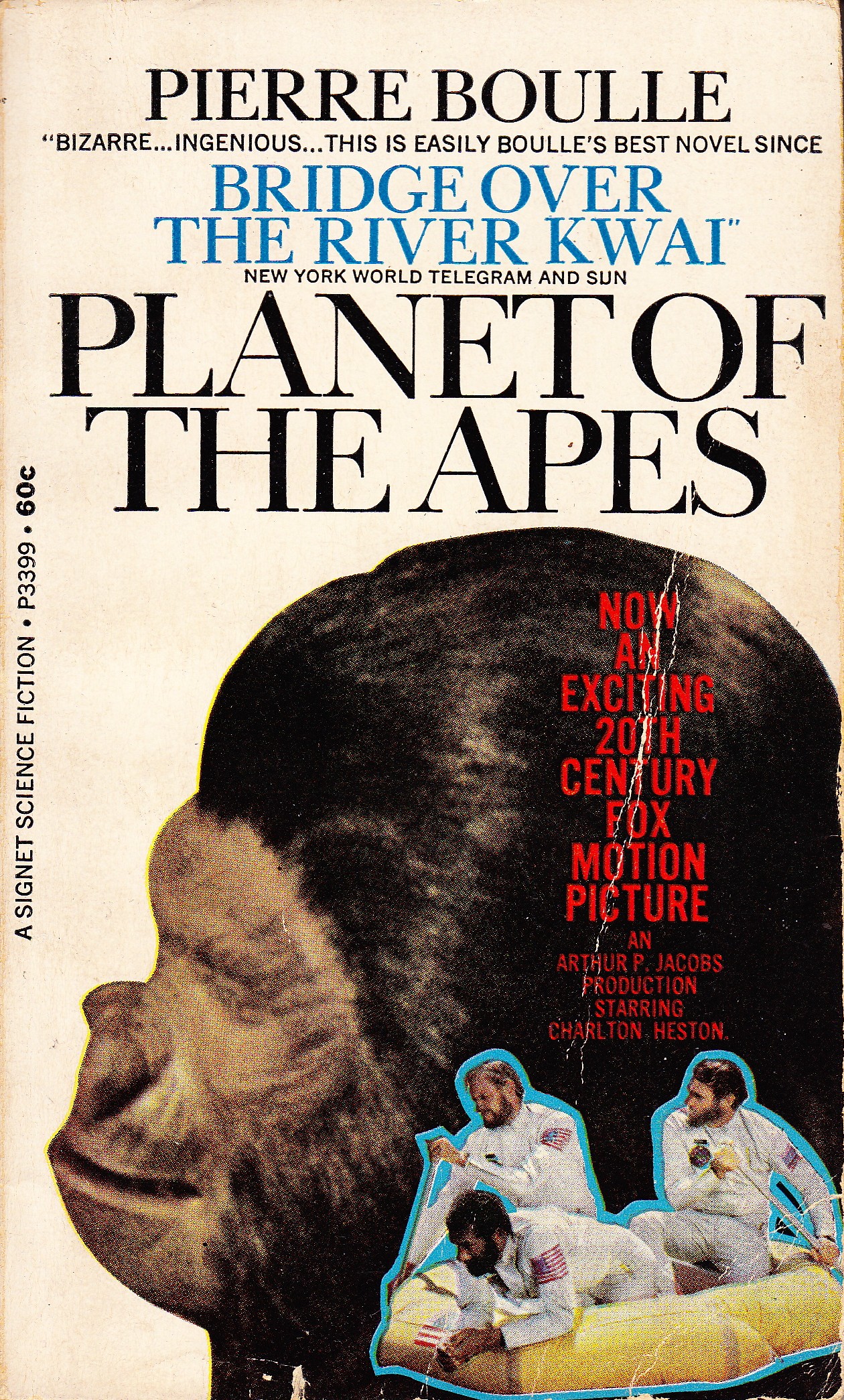
Knowing from experience that when I stay alone in a hotel, despite my best intentions, I will get bored and end up watching Mudcats or Dual Survival until my brain feels like a boiled egg, I anticipated my trip to California. I packed Planet of the Apes, the original and best of the lot, hoping for some intellectual stimulation. Having grown up in an anti-evolution household, we were curiously allowed to watch Planet of the Apes, a kind of forbidden zone of the mind. It remains one of my favorite movies of all time. It is also a manifesto of science besieged by religion. Note what Dr. Zaius says, “There is no contradiction between faith and science… true science!” And he is the Minister of Science, and Chief Defender of the Faith. The trial of George Taylor, a thinly disguised parody of the Scopes Trial, has Honorious (read William Jennings Bryan) stating, “It is based on our first article of faith: that the almighty created the ape in his image, that he gave him a soul and a mind, the he set him apart from the beasts of the jungle and made him lord of the planet,” and turning on his fellow apes Zira and Cornelius, he accuses them of being “perverted scientists who advance an insidious theory called evolution!”

Dr. Zira, as one of these “perverted scientists,” asks Cornelius (incidentally, the name of the first non-Jewish Christian, according to Acts), “How can scientific truth be heresy?” This is echoed by Dr. Zaius in the trial where he states, “It is scientific heresy that is being tried here.” Indeed, the entire simian culture is based on the blurring and blending of science and religion. Throughout the film various characters make barbed statements about the human propensity to ignore the obvious. Landon, challenging Taylor about the time change they experienced in space, says—in a line that could come straight from Answers in Genesis—“Prove it! It’s still just a theory.” The exact rhetoric currently used by creationists in school board meetings around the country. To which the most apt reply seems to come from Dr. Zaius, speaking of humanity: “his wisdom must walk hand-in-hand with his idiocy.”

Occasionally even the gun-toting humans get the picture clear. In his opening monologue George Taylor wonders about the world seven hundred years from now, “Space is boundless. It squashes a man’s ego. I feel lonely. That’s about it. Tell me, though. Does man, that marvel of the universe, that glorious paradox who sent me to the stars, still make war against his brother? Keep his neighbor’s children starving?” This seems to be the true measure of heresy—a religion that puts fellow humans on the same level as animals (and even animals deserve far more credit than we are willing to give). Among my favorite lines is Cornelius’ response to Taylor shaving his beard; “Somehow it makes you look less intelligent,” he opines. Endlessly remade, Planet of the Apes is a movie that still answers some of the issues that plague our society nearly half a century later. Perhaps the last line should go to the apes, adjusted of course, for gender sensitivity, “[hu]man[ity] has no understanding.” Well said, Dr. Zaius, well said.

A piece of childhood


Walking Monsters

It was a moment of weakness, or at least tawdry cheapness, that made me watch The Monster Walks. Just the day before the Cable Vision guy had stopped by, detailing how much money we could save by switching. We haven’t had television service since 2004, and even then it was only with a cheap aerial. Back in the days of Borders, I sometimes caved in and purchased the “Classic Features” movie boxes with 50 B, C, or D movies for what seemed a steal at less then 25 dollars. Maybe five or six of the movies from each set were actually worth the time spent watching them, but many of them proved an education. So it was with The Monster Walks.

Now, I readily confess to having a weakness for B movies. Made by people who were really trying, but who seemed to lack talent, I often identify with their efforts. So when I popped The Monster Walks into my DVD player, I had no idea what I might learn. The first revelation occurred in the opening credits where a character named “Exodus” was introduced. Since this was 1932, the character had to be African American. And comic relief. To spare you the pain of watching the movie, the plot is rather simple: rich man dies, helpless daughter inherits all to the chagrin of surviving brother and domestics, who plot to kill her by pretending to be a murderous ape. There also happens to be a murderous ape locked in the cellar. You get the picture. Aptly named Exodus is purely there as a foil for the educated, privileged white family. He was played by the talented but underappreciated Willie Best. As might (nay, should) be predicted, the scheme of killing the girl backfires and the ape kills the killer. Okay, so I can confess an hour wasted and get on with my reading. But the final scene arrested me.

Exodus wonders to the lawyer (who is there to read the will) why the rich man even had an ape. The lawyer, metaphorically transformed into a judgmental William Jennings Bryan, states that it was because he believed in Darwin’s theory of evolution. Exodus responds by noting some family resemblance to the ape. The blatant racism was hard to take, but in Black History Month the painfully obvious collective sins of our society should be laid bare. In 1932 Fundamentalism, often implicitly allied with racist causes, castigated Darwin’s theory for bringing all of humanity down to the same level. As long as a white god is creating the universe, the Anglo-Saxon can claim superiority. Never mind that Genesis was written by a Jewish writer living in Asia. Self-righteousness comes in many forms, but it always involves bringing others down to a rung below where the blessed stand. Has not the great Rick Santorum told us that even the Crusades were merely misunderstood?


Denying Truth, For Profit

Sometimes I’m questioned about why I bother with creationism. Everyone who’s intelligent knows it is religious ideology masquerading as science and people will eventually figure it out. But will there be time? An editorial in yesterday’s New Jersey Star-Ledger pulls the curtain back on creationism’s incestuous cousin, climate-change denial. As the editorial notes, key documents of the Heartland Institute—one of the major propagators of climate change as “just a theory”—have been leaked and show that they have learned their lesson from creationist tactics. They want “debate the question” instilled in science classes in lieu of facts. And much of their money comes from big oil. It is the hope of such institutes that an American public already woefully pathetic at understanding science will be led to believe “just a theory” equals “likely not true.” The data are stacked completely against them and the entire rest of the developed world knows that.

While the issue may seem less religious than creationism—which is based on getting Genesis 1 in the classroom as science, no matter what you call it—it has deep roots in that same insidious cocktail of politics, religion, and dirty money. Biblical literalists tend to believe the world is about to end. The belief has been around for at least two millennia. It is a damning and damaging belief that declares the world was made for raping because it is about to end. This deranged thinking is fueled, literally, by unrestrained economic interests. Sometimes the groups can’t see beyond the Bible to realize that they too are being screwed. Science is objective, and it is science that has been challenged by various religious and political groups since the 1920s. Today, when there is far too much information for anyone to stay on top of it all, and in an American society deeply distrustful of higher education, I smell an explosive amount of methane in the air.

Climate change is real. The “theory” is so well supported by evidence as to be fact. Is anyone really surprised that supporters of the Heartland Institute have also backed Newt Gingrich’s campaign? We have placed ourselves in a very dangerous position as the last remaining “superpower.” I tried to read a book on environmental issues that Routledge published, but was so scared after the first three pages that I had to put it down. What is the lesson here, class? Is it not that money is the root of evil? And that, my dear literalists, is biblical.

The future of human economic evolution


Being Human

Within the first three pages, if you’re not mortally offended or inexplicably happy, you’re probably not an American.

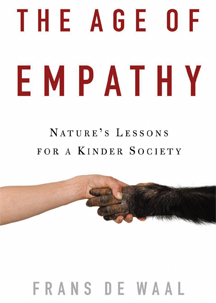
Growing up with pets, I had a hard time understanding the hard and fast line drawn between animals and people. The failsafe fact used back then is that only people used tools. When we looked closer at animals we found that wasn’t quite true. Well then, only people have language. A large question mark has grown from that assertion too. The final fallback, the sine qua non was souls: only people have souls. It is also the safest of assertions, since it can be tested for neither people nor animals.

This way of thinking, according to Frans de Waal’s The Age of Empathy, arises from the western religious tradition—a religious tradition that grew up in relative isolation from other primates. Many world religions do not feel the necessity of making people absolutely different from our animal cousins. In Christianity at least, heaven itself rides on it. What are we so afraid of?

I posted, a couple years back, on Frans de Waal’s Our Inner Ape. Having just finished The Age of Empathy, I have reaffirmed my earlier accolades—he is one of the most sensible and important writers alive. Step by slow, evolutionary, cautious step, de Waal illustrates that one of the taboos of science—that animals don’t have emotion—is patently wrong. Not only do they experience emotion, but apes, cetaceans, and dogs at least, know empathy. Even scientists don’t like to admit this because science grew up in the shadow of the Judeo-Christian-Muslim worldview of human superiority.

But there’s even more at stake. As de Waal makes perfectly clear, the unbridled capitalism of the United States goes against nature. The unlimited acquisition of the vast majority of the resources by the few sets our primate sensibilities on end. Empathy, the ability to feel for another and take their perspective, is not only part of animals’ experience of the world, it is also a mandate of our religions. In order for society to survive, we must come to know this truth. Falsely applying Social Darwinism as factual, biological Darwinism, the few have taken more than either biology or religion permits.

The Age of Empathy should be on every school’s mandatory reading list and corporate climbers should learn that even selfishness has a very steep price tag. Not only for themselves, but for all of us.


Fall of the Planet of the Apes

Perhaps it is being under the influence of a head-cold that just won’t go away, or perhaps something deeper, I decided to watch Rise of the Planet of the Apes. Raised in a fundamentalist household, I was enamored of Planet of the Apes (the original one) and watched it and all its sequels repeatedly back before VCRs made owning such chestnuts possible. Perhaps it was that taste of forbidden fruit—evolution—that left such an exotic buzz in my head, or perhaps it was the unforgettable climax. The message that we’ve done this to ourselves. I once even missed seeing a high school friend after several years’ absence on a visit home because an all-day Planet of the Apes marathon was airing on TV. Perhaps it was the subtlety, the Rod Serling feel to it, or the deep level of empathy it evoked, for whatever reason, that original movie remains one of my personal favorites. In Rupert Wyatt’s slick new backstory, something was missing.

The CGI of Rise of the Planet of the Apes is pretty remarkable, except for the occasional jerkiness of violent scenes intended to pump up the testosterone. The subtle emotions visible in Caesar’s every glance conveyed the sense that animals share rights to this planet with us. I’ve been reading about animal intelligence again, and it saddens me that we’ve reached this far in our development only to continue the fiction that homo sapiens are unique among the tree of life. It’s not much of a tree when one of the branches is not and never has been attached. Our animal cousins have much to teach us, and perhaps that’s why I keep returning to Planet of the Apes, despite Charlton Heston. Even the new movie makes several nods to the original with naming the main family Rodman, Caesar building a three-dimensional puzzle of the statue of liberty only halfway complete, calling his mother “Bright Eyes,” spraying Caesar with a hose in his cage and calling the primate center a madhouse, and the cheesy repetition of “Take your stinking paws off me you damn dirty ape!” It simply can’t rise to the level set by the writing of Rod Serling and Michael Wilson.

The box-office success of the film tells us something about ourselves. Ironically, and perhaps intentionally, Wyatt’s version neuters the evolution. The apes don’t rise from an unspeakably long evolutionary track from us, but we create them with the nemesis of twenty-first century humans, the virus. Caesar and his friends are genetically engineered by humans, and God has nothing to do with it. In the original, a theological subtlety lingered as a religious court of orangutans condemned Taylor for religious reasons. His claim of human primacy was heresy to primate sensibilities. The new version takes itself too seriously for that. We can’t jangle the evolution keys anymore because of our own national schizophrenia concerning the raw power of nature. Just when we think we’ve evolved beyond petty superstition masquerading as righteousness, yet another state attempts to guillotine the entire scientific enterprise. It’s a sure thing that if the apes don’t get us, we’ll take care of it ourselves. That was the message already in 1968.


Wired for God

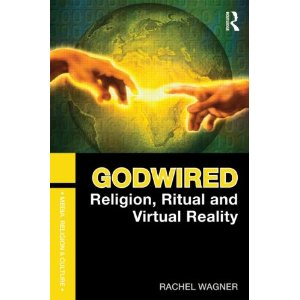
I am not now, nor have I ever been, a techie. When my fascination with the newest technological marvel borders on the rhapsodic, I suddenly realize it’s all electrons and immediately the fascination dissipates. It feels like an illusion. I am a guy who likes the sensation of a paper book in his hands and prefers conversation accompanied by all the subtle biological clues of being in the same room with somebody. Maybe it is lack of imagination on my part, but I will often get bored on the Internet and pick up a book instead. One book I recently picked up, and one that challenged my perception of reality, was Rachel Wagner’s Godwired: Religion, Ritual and Virtual Reality (Routledge, 2011). Wagner is one of that generation of younger scholars who is asking what the implications of electronic culture are for religion. If concepts such as online prayer walls, chat-bot salvation, and storing sacred texts on the same device as secular ones intrigue you, do yourself a favor and read this book.

As Wagner ably points out, religious individuals are tapping into the vast communications’ potential of the Internet to spread their faith abroad. There are apps to help you pray online, there are electronic games to prepare you for the fictitious rapture, and there are virtual churches. We have indeed sealed God in an Xbox, and we have beamed the divine across wireless networks and learned to confess our sins in cyberspace. And physicists are starting to confirm that, at our most basic level, we are energy rather than matter after all. Maybe we are tapping into ultimate reality here. Wagner explores how the level of engagement with virtual worlds constructed by software engineers (the new gods) becomes so intense as to provide an alternate reality. It all depends on how you define what is real. And it is clear that for many people, life without the Internet is now unimaginable. Those of us born before the supercomputer scratch our physical heads with amazement. How did Nebuchadrezzar or Alexander ever conquer the known world without GPS technology? Does my iPhone have a secret life about which I know nothing?

Within our culture live many older people who have never touched a computer. They exist alongside grandchildren practically born with some iDevice in their grasp (may be a choking hazard for children under three). I have lived long enough already to have witnessed keyboarding being replaced by thumbing, and research having shifted from long treks to the library in the snow to a few taps on a glass screen that can feel the electricity from my chilly fingers. From the comfort of my lonely room sings my soul, how great thou art! Perhaps Terminator didn’t go far enough, perhaps Skynet really is god. Maybe this matrix of blood, muscle, bone, fat, and spit is really just an illusion and the Internet is true revelation. Wagner pries open some very important questions in her book. And none of us should be surprised if, when we approach the pearly gates, we find a touchpad next to the electronic lock inscribed with this legend: “Welcome to Heaven. Please enter username and password. Type in the letters you see in the box below.”


Apples and Evil

I’m not really a mall person. Since I’m not really a techie either, however, I find myself in malls where Apple Stores are located when I can’t get by without a little help from my friends. So it was that I spent several hours at a mall earlier this week. While there I browsed an oriental imports store—the kind of place with a no-frills, I-might-be-gone-tomorrow kind of feel to it. In the front window they showcased a display of swords. Since dragons are a major motif in Chinese folklore, the transition to medieval images of dragon-slayers seemed to be at play here. I am not certain of the last time an actual dragon was reported in central Iowa. One of the swords had a Latin inscription along its blade. My Latin is very rusty, but I did recognize the word “God” amid the fantasy spell. The connection between religion and violence was facing me in that unused (I hope) weapon.

Religion often serves as an outworking of human violent tendencies. Our violence is, no doubt, a product of our godless evolution. As we ascended the tree of life that gave us birth, some other creatures on that tree thought we were tasty. In an unintentional effort to defend ourselves, we grew larger and larger brains that gave us the edge as predators. As a collective, humans tend to be overachievers. We’ve whittled away most of our large predators to the endangered list so that we might shop with relative comfort. If there is guilt about it, we can always blame God.

Evolution did not endow us well with body armor or sharp teeth and claws. People seem to have evolved mostly for running away—that’s what our physiognomy suggests. Among the earliest of weapons was the blade. To be effective a blade must have reach. The sword, the favored weapon of the Bible, grew until weight and balance became optimal. To harm another person you had to be close enough to look that person in the eye. If we look we find another person like us, and we need an excuse for our violence. Religion is readily farmed as the ground for justifying such violence, for religions combat evolution and any differences of opinion. What I was seeing through this mall window was a cross-section of the human story. The sword was ornamental and had clearly never been used. Unfortunately, such weapons are rare. Rarer than my trips to the mall, Apple Stores notwithstanding.


King Hong

When the same religio-historic event is described in three consecutive books I’ve read on diverse topics, I start to consider what strange form of coincidence is operating here. Coincidences are some of the potent spices that give life flavor—the tragic death of Suzanne Hart on Wednesday when an elevator crushed her to death occurred the very day my bus was late and I took the route directly past her building to avoid the crowds on 42nd Street. What was the series of uncanny events that led me to where someone was about to die? It hardly seems within the divine character. So coincidences have been on my mind of late.

The last three books I read have all discussed the Taiping Rebellion that took place in the mid-nineteenth century. Despite having studied religion all of my life, I had never come across this religiously motivated violence until reading Daniele Bolelli’s 50 Things You’re Not Supposed to Know: Religion. Unrest in imperial China had existed before, but Hong Xiuquan, the leader of the rebellion, was motivated by religion. Xiuquan was a Christian (no doubt the fruit of missionary activity) who came to believe that he was Jesus’ younger brother. His motivation for the rebellion was based on his aberrant version of Christianity that quickly grew into a full-fledged movement calling itself the Heavenly Kingdom. Basing itself in Taiping, the movement adopted the early Christian practice of communal property and came to rule over about 30 million people. The numbers are what is truly stunning about this tragedy. When the conflict with the Qing Dynasty ended, about 20 million people were dead. The number is so high as to shut down comprehension. So many dead because of religion. It has a corporate feel to it.

Religion evolves. When it is spread into new cultures, syncretism takes over. Many religious believers, through faith, insist that their religion is the same as the founder propounded. Such simplistic understanding is not true. Culture, just like biology, lives and grows through evolution. The American Christian dressed in expensive clothes in a phenomenonally costly mega-church with a shining preacher bearing a million-dollar smile is about as far from a property-less, vagabond carpenter from Nazareth as you can get. Yet we still pretend. If that pastor says he is Jesus’ younger brother, chances are good that many will believe him. Stranger things have passed the lips of televangelists. Emotional involvement in religion easily leads the zealous to extreme action. History has demonstrated this time and again. The Taiping Rebellion of the Heavenly Kingdom proves the point, even if we’ve never heard of it. Maybe it is no coincidence after all.


Paradise Re-Lost

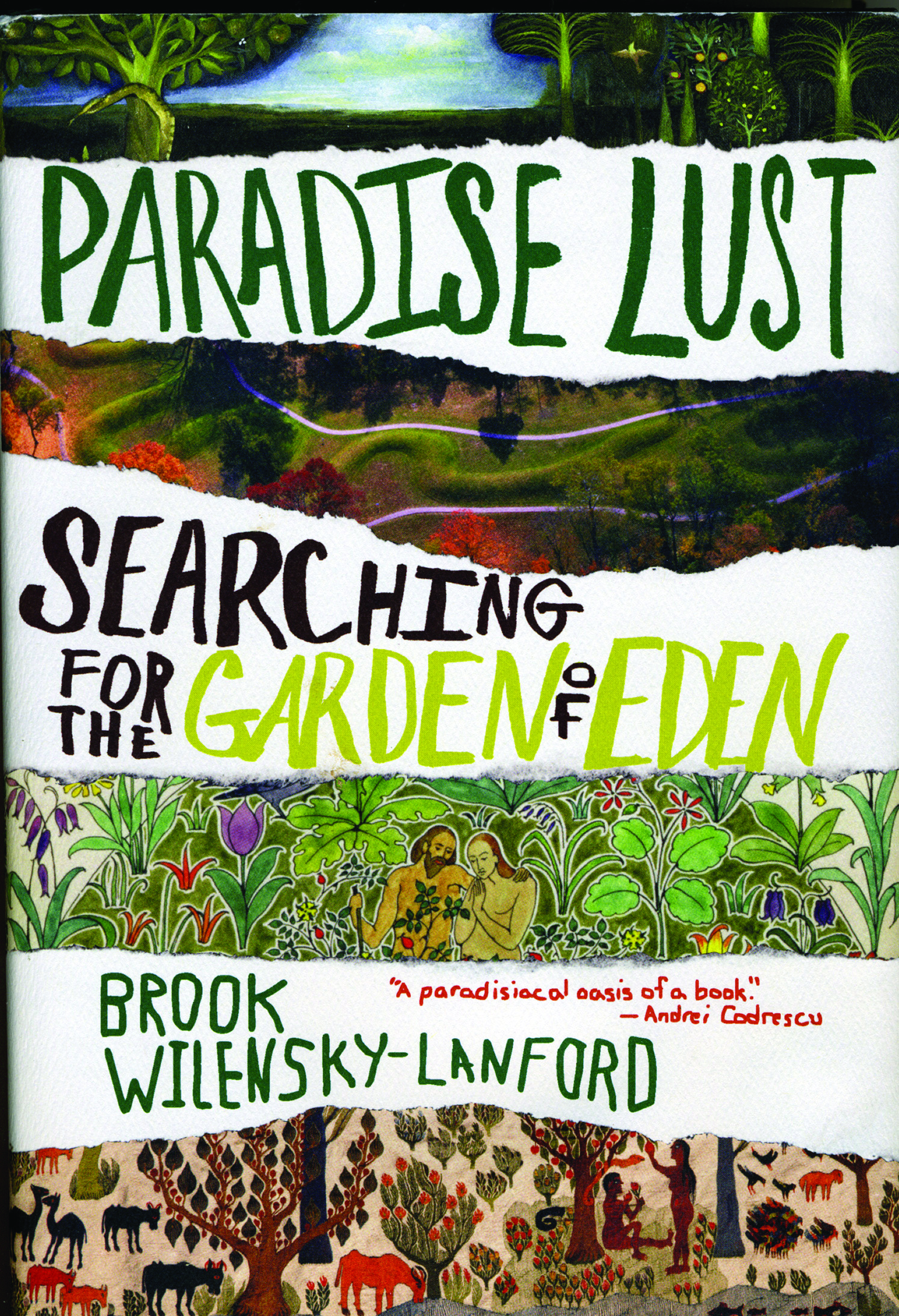
It is through the astute eye of my colleague Deane Galbraith that I came to know of my most recent reading project, Paradise Lust: Searching for the Garden of Eden by Brook Wilensky-Lanford. BWL (since the author’s name is a mouthful and since it took me four hours to get home tonight (at a distance of less than 30 miles) I’ll abbreviate her title. Being a fellow New Jerseyan, I’m sure BWL will understand) surveys various attempts that have been made over the past century-and-change to try to locate the Garden of Eden. Spurred on by the discovery that her own educated, rational great-uncle had also wondered about the mythical location of our mythical ancestors, she sketches various attempts to find Eden. Tracing a course that often crosses paths with my own academic background, BWL notes the pervasive—one might say undying—belief that once upon a time in a land far away there was a garden paradise.

Quite apart from the obviously folkloristic, and Mesopotamian, origin of the creation story, BWL demonstrates that the unifying factor behind the search for Eden is the four rivers mentioned in Genesis. The Tigris and Euphrates should be no-brainers, and no-brainer is a word that frequently comes to mind when otherwise intelligent people sincerely suggest Eden lies beneath the North Pole, or in Ohio, or Florida. Clearly this story left only psychological traces on the impressionable. Far more mysterious are the Pishon and the Gihon. The fact that these rivers have never been found (never existed) has fueled the economy of adventurers and bibliophiles for well over a century. The fact that people buy BWL’s book underscores the point. The end result is that any confluence of four rivers could potentially be Eden. What is lost is the biblical worldview.

The four rivers of Genesis 2 flow to the four points of the compass to water the entire earth since all ancient people seemed to have believed they lived in the middle of everything. The Genesis writer takes for granted that we’ve heard of them, and who, among the sophisticated, wants to admit otherwise? Since the story never happened, no physical evidence should be expected. And that’s what all of BWL’s explorers find. Nothing. Of course, if you want to run for President you’d better claim to believe in Eden, for plenty of Americans, despite our educational system, do. Many an ape is wiser. So if you want to find Eden, locate the center of the world. Given the traffic tonight, it surely must be New York City. If you’re going to look for it, you’ll want to take a book to read while the rivers of cars stop flowing. I’d suggest Brook Wilensky-Lanford’s Paradise Lust.


Don’t Need No Righting

“If you can read this, thank a teacher.” So the old saying goes. Besides the virtue of venerable age, this proverb has the added advantage of being true. When I first peered at a page full of complex combinations of minute, triangular wedge-marks and was told I’d learn how to read them, I needed to head outside for a few gulps of cold air. My first attempt at Akkadian was doomed to failure, but eventually I learned to read cuneiform through the gateway language of Ugaritic. After that the bewildering sprawl of Mesopotamian languages didn’t seem so threatening. I don’t exactly remember when I was first exposed to English cursive in the classroom, but I do recall that same breathless fear of the unknown. The language I’d learned to print out neatly all seemed to be melting into curly figures that looked remarkably alike. How would anyone ever be able to read this?

According to a story in Sunday’s New Jersey Star-Ledger, schools are moving away from teaching cursive. Beginning next year 46 states will no longer require it. Beyond that, some politicians are questioning why teachers should be wasting their time instructing students in printing, or even keyboarding. The gold standard they are worried about is identity. Can you sign your name (to endorse this campaign check)? If we have another way of identifying you—eyeball scans seem to be very popular suggestion—why should you bother to scrawl your name? Keyboarding, well, kids already know that by the time they start school these days. If the texting craze really takes off we may evolve future generations with just thumbs. School is for teaching students science, math, business—practical stuff. Oh yes, and intelligent design. (Got to keep the gods, or anthropic principles, happy.)

In a world where languages are dying out at a disturbing rate (each language is a thought process as well as a way of stringing sounds together), we have become very cavalier about the very innovation that has allowed us to develop as we have. I used to tell my students that less than seventy years separated the Wright brothers from the moon landing. A human lifespan where technology outstripped our ability to think. And the pace has only accelerated since then. Are we premature in leaving out cursive from the curriculum? There is coming a day when future archaeologists will discover a strange substance that seems to have been manufactured from wood pulp. On it they will find scrawls with loops and curls that form a pleasing pattern in the repetition, but from which no intent can be discerned. And if they are like modern technocrats, they will quickly realize the utility of the wood pulp for starting a fire.

What's it say?