Dawkins Dilemma

Some of my regular readers may have divined that I’ve been reading Richard Dawkins’ The God Delusion. It is a book well worth more than one post on a blog, but it is also one of those troubling and liberating books all at the same time. Dawkins is a gifted writer who explains things clearly. He sometimes makes mistakes in the details, but his logic is flawless and consistent, at times running up against the limits of reason itself. There is a dilemma here, however, and that is the ghost in the machine. It may not be supernatural, but even Dawkins must occasionally refer to “enlightenment”—a term derived from Buddhism, and “essence”—something that does not actually exist, and other turns of phrase that wander beyond the strict purview of science. Nevertheless, his point, hammered home repeatedly, is well taken. The perpetuation of religion is not very healthy, and in a way, contains the seeds of its own destruction.

As a specialist in religion reading this book by a world-class scientist, it feels like awaking in the morning after a stranger has broken into your room at night and beat you soundly while you slept. Religion is what we do, our thing. That voice of indignation whimpers, “why must scientists come in here and trash all our stuff?” And yet, that is the way of reason. It takes no prisoners. Back at Nashotah House I used to argue points of Scripture with students. Often there would be someone who would resort to, “reason is fallen and is therefore not to be trusted.” I would always respond, “how do you come to that conclusion if not by reason? Can you trust it?” If reason be true, it must be true the entire journey, as anyone who has ever flown on a plane knows. When reason meets religion, however, fireworks fly.

Dawkins does an admirable job illustrating the troubles into which religion has led the human race. It is very unlikely, however, that the human race will ever outgrow religion. Perhaps it is one of those evolutionary mechanisms set into our brains in order to ensure that we are not too successful. With the exception of crocodiles, sharks, cephalopods, and many insects, life forms are continually evolving and dying out. Maybe religion is our apocalypse, the mark of the beast. The original sin. Call it what you will, but religion often acts as a massive deterrent to human progress, and especially to the ideals that it often promulgates. Sometimes it takes a biologist to sort out the menagerie.
Timing God

Two weeks in a row now God has made it into the pages of Time magazine. You’d think he was Rick Perry or something (no insult to God intended). This week’s Commentary, written by Harvard physicist Lisa Randall, argues for the importance of believing what science forces us to conclude. The world is warming up, ice caps are melting, and those in low-lying regions are in hot water. I am fully in agreement with her sentiments, but it’s the practicality that bothers me. Not the practicality of listening to science—that’s just common sense—but the practicality of doing so in a world where religion reigns. Despite cries of oppression and suppression and repression—just about any pression you choose—religions dominate the world. What particular brand you prefer does not matter; the fact is most people are religious. Randall believes that religion and science must learn to live together. Her problem is that she is looking at it rationally.

Science has given us excellent leads on tracing the origins of religion itself. Between psychology, anthropology, sociology, and biology we’ve got a fair idea how religion came about. The same brain that shows us the way, however, has evolved with religion still intact. In short, it has learned to accept the unlearned. With our brains acting like dogs chasing their own tails, is it any wonder that as a species we are confused? We see only what we choose to. In the great, artificial landscape of Manhattan many very wealthy people traverse the streets. Every day I see suits that would cost my entire paycheck casually strolling up Madison Avenue. I also see the beggars in the same doorways day after day, blending in with their surroundings. The solution of choice is to pretend they aren’t there, to not accept the evidence of our eyes. The wealthy have a knack for it, it seems. And when they work their way into politics their vision doesn’t improve much.

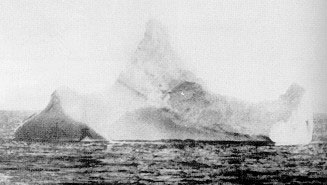
The problem that Randall points out is very real and deadly serious. Trouble is, those who pretend not to see are among the best actors on the planet. Faced with incontrovertible evidence the rational mind has no choice but to acquiesce. Religion, however, offers the perfect escape clause. If global warming discomforts you too much try fanning yourself with a Bible. Soon the excess degrees will simply melt away. And when the religious enemies of science find themselves sitting on the ocean floor like the victims of the Titanic, they too will have the satisfaction of knowing that they were privileged above all people for the time they had on earth. Everyone wins. The insatiably greedy and the abjectly poor both share a spot on an overheated planet. And if the pattern holds true we’ll evolve eyes to read under water, along with our gills, so that we can continue to read our waterlogged Bibles to find out what’s coming next.

Iceberg? What iceberg?


Secret Life of Language

I recently met with a friend to catch up on several years of silence. Increasingly I’m discovering the wisdom of those I’m privileged to know—perhaps it is the shedding of a purely academic way of learning. We all share in this very human voyage of discovery. This particular friend presented me with an idea that I just can’t dismiss: what if language is a living entity, existing in its own world but intersecting with ours? In a symbiotic relationship, we use words and they help us to survive and advance. This friend is a writer, and like all of us who attempt the art, knows the joys and frustrations of dealing with words that can elude but also fall subtly into place forming a poem or story of sublime beauty. We haven’t fully tamed language, but it defines us. Even my feeble attempt to replicate his fascinating idea is fraught with difficulty, for language won’t be relegated to the page, whether of paper or of electrons.

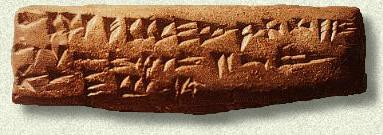
Language evolves along with us, helping us to express concepts that defy explanation. I recently read of the disappearance of three of our alphabetic letters in English. Alphabets, beginning with the earliest complete exemplar in Ugaritic, contain roughly thirty members that may be combined to replicate, in facsimile, the sounds we make. Different cultures use differing sounds; letters that represent those sounds require symbolic representation. Not all alphabets are created equally. One of English’s missing letters is “ampersand.” I always wondered why when I learned the alphabet the song ended with “W, X, Y and Z”—why the “and”? “Ampersand” was part of the alphabet in the early 1800s. Students sang “X, Y, Z, and per se and.” “And per se (‘by itself’) and” eventually ran together into “ampersand.” Over time it fell out of our rank of letters. As the runic Anglo-Saxon that gave us English was absorbed into Latin characters, the Teutonic “thorn,” or th sound, went extinct in our alphabet as well. As any student of German knows, “th” has distinct pronunciations in Germanic languages. It has its own letter of the alphabet in both Arabic and Greek. Since the Latin “y” resembled “thorn” the letter was replaced by ye olde “y.” The archaic letter “wynn” looks like a flattened “p” but was pronounced as “w.” As Latin superseded runic forms “wynn” was written as a doubled “u,” literally “double-u,” which, in Latin was scripted with a “v” shape. This gives us the anomalous W written with what looks like two “v”s.

The alphabet, second to writing itself, is perhaps the most important invention that humans have devised. The alphabet made writing much easier to learn and with writing ideas could be preserved for centuries and could be sent vast distances without changing. Writing allows us to stand on the shoulders of giants. As the school year is beginning again and kids everywhere feel the strain of losing the freedom of summer, I think back to the purpose of education—teaching our young to read, write, and calculate. Language has been guiding us all along. It may evolve, shed a letter or two, frequently grow by taking on entire new words, but it still cradles us as we struggle to find the perfect expression. We should take a little time to get to know our own language better, for without it we are merely biological entities.

An Ugaritic abecedary


A Sense of Place

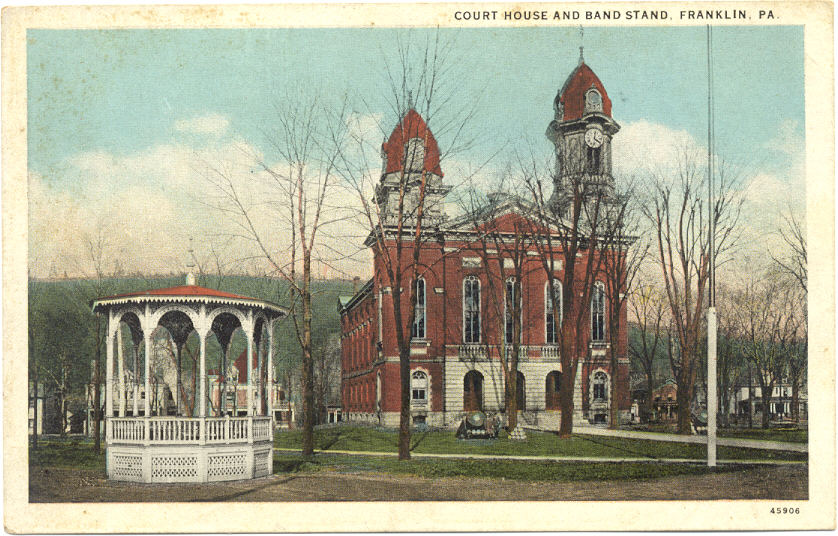
Franklin, Pennsylvania. The place I was born seems to participate in what is sometimes labeled “sacred geography.” No one really knows why people imbue certain places with a sense of particular significance, but we all do. Whether it is world-famous tourist sites or our humble hometowns, there are places for us that possess an emotional resonance that other places lack. By the time I was an adult I was eager to get away from my hometown, to stretch myself and see if there was more to this world than these ancient green hills were willing to disclose. But still I return. When something brings my town into prominence, it somehow still impacts me. In the second season of the X-Files Mulder and Scully came to Franklin. Of course, the episode was not filmed here, just set here. But that was enough. My small hometown had been validated. It is part of my personal sacred geography.

I recently learned about WestPA Magazine. While it still has a way to go before becoming mainstream, it needles into that sense of belonging that refuses to let me go. Reading about the grandeur that once settled over this town feels like reading my own biography at times. Last night, for example, I learned that one of the first steps of female equality—a small step, but we all must begin to walk somewhere—took place here. One of the inheritors of the oil wealth that originally put this region on the map was Charles Joseph Sibley Miller. He hosted two presidents on his yacht, partnered with John Astor and William Vanderbilt on a business venture, and had his car personally delivered by Louis Cheverolet. Although largely overlooked by history, Miller purchased a hot air balloon in which he took his wife, Mary Prentice Miller, for a ride, making her the first known woman aeronaut in history. One small lift for a woman, one giant lift for womankind.

There seems to be no scientific basis for sacred geography. It is simply something that we sense. I left my home region, the birthplace of the oil industry, a site of some importance in the Revolutionary War, to pursue a more tenuous, if abstract career track. And still I come back and find myself amazed. I suspect our sense of sacred geography evolved along with our penchant for territorialism, our desire for private property, and our need to find sanctuary of some kind. I can stake no claims for the accomplishments of those who settled this region, but for me it will always be a touch-point for sacred geography. When I make my occasional returns, it feels as though I might still belong.


Failing Geology

Rocks of ages

Watkins Glen, New York, sports a natural wonder that has occasionally drawn me to the Finger Lakes region to refresh my memory of the view. The eponymous glen has been carved out of the relatively soft shale by a tireless stream that falls to the level of nearby Seneca Lake. The relentless persistence of this water has left a canyon of striated layers over a period of 12,000 years. Even today tourists from around the world flock to the site, captivated by its natural beauty. To assist walking the gorge, 832 steps have been added alongside a mile and a half of the stream, taking the visitor past, and occasionally behind numerous small waterfalls. When we visited yesterday, what struck me—beyond the sheer number of out-of-shape Americans complaining of the number of stairs (this was well before the hundredth riser), a number that continually thinned the further we climbed—was the special compensation that biblical literalists claim to accommodate their view. The typical response is that all geologic wonders are a result of Noah’s flood, despite the different erosional rates and dates of the sites. Watkins Glen is a fairly new piece of earth architecture.

Some years back while driving out to the western United States, my family camped in Makoshika State Park in Montana. This particular park, apart from its wild, arid, and rocky scenery, also boasts many dinosaurs. You can sidle right up to the exposed, fossilized backbone of a hadrosaurus, and triceratops skulls can be found in situ. Preparing to hike one of the trails, we stopped at the ranger station for a map. As usual, interpretive displays explained what we were about to see. As we entered, an older couple spoke with the ranger. One of them said, “How can that be, since the earth is only 6,000 years old?” Special compensation is required to refuse the evidence that lies all around us. The Fundamentalist movement seldom takes into account that this distorted and bizarre worldview is almost uniquely American. Religion drives their scientific outlook, even as they are relying on the factuality of actual science to prolong their lives with medical advances or to allow them to read this blog (although the latter is not likely).

The same flood had to carve out the buttes of Makoshika and expose its Cretaceous fossils of 65 million years ago at the same time as eroding the first 6,000 years of Watkins Glen, leaving the remaining 6,000 to be worn away during our world’s lifespan so that we might declare the great works of God. It is a worldview that demands a constant center stage for a feeble explanation based on the worship of a misunderstood book. And yet they come to see the beauty. No matter how many persuasive words might be penned, the possibility of changing this outlook will elude us. Reinforced by television personalities and politicians, this utter breakdown of reason is one of our national characteristics. As a nation we suffered through eight years of “leadership” by a president who did not believe in science, and we are still paying off his tab. In another 6,000 years or so we may succeed. By then, however, I expect, if I’ve learned anything from the movies, we will have reversed roles with the great apes.


Elephants and Earthquakes

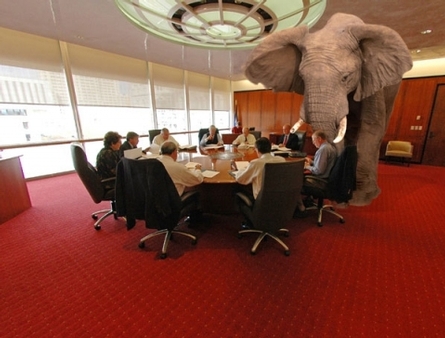
Two things happened yesterday that underscore the danger zone in which we currently live. The more dramatic event, an earthquake in central Virginia felt by many of us along the East Coast, had the social media tweeting for some time. The second event took the form of an editorial in the New Jersey Star-Ledger concerning GOP hopeful Jon Huntsman. Huntsman is quoted as saying, “The minute the Republican Party becomes the anti-science party, we have a huge problem.” An even larger problem is that the clock has moved well beyond the future tense. The editorial cites GOP candidates who routinely dismiss the science of global warming, evolution and other certainties as mere “data-fixing.” Perry and Bachmann have both decided they “don’t believe” in global warming. The elephant in the room, however, goes without mention.

The elephant in the room is religion, and it is a killer elephant, one that has a history of stomping those who attempt to control it. Politicians attack religion—whether or not it is bad juju makes no difference—at their eternal peril. In this “nation under God” (really under God) even a finger pointed towards conservative Christianity becomes a dagger plunged into a candidate’s chest. The Religious Right has been doing its homework for decades: no voice of reason can speak loudly enough to be heard over the songs of praise of the self-righteous. Reason, as scientists have discerned, cannot impact religious fervor. Belief can withstand a full-frontal attack from logic, reason—all that is sacred to rationality—and emerge without a scratch or dent. It is time that those in the middle and left took religious studies seriously.

Then I felt the earth move under my feet. As our house swayed and I checked on my daughter, I couldn’t believe I was feeling my third earthquake. I checked the web to see what in the world was going on. Interestingly, no witch doctors or Fundamentalist soothsayers were being consulted, but the scientists were. The news stories emerging minutes after the ground shook from Pittsburgh to Concord to Chapel Hill rang with the refrain, “scientists say.” Where was Rick Perry and his dowsing rods? Where was Michele Bachmann and her chicken bones? No, the religious war on science was switched off for a moment and those who felt afraid listened to those who actually knew what they were talking about. It was the elephant moving around the room, I say. It will only be a matter of time, however, before it is claimed that the people of Mineral, Virginia did something evil to prod an angry god into action.

Nobody felt anything, right?


Slash and Burn

Extinction is an evitable part of life in the universe we’ve inherited. Throughout the eons of our planet mass extinctions have occurred several times, and the new world that emerges is strange and unexpected. We as primates owe our existence to such a natural occurrence at the end of the Cretaceous Period. We evolved religion, which, in some species, bestows the right upon us to alter, or even destroy, our environment. The lame reasoning that generally accompanies such amateur theologies is that a deity is about to sweep down and reclaim those “he” (inevitably) likes. All the rest are just part of a hellish charade to make the righteous feel their entitlement more acutely. So we now find ourselves facing, as scientists warn, another great extinction. This one is of our own making.

The causes are not too difficult to discern. For centuries the dominant religions in the western world have preached messages easily mistaken for selfishness. The perverse aberration called the “prosperity gospel” is one such bastard theology. (I use that term in its literal sense here: the prosperity gospel claims false parentage in declaring that Jesus rewards the affluent with material wealth.) An article in Sunday’s New Jersey Star-Ledger points out that the unprecedented human involvement in extinctions. Using Haiti as a test-case, Faye Flam of the Philadelphia Inquirer notes that 99 percent of that nation’s forests have been wiped out as the poorest people in the western hemisphere seek wood for the basic necessities of life. Just over six hundred miles to the north begins one of the most affluent nations in the world where as long as we get our own, the rest of the world can go extinct. We are so blessed. While the loss of forest barely keeps the people of Haiti alive, it drives unnumbered species to extinction.

Entitlement is an odd phenomenon. Without those further down the food chain, the advantages of privilege disappear. When there are no poor to support the wealthy, the comparison fails. The same is true on a species level. As privileged Homo sapiens, we have climbed to the top of the mountain and made ourselves gods. Other species are counted as chattels to be divided up among the wealthy. The rarer they are, the more valuable. Problem is, once rarity reaches extinction there’s no turning back. Our environment placed us in this position and gave us the grey-matter to figure it out. Instead we liken ourselves to gods who do not need this world that gave us birth. Biology disagrees, as time will tell.

Icon of the prosperity gospel.


In God We Lust

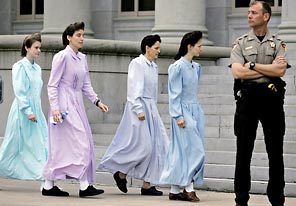
One of the entrenched ironies of human mentality is that reason will not suffice to change religious views. Many studies have repeated demonstrated that faith is impervious to logic, and this has appeared with Ektachrome clarity in the case of Warren Jeffs. Rev. Jeffs, the leader of the Fundamentalist Church of Jesus Christ of Latter-Day Saints, has painted himself into a mental corner that makes the logic of legal proceedings appear as slapping the idiot. Logic and faith do not connect. Any Christian who has read the letter to the Hebrews should know that. Nevertheless, Rev. Jeffs, having illogically dismissed his team of lawyers, has been attempting a divine defense to justify his alleged sexual abuse of minors. He remained silent during his opening statement, despite judicial advice that such a tactic might harm his case. Breaking silence yesterday with a nearly hour-long sermon, faith responded to logic and was found wanting.

Society at large fails to consider that studies of religion have been carried out from multiple angles over many decades. We have erudite studies of the philosophy of religion, the psychology of religion, the anthropology of religion, and the sociology of religion. They all point to the human origins of this phenomenon, often demonstrating that a basic disconnect remains when religious belief is brought into the harsh light of logic. Neurologists and biologists have explored the utility of religion as a survival tactic, and evolution seems to have blessed it. Yet trial lawyers, judges, law enforcement officials, and politicians—often themselves religious individuals—are charged with apprehending and convicting others who simply take their religion to extremes. Religions make untenable demands on adherents. God has a poor record of turning up in the courtroom. His divine statements are absent from the stenographer’s tape.

Not knowing the details, it is difficult to find much sympathy for Rev. Jeffs, should he be found guilty. Yet at the same time, his interpretation of religion differs only in a matter of degree from other religious sexual ordinances. Is it normal for a clergyman to live a lifetime of enforced celibacy? Although signing on the dotted line may indicate a tacit agreement with church policy, what young man can clearly anticipate the pressures of decades fighting biology and psychology? Yet the practice is perfectly legal. Until the nearly inevitable inappropriate results squirm out. Public rancor runs high, as it should, against child molesters. The children are innocent victims. The perpetrators, however, believe themselves to be following divine dictates. It would seem that much suffering would be ended if God would go on the record here, so that we might have solid evidence with which to judge the case. If it please the court.

Photo credit: Tony Gutierrez, AP, from The Seattle Times


Who Made Whom, Now?

John Lennon has great currency, in part, because he is a martyr. Music has moved on since the ‘60s and ‘70s, but aging Boomers still like to quote him, especially his song “Imagine.” In an article written for the Los Angeles Times, reprinted in the local Sunday newspaper, J. Anderson Thomson and Clare Aukofer cite “Imagine” as the statement of what a world “that makes sense” looks like. I applaud their idealism. Citing psychological and sociological work that has been done over the past decade in the attempt to unravel “homo religiosus” they entitle their article “God didn’t make man: man made gods.” Much of the evidence they cite has been discussed elsewhere on this blog, but the overarching issue—whether this explains human religious behavior or not—remains open. In other words, if evolution provided us with religion, it must have some survival benefit and humans are not easily going to dismiss it.

Admittedly, the evidence for human conceptions of God arising from the need for close connections in community is pretty convincing. Nevertheless, the issue of whether there is a God or not will never be answered by empirical observation. As I tell my students, belief is not based on empirical observation. We do not yet know why people believe, and even if we find the right node, neuron cluster, or sensory stimuli, there will always be those who insist that the hardware is sparked into action by the unseen Other outside the system. It is the classic chicken or egg debate, taking place in that henhouse in the sky. The problem is that God is more like the rooster in that scenario.

The human brain is an endless source of fascination. Science has given us a sense of wonder about our own on-board computer, but it has not managed to capture the sine qua non of the totality of the experience of owning one. Scientists also read, go to shows, make love and eat fine meals for the enjoyment of it all. But as Cipher says in The Matrix, “I know this steak doesn’t exist. I know that when I put it in my mouth, the matrix is telling my brain that it is juicy and delicious. After nine years, you know what I realize? Ignorance is bliss.” Our perception of the world as a stable, unmoving center of existence is an illusion. Science has revealed an even stranger reality involving equations that used to haunt my nightmares. Should God ultimately be reduced to formulae, true believers will find another entity to name as the divine. “Imagine… no religion too”? As long as humans are humans such a world remains pure imagination.

Imagine


After the Carapture

When my wife showed me the first news article about “Carmageddon” I shrugged my shoulders with a noncommittal “meh.” Now that the nation has somehow managed to survive the two-day closure of a highway in Los Angeles, commentators are wondering what this reveals about our cardolatry. As a nation, the United States worships cars. Last week predictions were made that traffic jams of biblical proportions would disrupt the second largest city in the country and that not even God would be able to sort out the mess. In Norway, in the meantime, a right-wing conservative Christian decided to tip the scales of justice by becoming a mass murderer. Why do we glory in our own destruction?

Human beings only developed what we recognize as religion after the advent of the city. Cities require temples and temples require religious infrastructure. Priests had much to gain in antiquity by proclaiming the wrath of God—the angrier the deity the more offerings that roll in and the wealthier priests become. Religion has evolved over the five-and-a-half-thousand years of civilization, but it has never had a true conversion. It is one among many ways of coping with the stresses of becoming an urban population. We live in cities and we have traffic jams. We live in cities and learn from those far different from us. We live in cities and bomb our enemies in the belief that God finds those far different from us evil. Apparently God approves of the killing of teenagers. Just ask old Ramesses about that one.

Norway is among the most non-violent and secular cultures in the world. Los Angeles is a liberal city among one of the most religious cultures on earth. They experience the wrath of God in different ways, according to the media. Cities gave us religion. When we had had religion long enough, cities began to withdraw from that particular approach to life. When we can’t get our cars where we want, it is the wrath of God. When we can’t get the government to follow our personal religious quibbles, we take the prerogative to introduce the wrath of God. We long for the end of what we have created. No matter how we achieve such destruction, we’ll find religion planted squarely in the middle.

What's coming to your neighborhood?


Religion Al Dente

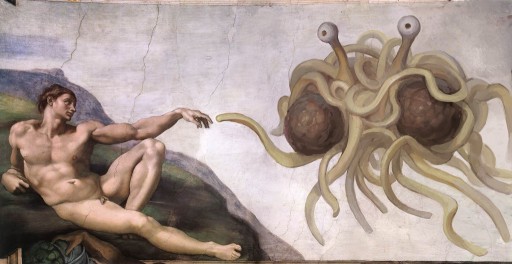
I first learned of the Flying Spaghetti Monster while teaching a course on the Bible and Current Events a number of years ago at the University of Wisconsin Oshkosh. Being freed from the confines of my humorless seminary teaching post, I was free to explore innovative ways to approach my subject matter. When discussing evolution, it was helpful to bring in Pastafarianism as an example of how some highly intelligent—and very creative—people deal with the ridiculousness of Creationism. Lest I be accused of unfairness here, Pastafarianism is also ridiculous. That is precisely the point. The Church of the Flying Spaghetti Monster (FSM) was formed to demonstrate that any inane idea might pass as a religion and should be given equal time with those who use ultra-conservative views on the Bible to effect public policy.

A friend sent me a link to a BBC story of an Austrian man who has finally been successful in his attempt to wear a pasta-strainer on his head in his driver’s license photo. Claiming the headgear to be demanded by the Flying Spaghetti Monster, Niko Alm wished to have his official ID photo taken with the symbol of his faith. I sense an evolution taking place here. The Church of FSM has gone mainstream in many respects; there is a Bible available, you can buy a bumper-magnet to rival a Jesus fish, adherents have designed a slick website, and it boasts many, many followers. While the website of the Church of FSM defiantly refuses to be taken seriously, it makes legitimate claims—religions do not require literal belief, and therefore Pastafarianism is a true religion with believers not being held to any particular doctrine.

The outcry against the FSM movement (which began roughly early in the new millennium) demonstrates its effectiveness. Are there really people who believe this religion? A tour of the website should be proof enough. The claims made by the group have analogues in traditional religion; many major religions teach events and doctrines that are equally unbelievable in the confines of the physical world in which we find ourselves. It is difficult to believe that Niko Alm actually takes this seriously, but who are we to judge? The FSM has moved from making fun of Intelligent Design to casting the very definition of religious belief into sharp relief. Who’s to say we haven’t all been touched by his noodly appendage?

Touched by his Noodly Appendage


Sanctuary

Sanctuaries are often difficult to get to, but are often even more difficult to leave. Various religions make use of the concept—a sanctuary is a safe place, somewhere away from the normal world. Perhaps this is one of the reasons humans devised religion to begin with; the world feels heartless and threatening much of the time, and a place where the unseen parent will keep us safe is a desideratum anxiously quested. The problem with sanctuaries is that too much safety inhibits growth. As history repeatedly demonstrates, sequestered religions grow stagnant and antiquated—frequently hindering more than helping.

The concept of a sanctuary is of a piece with the amorphous idea of sacred space. The idea that some places are different, special, or spiritually vibrant is one that admits of no testing or verification. Nevertheless pilgrims will seek out such places in order to recover a sense of balance or peace. Even scientists know the feeling, although it is frequently consigned to the psychologist’s couch. Finding that spot that gives momentary tranquility is big business, as any travel agent knows. While we may invest our sanctuaries with divine trappings, the practice is, at its roots, very human.

The world was not created for us. Congealing from a rapidly spinning mass of superheated rock and dust, it took a few billion years before life might even manage to float atop the cosmic embers. As part of this fascinating development called life, we have learned its hard lessons. Nature is beautiful and dangerous. We are its masters and its slaves. Some of us take great pains to escape to it and when it is time to leave we are ripped from it like a crying babe from its mother’s arms. Sanctuary is a human concept with divine implications.

A sanctuary


Dead Wood

nurse log

Whether it makes a sound or not, when a tree falls in the forest it joins that great cycle that embraces all living things. Decomposition is as much a part of life as conception. Rotting logs provide homes and minerals and nutrients to other living creatures. Although the individual life is over, life as a whole goes on. Nowhere is this more evident than in nurse logs. Nurse logs are those trees that directly host seedlings after they die. While examining such a nurse log yesterday my daughter said, “It’s life after death.” Resurrection. The more I reflected on nature’s resurrection, the more selfish the human concept seemed to become. We want—and some of our religions offer—individual resurrection, the continuance of me, not mere life.

Nature has no theology. In its immediacy and pragmatism, creatures live without pondering what it means, striving to pass on the gift of life they’ve been given through their offspring to keep the cycle going. Evolution may shape forms into new varieties along the way, but we are more amoeba than angel. We are part of something larger than ourselves. Unfortunately our society has evolved to emphasize individual drive over collective effort. We don’t want to tax the ultra wealthy, for they are where we all want to be. It is the poor who are sacrificed on the unholy altar of this thinking that truly reflect what nature intends for us to be.

To justify our selfish outlook humans made gods in their image, adding prerogative to perfidy. Somehow we deserve more than others—longer life and even more life after that. Evolution has, in its non-directional way, distorted the picture by providing us with inordinately parsimonious attribution of souls, according to theologians. Nature belies our paltry attempts at self-deification. Quietly in the forest a tree dies, offering its life for those that will come after. The nurse log knows the true meaning of resurrection, while we fumble to gain more for ourselves, backed by the religions we’ve invented.


Bread Alone

The sad story of the death of an eight-year old girl from Irvington, New Jersey bears uncanny echoes to a case a year and a half ago of a mother who starved her children believing God would provide. The current case of Christiana Glenn’s death is heart-wrenching and the outlook is not improved when it appears that the girl’s mother had religious motivation to abuse her child. Christiana died from untreated physical wounds and malnutrition, prompting columnist Kathleen O’Brien to write about how food and religion often come together in unusual ways. As O’Brien points out, religions generally safeguard children from food privations, but less scrupulous leaders of what are frequently termed “cults” do not have the same strictures. The only real difference between a religion and a cult is society’s attitude toward it—religions tend to be larger and with finer pedigrees, but beliefs are beliefs. When religions seek control over believers’ lives, they often delve into the practice of deprivations, generally mild. More extreme groups take the idea to fatal limits.

Even the Bible records from near the very beginning that deprivations are part of the religious expectation. One of the most complex and frightening stories from Genesis is that of Abraham’s near sacrifice of Isaac. No matter how theologians wash it, this story retains its stain of an adult—whether directed by God or not is a mute point—attempting to harm a child in the name of faith. The story, many centuries later, still sent Søren Kierkegaard into a tailspin that came out as Fear and Trembling. What kind of deity asks for a child to be harmed, even in jest? For Christiana Glenn, there’s no taking it back. The Bible tells us nothing of how the interior life of Isaac responded to this episode.

Food and religion are among the most common elements abused in American society. For our bifurcated (if not bipolar) outlook, one sustains body and the other sustains soul. While science still lacks evidence for the soul, the body remains the only basis upon which we have to base our ethics. Even biology dictates that care of one’s own young is an evolutionary imperative. It is tragic indeed when a religion overrides what all cultures respect as the ultimate “should” —take care of your children. In a world overpopulated by religious experts the street value of the soul will never face a recession. Believers, characterized my many religions as sheep, will go wherever their leaders tell them to go. As a culture suspicious of funding the study of religion, it may not be food that is reaped at the end of this harvest.

Thou shalt not...


Now Locusts?

With the same page of the newspaper lamenting flooding in Iowa and drought in Florida, it seems that nature has turned against us in an almost biblical way. A more biblical plague than locusts would be hard to conceive, however, so when my wife pointed me to a current video of a locust invasion in Russia, I took notice. In the United States we seldom consider locusts since they have largely ceased to be a problem with the extinction of the Rocky Mountain locust for unknown reasons, last century. One of the more interesting books I’ve read over the last few years was Jeffrey Alan Lockwood’s Locust: The Devastating Rise and Mysterious Disappearance of the Insect that Shaped the American Frontier. Because the locust is not an American problem, biblical literalists like to transform biblical locusts into something else. The transformation is not necessary. We’ve eliminated the large predators from our planet, and the small ones often go unnoticed.

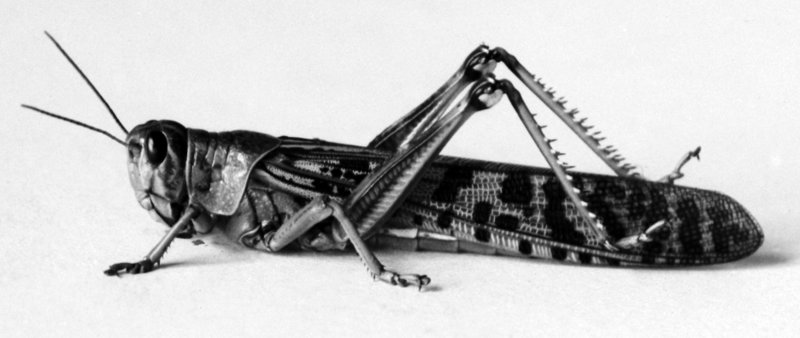
Each year as I lecture on the book of Joel, I spend a little time with locusts. The Asian varieties of locusts tend to reproduce rapidly and prolifically in the desert. Quickly exhausting the sparse food supply, they take to the air and fly for, literally, greener pastures. They can fly for three days without stopping which means they are suddenly there and eating everything. They look like divine judgment. Each locust eats its own body weight in green matter daily, and when a swarm can contain over 100 billion locusts, that can add up to 50,000 tons of food a day. Like poorly mannered house guests, locusts stay until all the food is gone, then leave. They are fully capable of devastating entire nations.

An actual biblical locust, vintage 1915.

Hal Lindsey famously converted Joel’s locusts into military helicopters, claiming that they presaged the end times. Decades later we are still here and so are, apparently, the locusts. They are part of evolution’s great machinery. The biblical view that we are the purpose behind that machinery has caused endless problems for the ecosystem. Locusts are a problem because they consume the food that we would otherwise eat or waste. In the struggle for survival, as Joel attests, it is not always the biggest that win.