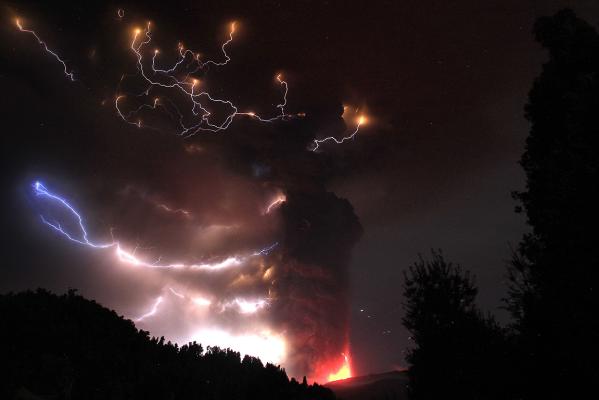
Vulcan’s Anvil

Volcanoes have long been the prerogative of the gods. Saturday’s eruption in the Puyehue-Cordon Caulle volcanic complex in southern Chile joins last month’s outburst from Grimsvotn in Iceland for divine fire-storms. In the days before geology, the only explanation for these impressive explosions was the gods. The concept of Hell was fairly late in the development of ancient Near Eastern religions, otherwise volcanoes might have been labeled as Hell breaking loose, literally. Many historic eruptions have influenced the course of history, most notably Thera and Vesuvius. Ancients would have been hard pressed to see such spectacular—and obviously divine—displays as “natural.” Indeed, the concept of “natural” events was itself slow in evolving since the gods were always lurking in the dark corners of the evolving human psyche.

Fortunately, beyond disrupting some air travel, these two latest outbursts have been fairly benign from a human point of view. This too is an evolved perspective since we tend to see ourselves as the overlords of the natural world. Watching industrialists poke new orifices in the planet’s crust for personal gain even in rare and delicately balanced ecosystems, who can doubt that we are masters of our own domain? Much of the misdirected sense of such entitlement comes from interpreting the Bible as declaring the planet ours from the days of mythical Eden. Some of the more perverse applications of this principle include those who try to force the hand of God into sending the Second Coming due to their creating conditions appropriate to an apocalypse. Others declare that since said Second Coming is nigh, why not trash the environment? We won’t be needing it much longer.

Apart from the obviously failure of logic here, the anthropocentric view is also misguided. The earth was not created for us—we simply evolved on it. The corollary also stands true: long after any human intelligence is here to read these words, our planet will continue on its weary track around the sun until it blossoms into a red giant and consumes our final cinders. There are no horsemen in the clouds, but this planet is all that we have (even the space station depends upon it) and when we grow too arrogant, the planet unconsciously gives us a spectacular display to remind us that we are mere guests upon this globe. We need to treat it with respect.

Inventing God

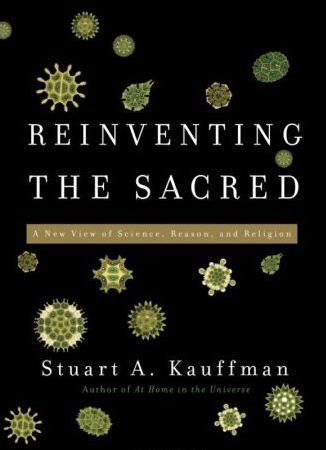
Reductionism has been a hallmark of science for many years with the most extreme forms suggesting a kind of cold determinism in the universe. Having known since my undergraduate days that science is the key to knowing, yet having the experience of believing as well, I wondered how they fit together. If they fit. I have just finished reading a very important book on the topic – Stuart A. Kauffman’s Reinventing the Sacred. A theoretical biologist, Kauffman has come to the conclusion that reductionism cannot account for many aspects of the world we actually experience. Evolution, biologically as well as culturally, demonstrates again and again a creativity that cannot be predicted, no matter how much data is acquired. Kauffman suggests that this non-reducible creativity is what might properly be called “God.” Not a believer in a transcendent creator God, Kauffman does not wish to remove the God meme from our psychological vocabulary, but to reinvent it.

In many ways, I found Kauffman’s work to be some of the most affirming science writing I’ve ever read. He believes there is a place for creativity in the overall human experience of knowing and being. Values are not simply arbitrary points selected by people, nor are they imposed on us from a personified God. Values and beauty are emergent phenomena. As Kauffman argues, they are clearly and blatantly real, but not reducible to physics. He also demonstrates that economics falls into the same category of real but non-reducible. As a researcher in complex systems, Kauffman quickly left me in the dust when he reached the more theoretical material. I am not equipped to assess his scientific conclusions. Overall, however, his book possesses a rare sort of urgency for a scientific exploration, and it values the whole of the human experience.

Demonstrating that ethics emerge not from “on high” but from a human sense of value and “right,” Kauffman suggests that we desperately need a global ethic to realize our full potential. In the ongoing debate between science and religion, Kauffman is a voice of both reason and compassion. Science is the way we know – there is no point in debating that. If you are reading this on a computer, Q.E.D. If you are a human being, then you have also experienced the phenomenon of believing, whether or not it is religious. Kauffman has addressed the question directly and has given both specialists in science and in religion a trenchant analysis of an intractable issue. His irenic approach is to be applauded, and hopefully, widely read.


Science of the Bible

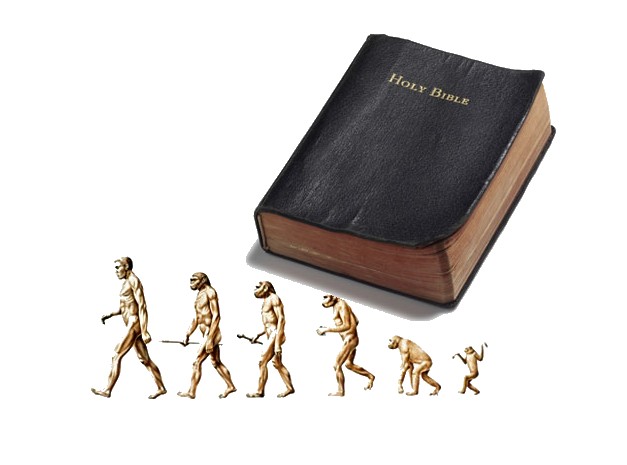
It should be a local decision. Science, that is. This straight from the mouth of America’s darling Chris Christie. New Jersey’s governor does not wish to weigh in on this one. His children attend private school. Yes, even New Jersey is under the anti-evolution gun. In the light of the inevitability of Creationism trumping real science, I’ve been working on a sample syllabus for high school science teachers. The way I see it, this new focus in American education should teach science the way the Bible does – no holds barred, no punches pulled. No picking and choosing like Creationists do – Hey! Put that cell phone down, it is a device of black magic! (This will need to be followed up, supernaturally, by a course on how to handle witches in the classroom.) My proposed syllabus looks something like this:

Astronomy: study of that mysterious dome that encircles our earth. It seems to have holes poked through it, or so it looks at night. Science can change depending on the time of day. The sun and moon live in that dome as well, as our astronauts can attest. (Their views that the earth is round, without four corners as the Bible instructs, are, of course, heretical.)

Meteorology: study of the windows of the dome. When God opens these it rains. When God is angry he sends fire down from the dome. The loud sound that follows that is his angry voice. So play nice!

Geology: study of the very center of the cosmos. Our flat earth home, with its four corners and steady pillars reaching down into Sheol, is the exact center of everything. There are no such things as dinosaurs (or cats) since they are not mentioned in the Bible. The layers that you see here and there were all caused by the flood in a matter of about 150 days. The whole thing took only 6 days to make.

Biology: study of the separate kinds God created. Let’s be honest here: the chihuahua and the mastiff share a common ancestor? Preposterous! God made each kind separately and they’ve stayed that way for the past 6000 years. Oh, and yes, animals have telekinetic abilities – that’s how they knew to show up at the ark on time. And when the flood was over the marsupials all knew to swim to Australia. Koalas are surprisingly strong in the breast-stroke category.

Humanology: study of human beings (which are not animals). We were created after the animals (unless you read Genesis 2, where we were created from dust before the animals) and are therefore superior to them. Our natural lifespan is about 600 years, but if you are really wicked you might make it almost to 1000. Reproduction is by means of men planting seeds in women. Females contribute nothing to new children except a womb of their own. We teach these new generations by using the science of miracles, and since there are no schools in the Bible, what are we doing here anyway?


I Swear it’s True

Spoon-fed the belief from youngest years that certain words are categorically bad, I find myself as an adult who daily plays with words wondering how this curious idea began. The taboo. The “badness” of select words can have nothing to do with the combination of sounds; one language’s swear word is another language’s polite invitation to dinner. It is the context of those sounds that constitute a swear, a cuss, a curse. Forbidden words. The sanctions against such words generally come from religious specialists who know the hidden power of human utterances. Even magic words trace their ancestry back to religious elocutions. In a report sure to be condemned by many religious groups, the journal NeuroReport has announced this week, according to the Los Angeles Times, that cussing makes you feel better.

In a controlled experiment involving ice water (shudder), participants who swore in response to the pain were found to have higher tolerance to discomfort compared to those who suffered in saintly silence. Those writing the report theorize that flight-or-fight response may be triggered by angry expostulation, giving cussing a survival advantage when used judiciously. I had previously read reports that suggested swear words, different for each language, were societally determined and were intended to freeze action (without ice water) in a similar way to a lion’s roar. Indeed, apart from those who habitually cuss, thus cheapening the effect, an inappropriate word is often enough to get the attention of a room full of people (not that I would know).

No matter what their psychological origins, taboo words exist in every culture. Whether they are intended to hurt or help is a matter of theoretical perspective. There is no question that these words possess the power to give pause. I am reminded of a former student who had gone on a missionary trip to a part of the world where Indo-European languages were not the norm. Introduced to a young Christian woman who had a name that sounded to English-speaking ears like his host (a bishop) was suggesting he commit an immoral act with himself, said student turned red with indignation. Months later, safely back in North America, he remained scandalized by the experience. In their context those sounds meant nothing inappropriate – so swearing is in the ears of the beholder. Before you decide to use this curative, however, be aware that the study reveals the best results in pain control apply to those who generally do not swear. Many of those I have worked with through the years would perhaps find a non-swear word far more helpful in stopping pain than their everyday vociferations.


O Tenn Won’t You See?

Truth goes to the highest bidder. In the United States the highest bidder is the party with the numbers to get elected. Truth by democracy. Once again Tennessee is flirting with Creationism, if not having already climbed into bed with her. High school biology teachers nationwide are afraid to take on the issue directly; many of them are told by their clergy that the concept itself is anti-Christian. This is what happens when mythological needs go unanswered. No one has yet deciphered why human brains evolved the capacity to believe in outside agency beyond the realm of nature. Many Fundamentalists use the phenomenon as proof of their pre-decided answers, despite their willingness to utilize this evolved Internet to spread their ideas. If evolution is false the Internet does not exist.

The larger issue here is the fact that educators have, by-and-large, dismissed the impact of religion. Particularly in higher education. Everyone has their own religion, we don’t discuss it because someone will become offended, and we pretend that, gosh-darn-it, people are just too smart to believe all that. Meanwhile millions of tax-payer dollars are wasted on cases continually going to court where one subset of one religion insists that its mythology has a right to be taught as science. Even the Fundamentalist’s strange bed-fellows in other conservative issues, the Roman Catholic Church, has stood up and put on its slippers. This one is not a matter of opinion, ecclesiastical or otherwise.

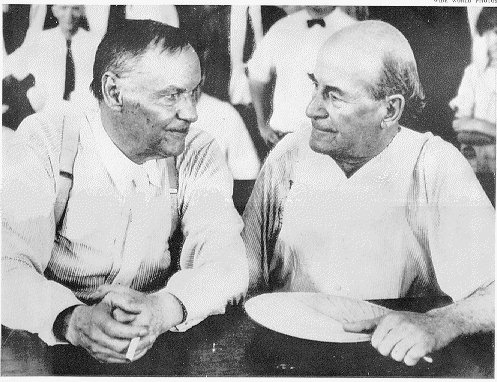
But religious folk understand that if they elect the right candidates, the issue can be forced again and again. The Creationist tactics are evolving to fit the situation. Meanwhile, not only religion, but also the study of history is largely dismissed as irrelevant. It is history that demonstrates the birth, growth, and current goals of the movement. The Scopes Monkey Trial was nearly ninety years ago, but it may as well have not taken place yet. If William Jennings Bryan had been smart, he’d have waited until his cohort had had time to carefully sow their seeds, water, weed, and fertilize them (using the oldest known material to ensure growth – plenty of manure) and then take it to legislators. The results are as predictable as the sunrise over our flat earth.

Seems just like tomorrow...


Genesis Rising

Educating against the grain of an unthinking religiosity is a sobering enterprise. Every semester students provide presentations for my intro class on various issues that the Hebrew Bible informs in wider society. Inevitably one group will choose evolution as the relevant topic. While the actual theory of evolution is outside the scope of a Bible course, I spend more time on Genesis than on any other book. I carefully explain how “science” is a concept absent from the biblical world and how the creation myths in Genesis have no basis in the physical reality we know. The world Yahweh is busy creating consists of a dome turned upside-down over a plate-like earth. That see-through dome keeps out the waters that rush back in a few chapters later to flood the world. It is a fantasy world that even the most intractable creationist can’t accept. (Well, maybe not the most intractable.)

Nevertheless, the Creationist movement that began about 1920 has done its homework. That homework, unfortunately, has been in disciplines that both biologists and biblical scholars ignore – public relations. Any observer of modern American society can easily see the distrust with which education is regarded. As a culture, we dislike those who “think they’re so smart” while we daily use the gadgets and devices they design and improve. Biblical scholars are especially suspect because they engage in the most hubristic of all human activities: storming Mount Olympus (oops, sorry, Heaven) itself.

In a typical Rutgers University intro class of 50 or so students, with a wide variety of majors including the sciences, student presentations on evolution ultimately end up suggesting “let the students decide for themselves.” Although they consistently rate my instruction highly, they just can’t let go of the gnawing belief that Genesis 1 describes the world as it actually is. Disappointed, I am not surprised. When headlines constantly demonstrate the antipathy – if not downright hostility – that governors and some presidents have for education, we will reap what we sow. That, by the way, is from the Bible.

(It's just made of green cheese)


Ring of Fire

It looks so peaceful from above

The great tragedy unfolding in Japan has many Internet pundits wondering if this is a sign of the 2012 apocalypse. In reality it is simply a great human tragedy, a reminder that we are creatures who’ve evolved in a dangerous, often inhospitable universe. Natural disasters may have been one of the stimuli for the development of religion in the first place. Now we can look to seismology and tectonic plates to find out “why” hundreds had to die in Japan, but the human psyche demands a metaphysical reason. Some Christian websites are quick to point out that only a very small percentage of Japanese are Christian. Born with the sin of not being American, well, Shinto happens.

Like last year’s Chilean earthquake, this current disaster has once again shifted the earth on its rotation axis, according to the U.S. Geological Survey. GPS markers on the coast of Japan indicate that the large island has shifted over two meters because of the quake. The world was not made for us, however. We evolved on a planet, peopled it with gods, and decided that they created this place for us. In reality, we survive on the basis of our adaptations to this planet. Any planet dynamic enough to support life will be volatile enough to demand life from its inhabitants.

This is not as fatalistic as it sounds. Religions reflect the impotence humans feel in the presence of raw nature. We’ve shed many physical defenses for the advantages of large brains that require us to piece together a sensible view of an event that has no inherent meaning. The fact is that we are not in control. Once we eliminated the smaller-scale threats of exposure and the dangers of predation, we left ourselves open to macro-scale disasters that no human is large enough to impact. And we know, deep in our psyches, that this is simply part of the price we pay for being human. 2012 will come and go with its own share of natural disasters, but right now we should focus on helping those who’ve experienced their own current apocalypse.


Gila’s Got the Whole World

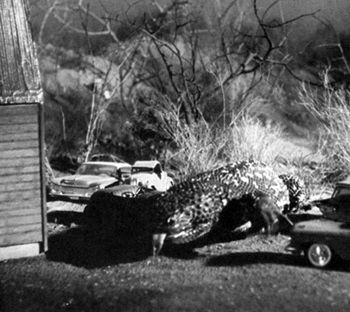
Singing pretty-boys and colossal lizards – it must be time for The Giant Gila Monster. A horror film that portrays all the innocence of the 1950s before the Beat Generation led us down the path to reality, the film has earned cult status in recent years. More accurately titled, “A Regular-Sized Gila Monster Filmed in Close-Up,” the sub-mediocrity of the movie has probably done more for preserving it in popular culture than any other aspect. The film stars the relatively unknown Don Sullivan as a great teen role model who writes and performs his own songs. The number that receives the most Internet attention, and the one that makes this movie of interest to this blog is “The Mushroom Song.” Chase Winstead (Sullivan’s character) has a young sister who is just learning to walk with leg braces. To cheer her, he picks up a ukulele and sings: “And the Lord he said I created for you/A world of joy from out of the blue/And all that is left to complete the joy–/Just the laugh of a girl and boy/And there was a garden, a beautiful garden/Held in the arms of a world without joy/Then there was laughter, wonderful laughter/For he created, a girl and a boy/And the Lord said, laugh, children, laugh/The Lord said, laugh, children, laugh” with the final line repeated numerous times.

Laugh, children, laugh

Perhaps intended to underscore the societal norms of a time when “the Lord” made frequent appearances as an unseen supporting actor in many movies, this song is oddly out of place. The disability of Missy Winstead is obviously a device to raise tension: how will a disabled girl run from a giant lizard? The song, however, provides the resolution – the Lord will take care of all good people. Their response should be to laugh. The reference to Adam and Eve, fitting for teen fantasies of all generations, also belies the evolution of this monster. The gila grows to its great size because of chemicals in the water that wash to the delta somewhere in Texas. This creature did not evolve. The Lord will take care of it. The Lord and nitroglycerin.

Respectful teenagers with predictable haircuts and a society that believes a missing teenage couple could be doing nothing but eloping fits the world of the Religious Right exceptionally well. Even though they may not be perfect, these kids know right from wrong for they live in a black-and-white world with no ambiguity or ambivalence. Children of subsequent generations have grown up with shades of gray or psychedelic colors. The older generation is frightened by new developments, claiming that the world they know is about to end. In fact, an evolution is occurring. Those who try to hold society to the norms of the 1950s would do well to move ahead a decade and at least listen to Bob Dylan. No matter how far we progress, however, it seems that Texas will always delight in producing Lord-loving, bloated threats to rational civilization.


Vindication

Back in the summer of 2009, I chose the name of this blog on a whim. Relatives had been encouraging me to provide a platform for podcasts and the occasional post and asked me what I would call such a blog. The pun of sects and violence initially drew some good humored interest, but there was a serious subtext beneath the choice. Nature has now published an article declaring that violence and sex are related. (Sects and violence is a no-brainer; just look at the newspaper.) The connection has been established satisfactorily only in the brains of mice so far, but what is the real difference between mice and men?

Yes, men. The studies focus on the male brain, that organ that continues to confound those of us who daily try to use one. Certain circuits in the mouse hypothalamus trigger either a violent or loving response when stimulated certain ways. Aggression is almost an automatic response. My mind tied this in with the Singularity article in last week’s Time. As we race forward with technological mergers between artificial intelligence and the human machine, do we really understand what that brain is that we are attempting to emulate electronically? Biology, according to many theorists, does not bow to the rules of reductionism. What happens when the violence of natural circuits (fight or flight) kick in with titanium feet?

I commented on a friend’s post when he cited the Singularity article in Time. Others responded to my remarks suggesting I did not take the reality of this seriously enough. Those who are familiar with Sects and Violence in the Ancient World will have no such questions. The minds that have given us both gods and guns are machines that can not be replicated precisely. Their function is to keep a degenerating biological mass alive. Electronic brains with replaceable parts (think Wall-e) have no such concerns. The missing limb syndrome is a very human response that is well recognized by those who understand the human psyche. And that psyche, it seems, is ready to fight as long as it is properly stimulated.

A boy's eye-view of the world


Evolving in America

Columnist Leonard Pitts Jr. is one of the most sensible men in America right now. Witty, humble, and bright, he sees clearly and shoots straight. In an allegory entitled “A tale of a giant grown stupid” he illustrates the frustration many intelligent people feel in a country where thinking is viewed askance, and accepting empirical data is rife with suspicion. He begins his article by citing a statistic in Science that indicates some 60 percent of high school biology teachers in the United States inform their students that they don’t have to believe in evolution, they just have to know enough to get through the test. And evolution is not alone in the field of falsified information. Americans are regularly fed a high-fat, low-fiber diet of poor quality religion and told it is the only correct one.

While the remainder of the developed world has moved on to more important issues, we in America are still stuck in Fundamentalist kindergarten. The constant barrage of insipid theology from self-proclaimed doyens of the Scriptures assures the masses that the price of heaven is a healthy dose of creationism. Making matters worse, most biblical scholars choose not to engage these misguided spokespersons, choosing instead to believe they’ll eventually just go away. But why go away when you’re winning the fight?

Evolution is such an odd issue over which to argue. Neither serious biologists nor serious biblical scholars have any problem with it. Only a society increasingly under the power of a jacked-up, over-eager, offensive Christianity buys the feeble creationist rhetoric. And buys it in bulk. That is the American way. For many, society’s ills may be blamed on too much thinking. The Bible requires no thought, just the ability to see in black and white. And the Bible has proven a more powerful weapon than an H-bomb in the educational curriculum of our bright young minds. America itself is evolving. Unfortunately it is evolving into a nation satisfied with simplistic solutions to complex problems. And Bible scholars do nothing and wonder why everyone ignores them. Once upon a time there was a giant. Only it was not sleeping, it was already dead.


Misjudging Dinosaurs

Two dinosaurs diverged in the middle of evolution, and I’m not at all sorry that they both flourished. One became an herbivore, harming no one but plants, while the other grew into a carnivore, eating its siblings. That’s the way of this evolutionary universe. The Eodromaeus and Eoraptor split took place near the very inception of the dinosaur form, with the most basic of existential options: eat or be eaten. Noted paleontologist Paul Sereno has been excavating these Argentinean Lilliputian dinosaurs and has detected that the species, while similar, had irreconcilable food preferences.

Dinosaurs are often relegated to the age of children. When we grow up, we’re supposed to take interest in more modern developments and leave the dinosaurs in the dust. Their value, however, is often underappreciated. We learn about our world by examining theirs. Identification is subtle and sometimes wrong. Little Eoraptor is now thought to have been the plant-connoisseur, despite the terrifying, Jurassic Park-sounding name. We call them what we think they might be. Further discovery often changes the complexion of the picture.

When forced into a choice of more adult occupations, perhaps I unwittingly rebelled, choosing to study ancient religions. Like dinosaurs, religions evolve. As a child it was far easier to tell the preferences of dinosaurs since their morphology often gave them away. Religions are much more subtle. We are told that some dinosaurs survived in the form of birds. Many, many millennia of evolutionary pressure reduced their size and morphed their scales into feathers. Sometimes it’s hard to recognize a carnivore even when it’s just outside your window. That’s the way it works. Some follow the herbivore track, others prefer the way of the carnivore.

It's not the Eoraptor you think you know (from WikiCommons)


The Politics of Dentistry

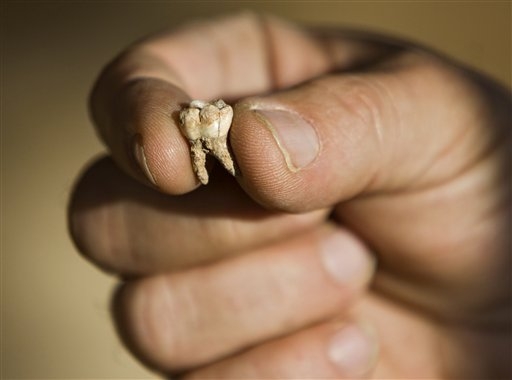
A story from the Associated Press on NPR this week announced the discovery of some teeth. No ordinary teeth, these perhaps belonged to Homo sapiens at 400,000 BP (“Before Present,” no apologies to gas-guzzlers). And they were found in Israel. Archaeologists from Tel Aviv University are quoted as stating this could rewrite the story of human evolution, suggesting that modern humans emerged some 200,000 years earlier than thought, and in Israel instead of in Africa. Now those are some ambitious choppers! Coincidentally, the discovery was announced the day I was discussing the earliest human occupation of the Levant in my Winter Term class. Of course. One of my students pointed the article out to me.

One of the endlessly fascinating aspects of archaeology and paleontology is the constant surprise of discovery. Often I have to remind myself that the past only exists in reconstruction. Once the moment is over it is lost forever, only to be rebuilt by specialists in documents and artifacts. Reconstruction, however, often comes with a political price tag. Anyone who follows the claims based on archaeological finds knows the folly of discovery. In disputed territories the work of archaeologists is used to stake claims to modern land ownership. Who in the world would not want to own the first location where modern humans emerged on the planet? What staggering claims could be made!

I have always sensed a comfort when thinking of human origins in Africa. Far from the (modern) industrialized mayhem of “civilization,” early hominids took their first tentative steps in Africa. Cut off from the rest of the post-Pangean continents except via the narrow passage of the Sinai, Africa harbored our pre-sapiens ancestors. Once they reached Asia and Europe, they interacted with Neanderthals, as genetics now demonstrate. Interaction led inevitably to extinction, so politics had to have been involved. To find the pre-political Garden of Eden, we need to cast our eyes on Africa. Anthropologists are even now disputing whether the teeth are of Homo sapiens or not. I find, when I’m in the dentist’s chair, it is best to leave politics out of the discussion.

From the Associated Press


Ouroboros

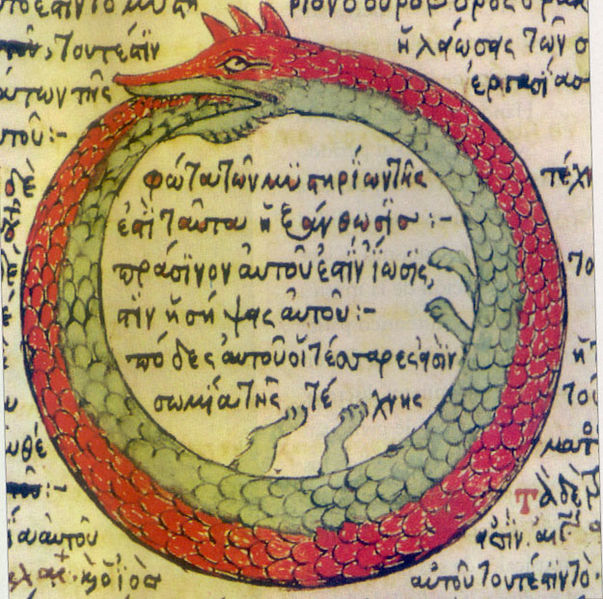
The Science Channel’s program, Through the Wormhole, hosted by Morgan Freeman, has a noble goal: help educate non-scientists with cutting-edge ideas. The series opens with an episode on God: “Is There a Creator?” Interestingly, in our society there are those who turn the question around. Religious folks ask the question: does science really have the answers? It is the classic ouroboros, the snake swallowing its own tail. Perhaps the best way to consider this entrenched issue is to consider its history. Gods emerged as explanatory figures. In the days when the Bible was the oldest known book, it was believable that God had dictated it and therefore the idea of God required no explanation: the ultimate tautology. When extra-biblical material predating the Bible was discovered, a warning bell rang. Most established religions in the western world simply pretended not to hear.

Snake, dragon, whatever.

Neuroscientist Michael Persinger of Laurentian University features in this Wormhole episode, demonstrating his “God helmet.” The principle is that stimulating the specific part of the right hemisphere of the brain that corresponds to the left hemisphere’s region of “selfhood,” a brain will fabricate a presence. While the experiment has promising results, it can’t fully explain God. Other neuroscientists are working on the issue as well. Historically we know that Yahweh was one among a polytheistic entourage of deities. With the stresses and mysteries of exilic existence, monotheism was born. Only one of those many gods survived. By studying the character of Yahweh’s departed compatriots, however, we can learn of the origins of gods as well.

Science entered the picture much later. By the time of truly empirical observation, God was an assumption as certain as ether. When science offered an alternative explanation, religion countered. “I see your Big Bang and raise you one Prime Mover.” And thus it will always go. With no witnesses, alas, no intelligence even yet evolved, our universe began. We can ask the physicist or we can ask the priest. Even if God is discovered and described in the laboratory, with or without a helmet, those standing outside will always believe, with Anselm, that there is an even bigger one somewhere out there.


Explaining Religion

Religion Explained, by Pascal Boyer, is one of those books that I wish had been written earlier and I had read earlier. Like several of my recent reading projects, this book was suggested to me by my cyber-friend Sabio Lantz’s blog. In the course of a very busy semester, it took several months to read, but Religion Explained is an astounding book that raises the ultimate issue: whence religion? Among the many revelations in this monograph – based on solid anthropological and sociological data, as well as neuroscience – is that religion has multiple origins. As Boyer demonstrates repeatedly throughout his book, religion arises from several mental processes symbiotically supporting assumptions that, taken alone, would often fail to survive in the meme pool.

Summarizing Boyer’s work would require a book in itself, but a few of his points struck me as particularly apt to today’s struggle between religion and society. At one point (140) Boyer demonstrates that doctrine is not nearly as important to religions as most specialists assert. In fact, most regular adherents to a religion misunderstand the doctrine to which they give lip service. After having spent too many years in a doctrinally ossified seminary, reading Boyer’s analysis was like liberation at this juncture. As Boyer points out later (282) Christian doctrine emerged in the conflicted environment of revolutionary movements with differing ideas as to what a messiah was. Only after the situation became too complex did one group decide that councils were necessary to decide what they in fact believed. Not really an inspiring story for those who wish to claim absolute certitude about their belief structure! Boyer also draws from other religions around the world to support his case.

Having stated that, Boyer does not attempt to destroy religion, but to explain it. The very premise itself will obviously strike many as blasphemous, but religion, like all human practices, can be studied with a scientific outlook. Accessing anthropological studies and neurological analyses, and the battery of tools provided by decades of psychological and sociological research, Boyer’s portrait is lifelike and believable. Religion developed as an amalgamation of human survival strategies that synchronized into a relatively consistent system that helped to explain a confusing world. If I had read Religion Explained when I was in college, my lifelong religionist enterprise might have turned out rather differently.


Lead Us Not

The media love the story of the fallen. Sometimes even those in religious institutions secretly delight in seeing the foibles of their infallible leaders. Part of the problem is that many clergy (but by no means all) place themselves on a moral precipice impossible to reach by mere mortal standards. So the Associated Press carries the story of a Neptune, New Jersey pastor who’s taking a sabbatical. What makes this leave noteworthy is that Pastor Miller railed against his flock using Facebook, arguing that it leads to adultery. So far, so good. This is standard pastor-babble. The problem is a decade ago the good reverend was involved in a ménage à trois, thereby predating even Facebook and still finding access to adultery. The response of Living Word Christian Fellowship Church: take some time off.

The real problem, the Republican symbol in the room, is that human nature likes to place the blame elsewhere. “The Devil made me do it,” was the 1970’s version (thanks, Flip!). Many religions, uncomfortable with the implications of humanity’s evolution, have devised means of shifting the blame. Augustine gave us “original sin,” suggesting that the true blame went back to our first biblical ancestors and forever made sex dirty. Somebody else must take the fall, as the Neptune preacher has discovered. The words of another famous New Jerseyan capture the sense exactly: “Now he walks these empty rooms looking for something to blame, if you inherit the sins you inherit the flames. Adam raised a Cain.”

Coming to grips with being human may be the greatest challenge bestowed by consciousness. There are primate survival strategies inherent in shifting the blame. Where evolution is disallowed, supernatural agency – even Facebook – is placed in the dock. Facebook may encourage the wasting of time on trite sentiments endlessly repeated across this universe we call the Internet, but it can hardly be blamed for adultery. For that, the beast is within. And those who place themselves on pedestals have a great distance to fall.

Lead us not into Facebook...