Curious Valley

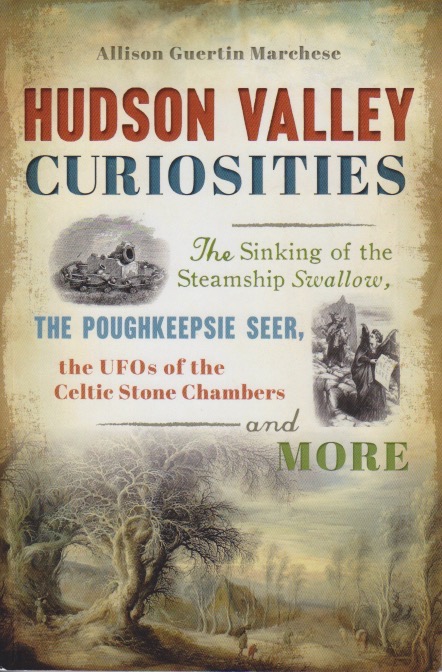
Another of my guilty pleasure reading categories is local history, written by locals.  As a genre these books may not always go back to primary sources, and they may get a fact or two wrong, but still they’re endlessly fascinating and I always learn something (which is the point of reading, after all).  I enjoyed Allison Guertin Marchese’s rambles along the Hudson Valley.  I’d encountered some of these tidbits before, but most of them were new to me and show just how interesting a place this particular river valley is.  Living in a strange world is so much more beguiling than a prosaic, predictable place.  Still, you’ve got to accept that anything can happen.  Unlike many such books, Hudson Valley Curiosities does not focus on paranormal, although ghosts and UFOs turn up a time or two.

Since this region is about 145 miles from end to end, the book divides it into lower, middle, and upper regions and gives about equal time to each.  The curiosities range from mastodons to prohibition busters, from shipwrecks to Shakers.  I’d never made the connection with the Shakers and the Hudson Valley before.  While the Shaking Quakers had their origins in England, they eventually migrated to the New World, settling in the northern end of the Hudson Valley.  The book points out that they were noted inventors, living by their own means as they did, they came up with their own solutions to problems.  Another aspect of these curios is the number of them that involved women who took on the cause of women’s rights.  The first female candidate for President of the United States, Victoria Woodhull, is discussed, as is Deborah Sampson, the woman who dressed as a man to fight in the Revolutionary War.

Marchese provides a helpful bibliography as well.  As someone trained in historical method, I like to go back to the sources.  Of course, that means assessing both publisher and author, and taking into account what passed for facts at the time.  History is an endlessly fascinating enterprise.  Many historians, however, leave out the controversial or questionable materials that a local historian is inclined to leave in.  That’s what makes books like this such a guilty pleasure.  Who doesn’t like to look behind the curtain now and again and see what’s happening out of the public eye?  And it’s helpful to keep in mind that by far the most of history takes place far from the headlines.  That’s where real life happens, no matter how strange.  And it’s a guilty pleasure to read about it from a local who finds, gathers, and preserves the stories.


Striving for

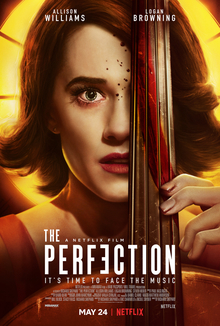
Get Out! was Allison Williams’ first feature film starring role.  Playing the unsuspected villain, she was incredibly believable.  Then I saw M3GAN where her role was again not exactly that of protagonist.  Curious, I decided to watch The Perfection, the horror film between the two in which she also stars.  As always, she starts out looking innocent enough, but this film has so many twists that you might be left feeling a bit dizzy when it’s over.  Williams plays Charlotte, a gifted cellist at the prestigious Bachoff Academy.  Forced to leave by her mother’s stroke, Charlotte became a full-time caregiver, leaving her promising career behind.  She’s superseded by Lizzie, whom she meets in Shanghai as the two are judging a scholarship contest for a new Bachoff student competition.  Lizzie and Charlotte hit it off and travel across China together.  Lizzie, however, falls ill and has to have her hand amputated.

A flashback reveals Charlotte tricked Lizzie into that situation so that the Bachoff star cellist would no longer be useful to the academy.  Another flashback shows why: Anton Bachoff has devised a horrid punishment for making mistakes while playing.  While this is disturbing enough, it takes place in “the chapel”—a room designed with perfect acoustics—and is done to please “God.”  This set-up has been operating for years and Charlotte was rescuing Lizzie from it, albeit in a rather extreme way.  The two cellists team up to bring Anton down.  There are quite a few holes in the plot and rape revenge films are one of the kinds I tend to avoid.  Still, the integration of religion with the horror is intriguing here.  One of the opening establishing shots is a close-up of a crucifix.  Sacrifice is indeed a theme of the film.

Critical opinion was mixed, but mostly positive.  The plot twists get you thinking that Williams is again playing the unexpected villain, and in a way she is.  Still, the real villain is a man who manipulates religious rhetoric (God demands perfection) in order to supply him with access to talented young women.  When they achieve international stardom, they’re not inclined to join #MeToo and lose everything because Anton is not only wealthy, but highly respected in classical music circles.  This is an odd sort of horror thriller that works on some levels but that leaves you feeling violated on another.  It doesn’t play out the religion element in any detail, which would’ve been helpful.  At least it would to a certain kind of viewer, who’s trying to figure out how this all fits together.


Perhaps Unexpected

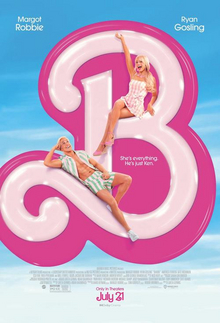
Of course I’d heard about it, but I hadn’t envisioned myself seeing it.  My family, however, wanted to get in on the Barbie conversation and, I justified to myself, at least we’d be in air conditioning for a couple of hours.  Besides, I now get “senior” rates at matinees!  I knew very little of what to expect, and I was pleasantly surprised by what I found.  In fact, I can’t remember the last time I saw a movie that was so full of social commentary.  And I actually learned quite a bit.  If you’re one of the maybe a dozen people who hasn’t seen it, the plot is more complex than you might think.  And the writing is smart.  And it’s funny.  I was hooked from the opening parody of 2001: A Space Odyssey.  The scene based on The Matrix made me realize that I was watching something unusual and important.

I’ll try to be careful with spoilers here, but basically, stereotypical Barbie experiences an existential crisis that leads her to the real world to find out what’s going on.  Ken tags along, uninvited, and Barbie is distressed to find that the real world hasn’t been equalized between the genders the way that she was intended to help it become.  While in the real world Ken gets a taste of patriarchy and decides to take it back to Barbie Land.  When Barbie returns she finds her once perfect world upside down.  But that’s not quite right.  She comes to realize that the world run by women wasn’t exactly perfect because men and women need to cooperate and share some responsibility.

There’s a lot more to it than that, of course.  How we’ve gone for centuries maintaining male dominance (might makes right philosophy), even while claiming to be “enlightened” is a mystery. Gender inequality is one of the biggest social concerns we experience.  Almost nowhere in the world are societies truly equal and Barbie offers a funny, yet poignant way of thinking about that.  I wouldn’t bother writing about it if the message wasn’t important.  The movie isn’t a feminist screed.  Nor is it simplistic drivel.  It’s a surprisingly sophisticated consideration of a society out of balance.  I’ve been in favor of equal treatment of women for as long as I’ve been conscious of the difference.  Raised by a capable single mother, I noticed in my formative years that she was doing what two-parent families did, with less than half the resources.  While Barbie won’t solve all our social ills, it is getting the conversation going.  From my point of view, it’s about time.


What You Can’t Show

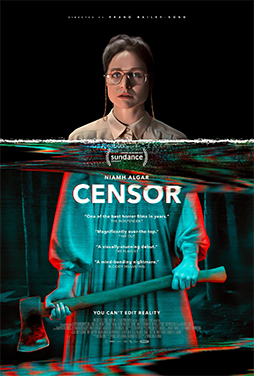
As I spend my life trying to figure out why I do what I do, I take book and movie recommendations.  I really should note who recommends what because it often drives me crazy trying to figure that out after the fact.  A friend recommended Censor, and since this friend told me where it was streaming for free I’m sure I got the right one.  Like several one-word title movies, there are several with the same sobriquet.  This was the 2021 movie and it’s a British horror film which raises the question of why we watch horror.  It does this through the eyes of the eponymous censor (Enid) who’s particularly tough on movies.  Set during the “video nasty” scare of eighties Britain, the question is whether such movies motivate real violence but with the twist that the censor is the one who turns violent.

Enid is haunted by her missing sister and she finds a video nasty star who looks like her sibling and becomes convinced that it’s her.  Enid gets to the set where her movie’s being shot (a remote cabin in the woods) and ends up killing the star and director (after accidentally killing the producer earlier, in self-defense).  She kidnaps her “sister,” and in her imagination—rainbows are everywhere—takes her home.  That’s where the real social commentary comes in because during this imaginary drive the radio announcer says these kinds of movies have stopped, and all crime and violence have ceased, and social harmony has returned to Britain.  This is revealed, of course, as a delusion.

Left to my own devices, I probably wouldn’t have watched this movie.  I don’t like blood and gore—I’m more looking for gothic themes like haunted houses—but it turns out that this is a smart film.  That’s probably why it was recommended to me.  Intelligent but also with tongue in cheek at times.  Still, it’s a movie about reconciling with childhood trauma, which is something that speaks to me personally.  That’s a wound I don’t always like to have poked.  It’s one of those movies on which I’d like to see more analysis, maybe talk to Prano Bailey-Bond, the writer and director.  Horror with female directors is often thoughtful, and movies are really meant to be discussed (just like books are).  The question remains—why do we watch disturbing movies?  I know I’m not the only one who does.  And in this case I remember who recommended it, so perhaps I’ll be able to get some closure.


Baptist to the Future

Setting aside their smartphones and MAGA hats for a moment, the Southern Baptist Convention voted to exclude women pastors this week.  The photos seem to show a rather dour delegate pool that seems ready to head to the apothecary for some leeches to take care of this headache.  The conservative mind is a curious place.  I can understand wanting to slow change down—it is moving at a scary pace, leaving many of us concerned and confused.  Yet the idea that nothing has changed in two millennia isn’t only demonstrably wrong, it’s something that history demonstrates is a relatively recent, and reactionary, idea.  The fundamentalist brand of religion that elevates the Bible to godhood has only been around for about a century.  It’s a reaction to a hundred-year-old modernism that, in spite of all the evidence, closes its eyes.

Fear is natural enough.  Some of us actually watch horror movies voluntarily, after all.  But when fear overtly drives your religion isn’t it time to stop and ask what you’re doing?  The Southern Baptist Convention ejected its largest church, Saddleback, which had achieved national influence under Rick Warren.  According to the New York Times, Warren himself addressed the Convention citing none other than Billy Graham in his defense of women pastors.  The convention overwhelmingly voted to excise its most successful church for fear of that dreaded slippery slope of liberalism.  We’re fixated at some sexual level, it seems, and afraid of what might happen if we admit that even as AI is taking over our world, things may have changed.  At least a little.

The Bible is a sacred document with a context.  That context was patriarchal and it held considerable sway for about two millennia.  Power is difficult to relinquish.  When you get to call all the shots you don’t want to be reminded that those shots are wounding and killing innocent people.  “It was just better that way,” people think, ignoring the very Bible they worship.  It’s a point of view I understand, having grown up in it.  I remember reading with the juvenile furrowed brow of some tender twenty years how C. S. Lewis simply couldn’t see how women could be priests.  And then noticed how Baptists and other Protestants embraced Lewis although they condemned his idolatrous Anglicanism.  Sometimes it’s difficult to believe we’re actually in the twenty-first century with AI knocking at the door.  And we still can’t get over women wanting to be in the pulpit.

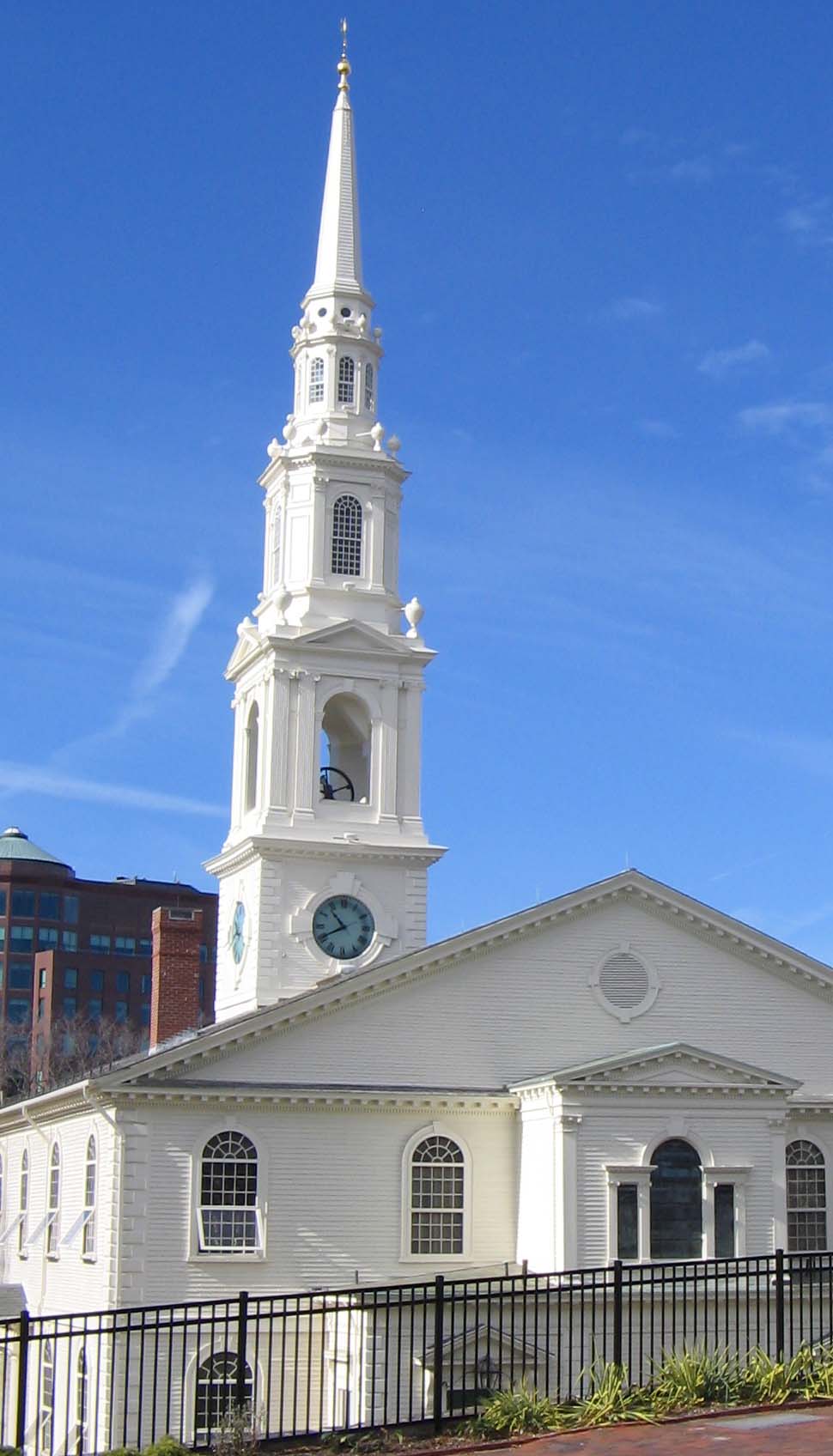
What would Roger Williams say?

More Water Monsters

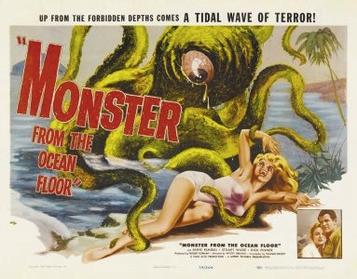
Monster from the Ocean Floor, one gets the sense, wouldn’t have merited a Wikipedia article were it not for the fact that it was the first film Roger Corman produced.  Despite its B-movie quality, there’s quite a lot to like about it.  First of all it has a strong female lead.  Julie Blair is the only gringo in Mexico to believe the locals that there’s a monster just off shore.  Steve Dunning, the scientist, is an avowed skeptic.  The plot is cheesy—the monster is an overgrown amoeba irradiated by the Bikini Island underwater nuclear tests, and it’s killed by getting a submarine in the eye—but there are some very effective cinematographic moments.  When the young boy talking to Julie in the opening turns to stare at the ocean where his father disappeared, the framing and emotion are perfect.

The theme music for the approach of the shark, and then the amoeba, anticipate Jaws by a couple of decades, and I have to wonder if John Williams hadn’t watched Monster from the Ocean Floor.  (I’m sure even cultured people watch the occasional B-movie.)  There’s also an unexpected religion angle.  A series of episodes in the film have a couple of locals trying to kill Julie as a sacrifice to the monster.  Despite the holes in the plot, it’s remarkable that in 1954 there could be dialogue suggesting that the Christian God (“the other god” according to a local woman) isn’t the God that Quetzalcoatl is.  All the same, the sacrifice is based on the folklore that the sacrifice of the “fairest” (Julie is, naturally, blonde) will appease the monster.  Maybe not the most solid theological basis, but still, not bad for a bad movie.

I’ve recently published a piece on Horror Homeroom about women and water monsters.  Having a strong woman in a 1954 film is especially remarkable.  Julie, despite the skepticism of the scientists, takes the initiative to dive right down and see the monster for herself.  It’s only when she comes up with physical proof that the men consider that she may be right (and in danger).  Of course, the men do have to rescue her—you can’t have it all.  Yes, it’s a cheaply made movie with a paper-thin plot but it was beginning to show that a woman could take the reins and with good motives (if nobody else will do something about the monster, she will).  Although she’s the love object of the movie, she’s so much more.  And a submarine in the eye—that’s gotta smart.


Learning from Mother’s Day

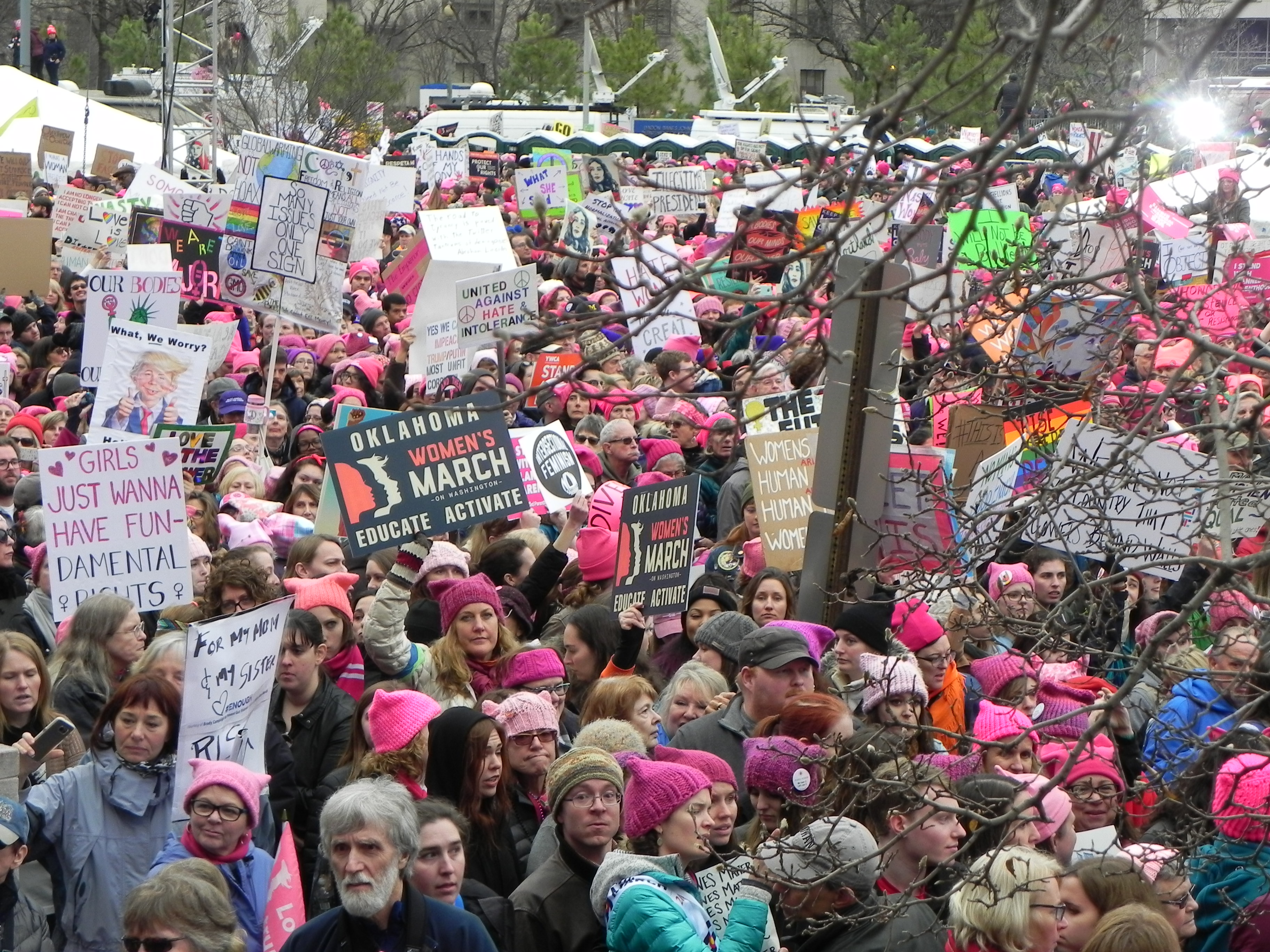
Looking back over the past year, I see that we’ve still got a lot of progress to make.  It’s only been about five millennia of “civilization,” but we still haven’t figured our that women are just as important as men.  Probably more.  This Mother’s Day we stop to think of our moms and many of us wish we were closer to home so that being there this day were possible.  Even the spineless men who degrade women are probably on the phone to their moms today, or maybe sending flowers.  The real truth emerges tomorrow.  Did we learn the lesson?  Are women to be accorded the same rights as men?  And who, really, has the right to decide who’s more human than anyone else?

Born as human beings, we need our mothers to survive.  They nurture and comfort and provide for us, even if fathers step out of the picture.  I’m reminded of an experiment that I learned about in some science class along the way.  A baby monkey (I can’t recall the species) was given a choice of two artificial “mothers.”  One, made of wire, monkey shaped, had a bottle where the baby could feed.  The other had no bottle, but was covered in fur.  The picture of that poor monkey clinging to the bottle-less but “comforting” fur-covered mother has haunted me ever since.  The look of desperation on its face makes me want to weep.  Why can’t we treat all people equitably?  We require no experiments to reveal the truth here. I look forward to the day when such messages will no longer be needed.

Too often we allow our holidays to assuage our guilt over poor treatment for the rest of the year.  Churches used to be plagued with those living sinful lives making it to Sunday’s absolution only to start it all over again.  If only we would learn the lessons Mother’s Day has to teach us.  People depend on one another to survive.  We like to think of ourselves as independent and not requiring help from anyone.  That’s a lie on a Trumpian scale.  We need each other.  Every live deserves fair treatment.  The same wage for the same work.  The right to protect their bodies and their health.  The right to show us a better way of being in the world.  It’s Mother’s Day, and if you’re reading this you have a mother to thank for this very modest possibility.  When a new sun arises tomorrow, let’s remember what we learned today.  Thank you, Mom!


Connecting Many Leagues

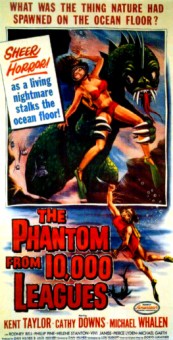
Much of movie viewing life is about making connections.  Many, many films have been made and I’m not the first to suggest that cinema is a form of modern mythology.  But those connections!  Pressed for time one busy weekend, I found the brief, low-budget The Phantom from 10,000 Leagues.  It was included with Amazon Prime and I had an obligation in about 90 minutes.  I could just squeeze it in.  As I’d anticipated, it was another of those poorly written, cheeky teen-magnets from the fifties.  The monster created by radiation, the threat to the world that the government sends only two guys to handle, and lots of lingering shots of men in business suits walking on the beach, it’s about what you’d expect.  It did well at the 1955 box office, though.

My first thought was that it was an attempted marriage between The Creature from the Black Lagoon and The Beast from 20,000 Fathoms.  Indeed, Black Lagoon had been released the year before, opening the realm of underwater filming for monster movies.  It, however, had a believable monster that wasn’t so monstrous.  The “phantom”—the name is never explained—is obviously a person in a cheap monster suit that can barely open its mouth.  It kills by holding people under water, or getting them into a radioactive beam, or preventing them from getting away from dynamite.  Oops, that last one’s a spoiler, I guess.  The Beast from 20,000 Fathoms came out a year before Black Lagoon.  The title of The Phantom from 10,000 Leagues title was obviously ripped off from it, and the atomic connection and undersea beast are common to both.  Connections.

The Beast had the benefit of a monster by the master, Ray Harryhausen.  And it was based on a story by Ray Bradbury.  That was a winning combination.  The Phantom claims to be based on a story by Dorys Lukather.  This movie is all she’s known for writing, God rest her soul.  Produced by the subtly named American Releasing Corporation, the production company would go on to become the respectable American International Pictures.  Interestingly, given the sexism of the era—reflected fairly clearly in the writing—the monster was played by a woman.  Norma Hanson, like Milicent Patrick, brought a monster to life only to be largely forgotten.  Patrick was rediscovered by Mallory O’Meara, but Hanson—one time a diving world-record holder—seems to have faded.  Had I but more time, I would enjoy diving those 10,000 leagues to bring another forgotten Hollywood monster woman to life.  And if I had the connections.


Female Future

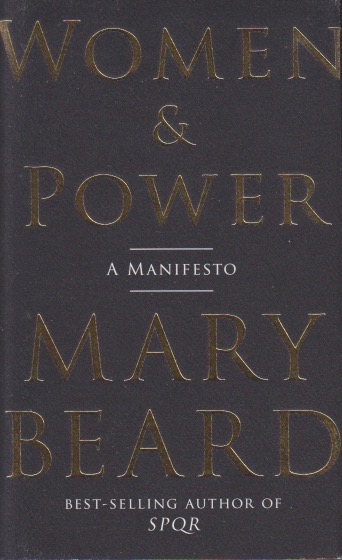
One thing we repeatedly heard during the early days of the pandemic is that people couldn’t wait for things to get back to business as usual (BAU, in corporate speak).  I told others then that we shouldn’t strive for “as usual,” but we should try for something better.  I got that same sense from Mary Beard’s Women and Power: A Manifesto.  Beard is a classicist.  She’s studied ancient Rome and earned her reputation in that area.  Women and Power is the publication of two public lectures on, broadly speaking, why women aren’t ever truly allowed to share power.  The first essay focuses on how women’s voices are routinely silenced, as they have been since classical times.  The second essay, more akin to what I was hoping about the rebuilding of society, is that we need to redefine power and how it is ascribed.

You see, as a society we have the opportunity—mandate even—to decide what’s truly important.  Electing angry old men like Trump only served to set back our progress by refusing to address the problem.  The idea, and this has been true throughout history, is that what men value is more important than what women value.  And we can’t assume all women value the same thing.  In other words, some serious thinking has to be done.  It doesn’t surprise me that some of this thinking has been undertaken by a classicist.  Those of us interested in how ideas began can have insights into why things are the way they are.  That won’t hand us the answer to the dilemma—as Beard says, hard thinking must be done—but it does show that we can begin to understand.  Beginning to understand is the first step to coming up with a solution.

Biology, and the history of biology, has something to do with the dilemma.  Childcare is a necessity and although we might be able to train brains, it does seem that women tend to have more empathy than men.  History tells us that prior to the invention of baby bottles women had to be available to unweaned children to meet their nutritional needs.  Meanwhile, men had to provide  the social structure that made the agricultural revolution possible.  As far as we can tell, hunter-gatherers (and there’s no going back to that) were more egalitarian.  Beard is right—we haven’t hit an impenetrable wall.  There are ways forward.  Equitable ways.  Different ways.  We need to stop longing for “business as usual” and imagine a better future.


Finally, Therapy

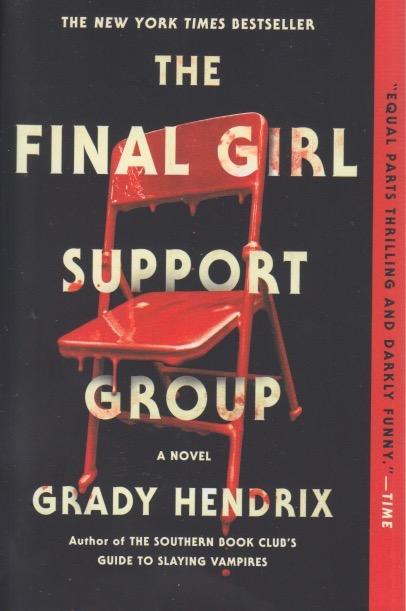
Like religion and horror, humor and horror can also get along well.  As an aesthetic, it’s not for everyone, but Grady Hendrix does it well.  It took some convincing for me to read The Final Girl Support Group.  I’d read one of Hendrix’s nonfiction books and was impressed, and that led me to his fiction.  It also demonstrates how an academic might actually be able to make a difference.  As you might guess, the novel features “final girls” from several fictional events, made into fictional movies, who get together for therapy.  It’s a funny idea and yet it’s not.  Hendrix clearly wants women to be treated fairly, but he’s also clearly a horror fan.  It’s sometimes a tricky balance to hold.  He does it pretty well in this novel.

The idea of a “final girl” comes from Carol Clover’s crossover academic book, Men, Women and Chain Saws.  This is the book that introduced the concept to the world.  As with most analytic concepts it’s only an approximation.  Clover noted the way that, in slasher films, the only survivor tends to be the virginal girl who doesn’t join in substance abuse.  Since the slasher genre is usually first credited to John Carpenter’s Halloween (Hendrix suggests in his acknowledgments that it’s Psycho), I’ve always wondered because Laurie Strode does take a toke in the car and we’re not really told much about her dating life.  I’m not a big fan of sequels, so maybe I’m missing something.  In any case, slashers have never been my favorites, and as sexist as it might sound, Poe’s observation about threats to beautiful women is something the “final girl” relies heavily upon.

The novel itself is pretty gripping.  I’m not going to put any spoilers here.  I was reluctant to read it but I’m glad that I did.  It’s classed as “horror” because of the theme but there’s definitely a lot of literary finesse as well.  It’s the kind of thing that doesn’t really seem to be deep, but upon reflection, it has more to say than you think it does.  The resolution of the novel is messy.  I suppose that’s one thing that makes it literary.  The characterization is amazing well done.  I had trouble keeping track of the back stories of all the final girls but that’s part of the fun.  While there are definitely horror moments, Hendrix never lets you forget that you are supposed to be laughing too.  It’s a fine balance and he manages to hold it together throughout while giving agency to final girls.


Love’s Life

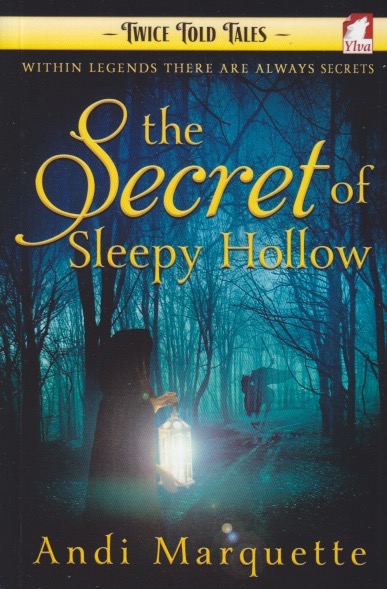
One of the things about literary classics is they open themselves to reinterpretation.  It’s often a lot of fun to trace these.  Andi Marquette is obviously an educated writer.  Her The Secret of Sleepy Hollow is one of those reinterpretations that has a unique take on the tale.  Set in modern times and featuring a member of the Crane family—Abby—as a graduate student, this story brings the tale into a contemporary context.  Abby meets another graduate student—Katie—in Sleepy Hollow and the two fall in love.  It turns out that Katie is a member of the Van Tassel family, thus bringing the two main families of Washington Irving’s “Legend of Sleepy Hollow” together again.  There’s even a headless horseman.

Like the biblical book of Ruth, this is a gentle tale of women’s love.  There’s no overt violence, no heads get chopped, but two women love and care for one another.  Many of the more modern repackaged versions of Sleepy Hollow tend to go for the violent, sometimes drug-fueled tales of bored youth in a small town facing an angry ghost.  Here the interest is more literary, a gothic romance.  The fact that it’s a lesbian love story makes me wonder why so many people have trouble with others’ love lives.  People are prone to curiosity about sex—that’s a simple fact.  What isn’t so simple is that mores based on culturally specific ideas from millennia ago don’t stand the test of time and yet cause misery in modern lives because they can’t accept what we now know—sex and love are anything but simple.

Marquette’s book is marked by that anxiety.  When people discover a love that’s often misunderstood, they face ridicule or worse.  The book of Ruth provides a good guide here—the acceptance of a normally forbidden love can bring good and happiness to people in what is often a difficult world.  There’s trouble enough—there are headless horsemen out there—that we don’t need to be causing more by judging the loves of others.  Even a cisgender heterosexual can understand that.  Life is complicated and we all try to find our way through.  Love is one of those things that can help to make it more bearable.  I found The Secret of Sleepy Hollow compelling in that way.  It may not be a literary classic—few books are—but it takes on a complex topic intelligently and with heart.  It’s a new take on an old story that still fits the modern world.


Just Justice

I don’t mean to be insensitive, but there’s so many injustices to address.   We need better vocabulary for the victims of patriarchy.  And patriarchy tends to be “white” in color.  February is Black History Month and March is Women’s History Month.  These are important reminders, but I have trouble focusing on an entire month, let alone a day—particularly if it’s a work day.  That doesn’t mean I don’t support my fellow human beings.  So today’s International Women’s Day.  I frequently wonder why it’s so hard for a particular type of man to see and treat women as equals.  I’m afraid that it often comes down to might making right, which we all know is wrong.  While power may not be inherently corrupting, many people are weak and are too susceptible to its blandishments.  And power likes nothing better than similar people and sycophants.  Women remind us that we can do better.

We don’t see those women elected to high political office grasping for the power to be queen for life (except queens, but that’s a different story).  Instead we find a spirit of cooperation instead of this constant atmosphere of competition that seems so testosterone-driven that it ought to be X-rated.  I don’t stereotype women as docile, but female leaders aren’t known for starting wars.  And none of us would be here if it weren’t for women.  The spirit of the times is one of wide representation—the principle of hearing all voices instead of only those of the powerful and ultra-wealthy.  I’m not sure why men feel so threatened by women that they try to deny them a place at the table.  Or pay them less for the same work.

Perhaps we fear societal change, but change finds us no matter what.  We now know that sex, gender, and race don’t make any person inferior.  Indeed, the struggle to be dominant often creates these categories in order to assert oneself over others.  As any mother of multiple siblings knows, teaching children cooperation leads to much better results than setting kids off against each other.  It’s a lesson that politics has yet to learn.  Culturally, it seems, this is well accepted.  People deserve to be treated equally.  That concept is called “justice” and our entire legal system is based on it.  Why don’t our politics match our culture?  I don’t want to stereotype, but it seems to me that far too many men are involved.  It’s International Women’s Day.  Let’s take the opportunity to rethink how half the human race is treated.


Expiration Date

One of the perils of trying to understand others—something that is vitally necessary for a humane and civil world—is facing difficult truths.  Sometimes horror makes you do that.  I’ve recently been trying to watch horror directed by women, as this gives another perspective on what’s scary.  Directed by Mimi Cave and written by Lauryn Kahn, Fresh is very disturbing.  Noa is a young professional who’s not having much luck dating.  He best friend Mollie, who is African American, is the voice of reason in the film.  Noa finds internet dating services inadequate, matching her up with losers, but then she meets a handsome, funny guy in the grocery store.  She agrees to a date and they hit it off.  So far, so good.  Then he takes her to his place and abducts her.  He explains that he’s a supplier of human meat for an ultra-wealthy circle and she is to be consumed.

I won’t say much more about the plot since you may want to disturb yourself some day, but I will say that the movie reinforces something I get from reading Carmen Maria Machado:  women have to deal with men’s assumptions about their bodies.  Even the institution of marriage is all about ownership; men don’t want to pay (the key word) for supporting someone else’s child.  The nuclear family is intended to keep that at a minimum.  Just a glimpse at social standards reveals that men are held less accountable for cheating than women are, largely because there’s never a question of who someone’s mother is.  Noa’s captor is charming and nice.  He’s also a (as later revealed) Satanic psychopath.  He’s also also married, with children.

The film is disturbing on so many levels as it reflects on how a man feels he has the right, literally, to take women’s bodies.  Habeas corpus indeed.  It feels like being invited to dinner at Hannibal Lector’s house.  The religion element—for there often is one—is only revealed in two short glimpses.  One is the plate of one of the cannibals which has a Satanic symbol printed on it, and the other is a mid-credit shot of the butcher’s customers where the Satanic symbol reappears.  This theme isn’t really explored in the movie, but it is equated with “the one percent of the one percent.”  The clients are those who can afford anything and who crave the one thing they can’t have.  This is a movie to keep you up at night but it’s also one with a very strong social commentary.  That commentary is as disturbing as the entire premise of the film.


Annihilated

For a long time I resisted seeing it.  Partially I wasn’t sure if it was any good and partially—mainly—it was because of spoilers.  Annihilation came out in 2018, just as I was reading Jeff VanderMeer’s novel upon which the movie was based.  I will always remember this because I worked in a cubicle where I couldn’t see my fellow workers and the woman in the next cube was a bit of a chatterbox.  She and one of her coworkers had seen the movie and began discussing, somewhat loudly, what’d happened.  I was in the middle of the book at the time and didn’t want any spoilers.  I’d never actually met the woman in the next cube and I couldn’t go over and tell her to stop talking about the film because one of the reasons we watch movies is to talk to one another about them.  (Mostly I do this online.)

Enough time has passed, and a different woman at work, remotely, suggested I see it.  I don’t know why the movie did so poorly at the box office.  The director, Alex Garland, has said he didn’t reread the book as he was making the film because he wanted it to be impressions of the novel rather than strictly based on it.  Even as I watched, I recalled some of what I read back in 2018.  I’ll try to limit spoilers here, but if I’m talking too loudly you can just click away (and, hopefully, come back after you’ve seen it.)  It begins when a mysterious “shimmer” appears after a meteorite strike in Florida.  Those who enter the shimmer never come out.  A team of women scientists are sent in, wondering if gender might make a difference.  One of them, Lena, volunteers because her husband did make it out and almost immediately went into a coma.

A sci-fi horror movie, I wonder if it underperformed at the box office because it stars women.  The tension builds between them as they try to figure out what’s going on within the shimmer.  Species have mutated rapidly and the predatory animals are pretty frightening.  The threat, as in VanderMeer’s novel, is ecological.  The ending, I’ll say, is quite different from the book because it was intentionally written as a trilogy and the director wanted to resolve the tension in a single film before reading the other two (which I still haven’t done).  The end result is thoughtful and tense.  The acting is good and the effects are stunning.  I’d class it with Arrival as an intellectual exploration of what it means to be part of a universe we barely begin to understand.  And kudos for having women lead the way.


Like a Splinter

I saw that it was based on a novel by Ira Levin, and it was free on Amazon Prime, so I watched it.  I’m not sure Sliver did much for me, however.  Ironically I watched it a weekend after watching another Sharon Stone movie that had been panned, Diabolique.  (Stone grew up not far from me I learned, but then, it’s a small world.) Something I’ve noticed about myself is that my limited experience sometimes sets false expectations.  My experience with Ira Levin has been The Stepford Wives and Rosemary’s Baby.  I read both novels and saw both movies.  I’d classify them as horror, so I guess I thought that’s how Ira Levin translated to me.  What Sliver (the movie) suggests to me is that Levin must’ve been really conflicted about living in New York City.  In both this movie and Rosemary, getting a great apartment always comes with a hidden problem of a major kind.

Sliver is a bit difficult to figure out because the original ending was changed so I’m not sure what to believe.  One thing I know for sure is that movies that make a character work in publishing are never shot by someone who actually does work in the industry.  Either that or I’ve been shortchanged.  In the movie Carly Norris (Stone), who moves into the Sliver, has a huge office.  I’ve only ever had cubicles, if even that.  No oak paneling and book-lined walls for me.  In any case, the movie focuses on Carly’s home life because two men fall for her as soon as she moves in.  One of them is a killer (this was what was changed with the rewritten ending), and both of them are creeps.  One spies on everyone in the building through hidden cameras and microphones, and the other has affairs with the young, single women.  And maybe kills them.

I guess I was expecting something more like the original Stepford (the remake—why?) or Rosemary.  Both had a message with plenty of social commentary, it seemed to me.  Of course, both of them were pretty close to the book.  (I’ve not read this novel.  Perhaps I should.)  Sliver, at least the film, was more a matter of moving into a building with a mystery and not knowing whom to trust.  It really didn’t suggest much about surveillance, or women’s agency or lack thereof.  It did make a case for not moving to New York City.  I don’t know how an editor could possibly afford such a nice apartment, in any case.