Sodom Returns

Somebody really ought to write a book.  It’s not me, but when new archaeological discoveries with large explanatory value emerge, they begin to paint an interesting picture.  Archaeologists have determined that Tall el-Hammam, a city in Jordan of about 8,000 residents, was wiped out by a cosmic airburst, or meteorite.  If you missed it in the headlines it may be because this happened in 1650 BCE.  Barring volcanoes and other melting phenomena, since they don’t get hot enough, the cosmic airburst is the best theory.  Given that Tall el-Hammam is not far from the Dead Sea, it has been posited that the sudden destruction of this city led to the biblical story of Sodom and Gomorrah.  This makes sense to me.  Just like the theory that the flooding of the Black Sea by the Mediterranean led to stories of the flood.

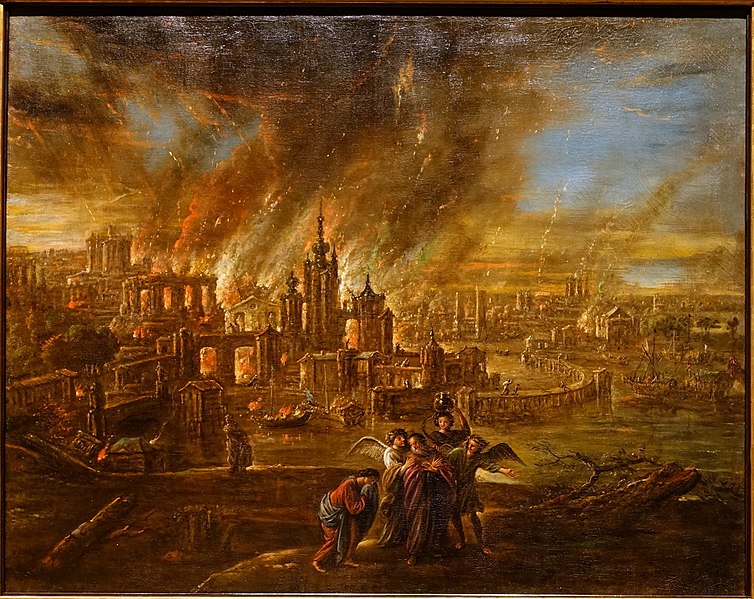
Sodom and Gomorrah afire, by Jacob Jacobsz. de Wet; image credit: Daderot, public domain via Wikimedia Commons

People who had no other ways to explain such things would naturally consider them forms of divine punishment.  Deep-seated guilt seems to be a universal of human psyches, sometimes for good reasons.  In any case, an entire city wiped out by a meteorite looks like the finger of God just as much as lightning does.  Biblical scholars have long supposed that the story of Sodom and Gomorrah was an etiology, or origin story, of the formation of the Dead Sea.  This is partially based on the famous salt pillars, more than one of which bears the name “Lot’s wife” or the equivalent.  And the Dead Sea is unlike any other body of water on the planet.  

I suspect that over time other biblical stories may find logical explanations in ancient catastrophes.  I haven’t found convincing those that try to explain the “plagues of Egypt” based on a scientific daisy-chain of events, although they are interesting.  There’s no doubt that between the expulsion from Eden and the arrival of Moses there were dramatic events narrated by Genesis.  If these were ghosts of memories of ancient tragedies that makes sense to me.  They’re moralized, of course.  Aesop’s Fables also ended with the moral of the story.  We still like to know what a story means, and a good movie or novel will have some kind of message to convey.  There’s no way to prove that Tall el-Hammam’s destruction led to the biblical account, or that memories of a catastrophic flooding of the Black Sea led to tales of arks.  But still, somebody ought to write a book.  I’d read it.


Dental Dawn

Someone knowing my interest in religion and horror recommended Teeth.  A comedy horror film based on the concept of vagina dentata—an idea I first encountered in Neal Stephenson’s Snow Crash—it begins with a purity event.  Dawn, a teen leader in the abstinence movement, addresses other adolescents about the importance of maintaining, well, purity.  They all wear purity rings and vow themselves to chastity until marriage.  As might be expected, not all of them are able to uphold their pledges.  Being inexperienced, when Dawn finds herself in a compromised position with her boyfriend she learns she has, um, teeth.  Other guys, even when warned, can’t resist an opportunity and they too pay the price.  The point of the film seems to be female empowerment, but it’s also pretty funny.

After boyfriend number one has disappeared, Dawn again addresses the purity group only to have them quote Genesis 3 at her, clearly intimating that sin is the fault of women.  The Bible is there by implication and the sermonizing of the adult leader after Dawn has to leave the stage again takes up the religious outlook.  The underlying concept of purity movements is distinctly Christian.  While all religions have something to say about sex, generally the most negative about it is Christianity.  That’s not because other religions lack for spirituality, but Christianity tends to denigrate the body, and in the process tends to make natural things sinful.  This gives plenty of fuel to a movie like this where a woman has to make her own way in a man’s world.

What’s really interesting here is that no punches are pulled when it comes to the origins of patriarchy.  The Bible clearly views males as the standard of humanity and females as an adjunct.  That idea has had a death-grip on western society, particularly in America, from the beginning.  Teeth was written and directed by a man.  I suspect that the presumably well-intentioned use of an old mythical idea that makes females into monsters may not appeal to women writers or directors, empowering as it may be.  Nevertheless, if taken with the fun obviously intended from the opening playful music to the comically terrified responses of Dawn’s adolescent victims, the movie can still convey a positive message to women who might watch it.  Horror is often a repository of social commentary.  Not taken seriously by the mainstream, it nevertheless puts good messages out there.  And sometimes it bares its teeth.


Many Days

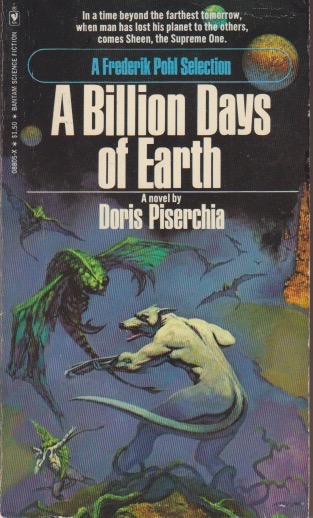
Science fiction.  I used to consume it by the bookful, and even now I occasionally turn back to it.  Having read Doris Piserchia’s A Billion Days of Earth, I do have a confession to make.  I don’t know why I read it.  Literally.  As I’ve indicated many times before, I keep a reading wishlist.  It’s comprised of books that others recommend and things that catch my eye.  Every now and again a used book sale will bring something unexpected into the mix, but overall, I rely on my list.  I can’t remember who recommended A Billion Days of Earth, or why.  The cover is striking in that 1970s sci-fi way, and it took me back to the actual seventies when I was reading sci-fi quite a bit.  Some of that cover art still mesmerizes me.  So, about the book…

I didn’t know what to expect and received what I was expecting.  This is a philosophically heavy novel that, in the style of some other seventies fiction I read, was a bit difficult to follow.  The main idea (and there will be spoilers) is that Sheen, a silvery, shape-shifting being, emerges a billion days along.  Evolution has taken multiple tracks with animals such as dogs and rats becoming essentially what humans are today (or were in the seventies) and humans evolving into what the other animals call gods.  Sheen slithers about the world taking the egos from all creatures, kind of assimilating them.  A rat person and a dog person resist the relinquishing of their egos while the world around them begins to collapse.  The “gods” refuse to help.  Then, at the end, the gods board their spaceship, and released by Sheen, leave for another planet.

Although I was confused most of the way through, the book leaves a lot to exegete.  This is definitely a retelling of Genesis 1–3.  Sheen offers people (and animals) paradise in exchange for their egos.  Nearly everyone, except those who think (a small number) accepts this offer.  Even the gods are tempted.  We’ve got the snake (Sheen), the expulsion from paradise, and the gods who separate themselves from humanity.  But still, I’m sure there’s something more that I missed.  There are subplots for Rik (rat man) and Jak (dog man) and the rich Filly family that seem to evade conclusion or resolution.  Or maybe once the gods are gone there’s nothing more to say.  This seventies classic left me thinking.  And wondering who it was that recommended it to me.


James and John

One of the first questions expectant parents are asked is if they have yet come up with a name for their child.  Quite often, and probably without realizing it, some of the most popular names are biblical.  Jacob is one of the most common boys’ names in English.  It derives from the story of Isaac’s younger son in Genesis.  Its popularity increases exponentially when its variant James is added to the total.  The name James comes into English from Old French where it was derived from the Latin Iacomus.  B and m are, phonetically speaking, bilabials (the former voiced, the latter not).  This Latin form also led to the Spanish name Iago, which many know from the apostolic name Santiago (“Saint James”).  Or Saint Jacob, only nobody calls him by that name anymore.  Biblical names are exceptionally common in the western world.  Even so, it often seems implausible that names like Jimmi could be alternatives to Jacob, but small steps make evolution possible.

It has been popular among evangelicals for years to know that Jesus is the Greek form of the name Joshua.  Having a savior named Josh just doesn’t have the gravitas we’re looking for, however.  Greek is an Indo-European language while Hebrew is a Semitic one.  While these two family trees have points of contact, their vocabulary and syntax developed quite independently.  Names change when they’re translated.  Many of our familiar New Testament names are translations from their Hebrew (or Aramaic) counterparts.  The New Testament was written in Greek and we receive Greek versions of such names.  John, for example, is another name that comes to us in many forms.

The apostle we call John was called Ioannes in Greek.  This was derived from the Hebrew name Yochanan.  John comes into English via the Germanic form Johannes, where the connection to the Greek becomes obvious.  From there it shortens to John.  It comes in many varieties too: Juan, Jan, Ivan, Han, Evan, Sean, Jonas, Giovanni, and even Jack.  The latter sounds more like Jacob, but in their original forms the names are quite different.  Apart from names, Indo-European borrowing from Semitic languages isn’t terribly common.  Throughout the Christianized world, names based on these two apostles, however, have become extremely popular.  In recent times parents have been branching out into more creative names for their children, but many of them still derive from their biblical antecedents.  This is just one more way that the Bible continues its influence in an increasingly secular world.  


Pure Fear

At work we have the opportunity to say a little about ourselves on a shared document for our teams.  This is a fairly new thing, so people I’ve worked with for years have no reason to look at it.  A couple of new hires, however, have noted that I watch horror movies and this has led to some budding friendships.  Since we’re all remote workers it’s mostly a matter of a line or two in an email about whether I’ve seen this or that film.  One of those recommended was the Hulu original Pure.  It’s actually pretty good.  The idea is a bunch of teenage girls are brought to a retreat center for a purity ball with their fathers.  This kind of thing can get very creepy very fast, given the incestuous overtones for such a thing.  Not only is it a religious event, it’s based on the story of Lilith.

Collier’s Lilith

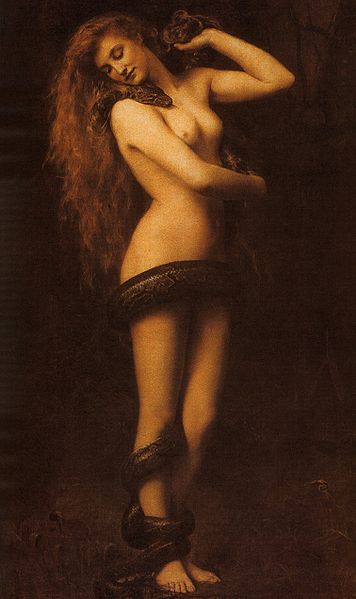
The pastor preaches his first sermon about Lilith, but the girls from cabin 4 sneak out at night to meet some guys.  (Their presence is explained at the end of the movie.)  That night the girls summon Lilith, whom the minister’s daughter says is a demon.  The summoning works.  Lilith begins to interfere with services as the girls are tempted by the guys who are hanging around.  At the end, Lilith “possesses” Shay (the lead girl) and frees them from being controlled by the men in their lives.  The message is a refreshing one, and Lilith ends of being, well, somewhat as Shay puts it, “One man’s demon is another’s angel.”  

Religion and horror make a good couple.  I’ve never seen a movie that features the story of Lilith before.  The thing is, she’s not the scary part of the movie.  The religious believers, the fathers who try to control their daughters rather than giving them support after listening to them, are.  Parenting is tough, no doubt about that.  None of us are born into life with all the answers.  We quite often find ourselves not knowing for sure what we should do.  I couldn’t imagine being a parent claiming to have the solutions for all problems.  I’m a guy who watches horror for a form of therapy!  What I do think, however, is that we can try to be reasonable, loyal, and supportive.  I learn as much from being a parent as I teach.  The same was true of being a professor.  Humility, along with a willingness to continue learning your entire life is the only way that makes sense to me.  Although not a major studio production, this was one of the scariest movies I’d seen in a long time.


Eve’s True Desire

Psst—don’t tell anyone!  There is a free copy of my first book available on Academia.edu.  I thought I was kind of radical for doing that, but people who write books want people to read them.  Having a book priced $70 or more, heck, even $30 or more, means only diehards will buy it.  Nightmares with the Bible promptly sank at $100 cover price, released during a pandemic.  I’ve always admired scholars who’ve bucked conventions to make their work available.  Recently I needed to consult a book.  I won’t say what it is because I fear a take-down order will be issued where I found it.  The author, aware the book was hard to access, actually photocopied the entire book and put it on a website.  I stand up and cheer!  Photocopying an entire book is a lot of work, a labor of pure love.

Now, I’m all for authors getting royalties.  It takes a lot of time and energy to write a book.  It can cost years of your life.  You ought to get something back for it.  It seems to me, however, that a different model is required for academic books.  Why are they so expensive?  Not only that, but smaller publishers without the distribution channels often publish worthwhile books, but in small quantities and they go out of print after the initial run is sold.  The academic enterprise (knowledge for knowledge’s sake) has become a captive of capitalism.  There’s no other way to trade in that market.  Books that have willing, even eager, readers are sequestered in libraries only accessible to employees.  Is there anything wrong with that picture?

Academics at less wealthy institutions often find ways around the rules.  I did my research for Weathering the Psalms at a small seminary that had trouble getting unusual items on interlibrary loan.  Bigger schools were distrustful of this tiny enclave called Nashotah House.  Would they ever get their rare property back?  Meanwhile worldwide mail service crisscrossed with offprints sent for free from scholar to scholar.  It was like your birthday, or Christmas, when a long-awaited piece of research landed in your mailbox.  Nobody was in it for the money.  We were beguiled by learning.  Eve looking wistfully up into the tree.  Now it’s all business suits with dollar signs for eyes.  The academic who puts their book up for free on the internet is nothing less than a saint.  Seeking knowledge is never really a sin.

Tasty fruit of knowledge

Sodom

Look!  Up in the sky!  It’s a bird!  It’s a plane!  It’s an asteroid coming to wipe out a city!  One of the cottage industries outside biblical studies is the interest in finding historical events to explain Bible stories.  A few years ago it was proposed, with some degree of probability, that the flooding of the Black Sea by the Mediterranean, validated by archaeology, led to the story of Noah’s flood.  I recently saw a story suggesting that the destruction of Tall el-Hammam by an asteroid about 3,600 years ago might’ve been the basis of the story of the destruction of the cities of the plain, Sodom and Gomorrah  most prominent among them.  The piece by Christopher R. Moore in The Conversation describes the moments of horror—mercifully brief—as the space rock exploded above ground and wiped the city from the face of the earth.

Since this happened near the location of Jericho, the destructive shock waves knocked its walls down, leading to another biblical tale.  I often wonder about these “theories.”  They show just how deeply biblical our society is.  The frame of reference is already there.  People know about Sodom and Gomorrah.  They know about the flood.  They know of naked Adam and Eve and a snake wrapped around a tree.  When a disaster happens in the right region, and before the biblical story was written, it is suggested as the etiology of the tale.  Many have tried to explain the plagues of Egypt using similar methods.  Our culture seems to long for some skyhook on which to hang our biblical hat.  Some indication of why people put such strange stories in the Good Book.

Biblical scholars look too, but with a different perspective.  Etiologies are stories of origins.  Traditionally the Genesis account of the cities of the plain is understood as an etiology of the Dead Sea.  A unique geological feature of this planet, it is, in a word, weird.  The story of Abraham’s nephew Lot seems to explain it.  The article makes a compelling case for a heavenly fireball at about the right time that wiped out a settlement of about 8,000 people.  Genesis wasn’t written yet at 1600 BCE, the time of the event.  Since the impact site wasn’t far from the Dead Sea it seems to fit  the bill for a valid etiology.  None of these events proves biblical stories true, but they do show possible avenues of transmission.  This one definitely has me wondering.

Image credit: Daderot via Wikimedia Commons

No, uh, It Won’t

Irony comes in all shapes and sizes.  Over the past several decades various fundamentalist groups have built replicas of what they believe to be life-size versions of Noah’s ark.  All of these are approximations because the cubit was never an exact measure.  Nobody knows what gopher wood was.  Most of them ignore the fact that the story of Noah clearly borrows from the more ancient Mesopotamian flood story where the measurements of the ark differ.  In any case, these arks—some containing dinosaurs and others not—are made for convincing people that Genesis is to be taken as history.  While there is some irony in that itself, the larger irony comes in the various proofs that are given that such things really would work to preserve all species since evolution could not have happened.  To work such models have to be seaworthy.

One such ark, according to the BBC, has been detained in Ipswich because it is unseaworthy.  An ark may be useful on dry land for drawing tourists, but would such a large boat work on the open ocean?  All of this brought to mind a Sun Pictures documentary from my younger days.  Giving the ark a makeover, various literalists re conceived the classic design from children’s Bibles to a more boxy, sturdy shape.  This was based on alleged encounters with the ark on Mt. Ararat.  To test this new design, the producers made a scale model and tested it in a pool of water and declared it eminently seaworthy.  Of course, there’s no way to make water molecules shrink to scale to test whether a full-sized ark could actually handle the stresses and strains of a world-wide flood.

Ship building is an ancient art.  Peoples such as the Phoenicians, the neighbors of ancient Israel, achieved some remarkable feats in ocean travel without the benefits of modern technology.  They didn’t have boats large enough to hold every species of animal that exists today, but they sure knew how to get around.  The real issue with literalism is the failure to recognize ancient stories for what they were—stories.  Such tales were told to make a point and the point was often obvious.  The obsession with history is a modern one—indeed, the ancients had no concept of history that matches what our current view is.  Borrowing and adapting a story was standard practice in those days.  Unaware that centuries later some religions would take their words as divine, they told stories that, in the round, just wouldn’t float.


Museum Time

It was a very strange feeling.  Wearing masks, yes, and socially distancing, we went to a museum.  Casting my mind back, I can’t recall the last time I was in a museum.  On a family visit to Ithaca we decided to go to The Museum of the Earth.  Ithaca is a small town, and this is a small museum, nevertheless the first place Google (or Ecosia) brought up for fossil identification was The Museum of the Earth.  On Saturdays a paleontologist is on hand to help identify the traces of life from millions of years ago that lie scattered around for anyone to pick up.  Collecting fossils has a treasure-hunting vibe to it, and it’s great to find anything beyond the usual, ubiquitous sea shell imprints.  Don’t get me wrong—I love sea shells with their symmetry and flowing lines.  Some of them even look like angel wings.  But there’s a draw to the unusual.

Some time back I’d found a fossil in the Ithaca area that I couldn’t identify.  It was Saturday, and we’d all received at least our first vaccination.  And I had to wait in line to get an identification.  It was cheering to see so many people—with limited, timed entry—coming to a museum.  The specialist confirmed this to be an interesting fossil.  She identified it as a bryozoan, ancient animals related to coral.  This one, she suggested, based on the age of rocks in this area, was likely Devonian.  The age of fishes.  I was glad I hadn’t wasted her time, and I was glad to have an expert eye on something that, let’s be honest, often functions like pareidolia to the laity.

Years ago I took my daughter to an open house day at the geology department at the University of Wisconsin in Madison.  If it weren’t for the calculus requirements (and I even tried to teach myself calculus because of it), I was seriously considering going back to school to study geology.  There is an organic connection between biblical scholars interested in the first eleven chapters of Genesis and paleontology.  I get too busy, it seems, to go down to the local creek to look for fossils.  Perhaps it’s for the best because our house would be full of rocks (even more than it already is).  The earth is a great museum.  Even so, it felt like an alien activity, late in this pandemic, to remember what it’s like to explore these treasures indoors, with strangers.  It felt as if time was actually progressing.


Women and Mothers

This is our first Mother’s Day with a female Vice President.  After four years of a female-groping administration, it feels like we’ve made a turn in the right direction.  Ironically, it’s often religions that keep women oppressed, even while women are often more faithful to them.  Religions like to claim to have the answers, and for the monotheistic traditions an origin myth with Eve—the first mother—as the first picker of forbidden fruit, has suggested one answer that has held women down for centuries.  Taking origin stories too literally can cause so much suffering in the world that we’re confronted with the question of their morality.  Religions are for people.  If they exclude half the human race we need to pause to ask if we got something wrong.  It’s Mother’s Day, always on a Sunday.  It’s a chance to think about such things.

Many churches will have sermons honoring mothers today.  Will they work for the wellbeing of women for the remaining 364 days of the year?  Our society, purely on the basis of biology, routinely puts women at risk and underplays the need to help them when that happens.  I’ve seen this firsthand.  We’re finally starting to get some female representation in Congress, yet less than a quarter of the seats are held by women.  Isn’t government supposed to represent its constituents?  Why has half of humanity had to struggle for so long to be treated as equal?  Mother’s Day cannot be a salve to ease our consciences about mistreating women for the rest of the year.  Equity should not be a goal, it should be reality.

We’ll be thinking about our mothers today.  Still under a pandemic, we’ll be Zooming them or calling them.  Those fortunate enough to live close may even get to see them in person.  These mothers sacrificed a lot to take on that role.  Our society could not continue without them.  We’re starting to come to the realization, I hope, that it is male-devised forms of government and business that are the problem.  They protect the wealth and power of a few.  They jealously guard against letting men offer the true justice of equity.  Some religions have begun to address the obvious injustice they have largely originated.  The story of the Garden of Eden was meant to teach a lesson.  That lesson has been abused for centuries as a way of making women seem somehow less than men.  It’s Mother’s Day.  Let’s see if we can’t learn to read more deeply and apply what we have learned.


Lizard Lords

In the aftermath of last week’s attempted coup by the alt-right crowd, NBC ran a story about conspiracy theories.  Specifically the lizard people (actually aliens) who secretly run the world.  If you hang out in weird places, like I do, you already know the story behind this: fueled by David Icke, some conspiracy theorists believe a race of shape-shifting alien lizard people control the government.  They’re deadly serious.  (You can fairly easily find videos purporting to show lizard people caught transforming at government events.)  The NBC story, by Lynn Stuart Parramore, traces the belief to an old anti-Semitic trope.  I haven’t studied this enough to have any opinions on the idea, but what caught my attention is that this particular conspiracy grew out of objections to Darwin.

While teaching I’d planned to write a book on Darwin and Genesis—I researched it for years.  I would add to Parramore’s story the fact that most of our political troubles today can be traced back to that same unwillingness to accept evolution.  Over the centuries in western culture, the Bible (while not necessarily read) had grown into such an object of veneration that anything which challenged it had to be rejected.  Charles Darwin was well aware that anyone following the dictates of science would be pilloried by a “Bible believing” culture, and this was in the middle of the nineteenth century.  Elitist intellectuals assumed this literalism would just go away but it never has.  When it appears (which it frequently does) they laugh at it and insist that if we ignore it it’ll just go away.  Then an armed mob takes over the U. S. Capitol.

The concern shouldn’t be that people believe in lizard people, but that they can’t let go of a threadbare literalism toward a book.  Biblical scholars are routinely ignored by those who believe their way of reading the Good Book is the only possible way to do so.  All other ways are “interpretations,” and these interpretations don’t reflect what God has told them personally, so they’re clearly wrong.  This view, simply dismissed by most of the educated, is extremely widespread.  It must be addressed in some way, rather than being treated as some passing fad.  There may be no lizard-people taking over, but this view of the Bible has been politically active for going on two centuries.  Instead of studying it and trying to understand it, we cut departments and positions that might help to solve the problem.  Maybe the lizards are controlling us after all.


Jacob’s Ladder

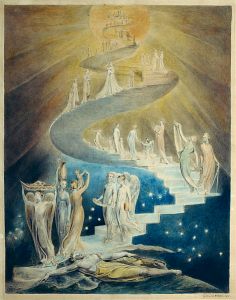
Jacob, it is said, was quite a dreamer.  While fleeing from his brother Esau he had a dream of a ladder, or stairway, to heaven.  Well, “Heaven” as we recognize it didn’t exist then, but you get the idea.  Angels were climbing up and down on it, I’m guessing to do roof repairs.  You see, neither my wife nor I are what you might call tall.  In fact, I’m a bit shorter than the average guy and we can’t reach the top shelf in our kitchen, let alone the ceiling.  Or, God forbid, the roof.  So when tropical storm Isaias (not to be confused with the prophet) dropped upwards of five inches of rain on us, some of it got inside.  Our roofer, vexed as I was, promised to get over the next week but there’s more rain in the forecast.  I had to get up there to do some temporary patching.  I needed a ladder.

Ours is an older house.  The roof is way higher than any ladder we have.  I have one that allows me to get as high as the ceiling, but being acrophobic I don’t use it much.  It doesn’t come halfway to the lowest roof.  The hardware stores have ladders, but delivery’s a problem.  A ladder twice as long as our car seems like a road hazard, strapped to the top.  I asked about delivery at the local Lowe’s.  It would cost a third of the price again of the ladder itself, and that’s only be if they could deliver it.  Their truck was, ironically, broken down.  Wasn’t this a DIY store?  Could nobody there fix a truck?  I put a face-mask and rubber gloves on for this?  The world isn’t easy for the vertically challenged.  I really don’t want to climb that high, but with the ceiling below already coming down I’ve got to do something.

I wonder if Jacob’s ladder is still lying about somewhere, unused.  We don’t live far from Bethlehem.  Maybe I can scoot over the Bethel and pick it up.  Then again, maybe angels deliver.  I hear they can be quite accommodating.  Of course, if they’d keep the rain off in the first place that would’ve been helpful.  I’m pretty sure that Plant and/or Page had a leaky roof.  When they went to get up there they’d found somebody had already purchased the ladder (I think they call it a stairway in England).  So I find myself with a leaky roof and no way to get to heaven.


Falling

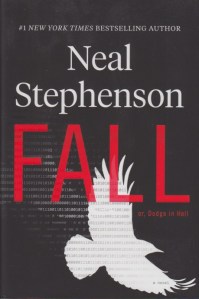
Time.   It’s a resource of which I’ve become acutely aware.  If I probe this I find that among the assorted reasons is the fact that I’ve finished my fourth book and I realized I’m much further behind that I’d hoped to be at this point.  It took me a decade to get Weathering the Psalms published and Holy Horror seems never to have gotten off the ground.  I’ve pretty much decided to try to move on to writing that people might actually read, and academic publishing clearly is not the means of reaching actual readers.  I can’t help compare myself with prolific writers like Neal Stephenson.  (It helps that he’s a relative.)  I just finished Fall, Or Dodge in Hell, and was wowed by the impact of both the Bible and mythology on the story.  I’ve always admired the way that writers like Neal can not only comprehend technology, but also can project directions into which it seems to go. 

Not to put lots of spoilers here, but the story of one generation of gods being conquered by another is the stuff of classic mythology.  Many assume it was the Greeks who came up with the idea, what with their Titans and Olympians and all.  In actual fact, these stories go back to the earliest recorded mythologies in what is now called western Asia.  For whatever reason, people have always thought that there was a generation of older gods that had been overcome by a younger generation.  Even some of the archaic names shine through here.  Like many of Neal’s books, Fall takes some time to read.  It’s long, but it also is the kind of story you like to mull over and not rush through.  Life, it seems, is just too busy.

There’s a lot of theological nuance in Fall, and the title clearly has resonance with what many in the Christian tradition categorize as the “Fall.”  (Yes, there are Adam and Eve characters.)  Those who are inclined to take a less Pauline view of things suggest that said “fall” wasn’t really the introduction of sin into the world.  Anyone who reads Genesis closely will see that the word “sin” doesn’t occur in this account at all.  One might wonder what the point of the story is, then.  I would posit that it is similar to the point of reading books like Fall.  To gain wisdom.  Reading is an opportunity to do just that.  And if readers decide to look into matters they will find a lot of homework awaits them.  And those who do it will be rewarded.


Virtually Religious

“Which god would that be? The one who created you? Or the one who created me?” So asks SID 6.7, the virtual villain of Virtuosity.  I missed this movie when it came out 24 years ago (as did many others, at least to judge by its online scores).  Although prescient for its time it was eclipsed four years later by The Matrix, still one of my favs after all these years.  I finally got around to seeing Virtuosity over the holidays—I tend to allow myself to stay up a little later (although I don’t sleep in any later) to watch some movies.  I found SID’s question intriguing.  In case you’re one of those who hasn’t seen the film, briefly it goes like this: in the future (where they still drive 1990’s model cars) virtual reality is advanced to the point of giving computer-generated avatars sentience.  A rogue hacker has figured out how to make virtual creatures physical and SID gets himself “outside the box.”  He’s a combination of serial killers programmed to train police in the virtual world.  Parker Barnes, one of said police, has to track him down.

The reason the opening quote is so interesting is that it’s an issue we wouldn’t expect a programmer to, well, program.  Computer-generated characters are aware that they’ve been created.  The one who creates is God.  Ancient peoples allowed for non-creator deities as well, but monotheism hangs considerable weight on that hook.  When evolution first came to be known, the threat religion felt was to God the creator.  Specifically to the recipe book called Genesis.  Theistic evolutionists allowed for divinely-driven evolution, but the creator still had to be behind it.  Can any conscious being avoid the question of its origins?  When we’re children we begin to ask our parents that awkward question of where we came from.  Who doesn’t want to know?

Virtuosity plays on a number of themes, including white supremacy and the dangers of AI.  We still have no clear idea of what consciousness is, but it’s pretty obvious that it doesn’t fit easily with a materialistic paradigm.  SID is aware that he’s been simulated.  Would AI therefore have to comprehend that it had been created?  Wouldn’t it wonder about its own origins?  If it’s anything like human intelligence it would soon design myths to explain its own evolution.  It would, if it’s anything like us, invent its own religions.  And that, no matter what programmers might intend, would be both somewhat embarrassing and utterly fascinating.


Yeti Again Again

I wish I had more time for reading short stories.  I grew up on them since, like many young boys I lacked the attention span for entire novels.  Many collections of short stories sit on my shelves, but I’ve been drawn into the world of extended stories, perhaps because so much of reality bears escaping from these days.  In any case, I find myself neglecting short story collections.  I have a friend (and I tend not to name friends on this blog without their express permission—you might not want to be associated with Sects and Violence!) named Marvin who writes short stories.  This past week his tale called “Meh Teh” appeared in The Colored Lens.  Marvin often uses paranormal subjects for his speculative fiction.

“Meh-Teh” is a Himalayan term for “yeti.”  Since we jealously guard our positions as the biggest apes on this planet, science doesn’t admit yetis to the realm of zoology without the “crypto” qualifier in front.  Still, people from around the world are familiar with the concept of the abominable snowman.  Maybe because I grew up watching animated Christmas specials, I knew from early days that a mythical, white ape lived in the mountains, and that he needed a visit to the dentist.  The yeti has even become a pop culture export from Nepal, since those who know little else about that mountainous region know that strange footprints are found in the snow there.  Apes, however, like to dominate so we tend to drive other apes to extinction.  Still, they had to be there on the ark, along with all other cryptids.

I recall an episode of Leonard Nimoy’s In Search of that dealt with yetis.  Or was it a Sun Pictures presentation about Noah’s Ark?  I just remember the dramatic earthquake scene where either the skullcap of a yeti or a piece of the true ark was buried, lost forever under the rubble.  Yeti is also a brand name for an outdoor goods company based, ironically, in Austin.  This fantastical ape has become a spokesperson, or spokesape, for the great outdoors.  All of this is a long way from the story Marvin spins about the great ape.  As is typical of his fiction, religion plays a part.  I really should make more time for reading short stories.  In a world daily more demanding of time, that sounds like a solid investment.  And free time is more rare than most cryptid sightings these days.