Book Ideas

Call it sour grapes. When I was a young scholar, I used to wonder how to develop book ideas. You see, at a young age—twenties or thirties—even a doctorate means your understanding of the world is limited. I’d written a substantial dissertation on Asherah, and I was faced with developing several new courses from scratch at Nashotah House. My mind was focused on the immediate concerns. I did continue my research, however, into ancient Near Eastern deities, with an eye toward writing an account of celestial gods and goddesses. A substantial piece on Shapshu ended up being snatched up by a Festschrift, and colleagues began to tell me that to get hired away from Nashotah I had to write something biblical. Thus Weathering the Psalms was born. The research and writing took a few years because I never had a sabbatical, or reduced teaching load. In fact, administrative duties as registrar and academic dean were added to my remit. Still I scribbled away in the early hours and finished a draft. Then I was cast into the outer darkness.

Publishing was never my first choice of career. I’m more a writer than an editor. In publishing, however, you are not encouraged to write your own content. I can’t help myself. As I rounded the corner from my forties, I had finally read enough material—both relevant and extraneous—to have book ideas. In fact, too many. Held back by the lack of publication, I didn’t know how to channel this energy. One of the benefits of working for publishers is you learn how to come up with a viable book idea. I’ve got a backlog now. I’m currently working on a few books, but one is in the forefront of my mind and eclipses all other projects at the moment. Having watched what sells, I think this one has a real chance. Time to write, alas, barely exists. The writer, you must understand, has to build a platform. Get a fan base. Welcome to my platform.

Daily I receive the first books of young scholars. In this publish or perish—strike that—publish and perish atmosphere, even the mediocre is encouraged by dissertation advisors. Young scholars, maybe thirty, think they have something profound to say. Call it sour grapes, but I’m not getting any younger and I don’t have an institution to support me while I write what should be written. The face looking back at me in the morning has more gray hairs than I remember growing, and has wrinkles that my mind doesn’t recognize. It’s too full of books to write to pause long. The bus is coming soon and I have younger scholars’ careers to build with premiere branding. My own ideas ferment unseen in the basement. What some call sour grapes others call fine wine.

Photo credit: Dragonflyir, Wikimedia Commons

Photo credit: Dragonflyir, Wikimedia Commons


Mother’s Night

It wouldn’t be Christmas, in the Christian tradition, without Mary. Still, apart from her later enhanced role in Roman Catholicism, Mary’s part beyond Christmas is minor in the church. She seldom features in biblical accounts of Jesus’ life. It is easy to forget the female role that was so much a part of winter solstice celebrations that coalesced into our modern twelve days (really only one, for work purposes). That’s why I was glad that a friend sent me a link to a site about Mödraniht, or Mother’s Night. Honestly, I had never heard of this holiday before. Given the Germanic penchant for dramatic festivities, it comes as no surprise that Yule involved a night celebrating the feminine aspects of the season. Apart from the occasional references to Mary, we tend to think of this as the time a male son of a male God came to save mankind. What of the women without whom none of this would have been possible?

As Carolyn Emerick notes on her page, we know little about this sacred day because Christianity managed to wipe out most of the pagan traditions of northern Europe. Some, of course, survived and worked their way into Christmas. Modern holidays, being primarily days off work rather than deeply felt celebration (for we live in a world with no need for religion), have gravitated toward what had once been the male preserve of earning a living. Watching movies of Dickensian times, it is clear the women continued to work—likely even more than usual—to bring off a holiday celebration. It was the male prerogative to be the recipient of largess.

Photo credit: "Urban" WikiMedia Commons

Photo credit: “Urban” WikiMedia Commons

My concern is that gender equality may sometimes be confused with gender stereotyping, or even with patronization. How is it possibly to build equality into a system put into place by generations of men? Is civilization truly civilizing when half of the race and only a very small portion of the planet benefits? The Christmas season, even now rapidly slipping away, is a time for considering equality. Every year modern non-believers and humanists ask for equality—a dream always held at arm’s length, since the holiday earns record profits as it is, and the financial year revolves around it like a Pole Star. It is the time of year when we see if we’ve turned a healthy profit. The rules in the system were set long ago. Even with Mary in the manger, she blends into the background while shepherds, wise men, and other interested males plan to make a holiday of it.


Let It Be

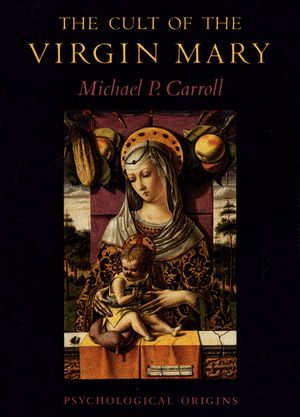
CultOfTheVirginMaryWhy do people pray to Mary? The question is a complex one and answers range from a desire to find some feminine compassion in an angry masculine god to the distinctly Freudian. Michael P. Carroll, in The Cult of the Virgin Mary: Psychological Origins, falls into the latter category. Yes, the book was written in the 1980s, but even then Oedipal complexes and penis envy were deeply suspect. Still, at various points along the way Carroll had me scratching my head and muttering “there may be something to this.” For a few pages, anyway. The problem begins much further back than Mary. To start with, we can’t all agree on what religion is. From there we move to the stage where ancient religions had as many goddesses as gods—even the divine don’t like to be lonely. The heads of most pantheons were male, which likely matched most earthly political systems. Powerful females still existed, at least in mythical realms. Monotheism effectively put an end to that, but before too terribly long, Mary emerged and eventually became almost a goddess.

Indeed, early on in his book Carroll discusses how Mary differs from the goddesses of antiquity, drawing parallels with only Cybele. Mary is the virgin mother completely dissociated from sexuality. Deeper study would reveal some mistakes in Carroll’s reasoning—there were virgin mother goddesses, such as Anat, who might in some ways fill in the gaps. Indeed, arguing for the uniqueness of Mary is kind of a goddesses-of-the-gaps theology. The more we learn the less unique any deity becomes. Still, looking to the psyche to explain Mary is a logical step. Tracing Marian devotion to the ineffective-father family, where a machoism hides a longing for the protective mother, Carroll offers us a Freudian feast of options here. Still, in the light of developments in psychology over the past quarter century, his premise is a bit dated.

We simply don’t know why Mary became such a strong devotional interest in a religion with a masculine Trinity. It would seem that women might be the motive force behind it. Given that half of Christendom was displaced, by default, from the male savior, why would Mary not emerge as the mother all people crave and whom, women know, often soften the harsh decrees of martial law? Delving into the apparitions of Mary from Our Lady of Guadalupe to Fatima and Medjugorje, Carroll finds illusions and hallucinations based on strong females behind each one. Rational inquiry into the deeply spiritual. This, however, remains the proximate cause only. What is really seen can’t be known, except to the seer. And it seems that seers tend to find, amid a religion with an omnipotent man at the top, that it is the mother who appears in times of need. Unless, of course, it is a matter of healthcare where, as government shows, father knows best.


The Fate of Goddesses

The goddesses Asherah and Astarte are sometimes confused, even by experts. Astarte, also known as Ashtart, Ashtarte, Athtart, and Astaroth, among other names, is the lesser attested of the two among the Ugaritic texts. Indeed, to read some accounts of the latter goddess, she becomes dangerously close to being labelled generic, the sort of all-purpose female deity embodying love and war, and sometimes horses. In the Bible Astarte lived on to become the bad-girl of Canaanite goddesses. Her corrupting ways were a conscious danger to the orthodox (as much as that is read back into the texts). She became, over time, literally demonized. It seems that originally she, like most goddesses, had a soft spot for humans. Since she wasn’t the one true (male) God, however, she had to be made evil. It is an unfortunate pattern as old as monotheism. One of my original interests in studying Asherah (not Astarte) was precisely that—the obviously benevolent divine female seems to have been chucked wholesale when the divine masculine walked into the room. Why? Well, many explanations and excuses have been given, but whatever the ultimate cause, Astarte lingered on.

IMG_1620

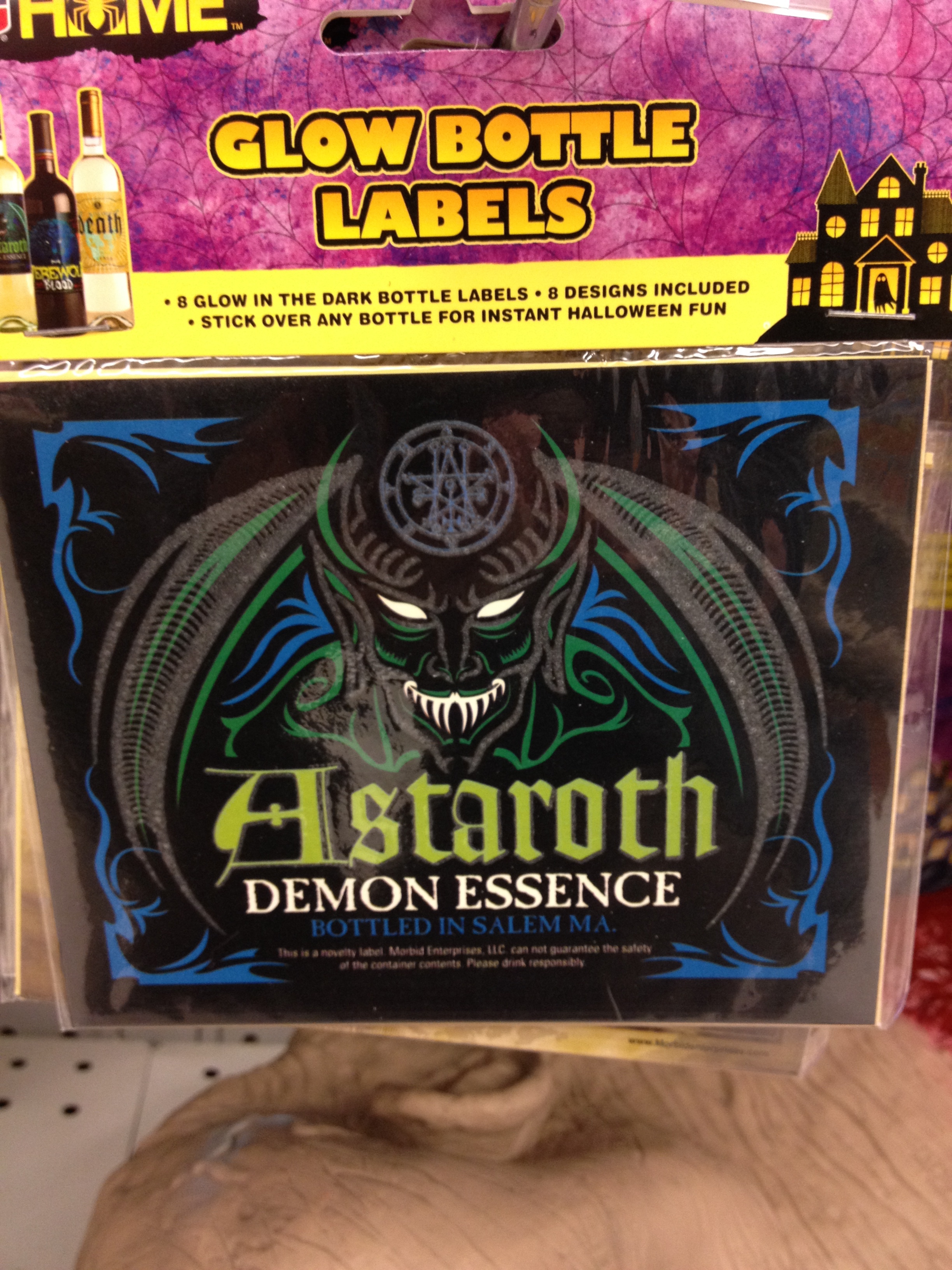
In a local pharmacy the other day, I was looking over the Halloween tchotchkes. Amid the usual assortment of pumpkins, skeletons, and ghosts, I found bottle labels reading “Ashtaroth Demon Essence.” Although I’ve spent a good deal of my life cloistered in academia, I was not surprised by this. I know that in popular culture the goddesses of antiquity live on as supernatural powers, sometimes good, sometimes evil. Astarte, once depicted as the friend to at least some of the humans devoted to her, is now commonly a demonic force. The image on the bottle label, however, was most unflattering. I know, this is just kid’s stuff. Still, as I stood there among last-minute costume seekers and distracted parents, I knew that I was witnessing the influence of ancient religions in an unexpected way. Did any of the goddesses survive as a force for good? How could they when the only god was male?

We know very little about ancient Astarte beyond the fact that she took away some of the luster of the omnipotent (as now conceived) deity of the Bible. A jealous God, as Holy Writ readily admits, visiting iniquity down to the third and fourth generation. (That might explain a lot.) Prior to monotheism benevolence and malevolence could arise from goddesses as well as gods. Compassion, it was believed, was largely a feminine trait. Monotheism decided for the jealous male instead. We won’t find a bottle label for the Almighty, although the accouterment of the arch-enemy are everywhere evident this time of year. And speaking of the diabolical, the Ashtaroth Demon Essence, I noted, was available at a steep discount.


Uisge Beatha

Water is essential for life. Life as we know it, in any case. It is no surprise, then, that many religions incorporate water into their rituals. Last week I posted about the biblical stories of Jonah and Noah, both of which involve acts that were later interpreted by Christians as baptism. Muslims use ritual ablutions as part of their worship tradition. Water is life, after all.

IMG_1392

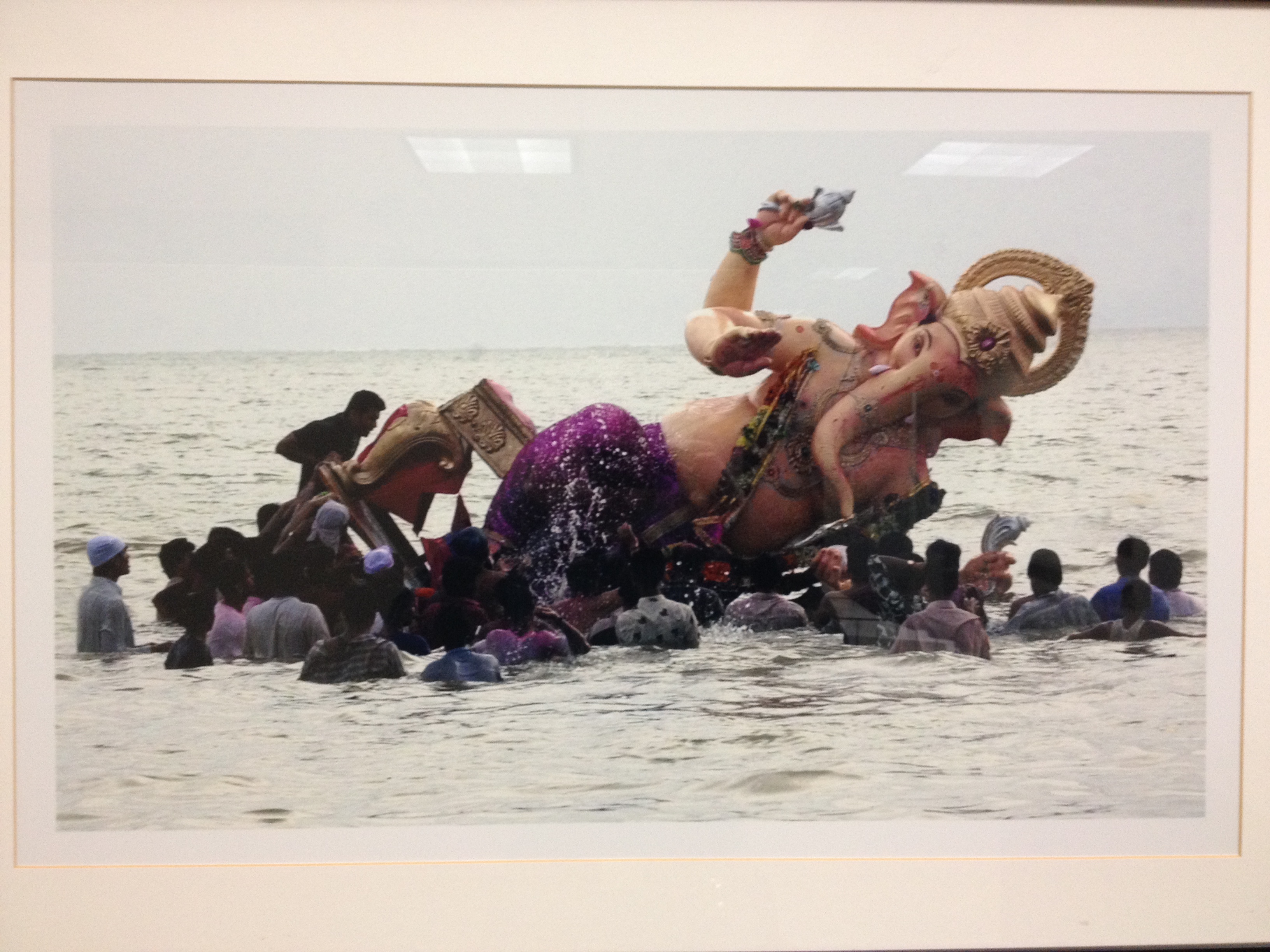
While wandering the halls at work, I notice the various artwork on the walls. One large, framed image has frequently caught my attention: several men are shown carrying a statue of Genesha, the Hindu elephant-headed god, through the water. Coming at this from a Christian background, I wondered what was going on since it looks like baptism. Hinduism, I know, is not a unified religion, but rather a conglomeration of many folk traditions from ancient India—one of the two seats of ancient religiosity. The stories of ancient India are colorful and diverse, and a bit of research suggests that this particular photo is likely the festival Ganesha Chaturthi, commemorating the story of how Ganesha came to have an elephant’s head. Crafted from inert matter by his mother Parvati, Ganesha was posted to watch the door while his mother bathed. Parvati’s consort Shiva returned and not knowing who the boy was, the lad’s refusal to allow anyone to enter led to a war. Eventually the Ganesha was beheaded and to appease his consort, Shiva supplied him with the head of a dead elephant and the boy resurrected. The immersion of Ganesha statues, or Visarjan, takes place as part of the Ganesha Chaturthi, during August or September.

I admit I’m not an expert on Hinduism, so some of the details may be a little off here. What strikes me, however, is the similarity between this story and that of Jesus. Like Ganesha, Jesus was associated with a modest mother, slain, and resurrected. He, too, is associated with ritual baptism. Growing up, we were taught of the many unique aspects of Christianity. We had, we were led to believe, the only resurrecting deity in the world. Our God alone could bring back from the dead, and the way in was through immersion in water. While learning about Ugaritic religion I read of Baal’s death and resurrection. Although stories of baptism haven’t survived, he also battled the sea and came out victorious. Some ideas, it seems, are particularly fit for religious reflection. The details may be unique, but the archetypes are very similar. Religions may be many things, but in the end, unique is a word that must be applied with the greatest of care. In the meanwhile, the next time I read of walking on the water, I will recall that even Asherah was know as “she who treads upon the sea.”


The Lost Forest

DSCN4420

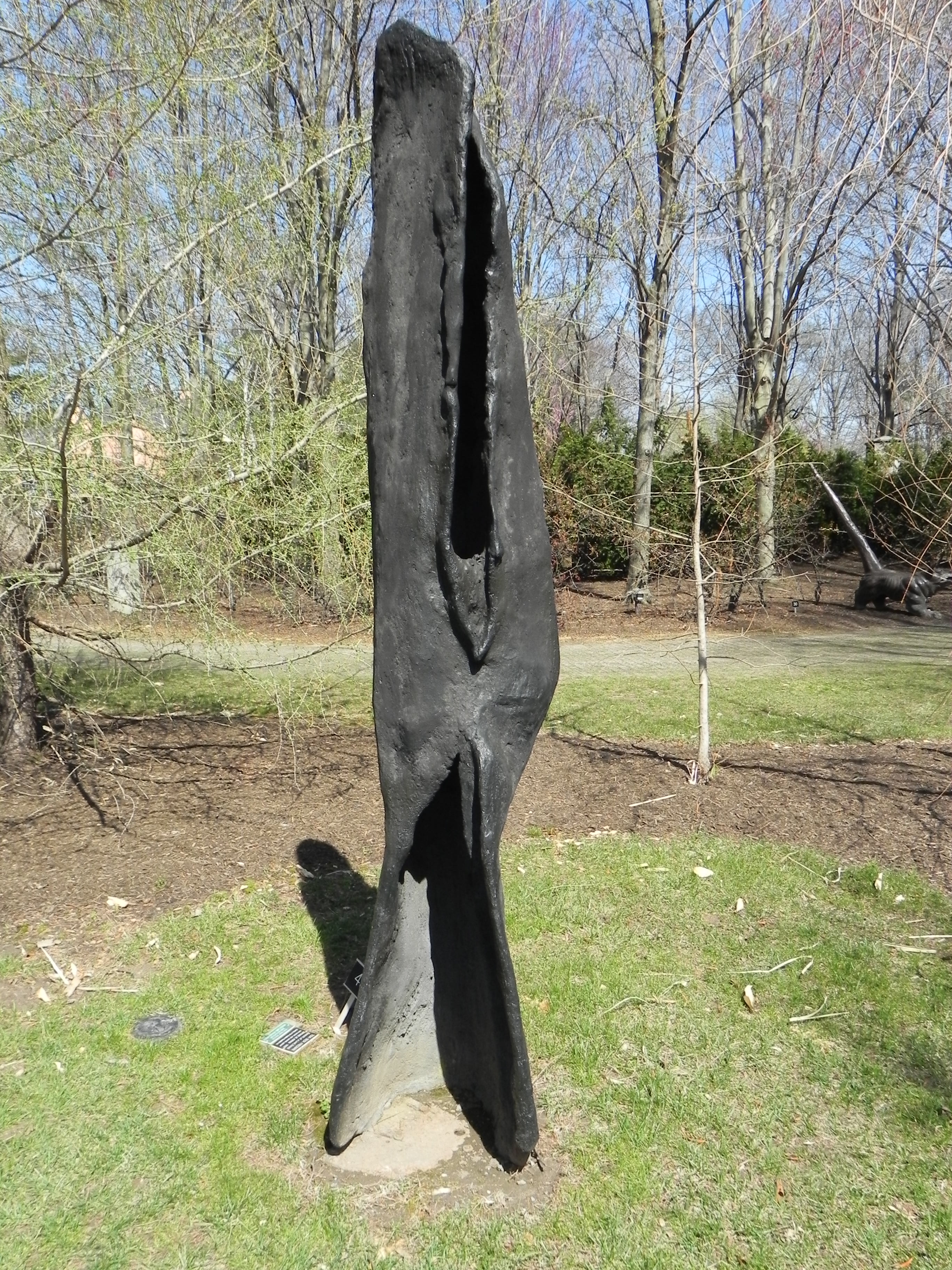
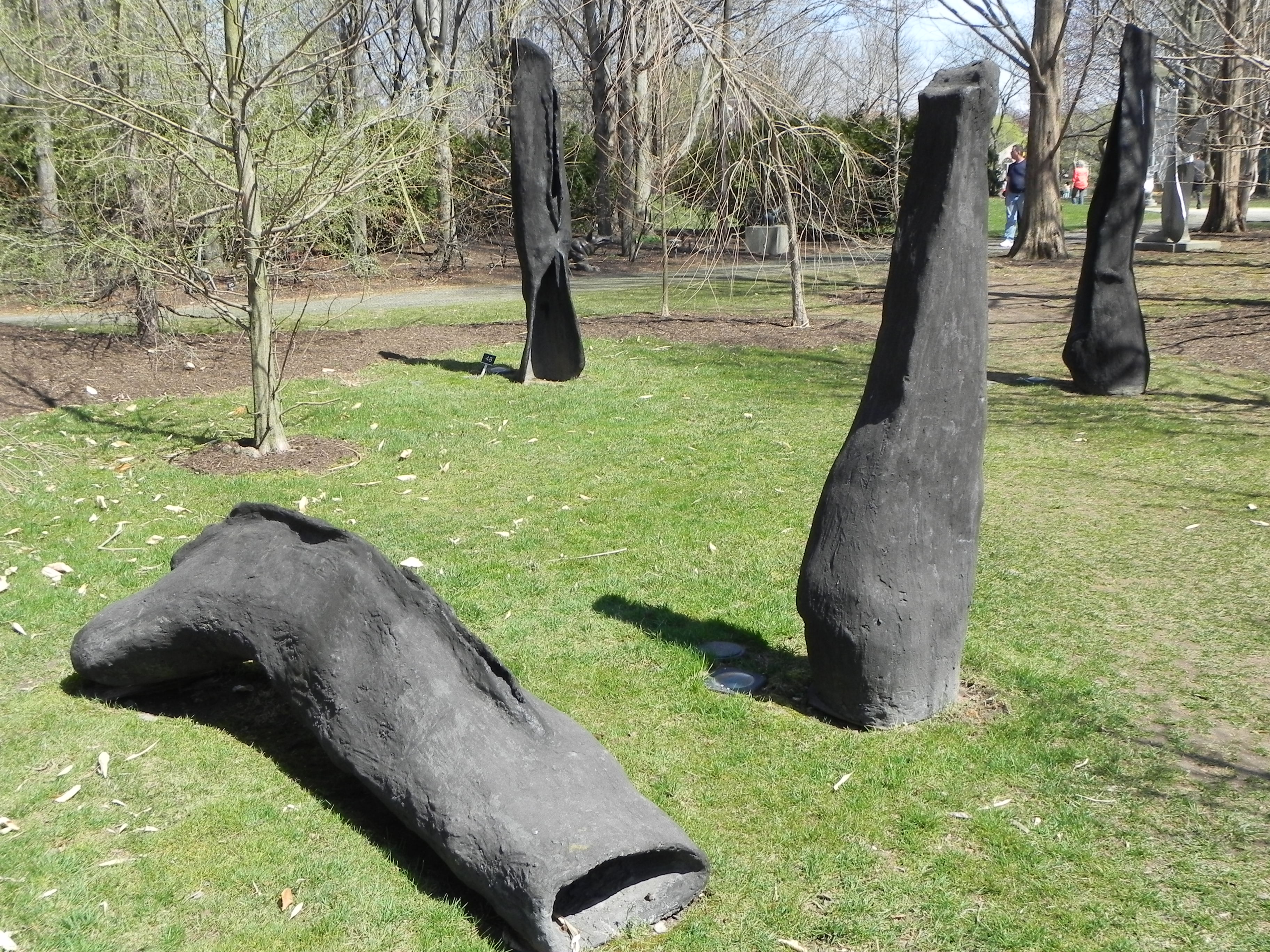
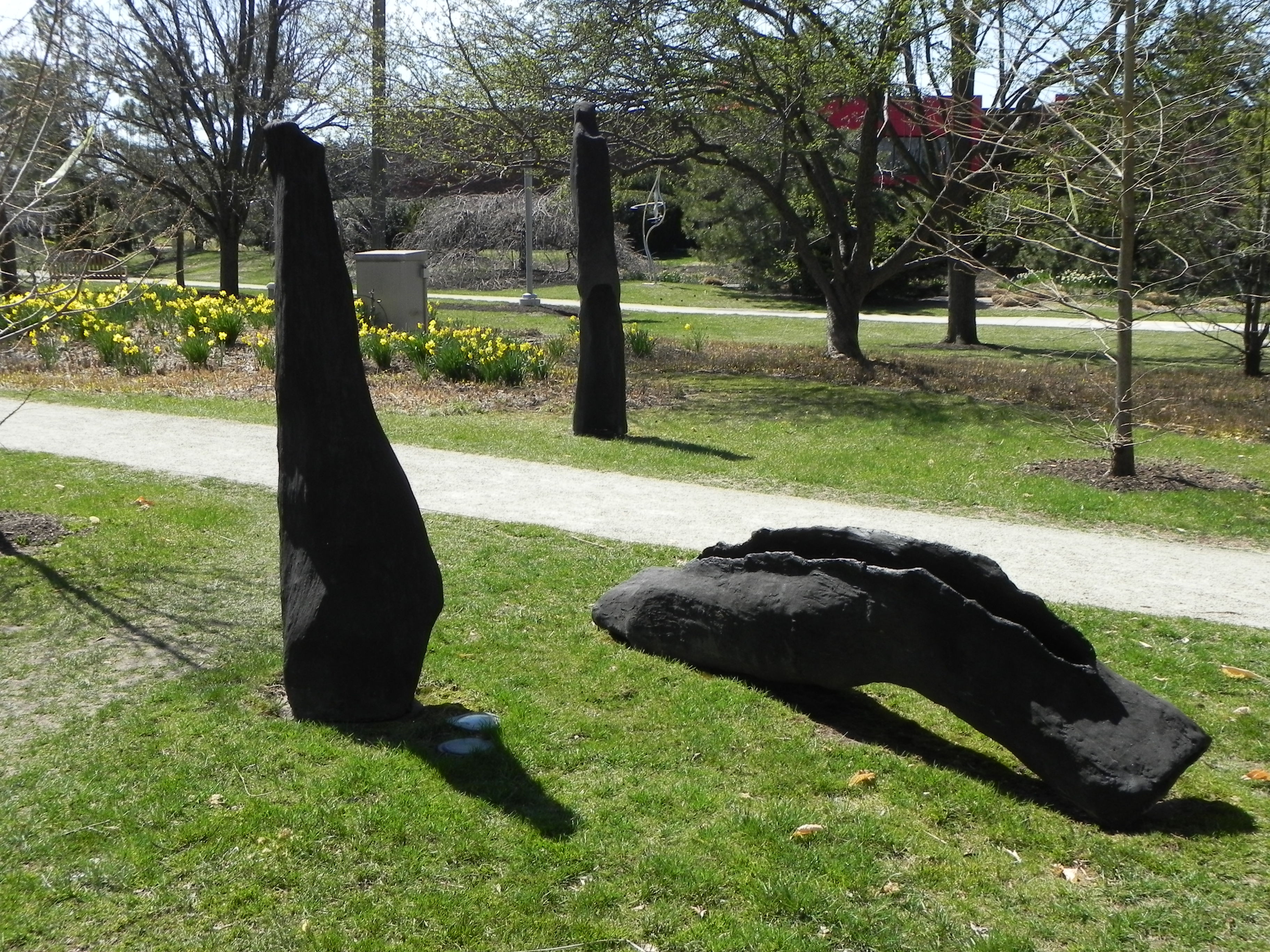
Asherah has, from lack of new material, fallen into a quiet retirement among the gods. For a while there no shortage of new books appeared, including my first, which explored many aspects of this shy goddess. While academia has pushed her to her logical limits, she has thrived in the world of popular imagination. I was reminded of this during a recent visit to Grounds for Sculpture, a whimsical park in Hamilton, New Jersey featuring the work of many artists. The appreciation of art works on many levels. A piece of sculpture can take on new meanings when viewed from different angles, and a piece that seems to make no sense can become imbued with meaning when new perspective is added. Sometimes it is the title of the sculpture. A friend had pointed out to me last year that one of the artworks was entitled, Excerpts of a Lost Forest: Homage to Ashera, by Tova Beck-Friedman. Ironically the sculpture is from the same year as my finished dissertation on Asherah, a continent away. I must have seen this sculpture many times, but without knowing what it was, had paid no attention.

DSCN4424

Asherah is often considered a goddess of trees. My research indicated, however, that such an association was premature. Of course, any discourse that has the Harvard University stamp of approval is decidedly fact, despite contrary evidence. Nevertheless, the dendrite nature of the goddess has persisted into popular culture and even into the world of abstract sculpture. The loss of a forest is, no matter whether goddesses are involved or not, tragic. Asherah has become the protectoress of trees.

DSCN4422

The nature of this particular lost forest isn’t clear. At first it might appear that a fire has gone through, claiming the vitality that once thrived in green leaves and mottled bark. I sense that something more is happening here. Asherah is, above all, the divine female. Here single-most constant role in antiquity was as the spouse to the high god. The loss of the forest still speaks to the on-going repression of women. We like to think that our society is headed toward equality, but progress is painfully slow. As usual with lack of momentum, religious institutions lead the way in conservatism. In the largest Christian body in the world, and in some of the fastest growing religions on an international scale, women are kept from leadership roles on the basis of gender alone. Monotheism declares there’s one god for two sexes. Those who experience life from the other side are like trees falling in the forest. We still don’t know if anybody hears.


Falls Tree

The autumn trees have been absolutely transcendent the past few days. From my earliest memories fall has been my favorite time of year, and a large determinant is the trees. Some weeks back, while on the campus of Notre Dame University, I noticed the highly stylized icons of biblical tropes etched into the stone walls of the library. The marble of the walls was highly polished, making images difficult to capture, but I tried to snap one of the tree of life. The tree of life has many associations that go back even into pre-biblical times. Many people are familiar with the story from Genesis, where the tree of life is forbidden to Adam and Eve because they ate from the tree of knowledge. That tree, however, goes back to ancient Mesopotamian stories of paradise as well. Even the Sumerians considered trees foundational.

IMG_1001

I suspect that trees are impressive partially because of their longevity. From a human perspective, they long outlast us—some of the oldest trees in the world are located in western Asia. If we don’t attack them, some species have a pretty good chance of lasting hundreds of years. With roots that run deep and crowns that reach high, trees have been a rich source of symbolism for religions for a very long while. The goddess Asherah was, in some way, connected with trees. I’ve noted in some of my more academic work that the precise nature of this relationship is never really clarified, but some have suggested that the tree of life itself is a form of the goddess. Certainly in Judaism the tree of life inspired the menorah and its gift of light, to be celebrated later this month.

Looking out my window at the brilliant reds and yellows, I am glad for the solidity of trees. Much of life is much less stable than our wooden companions. The myth of the tree of life is a reminder that even if we can hold the eons in our heads, our bodies will not last so long. It is a poignant thought, best captured by the slow falling of the leaves at this time of year. The leaves had just started to change as I strolled the campus of Notre Dame, unaware that my own fall was likely already set in place. The proverbial axe, as it were, was already laid to the root of the tree. I was perhaps too busy thinking about the tree of life to notice the changes taking place around me. A good metaphor will do that to you, and it might even live as long as the tree of life itself.


The Goddess

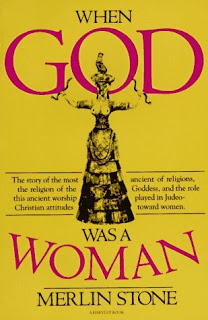
WhenGodWasAWomanMerlin Stone was a sculptor and an artist. I met her only once, a few years back when I was still recognized as an “authority” on ancient goddesses. At one of the many Society of Biblical Literature annual meetings I attended, she came and introduced herself to me, thanking me for my work. Of course I knew who she was—the author of When God Was a Woman, one of the books that was most influential in the revived goddess movement of the 1980s. I have always appreciated those women who have dared to take on the often amorphous patriarchal power structures of society to raise the necessary questions of fairness and justice. Stone was one of those women. Her book, while based on sometimes questionable historiography, nevertheless highlights some of the issues that many male scholars have chosen simply to ignore.

One of the biggest problems faced by authors like Merlin Stone and Marija Gimbutas has been the shifting sands of history. I recently had a deep conversation with a couple of feminist friends of mine where the issue of truth emerged. Truth, as I came to realize, may be a temporary phenomenon. What is true today (the earth is the center of the universe) may not be true tomorrow. It is always contingent. Historians reconstruct a past to which they do not have direct access, and further discoveries will often detail the errors made along the way. When God Was a Woman was originally published in 1978. Some of the historical constructs that Stone uses have since crumbled, but the main point of the book remains firm—women have as real a claim on the divine as do men. (I can’t help but wonder if there is some connection between this and the recent trend towards prominent male thinkers declaring themselves atheists.)

Although I can’t agree with everything Stone wrote, one of her ideas dropped a hook in my brain. In describing the sexuality that apparently attended worship of “the goddess,” she notes how male scholars came to refer, always derisively, to the such religions as “fertility cults.” Turning this phrase about, Stone wonders whether far distant future analysts will look at monotheistic religions that decry sexuality as “sterility cults.” Not that the goddess is all about sex. Religions, however, always weigh in when such spiritually significant activities as sex take place. Men, who are often eager participants, are the ones to construct religions condemning what should be a most obviously sacred human activity.

Merlin Stone may have died just over two years ago, but her book will stand as a yad vashem to half of the human race who have been religiously subjected to the other half. And perhaps there is a goddess out there yet who will bring about liberty and justice for all.


Divine Sex Change

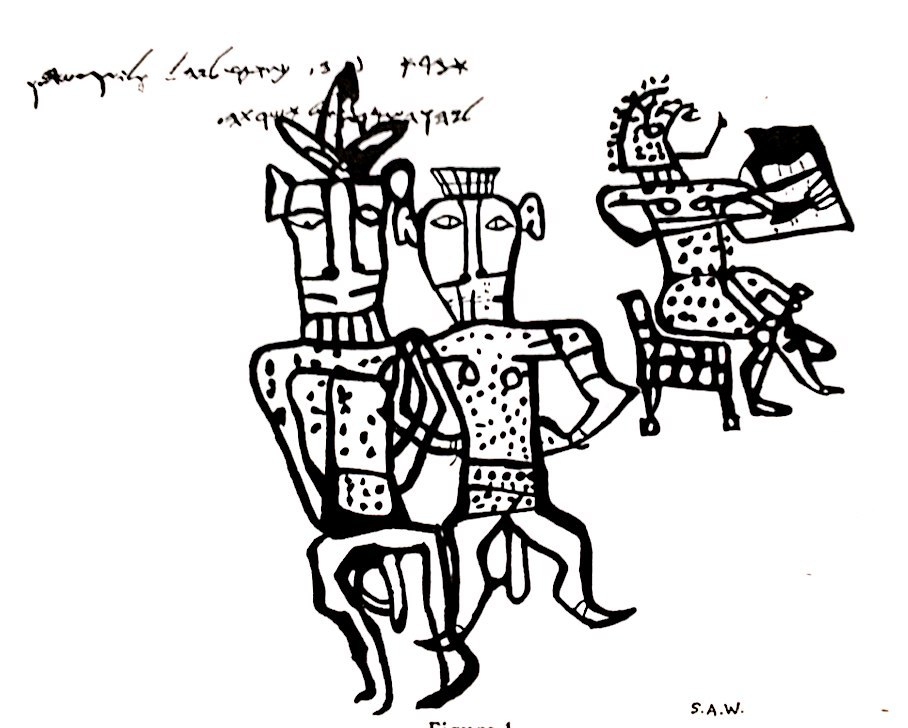
One of the greatest problems in reconstructing ancient religions is the ambiguity of the evidence.  Most ancient artifacts are not labeled (they probably didn’t need to be for the original viewers) and few have textual materials explaining them.  This became clear to me when studying the famed inscription found at Kuntillet Ajrud in the mid-1970s.  The most (in)famous aspect of this artifact was that an inscription overlapped a doodle, and due to the urgent desire to interpret the inscription a particular way, the line drawing was supposed to be an illustration of the inscription.  The inscription is commonly translated as something along the lines of “I bless you by Yahweh of Teman and his asherah.”  Many scholars took asherah to mean Asherah, the goddess, despite no evidence for pronominal suffixes on personal names in classical Hebrew.  The doodle shows three figures, perhaps related, of which two were said to be Yahweh and Asherah.  Despite the very clear resemblance to the Egyptian dwarf-god Bes (Kuntillet Ajrud is between Israel and Egypt), it was argued that the figures in the “foreground” should be considered Yahweh and his main squeeze, Asherah.

KuntilletAjrud

The artistic analysis of these doodles has always been torturous. Tiny, perhaps insignificant, details were ascribed great importance—particularly those indicating the gender of the figures.  For the Yahweh-Asherah connection to work, one had to be male and the other female (with the male preferably in front).  The problem was that both figures seemed to have penises (in keeping with Bes’s typical representation).  In order to make it clear that the right-hand figure was female it was claimed that she was wearing a lion skin and the “penis” was literally a tail, the leopard’s tail, seen between “her” legs. The problem seemed to be a possible scrotum appeared to be present.  The left-hand figure, larger (therefore, in front) had a clear scrotum, and that sealed the case, in a manner of speaking.  Little chestal circles were said to be breasts on the right-hand figure, but male nipples on the left-hand figure were lacking.  Oh, and they were dancing, as shown by the woman playing the harp in the “background.”  Believe it or not, seriously scholarly debate raged over this—nothing short of the discovery of Yahweh’s wife seemed to be at stake!  A colleague recently emailed me to tell me the final report of the archaeologists concludes that the “scrotum” on the right-hand figure was a mere dust smudge and so, aha!, she is a female after all!


I argued years ago that this drawing was clearly a representation of Bes. The connection with the inscription is accidental (the jug on which the inscription occurs is full of doodles); if someone wanted to illustrate an inscription, they would not draw figures that actually obliterate part of the caption. Assumption is built on assumption here, however, making for a very shaky foundation indeed. Don’t get me wrong: I would like to see Yahweh as happily married as the next deity. It is not good for the god to be alone. Still, it is going to take more than a divine sex-change operation to transform Bes into Asherah. If nothing else this divine gender-bender ought to serve as a cautionary tale for scholars, yet somehow I doubt that it will. We see what we want to see.


Super Women

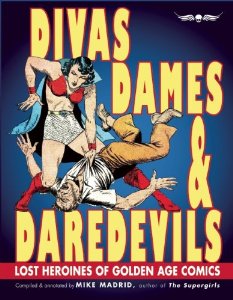
DivasDamesDaredevilsDivas, Dames and Daredevils: Lost Heroines of Gold Age Comics, by Mike Madrid, is a stroll down a memory lane that many of us never previously walked. My imagination is such that I no longer read comic books, but as a child they provided a cheap escape from a reality that didn’t feel so different from the crime-infested world that superheroes inhabited. For young boys reading these stories the absence of women was normal—there were some things of which Mom didn’t approve, and that was because she just didn’t understand. Boys will be boys. Still, Mike Madrid has ably demonstrated a secret knowledge that the 1950s would deem arcane—female characters once held a position nearly equal to that of men in the world of comics. Prior to Comics Code Authority in 1954, the women who helped win the Second World War were portrayed as tough, independent, and in charge (to an extent) of their own destinies. In the conservative backlash of the ‘50s, however, women were diminished, relegated to the home and domestic life. Comic books presented them as secondary to men. That myth has proven pernicious, even now, six decades later.

One of the perks of blogging is having someone you’ve written about contact you. Mike Madrid has been the subject of a previous post for his book The Supergirls: Fashion, Feminism, Fantasy, and the History of Comic Book Heriones. Madrid’s agent kindly sent me an advance proof of Divas, Dames and Daredevils, and I was once again struck by the historical scope of knowledge that these books present. Academics are—let me correct that—some academics are becoming aware of the fact that popular culture defines reality for many people. We find our troth in those who live on the big screen or on the pulp paper, those who rise above the constant threats of an uncaring world. We’ve seen that business can be its own evil empire, and superheroes, and everyday people, do have it within their power to act. Madrid shows that we were well on our way to equality of the sexes when the haircut and horn-rim crowd of the clean-cut 1950s insisted a return to Stone Age ethics in the treatment of women was appropriate.

In keeping with the general theme of this blog, the book has a chapter on the goddesses who became heroes. We all know Thor, but what of the forgotten Fantomah, Amazona, Marga the Panther Woman, Wildfire, Diana the Huntress, or Maureen Marine? Madrid’s book presents a story from several of the animated heroines of the days before censorship tamed the feminine mystique. More than that, he clearly shows how women—even ordinary women—were once deemed incredible and awe-inspiring. Then the titanium gate of male inferiority complexes and the vaunted “old ways” crashed down, trapping us all in a world fit to be ruled by men alone. I congratulate Madrid for resurrecting so many forgotten figures who never had a chance to become cultural icons. All women are heroes, and I know there is a hero that I miss very much, although even Mike Madrid didn’t mention her in his wonderful book.


Esoteric Goddesses

250px-Statuette_Goddess_Louvre_AO20127One of the nice things about the internet is that you can indulge your unorthodox interests and nobody will much care (except, of course, the US government). The other day, while reading about monsters, I found a fellow WordPress site, EsoterX. More specifically, I found a blog post on Ashtaroth. Those who have more than a passing interest in my background know that I spent a few years of my life writing about the goddess Asherah. Asherah and Ashtaroth are sometimes easily confused by anyone not reading about them in the original languages, but I settled on Asherah because we simply don’t have much textual information on Ashtaroth. Ashtaroth has gone by a number of names over time: Athtart, Astarte, and, as I just learned from EsoterX, Lord Treasurer of Hell. I won’t try to repeat the clever observations of EsoterX, but I can’t help myself add my own two shekels’ worth.

Ashtaroth is clearly one of the bad girls of the Hebrew Bible. She tempts the upright astray, and she seems to have been a perennial favorite among the less-than-orthodox Israelites. The Bible doesn’t take much care to flesh her out fully, and she appears only in minor roles in the Ugaritic texts. Some in the ancient world easily associated her with Ishtar, and their names do seem to bear some kind of relationship. Ashtaroth is connected to the planet Venus, as was the latter goddess Aphrodite—named, appropriately enough by the Romans, as Venus. Ashtaroth was also a militaristic goddess associated with horses. That girl got around.

Unfortunately, in the literature that survives from the earliest period, we are left with only the sketchiest of outlines of this once important goddess. Many of the Semitic deities have been revived in popular mythology of the modern age, and Ashtaroth, with her sexy, yet belligerent nature, is always appealing to the puerile imagination of pubescent boys. She was taken with great seriousness long ago, however, although her origins are lost to history and her attributes have become general enough to fit just about any old generic goddess. I’m glad to see that EsoterX has given her a shout-out and has traced a brief history of the goddess through the ages. Maybe someday we’ll find some accurate information on her early days. If we do, will somebody please give me a poke? I will probably be busy reading EsoterX.


To a Fallen Goddess

One of my favorite places to visit in New Jersey is Grounds for Sculpture. Over the past several years that we’ve domiciled here, we’ve had the opportunity to take several friends and family members to see the whimsical, creative, and inspirational park over in Hamilton. When my daughter graduated from high school, she requested a visit to Grounds for Sculpture, and, since family were near at hand, we took the opportunity to see it again.

I’ve always been aware of the religious aspect of creativity. Perhaps it is because I like to flatter myself into thinking that I’m the creative sort, despite my years of academic training, or perhaps it is the kind of pipe dream for which the liberal-minded are easily accused. In either case, I have always found that the best art evokes something similar to a religious experience. There is an element of wonder, emotion, and awe here. Not every piece of art conjures it, just as a single god isn’t sufficient for the whole of humanity. As I wander the grounds, I grow convinced that this or that sculpture had a vision akin to what I’d call religion, that led to the creation of such a trenchant piece. I always leave feeling blessed.

Photo credit: Grounds for Sculpture, postcard

Photo credit: Grounds for Sculpture, postcard

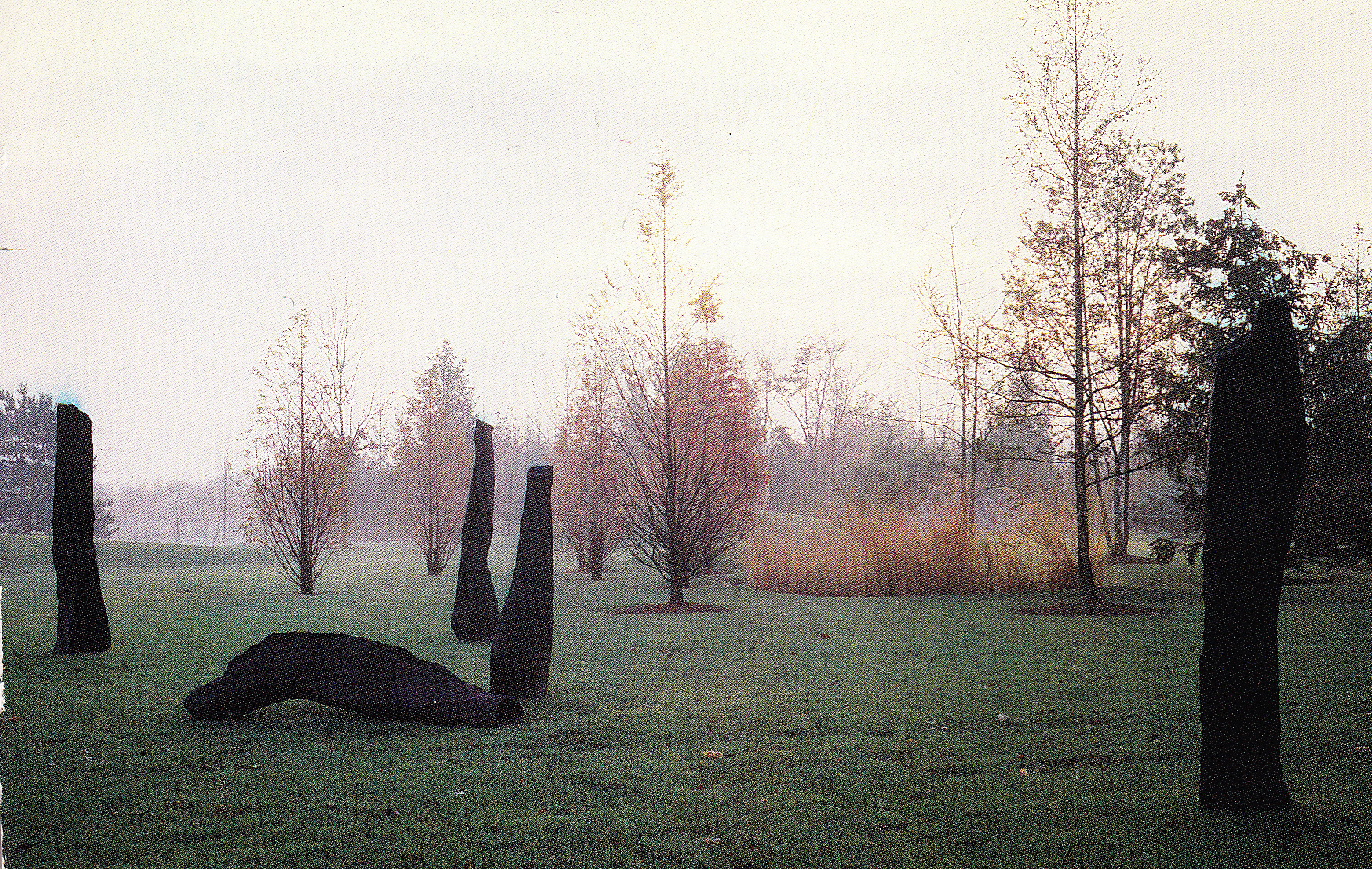
On this most recent visit, a very conscientious relative found, and later sent, a postcard of a sculpture I’d never seen. (It is possible that the sculpture is not currently on display, as the Grounds are continually evolving.) The piece is entitled “Excerpts of a Lost Forest: Homage to Ashera,” by Tova Beck-Friedman. Several of my relatives have me to blame for their awareness of Asherah; she is, after all, a relatively obscure goddess in the Hebrew Bible. The sculpture, however, speaks to me of the continuing ability of even extinct gods to inspire artists. Just as Asherah occupied several years of my academic life, I suspect she also haunts the work of sculptors who’ve come to realize that not all gods must be male, and not all gods must be real to be important. Quite the contrary, the collective deities of our heritage may still be found where art thrives.


Like Virgins

If you are reading this, I have safely arrived in the United Kingdom, courtesy of Virgin Atlantic. Given the lens through which I view everything, I somehow supposed that Virgin Atlantic was named after one of history’s two most famous Madonnas—the Blessed Virgin Mary, or just plain Madonna. It turns out that I was wrong on both counts. Virgin Atlantic, famously under the leadership of Richard Branson, borrowed its name from its older sister company, Virgin Records, also founded by Sir Branson. Virgin Records, I had supposed, was named after the only musical Madonna, but again, not so. The record company, new to an inexperienced Branson, was named by a colleague who noted that they were business neophytes, like virgins. The original logo showed an Eve-like virgin with a snake and everything.

Steve Fitzgerald's pic from WikiCommons

Steve Fitzgerald’s pic from WikiCommons

While in the UK I always call on Nick Wyatt, one of my doctoral advisors and now a good friend. As my mentor in Ugaritic, we always joke that I fly Virgin Atlantic because of the Virgin Anat, Baal’s famous warrior sister and sometimes lover. Anat was, of course, not the first perpetual virgin. The Mesopotamians had the idea that a goddess could be a perpetual virgin and still have kids, and what led up to said motherhood. Virginity is a status marker, still unfairly applied to women. I suspect a good part of it is biology (and if this seems weird, blame it on the jet lag), because the essential male reproductive function occurs whether or not a female is present, and even the most saintly men can not, from time-to-time, barring very extreme measures, avoid it. It is difficult to measure virginity in men, so why the double standard?

In this early morning haze (or is it really afternoon?), I suppose it comes down to not wanting to support somebody else’s child. Looks are at best a lackluster proof of paternity, and in the days before effective birth control, the only way you could be absolutely sure was to make sure your spouse was a virgin. Goddesses could get away with sex and still retain their purity. It was less sanguine for the human woman. Thus the Virgin Mary is accorded a special, but not unique status. But it turns out that none of this really matters because the Virgin I fly is merely a business virgin. And with a bit of experience, provides some of the best care in the air.


Girls Rising

While I was home watching Bruce Almighty, my wife was attending a local screening of the documentary Girl Rising. (There was a good reason for this discrepancy; you’ll need to trust me on this one.) Chances are that many readers haven’t heard of Girl Rising; I know that if I weren’t the husband and father of Girl Scouts, I’d likely have missed it myself. Isn’t that part of the problem? Why does our society make females invisible, unless sex objects? Tabby Biddle has a thoughtful observation about this in the Huffington Post. She notes the importance of the film, but laments that the only way to make it through to the masculine mind is to pose the argument that educating girls will increase the GDP of less fortunate nations. Girls should be educated for their very humanness, Biddle suggests, but our view of a masculine God often prevents this from happening. While Biddle may have fallen a little under the spell of Marija Gimbutas, she makes a very valid point: there is no human reason that girls should not receive equal opportunities with boys. The fact that I even have to write that in the twenty-first century saddens me. It is not just “Third World” girls that have to struggle to gain what is rightfully theirs.

In my career I have been passed over more than once so that a woman might take the advertised position. (I have even been informed of this fact by friends on search committees.) Somehow I can’t find any injustice in this situation, as much as it has personally disappointed my hopes and dreams. Men have been frustrating female hopes and dreams for millennia. Maybe the matriarchy that Gimbutas envisioned never really existed, but the concept is sound: women and men both contribute to this thing we call civilization. Our religions, as they developed in our societies, have held the mirror up to the might-makes-right paradigm from the very beginning. Wouldn’t a male god with a more muscular upper body shove a fair, and giving goddess out of the way every time? Just ask Zeus. Or Odin. Or El. Divine civilization is only human projection, and we just can’t relate to a genderless God. So he becomes the excuse for female repression.

The face of divinity?

The face of divinity?

We’ve firmly entered a new millennium, and, looking at our treatment of half of our species, we still have an incredibly long way to go. In much of the western world, traditional religion has lost its grip, but I’m a little frightened by what I see taking its place. There are a few pockets of female-friendly religions awaking, but there are many more backlashes from the traditional male preserves of conservatism, patriarchy, and free enterprise. It is time for all men to consider that none of us would be here without our real-life goddesses. Some may rail against unorthodoxy, but unfair structures must be imploded for a new, and true, orthodoxy to be established. Women and men—not women for men, not women for profit—that is the only right teaching. So we should promote Girl Rising, and we should seek to move beyond the mere financial benefits for a free market to find the divine spark that masculine interest seems to have lost.


Inhumane Society

AnimalsMatter“I’m a member of PETA,” I’ve had more than one wag say, quoting bumper sticker wisdom as if it were profound, upon learning I’m a vegetarian. “People Eating Tasty Animals,” they then spell out with a smirk. I stopped eating animals at about the turn of the millennium, and since then I’ve discovered more and more reasons that it was the correct decision. I’ve just read Marc Bekoff’s Animals Matter: A Biologist Explains Why We Should Treat Animals with Compassion and Respect. It saddens me that in our world where nothing escapes being posted on Facebook, people still tend not to notice the suffering we impose upon animals as a matter of course. I’ve always been inclined to look closely at things, including animals. Watching them, it is clear that humans are indeed animals only differently evolved. Our mannerisms, our emotions, even our expressions, can be found among our animated kin. We share a planet on which we all evolved together, so why do we find it so easy to exploit other creatures?

One of the reasons Bekoff notes, without being judgmental, is that some religions inform us that people alone are special because we bear the image of God. Although God is supposed to be altruistic, we don’t wish to share that exalted status with any other species, apparently. Even in the twenty-first century many otherwise intelligent people still claim that animals feel no pain. Can’t reason. Are mere machines. We’ve been taught to distrust common sense that informs us that if an animal in distress acts like a human in distress that it experiences the same anxiety. The more we study animals the more human they become. The theology of Genesis has much for which it will be called to answer.

It seems, however, that the Bible is used as a mere excuse here. We exploit other animals because we can. We have taught bovines and ovines to trust us so that we may more easily slaughter them. Perhaps this is an exercise in divine image bearing, but somehow I doubt it. Reading Animals Matter in many ways felt like listening to a scientist who has taken the message of the Lorax to heart. We treat animals the way we do because we don’t understand their language, but we are morally obligated to speak for those who have no tongues. Although accessible to younger readers, Animals Matter is nevertheless a profoundly disturbing book. What does it say about the highly evolved when they exploit their relatives who’ve not learned the language of humans? Or, more accurately, who’ve not learned to vocalize like humans. Other animals speak, just like people sometimes, if we would only translate their actions into words.