Here Comes the Sun, and Is She Ever Hot!

As I enjoy my Kellogg’s Raisin Bran at breakfast, a benevolent sun smiles down on me from the box. I know from social conditioning as a child (courtesy of television), that the smiling solar disc converted the healthful grapes into equally healthful raisins so that I could grow up to be big and strong. While there is no doubt some truth to this solar myth, it does demonstrate how pervasive solar personification is.

A persistent myth to minds conditioned by trinitarian concepts of early Christianity is that the ancients recognized three major goddesses. Although their names are distinct in the original languages, in English three of them begin with A and form a delightful Trinitiess: Asherah, Anat, and Astarte. So this feminine triune godhead is considered to represent the female power triangle of the ancient Ugaritic world. (Ugaritic, I know, is a far too limited term for what was a widespread idea. On the other hand, “Aramean” and “Canaanite” are inherently problematic!) It has been my contention for years that this construct is A) modern, and B) false.

Throughout the ancient world the sun was considered a major deity. And although deities frequently overlapped in their spheres of interest, the principle Ugaritic deity in charge of the sun is Shapash. (With apologies to Nicolas Wyatt, I simply can not find Asherah in her.) In the surviving Ugaritic mythology, which we know for sure is only a portion of a larger corpus, Shapash appears frequently to enlighten both gods and humans. She guides the dead to their repose in the underworld and provides them with some kind of light while the world sleeps unknowingly above. She even seems to have the ability to cure snake bites. Now in the heat of summer, there is no question of Shapash’s ability to turn our grapes into raisins. She even kept many indoors in India last week as the longest solar eclipse of the 21st century crossed that country (chalk one up for Yarikh). Let’s give the sun her due!


Yes, Mammon

In the continuing coverage of the most recent New Jersey scandal the Star-Ledger, on Monday’s front page, posted a picture of San Giacomo Apostolo in Hoboken. San Giacomo is traditionally the brother of the equally mythical St. Ann. The statue, which stands outdoors in a public street, has monetary donations tacked to it. The image flashed me back to my Nashotah House days when students became visibly excited nearing the date for the procession of Our Lady of Walsingham at the proto-shrine in Fond du Lac, Wisconsin. Seminarians would beg for an opportunity to hoist the holy statue, or at least be a lowly acolyte. (These were grown men, mind you — many of them seeking the priesthood as a second career.) I never attended Walsingham, but it was my understanding that pilgrims and penitents at the festival also adorned their lady with money in hopes of some gift of grace. I grew up in a blue-collar household where paying ladies for favors was itself considered a sin.

Looks like Our Lady has put on some weight

Looks like Our Lady has put on some weight

While on a recent trip home, I saw a church for sale. As I started to break out my checkbook, I recalled how closely money and religion are tied together. The more I pondered this, the clearer their ancient, entangled roots became. The religiously observant bringing gifts to the temples of their gods was a standard act of piety and civic duty in the ancient world. Temples were expensive and the staff could only be supported by continuous donations. In the Ugaritic tale of Kirta, our protagonist seeks a son and makes a vow to Lady Asherah that if he successfully procures a wife he will make a statue of her in silver and gold. The favors of gods may be purchased. Today credit cards are accepted, but we are still caught in the web of those who claim God has asked them for your money.

For sale, God not included

For sale, God not included

When I was a teenager a friend invited me to attend a public presentation by some visiting Rev. Harrington, a popular evangelist. Several times during his high-energy sermon he sent the collection baskets around. The first time it was for your standard church offering. The second time was for any change you had in your pockets. The third time was for a special blessing. For those who had checkbooks ready, a thousand-dollar donation would get your name on a personalized plaque in his private jet. Years later I saw Harrington on television during an interview on his private estate. He puttered around it in a customized golf cart with wheels designed not to scuff up the gold-plated bricks that constituted the drive before his opulent mansion. “If we’re going to walk on streets of gold in heaven, I want to get used to it here,” he casually explained.

So, as an (unofficial) agent of Asherah, if you are seeking to make a divine investment, get out your checkbooks and I’ll tell you where to send the donations (checks made to “cash” please!).


Sects and Violence

Religion-sanctioned violence has a long (overly long) pedigree. Early myths going all the way back to the Sumerians incorporate violence on the part of the gods. Depending on one’s school of interpretation, this could be seen as “form following function” — people saw the violence inherent in nature and projected its causation onto the source of nature, namely, the gods. Ancient people did not perceive of the world in terms of natural phenomena. “Nature” behaved the way it did with will and reason, the will and reason of the gods.

The stories preserved from ancient Ugarit stand as witness to this conceptual world. In one story, Kirta by title, the eponymous king Kirta seeks a family and has his wish granted by El and Baal. Hedging his bets, he makes a vow to Asherah that he forgets to fulfill. Asherah sees to it that Kirta’s divine gift comes undone. More obvious is the tale of Aqhat, another divinely granted child. Aqhat is given a bow by the craftsman god Kothar-wa-Hasis, only to have it coveted by Anat. When he refuses to release it to the goddess he is unfortunately pecked to death in a hitchcockian demise by a swarm of buzzards with attitudes. Violence is introduced into the human realm by the gods themselves.

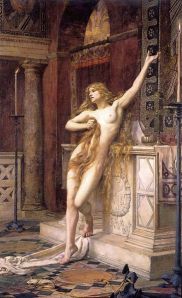
Today, some 3,000 years after Ugarit, we still find ourselves living with violence sanctioned by religion. Whether it is as obvious as extremist factions of a religion calling for outright attacks on others, or as subtle as self-professed righteous believers destroying a colleague’s career in the name of Jesus, religion is used as a mental crutch for striking others. While I can not walk all the way with Christopher Hitchens, I do have to acknowledge that when it comes to human-on-human violence religion is a socially accepted motivation, no matter how pure its original intentions.

Hypatia, a scholar-martyr due to religious violence

Hypatia, a scholar and martyred victim of religious violence


Asherah Begins

Back in the Dark Ages when I was working on my dissertation on Asherah, web research had not been born, or even conceived. Its parents might not have even met yet at that stage! When Gorgias Press decided to print a second edition of my book on the goddess a couple of years back, I utilized the opportunity to peruse the web to find out where the old girl is these days.

It seems that Asherah worship is alive and well, according to the internet. I suspect that the ancients would be scratching their heads — and not just because of the omnipresent lice — at the ways she is portrayed these days. The matronly bearer of the gods of Ugarit is a lithe and whimsical girl, walking on the water just like so many other ancient divine figures. She has become a patroness of witches and is identified with any number of pet causes. She is chic, sexy, and alluring.

Unfortunately, what we know of the actual goddess is quite a bit less exciting than all that. Asherah is best attested at Ugarit, a city on the northern coast of Syria that has been extinct for 3000 years. Here she is matronly, passive, and interested in doing the laundry. Her role in the mythology is small, despite being the mother of the gods. She does become notorious in the Hebrew Bible and still has the power to inspire the “bad girl” dreams of many a rebellious youth. She is a fascinating figure — some pundits even think she might have been the main squeeze of someone very high on the spiritual food chain!

Perhaps this is one of those “disconnects” that pop-up like toadstools during a wet and rainy summer. Technology has outstripped reality. A goddess once feared and revered as the ancestor of the gods has become a pin-up girl in a digital era. If a mirror could be held up to time itself, I’m not sure that Asherah would recognize herself even if she long gazed into it.