Breaking Day

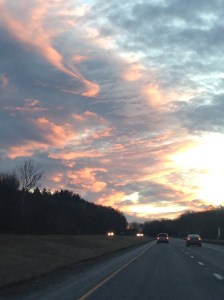
When does the day start?  Years of awaking around 3 a.m. may have distorted my perceptions a bit, I suppose.  Here in the mid-Atlantic states, the sun is never up that early.  Year round I get out of bed when it’s still dark.  I’m not complaining—this is generally a peaceful time, a rarity in New Jersey.  If the bus didn’t come so early I’d get an awful lot done in a day.  But when does the day really begin?  I rise early to write.  Computers have changed my writing style quite a bit.  I used to write everything by hand.  Even as a kid with a second-hand typewriter, I preferred longhand first.  I still do, truth be told.  It’s slow, though, morning’d gone before I got too far.

So I get up and boot up.  I’m not sure that I’m crazy about my computer knowing so much about my personal life, but one thing it simply can’t understand is that I’m an early riser.  Many days my laptop will condescendingly ask me if I mind if it reboots—it’s been updating software when it thinks I’m asleep.  For the computer, day doesn’t begin this early.  Sometimes I worry that my blog doesn’t get readers because the new posts come up around 5 a.m., before I jump in the shower and head for the bus.  If things don’t appear in the feed at the top of the page, well, they’re old news.  I admit to being guilty of that myself; yet knowing when it’s day has consequences.  Maybe I should be posting a bit later?
For some reason my computer likes to send me notices.  Like I’m not already paying attention.  I’m sure there a setting someplace I could change, but I’m busy most of the time and figuring that sort of thing out takes longer than I have time for.  Birthday notices for complete strangers—maybe they’re connected on LinkedIn?—appear, at 9:00 a.m.  I’m at work already by then.  I think this is my devices’ way of letting me know that it’s a nine-to-five world.  As an erstwhile academic I never cottoned onto that.  I started getting out of bed at 4 a.m. when I was teaching so I would have time to write before daily chapel.  I also taught classes that ran from six-to-ten (p.m.) while at Rutgers.  When does the day start?  When does it end?  The decision’s not mine, as my laptop’s only too happy to remind me.


Divisive Devices

In some kind of vague attempt at spring cleaning—yes, I know it’s late for that; I’m always running behind—I’ve been taking some old electronics for recycling. You know the pattern: you replace a piece of equipment and set the old one aside and next thing you know it’s become a handy horizontal surface upon which you can stack other things you don’t have time to deal with right now. House-cleaning day should be a national holiday in a country of inveterate consumers. In any case, this exercise in household archaeology has revealed quite a bit about just how much we owe to our technological overlords. I’m still of the mindset that anything over $20 is expensive. When it comes to any piece of electronic hardware, my wife and I have a serious tête-à-tête as to whether we really need it or not. I mean, we both grew up with pen and paper.

Everything’s electronic these days. During my vernal excavations I’ve come across more than one device that I can’t identify. “What this thing?” I ask. I don’t remember buying it, although there must have been some serious discussion first, and I’m not even sure what it does. At the time of purchase, I know, it felt pretty urgent. So we are led like sheep to the hardware. Is your house cluttered with old photos? Digitize them! Too many CDs? Thousands of MP3 files fit onto this device! But what about when devices clutter up your house? Who even uses an iPod anymore? Or a digital camera? We still have a few rolls of actual film sitting around, waiting to be developed.

My grandmother lived from the first heavier-than-air flight to Neil Armstrong stepping foot on the moon. As someone pointed out the other day, kids these days can’t figure out how to use a rotary-dial phone. I won’t find one of those tucked in the closet anyway, because they were owned by the phone company. I’m not sure who actually owned this dial-up modem in front of me—if that’s what it is, but chances are that Verizon won’t have any use for it anymore. These are strange days when you feel nostalgic for a wide-ruled tablet and a pencil freshly sharpened from a hand-cranked device bolted to the wall by the classroom door. And I think it’s still spring.


Let the Sunshine in

The earliest sunrise does not occur on the longest day. At least not at this latitude—I can’t speak for the entire world, but sunrise lags behind the latest sunset by a few days. In Germany the longest day was January 30, 1933. It seems that the Nazi Party did not win the majority, but Hitler was made chancellor anyway. All he wanted to do was to make Germany great again, right? No matter who it hurt. When Americans, who sacrificed thousands of souls, found the concentration camps they swore it would never happen again. That was, however, before Donald Trump was born. Indeed, those seeking the transmigration of souls might wonder where he’d been wondering for the previous thirteen months. There’s some cryptic stuff happening here.

How can it be that sunrise isn’t earliest on the longest day? Back in the days when science mattered, it was simply explained: the number of minutes the sun is in the sky maxes out on the summer solstice. Sunrise can keep getting earlier for a few more days, but so will sunset. The longest day, in the biblical world, was when Joshua was fighting at Makkedah. The slaughter was going so well that the big white guy upstairs (oh no, he’s not Jewish, you see) reached out and held the sun in place for another 24 hours so it could continue. That, you see, is the longest day. Not exactly sand chairs and sunscreen, although the latter might’ve been awfully useful.

Although in modern times the solstice is known as the first day of summer, in olden times it was considered midsummer. The solstices and equinoxes were the midpoints, not the start of something. Such a perspective can make a world of difference. June, it is said, is named for Juno, the pagan wife of Jupiter. The constantly cuckolded goddess of marriage. Only we call her long-suffering, since stormy weather should be over by June, shouldn’t it? With enough lawyers even sin can be made to sound righteous, for longest day brings everything out into the light otherwise. The longest day, you see, can be fake news. Around here the sun will rise still earlier tomorrow. Experts—those we no longer believe—tell us that the solstice was yesterday. And yet, what is that orange thing arising in the east so early in the morning? Don’t be fooled; the longest day is over.


Cult of Paris

The cult of celebrity is dangerous. The results of both biological and psychological sciences inform us that mammals, especially primates, hold “alpha” individuals in awe. We don’t know what quality makes them irresistible to some, but in the case of humans before you know it everyone is talking about this Kardashian or that Trump. Valorizing the power of media as we do, those who appear ubiquitously on screen gain in magnitude merely by the attention paid to them. Others have vetted the details, and those who are deemed important enough for constant, widespread television exposure are worthy of our worship. Most of the time it seems banal, harmless. But when those without scruples are willing to exploit it, it is dangerous.

Paris rejecting the cult of celebrity

For example, the other day my wife and I rewatched An American in Paris. I know my wife likes the movie, but when it was over I couldn’t help noting that Jerry Mulligan chauvinistically claims his right to a woman he’s just met, and who is, moreover, engaged to a friend of his who had just lent him money. The fact that he doesn’t know about the engagement is no excuse. Lise tells him “No,” and when she gives him a false telephone number he doesn’t take the hint that she doesn’t want him to call her. He stalks her in a selfish and predatory way. Only because she laughs at his antics with some perfume bottles does she agree to meet with him later. He takes advantage of another woman who clearly has feelings for him and who sponsors him, using her money but not reciprocating her feelings. He’s aggressive and eavesdrops to get Lise’s name. He lies to her and about her (saying he knows her so her friends don’t object) and refuses to take no for an answer. Laying out my grievances, my wife politely listened and then said, “But it’s Gene Kelly.”

Like many people, I was jilted a time or two when I was younger. Losing out to a rival lover leaves a lasting scar. How can we hope that on New Year’s Eve Lise will leave Henri for the interloper Jerry? But it’s Gene Kelly. The cult of celebrity allows those on various pedestals to get away with many things. Trump was likely correct in saying he could stand in the middle of a crowded street and shoot someone and his base would not object. The cult of celebrity ’sn’twonderful, ‘sdangerous.


Sects on the Highway

Here in the east, it’s not unusual to see Amish buggy road caution signs. Well, not so much in New Jersey, but in my somewhat frequent trips into Pennsylvania and upstate New York. On a recent trip to western Pennsylvania I mentioned to my mother that I’d never seen any Amish along the infamous route 322, where such a sign resides. Driving down 322 on my way home from that trip my wife and I passed three Amish carriages and one baby stroller. Religion has a way of surprising you along the highway. Roadside sects are not uncommon. Apart from the many biblical billboards I’ve been seeing lately, there are any number of indications that once you get out the urban areas of the nation, religion is alive and well. While driving to Ithaca, New York recently my wife and I simultaneously spotted a sign we’d never seen before. We have made this trip to upstate many times, mostly along Interstate 81. The sign was for a tourist attraction called “Historic Priesthood Restoration Site.”

Being hopelessly mainstream, we assumed this meant Catholic priesthood. The problem was, what was either historic about this area north of Scranton, or what might be this restoration? Once we found wifi access again, I learned that the priesthood referenced was that of the Church of Jesus Christ of Latter-Day Saints. I have to keep reminding myself that Mormonism had its start in parts of upstate New York—an area so prone to religious flare ups that it was called the Burnt Over District back in the day. So Joseph Smith and Emma Hale had lived just over the border in the area of Susquehanna, Pennsylvania while Smith was working on the Book of Mormon.

A great deal of America’s religious history may be found on roadside markers. We are an inventive people when it comes to ways of exploring what we consider the divine world. Mormonism has been one of the more successful brands of American religion and although we tend to associate it with Utah now, it was a faith that grew up here in the green hills of the mid-Atlantic states. Being inveterate seekers, Homo sapiens go after new revelations with surprising aplomb. And we’re willing to change the constitution of old religions to fit new prejudices. Religion is anything but static. To test this theory simply get behind the wheel and drive out into rural America. You’ll be surprised how much you can see even at highway speeds, if you have eyes to see.


Rains and Bows

It’s raining and I’m here for an outdoor event. Here, in this case, is Ithaca, New York. The event is the parade that’s an integral part of the Ithaca Festival. As people have been laying out their chairs and blankets along the route since morning, it’s a fair guess that if we don’t stake out our few feet of available public space we’ll miss the parade. And yes, it will rain on my parade. The problem is waiting in the rain. With one hand holding an umbrella and water getting in anyway like a leaky roof, there’s only so much you can do. Reading a book—my default activity—is out of the question. I know very few people here and since I’m acting as a placeholder, there’s nobody to talk to. Tom Petty was right after all.

The parade itself turned out to be a celebration of diversity. Ithaca is what America could be. The various liberal organizations, eager to educate, marched by to cheers and bonhomie. There’s nobody judging here. This became clear in a particularly striking juxtaposition (for which I have no photos, because it was raining) in the parade lineup. A group of Mad Max-themed metal rockers went by in a gnarly truck decorated with torches protruding from fake human skulls. Dressed in future period costumes from the movie diegesis, they produced the guttural, primal roar that is an accusation against current society. Then, like Mel Gibson shifting to The Passion of the Christ, the group immediately behind was a Bible Baptist Church. Add water and mix.

For this I’d sat in the rain for a couple of hours. Forced to relax, I watched the water on the fabric over my head as beads crawled together, joined one another, and scurried, animal-like, from the umbrella to the ground. The drops may look uniform from a distance, but they’re diverse. They come in different sizes, and perhaps because of the distorting character of the nylon, they took different shapes. Placed together in one location, it was natural, it seemed, for them to come together for a common goal, which was the ground. There was a parable playing out here right over my head. While it didn’t seem to be the case at the time, it clearly was a lesson to be shared. Had it been sunny, I would’ve been reading a book. Sometimes it takes sitting in the rain to learn something that should be obvious no matter what the weather.


APB

It’s disconcerting. Being mistaken for somebody else. I suspect I’m not alone in having shown up somewhere I’ve never been before only to have people mistake me for a local. It’s happened to me a couple of times, and what with the recent Steve Wiggins incident in Tennessee, it’s enough to make me question my uniqueness. I’ve also had the unfortunate experience of undergoing identity theft some years back, and floating myself out here on the internet is something the wisdom of which I sometimes question. If I’ve got enough doppelgängers running around out there, perhaps I should be careful of revealing too much online. Such problems my grandparents never had.

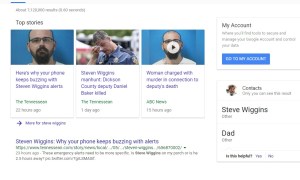
A long time ago I turned off the warning alerts on my phone. It’s not that I don’t care, but rather it’s that I keep odd hours. Without revealing too much, I think I can say that I’m awoken somewhat often by those who don’t go to bed so early, or who don’t think about timezone changes before hitting “send.” We here in the American orient awake earlier than others. So I switched off my alerts. Then I started reading that other people were getting “Steve Wiggins alerts.” Was fame passing me by in the night? While this wasn’t the kind of fame I’d hoped to attain, a few stray visitors to this blog couldn’t hurt. When I searched Google for information on “Steve Wiggins” I found myself listed in the Google box on the right as “other.”

Some people who’ve written only two books are listed as “author” on Google. In my case it seems Google can’t figure out why anybody would be searching for me. “Other.” They say Google knows everything. It certainly knows how to flatter the self-seeker, at least most of the time. What does it mean to be an “other?” The unclassifiable? My work, indeed, falls into the “other” column, like that of many people who’ve made plans only to run into the cold reality that fate has laid out for them. Not being a professor any longer is a source of constant confusion to me. Books I read state that x or y knows about a subject because university z or w has hired them. There are those kinds of experts, then there are the “others.” And because of recent events, there are those instantly famous for killing another man and running away. Who am I? I’m not legend; I am other. What exactly that means I still haven’t sorted out.


A New Look

I beg the indulgence of my regular readers as I post a public service entry today. As I noted a few weeks back, I have filled the allotted free space on WordPress. That meant I had to move to a paid plan and what with all the extra space in here I hired a professional web-designer to help me spruce the place up a bit. This note is to let you know that within the next 24 hours the appearance of this website will change dramatically. Don’t worry, Sects and Violence in the Ancient World will still be part of it. I hope that, if you subscribe, you’ll be willing to move that subscription to the blog page because I’ll continue to use it. The new home page will allow me to attempt to bring my books to the attention of the world while continuing to do whatever it is I do on a daily basis here at the blog. Since you’ve been kind enough to read this far, I figured I could share a little of my thinking about the blog in an exercise in meta-narrative.

First of all, the title. Why do I call the blog “Sects and Violence in the Ancient World”? As much as I’d like to say it was an intentional quasi-anagram involving my initials and other key letters of my full name, that wasn’t actually it. This blog began as a summertime conversation with my extended family while on vacation. I hardly knew what a blog was then (and some would argue I clearly don’t know what one is even now!), but but brother-in-law suggested it as a place to do some podcasting. (I did, until I started working in New York City, which ate up virtually all of my free time during the week.) One of my nieces said “What would you call your blog?” Off the top of my head I said “Sects and Violence,” well, you know the rest. I originally had hopes that my career teaching ancient West Asian religions would continue some day. Indeed, I still post in that area, but my interests have shifted a bit since then. The main theme of the blog has remained religious studies, broadly conceived. I don’t limit myself to that, but I do use it as a personal pole-star.

Writing is its own reward. And besides, WordPress told me I’d run out of space. The next time you check in here, things will probably look a bit different. The blog will still be there, but there will be some other pages and features. Thanks for coming at least part way on the journey with me. And when I run out of space again, we’ll see where it goes from there.


Eternity, Technically

When the robot uprising comes, we have a factor in our favor, we biological beings. That is our parts, although they do break down, generally heal themselves. I write this as kind of a forecast, because I’m not at home due to the holiday weekend, and neither is the internet at my home. You see, our internet service (which is not cheap) has been going out from time to time. Our service provider thinks it may be old parts. The box was installed in our basement over a decade ago and when the technician sent me down amid the cobwebs before leaving town I had to report to her that all cables were hardwired into the box. No clip and slip here. She thinks the cable has gone bad.

The cable just sits there. It never gets moved or jostled. How it could fail I don’t know. But the consequences are two. There may not be posts on this blog for a while once I return home. I’ve posted every day, holiday and secular-day, for years now. Technology, however, is a jealous deity and will not permit humans taking it for granted. The second consequence is more optimistic; when the robots rise up against us, their parts will wear out and they won’t be able to regenerate them organically. They’ll need to order them and hope they can find a delivery system even more efficient than Amazon’s. Good luck with that! I ordered a book the other day and less than 24 hours later it was at my door. That’s service.

I decided to post this advance warning so there may be no weeping and gnashing of teeth (please—dental work is expensive!) on Monday or Tuesday when no new post appears on this blog. It’s not that I’m not thinking of you all, it’s just technical. Robots may run system tests, but can they feel it in their bones when something’s about to go? Do they indeed sing the body electric? Can they feel the poetry they write? To be human is to think with our emotions and to reason ourselves out of irrational angst. I see the slaves to technology putting on weight as they rely more and more on labor-saving devices to make their lives automated. I’m guilty too. As I sit here many miles from home, however, I worry about the internet back there. Is it sick? Is it dying? And if so, to which mechanical god should I pray to save its technical soul?


Wired for Good

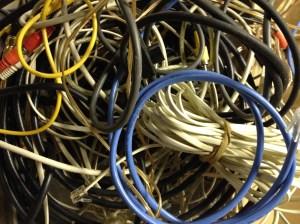
I spend entirely too much time untangling wires. Recently I read a survey asking whether you’d rather face a robot uprising or a zombie apocalypse. There’s no question that the devices have already taken over. And they’re eager for your source of power. The work laptop, the home computer, the aging iPhone, the iPad—they all want feeding, like a nest of hungry chicks. And their cords get tangled. It’s up to the human servant to come along and try to introduce some order into this chaos. Then there are the devices that go the way of the iMac, and yet their cords somehow remain. We have boxes of cords that look like an octopus orgy—uncertain to what device they once belonged we’re afraid to send them to the recycling plant because you may have accidentally rid yourself of one you still need. If there was a robot uprising, they’d be tripping over their own umbilical cords.

We used to go camping. Completely unplugged. These days of state parks offering wifi, even a trip to the wilderness isn’t really wireless. I’m a little afraid of this new dependency. The joy of memorizing has been replaced with the internet in my pocket. Life has become much easier in some respects, no doubt, but it’s not a one way street. Technology has its price, as this tangle of cords I’m facing reminds me. There’s no cutting this gordian knot without going back to the Stone Age, it seems. What would I do if I couldn’t post on this blog daily? What would remain of me?

If electricians are the acolytes to this new religion, then programmers are the priests. Each keystroke produces a recognizable letter because of their prayers and supplications to the great god Internet. Without it my job would be impossible. It knows how much money I have and where. What I’ve spent it on. It even flatters me when I search for something I wrote. The robot uprising, you see, need not be violent. It’s subtle and gradual. When you can’t live without something—when you adore it and depend on it constantly—it’s become a deity. The god, however, depends on us for providing it the constant sacrifice of power that it demands. It hasn’t figured out how to extract electricity from the air, or suck it from our fingertips as we type. And for its needs it requires cables. Like a good servant, I’m going to sit down and sort them all out again.


Creating Afterlife

Once upon a time I wrote a book on commuting. It never got beyond my laptop, but I often wonder if it was simply premature. Some stories from public transit can be quite amusing. A few weeks ago I posted on how a woman spoke up after our bus missed it’s turn off the highway and made us all late for work that day. No matter what you think of developers and speculators, one thing we can say for certain is they lack imagination. If you’ve driven this stretch of highway 22 you know that the exits look very much alike. Early in my commuting days a young woman took the empty seat next to me on the way home and asked where we were. “I miss my stop because they all look alike to me,” she explained. She had a point.

So one morning last week I was in my usual seat, reading along, when the driver—new to our route—missed his turn off the highway. The same woman (for we are mostly regulars at this forsaken hour of the morning; if this doesn’t ring a bell search this blog for “commuting”) said, “No need to turn back, they have another bus coming.” I was pleasantly surprised at the learning that had taken place since the last time. I am, however, old enough to remember Greyhound commercials and their slogan, “Take the bus and leave the driving to us.” I also thought of those passengers waiting like evangelicals for the second coming for a bus that would never show up. Our gain in time was their loss. Such are the dynamics of life in a universe not built on the principle of fairness.

The bus can be a microcosm of the moral universe. Evangelists, for example, believe all people must have the opportunity to catch this express bus to Heaven. The bus that comes after the express makes more stops, somewhat like Catholic Purgatory, increasing the suffering for a while, but ultimately making the goal. Missing the bus completely are the Hell-bound for which some claim we must turn back while others insist we press on; there will be another bus. In this case, the same passenger insisted that we help those left behind just a few weeks ago. This led to lengthening of her own stay in Purgatory, so when it happened again she decided those waiting were simply too hard to reach. Or maybe she’d come to believe in predestination. Perhaps it was on some ancient bus that ideas of the afterlife emerged. Experience teaches that much depends on factors beyond your personal control.


Real Dreaming

I keep odd hours. Although we don’t live far from New York City, as the pigeon flies, public transit sets the schedule for my day. (I’m merely writing as a representative here, since I know others keep my hours as well.) Since I’m usually waking up around 3 a.m., I have to go to bed pretty early. One night recently I turned in around 8:00 p.m. and fell into a fitful sleep. When I awoke three hours later, it was as if my gray matter were a thunderhead. Ideas, worries, and memories flashing like lightning. Concerned, I watched the clock since I knew it was a work day. When three rolled around with no more sleep I hoped it would be like one of those rare days of interrupted rest when my conscious mind does just fine. Would it function that way on just three hours of sleep?

This incident brought home to me once again the mystery of consciousness. I had a meeting in New York I couldn’t miss that day, but by mid-morning (in real-people time) I was seeing things that weren’t there—an almost Trumpian dissociation from reality. Then I’d snap back to awareness and realize my mind was drifting off to steal some of the sleep it refused during the hours of darkness. Using the usual tricks I stayed awake for the workday and even for the bus ride home, with only brief momentary lapses where what had been reality had stopped making sense. Consciousness, it seems, functions best with a well-rested brain. A good night’s sleep put me back to normal the next day.

Reflecting back over that previous 24 hours, I thought how surreal they’d felt. Not to put too fine a point on it, but they were like an altered state of consciousness. Religions, some claim, began because of such altered states. They are strange and powerful. And fairly universal—almost everyone experiences them from time to time, whether by sleep deprivation, controlled substance use, or prayer and meditation. Even knowing the cause (going to bed with a lot on your mind when you have to wake early, for example) doesn’t change just how real the experience feels. This is one of the reasons that rationality doesn’t explain all of experience. In the same brain there are Jekyll and Hyde aspects to consciousness, interchanging with each other every few hours. As the movie Inception underscored, you don’t remember how you entered the dream. You’re just there. And when that world intrudes on the conscious, rationally ordered territory of wakefulness, the questions can become quite religious. Unless, of course, I’m still dreaming.


In God’s Name

If anyone ever bothers to go through my personal zibaldones (if the word’s unfamiliar, please use the search box for my post on it) they’ll find my personal shorthand. It’s not extensive since I’m a firm believer in explaining things and if I don’t write things out I often can’t decipher what I meant. One of the shorthand marks that I do use is the Greek letter theta. Those who know me will have no trouble guessing that it stands for “God.” Or more appropriately, “theos” the Greek word for God. This particular Indo-European lexeme has a venerable history and appears in such forms as deus, Zeus, and deity. Although in a case such as Zeus it can be used as a personal name, it is, in fact, a title. Somewhat like “president” used to be. And it can be used for any number of divinities.

In the Bible there exists a well-placed concern not to dis the Almighty. God—to use his title—had a temper and was known for not being afraid to show it. Among the Ten Commandments is one not to take God’s name in vain. Scholars argue over what exactly that means, but Judaism, on the ground, had to make decisions about it in a practical way. The best way to avoid divine wrath was never to say the divine name at all. God’s name isn’t “God.” That’s a universal word, applicable to any garden variety divinity. God’s personal name, we think, was Yahweh. To ensure the keeping of the commandment whenever this noun was encountered in the Good Book, the word “Lord” was used. That’s the convention behind Lord in small caps in some Bible translations. If you don’t say the name you can’t break the commandment.

In more recent days, in print culture, a further caution has been introduced. In academic writing it’s common to see “G-d.” I can guess the origins of this convention, but I have to admit that concern can lead to obfuscation. Nowhere does Scripture proclaim that you can’t use the title of the ineffable one. I can’t help but think this is following the conservative tendency to see the use of “God” in exasperation as swearing. The fact that another common swear abbreviates itself as “G. d.” might caution against using this particular combination in an effort to preserve the sanctity of the title. No one ever doubted that Baal was a god—but note the carefully lower case “g”—or for that matter, Mars or Zeus. Or, just to be safe, B-l, M-rs, and Z-s. May I suggest, based on personal experience, that theta might be used instead? But only if referring to the true G-d.


Academia Dot

The marketplace for ideas is just that. A place of commodity and exchange. We pay our professors good money (and our administrators even better) so that we can be given “goods.” The same is true of the publishing industry. Those of us who write books primarily (I think) think we are expressing ideas we have that we suppose are worthy of discussion. The book comes out. We await reviews. Citations. Exchange of ideas. Oh yes, and royalties. Only the naive think academic publishing will lead to much of the latter in the greater scheme of things. And so many of us turn to for-profit sites like Academia.edu to pedal our wares for free. After all, Academia is offering us a free service, isn’t it? (At least if you can ignore the constant sell-ups to find out who’s been reading your stuff.) But Academia isn’t non-profit. There’s money to be made here among gullible academics.

Oh, I have a page on Academia just like everybody else. Several of my papers, long out of the payout stage for their journals or parent books, are there for free. Academia frequently asks me if I’m sure I don’t want to upgrade—increase my visibility. Make them a bit of lucre on the side. So the other day I was flattered when I received an email about my dissertation from another vendor. I didn’t recognize the sender, but the content of the email made it clear they didn’t recognize me either. It was an offer to publish my original research done at the University of Edinburgh. Problem is, it’s already been published. Twice. Both editions beyond the purchasing power of mere mortals, but still, it’s out there. Academics, I expect, are some of the favorite targets of the entrepreneurial. We, after all, don’t speak that language. We trade in the currency of ideas. We’re easy marks.

I think Academia.edu is a great idea. Often it’s possible for those of us who are unaffiliated to find papers that journals insist on selling for fifteen bucks a pop—considering I can buy an entire book for that much, no thank you—for free. There may be hidden costs involved, but some days I do miss Robin Hood. No matter how many years I’ve been an editor, I can’t stop thinking like an academic. It comes with the territory. You can’t simply forget all that graduate school taught you. One thing most academics haven’t learned, however, is how to interpret the web. Long before our government allowed the freedom of the web to end, not all sites were free.


Woodland Creatures

Maybe I watch too many zombie movies, but the story of zombie raccoons was just too good to pass up. A story by Marwa Eltagouri in the Washington Post described a spate of recent “zombie raccoon” incidents in eastern Ohio, not far from where I grew up. While the likely explanation is distemper, one of the behaviors of these raccoons stands out—they walk on two feet. Since I also enjoy the occasional non-fiction book by Linda Godfrey—who’s made a name writing about anomalous animals in North America, particularly bipedal dogs, or wolves—I found this aspect of the raccoons particularly interesting. That’s the thing, you see. Bipedalism suggests other human-like traits. Think great apes. Or penguins. (Although birds are generally bipedal, they tend to be squat and more horizontally inclined than vertical. The penguin not only dresses for our most formal occasions, but waddles around like many of us do after having been a bit too generous at the dinner table.) But bipedal raccoons—now that’s scary.

As a species Homo sapiens seem to have a need to believe themselves unique. Over the centuries any number of traits have been claimed as unique to us. Bipedalism, the ability to speak, being relatively naked so that we have to wear clothing, being able text with our opposable thumbs—we’re not like other animals. We’re special. So when animals that normally go on all fours walk on two legs we instantly think they’re trying to be like us. They want to have all the rights and privileges of our species so they can elect alt-right leaders and destroy everything they’ve built. Uppity critters! We have trouble reconciling ourselves with our animal origins.

Other animals, it seems, are beginning to note the advantages of walking on their hind legs. I’ve watched enough zombie movies to know that it’s the intention that’s the real problem. They want to be like us. Notice the accounts of bipedal animals—witnesses say there’s something in their eyes. Global domination. Yes, they’ve been watching us and now they want the same things we want. They want to take over the world. I know enough about World War Z to know that you can’t save everyone. Hard choices will have to be made. And maybe I’ve watched too many movies, but I’ve noticed the bipeds are from red states: the dog-men of Michigan and Wisconsin, the raccoon-men of Ohio. If we can’t save everyone, we need to make wise choices. Why not let them have Washington, DC? They certainly can’t be any worse than what we’ve got there right now.