Nobody’s Business

Working in academic publishing some insights are available that academics typically miss. For example, it isn’t unusual for a professor to ask why royalties aren’t higher on ebooks because “they don’t cost the press anything.” Ah, my poor, simple academics! If only life were so kind. Ebooks don’t require any ink, paper, or binding. They require a whole lot more than that. Ebooks require publishers to hire entire new divisions to oversee the complicated, technical, and swiftly-changing business of having ebooks in the format that they can be accessed by various reader platforms. Think of it this way: instead of buying materials, publishers have to enter an entirely new business area to sell what they always sold without it before. Now let’s twist the letter-opener just a bit more. Ebooks have exploded exponentially. Anyone with an Amazon account can be an author. Who buys academic books? University libraries. How to libraries decide what to buy? Well, let’s just say “it’s complicated.”

Now let’s go a bit deeper. Have you noticed that instead of fewer presses there are more and more of them? Stop and think about this. Universities have been churning out more and more doctorates for a system that has had a shrinking number of positions for at least the last three decades. Yes, someone’s entire academic career could have been spent in a vanishing profession and they never noticed. There are no jobs out there, my dear professors. Why do you continue to churn out graduate students? The student knows that s/he will be expected to publish. A lot. Librarians, whose jobs have gotten a whole lot more complicated, face budgets that have been simplified. That is to say, administrators say “Ebooks cost less, so libraries need less money. Besides, there’s Wikipedia.” A doctoral dissertation on a single word in a single verse on a single book in the Bible is not likely to get noticed in such a situation.

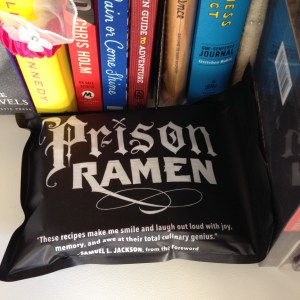
The fact is society is hungry for new knowledge. It just doesn’t want to pay for it. That’s the illusion cast by the internet: knowledge should be free. Tenured professors, however, don’t come cheap. Just ask the professional adjunct living out of his car and eating Ramen noodles heated up with the cigarette lighter. We don’t think about her, however, because she’s not writing books. Society wants an alternative to consumer capitalism. It just doesn’t want to pay for it. Presses start up because there is plenty of content out there—all those dissertations you direct—and anybody can make an ebook cheaply. Print-on-demand alone can keep a press in business. The knowledge pours out the facet, goes over the hands and down the drain. Professors, comfortable in their paneled offices, will never complain. You’ve beat the system—congratulations! But I just can’t help you with those ebook royalties. If you’ll excuse me, my noodles are getting cold.

img_2401


Twitter Me This

Techoncrat I’m not. At least I understand that to be authentic in this world you need to be on social media. I have a Twitter account. Have had for years. I don’t follow it religiously, but then, I don’t treat any social media like holy writ. The other day I noticed a disturbing trend. Donald Trump’s tweets end up on my bird feed. No, I didn’t accidentally follow him—I have a natural aversion to fascists with delusions of divinity—but nevertheless his mug shows up so frequently that I tend not to follow the bird maybe as much as maybe I should. I wonder how someone thinks s/he has the right to buy part of my consciousness.

Tweet or honk?

Tweet or honk?

The world-wide web is without laws, like the subconscious mind. Thoughts from around the world—at least the affluent part of it—milling, swirling about in an electronic soup thickened by irony. It’s addictive. The opiate of the masses. Perhaps it is a religion after all. Tweets are micro prayers. Blogs are sermons. Facebook is coffee hour. All these connected minds have created a consciousness of their own. Like Victor Frankenstein, we too know what it feels like to be God. It’s not a particularly joyous place to be. Does God, I wonder, lack the control that we experience on the Internet?

I like Twitter. It doesn’t demand much. The only problem is that to stay on top of things you have to have it going all the time. I turn it off and when I come back on I’ve missed hundreds of tweets. And then there’s Donald Trump again. I can come up with my own nightmares, thank you. I don’t need Twitter to suggest any.

Perhaps this is the apotheosis of capitalism. The ability to buy anything, including space on somebody else’s bird feed. Buy the most powerful office in the country, if not the world. Buy hatred and distribute it freely. One thing you can’t buy is intelligence. At least, up until now, some universities still understand that. It has taken me years to gather Twitter followers, like Mrs. Partridge the family band-mates fall behind in a neat, technicolor line. I have no money. I have very little influence. I’m really not a very good capitalist at all. I give away for free what universities charge for. Just like in the classroom, few pay attention. What do I expect? Who really listens to sermons anyway?


Take Your Time

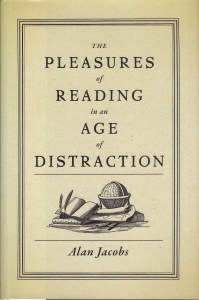
PleasuresOfReadingReading is fundamental. Those of us who grew up hearing that slogan have never forgotten it. The part that I wish had stuck better is just a touch shorter: reading is fun. Or it can be. Should be. Alan Jacobs’ little book The Pleasures of Reading in an Age of Distraction is like an extended essay on the subject. As a professor of literature, Jacobs has considerable experience encouraging people to read, and in his book he makes a case for reading what you want to read (reading on a Whim, he calls it). Wisely he recognizes that many would-be readers are discouraged by being instructed to read that which they don’t find appealing. I learned quite a lot from the suggestions contained herein, and I’ve been reading so long that I thought I knew pretty much what I needed to know about it. Perhaps the most fundamental issue (apart from reading itself) is that many of us expect to be told what to read. We second-guess our own judgment, feeling we need an expert to tell us how to do it. Like singing in public, it’s intimidating to come across someone better read than oneself. Jacobs advocates reading what gives you pleasure and not worrying about what others think.

Recognizing that readers are spoiled for choice, Jacobs addresses, among other topics, rereading. And taking notes. And reading slowly. I recall speed-reading courses advertised, ironically, on television. At college you could take courses in improving your quota of pages turned. There is a specific kind of reading, as Jacobs notes—reading for information—where this may be helpful. This is different than reading for pleasure, or even reading for understanding. In the case of the Bible (Jacobs taught at Wheaton before moving on to Baylor) many people, he suggests, read for information rather than for understanding. When reading for pleasure taking your time is a virtue. Getting to know a book requires rereading. We need to make time for what is important.

Jacobs makes the point that readers are a minority sect. There have always been fewer of us than there have been of those who don’t read. We are, in his words, a tribe. We can generally spot one another. Those of us who can’t walk past a bookstore will recognize ourselves in the pages of this meditation. Those who spend long hours with books become like them, in some respects. Familiar, layered, and requiring more and more attention. Like the reading that it advocates, this book itself is a delight to read. There is so much in this brief volume that it’s difficult to summarize in the short-form writing that I use on this blog. I found myself wishing for an index so that I might find my favorite passages again. Then I realized that perhaps this absence was intentional. Maybe I’ll have to reread it, taking notes as I go. What a wonderful thought.


Circus of the Absurd

As long as I’m thinking about ethics, my thoughts turn to the fair. Every August our county 4-H Fair becomes an event in our lives. Since my family has been involved with 4-H for many years, we always try to spend as much time there as we can afford. Jobs and daily life tend to get in the way, of course. While there we get to see the animals that are missing from our lives, and reconnect with art and culture. Robotics are now part of our local fair, and this is the first year that I’ve ever seen pigs there. And there were the political booths. Just around the corner from where the sheriff’s office was giving out free gun locks to prevent kids from shooting someone accidentally was the booth supporting Trump. I’ve never been so strongly tempted in my life to walk up to a total stranger and say, “You are kidding, right?” But no, like the Donald himself, a flashy large sign displayed their ignorance for all to see. We live in the era of the delightfully uninformed.

IMG_2908

I’m no political pundit. I tend not to trust any politicians much. I distrust businessmen even more. The fact is the only thing you need to be a viable candidate for President is money. Over the past several weeks Trump has shown himself to be anything but qualified for political office. Major newspapers run articles that seriously question his sanity. And yet here are good people who don’t have the sense to maybe put up an embarrassed, small sign saying “Sorry folks, we’ll try again in 2020.” We find it hard to admit our mistakes. Especially when the stakes are so terribly high.

I go to the fair to support 4-H and to enjoy an evening out with my family. Although I spend most of every day in a different state working in an isolated cubicle, I can always count on seeing people I know at the fair. I enjoy the arts tent where young folks are making their first steps into lives filled with creativity and imagination. The more technical tents can be intimidating where kids a quarter my age are launching model rockets and those under half my age are building robots. In the herpetology tent I see a snake amid a bed of shredded newspaper. He’s hiding under the photo of a prominent non-politician who has a large booth displaying his name just across the grounds. And I remind myself this is the first year they’ve had a swine tent. I wonder if anything will be the same next year.


Flying with Strangers

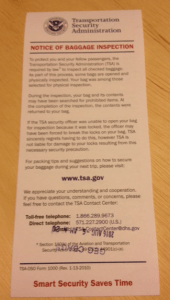
TSAThe world is safe now. It’s okay—you can unlock your doors and windows at last. I have the proof right before me. Two weeks ago I was out of town. To get to my final destination I had to fly. I travel light. Seeing families at the airport with stacks of suitcases, I often wonder what people find necessary to take with them. It depends on the destination, I suppose. If you’re skiing you’ll need different gear than if you’re snorkeling. Or spelunking. In my bag there’s just the same old togs I wear at home. Never a clothes horse, I seldom update my wardrobe. I’m not into extreme sports, and for hiking, well, I can wear what I’m wearing right now. One thing is universal, I suspect. Underwear. We all have tucked away in our bag somewhere that necessary item of human social politeness. That’s why the world is safe, you see. I have in front of me a slip of paper informing me that the Transportation Security Administration has looked at my underwear and declared it safe. Go ahead and fly the friendly skies. Just make sure your underwear is clean.

Long ago I learned that if I fly alone I will be singled out for added security checks. I’m a bearded man. A non-conformist. My beard isn’t one of those consisting of trendy hipster stubble either. Just a regular beard. No fuss, no muss. My life is far too busy for me to spend extra time scraping off hair that will only grow back. I have enough pointless tasks as it is. But once you’ve seen the TSA agents looking you in the face and pointing you to the extra-search line time and again, you start to notice patterns. Especially since nearly every TSA agent in Newark parks in the same airport lot as I do and rides the same shuttle in. Sometimes there are so many of them that they ask if I’m lost. No, just looking for a restroom so that I can check my underwear before you do.

The truly ironic part—and I appreciate irony so I know that there’s no way that an agent can know this—is that I’ve been a life-long pacifist. The draft was reinstituted when I was just the right age to sign up. I was a conscientious objector. One of my uncles was too, during the Second World War. The very title of the conflict should’ve made the need for more objectors obvious. I wouldn’t knowingly hurt another person. Or animal. I step over worms after it rains and will yield to an ant on the sidewalk. Still, you’d better check my suitcase just to be sure. To me, it seems the world might benefit from teaching more people to respect those who are different. Bearded men and those whose skin tone differs are not evil. We just don’t have the time to get to know them before we throw their bag onto the conveyor belt.


Words for Play

IMG_2849

Maybe you’ve seen it too.  Corporate-style psychobabble.  Memos land on your desk, whether real or virtual, jostling with neologisms, indicating the trendy new directions the business is going.  Apparently a legal requirement is that old vocabulary is vorboten in such information-bytes.  You can’t call a spade a spade—it might confuse somebody.  Do you mean a playing card spade, or something to dig with?  And do people even use spades anymore?  Why not call them loam-moving facilitators?  Isn’t that really what they are?  If you can get through a memorandum without a dictionary (slang or otherwise) you’re much more fluent in my native language than me. Or I.  I often wonder how much this has to do with an inherent inferiority complex.  A cog in this corporate machine has to prove it’s usefulness.  If nobody can understand what you’re doing, it seems, your job is secure.  I imagine think tanks as being like big aquaria, but with fewer viable ideas than captive fish.  I once read a memo that had to give each and every stage of a process a chic new name.  I felt like I needed to update my wardrobe and get a fashionable haircut just to read the thing.

Perhaps it’s just that a simply guy like yours truly prefers things explained clearly.  I can imagine a meeting taking place where nobody really understands what’s going on but they all have to nod their heads in approval for fear of feeling stupid.  New phrases, of course, have their place.  We needed a portmanteau for “telephone” back in the day, since there had been nothing like it before.  Most of my memos, by contrast, have been about plain old things that have been around for centuries.  Or millennia.  And if an old word is used, such as “idea,” it has to be in quotes.  Business must find a way of ensuring stakeholders that it’s on top of the latest developments.  Who uses a fax any more?  Most people consider email outmoded.  The period itself, I’ve read, is about to go extinct.  Still we have time to make up corporate-speak.

I work in the publishing industry, which is notoriously slow.  Unhurried attention to detail is a sign of quality.  If you want a book to be good, you need to take your time at every stage of the process.  Sure, a book can be churned out mere days after an important event, but if you read it you’ll see the corners that have been cut.  We even received an issue of Time once that had the “e” accidentally chopped off by a hasty cutting machine.  You want quality, you need to take your tim.  Adopting the newest coinage in the busyness business hardly seems a way for minting success.  Utilizing quality ideas isn’t the same as the fabrication of nonce words.  Of course, attention to detail takes away from time that could be spent making more money.  Churning out new verbiage creates the illusion of being ahead of the game.  If you need a dictionary to understand what your company is doing, perhaps it’s a good thing to work in publishing, even if you have to look words up online.


Biological Imperative

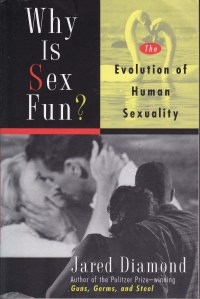
DiamondNothing used to make you feel smarter than being in a British bookstore. With that curious blend of proper, insane, and bawdy, books are displayed that you might find surprising. Alarming, even. Last year as I strolled around Blackwells in Oxford, I spied Why is Sex Fun?, by Jared Diamond. I mean, it was sitting right there, face-up, on a table with perfectly respectable, straight-laced books. Curious, but not curious enough to pick it up in a public place, I remembered the title so that I might find it on Amazon, where it could arrive in a nice, safe, opaque box. I finally stored up enough points on Amazon to get it, but then the problem was how to read it. I do a great deal of my reading on public transit—a place where you inordinately care what others might think of you. Finally, planning a seating strategy that would hide the cover by sitting on the left-hand side, next to the window, I took the book along, hoping it would keep me interested to and from work.

Subtitled The Evolution of Human Sexuality, the book isn’t salacious at all. It is scientific, but not clinical. I’ve mentioned before that all religions have something—quite a lot, usually—to say about sex. While religion doesn’t play into Diamond’s book, morality does. What I found interesting is his use of the phrase “God or Darwin,” which comes up a few places in the book. Diamond is a witty writer, and he explains that not all his phraseology is to be taken literally, but I appreciated his hedging his bets, nevertheless.

This book isn’t really titillating. In fact, it’s somewhat depressing. Perhaps it’s just phrasing again, but the production of offspring is described in economic terms. Resources, investment, efficiency, and the like. I think back to being a child. My family life wasn’t ideal, but I never thought of myself as anyone’s resource or investment. I was just me. That delusion stayed with me until I started working in the corporate world. I quickly discovered that others considered me a resource. “Human resources,” we call it. An investment. My efficiency was valued. Was it God or was it Darwin? Although I learned a lot from this little book, I wonder if it was worth the effort of having to hide the cover on the commute. After all, we’re all stuck together on this bus, units of investment, born to yield a profit. Why not have a little fun on the way?


Philosophies of Reading

I like my Starter. For those of you unaccustomed to New Jersey Transit buses and their ways, a Starter is a person who makes sure the buses scheduled to arrive at her or his gate do so on time. It’s not a job for the faint-hearted. If a bus is late, or AWOL, the Starter takes the heat from angry would-be passengers. Since they’re present “on the ground,” angry people lash out with their frustration. My regular Starter recognizes me. I’m usually early in my line, so I appear about the same place most days. My routine is, well, routine. I get to the Port Authority Bus Terminal, pull out my book, and read. Starters can’t really get involved in anything like a book because their job requires constant interruptions. Even when no buses are coming in because of an accident in the Lincoln Tunnel, they still have to answer questions and hold up the occasional crucifix. My Starter came to me the other day, as I was reading, and asked me what I thought of an incident four days earlier. To put this in context, the incident happened on Friday. I was there for it, in my usual spot, and this was Tuesday. Clearly it still bothered the Starter that someone had come out and yelled at him for not getting us a bus on time.

I sympathized. Starters can’t materialize objects. If they could, they wouldn’t be Starters. Yet, I realized as I turned back to my book, that I had lost some reading time. I don’t mind helping out my Starter, but it occurred to me that there are a couple of different philosophies behind reading while waiting for, and on, the bus. Many people, I suspect, read to pass the time. I don’t know what they’re reading, since much of it is on a flat device, but knowing that research reading is nearly impossible on the bus, I suspect they are just reading to make the weary time go quicker. Others, I know, read for content. For me, reading is very seldom passing time. I read because reading is what I want to do.

Commuting behavior isn’t conducive to my life choices. No longer do people sit quietly on the bus, respecting that inherent violence of awaking before 4 a.m. to try to get to the city before traffic inevitably makes you late. Devices make their unmuted bodily noises and glare in your face. The guy next to you pulls out his wide-screen laptop, while tapping away on his phone. Or pulls our her iPad to watch a movie with fast-paced images splashing in your face. The book is demanding company. Your time, your attention, your concentration are required to get the most out of it. I don’t mind supporting my Starter. I feel for the ennui of my fellow commuters. I also crave time alone with my books.

IMG_0899


Paraleipomenon

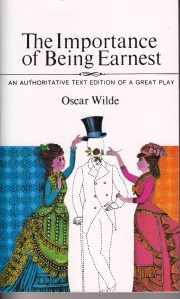
EarnestI suspect, like most people, I missed quite a few classics in school. This was the ’70’s when new and experimental were still the rage. One of the must-reads I missed was Oscar Wilde’s The Importance of Being Earnest. As usual when approaching books like this, I’m delighted at the sheer number of famous lines I’ve repeatedly heard, whispering to myself, “So that’s where that comes from!” as I go. Since I expect you, my cultured reader, have walked on the Wilde side, I need not provide any of these lines here. I won’t even have to go over the plot. The edition I read, however, contained lines and scenes that did not make it into the canonical version. As an erstwhile writer, I know that final versions seldom resemble those that felt so magical at their penning. Cuts must be made. Editors must be satisfied. And so goes the life of the writer.

It was one of these cut lines that caught my eye. With Wilde’s keen wit, the clergy, represented by Dr. Chasuble. (For those liturgically challenged readers, a chasuble is a priestly vestment in the Roman and Anglican traditions.) In an unfortunately stricken scene the minister says, “I am compelled, like most of my brother clergy, to treat scientific subjects from the point of view of sentiment. But that is more impressive I think. Accurate knowledge is out of place in a pulpit. It is secular.” Accurate knowledge is secular. That thought stayed with me long after reading the out-takes and deleted scenes of the play. Those that remain contain priceless comments about the church and the dangers of christenings. This particular gem, from the cutting room floor, would be hilarious were it not so often true. It explains, for example, creationism.

It’s a fair wager that science remains, even today, a subject that flummoxes clergy and laity alike. It is the new revelation, after all. No truth cannot be reduced to numbers. Even my scribbling this post is mere electro-chemical signals jumping synapses like electro-chemical salmon dying to spawn. We’ve simply substituted one clergy for another. When’s the last time a preacher has been cited as an authority on anything? What with televangelists setting the bar (for anything we see on the media is necessarily representative), it stands to reason that no real intelligence lies here. By default we nod toward those who hold the paten and chalice of empirical evidence. As it is now, but never was, and shall be forever, amen. Who’s being earnest now?


:-D

Screen Shot 2016-06-12 at 8.33.16 AM

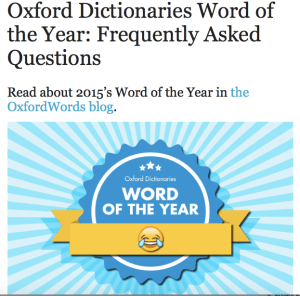
Technology runs amok. I confess to being born before earthlings landed on the moon. I remember a world where Purelle boogers simply did not exist. A time when to read the Bible meant opening that black leather with gilt edges that suggested some unknown bovine had paid the ultimate price to wrap those red-lettered words. Then came the LOL Cats Bible. The Lego Bible. Now the Emoji Bible. Emojis are made possible by the demand of cell phone users to express that which otherwise requires considerable wordsmithing. They’re popular. So much so that Oxford Dictionaries’ word of the year is the unpronounceable 😂. I’m not even sure if you’ll see it on your screen. If not, imagine a yellow circle laughing until it cries. Or crying until it laughs. There’s some ambiguity there. In any case, bibleemoji.com offers to translate your favorite Bible verses into emojis.

A naughty little boy, I suspects, lurks inside many of us of my particular gender. So I opened a new tab and went to biblegateway.com. There I looked up Ezekiel 23.20, in the King James, of course, and copied and pasted it. The results were somewhat 😒. “4 she doted upon their paramours, whose flesh is as the flesh of asses, & whose issue is like the issue of 🐴s.” I don’t know about you, but I see several missed opportunities there. A picture, they say, is worth a thousand 📚. Is there an emoji for “words”? Can there be? I’m trying hard to keep within my word quota here, so please bear with me.

I’m hoping against hope that unicode has kept up with my puerile fascination with rebus writing. It seems likely that all writing began that way. Draw a picture of what you mean and, with a little luck, others will understand. The capital A, for example, represents the head of an ox. It’s easier to see if you flip it upside-down. Better yet, just write it this way: 🐮. The ancient Egyptians, one gets the impression, would’ve been proud. After all, we call their labor-intensive communication system hieroglyphics, or “sacred writing.” It was inevitable that what some consider holy writ would eventually come down to the lowest common denominator. Still, I’m somewhat disappointed. When I dragged my mind to more lofty verses all I found were simple textual changes to my requests. Perhaps it’s for the best. When I tried “Jesus wept” I got “jesus wept” rather than the expected 😭. 😦


The Survey Said…

Survey

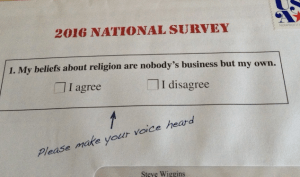
There may come a time, perhaps “when the trumpet of the Lord shall sound,” that junk mail will be no more, a mere historical curiosity. For now, in these days of declining postage prices, we’ll continue to put up with it. I suspect much of it targets my generation and those older—people who are modest about the time they spend on the internet, and who long to look out the windows when they’re at work. (The non-virtual windows, I mean.) Although I lament the waste of paper, and the cost to our literal dendritic friends, sometimes free amusement comes in my mailbox along with the occasional profundity. I received a survey the other day that had decorative check-boxes on the envelope for agreeing or disagreeing. “My beliefs about religion are nobody’s business but my own” the question read. My knee-jerk reaction, itself a religious term, was to think “Of course! Nobody can tell me what to believe.” An occupational hazard of being a religionist, however, is that the ready application of exegesis always stands to hand.

Are my religious beliefs nobody’s business? I suspect since the sender was looking for money that some manner of business was indeed involved, but beyond that are my beliefs nobody’s concern? Freedom of religion allows us to believe what we will, and since beliefs are very, very difficult to change, this is a central tenet of any form of democracy. You can’t have a free people without letting them believe what they can’t help but think to be true. It may, however, sometimes be somebody else’s business what I believe. If my religion is dangerous—and what religion isn’t, to some degree?—don’t hoi polloi have a right to know? Ah, but then aren’t we in danger of registering, profiling the believer? This is a violation of rights as well.

My pen hovers uncertainly over the paper. My views are something that I keep to myself. Few people know what I actually believe. On the other hand, day after day I post thoughts that in some way can be tied to religion. Is this a trick question? A junk mail survey shouldn’t be so hard. When did studying before checking the mailbox become a requirement? In my teaching days I had students who claimed they had a right to know what I believed. I had a right to keep my views private. Who’s right? Whose right indeed? Belief doesn’t come easy. It’s not as cheap as the media makes it out to be. Unless, of course, it arrives unbidden among the junk mail that makes up so much of our lives. And even then it might be something to take seriously, at least for a little while.


Forgive Us Our Tabs

Forgiveness is somewhat of a specialization among the crowd courted by the new GOP. Although it is forgiveness that goes only one way, at least it’s a start. Think back to Bill Clinton making his non-inhalation declaration followed by W who could not hide from his drug-fueled Yale days. Televangelists who admit, in tears, that they had an affair stand a fair prognosis for at least a limited recovery. The religious right loves a repentant sinner. I suspect it will be the trump card in the deck, come this fall. A host of sins can be banished under this incredibly effective rubric. This past week Mike Webb, Republican hopeful for Virginia’s Congress, having lost his party’s bid decided to run as an independent. No forgiveness required. What’s right is right. During his announcement of his decision, however, he posted a screenshot on Facebook without checking his tabs. As the Washington Post article by Justin Wm. Moyer reveals, some of those tabs included porn sites. In a move no Democrat could’ve made, the conservative candidate thanked God for his mistake and his likes increased by 25 percent.

Technology is a kind of big brother. By their tabs you will know them. Our browser histories reveal who we really are. Browser histories, however, may be cleared. And those who know how to manipulate the forgiveness card can make no mistakes. After all the Gospels declare that you must forgive the repentant 490 times (taken literally), which leaves a comfortable margin to get elected. A little bit of time with the Good Book can do wonders for your campaign. The problem is, it only works with the GOP. If he admitted to inhaling, you can be sure that the War on Drugs would’ve crashed down on the White House. Dems have to keep squeaky-clean records because forgiveness doesn’t apply to that crowd.

Screen Shot 2016-05-21 at 5.38.11 AM

One of the ironies, apart from the Viagra ad on the page telling this story, is that such incidents reveal a basic misunderstanding on the part of the electorate. No tenet is more easily finessed than forgiveness. Who’d hit a dog who’s rolled over on his back, exposing his vulnerability, admitting that he’s just eaten what you left on the counter for your dinner? Apologies can be accepted for some of the most outlandish sins. They’re cheap to make but reap rich rewards. As a former evangelical I know this may sound terribly cynical. All I can say is I’m sorry, please forgive me. And don’t look too closely at my tabs.


Map to Eternity

One of the most remarkable things about Christianity is its fascination with the end of the world. Far from being the obsession of nineteenth-century dispensationalists alone (the other Mr. Darby), the earnestly anticipated end goes back to Paul of Tarsus, the first known Christian writer. Before even a Gospel was penned, this sect was expecting the end to come any day now. It still is, at least among many sub-sects. My wife, however, recently sent me a story on National Geographic about a map collection from the 1480s that depicts a geography of the apocalypse. If you were wondering where to make that left-hand turn, this book may be for you. One wouldn’t want to drive a German mile into Hell without an indicator signal on.

The story by Greg Miller describes this late Medieval manuscript and its assurance that the world will end in 1651—talk about your great disappointment! The unknown author of the codex feared Islam almost as much as Donald Trump but instead of running for the GOP nomination he wrote a book showing just how the end would take place. Illustrated, of course. Map is territory after all. I grew up reading fundamentalist tracts that did essentially the same thing. The more progressive bits of the propaganda left out the actual dates because an earlier Miller seems to have missed the doomsday boat, along with various and sundry telltale timekeepers. There in front of me I could nevertheless unfold the future and once the European Common Market gets its tenth member—wait, what? Has yet another head of the beast been lopped off?

Maps give more than directions.

Maps give more than directions.

Ironically, early Christianities were anti-materialistic. Money was considered the root of all evil and communism was the ideal. If you doubt me ask Ananias and Sapphira. They thought long-term investment was a bit of a foolish notion—something that I have somewhat naively, if unintentionally, followed my whole professional life. You can’t be vested without three years of servitude after all, and I was expecting the Second Coming after one year. Two, tops. If only I’d had a roadmap. It’s only 1777 German miles from Lübeck to paradise, so maybe I can catch the next doomsday boat and still get there in time.


Prophets Paid

Photo credit: Cephas, Wikimedia Commons

Photo credit: Cephas, Wikimedia Commons

Prognostication used to be the remit of oversized rodents and individuals we’d now classify as mad. And news used to be stories about things that had already happened. Past tense things. I don’t read any daily newspapers—a personality flaw, I know—but I do read stories that are sent my way, even if it takes some time. One of the things I’ve noticed, particularly in this election year, is the amount of prediction that passes as news. Future tense reporting. And the future is very tense.

Always one to assume that others know more than I do, I consider the opinions of experts as more valid than my own. After all, they are paid for what they think. Nobody spends good money on amateur opinion, which is one of the cheapest resources available in the civilized world. So when I read the headlines about what to expect this fall I see that the prophets and anti-prophets are lined up along party lines and, if democracy holds up, we’ll find out which group is which, come November. This makes me wonder what life would’ve been like under biblical prophets. No, their job was not primarily foretelling—future prediction was a small percentage of their job description—but they occasionally made political predictions when the boss told them to. Some people think they were primarily concerned with a future political figure, even if Messiah isn’t exactly an elected position. Hoi polloi must have been in a state of high anxiety. Who’s right? We know that for every prophet, according to the laws of rhetoric, there must be an anti-prophet. If a message is coming from on high we don’t know from whom.

Long ago media moguls learned that anxiety sells papers. Or news broadcasts. Sales boom after disasters. Extra! Extra! Read all about it! I’ve seen it in movies and televisions shows, so I know it must be true. As if real life events don’t generate enough trauma, we speculate about a future that tends towards the bleak. What’s a polis to do? The dilemma hasn’t changed in the millennia since we’ve outgrown prophecy—there’s no way to know who’s right. It’s all speculation. As for me, I wonder what the local groundhog thinks. And while we’re at it, could we get a bit nicer weather for a while? I thought the prophecy was April showers bring May flowers, not the other way around. But then again, my opinion is a decidedly amateur one.


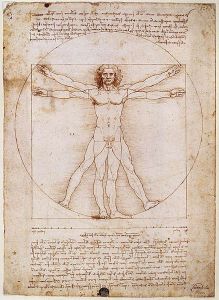
Vitruvian Savior

If memory serves, I was still in seminary when “Piss Christ” was first unveiled. As photographic art, I can’t say when the shutter snapped, but I seem to recall animated discussion over it and since seminary animated discussion has been at a premium, so I think I’d remember something like that. In any case, the artwork still has the power to shock and enrage as the world teeter-totters in its love-hate relationship with religion. Some people seem surprised when other people respond somewhat pointedly to what they perceive as affronts to their beliefs. The thing about beliefs is, well, people believe them. In this day of electro-chemical signals between synapses it may be hard to attribute any substance to belief. Still, if someone makes that claim, insult their mother and see what happens. Beliefs, by their nature, are sacred.

438px-Vitruvian

I was reminded of this when my wife pointed out to me a story about Dartboard Jesus. If you’re not a Rutgers University person (as I no longer am), it takes only a little imagination to visualize this artwork. Conjure a dartboard in your mind. Then picture a crucifix superimposed on it with darts instead of nails. Red darts, if that helps. You’ve got it. The official name of the piece is “Vitruvian Man,” but the public outcry was enough to have the piece removed from public display. I taught (strictly as an adjunct, no complications, please) at Rutgers for four years. People sometimes expressed surprise that multiple sections of Intro to “Old” and New Testaments filled up every semester. I wonder if the university ever takes measure of its students’ beliefs. I had Seventh-Day Adventists in my courses. I had Jains, Muslims, and Hindus. I had Atheists and, God help us, Episcopalians. One thing all these people had in common was belief. Not beliefs, but more singular: belief.

No one in the world intentionally believes falsely. Indeed, should Oxford Dictionaries be trusted, belief is “Something one accepts as true or real.” By definition, it seems, beliefs are believed. Artists serve a valuable function in expressing ideas that words struggle to articulate. There is more going on when your crucifix is juxtaposed to a glass of urine or a dartboard than you might otherwise imagine. It says something about belief. In some cultures such heresy is punishable by death. It isn’t so much a matter, I would suggest, of freedom of expression as it is a matter of advocacy. Artists are teachers and even teachers sometimes don’t consider how their lessons will be taken. Respecting belief, perhaps, is something electro-chemical signals leaping tall synapses in a single bound simply don’t understand.