Know Thyself

Perhaps it is a perverted sign of the times, but sometimes I seek myself online. Not surprisingly, most of what I find there is stuff I’ve posted myself. Then my daughter suggested that I search “wiggins” in the Urban Dictionary. For people my age, the Urban Dictionary is often handier than Merriam-Webster for reading online lingo. I’d never tried to find myself there before, however. It turns out that “wiggins” is defined as “The state of being uncomfortable or freaked out… an uneasy feeling; a sense of foreboding badness.” Speaking strictly for me, this is a spot-on definition. Other Wigginses would likely take exception, but this connotation fits me like a thumbscrew. Perhaps our names make us who we are. The Dictionary also cites the source of this slang; Joss Whedon (who also gave us The Avengers) apparently coined this term on Buffy the Vampire Slayer. (His name, by the way, is defined as, “To kill off the most lovable b-list characters in your movies.”)

Naming, in ancient times, held a distinctly religious significance. Ever notice how many biblical characters were renamed by God? Even today the Catholic Church recognizes renaming after a saint as part of a person’s identity at certain crucial junctures in life. Indeed, in western culture “Christian name” equates to the more secular “given name.” Names define us.

I’ve done a fair amount of genealogical research. The actual etymological origins of the name Wiggins are obscure, but likely have to do with living in a valley. More exciting prospects trace the name back to early English forms that look like the word for “Viking,” and the name does seem to originate from the vicinity of York, where Vikings were not unknown. Still, the more prosaic, the more likely.
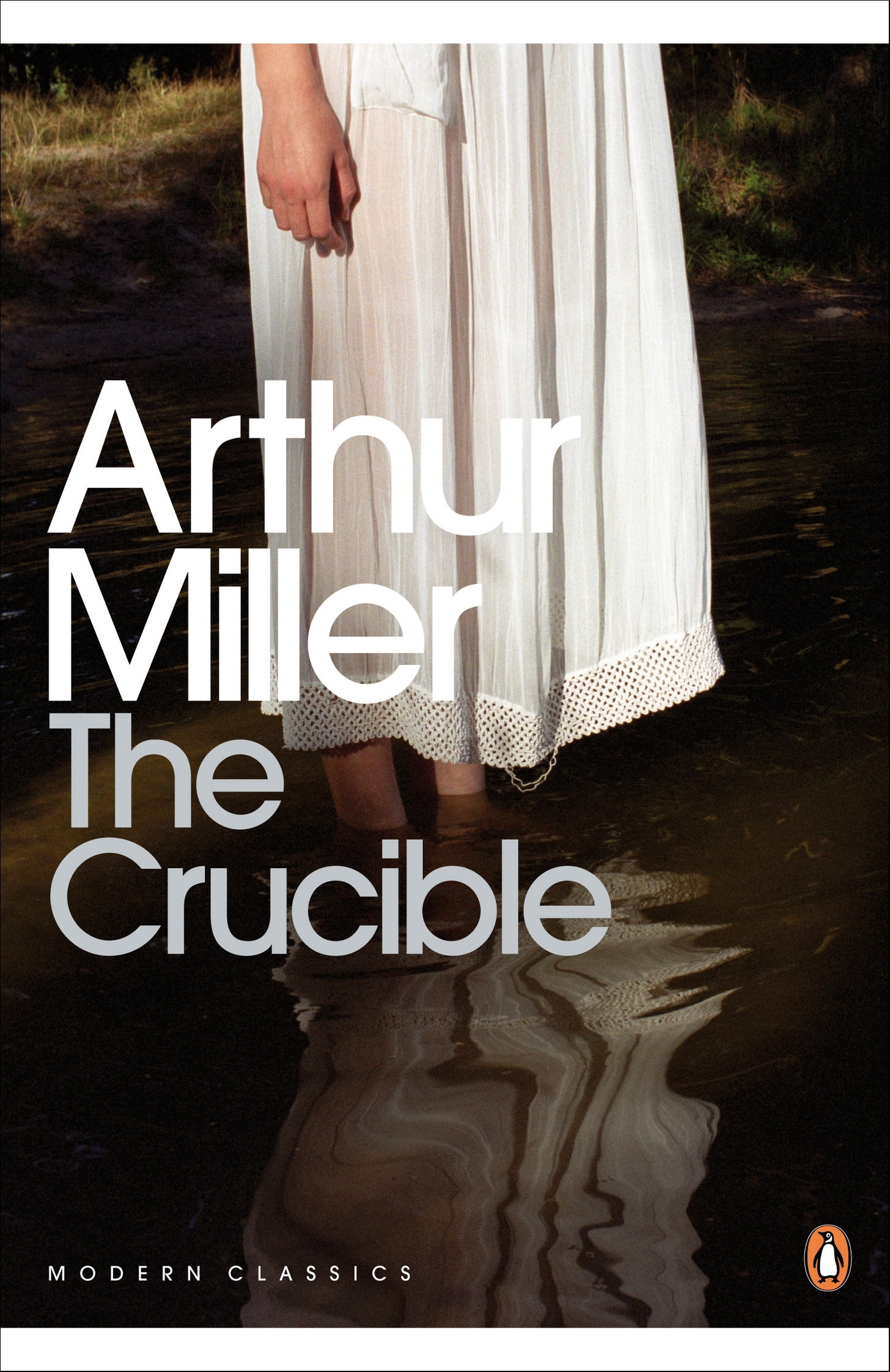
crucibleWhen my mother remarried, I took on my step-father’s surname. It didn’t sit well. When I read Arthur Miller’s The Crucible in seminary, John Proctor’s words leapt out at me: “Because it is my name! Because I cannot have another in my life! Because I lie and sign myself to lies! Because I am not worth the dust on the feet of them that hang! How may I live without my name? I have given you my soul; leave me my name!” When I later went to court in Massachusetts to reclaim, legally, my birth-name of Wiggins, I had that quote written on a paper in my pocket. We are our names. Slang has, in my case anyway, provided the most reasonable definition of my surname. And only courts, as I know from experience, have the authority to change this pre-decided declaration of who we are.
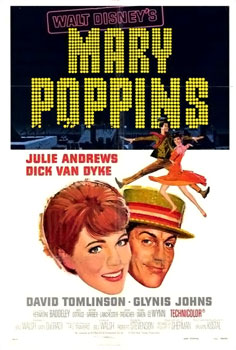
Money Poppins

Marypoppins Easy answers seldom hold up. Generalizing is a way of dealing with the vast amounts of data people continually process. Now that many of us in the “developed” world spend much of our time indoors, those skills earned from thousands of generations of learning about the environment have transferred to media of various sorts. I watch a lot of movies—they are my escape from an urban reality that often weighs too heavily on my primate brain. Long ago I relegated Disney to that shelf of the least profound films. Although many of their animated features of the past decade or so have introduced complexities and some seriousness into the mix, often I find myself still hungry after sitting through a helping of the Disney fantasy-land. It seems to me that nature is crueler and more careless than Disney makes it out to be. Nevertheless, sometimes something profound can be discovered in the most unlikely of places.

I never saw Mary Poppins until I was in college, but now I come back to it as an adult from time to time and I still learn from it. While watching recently it struck me that two worlds (at least) are juxtaposed here: the world of St. Paul’s Cathedral and the Dawes Tomes Mousley Grubbs Fidelity Fiduciary Bank. On the night before the Banks children accompany their father to the bank, Mary Poppins suggests that some things are important, although quite small. She refers, of course, to the birds that the Bird Lady uses to make her pitiful living. She sells crumbs within sight of an opulent bank that stands for the order of society. She is dressed in poor clothing, a beggar woman under the protective gaze of saint and apostles. The bank has guards and bars and powerful men. The worlds are brought into collision by Jane and Michael wanting to feed the birds but they instead are forced to open a bank account. In the ensuing melee, George Banks takes the blame and is fired.

On his way to the bank that night to be sacked, he reevaluates. In a brief but significant scene, he pauses in front of the Cathedral, deserted at night, and scans where the Bird Lady sat. The scene immediately cuts to the bank, still at work, its great doors snapped open by uniformed guards. The Cathedral, dark and glowering, is just down the street. And yet, once dismissed Mr. Banks chooses the way of the Bird Lady, an unemployed man spending tuppence for paper and string to mend a kite. No, I don’t attribute much profundity to Disney, but Mary Poppins does give pause for a moment. We never see the inside of the Cathedral. It is generally dark and forbidding. The bank is light and inviting, yet liable to turn on you. Maybe it is merely lack of sleep, but as I closed my eyes last night, it seemed that even Disney may have, for one brief instant, turned its back on money.


Fun Fiction

While I tend to limit my ramblings to once a day, every now and again something prompts another little post once the bus finally gets in and before sleep completely takes over. One such thing was an email from my friend Marvin announcing the publication of his latest story in Jersey Devil Press. It’s a fun piece about a malevolent goose. So, if you’re in the mood for a fictional escape, and you’d like to read something that’s free, check out “Good for the Gander.” Be sure to tell Marvin I said “hi.”


Umbrella Apocalypse

Broken ribs and twisted, tortured limbs hanging useless under a leaden sky. It was a scene of carnage. I knew the world was supposed to end yesterday, but I didn’t believe I would experience it, but the evidence was indisputable. It was the apocalypse. For umbrellas. Winter storm Draco had melted by the time he reached the East Coast. I awoke to the apartment shuddering in the wind, and I could hear the rain pelting the windows. I had one more day to go to work before two things: the end of the year and the end of the world. And I would be relying on New Jersey Transit. The very thought makes me want to cower in the closet. My bus stop has no shelter—it’s just an exposed street corner, not far enough away to justify a drive. I stood in the rain, faithful umbrella held like a shield in the blast of Draco’s breath. The bus, of course, was nearly half an hour late. I stumbled up the stairs, glasses dripping, and decided that today, only today, I would take the subway across Manhattan. After all, the world was ending.

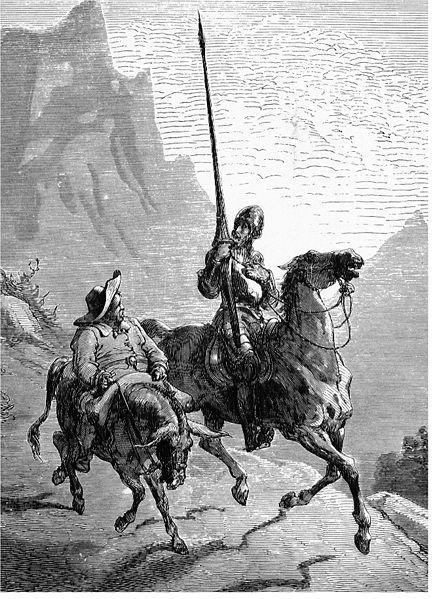
The lines from the Port Authority to the bowels of the subway are like those old documentaries of massive lemming migrations off a cliff. My turn. The card reader said “Card Already Expired.” Metrocards don’t expire; you charge them up and recharge them when they’re empty. I still had money on my account, but with other lemmings close behind, and rush-hour grade lines at the recharging machines, I decided to fight the dragon on the streets. It was with a certain Cervantesque tilting at the wind that I made my way across West 41st Street, umbrella forced into a tiny cone by Manhattan’s famous wind tunnels. Twice I was blown off the curb. Then at 5th Avenue the wind defied both the laws of physics and the agreed conventions of meteorology and slammed me from north and south simultaneously, my umbrella bucking in my hands like a terrified stallion. It sustained two broken ribs, metal twisted in opposite directions, flesh flapping uselessly. By the time I reached Grand Central, it couldn’t close, so I dumped my companion into a garbage can with other umbrellas and went on alone.

When I got to the office I discovered my hat was missing. While it would be more dramatic to say that a stocking cap blew right off my head, the truth is that it must’ve fallen out of my coat pocket. I was wet, buffeted, and without two items with which I began the day. The sky was still black as I looked out on the scene of the final battle from The Avengers movie. It had been an apocalypse all right, for the umbrellas. Chicago may be the Windy City, but New York is the Umbrella Killer. When I made it home as early as 6 p.m., I knew the world had ended for certain. I read the Cajun Night Before Christmas and went to bed, thinking of all those poor, dismembered umbrellas. Today is the day after the end of the world, and I am huddled here waiting for the dawn.

Don Quixote rides out of Manhattan yesterday with Sancho Panza wondering at his denuded umbrella.

Don Quixote rides out of Manhattan yesterday with Sancho Panza wondering at his denuded umbrella.


Merry X-Man

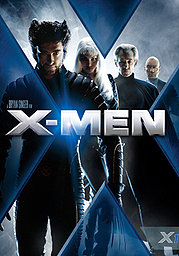
XMenComic books were hard to keep up with for a kid of limited means. Consequently, I never heard of the X-Men until the movies started coming out. Since I suppose I fit the profile of the guy whose life has devolved into day after long day in the office, superheroes are burdened with living life for me. I’ve watched the X-Men movie a few times, but after reading Jeffrey Kripal’s Mutants and Mystics my latest viewing took on a different angle. Of course, Mageto is presented as being separated from his parents at a concentration camp in Poland as the film opens. A child on trial for his ethno-religious heritage. That, and the fact that he’s a mutant, lends him a perspective on evolution not shared by many. His scheme to transform world leaders into mutants is premised on his understanding of evolution. He tells Senator Kelly, however, that God is too slow. That apparently minor line may bear more weight than it seems at first.

I can’t see the title “X-Men” without thinking of Xmas. Probably the fact that it is now mid-December has something to do with it, along with the bumper crop of Keep Christ in Christmas media this year. Yard signs, church marquees, bumper stickers. People who don’t know the history of their own holiday fear that they’re losing its meaning. Already by the twelfth century the abbreviation Xmas was in use—this is a centuries old tradition that predates American white Christmases by several hundred years. The X is not a substitute, but rather a symbol. A religion that has lost its appreciation of symbols has become just another set of onerous laws.

Maybe we can learn a lesson from our X-Men and their too slow deity. Not having read the X-Men when I was young, and even now noting that there are just as many X-Women as Men, I had to puzzle out the name on my own. Of course, it wasn’t too hard to see the connection of Charles Xavier with his clan of adopted mutants, and therefore the origin of their X. It is a symbol and no one disparages Cyclops his sight or Storm her lightning (miracles all) for having an apocopated title. I think, too, of how the Grinch stole, and returned, Christmas. Dr. Seuss created a tale that captured the essence of Christmas without so much as a religious vocable in the the book. And his eponymous character has come to represent all those who refuse to celebrate when occasion calls for it. So when God is too slow, X-Men, or even a Grinch in a pinch, can keep the X in Xmas.


Hallowed be thy Kane

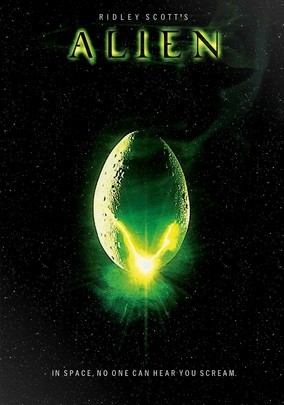
Watching the alien burst from Kane’s distended abdomen as he appeared to have eaten too much seemed somehow appropriate on Thanksgiving. I’m well aware that my taste in movies does not always match expectations and few bother to comment on my idiosyncratic observations. Nevertheless, it had been years since I’d watched Alien and on this particular holiday it felt like synchronicity. I’ve seen the film a few times before, but this is the first time since starting this blog. Not surprisingly, some biblical allusions popped out at me as I watched the crew of the Nostromo struggle with alien life. And I’d just read of NASA’s “exciting discovery” on Mars, a discovery whose official announcement for which, like Christmas, we’ll have to wait until December. Learning that the gut-busting alien was modeled on Three Studies for Figures at the Base of a Crucifixion by Francis Bacon (a contemporary one) only sweetened the analogy.

Character names hide aspects of personality and intention. Sometimes the writers may not even be aware of all the shades of gray. The alien’s first victim is Kane. On paper he seems an ordinary citizen, but on the screen the euphony with the first human child, Cain, is obvious. As Parker is lamenting how large the alien has grown in just a short time, science officer Ash whispers, “Kane’s son.” Or is it Cain’s son? Cain, the infamous ancestor of the sinful Grendel and any number of other villains of literature and cinema. Cain is, significantly, the first child born in Genesis, himself the genesis of sin in the world since his murder of his brother is the first act that the Bible declares a “sin.” The alien, born worlds away, conforms to biblical expectations.

Since Ash is actually an android and has no real feelings, he admits the alien to the ship and protects it until he is destroyed by his shipmates. He represents unfeeling science amid the horror of human bodies being invaded and rent apart. When accused of admiring the alien, the resurrected (!) science officer states, “I admire its purity. A survivor… unclouded by conscience, remorse, or delusions of morality.” Is he not really describing science itself? Religion is running rampant on the Nostromo. As Ripley sets the detonation charges and finds her escape blocked, she races back to the console and cancels the self-destruct order which the HAL-like Mother ignores. In a secular prayer Ripley calls out to Mother who, like any deity, does not answer all human pleas. And even as she escapes the detonating ship, Ripley will find that Cain’s son is still lurking in the corner of the emergency shuttle, for the science can never truly escape from Genesis.


Holy Gobblers

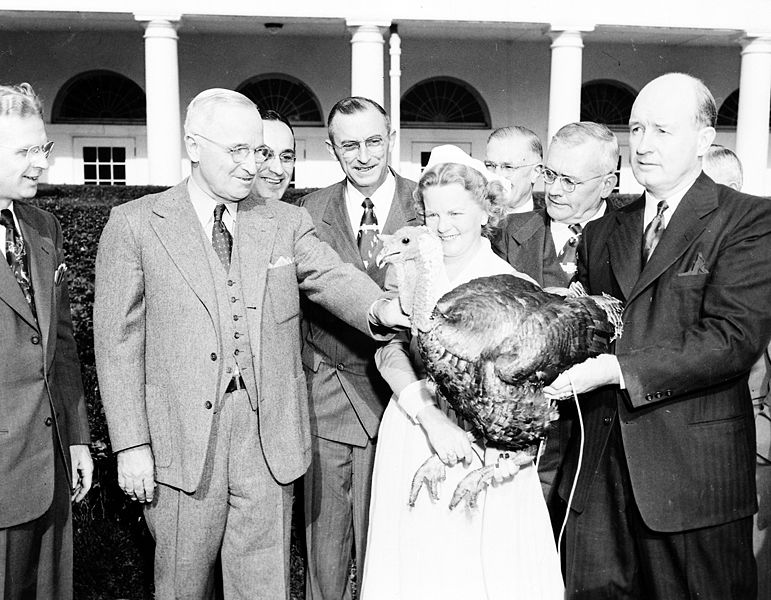
I wonder if this is how religions get started. Yesterday President Obama continued the lighthearted tradition of pardoning two turkeys prior to Thanksgiving. There has been a gifting of turkeys to the United States president at least as far back as the Harry S. Truman years, but the pardoning began, as did many myths, in the Reagan years. Ronald Reagan took considerable heat for pardoning Oliver North after his crimes in the Iran-Contra Affair. Handling criticism with a joke (again, of which there was no shortage in those days), he offhandedly mentioned pardoning the turkey. Reagan had already decided not to eat the bird and had it sent to a petting zoo. The first recorded official pardoning came in 1989 with George H. W. Bush. This seems so close to the origins of the concept of salvation that I have to pause and baste in the implications. Pardon is only effective when there is guilt involved, so presumably turkeys sin. The only sin that suggests itself is gluttony, but I’ve seen more than my share of wild turkeys and they seem to have any natural weight problems under control.

Ironically, the guilt in this case seems to rest with those who do the pardoning. Turkeys grow fat because they are raised to do so. They are, like most eating animals, sacrificial victims—sinless and slaughtered. Again, there is another beautiful religious trope here, but we seldom sing the praises of the noble turkey that takes away the hunger of the (first) world. So, as crimes are committed in real time, we can shift the focus to the turkey. The analogy with sheep in the first century is apt. Like the turkey, the sheep was known as a creature of rather simple mental capacity. The lamb was sacrificed for sins it did not commit. Yet we don’t sing hymns to the noble turkey. In fact, Thanksgiving, being a non-commercial holiday, has largely been eclipsed by Black Friday.

I see a future religion in which the turkey plays a supporting role. All we, like turkeys, have gone a-peckin’. Turkeys have no shepherds, but they are kept in tiny cages, and the pardoned pair are the great Moses and Aaron of the turkey world. They are released to live out the rest of their short, obese lives in relative comfort, having been messianically chosen from before hatching to be spared the fate of being consumed by the ultimate consumer. This is the very stuff (stuffing?) around which Bibles are written. The theology here is as thick as gravy. As a vegetarian, however, my sympathies are with the birds. Heaven help us all when the pardoned pair come back and declare, “Let my turkeys go!”


Hallowed Eve

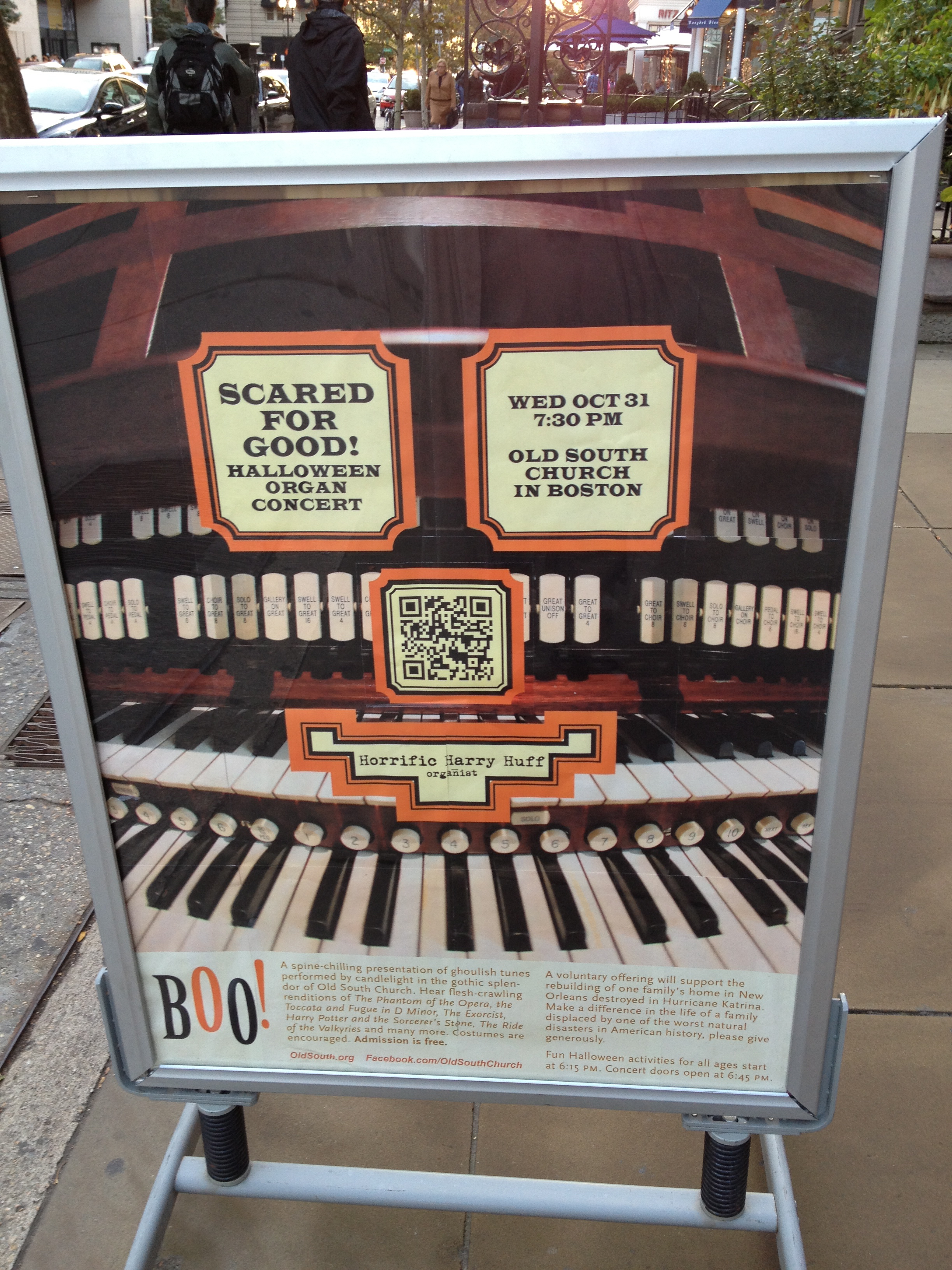
My last night in Boston found me in Copley Square. This has always been one of my iconic Boston locations; something in the juxtaposition of squat, solid, dual-toned Trinity Church with its wide, open plaza, the blue glass razor of the Hancock Tower, and the classical facade of the Boston Public Library where Sophia broods over the world, arrests my wondering gaze. Across Boylston Street stands the gothic Old South Church like a guardian for straying souls. As I walked through the square a local band of street musicians jammed and the first neons of an October evening were awaking. As I strolled past Old South I had to back up a step or two to see if I’d read the sign right.

Scared for Good, a Halloween organ concert featuring spooky music, will soon be on offer. Business-types have long noted that Halloween is a great potential selling holiday. With kids who want to dress up and parents stressed for time, the selling of costumes has grown into an increasingly substantial accessory item holiday. People want their houses to look scary, knocking down real cobwebs to make way for the artificial ones, hanging out orange and purple lights, and ordering pre-carved, artificial pumpkins. All the fear is, of course, a charade, and we laugh at ourselves for taking it too seriously. Some churches object vociferously to the very holiday itself, claiming it is devil worship and evil.

While Halloween does have some serious pagan influences, it is, in its present form, a good Catholic holiday. The night before All Saints, aka All Hallows, begins a period of reflection on mortality. I’ve celebrated “Protestant” Halloween from my youngest days and have never been in any way tempted toward devil worship. It is fun to be scared when you know it’s not real and it won’t last long. That’s why I applaud Old South Church’s Scared for Good concert. Reading the list of pieces included, it sounds like it should be a grand time. Too bad I won’t be in Boston for the occasion. As I walk back to my hotel in the chill of the evening,the only fear i feel is that moments like this evening come at insufferably long intervals for those who feel about the city as must the denizens of Copley Square.


Holy Wolves

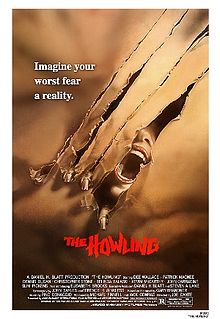
Nothing creates the mood for a werewolf movie like reading a book about real werewolves. The Howling was released the year I was finishing high school. At that time my humble circumstances allowed for very few visits to the movie theater, and certainly never to see horror films. I grew up watching B-films in black-and-white on television, but paying extra to see what was slightly unseemly in a theater stretched the limits for a good Christian just a bit. College was on my mind, and it was while in college that my horror film interest blossomed. All of which is to say, I’ve never seen The Howling before. I remember the movie posters, but the film had to wait until werewolves clawed their way back into my mind. Most of the classic movie monsters have their basis in religion, but The Howling doesn’t really delve into the origin of werewolves as much as it wonders what to do about when their numbers start to become a problem. Those who know about such things note that the special effects were cutting edge for the time, but CGI has spoiled us all.

Although the film doesn’t inquire into werewolf origins, it still gives a nod to the religious. The film’s werewolf population lives in a colony that has a “ritual center,” and since the cover for the colony is a retreat center for a psychologist’s patients, we find seekers amid the crowd. One of the inmates, Donna, explains that before joining the colony she had tried all the new religious movements, without success. And the one character who knows how to dispatch werewolves runs an occult bookstore in Los Angeles that is visited, in a shock-comic moment, but a pair of nuns. The message, so typical of the early 1980’s, is that all religions are just about the same. People are seekers, and any religion will do in a pinch.

In a way, this downplaying of the religious element in werewolves is not unexpected. As society was becoming more obviously secularized in the sixties and seventies, religion was becoming just one of many options available on the path toward self-fulfillment. In The Howling, becoming a werewolf was another. Ironically one of the old-timer werewolves laments the loss of “the old ways.” The werewolf colony lives on cattle that are farmed as politically correct sheep for the wolves, and it just doesn’t satisfy. The same might be said for religions. Accommodations, so necessary to survival in an evolving society, inevitably change the old ways of religion. Religions themselves transform over time. The Howling may not be scary, or believable, but it does serve as a kind of paradigm for worldviews that are undergoing transformation. Shifting shape, after all, is a sure symbol that one is still alive.


Country Roads

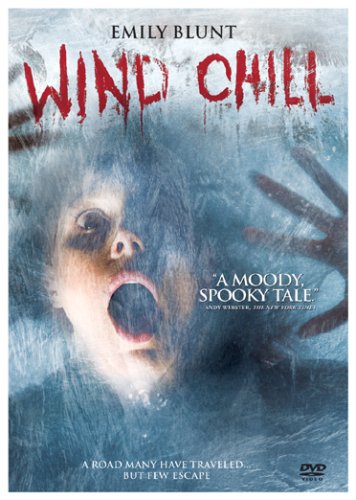
It may be a little too early for winter, but scary movie season has begun in my personal calendar. This weekend I watched Wind Chill. Although critics weren’t always kind to the movie, and the ending is somewhat predictable, it is one of the more decidedly creepy films I’ve seen recently. Since it is set in Pennsylvania there was a bit of a homey touch to the terror. I have driven on similar roads to that in the movie, during snowstorms, and that is one of life’s true terrors. What makes the movie so frightening is its ambiguity. Put a teenage girl alone with a guy in a car on an isolated road and you’ve already got enough elements to make your spine tingle. It becomes clear that the guy hasn’t been honest with the girl all along (the characters are never given names in the movie) and as they spend the night in the broken-down car reality and nightmare become increasingly difficult to parse. Of course, religion plays a role in the show.

The guy is giving the girl a ride home for the holiday break. He’s been watching her, a little too closely, for some time although she doesn’t know that until it’s too late to turn back. As they fumble for conversation it turns out that he is an “Eastern Religions” major and they met in a philosophy class. This just keeps getting scarier and scarier! After they break down (spoiler alert!) and the ghosts start showing up, we learn that some of them are priests. They had come to this haunted road to give the last rites to some accident victims before freezing to death in the poorly insulated cells in a strange little monastery on the hill (this is Pennsylvania, remember). As the night wears on we find the priests condemning the bad cop to a fiery death before light dawns and the girl finally finds salvation.

Of course, this is a variation of the old urban legend of the teenage couple out parking when something scary happens. Having everything in half-light and through smeary, foggy windows makes it more difficult to perceive what is actually going on. A lying religion major, priests complicit in a deserved fatality accident, and Nietzsche’s eternal recurrence give the film a little intellectual heft among the muted special effects and bleary-eyed confusion as the night goes on. Morality is on trial here. Although not the most profound of films, Wind Chill deserves some credit for bringing religion and horror to the same remote location and having them trade cards in the dark of night.


Shopping for Fear

So I decided to visit a Halloween store. These have been showing up with metronomic regularity in September for several years now and are usually good for a cheap thrill. My personal preference for Halloween is more somber than garish, but the affirmation that other people enjoy a safe scare has a way of drawing me in. Those who read this blog on a regular basis know that I frequently point out commonalities between fear and religion. They both seem to hover around the same orbit in the brain, and, in some accidentals are very similar. Horror films therefore often indulge in religious imagery, and monsters do not infrequently partake of the divine. So it is no surprise to see my thesis borne out in shops intending to capitalize on fear.

I will freely admit that there may be cultural references that I’m missing here. A movie that I’ve neglected, or some television show or graphic novel may be informing some of the images in ways I can’t comprehend. Nevertheless, we all know of the power of the crucifix when it comes to vampires. I wasn’t aware that the cross had horrific effects on other species of monsters as well. Take this guy here. I’m not sure what he’s supposed to be—perhaps a zombie? It seems a little too corporeal to be a demon. The teeth just don’t look right for a vampire. In any case, he seems to have an extreme reaction to religion, with the cross melting right into his skull. Is there a conversion message hidden here somewhere? Of course it could be just a chinzy attempt to scare a real religiophobe. The cross has become the backup weapon against all supernatural evil.

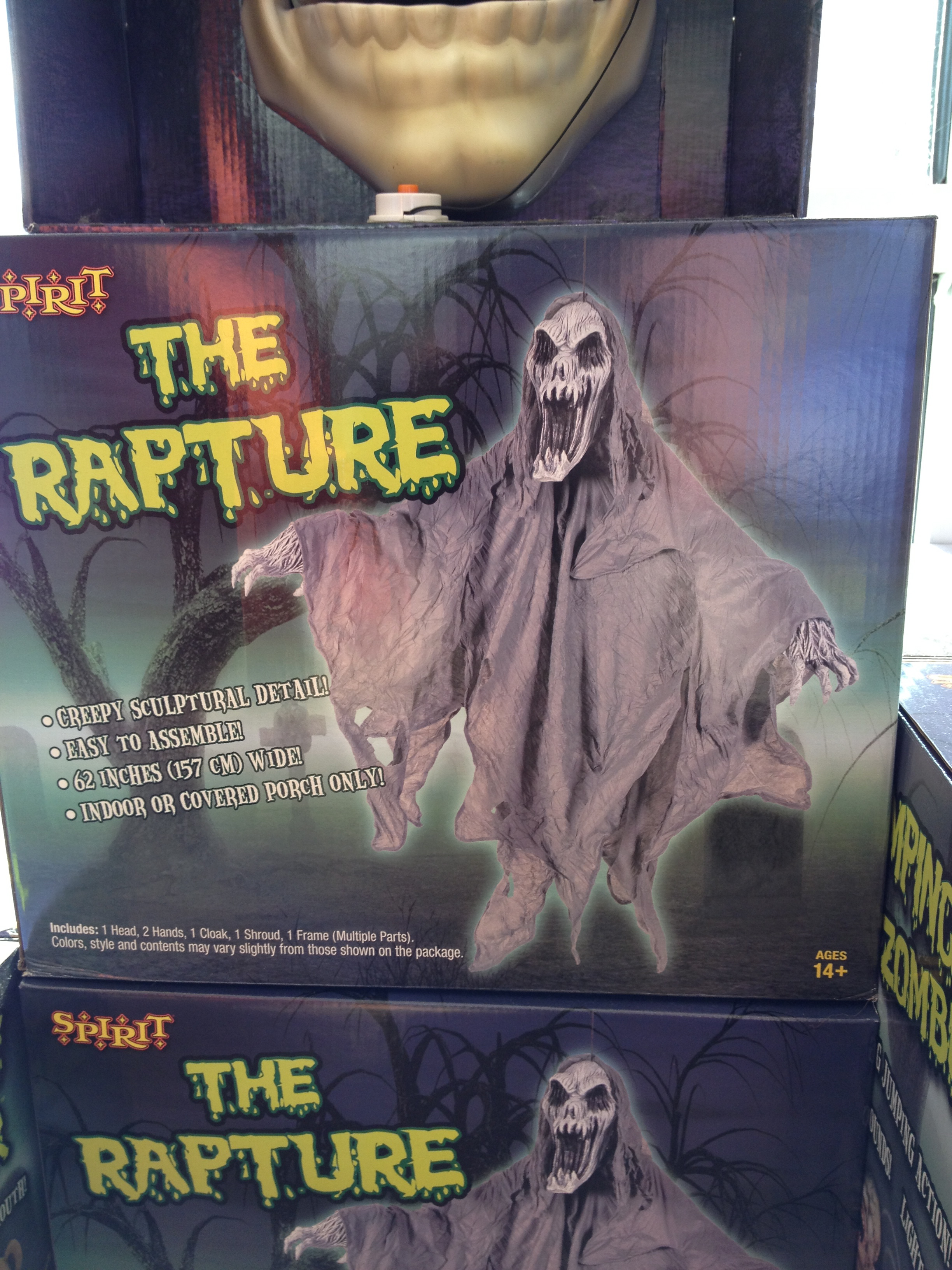
The use of a grim-reaperish ghoul rising from the grave to illustrate The Rapture was a new one on me. Last I heard only the squeaky clean and friends of the Tea Party got to go on the Rapture. (Well, the latter category might explain it.) The idea of the Rapture, as it was fabricated late in the nineteenth century, involved the chance for all the good Christians to escape before things really got rough down here for us normal folk. I would’ve thought that scary guys like this joining the heavenly crusade might take a little bit of the joy out of the occasion. Or maybe they’re being left here to haunt the rest of us. In either case it is clear that consumers respond to religious sounding language and symbolism when looking for a scare. Obviously there is plenty in the store with no religious significance at all, but finding hints of religion scattered in with the plastic scares does show a kind of Frankenstein’s monster of human sentiments and emotions. It’s only appropriate when the nights are now longer than the days.


Assaulting Pepper

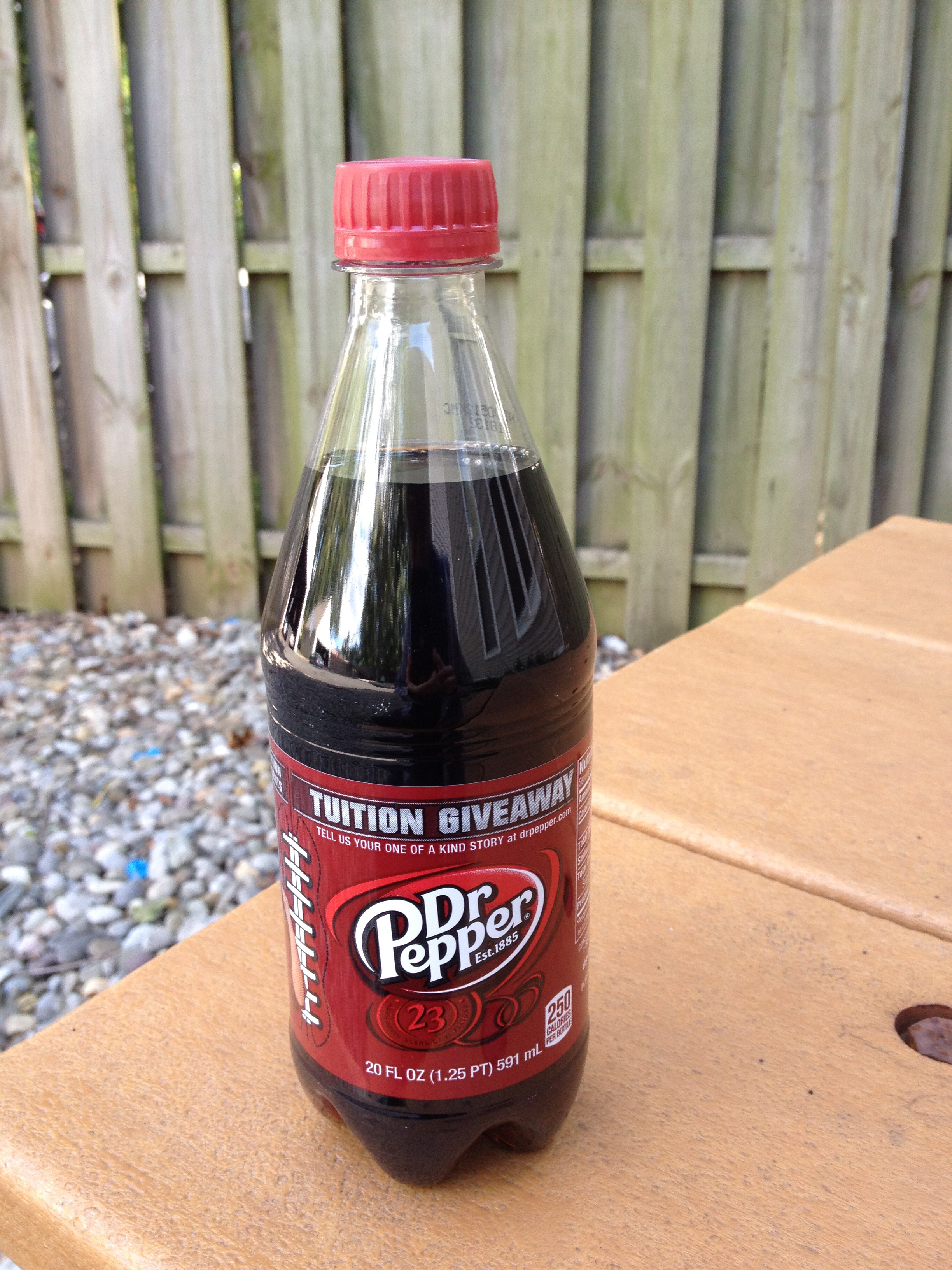
“I’m a Pepper, he’s a Pepper, she’s a Pepper, we’re a Pepper,” so goes a jingle that is still in my head decades after I last heard it. Early in my marriage I learned that Dr. Pepper was my wife’s favorite, and we sometimes purchased it by the case when we felt daring. I seldom drink soft drinks anymore, having converted to a more juice-oriented penchant with the increase of years and poundage. I always found it to be a pleasant flavor, however, and it was a frequent choice in those halcyon days when I could eat or drink without much regard for potential tonnage. My wife resurrected my interest in the cola with a link to Time’s NewsFeed announcing that some Creationists are boycotting the soda because of an ad that looks like evolution. The ad campaign shows the evolutionary progress chart we’ve all seen with the tipping back of a Dr. Pepper making the ape human. Creationists aren’t known for their sense of humor, but boycotting a drink because of implied heresy implies a fascinating study.

Boycotting companies that offend moral sensibilities is not an unreasonable response to ethical dilemmas. I haven’t shopped for some products for years because I don’t like what the company does. My choice, I’m sure, has little impact but it makes me feel better about myself. Sometimes the choice is religiously motivated—if I don’t want to support a particular group I won’t buy a product they offer. Secular companies, however, seldom offend theological sensitivities. I, for one, would seldom know the guilty party: the founder of the company? The current CEO? Someone in upper management? An advertising director? Do all employees have to agree with my religious outlook? Ahh, but then there is the political angle.

This is a presidential election year and the first one since 1980 without a Republican candidate who is a darling of the Religious Right. Not to suggest that Reagan or Bush the First were really as religiously orthodox as they were presented, but the perception of their friendliness to conservative Christian causes went unquestioned. With a “liberal” in the White House and the only viable alternative a mysterious Mormon, frustration must be building. On top of it all, Dr. Pepper is showing a funny image that might be interpreted as suggesting a simian forebear to those who drink the stuff! I think I understand the anxiety, and it might help if they just had a drink to calm down. After all, “wouldn’t you like to be a Pepper too?”

Dare to evolve


Magic Bibles

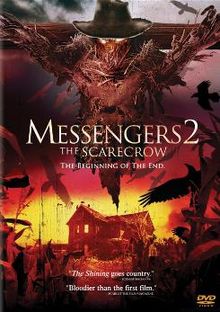
With autumn not far down the road, my mind turns to scary things. Actually, it is that way quite a bit of the time. Nevertheless, movies about farms are often the setting for the creepy—the sense of isolation, the sharp implements farmers use, the rustling of the drying crops in the wind. A couple years back I watched The Messengers. As a horror film it had a number of good scares, but the menace always seemed somewhat restrained. Nothing profound happens, and it is a film fairly easily forgotten. It was a rainy Saturday afternoon and The Messengers 2: the Scarecrow suggested itself to me. I began watching in an ambivalent mood, but when the first scene began with the protagonist (whose name I’ve forgotten) dropping his Bible on the porch chair as he loosens his tie to work on a derelict water pump, I was curious. When his wife arrives home and asks why he left church before it was over, my interest grew. This direct-to-video prequel turned out to be a cut-budget horror flick based squarely on a religious parable.

In a faustian moment of abandon, and at the advice of a jocular neighbor named Jude (Iscariot, anyone?), our hero erects a scarecrow to try to improve his lot (literally). To give credit where it is due, the scarecrow is distinctly disturbing. The scene of John (okay, I looked it up) nailing the scarecrow to the cross is clearly a crucifixion scene, and the blood that will later appear at the foot of the cross bears this out. Before he realizes that the scarecrow is evil, John hears ghostly children singing in his cornfield. The song is “Jesus Loves Me.” There is a strong fertility goddess theme running through the film and when Jude reveals that his wife has a magic book that explains all the benefits of the scarecrow, John decides to cut it down. The scarecrow, predictably, resurrects.

Meanwhile, John’s Christian family thinks he has gone insane. Or worse, backslidden. As he tries to explain to his wife what has happened, John shows her the magic book and she insists “It’s just your old Bible,” and it is. Heathenish occult instruction transubstantiates into Christian scripture. It is tough to tell one sacred writing from another. For cut-rate horror fodder, this is wonderful commentary on religious sensibilities. Although straight-to-video movies are not high art, and will never receive academy award nominations, they do reflect popular religious beliefs. Scholars are now in search of such beliefs in ancient societies since “official religion” almost never reflects what actual hoi polloi think. Lived religion seldom conforms to the intricacies envisioned by religious founders, and yet it is out there on the Internet for all to see. Maybe the messengers in this film are not the crows after all. The point of the parable? Stay true to your Christian upbringing or else the scarecrow will get you.


Life After Mirth

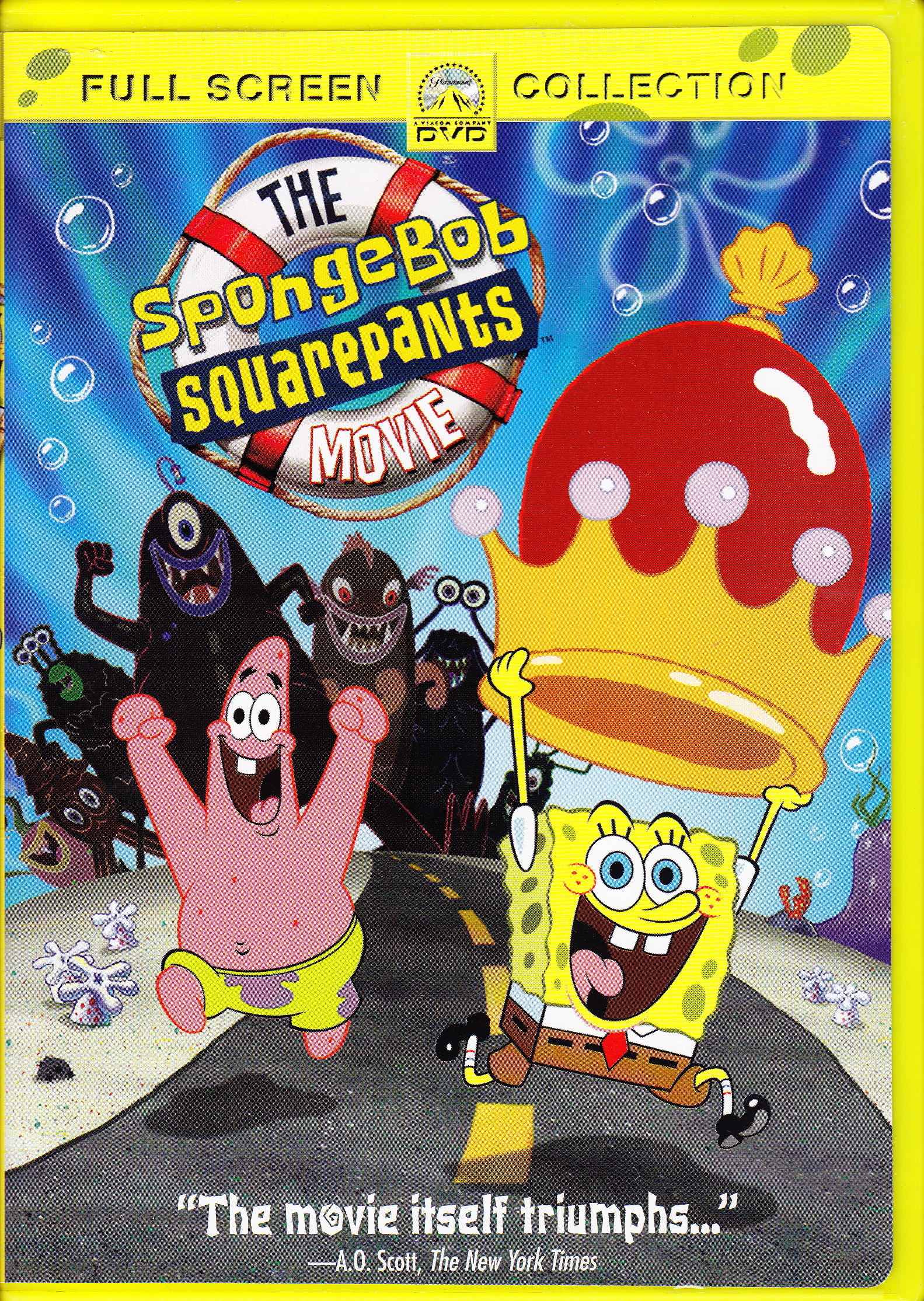
Who lives in a pineapple under the sea? In this era of fast-paced technological change, I’m probably displaying my terrible penchant for the passé when I confess to having watched Spongebob Squarepants with my daughter. I even went to the theater, back in Wisconsin, to watch the much hyped Spongebob Squarepants Movie. We eagerly awaited its release on DVD. Well, maybe not eagerly. In any case, after repeatedly watching it for several months, it was shelved and forgotten. Until recently. Playing archaeologist in our apartment, I sometimes unearth artifacts that have been hidden since our hurried and harried move from Wisconsin to New Jersey. We have never really fully unpacked since leaving Nashotah House, and opening a dusty box in a corner can feel like Christmas sometimes. Or, maybe you just discover the Spongebob Squarepants Movie.

It was a rare three-day weekend. School was about to start, and the commute to work would begin to take longer now that the leisured class had to admit to summer’s end. A little silliness seemed just the prescription I needed to face the work week. A little softness before hard reality.

I have noticed for several years now that American movies (and this may be true of movies from elsewhere, but I can’t say for sure) frequently make use of the death and resurrection theme. I suspect that a country that identifies itself so closely with Christian ideals finds this reiteration reassuring. Sure, the scenario is cathartic on a very basic level, and yet, it lies at the very heart of a central Christian belief—death is not the final word. So as Spongebob and Patrick are laid out on the drying table in Shell City and the water vapor rises from them like their departing souls, the viewer is left with a desiccated porifera and echinoderm and a profound sense of loss.

Of course, resurrection is right around the corner. The fire alarm goes off, showering down life-giving water from above, and our stars pop back to life. Resurrection in nature is limited, by appearances, to plants. With the annual cycles of death and rebirth, an individual plant may attain that for which animals only hope. This is a most robust religious symbol and movie viewers would be bereft without it. Even if the next time you see a sponge is when using it to clean the toilet, remember that resurrection crops up in the unlikeliest of places.


Premature Transportation

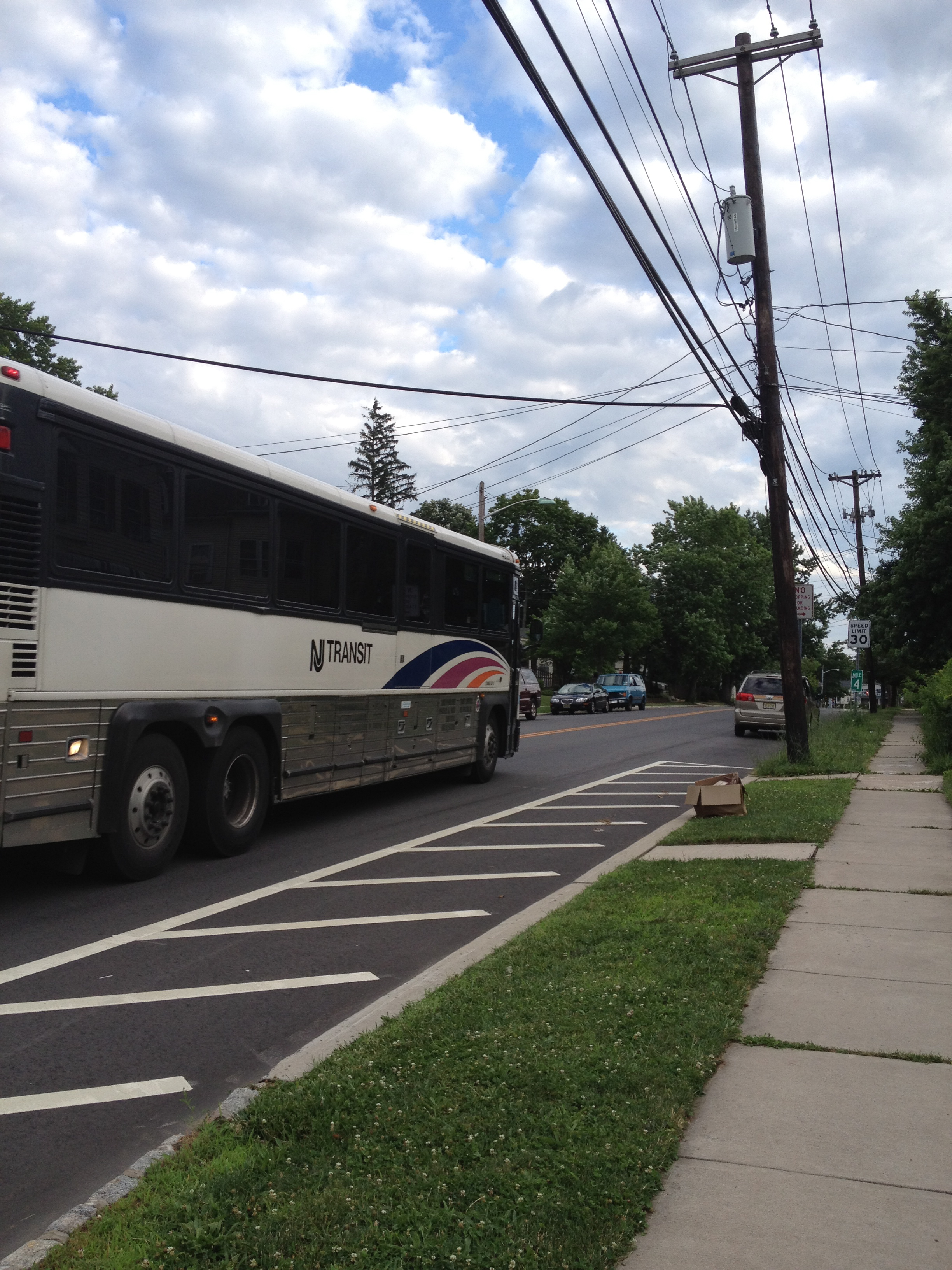
Few experiences encapsulate one’s lack of control like commuting by bus.  As my first year of a daily commute to Manhattan draws to a close, I have experienced many mornings of standing in cold or hot air while a bus leisurely makes its way toward my appointed stop twenty, thirty minutes late.  The commuter can’t head back home for a moment’s warmth/coolness, because the bus could come at any time.  The sense of utter helplessness as you know that you’ll be late for work, and that you got up at 3:30 a.m. for this, settles like an iron blanket over what might have begun as an optimistic day.  Then there are those who sit beside you, totally beyond your control.  I’m a small guy and I sit scrunched next to the window to get as much light for my reading as I can.  Very large people find the extra space next to me attractive, although sometimes they insist I squish even more against the window so they might fit.  Overall, however, the exchange of comfort for reading time makes the arrangement palatable.  It’s the loss of time that bothers me.
 
Without traffic, my bus can be at the Port Authority Bus Terminal in an hour. To manage this feat, it has to reach my stop before 6 a.m.  On rare occasions it comes perhaps five minutes early.  When you take a bus, subject to the vagaries of traffic, the only wise course of action is plan on being a few minutes early.  Drivers who watch the clock are dangerous.  So it always annoys me when passengers down the line complain if a bus is one minute early.  On those exceptional mornings I hear strident voices raised, “you’re two minutes early—I had to run!” or “I was sitting in my car; you came too early!”  The driver is scolded and the next day we’re all half an hour late for work.  It is the problem of premature transportation.  Time, to the best of our knowledge, is something you never get back.  I would rather be early rather than late.
 
I first conceived of wasted time as a religious problem when I was in seminary. There was always so much to do, and relinquishing time to pointless activities such as standing in line, or waiting for the subway, grew acute.  Now that I’m an adult anxious about holding down a job that requires a lengthy commute, the issue has arisen again. Clearly part of the difficulty lies in that time is frequently taken from us.  The nine-to-five feels like shackles to a former academic.  I had classes anywhere from 8 a.m. to 10:30 p.m. without considering the drain on my time.  It was largely, I believe, because pointless waiting was not very often involved. Time, like any limited resource, must be parceled out wisely. Time to bring my morning meditation to an end and get ready for the bus. And if it’s early I will consider it as a divine gift.