The Skinny on Kansas

Perhaps it was just a slow news day, but Monday the Associated Press ran a story about a year-old skinny-dipping episode involving Kevin Yoder, US Representative from Kansas, and, by extension, Jesus.  Given that I’ve just posted on the skinny-dipping priest in A Room with a View, this seemed an apt place to consider what is being shown to the public. First of all, Yoder did not go au naturel in the swimming hole behind his house. The incident took place last August in the Sea of Galilee, the very body of water Jesus putatively walked upon.  Here’s the rub: with or without a boat, because of the association of Jesus of Nazareth with the Sea of Galilee, many people consider it a holy site. Even an Israeli police spokesman seemed a little put off by the mental image that, even if a year old, is a bit disturbing.  (The thought of any politician undressed is a bit jarring to the puritan imagination of the United States, and, one imagines, in many cases it is a reasonable phobia.) Yoder was reportedly in Israel for a trip funded by the American Israel Education Foundation. They were traveling to discuss international relationships, apparently.

As much fun as it is to catch a big player with his (less often her) pants down, I do wonder at the fuss. During my time in Israel—granted, many years ago and fully clothed except when in the shower—I noticed that American standards were not completely in force. A stroll down the beach in Natanya would easily prove my point. We like to hold our public officials to a higher standard that the average citizen, and given what they take from the system, rightfully so. Nevertheless, I wonder what harm is really done by a bit of juvenile fun. Obviously I wasn’t there, and I don’t have the context with which to judge such behavior accurately.  The Israeli police representative stated that public nudity is forbidden at the Sea of Galilee, so I suppose the legality of the act was an issue. American sexual mores, in addition to having been tempered by Victorian attitudes, are largely based on religious prejudices. The Bible is not shy on nudity, however, and people in the early Christian centuries participated in that world.  According to the Gospels, Saint Peter went fishing naked on that very same lake.  Progress obviously involves putting a cover on it.

Ironically, in trying to explain himself, Yoder said that the jump in the lake was spontaneous, a moment of joie de vivre, “just to have the experience.” He conceded that the Sea of Galilee is a special place.  And, he avers, drunk diving was not involved in the incident. No matter your level of tolerance, the emerging picture is an odd one. A group of government officials, one of them naked, standing around the Sea of Galilee at night.  A 30-something from Kansas jumps in for 10 seconds and it seems as if a storm arose over the feted Sea of Galilee just like New Testament times. One wonders how well our government represents the puritanical interests of their constituency.  Kansas, as we all know, is immune from evolution and provides a home for Fred Phelps and company. And it’s also a land-locked state. If you want to run around naked, and you’re a public official, it looks like you—like Dorothy—have to get out of Kansas.  Even then you might find yourself rocking the boat. Let’s just hope that if Peter’s inside he has the sense to pull on at least the girdle of righteousness before company comes.


Used Against You

Many times I’ve confessed to being a reluctant Luddite. My reluctance arises from a deep ambivalence about technology—not that I don’t like it, but rather that I’m afraid of its all-encompassing nature. This week’s Time magazine ran a story on how smartphones are changing the world. My job, meeting the goals set for me, would be impossible without the instant communication offered by the Internet. Everything is so much faster. Except my processing speed. We all know the joke (which would be funny if it weren’t so true) that if you’re having trouble with technology, ask a child. In my travels I see kids barely old enough to walk toddling around with iPhones, clumsily bumping into things (i.e., human beings) as they stare at the electronic world in the palm of their tiny hands. And once the technocrats have taken over, “progress” is non-negotiable.

I made it through my Master’s degree without ever seriously using a computer. Even now I think of this very expensive lap-warmer before me as a glorified word processor. Over the weekend I succumbed to the constant lure of Mac’s new OS, Mountain Lion. Some features of this blog had stopped working, and, being a Luddite, I assumed that it was outdated software. Of course, to update software, you need an operating system that can handle it. So here I am riding on a mountain lion’s back, forgetting to duck as the beast leaps dramatically into its lair. In this dark cave, nursing my aching head, I realize that I have become a slave to technology. For a student of religion who grew up without computers, I’ve got at least half-a-dozen obsolete ones in my apartment, each with bits and fragments I’m afraid to lose, despite the fact that I’m not even sure where to take them to retrieve the data. When I sat down to write my post this morning I received a message that Microsoft Word is no longer supported by Mountain Lion. Fortunately my daughter had the foresight to purchase Pages, so life goes on.

This blog has an index. It is an archaism. Indexes are not necessary with complete searchability. It is there mostly for me. In my feeble attempts at cleverness, I sometimes forget what a post is about, based on its title. The index helps me. In a truly Stephen King moment, I found this morning that my index had infinitely replicated a link to my post on the movie Carrie, so that any link after that will lead you directly to the protagonist of Stephen King’s first novel. It will take a few days to clean that up. There’s probably an app for it. For those of us brought up before household computers were a reality, however, there is a more religious explanation. Yes, my laptop is clearly haunted. And in the spirit of Stephen King I type these words while awaiting the top to snap down with the force of an alligator byte and break off my fingers. I should be worried about it, but instead, I’m sure there’s an app to take the place of missing digits. Even if there isn’t I’m sure my iPhone will happily survive without the constant interference of a Luddite just trying to call home.

Not a lap-pet.


Isaiah Thwarted

Back in January, out of a sense of curiosity on a number of points, I began tweeting the Bible. I wondered how long it would take, at 140 characters a day, to type the King James Bible into Twitter. Since that time, I have not missed a day. Until this week. International travel and business travel with uncertain Internet access have been overcome as I flew with Bible in hand to keep it going. On Monday I was just wrapping up the flood story. Clearly this was going to take a long-term commitment. Then early this week a message popped up on my Twitter account stating, “You cannot send messages to users who are not following you. Learn more,” so naturally, I learned more. Unfortunately I am not now, nor have I ever been, a techie. Just a sentence in and words I don’t understand begin to flummox me, building confusion on confusion. What it appears to be telling me, in layman’s language, is that I can no longer post to Twitter.

Apart from the personal rejection such impersonal messages inevitably engender, this development brought to mind the famous verse from Isaiah 40.8, “The grass withereth, the flower fadeth: but the word of our God shall stand for ever.” Hath the Lord been stopped by Twitter? Technology changes rapidly, and those of us who’ve never had any formal training in it sometimes feel like we’re driving a car on a dark country road at night with no headlights. I’m not really sure how this all works, but I try to send daily thoughts out into cyberspace and, yes, what you say can and will be used against you. And I wonder about old Deutero-Isaiah sitting there in Babylon peering into an indefinite future.

Our abject dependence on the Internet has changed us as a species. I’ve recently read about how technological innovations have become the evolution of the human species. This collective brain we refer to as the Internet has revolutionized the way we do business, but it has also introduced a component of fragility into the equation. Electronic information is untested in the long term. Some of my earliest writing projects now exist only on three-and-a-half inch floppies, most of which are tucked away in some musty corner of the attic. And what if the earth passes through a comet’s tail or a nasty solar flare jets out our way? Doomsday scenarios have been based on such things (just remember Y2K and smile). So maybe Second Isaiah was onto something after all. Printed books have been known to survive for at least half a millennium, and in rare instances, a couple thousand years. And the pagan sources on which parts of the Bible are based, written in clay, last even longer. And one of the earliest stories recorded was that of a worldwide flood.


Strawberry Meatloaf

Strawberry ice cream. It tastes like summer in a waxed cardboard carton. While having a small dish of it recently it occurred to me that strawberry is my favorite flavor of ice cream. This was the first time I’d had any in perhaps twenty years. I am not diabetic, but I am extremely phobic. I avoid the things I like out of fear. There always seems to be plenty of bad to go around, but I’m always afraid the good will run out. Waiting two decades for something I like is a small price to pay. This same phenomenon accompanies my musical tastes. When I listen to music, generally, I listen to music. I’m not a background music personality. Life has been so busy lately, however, that I don’t have the time for music that I would like. I bought a CD (yes, they still make them) of Meat Loaf’s Hell in a Handbasket shortly after it was released. I just listened to it over the weekend. (It has been that busy.)

Since I had a lot to accomplish last weekend I listened to the CD as background music, violating my own standards. That meant that I had only impressions of what was going on rather than the full impact. Immediately, however, I was struck at how socially conscientious this album is. I realize that Meat Loaf is primarily a singer, performing songs written by others. Nevertheless, it seems that a singer must have some investment in the songs they perform to put the kind of empathy into them that Meat Loaf does. The theme that seems to be running through these selections is that violence and greed have become our paradigms, and we are heading to, well, Hell in a handbasket.

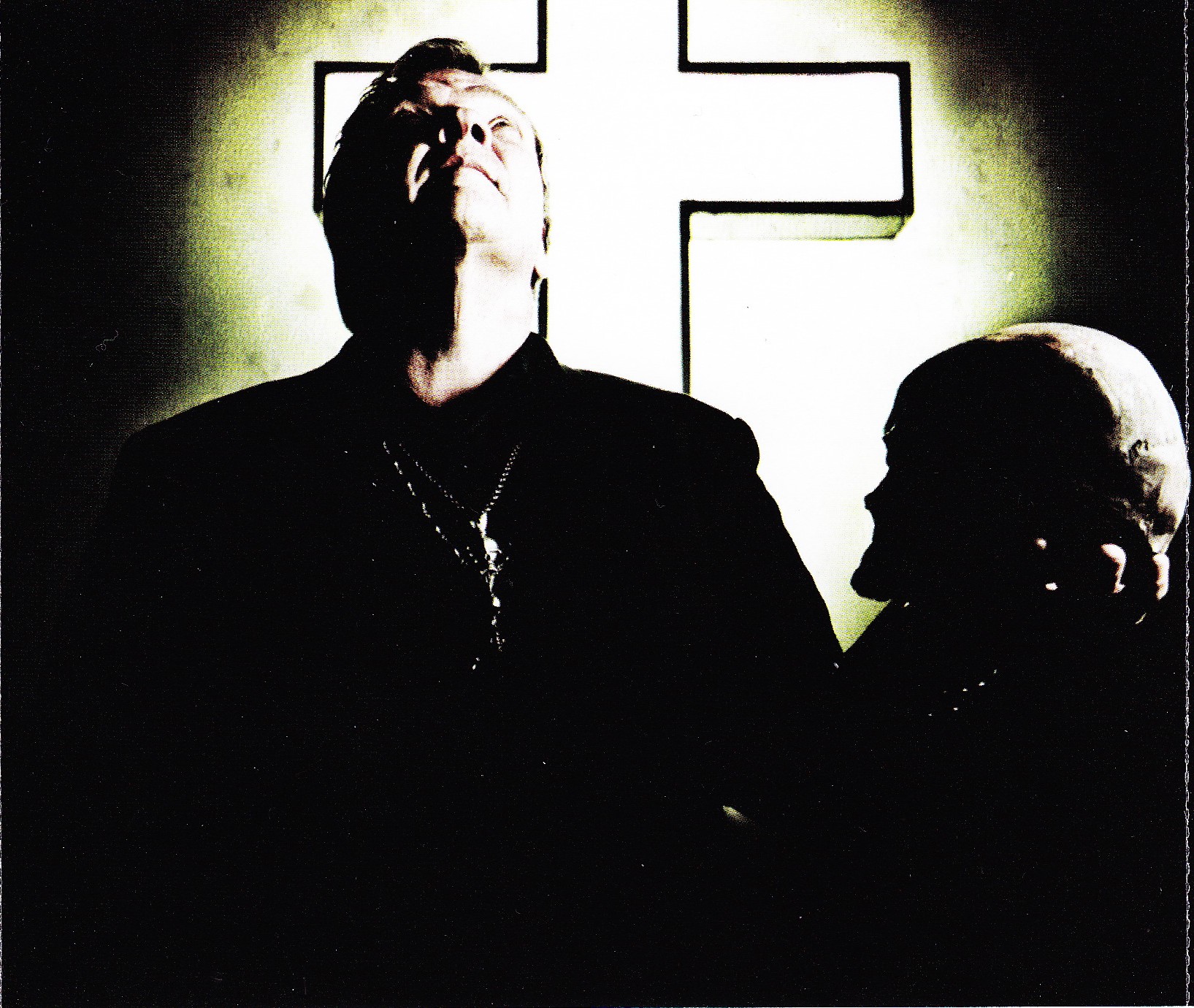
I’m old enough to miss album art. I don’t miss the hiss, skips, and pops of vinyl, but the square foot of album art was often a gift. The album art is part of the message of the music. Inside the back cover of the Hell in a Handbasket CD, behind where the disc is mounted, is a gothic photo of Meat Loaf holding a skull, Hamlet-like, before a large cross. Around his neck is a chain that holds another skull, and, with a bit of imagination, perhaps a small crucifix. (Like most people who still remember album art, my eyes aren’t what they used to be.) Something is happening here that I can’t quite define. Jim Steinman is not on this album, and my fear seems to rise. Then I listen and I hear my social consciousness being in some small way affirmed. It may not be Wagnerian rock, which I fear is rapidly running out, but it is worth another listen when I’m able to set aside the world for maybe an hour or two.


High Aspirations

I’m not a fan of the Olympic Games. It’s not that I have a problem with the passion and dedication of these (mostly) young people who’ve trained themselves to perfection in various physical skills, but the Games have tended toward jingoism a little too often. They may be intended to bring the world together, but often they become the focus of international tension. And, of course, television shows us only where our own nation makes a good showing. In my more somber moments I wonder if there isn’t someone even better at this or that sport/event whose circumstances make it impossible for her or him to make an international showing. Olympic Games are for those who can afford personal trainers and who can manage to make it to tryouts on schedule. Again, I don’t demean the ability of the competitors; when I find myself in front of a television I often stare in awe at what they accomplish.

A certain disconnect always attends the opening ceremonies. I have to confess to having glanced at the screen in our hotel room once or twice during the London extravaganza, but what became clear is that culture is what’s celebrated here. Athletics are the same internationally, if we take the Olympics at their word, but culture in region specific. Figures from Harry Potter and Mary Poppins, and other British contributions to the world of art and literature, filled the arena with a sense of national pride. Even the queen deigned to parachute down to the level of the commoner, in the company of James Bond of course (Sean Connery, why did you have to age?). This is what the commentators called the “rebranding of the royals.” What is it that we really value about ourselves? Can we not truly overcome xenophobia?

Xenophobia has a reach far beyond nationalities. It is rampant between social classes, political parties, and language groups. We distrust the other, for those like us are the best. The best swimmers, the best gymnasts, and the best shooters.

To look down on the world.

Just days ago I stood atop one of the peaks of Mount Mansfield, the highest mountain in Vermont, with my daughter. As we looked out over the panorama that included New Hampshire and New York, and maybe even Quebec, it seemed as if the world could be one. Maybe the things we value could lead us to share instead of selfishly claim everything for ourselves. I think of Mount Nebo and I shudder. And I think if I knew how to ski and if it was winter, maybe I could be the best.


Sweet Heaven

On a weekend trip to Waterbury, Vermont, I found the sweetest cemetery ever. Ben and Jerry’s ice cream factory features a Flavor Graveyard where tombstones to deceased flavors stand. The epitaphs are frequently witty and the experience is lighthearted for kids and adults alike. I wondered, as I stood there looking at the monument to Bovinity Divinity, at the persistence of the belief in an aftertaste—what I presume is a flavor’s version of an afterlife. We like to believe in something more, sometimes at the expense of the here and now. Nevertheless, Ben and Jerry stand for something more than quality ice cream. Theirs is a company with social consciousness, started by two young idealists who have managed to keep their integrity in spite of success. I couldn’t help but to feel impressed by the entire operation. Frozen dairy with a conscience.

The larger question, I suppose, is why success so frequently leads to a loss of concern for others. People possess differing levels of empathy, just as animals do, but it appears so starkly in the case of those who prefer their profit at the expense of others, sometimes even the entire remainder of the world. In a universe of one, no one is rich. And seeing a successful company that has managed to pull off relative equity in the world of business has proven that it is possible. Too many idealists let go too soon.

Perhaps it is the rarified air at higher elevation, or perhaps I’m being brushed with the wings of angels at this altitude closer to the celestial sphere, but this giddiness that I’m feeling is likely born of bonhomie. There is no necessary correlation between success and lack of concern for others. I am reminded of this as I walk to work in far away Manhattan. The sidewalks, even in posh business areas, host ambiguous stains and crushed cockroaches. Even the wealthy must step out of their limos sometimes. When they do, they will plant their feet on the same dirty sidewalks as the rest of us do. Their elevators may lift them to pristine heights, but the bottoms of their shoes are just as full of the remains of everyday lives as are mine. From now on, however, when I see Ben and Jerry wrappers among the detritus on the streets, I will be smiling, thinking about the aftertaste.


Leggo My Congo

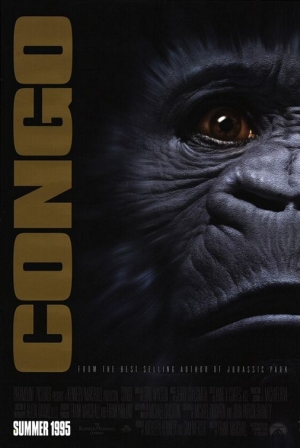
When I first saw the trailer for Congo, back in 1995, I was a new father and my interest in talking apes understandably took a back seat. While the movie sat back there like a quiet child, it was slowly forgotten. Something prompted my memory over the weekend, so I finally watched it. Now, I had plenty of time to read the negative reviews, but I have a soft spot for both talking apes and bad movies. The really fascinating aspect of Congo, however, was the fantastic liberties it takes with the ancient world, particularly the kingdom of Solomon. Solomon has been under investigation over the past few decades. Archaeologists have not found evidence of the biblical opulence concerning both his wealth and fame. It seems likely that he was an actual king, but the king of a small nation that did not have quite the pull that later tradition granted to it. Still, Solomon has become a cultural trope for great wealth and splendor, and if a movie-maker wants an easy frame of reference, well, some people will recognize old Sol. Those who do recognize Solomon probably won’t have a ready inventory of his assets to interrupt their enjoyment (that presumes a lot) of the movie.

The motive factor that brings our unlikely traveling companions together in Congo, are the fabricatedly mythical diamond mines of King Solomon, located in the Congo. A self-styled archaeologist and professional con-man from Romania assists to finance a flight to Africa to help return a homesick gorilla (Amy) who also, by the way, talks. The only realistic aspect of the heroes is that the university professors are the ones who are completely broke and have to rely on corporate funding to get their monkey off their back (well, actually she’s an ape). And then there is the huge communications giant (TraviCom) that needs the diamonds for their communications equipment. And a bunch of Africans who just want to stay alive (most don’t succeed). Solomon was never really associated with diamonds in the Bible. His wealth is described in terms of gold, silver, bronze, peacocks, and suprizingly, apes. Why and how he would have managed a mine in central Africa when even the Egyptians didn’t travel there is never explained.

Well, I shouldn’t be so hasty about the Egyptians. Our Romanian con-man is also able to translate Egyptian heiroglyphics, liberally scribbled on the walls of the fortress surrounding Solomon’s mine. These preserve the story of the “myth of the killing apes” that generated an honest-to-god guffaw from my cynical self. New mythology and corny characters aside, the movie didn’t fail to reach me. I’m always a sucker for talking apes and under-funded education, both of which represent a kind of extinction. If Solomon really had a reach all the way to the Congo, and if he extracted the huge diamonds the movie showed scattered around on the surface of the ground and if universities could actually get media attention for causes other than the shortcomings of their football programs, there could be cause for hope. In what is a bit of probably unintended social commentary, after the mine is destroyed in a volcanic eruption, only one diamond remains. And that diamond benefits neither the single surviving African nor the underfunded university professor. It becomes a weapon in the hands of a large, private corporation.


Risky Business

Scientology has been back in the news with the divorce of Tom Cruise and Katie Holmes. Media pundits like to point out the highly unorthodox nature of Scientology, but such critiques overlook the vital nature of New Religious Movements. Many of us are raised believing that religions, to be “true,” must possess at least a modicum of antiquity. We routinely reject the science of the first century of the common era (well, maybe the Creationists don’t), but we accept without question that the religious views of the time were on-spot and unchanging. It comes as a surprise, therefore, when a new religion like Mormonism or Scientology prospers. Accusations of being money-driven are rife, but then, who has recently audited the Vatican or CBN? Religions are “non-profit” by definition, but they certainly do raise money. As players in the capitalist game, I say more power to them. Who else can make tremendous profits and claim tax-free status (apart from major corporations, I mean)? Most believers are happy to throw a few dollars in the direction of some guru who will deliver him or her from hell, at least.

The fact that true believers in revelation don’t like to face is that every religion started some place. It would be a different story were there only one religion that ever developed, but as soon as someone started to declare their belief orthodox it was only a matter of time before heterodoxy joined the conversation. In the light of this wide-open world of religious beliefs, I think that creativity has been undervalued all along. Say what they might, critics have to admit that Mormonism, Scientology, and even Jehovah’s Witnesses have to score high on the originality scale. Since Yahweh has a lot of competition in the deity market these days it will be difficult to find an adequate final arbiter.

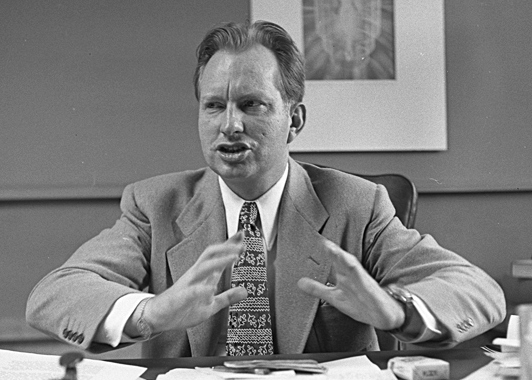
I would like to suggest a panel of experts, like on the appropriately titled “American Idol.” Gods are often hard to pin down, even with email and Twitter and Facebook. To fill in our distinguished panel of judges, then, who might we choose? The clergy of any tradition, I’m afraid, will be biased and so we might look elsewhere. Politicians too should be excluded since their remit is exploitation. Besides, they don’t often recognize creativity as something worth funding. Where does that leave us? We can’t use the average person, because who is going to watch their peers on television. Famous people. An athlete would be a good choice since overthinking religions can lead to trouble. We might need to avoid Tebow, however. Hollywood is said to be godless, so an actor would have great appeal—besides, good looks must equate to good theology, mustn’t they? Who will our third panelist be? Probably a writer; they are creative and their names are well-known. They would add intellectual heft without having the same star status as their more visible colleagues. Funny, L. Ron Hubbard was a science fiction writer whose religion thrives in Hollywood and who enjoyed the sport of yachting. We may have our winner here!

Religion or science fiction?


My Cultic Breakfast

The word “cult” is no longer used by religious specialists to refer to New Religious Movements, but when I was growing up in a fundamentalist home it was liberally applied to suspect groups. While having breakfast this morning I realized just how deeply rooted in American culture such groups are. I reached for my cereal. The reason that many Americans eat cereal for breakfast stems directly from the healthy lifestyle advocacy of John Harvey Kellogg of the Seventh Day Adventists. Adventists are vegetarians and are very concerned about healthy eating. Kellogg was a devout Adventist and produced Corn Flakes as a means of providing a—pardon the term—kosher choice for breakfast foods. Of course, growing up I’d been warned against the “cult” of Adventism, even as I happily munched their Corn Flakes.

So today I decided to have some Apple Jacks instead. Apples made me think of John Chapman, better known as Johnny Appleseed. Americans learn about the eccentric apple-planter from childhood, but most never learn that he was also a missionary for the Swedenborgian Church. Named after the Swedish scientist and theologian Emanuel Swedenborg, this New Church taught doctrines that set traditional Christians’ teeth on edge. Believing that Christ had already returned in the words revealed to himself, Dr. Swedenborg didn’t ingratiate the fundies by rejecting the standard interpretation of the Trinity and by promoting mystical beliefs. John Chapman spread Swedenborgian ideas along with his apple seeds. I’m sure that as we sang the Swedenborgian hymn at Methodist Church camp, we didn’t realize its heterodox origins: “The Lord’s been good to me, and so I thank the Lord, for giving me the things I need: the sun, the rain, and the apple seed—the Lord’s been good to me.”

What good is cereal without a spoon? As I grab my Oneida spoon, selected by my wife and me when we registered for our wedding, I’m sure I didn’t know at the time that the Oneida company is what is left of the Oneida Community. Founded by John Humphrey Noyes in the Burned-Over District back in 1848, the Oneida Community was one of the Perfectionist groups common at the time. Their town of Oneida held everything in common—everything. That included “complex marriage” which meant that all members had sexual access to all members of the opposite gender. They worked to support themselves, and one of their products was silverware. With the death of Noyes and concern of secular authorities about the interesting sex that was going on, the Oneida Community quietly closed, leaving us a company to produce fine stainless steel implements with which to eat our cultic breakfast.


Faith Falls

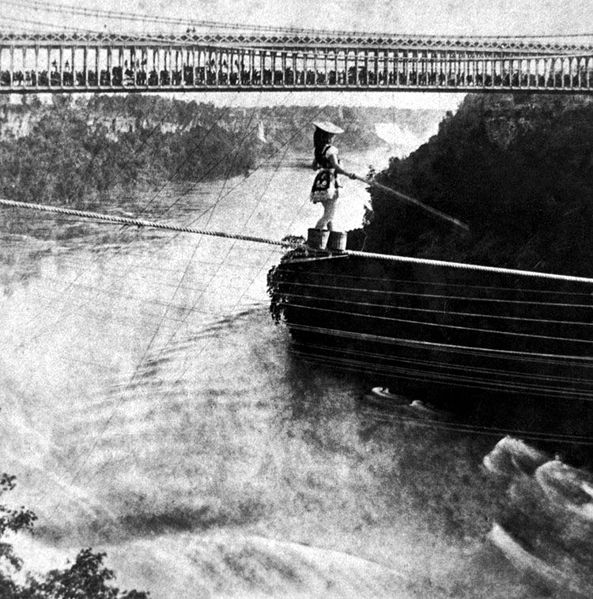
Niagara Falls, despite the crowds and commercialization and the diminished flow of the Niagara River to serve hydro-electric dreams, is nevertheless impressive. It is also one of those landmarks from my childhood since I had a great-aunt and cousins who lived in the town of Niagara Falls. That was back in the days when you could cross between the United States and Canada without a blink of a sleepy customs officer’s eye. Perhaps it is the nostalgia of a guy who’s not quite young any more, and maybe it is the sheer intensity of the negative ions released from all that falling water, but Niagara Falls remains one of my favorite places to visit. It is one of those places that you leave feeling like maybe you’ve been touched by something divine. At the office yesterday when talk turned to Nik Wallenda’s tightrope walk across the Falls last night, memories began to surge. I didn’t watch the live broadcast (I don’t have television service and with my commuting schedule I can’t stay awake past nine p.m. most days), but reading about the successful crossing this morning, I again found something divine.

When reporters asked Wallenda how he’d accomplished the feat he replied, “a lot of praying, that’s for sure.” Here’s where I had to stop and pause. Prayer is a common response to stress. Those moments when people face something that is beyond human capabilities—be it illness and loss in the family, financial ruin, or almost certain death—we often reach out for that which we hope will help us. When Wallenda stepped off that rope, his experience validated his assumptions that God helped him to do what is, in any rational universe, a very foolish thing. At the same time, he asked for divine aid in facing what must be, in that universe, a divine death-trap. Anyone who has stood close to Niagara Falls, or walked the wooded trail along the class five rapids of the Niagara River has come as close to the divine as humans are ever likely to get. To believe that prayer gets you through is to believe that God defies God.

Daredevils live for a thrill that transcends the comfort zone of most religious folk. I grew up during the days when Eval Knievel was a household name and his insane stunts drew millions to their televisions. Surrounded by television cameras, just nine months before his death he undertook his most dangerous stunt. He was baptized at the Crystal Cathedral, spawning hundreds of copycat baptismals. His death, it is generally acknowledged, resulted from complications of his many lifetime injuries. I remember his failed Snake River Canyon jump in 1974. Years later, staring out over the Snake River Canyon for the first time, I felt just a little of that transcendence that draws people to dramatic places. A friend tells me that whenever she goes to Niagara Falls she feels the urge to jump in. She is a very religious person. Hearing her remark about doing a Wallenda without a tightrope, I think she might be the most truly religious person I know.


Do Not Enter

“Sign, sign, everywhere a sign, Blockin’ out the scenery, breakin’ my mind,” so runs the chorus of Five Man Electrical Band’s only hit, “Signs.” It is hard to imagine a more righteous hippie classic. When I was a younger man, I believed in signs. It made sense that if the world were unfolding according to a divine plan laid out for good, Christian folk, signs should be scattered throughout the world, pointing us in the direction we should go. I used to look for them assiduously. As I grew a bit more cynical with the years, and learned a bit more about science and probability, the idea that coincidences bore anything more than incidental meaning became a fixed paradigm. Every now and then something happens to make me question my assessment.

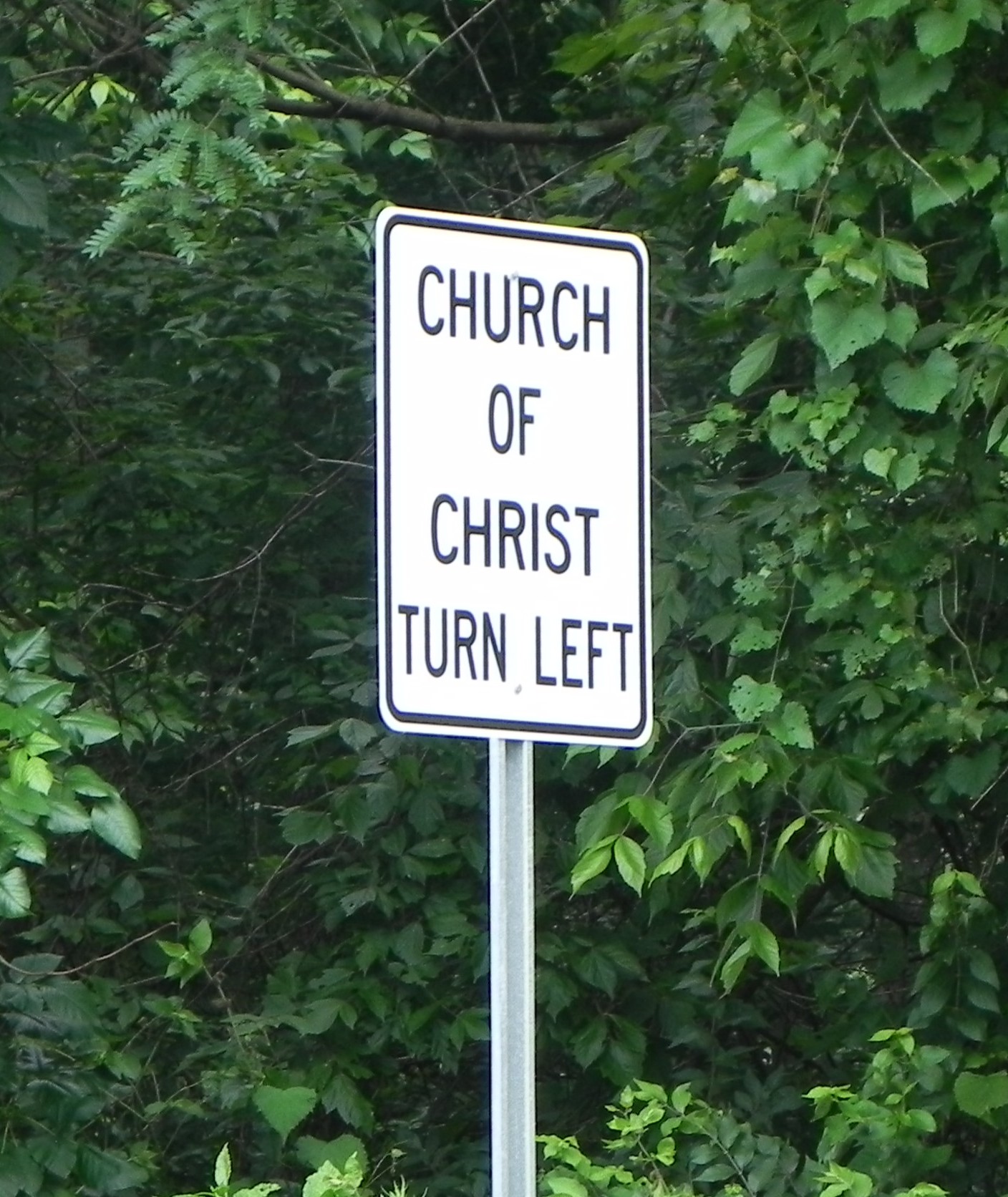
On my way into New Brunswick recently, I passed a sign. I used to drive this road several times a week when I was teaching at Rutgers, but I hadn’t been this way in a few months. I knew there had been construction going on, but a new road sign caught my attention:

Now, I’m one for finding the significance of buried statements. Here was a bold-face declaration that seemed to come directly from the almighty. In a day when Christianity is portrayed as an intolerant, bigoted institution, the simple truth of a road sign might actually bear considerable significance.

Throughout my life I’ve taken road signs a little too literally. When I worked at Nashotah House and I spied an orange sign on the road toward the seminary reading “Detour Ahead,” I knew that it was personally meant for me. The fundies from my college days frequently exploited the One Way signs liberally scattered across our nation, pointing their arrows into the mythological air. Anybody, of course, can make good use of a stop sign. A sign miraculously appearing that spells it out: Church of Christ Turn Left, can be nothing other than a divine message for a weary world. At least for those who still remember hippie bands with a certain fondness, and who don’t take themselves too seriously.


Lunchtime in Midtown

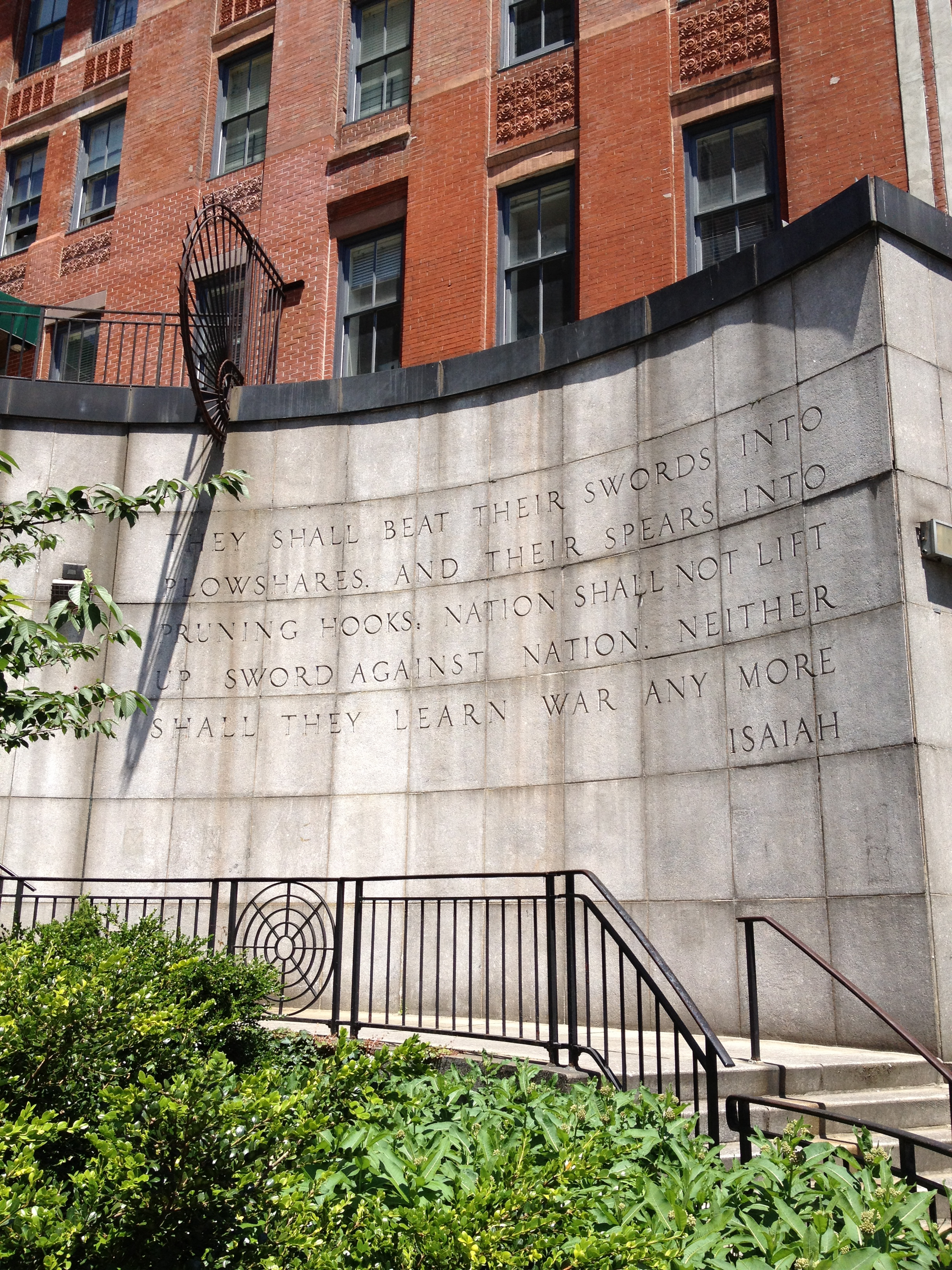
It was a brilliantly sunny day and there seemed to be rain nowhere in sight. It wasn’t even hot. Days like this have been rare this spring, so I went out for a lunchtime walk in my neighborhood. I’d been by the United Nations with some visiting family the day before, so I went down again and pondered the words attributed to Isaiah carved in the wall across from one of the largest intentional organs of peace in the world. I was reminded that a copy of the Edict of Cyrus resides in the UN; as a historical text it is often considered to be the first document promoting religious tolerance among lesser powers allowed by a greater power. The world could use a few more like old Cyrus the Great these days. I think Deutero-Isaiah would agree. So with biblical thoughts in my head, I strolled back toward Grand Central.

Along the way I saw a phrase from the Eucharistic Prayer on a building and it was like meeting someone from college that moved halfway around the world to disappear from your life. I saw that I was standing outside 815 Second Avenue. To the majority of the world—even the majority of Christians—this will mean nothing. At Nashotah House, however, “815” was regarded as the source of all evil. It is the headquarters of the Episcopal Church in America. It is hard, as a disowned son, to describe the feelings that assailed me there. Those good Christians who intended me such harm did not seem to realize all I had sacrificed to join them. Some of the clergy whose daggers remain in my back are well-paid priests right here in New York. Yon Cassius has a lean and hungry look, I thought.

With that cloud in my sky, I turned the corner back to work. Parked in the street was a truck labeled “Divine Moving & Storage.” That sounded an awful lot like a trope for my life. The reproduction of Michelangelo’s God reaching to Adam contrasting with a phone number ending in 666, this bundle of contradictions might just have been a small sample of the human experience. Caught constantly between Heaven and Hell with doleful prophets and profit-loving dolers of sacramental grace living one next to the other. New York is a religious city in every sense of the word. Somewhere off in the shadows I think I hear Isaiah whispering, “I make weal and I create woe…” I love a sunny day in Manhattan.


Haunted Pilgrim

No visit to Providence is complete without a tip of the hat to H. P. Lovecraft. As someone who dabbles in the noble art of writing, I have great appreciation for those who somehow made an impact (often only after they’ve died) on the literary world. I discovered Lovecraft only after I left Nashotah House, which was probably a good thing. Nevertheless, I have come to appreciate his breadth of vision, populating the earth with ancient gods who emphasize the powerful and heartless side of divinity. His vivid images of Cthulhu pervade popular culture to a level that few of the uninitiated would ever expect. And yet, deep in the depths he lurks. So when I was in Providence over the weekend for my niece’s graduation, I spent an afternoon seeking out some time with H. P.

Place inherently partakes of that we term holiness. Where something happened matters. There is no science to explain it, but it is something people know. It is for this reason that I try to visit the homes and resting places of classic writers. Over the years we’ve visited the haunts of Mark Twain, Laura Ingalls Wilder, Edna St Vincent Millay, Washington Irving, Edgar Allan Poe, and others, as well as H. P. Lovecraft. Simply standing in or near the places they once frequented provides a form of inspiration unavailable in any other way. So it was that I found myself at 598 Angell Street in Providence. It is a house still occupied, with no indication of who once called this building home. Lovecraft lived here from 1904 to 1924. If it weren’t for the Lovecraft walking tour I found on the Internet, I would have never known.

In many ways a provincial man, Lovecraft was born and also died in Providence. Apart from a stint in New York City, he spent his time in his hometown. I walked to 454 Angell Street, the address at which he was born. I knew the building had been razed in the 1960s, but I wanted to see what society deems more important than preserving those places that sequester the holy for haunted pilgrims. Although I couldn’t tell for sure, since house numbers change, I believe his birthplace is now the Starbucks that sits pleasantly in a small commercial district. I wonder how many of the thirsty realize where they’re sitting. Have they read any of Lovecraft’s stories? If so, are they uncomfortable sipping coffee in such a spot? Or perhaps it has become a kind of secular sacrament—a toast to all artists whose pasts have been obliterated.


Vampire Jesus

It was a dark and stormy night. Well, so far that could describe most any night in April or May of this year. Anyway, I had just read about vampire-bots for the first time. Robots, like all machines, require a power source. Those I’ve witnessed up close require rechargeable battery-packs that are surprisingly heavy. I’d read that some robots were being designed to consume their own energy sources—mechanical and chemical eating, if you will. One dreamer figured that blood could work as a source of energy. A robot could be designed to take energy from blood, and thus arises the concept of the vampire-bot. I don’t think such an insidious machine was ever really built, but it is theoretically possible. It is also a reflection of a biblical idea—the life is in the blood. Ancient people tended to associate life with breathing. With no CPR, an unbreathing body was a dead body. Blood obviously played into the picture too, but precisely how was uncertain. Clearly a person or an animal couldn’t live without it. To say nothing of robots.

One of those dark and stormy nights I watched The Shadow of the Vampire. Surprisingly for a monster movie, Shadow had been nominated for two academy awards. Not really your standard horror flick, it is a movie about making a movie—specifically Murnau’s Nosferatu, the classic, silent vampire movie that really initiated the genre. The actor cast as Count Orlock, however, is really a vampire. The premise might sound chintzy, but the acting is very good with Willem Dafoe making a believable Max Schreck (vampirized). Stylistic rather than gory, the story plays out to the fore-ordained conclusion and the vampire disappears in the cold light of dawn.

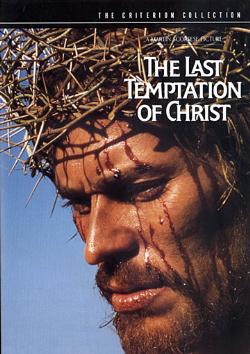
When I was an impressionable child I was told what is likely an apocryphal story about Leonardo da Vinci. The story goes that the man who posed for Jesus in the Last Supper was also the model for Judas, after living a life of dissolution. Willem Dafoe, of course, famously played Jesus in Martin Scorsese’s Last Temptation of Christ. From Jesus to vampire. Both characters are bound by the element of blood. Christianity still celebrates the shedding of divine blood symbolically while the vampire takes blood (also symbolically). Although the vampire cannot endure the sight of the cross, the same man effectively played both sides of the mythic line, almost as if the apocryphal story came true. There are implications to consider here, and not all of them insinuate Hollywood. On these dark and stormy nights, we have something to ponder.


Biblically Married

The Bible says—. Fill in the blank. Go ahead, someone will believe you. The problem with biblical literalism is that it is often held by people who don’t read the Bible. Well, it is a gosh-darn big book—well over a thousand pages—do you know how much quality television watching time that represents? So many fundamentalists are surprised to find out how little the Bible has to say about marriage. In fact, it says almost nothing. There are no marriage rites given, and marriages are mentioned but not described in detail. So when modern-day readers want to find guidance about political policy they have to—to be frank—make a lot of stuff up.

Take North Carolina, for example. Next week they are scheduled to vote on an issue of defining marriage. The intent, apparently, is to bring the state in line with the Good Book. In comes Matthew Vines, an evangelical Christian who’s also gay. Being a Harvard student, he has immediately impressive credentials. He has an on-line biblical exegetical exploration of what the Bible says, and more importantly, doesn’t say, about homosexuality. The other solution, to actually read the Bible, is a little too much to ask. Another part of the problem is that the Bible was written in a very different context, and to understand the Bible’s view on anything, you need to fit it into its context. All this Bible reading—and context too? Better leave it to someone on the television to explain it all.

Leonard Pitts Jr. is a columnist that I’ve come to trust. His good sense comes through in all his work. In Wednesday’s column, he highlights Matthew Vines’ hour-long talk as an example of what happens when common sense meets the Bible. For those who bother to read it, it will become clear that the Bible nowhere defines marriage. It says nothing about sexual orientation. The few passages on homosexual acts have a narrow context (that word!) that must be considered. Nowhere in the Hebrew Bible nor the New Testament is marriage considered a religious matter. It’s simply what people do. So as North Carolina heads to the polls, Bibles clutched in hands, but not in their heads, it might do to watch Matthew Vines as homework. I haven’t seen the video myself. An hour is just too long to take from my busy television-watching schedule.