Internet of Nothings

In the vast internet of things, it’s surprising that you can’t order some specific things.  This became clear to me recently when there were two separate things I was looking for.  I know these things exist.  You can find them on the internet, but they are not available in this area.  One of them is very mundane.  Lath.  You see, the previous owners of the house wired up the attic, which is handy.  To do so they had to break through the plaster and they removed several sections of lath.  Like a squirrel digging for a forgotten nut, they did this several times, leaving holes in the wall with exposed insulation.  One of my projects since moving in has been to plaster over these holes.  The gaps are so large, however, that you need lath to replace the discarded pieces.  

Our local big box hardware stores don’t carry it.  If you find it in a large urban store, they can’t deliver it to a local branch, and shipping isn’t available for this item.  I realize drywall has triumphed—I prefer it myself—but doing the entire attic is a major expense.  I just want to plaster up the holes.  No lath, no how.  At the same time I began to look for Top Ramen soy flavor for quick lunches.  It is the only inexpensive vegan option with the much coveted flavor pack.  I know it exists and that it is available in Ithaca, New York, the last place I bought it.  Although the brand is in our local grocery stores that variety is not.  It’s listed on Amazon, but as unavailable.  (Amazon, by the way, insists that you want to buy a lathe if you type in lath.  If it finally accepts “lath” it’s clear it has no idea what it is.)

So I went to the website of the Top Ramen parent company, Nissin.  They list the product as available.  They don’t ship themselves, not to small customers, but they helpfully tell you stores nearby where you can buy it.  Their vegetarian varieties are “not available in your area.”  Not even Amazon can get them.  This to me seems odd.  Nearly every day I read about the greatness of the internet of things.  Anything can be had in this market.  If you’re looking for something specific, whether it be thin strips of cheap wood or thin noodles without beef broth for your lunch, you can’t get those in an area within about 250 miles of one quarter of the US population.  Of course, I have until lunchtime to sort this one out.


Redacted

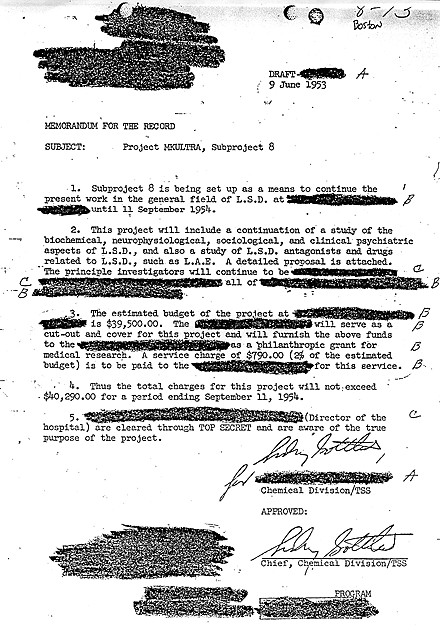
A friend recently introduced me to Redactle.  Yet another of those daily internet games that have become trendy in these pandemic years, Redactle gives you a page that looks like a Freedom of Information Act piece from the government.  Most of the words are blanked out and all you really know it that it is taken from one of the significant pages on Wikipedia.  You get some clues from the format, the way the prepositions and articles they give you are arranged, and occasionally, the punctuation.  You just start guessing words and it fills in the blanks as you get hits.  Like most things of this sort, there’s one puzzle per day, otherwise none of us would ever get anything done.  I’m a sucker for learning games, so we’ve been playing it as a family for a few days now.

A redacted file from the CIA, via Wikimedia Commons

The thing that has surprised me the most in our early on is that the trickiest ones to get right were on religions.  In our first week of play, two of the puzzles were religions: Lutheranism and Shaktism.  We’d been able to guess famous people in two dozen guesses, and countries in about the same.  Religions are trickier.  Despite having studied religion my entire life, my thought process doesn’t include guessing words like “theology” and “worship” for important articles on Wikipedia.  (In the case of Shaktism it took well over 100 guesses.  I taught world religion maybe fifteen years ago, but I haven’t kept up with my Hinduism.)  In the case of both of these religions what eventually gave them away was the place names: Germany and India.

India, of course, has been the birthplace of many religions.  The majority of Indians today are Hindu, but Buddhism, Jainism, and Sikhism were also children of India.  Even in this increasingly secular world, religions remain the driving forces behind lives.  So much so that some religionists consider Secularism a religion.  The fact is we all believe something.  It may not be supernatural, but then not all religions are.  They often brush up against philosophy at their most sophisticated end, and literalism is the least developed form of any belief system.  With some exceptions it doesn’t pay well to be a religionist.  Perhaps that’s because thinking hard about religion reveals uncomfortable truths.  Not only that, studying religion is no guarantee that when you have to fill in the blanks you’ll be able to guess one when it’s right in front of you.  That’s why I appreciate learning games.  


Bright Idea

No, I didn’t see a long tunnel with a light at the end, but I did have soot on my hands from the flash.  I’m no electrician and the ordering instructions weren’t clear about how to get the dryer installed, as well as delivered.  The driver, who spoke English haltingly, told me he would not set it up.  There was another problem with the order: the dryer cord was for a four-pronged outlet, but our house has a three.  I suppose that’s why the cord doesn’t get attached to the appliance.  Now, we lived in Scotland for three years.  Electronic devices there are sold with a cord that you have to wire into the plug yourself—different places have different outlet types.  With fear and trembling I’d wired a lamp or two.  I prefer not to play God when it comes to electricity.

I don’t know how many appliance-related deaths happen each year, but I’m sure it’s not a null set.  Here’s what happened.  A week after delivery I found time to go to the hardware store to exchange the four-prong for a three-prong.  I went home and wired it up.  The plug didn’t fit into the socket.  Muttering under my breath, I turned to the internet to find out what had gone wrong.  Well, it turns out that electric kitchen ranges are also not wired sometimes, and they take a different three-prong plug with wires handling different voltages or whatever.  Yet another weekend came and I finally got the right cord.  A little insecure from the two attempted efforts, I put the plug in the socket to see if it fit.  A bright spark and a loud pop occurred.  Two of the connectors had been touching and I’d closed the circuit.  If I’d been holding it differently, I wouldn’t have survived the experience.

As a child I once electrocuted myself, quite by accident, it is an experience I never wanted to have again.  I was so shook up after being so close to it again that I couldn’t face going back to the store to see if they had another one—the cord was now soot-blackened, and useless.  Living in a capitalist society my mind immediately turned to my electric bill, wondering how much that light and sound show would cost me.  The dryer is energy-efficient, all the more so for not having ever been used up to that point.  Now we’re hooked up and ready to go and I’m thinking how fragile life is.  And how, in middle and high school we had to have wood shop and metal shop but not a thing about that favorite tool of the gods—electricity.


Capital Idea?

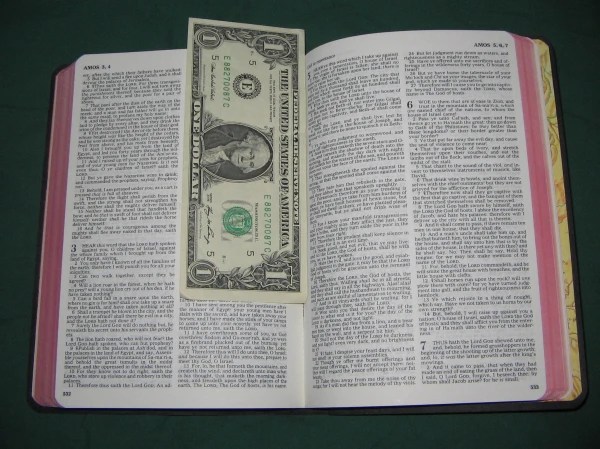
One of the most difficult parables in the New Testament is the one where Jesus praises the fraudster (in Luke 16).  In case you’re a little rusty it goes like this: a steward of the king learned he was losing his job.  Knowing his employment prospects were like those of a mid-career religion professor, he called in his masters’ debtors and slashed the amounts they owed so that they’d think kindly of him.  When the king finds out, instead of growing more angry, he praises the steward for his shrewdness.  The parable seems to not condemn deceit and his left both scholars and laity scratching their heads ever since.  I’ve never, in my long church going career, heard a sermon extolling fraud.  The good book can be tricky some times.

The parable came to mind because I’ve been the victim of the fraudulent use of one of my few credit cards.  I only have two.  One of the reasons for this is that it’s difficult to keep track of everything as it is.  Life is busy.  I have most of my bills set to autopay so that I don’t forget to do it when an email reminder comes.  I don’t remember the last time I used actual money.  Writing a check is a rarity.  How my credit card was hacked I don’t know.  I didn’t notice right away because the charges were always small and spaced out.  I caught on when I hadn’t been using the card in that lull after Christmas and the exact same amount was charged two months in a row.  I called the company and they confirmed that similar small charges had been going on since December.

Now I picture in my head a scene where the criminal is caught and in court they use the Bible in their defense.  I’m sure it wouldn’t happen that way, but it’s an interesting idea.  Who’s going to argue against the Bible?  Heck, most courts can’t get those who know Trump’s many crimes to get their cases ever heard!  What do we do when the Bible distorts the moral narrative?  The fraudster, after all, is breaking at least one of the ten commandments.  Of course, those are negotiable these days.  The right wing’s endorsement of violence to maintain power shows that.  So it seems a prudent time to consider the parable of the fraudster.  We might still have something to learn from the Good Book after all.


Companies

Perhaps you’ve seen them too.  Big companies that express what they do purely in platitudes that apparently impress business types.  I’ve looked at some of their websites and after considerable poking around I can’t conjure even a ghost of an idea of what they do.  Love ‘em or hate ‘em, we all know what companies like Exxon, Random House, or even Planned Parenthood offer.  They have a function—a product or service that you can recognize.  Some of these vague large corporations seem to exist simply to exist.  And get paid for it.  It reminds me of that episode of The Simpsons where Lisa asks a corporate executive woman what her company produces and she answers “Synergy.”  We see these “centers of excellence” popping up here and there.  Excellence in what?  Excellence is a quality, not a commodity.  Or maybe I think too small.

Someone I know recently changed jobs and I looked up the company she’d switched to.  It obviously had money for a slick website and an office in Manhattan.  The list of industries it supports as clients was wide and impressive.  But what does this company actually do?  They spew platitudes.  Corporate climbers apparently like this lingo.  You’ll never catch me citing “best practices.”  Are they trying to imply that the rest of us use worst practices?  Do they mean a better way of doing things?  Why not say what you mean?  I like to play with words.  It doesn’t pay very well, but I’m wondering if I’m perhaps missing an opportunity here.

We could form a company that spins out new corporate phrases to make business sorts sound intellectual.  We wouldn’t actually need to do anything except attend company meetings about our company and throw out a few phrases likely to become trendy.  Maybe hire a publicist to get those phrases going.  Surely some company has the money to spend on that.  Those of us who actually do peddle words for a living have trouble getting big corporate money.  Publishing is a low profit-margin business.  But a company that makes you sound intelligent?  Priceless.  Growing up there seemed to be only a few standard jobs.  Of course, I lived in a small town where the options were indeed limited.  Each of them, however, had a defined role.  You knew what the job entailed.  This new company, which will have a vague name, will be in keeping with the times.  Who’s with me?  Just be sure to bring your checkbook.


Namely Coincidences

One of my very first posts on this blog was about how I am not the Steve Wiggins who is a gospel singer.  There I mused on the coincidence that we share fore and surnames, as well as an interest in religion.  He is far more prominent than I am.  I don’t sing.  Since that time the most prominent Steve Wiggins on Google is the one who shot a police officer in Tennessee.  We don’t even share the same name, technically.  My given name is Steve, not Steven.  The branch of Wiggins I come from, however, is from the south.  Stephen F. Wiggins, even further removed in the name-spelling department, was CEO at Oxford Health Plans.  Now, I work for a publisher that shares one of those three words, and it’s the one that’s most specific.  Are Steve Wigginses drawn to the same places?  Another Steve Wiggins, just a couple years older than me, lived in Russellville, Arkansas.  I grew up in Rouseville, Pennsylvania.  Coincidence?

Our sense of individualism is, it seems, socially conditioned.  If we try to imagine life in earlier human social structures, such as hunter-gatherer society, it looks as though people tended to function more as a collective organism.  The benefit of the group was the deciding factor, rather than what an individual wanted.  No doubt this was a more harsh environment for those who liked to think for themselves, even though evolution had given us that capacity.  Biology, however, seems to have species survival as its goal.  Individuals die while the organism lives on.  In modern society we consider individualism as one of the highest aims.

Our names individualize us.  I sometimes think of countries like China that have a combination of very large populations and a tradition of short names.  With limited numbers of possibilities repeats in names becomes inevitable.  It’s a prominent aspect of our western society that we want name recognition.  We want to feel special.  Unique.  We work against evolution, but evolution has vastly more time than we do.  Perhaps we’ve gone too far with our individualism.  I hope we don’t have to step back as far as The Matrix, but maybe a movement in the direction of the social good over individual wants would be the right thing to do.  Our psychology makes us want to feel special.  Our biology wants us to play nicely together.  Who, in the end, wins out?  It could make a world of difference.


Evening Out

It feels like magic.  The morning after staying up late for something special has a transcendent quality to it.  You can almost touch the veil.  Now, for me it’s an admittedly low bar.  I get up around 3:00 a.m. most days, so “late” is when I venture past about 8:00 p.m.  And I don’t mean for a board meeting where you’re trying to solve the problems of the world.  No, I mean staying up for something you anticipate.  Or even if it’s something you experience only by association.  I had to pick somebody up in Easton after an evening event recently.  It wasn’t over until after I’m normally asleep, but I made plans to hole up in Dunkin’ Donuts and perhaps even sip a coffee if I had to, for the drive home.

This was a Tuesday night so most businesses were closed.  After parking the car I found out that Dunkin’ wasn’t keeping evening hours either.  I try always to travel with a book.  The one thing I learned from my brief stint in Boy Scouts was “be prepared.”  With no Dunkin’ the only places open were bars and clubs.  Thankfully it was a warm evening, so I found a free bit of curb on which to sit to read my book.  Easton’s a college town so young people were out and about.  It was good to see other folks enjoying life.  Then a woman stopped and leaned down.  She was looking at the cover of my book.  “Just wondering what you’re reading,” she said.  “I’m always on the look out for something good.”

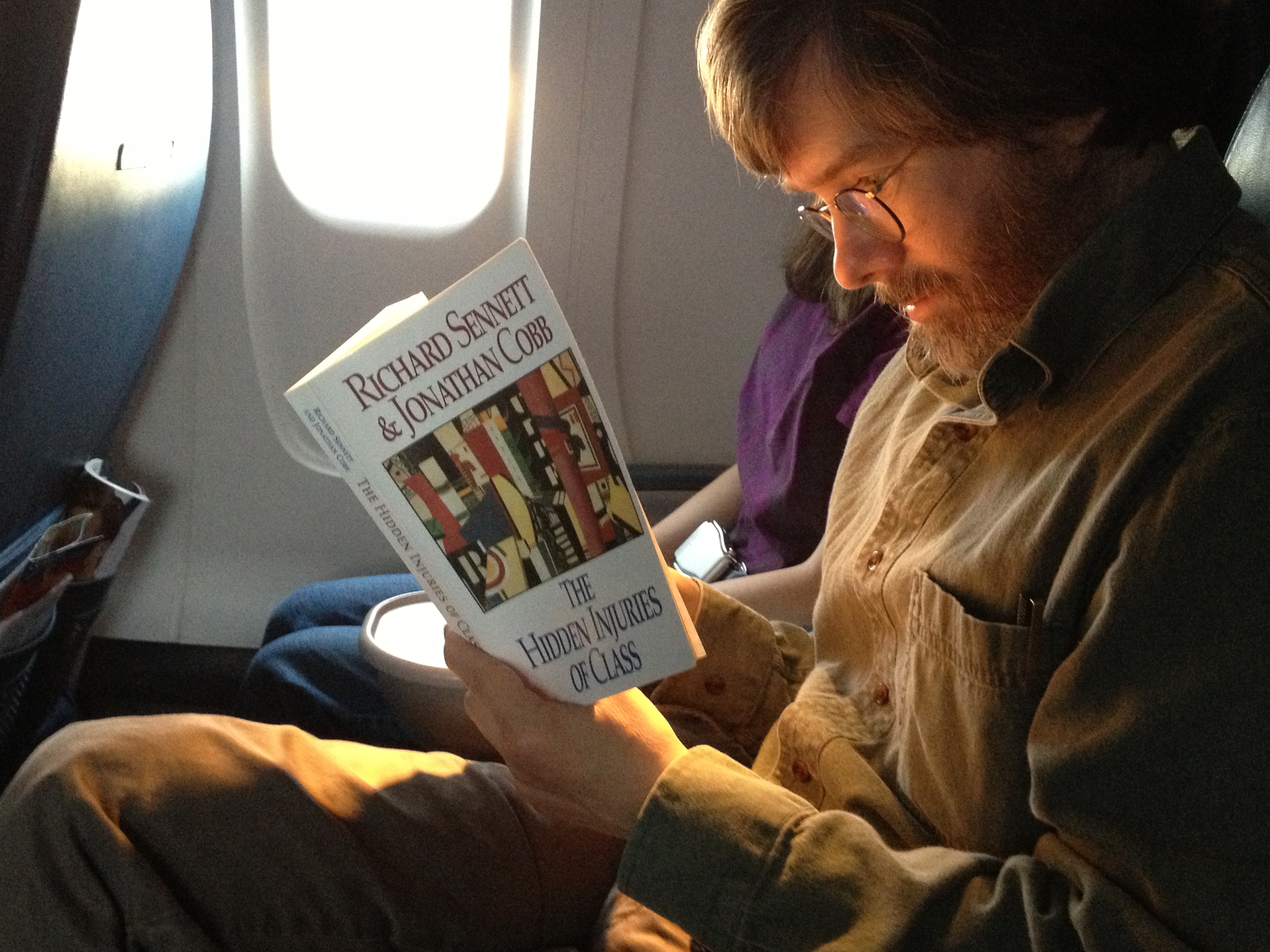
Reading in public

I can’t recall the last time a stranger struck up a conversation with me.  Especially about literature.  I was reading Toni Morrison’s Beloved (more anon) and she asked what it was about.  (You, dear reader, will need to wait a few more days if you don’t already know.)   I told her as best I could in a sentence or two, but I was in shock that someone I didn’t know was taking a moment out of her busy life to ask me about a book.  Her companion was ready to get going, so she left.  Shortly after that the event ended and I picked up my charge and headed home.  The next morning had that magic feeling.  I slept later than normal although it was a work day and when I went for my morning walk a startled bald eagle took off from the ground and flew less than twenty feet over my head.  Staying up late, talking about books, and a dawn-time walk in the morning.  Even everyday life can be magical, when it’s rare enough.


Status Check

It took many months, but one of my few Twitter followers was removed not for trying to take the nation by force, but because he’d died.  If I learn to tweet from beyond perhaps I’ll score a few more followers.  The situation, however, is one of the oddities of our socially mediated world.  I was trying to find some information on a potential author the other day and the only online presence I could locate was LinkedIn.  I clicked on the profile only to see the latest update was “Deceased.”  More than that, the Experience column indicated that “Deceased” continued from the date of passing up to the present.  I guess once you’re gone, your gone for good.  Social media, however, will perhaps find a way to keep you alive.

When I’m gone, I imagine WordPress will shut this blog down because nobody will be paying for it.  It’ll probably take a while for Facebook or Twitter to figure out I’m in the new category of “deceased.”  I do hope Academia.edu will keep my downloaded papers there for free. Real immortality, it seems to me, lies in the writing of books.  They too will eventually disappear, and who knows about the real longevity of social media.  It’s pretty difficult to believe Facebook wasn’t even around at the turn of the millennium.  I drive a car that’s older than Facebook.  I keep thinking of LinkedIn listing “Deceased” as a vocation.  Isn’t it really the ultimate vocation for all of us?  If you can’t be found online, do your really exist at all?

While experts debate social media, my job prevents me from using Facebook or Twitter during the day.  After work I’m anxious to get on to the other things in life that virtual friends and followers have to wait.  Early in the mornings I write and research.  I have mere minutes a day to look over social media.  I check Facebook only for alerts.  Life is short.  Is social media making it better?  It’s easy enough to be overlooked in real life, so why indulge in it virtually as well?  Of course, many see social media as a place to vent their spleen.  Why not try to inject some good into the virtual world instead?  There is hope for the dead, for they may still publish.  Their tweets may become somewhat less frequent.  Only the most callous, however, would drop them as friends for being dead.  Let’s just wait for Zuckerberg or Musk to notice.  It may take a few months.


Heat Pump

We’re preparing our home to welcome a new resident.  It’s not human.  Those of you who are home owners know how you move from crisis to crisis, paying to repair this just in time to start paying for that.  Our current issue is a dead dryer.  We knew it wasn’t long for this world when we moved in.  The previous owners, as most working class folk do, let things go until a machine forces  the issue by dying.  Being concerned for the environment, we like to replace appliances with more environmentally friendly ones, if we can.  They are, of course, much more expensive.  With the dryer it was also a space issue.  Snuggled together like young lovers in bed, the washer and dryer leave less than an inch clearance total from either wall.  The first issue we faced—modern dryers are bigger.

Small and energy efficient is what we wanted.  I learned about heat-pump dryers.  They don’t require a vent and they’ve been used for decades in Europe because of both space issues and environmental friendliness.  Here they cost more and you’ll have to wait because they’re in demand.  We decided to side with the environment.  Then there’s the problem of the old vent.  I gingerly walked out the old dryer and was amazed at the detritus I found.  Now, I’m an archaeologist at heart, so instead of sweeping it all in the trash, I sorted through it.  I found a dollar bill.  And 32 cents—this helps defray the cost of the new dryer.  Three guitar picks and a heap of cosmetics.  A box of rubber bands for braces.  There was ancient history in this pile!  The lighting’s bad in that corner so I put on a headlamp like a phylactery.  Let there be light.

I had to use most of my tools to tug the old vent out.  You have to stuff the hole with insulation and put some furring strips in place to hold the new drywall.  Cut out the patch to fit the hole and mud the whole thing up.  Why bother painting where nobody will see?  By the end of the weekend we were ready for our new resident.  It still wouldn’t be here for at least a couple of weeks.  The clothesline is strung in the backyard where the even better method of using nature’s dryer is free.  For those days without sun and on which we have time to do a load, we’ll be glad for our heat-pump dryer.  Particularly when the weather starts growing cold again and global warming enacts its chaos.  Hopefully we’ll have a stop-gap solution by then.


Soft Wired

A museum of discarded electronics.  I’ve been thinking that might be a good use for all the tech we’ve had to buy over the years that quickly becomes outmoded.  (Useless, that is.)  As I look over these devices I can recall just why they were purchased.  Mostly it was to solve a more immediate problem.  You perhaps overspend so that you can avoid disrupting the tech services you’ve learned you can’t live without.  Then new tech comes along and you need new hardware to do the same thing you’ve always done.  Soon you’ve got a museum’s worth of old tech.  I tried to get my mother on the internet by sending her an old computer that I bought with grant money back in my Nashotah House days.  When it was all set up, it was discovered that it was too old to connect to the modern internet.  I’ve lost track of how many computers are in the attic, but at least now there’s one less.  The thing these all have in common is that they require electricity.

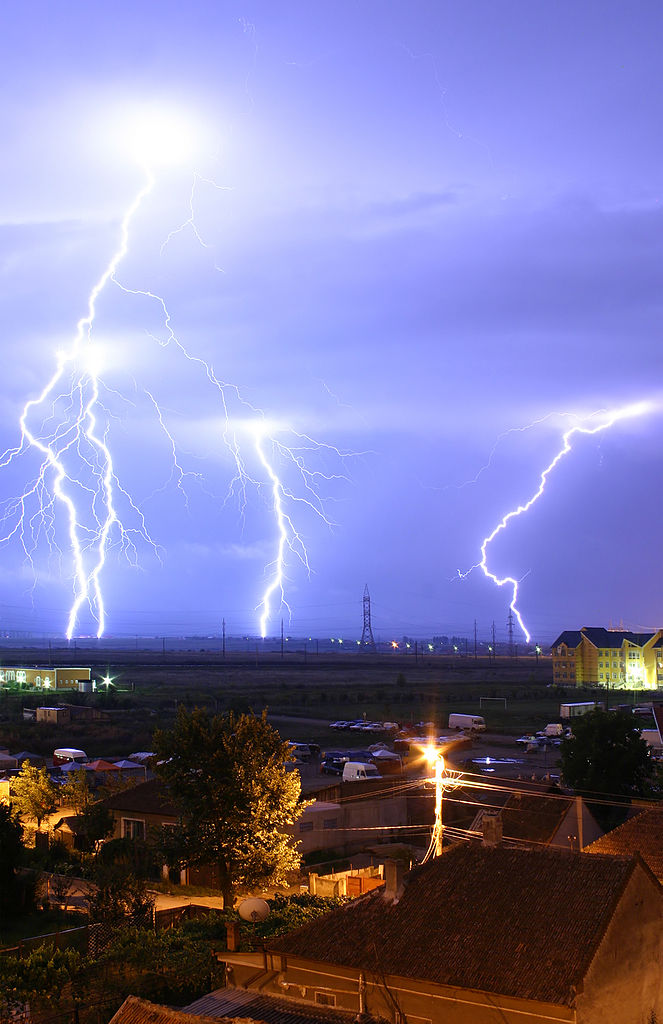
Image credit: Mircea Madau, public domain via Wikimedia Commons

A few weeks ago I wrote about our eclectic electric issues.  While our utilities company and electrician try to sort out who does what (it turns out that our house was never properly wired up from the mains), we’ve got a dilemma.  Since we all work from home and we all use computers, how are we going to work on a day when the electricity has to be off?  (Let’s hope it’s after this cold snap is over.)  We depend on electricity in this electronic world.  The solution may be to buy some new tech.  A battery-powered hot spot and fully charged laptops might be able to get us through an hour or two with no electricity.  We’ve become so dependent on the juice that the thought of being without it is scary.

The solution, of course, will quickly become outmoded as 6G and 7G, on to infinity, await in the wings.  They will all need electricity.  A house that was never properly hardwired can be a tricky thing.  Electricians and linemen have to have weekends too.  In a world where constant connectivity has eliminated snow days, such force majeure on a personal level holds no, well, force.  Aligning three employers who say it’s okay to step “out of the office” for a few hours at a time not of your own choosing will be impossible.  So we buy a new tech solution and hope it’s fully charged.  And when we’re fully wired up again the new device can eventually go in the museum of obscure electronics.


Body Doubles

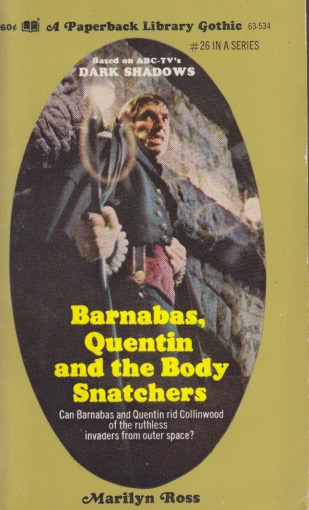
Learning about how Dark Shadows developed has freed me a bit, I think.  The stories between the original program, the novels, and the movies were never consistent.  I’d made that most fundamental of Fundamentalist errors—I’d assumed there was only one story and it went in only one way.  This helps explain, but not excuse, the Burton-Depp version of the story.  In any case, now I can read the novels with minimal baggage.  Understanding childhood is important if we survive long enough for it to haunt us.  Barnabas, Quentin and the Body Snatchers is a departure, even for Marilyn Ross.  Something critics sometimes overlook is just how literate the original, and subsequent, program was.  Ross occasionally attempts to cash in on that without feeling tied to the story line.

This plot relies on the 1956 movie, Invasion of the Body Snatchers.  Indeed, as a daily show Dark Shadows couldn’t really utilize a “monster of the week” format effectively (although it seems to have given the idea to those who later did).  The novels, however, could draw on such cultural tropes.  Both major releases of Body Snatchers (there was a remake after Dark Shadows ceased, in 1978) were considered terrifying by implication: how could you tell if someone took over the body of someone you know?  Who could you even trust, if such a phenomenon were possible?  Since such things aren’t common down here, it’s easier to suggest they come from outer space.  So it is that this installment has the weird juxtaposition of a vampire and werewolf having to outsmart aliens who take over human bodies. Kind of an early monsters vs. aliens scenario.

Again, not to seek too much depth where it doesn’t naturally exist, this scenario raises interesting questions.  How would terrestrial and extraterrestrial supernaturals interact?  I’m not sure W. E. D. Ross was up to this kind of gothic-sci-fi mash-up.  He was, after all, primarily a romance writer.  (Although, a recent trip to a library book sale and used bookstore in the same day led to the realization that paranormal romance is a burgeoning field.)  I recently read an article disputing the “willing suspension of belief” that is said to accompany such ventures.  As an adult I know that these novels are what must be considered cheesy, quick, and formulaic ephemera.  Still, I couldn’t help being pleased to see Barnabas and Quentin cooperating here.  If aliens ever do decide to invade, we’ll need all the help we can get.


Sexist Instructions

The thing about cars is there’s so much that can go wrong.  And when it does it’s costly to fix it.  Yet, even when working from home, we need them.  We have two, both quite old in car years.  One is approaching twenty.  We bought it new—the first time we’d ever been able to achieve such a feat.  This was one of the new Beetles and it has had never-ending electronic issues.  Warning lights come on that seem to be a malfunction of the warning lights—if you ever wanted an existential situation that’s one right there.  How do you know if there’s something wrong with your engine or is it just something wrong with the warning light?  A worrisome one came on just as winter was settling in and we didn’t need to drive it much before inspection time and we let it sit a little too long.

The battery, naturally, died.  We have an old, seldom used battery jump-starter, which, in the cold of the garage, also died.  We’ve been trying to find time on the weekend when both my wife and I are free (rare) so that I can drive it a ways to try to recharge the battery, but with someone home who can rescue me if I get stuck.  So it was we came to buy a new jump-starter.  These new ones are the size of a cell phone on steroids—much smaller than the old kind.  Ours came from China, I’m guessing, and the instructions are sexist.  They imply that women can use this because it’s easy.  Part of the description reads “It can be used more than 30 times, giving you peace of mind, no matter where you are, if the battery runs out, you can start it without looking for women who are not smart at night in an empty parking lot, such as a college campus or forget you.”  I don’t know about you, but this sounds like the writer had a past he’s trying to deal with.

I was indeed once left stranded because of a dead car battery.  It’s a story I’m saving for my autobiography, if I ever write one, but let me assure you all the people responsible for that abandonment were men.  Men with a car that wouldn’t start while I sat in the middle of nowhere in the dark.  (This was before cell phones.)  I didn’t want to buy a sexist device.  Both men and women have batteries die and I’m always a little scared to jump-start a car.  At least now we can get the Beetle rolling again and drive toward a future where women are rightfully seen as equal to men.  And I hope that instruction writer has found some help, perhaps with therapy.


Tax Season

And it came to pass in those days, that there went out a decree from the Internal Revenue Service that all the world should be taxed.  (And this taxing was first made when Penn was governor of Pennsylvania.) And all went to be taxed, every one into his own city. And Steve also went up from Galilee, out of the city of Nazareth, into Northampton, unto the city of David, which is called Bethlehem; (because he was of the county and district of Northampton:) To be taxed with Kay his beloved wife, being great with patience.  Well, not exactly biblical (with apologies to Luke), but this came to me upon having to go to Bethlehem to collect our tax documents from our accountant.  There’s something biblical about living in the Lehigh Valley.

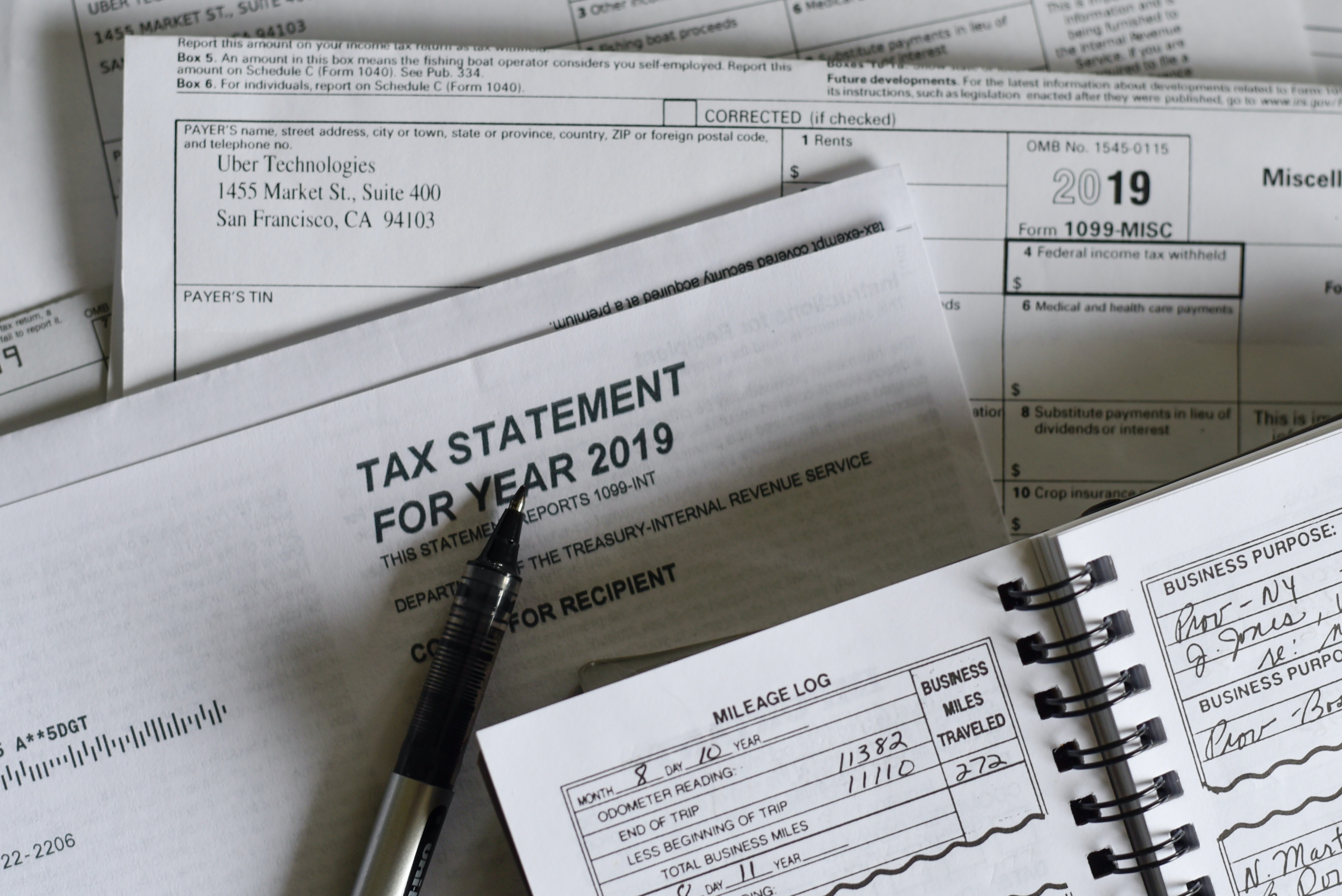
Photo by Olga DeLawrence on Unsplash

I don’t complain about having to pay taxes.  I only wish far less of the money went to pay congressional salaries.  And far less to the military.  Otherwise, I realize that in order for infrastructure to be up-kept, for the many services that make life possible for so many people, those of us who earn enough—even if not exactly flush—owe something to the system.  I’m saddened that the very wealthiest feel they’ve earned the privilege of not paying taxes. Modern-day Herods, I think, ready to kill babies in order to maintain personal power.  Still, those of us who pay participate in the most basic kind of charity.  So we make our annual trip to Bethlehem.

These days many people feel that if they don’t like other people they shouldn’t cooperate with them at all.  Even finding out that a certain Trump has been defrauding the very government which he purported to lead, and has been doing so for many years, doesn’t dissuade some of them.  I think our accountant, who looks gaunt and who doesn’t overcharge, could fairly claim a bit of back taxes that might be due.  Community is an endangered concept.  It’s a place where people support one another, and perhaps even care about others.  When I logon to Nextdoor.com I’m distressed to see the trolling and inappropriate emojis that show up.  The internet makes us all think we’re clever, ready with the snappy comeback.  Even to a recent story about a dead homeless man found in a park.  We need each other.  Society can’t move ahead if everyone keeps everything to themselves.  So it was we drove our rusty, four-cylinder donkey even unto Bethlehem.


Eclectic Electric

It all began with the internet going out.  Less than a month ago the modem was replaced, but the tech this time thought it could be the co-ax cable.  We went outside and he fed the cable through, but when he got to the box he noticed a problem.  “Your electrical drop isn’t attached to the house,” he said.  Sure enough, he was right.  “I can’t replace the rest of the cable until that’s fixed—it’s an electrocution risk.” So I called the electric company.  They said I’d need an electrician to secure the conduit to the house, but they’d send somebody out to look.  The tech must’ve been in the area because he arrived just after I spoke to our electrician.  “Your cable has never been permanently connected to the house,” he observed.  “It should be.  We can do that, but you’ve got to get an electrician to attach that conduit.”

The funny thing about this is actually two-fold.  One is that our home inspector didn’t notice that the electrical cable was not secured to the house (once the tech pointed it out to me it was perfectly obvious).  The second is that the former owner of the house claimed to be an electrician.  In fact, he runs a electrical contracting business.  The electrician we pay has said, on one of his many jobs here, “I don’t think he was an electrician.”  I, for one, believe the guy we pay.  So now we have to have him come out and secure the conduit.  Then call the electric company and have them permanently connect the cable (the house has only been here since 1890, so do a few weeks matter?).  Then we call our internet provider and have them replace the cable that’s been causing our internet issues.

We like our quirky old house.  It does seem, however, that many owners have neglected various aspects of it.  And that our home inspector was a somnambulist.  We’re just trying to get it up to code.  Well, actually, we’re just trying to get a secure internet connection because three livelihoods rely upon it.  Shoddy work has consequences, and caveat emptor reigns.  Few things are more basic to modern life than electricity.  Or even the internet, for that matter.  These things are fragile, it turns out, in ways difficult to imagine.  There’s a lesson hidden here, and it reaches back, I suspect, before the taming of electricity.

Image credit: Mircea Madau, public domain via Wikimedia Commons

Wordle

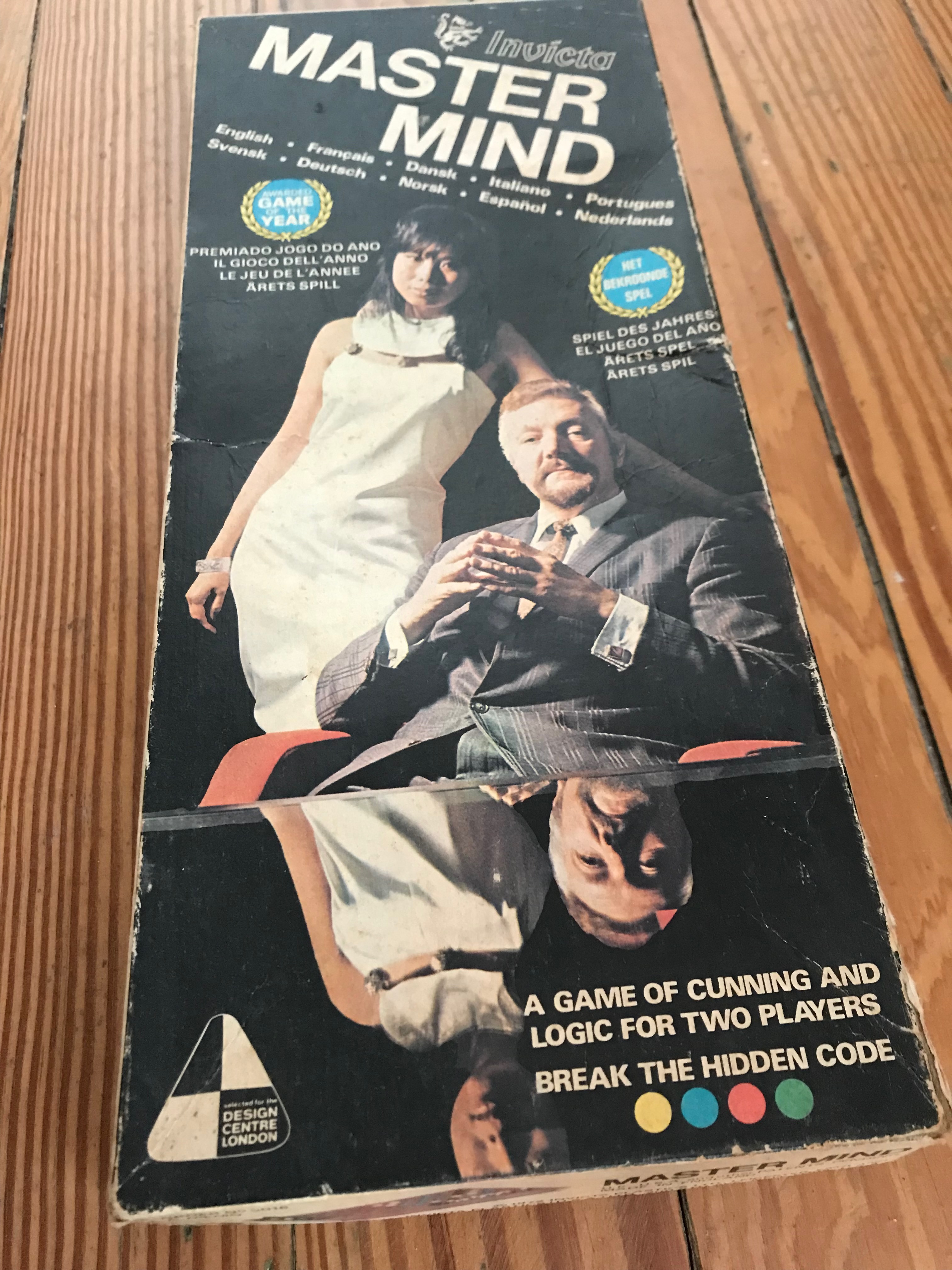
Each year in late capitalism seems to begin with a new fad.  This has been pronounced with the pandemic (which I almost wrote as “academic”) keeping people indoors.  Last year sea shanties were the rage with many of us finding ourselves humming something about a wellerman during the oddest times.  This year’s initial fad seems to be Wordle.  In case you’ve been living on the dark side of the moon, Wordle is an online game that is best described as Mastermind with five-letter words.  Mastermind, in case you were born after the Republican Party turned evil, is a game where you have six colored pegs that one person sets in a board a sequence of four.  The other player can’t see them, but has to try to replicate the colors in the right sequence.  At each guess the one who selected the sequence gives the guesser the following information: which pegs are the right color and which pegs were the right color in the right place.  (It occurs to me that explaining Mastermind could have been left out and I could’ve just described Wordle.  But what’s the fun in that?)

In any case the Wordle player has six chances to guess the right word based on the same clues: the right letter in the wrong place (yellow), or the right letter in the right place (green).  The hook is that you can only get one puzzle per day (otherwise many of us would be starving to death and out of work).  As a kid, I have to say, I could play Mastermind for hours.  I even brought our daughter up on it.  There’s something beguiling about trying to figure out what’s in somebody else’s mind.  There is a dark side to it, however.

I read a lot.  Lately I find that when I’m reading I’m secretly scanning for five-letter words that might be a good initial guess for Wordle.  The ideal word has no repeated letters and at least two vowels.  You need to narrow down the vowels first because every word has to have one of those six letters, since “y” functions as a vowel.  The other day I was thinking “s” has enough lubricant to function as a vowel too, but I digress.  Isn’t that the point of Wordle, though?  To digress?  There’s so much despair in the world with autocrats in power and the planet melting down that we need a little boost.  If only I could let myself read normally again, all might be well with the world.