Hunting

Every once in a while, I see a movie I should’ve seen a long while ago.  The Night of the Hunter is one such film.  Knowing little about it, I watched and was floored.  Not only could I have used it in Holy Horror (oh boy, could I have!), it uncovered a bit of cinema history for me.  Even just the words “love” and “hate” tattooed on Harry Powell’s knuckles have been referenced in so many places that I felt like I’d been missing a vital clue all along.  Since the movie’s now available on free streaming services, there’s no reason not to see it.  Although not generally considered horror, it is one of the genuinely scary movies of the period.  And it’s a strong blend of religion and horror, even if classified as a “thriller.”
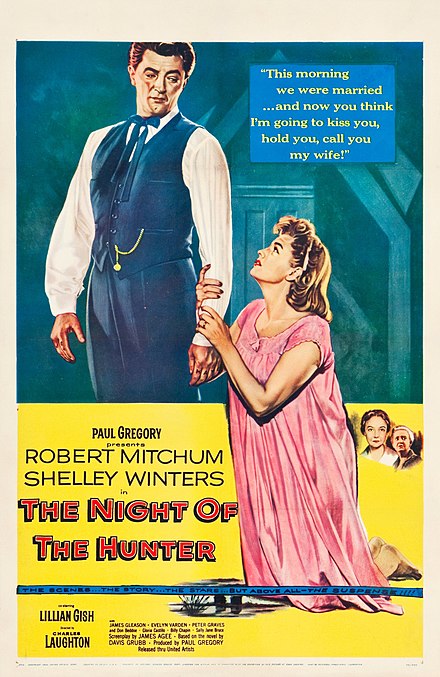
Taking inspiration from a true story, the “Bluebeard” character of Harry Powell is a serial killer.  Styling himself as “the preacher,” he murders widows for their money.  An avowed misogynist, he’s driven purely by greed and love of violence.  Yet everyone accepts him—except children—for what he says he is during the Depression era.  He gives sermons, sings hymns, and leads revivals and even his victims come to believe what he says about himself.  This is such a good commentary on the thoughtless acceptance of religion that it’s no wonder that it was a flop in the fifties.  Since then it has become considered one of the greatest movies of all time by many.  The seamless weaving of terror and religion hearkens once again to the wolf in sheep’s clothing.  Some lessons we never seem to learn.  Nobody likes to admit to having been fooled.

In character, the closest comparison I could make would be Cape Fear, which stars the same Robert Mitchum as villain.  That movie I saw in time to include in Holy Horror.  In this one, the only adult who seems capable of seeing through Powell’s lies is a religious widow who informally adopts stray kids during the Depression and raises them with the Bible.  She also keeps a shotgun handy, just in case.  The image of the preacher slowly approaching, singing “Leaning on the Everlasting Arms,” is the stuff of nightmares.  I suspect that one reason that seminaries developed in the first place is that the laity weren’t encouraged to trust self-proclaimed religious teachers.  Of course, the town turns on the preacher once they learn, because of the children, who he really is.  If, like me until today, you haven’t seen Night of the Hunter, I can recommend it.  Especially if you have an interest in how horror and religion cooperate so nicely.


Vlad Fest

I may or may not have read at least part of this book before.  When I found it at a used book sale somewhere, it looked familiar.  Having read it, I’m not sure if it was the same one as before.  There are certain parts that I would’ve thought a high schooler would have remembered.  I recognize the names of the authors, Raymond T. McNally and Radu Florescu.  You see, one of my senior term papers in high school was on vampires.  Unable to afford books, my research was done in the school library and this book is old enough to have been in the collection.  While the subtitle, A True History of Dracula and Vampire Legends, may seem to indicate a book primarily about vampires, In Search of Dracula is mainly about Vlad Tepes, or Vlad the Impaler.  I can’t imagine myself wading through all the Romanian history in high school.

You see, I remember reading a book on the history of vampires.  The strongest memory is of reading it in our church sanctuary.  Lest you get the wrong idea, I was very involved in our youth group.  We occasionally had chaperoned sleepovers at the church and I had already had a leadership role, serving on church committees and district and conference-level events.  Nobody had a problem with me sitting in the sanctuary.  On one of the sleepovers, I awoke early (as I have always tended to do), and I went to the sanctuary to read the book by the dawn’s early light streaming through the stained-glass window.  I have kept a look out for the book, and I thought this might have been it.

I’m pretty sure it wasn’t.  While this history does have a good summary of vampire customs and even movies, it takes a stout stomach to read the material about Vlad III’s reign.  Although he is a Romanian hero, he was a cruel man and his infamy was well established during his own lifetime.  I’m pretty sure that he would’ve been diagnosed with a mental disorder, had psychology existed then.  This book does trace his history and surveys various places associated with him.  One thing that might’ve been helpful would have been more maps.  The authors are clearly well versed in Transylvanian geography, but the average reader may not be able to find some of the many place names on the one map they include.  Otherwise, this is quite an informative book, mostly about Vlad, but with useful chapters on Bram Stoker and the vampire in the media up to the early seventies.


Locating Yourself

How do you come to where you spend your life?  It could be where you’re born.  I was born in Franklin, Pennsylvania.  Neither of my parents were.  On my mother’s side we had a tradition of wandering.  We eventually moved to Rouseville, a refinery town not too many miles from where I grew up initially, but very different in character.  I knew I wanted to get away.  I lived in Grove City next, only as a student.  For a short while I resided with some friends in the South Hills of Pittsburgh before moving to Boston to attend seminary.  Like many who go to Boston for school, I wanted to settle there.  I did so for about a year after graduation, making a living, such as it was, selling cameras.  My next move was precipitated by love.  I moved to Ann Arbor, Michigan to be with my fiancée, but I’d already been accepted to Edinburgh University, so an international move was imminent.

Roseville

Edinburgh, like Boston, is a spiderweb.  We would’ve stayed if we legally could have, but with a job market for academics already tanking, we headed back over the Atlantic.  My wife was a grad student at the University of Illinois, so we moved first to Tuscola (family there), then Savoy (on the outskirts of Champagne-Urbana).  Meanwhile I commuted to Delafield, Wisconsin, home of Nashotah House.  We eventually moved to Delafield and stayed until I was no longer wanted.  Our move to Oconomowoc was necessary to keep our daughter in the same school.  The possibility of full-time employment drew me to Somerville, New Jersey.  We would stay there until my daughter had a chance to graduate.  Depression convinced me that I’d run out the clock in that apartment, but a financial advisor suggested Pennsylvania, where I was born.  Thus we ended up in the Lehigh Valley.

I’ve liked every place I’ve lived.  If I had my druthers, however, I would’ve ended up teaching at a small college in Maine.  Several friends have moved to Maine as I’ve jealously watched.  The places we spend our lives, at least in my case, are determined by a measure of fate.  Nashotah House was the only job I was offered from Edinburgh.  Gorgias Press was the only job I was offered after the seminary.  Moving to my home state was volitional, of course.  As a couple we’d have been content in Massachusetts, Michigan, Wisconsin, or New Jersey.  Economics, of course, has a heavy hand in all of this.  I sometimes think that, if I could ever retire, moving to Franklin again would be a way of coming full circle.  But then, life is change and we end up, it seems, where we’re meant to be.  Perhaps Canada?


Not Fantasy

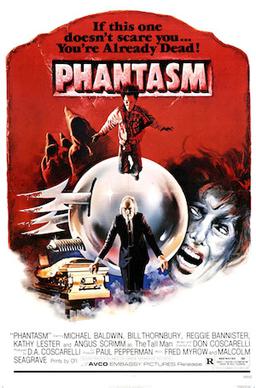
There’s a reason I watch horror.  One of the many things you can’t find online is how popular movies were before the internet days.  This is an issue for me because I only just now found out about Phantasm, which was released in 1979.  Granted, I lived in a small town, but I did know about The Amityville Horror—everyone knew about The Amityville Horror.  The films were released the same year, but Phantasm was an indie production and probably didn’t have reach into my local region.  Nobody talked about it at school and I only became conscious of it a few weeks ago.  I learned that it was quite a box office success, but the critics didn’t care much for it (and I can see why).  It was, however, rediscovered and has become a cult classic.  I can see that too.  The thing is, it is a bad movie.  I’m learning to appreciate such things.

Part of the reason the film bothered me is that I really dislike “but it was all a dream” endings.  Even though there’s a final suggestion that some of it “really happened,” or Michael is dreaming within a dream, such endings always make me shrug.  Horror, to really work, has to be in that liminal zone between believability while on screen and the deeper knowledge that it’s fiction.  Phantasm just had too many strikes against it to be believable.  The dwarves were lifted straight from Star Wars’ Jawa.  The Tall Man isn’t scary (this is from a current-millennium perspective, granted) and while you’re just trying to get into the horror mood (the music is appropriate) a flying ball of death, a sudden sci-fi element, is thrown in.  Of course, the plot takes a kind of sci-fi turn near the end.  It didn’t, however, do any heavy lifting.

I was surprised to learn that it became a franchise, no members of which I’d ever heard.  It is interesting that speculation exists that the creepypasta stalwart, the Slender Man, was developed from the Tall Man concept.  Given that I was seventeen when this movie came out it might be someone of my vintage—but from a different vineyard—would find Tall Man scary.  Of course, if I’d seen it when it was first out, and in a theater, I might’ve gotten some chills from it.  I could have included it in Holy Horror since there is some Bible in it, but it isn’t used to its full extent for a movie that mostly takes place in and around a funeral home.  There is some comfort in knowing that even if your work isn’t great, it can still be rediscovered if enough time passes.  And there’s good reason to watch it.


Firebrands

Although I’ve never lived there, I believe I have a fairly good idea of life in Ithaca, New York.  I’ve spent many, many days there over the past few years, often pondering how it is a city that would be an especially good fit for me, despite the fact I’m unhireable at Cornell and Ithaca College has never showed any interest.  It’s a liberal college town where even the street people appear to be educated.  The money of Ivy League students keeps it fresh and evolving.  And the shops in Ithaca Commons are set at eleven.  So it was that a headline in Publishers Weekly some months back caught my eye.  (I’m not behind only on movies, it seems.)  It showed a historical plaque for Firebrand Books, on the Commons.  The story stated that the plaque had to be placed on public land since the owner of the building where Firebrand started has a Christian prejudice against homosexuality.

I suppose I ought to take a step back and give a little history.  Firebrand was established as a feminist and lesbian publisher.  Its offices were on Ithaca Commons, but when the founder, Nancy K. Bereano, retired the press eventually found a buyer in Ann Arbor, Michigan.  (I have also lived in Ann Arbor, but for less than a year.  Likewise, it is the kind of place I felt instantly at home.)  Ithaca, meanwhile, wished to honor its contribution to literature and elected to put up a commemorative plaque.  The objection, however, was based on a particular reading of the Good Book.  (It must be stated that lesbianism is never explicitly forbidden in the Bible.)  To make a statement, the owner forced the plaque to the public domain.

We have a way of letting our prejudices become biblical.  I recently re-read 1 Corinthians—one of the infamous “clobber” texts for any number of people—and realized just how many of the words assumed to refer to “homosexuals” are words of uncertain Greek connotation.  King James, who seems to have preferred the company of gentlemen himself, was apparently not bothered by the text he had translated.  Of course, kings will be kings.  Our concern with sexual behavior is one of the hallmarks of our species.  We’re very concerned about how other people do it, even if it’s no business of ours.  And we consider it one of the highest moral concerns and a source of constant shame.  That was another thing that struck me while re-reading 1 Corinthians.  I wondered why Paul keeps coming back to it.  Maybe he was just being a firebrand.


Thinking about Vampires

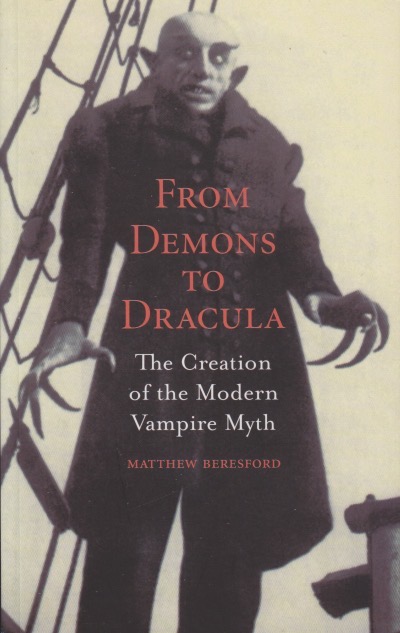
Any book on vampires has to be limited.  I first read Matthew Beresford’s From Demons to Dracula: The Creation of the Modern Vampire Myth back in 2009.  It has lots of information, but it was long enough ago that much of what I’d learned had grown fusty with age.  I began re-reading it as Halloween approached, and am glad I did.  The thing about vampires, however, is that you do have to compare sources.  Like many explorations of the vampire, Beresford’s notes that there are ancient analogues, but nothing precisely like we think of vampires today.  From my own perspective, I tend to think that our modern vampires, like our demons, come from movies.  Starting with F. W. Murnau’s Nosferatu, but more clearly from Tod Browning’s Dracula, our idea of what vampires are have been mediated by the silver screen.

This book ranges widely across time, region, and genre.  It discusses early reports that clearly considered vampires an actual threat, as well as movies made purely for entertainment.  One thing that I noticed this time around is that the author, being British, seems not to have noticed the tremendous influence Dark Shadows had on the popularity of vampires prior to Anne Rice’s Interview with the Vampire.  I suspect that soap operas were not widely known internationally, and even if they were, they were likely not taken too seriously.  Dark Shadows was different, however, and it made vampires chic in a way they simply weren’t before the early seventies.  At least in the United States, Barnabas Collins helped define the vampire.

Beresford makes the point that there is no single defining characteristic that applies to all vampires.  Early European vampires didn’t necessarily drink blood—they were revenants (they’d returned from the dead) but they weren’t always after blood.  In the nineteenth century bloodlust became the defining feature of vampires.  There are historical points on which to quibble with the argument here, but overall this book is a good overview of how ideas like vampires have been around for quite some time.  As someone who specialized in ancient literature for a good part of my life, I would not have called the various ancient analogues pointed out “vampires.”  Beresford is making the case that they lay the groundwork for what later became vampires.  And Vlad Tepes of Wallachia played his part as well.  As did the ancient Greeks.  It seems to me there’s more rich ground to explore here and this book provides a very good starting place.


Vampire or Not?

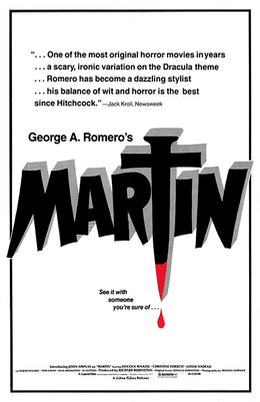
I’d heard that Martin was a depressing movie but I felt I should watch a Romero film that wasn’t about zombies.  I’d read bits and snatches of what happens, but I didn’t know the storyline in total.  Now that I’ve seen it, I’m still not sure what to make of it.  Martin is a young man who believes himself to be a vampire.  He does drink blood, murdering his victims, but there are no fangs, no “magic stuff” as Martin himself calls it.  It seems pretty clear that he’s mentally unbalanced, but he’s brought into his older cousin’s house in Braddock, Pennsylvania.  Cuda, his cousin, believes him to be a vampire, calling him “Nosferatu.”  He has protected his house with garlic and crucifixes, but Martin demonstrates that such things (magic stuff) doesn’t work.  

Daylight and eating regular food don’t bother him.  His cousin gives him a job at the grocery store he runs, while constantly warning Martin about looking for victims in Braddock.  Shy around women, he only has sex with his victims, after he has drugged them.  (This is a pretty violent movie, and the tone is downbeat throughout.)  Since he has no friends, he calls into a radio talk show to discuss the problems of being a vampire, and people love listening to him.  Meanwhile, Cuda arranges for an exorcism on Martin, which doesn’t work.  There are black-and-white sequences that aren’t really explained—either as fantasies or as past memories for a real vampire.  After his cousin becomes too suspicious, he stakes Martin to death and buries him in his back yard.

There are many unanswered questions about this movie.  If Martin is a vampire just about everything in traditions about them is wrong, apart from needing to drink human blood.  When Martin begins an affair with a troubled housewife, his bloodlust lessens, but he still gets “shaky” and has to find victims.  For those of us who tend to find ambiguity both beguiling and confusing, this is a vexing movie.  It makes you wonder what a vampire really is, and, as with most of Romero’s work, there’s a fair bit of social commentary—intentional or not.  Life itself has its fair share, perhaps more than its fair share, of ambiguity.  The only real certainty that Martin gives is that his victims die and he himself dies in the end.  Is his cousin correct?  Is Martin himself correct?  He may be mentally ill, but society is too.  And the working-class people of Braddock should know who the real vampires are.


Consciousness Conscience

Not so long ago—remember, I read old books—living to 60 was considered a full life.  I’ve passed that and while I’m in no hurry to shuffle off this mortal coil, I often think of how improved medical practice has prolonged many lives.  This is a good thing, but it does make death a more difficult fact to deal with.  If there is any good that came from my Fundamentalist upbringing, it was that it taught me early on to think about death with some frequency.  I’m not a particularly morbid person, but since we all have to face this, avoidance seems to lead to grief, shock, and acute mental pain.  I tend to consider watching horror movies a spiritual practice.  Little reminders, in case I forget to consider my own mortality today.

Our faith in science is a little bit misplaced.  Sure, it helps enormous numbers of people live longer, healthier lives.  But it may also detract from the necessity of attending to our spiritual lives.  I don’t care if you call it consciousness, your soul, psyche, or mind, but we have a life we’re accountable to, and it’s not all physical.  Since consciousness feels neutral enough, let’s go with that.  We don’t know what happens to our consciousness after death.  There are plenty of theories and ideas about it, but no certain knowledge.  There may be faith, and there may even be some evidence, but it is always disputed.  It does seem to me that facing death squarely on may help take care of at least some of the anxiety.  Fear of the unknown is probably the greatest fear our species possesses, so pondering it may take the edge off a bit.

Some people claim to remember past lives.  Sometimes I wonder if they might be tapping into the great unknown: consciousness.  Perhaps consciousness survives without a physical body.  Perhaps it’s large—expansive—and encompasses far more than we can imagine.  Maybe some people can access part of that consciousness that includes the past lives of others.  We have no way of knowing, but it seems worth thinking about on this All Souls Day.  Of course, I have the advantage of having lived what used to be considered a full life.  In it I have set aside at least a little time each day to consider what happens after this.  Do I have a definitive answer?  No.  I do have faith and I do have beliefs.  And I’m always reflective on All Souls Day.

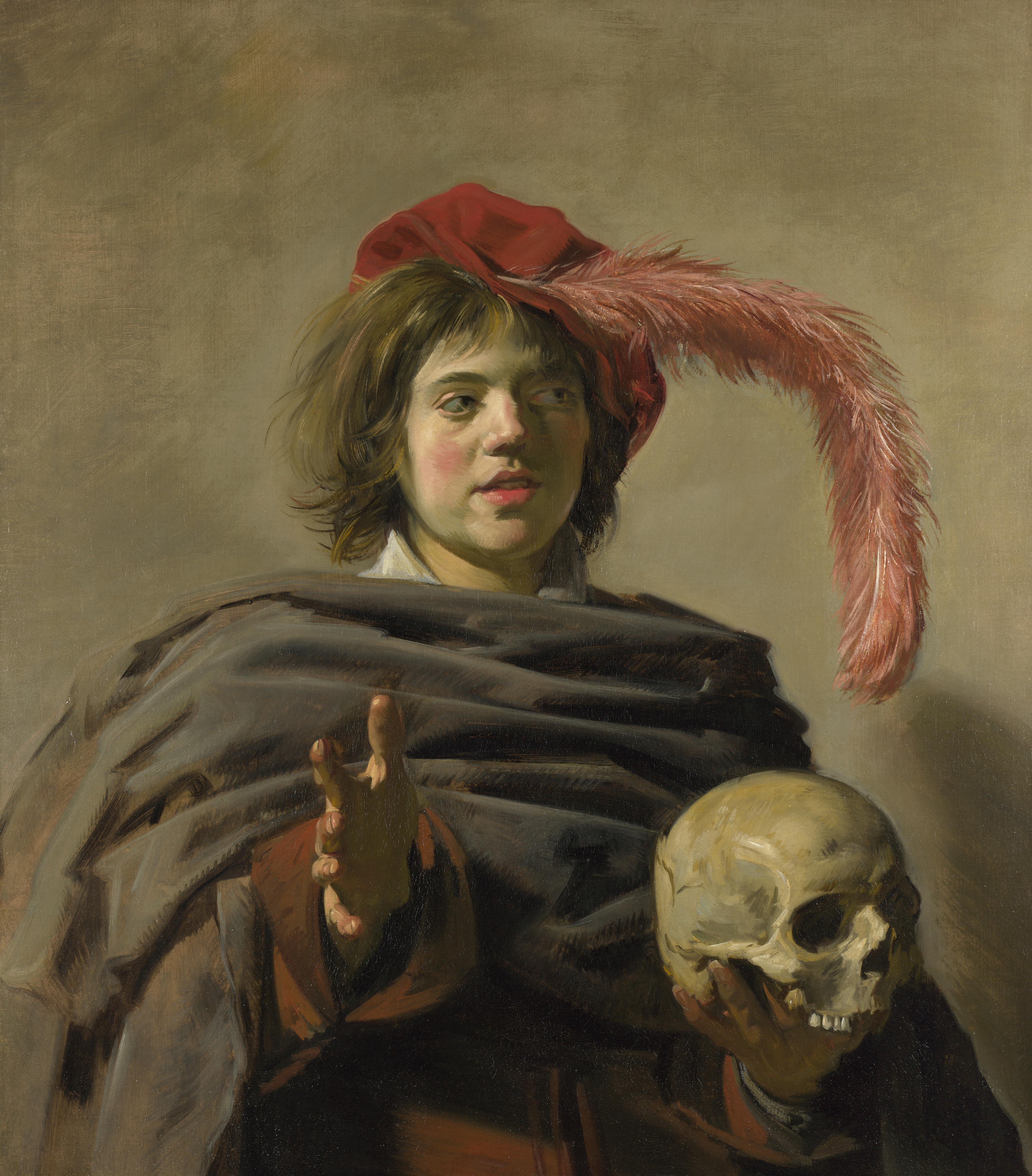
Frans Hals, Young Man holding a Skull (Vanitas), public domain via Wikimedia Commons


Pan Pandering

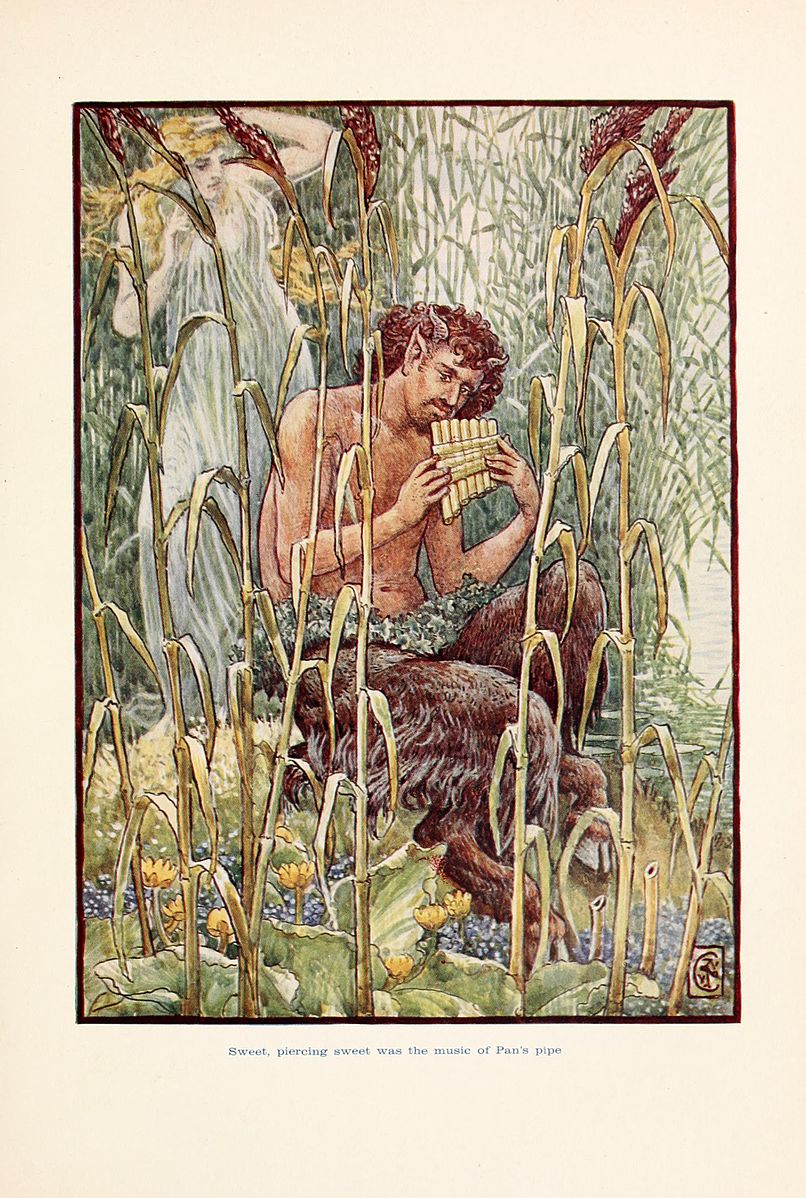
The Greek god Pan has had a rough go of it.  And I don’t mean that his name is a homophone for an essential kitchen item in English.  No, Pan was mistreated by early Christians, made evil, and then good, before finally being largely forgotten.  We’ll start with the bad and move to the good.  As I discuss in one of my publications, Pan was considered evil by medieval Christians for a few reasons, apart from being a “foreign god.”  First, he was associated with nature.  Early Christians weren’t naturalists.  They were looking to escape the world (a trait that continues to be manipulated by politicians even today).  Not only that, but Pan had goat legs and horns.  While horns could be used to represent any deity, including Yahweh, the combination with goat legs suggested Pan might be demonic.

Image credit: Walter Crane, public domain via Wikimedia Commons

Nobody knew what demons looked like.  They are incorporeal, after all.  As I point out in Nightmares with the Bible, the fact that the rarely used Hebrew word for demons is roughly translated to “hairy ones” added to Pan’s sins.  This was a common Hebrew phrase for goats, and over the course of many centuries, when people had the irresistible urge to draw the invisible, they gave Satan the Pan treatment.  Goat lower half and horns on his head.  In many esoteric groups the goat, i.e., Pan, became a symbol of demons.  All of this has a rich and detailed history and it literally demonized Pan.  Yes, he was all for free love, but he was a musician, after all.  Then something interesting happened.  

When the King James Version of the Bible was first printed, the biblical books each began with an illuminated letter.  The book of Psalms began with an L.  This letter was inscribed with an image of Pan.  What the devil was he doing in the Good Book?  Well, by 1611 Pan was considered a type (or foreshadowing, if you will) of the good shepherd.  And we all know who the Good Shepherd is, right?  Not only that but his name, “Pan,” translates to “all” in English.  Since Jesus is “all” to Christians, it was appropriate that he be symbolized by Pan.  This ancient force of nature had gone from being the Devil to representing God.  Indeed, he could, at the same time, be symbolic of both.  Now this is quite an accomplishment for any entity, let alone a rustic god who was never an Olympian.  Pan isn’t much discussed in Christianity today, but he had a fascinating place in its view toward goats, both bad and good.


This Is Halloween

He was probably trying to impress his wife with his wit.  I was in a department store—a rarity for me.  I was wearing a mask, because, well, Covid.  As this guy, older than me, walked by he said “Halloween’s over.  Take off your mask.”  It bothers me how politicized healthcare has become, but what bothered me more was that it was only October 20.  It wouldn’t even be Halloween for another 11 days.  What had happened to make someone think Halloween was over so early?  Yes, stores had switched over to Christmas stuff by then.  In fact, I wandered into another store where Christmas carols were playing.  Capitalism seems to have wrenched the calendar out of order.  We’re tired of All Hallows Eve before it starts.  In fact, just the day before we’d gone out to a pumpkin patch to get our goods and the carved pumpkins are now showing their age.

If that little exchange in the store had been in a movie, it would’ve been a cue for me to transform into some big, scary monster.  Of course, Halloween is what it is today because of relentless marketing.  And a handful of nostalgia from people my age with fond childhood memories of the day.  For some of us, however, it is a meaningful holiday in its own right.  It makes us feel good, even after we’ve grown out of our taste for candy.  It is significant.  Christmas is a bit different, I suppose, in that there is nothing bigger following, not until next Halloween.  Besides, Christmas is supposed to go for twelve days.  The fact that Halloween is a work day makes it all the more remarkable.  We have to work all of this out while still punching the clock.

I had really hoped to be able to get to Sleepy Hollow this Halloween.  Sleepy Hollow as American Myth tries to make the case of how that story and Halloween came of age together.  It is the iconic Halloween story, what with ghosts and pumpkins and all.  And the month of October is spent with scary movies for many people.  This month I’ve posted about horror movies every other day, pretty much, trying to connect with my audience.  If that is my audience.  I tend to think of Halloween as a community.  Those of us who, for whatever reason, think of this as our favorite time of year.  A time when perhaps we don’t feel so stigmatized for liking what we do.  A time that we’re not hoping will shortly end so we can get onto the next thing.  It may have been meant as a joke, but I wasn’t laughing.  Happy Halloween!


Premature

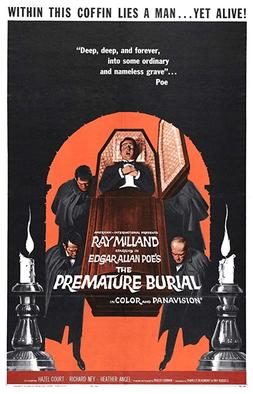
The last, for me (but actually the third), Roger Corman Poe Cycle film is The Premature Burial.  Released the same year as Tales of Terror, it departs from the other Poe films in not starring Vincent Price.  Indeed, this is because it was originally not an American International film, but was later brought into the fold.  This particular story by Poe doesn’t have the superstructure of this film at all.  Indeed, Poe’s tale is spare, beginning with reported events of premature burial and ending with a first-person fictional account.  The movie does have a quote or two from the story, as well as the elaborate preparations that the narrator, in the movie the protagonist Guy Carrell, undertakes to be able to escape his mausoleum.  In the movie Carrell has to be an aristocrat, so as to afford such a fancy contrivance.

Although the screenplay was written by Charles Beaumont, a frequent Twilight Zone contributor, it lacks pacing and contains some improbabilities.  The theme of grave-robbery is also prominent and doesn’t fit well with what actually happens in the plot.  Since the movie is over sixty years old it’s safe to say that it involves a twist ending.  The marriage—missing in Poe—of Emily Gault to Guy is a ruse to get the family fortune by murdering Guy by fright.  Emily exploits his fears of premature burial (his father suffered catalepsy)  to lead to his own premature burial.  The grave-robbers, however, visit Guy that night, not realizing that he was only catatonic.  Guy then takes his revenge, only to be shot by his sister when he attempts to kill an innocent family friend.

Fitting for the Victorian era, Poe used the theme of premature burial in a number of his stories.  “The Premature Burial” is the tale that contains Poe’s famous quote, “The boundaries which divide Life from Death, are at best shadowy and vague.”  This remains true even going on two centuries later.  Accounts of Near Death Experiences (NDEs) complicate our simple binary of life and death.  The movie is, of course, coded as horror and is part of the suggestive string of interpretations that cast Poe as a “horror writer.”  Corman had been growing a reputation as a director of horror (but he, like Poe, worked in other genres) and it was this recasting of Poe into what was developing into a mature cinematic genre that partially solidified the writer’s reputation.  Premature Burial isn’t the best of the series, but I do feel as though I’ve accomplished something by finally having watched all of them.  Or have I?


Still October

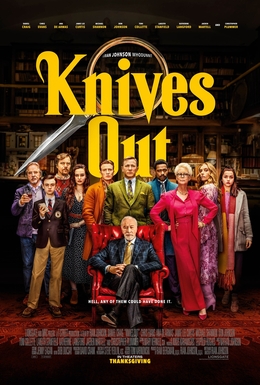
Before October was over, I wanted to watch Knives Out.  Not horror, it’s more of a murder mystery but it’s funny and it makes just about every list of movies to watch in October.  I’m pretty sure that list compilers don’t really understand what I mean by typing in “October movies.”  Or maybe the kinds of movies I’m thinking of simply don’t exist.  More on that later.  Knives Out is the story of the death of a famous writer.  (Given the fantastic house in which he lives, a very famous writer—the majority of us only ever modestly supplement our day job incomes with book sales.)  But this fantasy of being paid enormous sums for what is really hard work is, well, a fantasy.  This writer, who has/had three children, altered his will before his 85th birthday celebration and on this hangs the tale.

The two surviving children, and spouse of the third, have been cut out of the will.  Their means of support—they all relied on their father’s largess—is gone and so when the writer dies on the night of his birthday, by suicide, some questions arise.  There are many twists in the story, and I won’t give away the ending, but the main question that the private investigator asks is why he was hired in the first place.  All the forensic evidence confirms this having been a suicide, and although the adult children’s stories disagree in any particulars, the events surrounding the death seem clear enough.  At the center of all of this is the writer’s private nurse.  She’s an immigrant and she stays out of family squabbles.

The protests over the will bring out the true character of the children, or, in some cases, their spouses.  And although the viewer is clued in early as to what actually happened, like a mystery novel, a vital clue is left out that ties the whole together.  It’s quite well done.  It’s an October movie like Clue is an October movie, or perhaps Murder by Death.  There are some nice shots of trees in color, but it lacks the haunting, melancholy feel that I associate with October films.  Will I watch it again?  I should think so.  Movies like this bear re-watching, if for no other reason than to try to spot “donut holes” (the private detective’s phrase) in the plot.  It’s also a reflection on how money can corrupt.  But also how desperate people can become when their support system is withdrawn.  And that’s truly scary.  Knives Out would work on any dark and stormy night, but it’s not horror.


International Horror

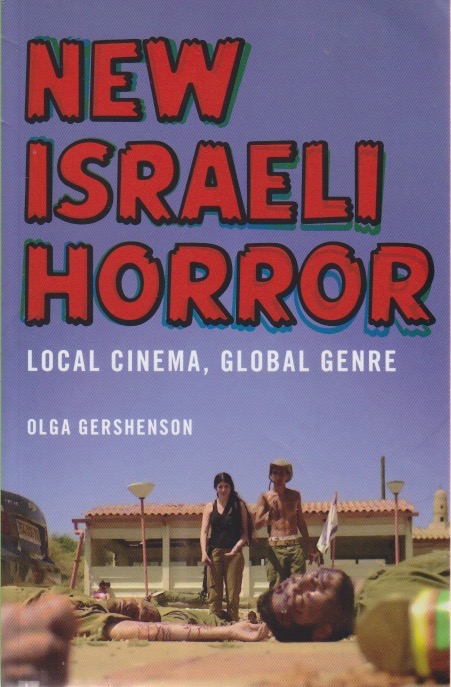
As someone who has written a couple pieces on Jewish horror for Horror Homeroom, I have developed a natural interest in international horror.  I was one of those who scrambled hard to find The Golem (2018) when it came out, but was able to see it only in 2020.  When I learned about New Israeli Horror, by Olga Gershenson, I knew I had to read it.  The subtitle, Local Cinema, Global Genre, pretty much captures how she approaches the subject.  It also helped me understand a bit better the way filmmaking works.  I once, rather naively, asked a film scholar how many movies had been made.  He responded, “It’s impossible to know.”  Even experts in cinema can’t see every movie, and those of us who watch horror can’t see every horror film.  (I wouldn’t want to.)  I hadn’t realized, however, until reading this book, that in places like Israel it often comes down to state funding.

I’ve written quite a lot about Euro-horror over the past few years.  Often cooperative ventures, these are horror films that aren’t part of the Hollywood system, and they are frequently quite good.  Those of us who enjoy movies may not often think of who pays for them.  It’s kind of like book publishing—someone’s got to pay for all this, and hopes to make their money back in the process.  In Israel many movies are funded by official agencies.  And such agencies tend not to like horror.  New Israeli horror, by Gershenson’s reckoning, began only about 2010.  One of the reasons I’ve turned to writing about horror is that its history isn’t so long as, say, ancient West Asian studies, which reaches back thousands of years.  Reading about something not even two decades old, but still history, is fun.

I learned a tremendous amount from this book.  Of the films discussed I’ve only seen one, the aforementioned Golem.  Before writing Holy Horror, I paid no attention to where films were produced.  I’d seen some international movies, sometimes obvious because of subtitles, but my usual fare is homegrown.  I gather that I’ve been missing a lot by not seeing more Israeli horror.  When you add Jewish horror (Jewish-themed horror, in my way of seeing things) to the mix, there’s a new angle to take on religion and horror.  Many of the films Gershenson reads are about Israel’s army and critique of the militarism that has become part of life in Israel.  I confess to not keeping up on politics because to me it tends to be scarier than horror.  But I can see, from this book, that I’ve been missing some interesting cinema.


Betelgeuse

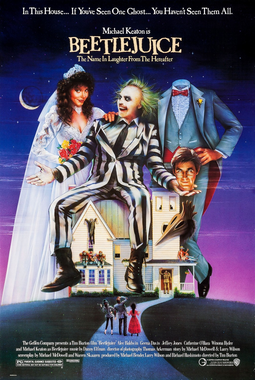
So let me see… from 1988 to 1992, what was happening?  Hmm.  I was getting married after moving halfway across the country in a rented car, moving to Edinburgh with no money, and working on a doctorate.  I guess I was pretty busy.  I missed Beetlejuice in 1988 and confused it in my head with Death Becomes Her (1992), which I may or may not have seen.  Some time ago I felt that I really should watch the former, not because of the sequel.  I may have seen bits of it over the years, but I wasn’t impressed with what I remembered.  Maybe part of the draw—the movie did quite well when released—is how different it was then from many things that came after.  Now that I’ve finally watched it, I can see it has some charms but I felt rather like the critics who noted the Betelgeuse subplot seems dissociated from the rest of the movie.

Michael Keaton as Beetlejuice is fun to watch, no doubt.  He doesn’t have much screen time, though.  His backstory, which seems important to explaining why he is how he is, feels shortchanged.  It also doesn’t really explain why the other characters dislike him so much.  When he’s released to save the Maitlands, he does, yet all they want to do is banish him.  I know better than to look for a coherent set of character motivations in such a movie, but for all the fronting of Beetlejuice, the story is really the Maitlands coming to grips with being dead and having other people move into their house.  The Others, while straightforward horror, handles this dynamic a bit better.  Of course, Beetlejuice is a Tim Burton movie, and that comes with a certain inherent quirkiness.

I had a mixed reaction, it’s fair to say.  Part of the problem may be that I’ve seen some of Burton’s better work, which came after Beetlejuice, before seeing the movie.  And other movies have done quite well in the weird category (Parasite, Everything Everywhere All at Once, Poor Things), making Beetlejuice feel its age.  Or maybe it’s all the build-up to Betelgeuse and then giving him so little time for his antics.  Perhaps it was the title of the film, or its confusion in my brain with another dark fantasy comedy, but it just didn’t press all my buttons.  Seeing it in the context of its Zeitgeist may have helped, but I was rather busy then and that part hasn’t really changed since.


Won’t Tell

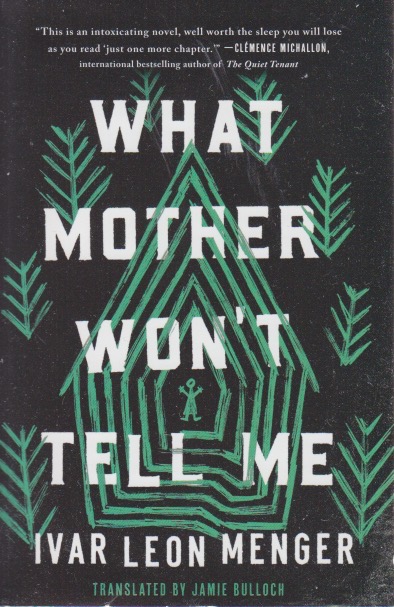
This one is pretty darn close to too tense to read before bed.  I don’t remember how I found out about Ivar Leon Menger’s What Mother Won’t Tell Me.  That’s usually a pretty good sign that I found it in a bookstore.  Those are still places to linger while trying to find something a bit different.  This one is a page turner, but also one that I’m not quite sure how to classify.  It may be horror but the “monsters” are all humans.  I almost don’t want to describe the plot because it is so exquisitely suspenseful.  When I’m reading to get sleepy, I often find myself trying to grasp pieces of a story that are floating away like dandelion fluff, unable to put them back together.  Then I know it’s time to close my eyes and re-read a paragraph or two tomorrow.  That never happened with this one.

I think I can say this much without giving it away: Juno lives on an isolated island in a lake with her parents and younger brother.  The parents warn them of the murderous strangers who are seeking them—the father was a states’ witness against a powerful criminal family—so the children must never be seen on the island.  If anyone happens to come, they must hide and remain quiet until they leave.  They have to practice drills in case this ever happens.  It gets pretty creepy, from nearly the first page.  I would also advise against reading the back cover copy, since it will give some of it away.  I tend not to read the copy until after I read a book—you just never know what they might let slip.

This is a story about perseverance and discovery.  Discovery that is full of tension.  It’s a reminder of how precarious childhood is.  There are plenty of twists in the story and chapters generally end with information that creates a tension that the next chapter will only partially resolve.  The end result is a story that pulls you along and is pretty chilling.  I’m not sure if I’d call this horror or not.  If there’s a good case for a thriller being a separate genre, this could be useful as evidence.  Even if it’s not horror, it is likely to appeal to many who read in that genre.  There’s nothing speculative about it.  Perhaps that’s why the story scares in the way that it does—this could happen.  What happens?  Like mother, I won’t tell you either.