The Evil Living

Returning home from my campus visits, I needed some brainless relaxation. Since we don’t have any television service at home, this means watching movies. I’d heard quite a bit about The Evil Dead over the years—a movie that was scary back in the 80’s when it appeared. Improvements in special effects and the intensity of engineered sound are capable of drawing a person into an alternate reality for a couple of hours these days, and the endless reiteration of earlier movie effects somehow robs the early thrillers of their impact. The Evil Dead, however, capitalizes on confusion about the menace and teeters on the brink of morality for the entire 85 minutes. Naturally, when looking for a source of fear, it seeks a religious agent. The source of the evil in the woods is narrated in a voice-over of the presumably dead scientist who has discovered Sumerian texts that release demons in the forest (mostly in the form of falling trees).

Sumerian is always a safe bet if you want a language that your viewers will not be able to identify. The earliest known recorded language, Sumerian is still difficult even for experts, and it conveys all the strangeness of long ago. We do know that the Sumerians recorded myths that involve what we might call “demons” today, but the possession of humans was a much later development—probably a pre-scientific way of explaining epilepsy. As our five students seek a weekend getaway in the woods, they become possessed and face the moral question of just when a person ceases to be human. At what stage does someone have the right to kill someone else? Perhaps unintentionally, the movie gives us the answer, “Never.” This kind of morality has a place in America, one of the very few “first world” nations in which the death penalty is still legal. Often promoted by those dead-set against abortion. Where do we draw the line saying a person has crossed over into the unforgivable other?

The Evil Dead has become a cult classic over the years. Its relatively low budget of less than half-a-million dollars brought an astonishing box office return on the investment. The gore, tame by more modern standards, does not mask that what is really at issue here: the question of right versus wrong. What is truly evil? Sumerians aside, what possesses people and drives them to destroy one another? The Evil Dead, like many horror films, reaches for a religious answer. As the supernatural fog begins to clear, however, we might not like what we see in the clear light of day. Religion may be an excuse, but the assaults upon one another are what Nietzsche famously called “human, all too human.” The sooner we clear our vision and pay attention to what is actually happening, the sooner we can combat the horror.
Tebow or Not Tebow?

It is time to bow to the inevitable. I am not now, nor have I ever been, a sports fan. Every web page I open, however, seems to feature Tim Tebow, as if the media had never seen an evangelical before. Where have people been? What is even more amazing is that this athletic kid has invented an entirely new human gesture, “the Tebow.” Incredible what young folks can accomplish these days. And as Saturday Night Live has showed us, Jesus really isn’t that much of a football fan after all.

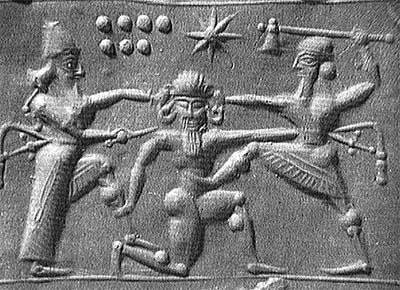
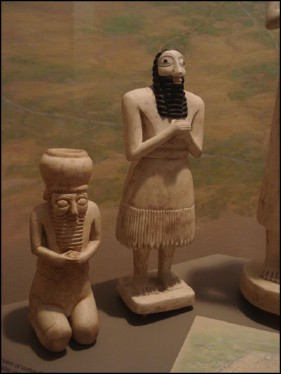
Ashamed at my naiveté, I decided to research the history of tebowing. What I found shocked and amazed me. Like so many modern day marvels, Tebowing seems to have been invented by those prescient Sumerians. Even before humans perfected the Tebow, semi-divine characters showed them how. This cylinder-seal depicts the monster Humbaba illustrating the correct posture to Gilgamesh and Enkidu. They do not, apparently, take kindly to his correction.

In the example below we see a rare double-kneed Tebow performed by an Asian football god while a hopelessly underchurched Joe Paterno looks on, hopelessly standing.

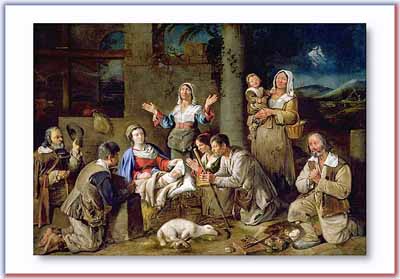
Fast forward a few centuries to a seasonal scene and we find shepherds tebowing to some baby. It is a fair guess that they suppose the baby to be a football incarnate.

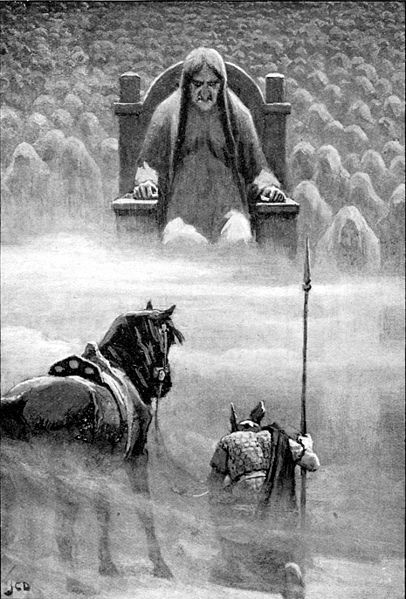
Lest we think the Tebow has been coopted by the Christian crowd, we must remember that no religion has a copyright on humility. In this scene from Norse mythology, a clearly pagan Hermod tebows before the goddess Hela. She does not look amused.

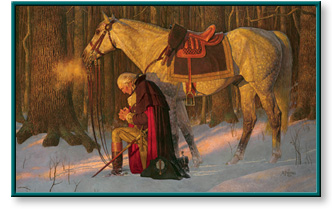
Americans, who after all claim to have invented the Tebow, can trace the gesture back to our founding father himself. In this famous painting of George Washington at Valley Forge, just after the crucial touchdown, the great man can be seen tebowing in the snow.

The snow is a great segue to the Cold War. Here, in a government photo, we see Soviet naval infantry tebowing as they contemplate the big game. They are not now, nor have they ever been, Broncos.

Now, none of this resembles the education I received during my three degrees in religious studies. No matter. ‘Tis the child becomes the man, as they say. And since a little child shall lead them, we can all learn to tebow as if there were no tomorrow. If the actual Tebow is as bright as the sports-scholarship students I taught at Oshkosh, Rutgers, and Montclair, the education of the future will include a lot lower academic expectations and, I suspect, lots and lots of Levis with holes in the knees.


Paradise Re-Lost

It is through the astute eye of my colleague Deane Galbraith that I came to know of my most recent reading project, Paradise Lust: Searching for the Garden of Eden by Brook Wilensky-Lanford. BWL (since the author’s name is a mouthful and since it took me four hours to get home tonight (at a distance of less than 30 miles) I’ll abbreviate her title. Being a fellow New Jerseyan, I’m sure BWL will understand) surveys various attempts that have been made over the past century-and-change to try to locate the Garden of Eden. Spurred on by the discovery that her own educated, rational great-uncle had also wondered about the mythical location of our mythical ancestors, she sketches various attempts to find Eden. Tracing a course that often crosses paths with my own academic background, BWL notes the pervasive—one might say undying—belief that once upon a time in a land far away there was a garden paradise.

Quite apart from the obviously folkloristic, and Mesopotamian, origin of the creation story, BWL demonstrates that the unifying factor behind the search for Eden is the four rivers mentioned in Genesis. The Tigris and Euphrates should be no-brainers, and no-brainer is a word that frequently comes to mind when otherwise intelligent people sincerely suggest Eden lies beneath the North Pole, or in Ohio, or Florida. Clearly this story left only psychological traces on the impressionable. Far more mysterious are the Pishon and the Gihon. The fact that these rivers have never been found (never existed) has fueled the economy of adventurers and bibliophiles for well over a century. The fact that people buy BWL’s book underscores the point. The end result is that any confluence of four rivers could potentially be Eden. What is lost is the biblical worldview.

The four rivers of Genesis 2 flow to the four points of the compass to water the entire earth since all ancient people seemed to have believed they lived in the middle of everything. The Genesis writer takes for granted that we’ve heard of them, and who, among the sophisticated, wants to admit otherwise? Since the story never happened, no physical evidence should be expected. And that’s what all of BWL’s explorers find. Nothing. Of course, if you want to run for President you’d better claim to believe in Eden, for plenty of Americans, despite our educational system, do. Many an ape is wiser. So if you want to find Eden, locate the center of the world. Given the traffic tonight, it surely must be New York City. If you’re going to look for it, you’ll want to take a book to read while the rivers of cars stop flowing. I’d suggest Brook Wilensky-Lanford’s Paradise Lust.


Don’t Need No Righting

“If you can read this, thank a teacher.” So the old saying goes. Besides the virtue of venerable age, this proverb has the added advantage of being true. When I first peered at a page full of complex combinations of minute, triangular wedge-marks and was told I’d learn how to read them, I needed to head outside for a few gulps of cold air. My first attempt at Akkadian was doomed to failure, but eventually I learned to read cuneiform through the gateway language of Ugaritic. After that the bewildering sprawl of Mesopotamian languages didn’t seem so threatening. I don’t exactly remember when I was first exposed to English cursive in the classroom, but I do recall that same breathless fear of the unknown. The language I’d learned to print out neatly all seemed to be melting into curly figures that looked remarkably alike. How would anyone ever be able to read this?

According to a story in Sunday’s New Jersey Star-Ledger, schools are moving away from teaching cursive. Beginning next year 46 states will no longer require it. Beyond that, some politicians are questioning why teachers should be wasting their time instructing students in printing, or even keyboarding. The gold standard they are worried about is identity. Can you sign your name (to endorse this campaign check)? If we have another way of identifying you—eyeball scans seem to be very popular suggestion—why should you bother to scrawl your name? Keyboarding, well, kids already know that by the time they start school these days. If the texting craze really takes off we may evolve future generations with just thumbs. School is for teaching students science, math, business—practical stuff. Oh yes, and intelligent design. (Got to keep the gods, or anthropic principles, happy.)

In a world where languages are dying out at a disturbing rate (each language is a thought process as well as a way of stringing sounds together), we have become very cavalier about the very innovation that has allowed us to develop as we have. I used to tell my students that less than seventy years separated the Wright brothers from the moon landing. A human lifespan where technology outstripped our ability to think. And the pace has only accelerated since then. Are we premature in leaving out cursive from the curriculum? There is coming a day when future archaeologists will discover a strange substance that seems to have been manufactured from wood pulp. On it they will find scrawls with loops and curls that form a pleasing pattern in the repetition, but from which no intent can be discerned. And if they are like modern technocrats, they will quickly realize the utility of the wood pulp for starting a fire.

What's it say?


Nightmare Behind Holidays

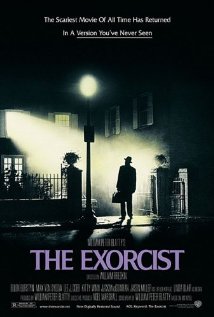
Among the first mythical creatures to go extinct when the early rays of the Enlightenment began to filter through the blinds of superstitious antiquity, were demons. It was recognized that the activities attributed to demonic possession closely resembled epilepsy and psychological illness and that Occam’s Razor would remove any unseen entities with its no-nonsense straight-edge in one deft pass. And yet they remain. Among the ghost hunting crowd, demons have been recategorized from fallen angels to entities that have never been human. Their reality is assumed, and results of investigations, not surprisingly, support that assumption. It was, however, a Dirt Devil advertisement that created a desire to watch The Exorcist now when darkness comes early and the leaves have fallen from the naked branches and a chill has permeated the air.

As I watched the still disturbing film, I realized that I had also watched the Exorcism of Emily Rose and The Last Exorcism within the past few months as well. I am no fan of demon movies; even with no demonic forces out there, inevitably young women are tormented by what ultimately turns out to be a male establishment. My threshold for watching the suffering of others, even if only acted, is minimal. Movie makers—and often horror writers—know and exploit this, bringing us to face the real demons, the shadowy regions of our own minds. The Exorcist is particularly effective in this since it is Fr. Karras’s demon that ultimately wins out. Having never read the novel, I’m not sure whose idea it was to make the demon Pazuzu, but once again the origins of demons does not fit modern media’s expectations.

Pazuzu was a Mesopotamian “demon.” Akkadian doesn’t have a proper word for what the Judeo-Christian tradition would introduce as a fallen angel. Demons were simply a way of explaining profound misfortunes such as droughts, pestilence, or the Bush administration. Eventually such misfortunes became personified and took on the ability to possess a human being. Here is where psychology and neurology have come to banish demons. Part of the terror of The Exorcist is that such scientific explanations are laid flat in the face of real supernatural power. The lessons of over-consumerism, as evidenced in Black Friday eclipsing Thanksgiving for many (the lines were formed in many locations well before midnight, cutting into family time in order to get first crack at the bargains) show the demon more clearly. Holidays are measured in importance by the amount of money spent. Perhaps it is no wonder that Halloween’s demons have lingered through November and even to the end of the year.


Cthulhu’s Revenge

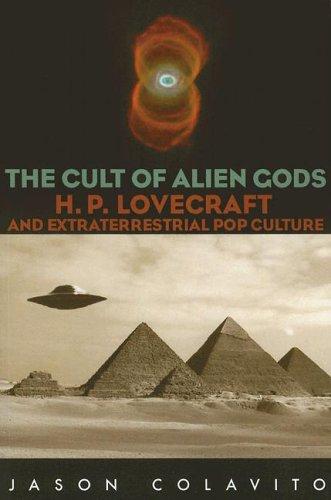
H. P. Lovecraft. Monsters. Aliens. UFOs. Ancient Egyptians. Sumerians. Is there nothing this book doesn’t have? Having read many of H. P. Lovecraft’s stories over the years, I have always been taken by how, as a writer, Lovecraft disappeared from public attention only to spring back in the 1990s. I discovered Lovecraft while doing research on Dagon, the putative “fish god” of the “Philistines.” Every time I typed the name of the deity into Google, I came up with pages and pages of Lovecraft. In my lonely room on a gray Wisconsin campus, I began to read his stories and shiver with fear as I walked across a dark parking lot to my car. Jason Colavito obviously has a great appreciation for Lovecraft as well, and his book The Cult of Alien Gods: H. P. Lovecraft and Extraterrestrial Pop Culture is a fun read for a November night. Colavito suggests that the “ancient astronaut” craze that has informed many a young mind stems back to Lovecraft’s fiction. Cthulhu and his ilk.

I’m not sure that Colavito convinced me that the ideas of ancient aliens began with Lovecraft, but he does an excellent job of exposing the foibles of many theorists who build houses of cards on shifting sand. One of the most interesting connections Colavito makes is that Creationism and Ancient Astronaut-ism are not dissimilar. “Both are, in essence, a concession that science is the ultimate arbiter of truth, and both seek to (mis)use science to give absolute authority to their beliefs” (331-2). This is an aspect of Creationism I hadn’t considered before. In the uncompromising desire for scientific respectability, the only option open is to bend science to the will of religion. This distortion must be carefully executed, convincing the followers that true science has validated a religious ideal. Rhetoric and occluding argumentation must be utilized carefully here. It seems Cthulhu has world domination in his squishy mind again.

Lovecraft famously gave us fantasy worlds where ancient space creatures left their impressions as gods upon a vulnerable humanity. Mysteries of the past—and Colavito doesn’t deny there are mysteries—are so easily explained by dei ex machina, and working with fantasy is so much easier than working with physics. To approach the mysteries with an answer already in hand, however, is to deny science its glory. As a civilization we owe much to a scientific understanding of the universe we inhabit.


Extinctions

Gaddafi is dead. Bin Laden is dead. Saddam Hussein is dead. The people of the Middle East have risen up to reclaim their world from the privileged. In Wall Street people are arrested and sequestered lest the discontent should spread. Do those of Libya, Iraq, Egypt, aspire to Wall Street? Are not the oil barons wealthy enough? How easy it is for us to forget that what we call civilization began here. In what we now call Iraq, people first banded together with complex governments, specialization of labor, and the arts. And, naturally, slavery. As civilization grew, priesthoods became strong. Governments could not stand without the support of the gods. Temples could not stay open without government funding. Gods and kings slept together. The Bible would later parody this as the tower of Babel. How we want to live in that penthouse chapel!

We often take from history that which sustains our interest. And when that interest is reinvested and compounds, we lay the foundations for yet another tower. We live in a world of towers, glad to accept their beauty and glory without realizing that no tower stands out without the deep valleys between the artificial peaks. To build high, some must be consigned to live in the subways and cluttered alleys and sleep out on the streets. The oil money in Dubai, not far from the fabled Eden, erects towers that are the wonders of the modern world. Just looking at pictures of the Burj Khalifa can make one shudder. Oil is decayed life.

Sometimes I imagine the world of the dinosaurs. Mammals must have seemed an endangered species then, small and insignificant as they were. Our distant, distant ancestors must have gazed up on the towering brachiosauruses and bruhathkayosauruses with awe and fear. When they finally evolved opposable thumbs, they decided to emulate their fears. Now the dinosaurs are all petroleum and birds. And still they rule the earth. Civilization began in the oil fields of the world with little use for petroleum. Instead, kings and priests worked together to construct towers that would ultimately fall. Oil makes some very wealthy, but it is only possible because of the extinction of the largest living animals that ever walked the earth.


Tepe Temple

When a colleague sent me an NPR story on Göbekli Tepe, I was thrown back into the conundrum far older than archaeology itself—how can a site be identified as religious? Most of us hardly realize that when we enter a church or cathedral that the overall plan is based on that of the earliest temples we know. Conventional wisdom associates temples first with the Sumerians, the harbingers of civilization itself. The basic premise was that a niche existed for a cult image (statue of a deity, generally) with an altar before it. Although the concept was widely disseminated, many reformed and rereformed Christian groups tried to distance themselves from it, calling altars “tables” and making them mobile. Probably the most successful are the Pentecostals; last time I attended a service the “sanctuary” felt like a warehouse. Actually, it was a warehouse. In general, however, there has been little need to reinvent the religious wheel, so the standard plan still often applies. Enter Göbekli Tepe.

Göbekli Tepe is located in southeast Turkey, near what was actually Mesopotamia in ancient times. The hill-top site is a Neolithic structure, and that means it was built before agriculture became widespread, during our hunter-gatherer stage. It is the earliest known human religious structure. The article on NPR questions precisely this: is it religious? How do we identify structures in pre-writing cultures as religious? Some archaeologists are guilty of labeling any structure or artifact with no practical function as “religious,” but this is a little cynical. Part of the problem is that religion itself remains ill-defined, being a post-Christian category to describe behavior singled out for God’s benefit. As a child I wondered, if God exists how could anyone not devote all their time to God?—the very speculation that led to my profession. Ancient people, like all animals, felt the urge to eat, rest, seek shelter, reproduce—animal things. It was a full-time job. When agriculture simplified things a bit by giving some measure of control over food supply, other professions began to emerge. Priesthood, as a means of ensuring continuity among the entire system, was one of the coveted jobs. Göbekli Tepe predates the Sumerians by thousands of years. The large structure with reliefs carved into the rock seems temple-like to some, less so to others.

The NPR article points out, correctly, that the distinction between sacred and profane may be premature as applied to Göbekli Tepe. We can test the cases even today: certain human functions are considered profane, chief among them sexual acts. It is clear from the sexuality of ancient religious artifacts that the profanity of sex is not an ancient idea. Ritualized eating is very common and still takes place in highly stylized form among many Christian, Jewish, and Muslim groups. Work itself was considered to be a divine assignment in ancient times. Our ultimate bosses were the gods. Little room remained for “secular” pursuits. By compartmentalizing life into “religious” and “not religious” we have found a way to pursue our own selfish ends and still wind up in the pews on the weekend, congratulating ourselves for obeying the dictates of divine law. Where is true religion to be found here? Is it not more likely to reside among ancient people, like those of Göbekli Tepe who lived their entire lives in the service of the gods?


Springing up Moses

“Springsteen’s work and person invite analysis in terms of the biblical themes of exodus and promised land,” so wrote Kate McCarthy in “Deliver Me from Nowhere: Bruce Springsteen and the Myth of the American Promised Land” (conveniently in a Routledge title, God in the Details: American Religion in Popular Culture, second edition, 2011). Having just finished Bruce Feiler’s America’s Prophet (not Routledge), I am attuned to the exodus theme at the moment. Feeling an unaccountable, personal connection to the other Bruce (Springsteen), I have felt the sense of exile in his songs since I was a teenager. I had no idea who Springsteen was when “Born to Run” made it to the charts. Living in a nowhere town at the time (population less than 1000), I felt the burning need for a personal exodus that eventually landed me in the largest city in the country. But still the sense of exile remains.

Lest readers be too confused, it might be politic to point out that the biblical concept of exodus likely had its origins in the Exile. Without rehearsing too much history, the Babylonian Empire, under Nebuchadrezzar, conquered Jerusalem in either 587 or 586 BCE, leading to the deportation of a significant number of Judahites who would become, over a generation, the “Jews.” These people were exiles, forced to live under the watchful eye of a political overlord with whom they shared only the most basic of heritages. Their religions had grown apart over the centuries, and as the Jews began to think back on their homeland, the exodus came to mind. Archaeological evidence for an exodus of biblical proportions (literally) does not exist. Why, then, the story of the exodus? Did not the desire to return home involve crossing the desert, with a divinely appointed leader? One who carried the law (Torah) with him? When Ezra led returnees home in the fifth/fourth century, he had the Torah in hand. Like Moses, he led the people out of bondage under the Persian plan. Exile and exodus are twin children of oppressive regimes.

So, how do ancient desert wanderers come into the orbit of a very damp New Jersey, and in particular, it’s arguably most famous resident? Alienation is home. Very few teenagers don’t understand this. As we attempt to integrate them into adult life, something vital, essential, is left behind. Consider all the long-haired artists of the ‘60’s and ‘70’s who still perform, now shorn to conservative acceptability and sometimes churning out very conventional songs. The fire has gone out. It is difficult to escape exile when you carry it with you. That’s something I think Bruce understands. His look may have changed, but his message has not. America has always been a haven for exiles. Simply because an exile moves into a new setting, however, does not mean that the promised land has been reached. As McCarthy seems to be saying, and as I have often felt, the promised land disappoints. The seeking is what must persist. America may have its Moeses, but it will find, from atop Nebo, that the path is where your feet already are.

Look carefully at your prophets!


Demonic Beginnings

A friend recently asked me what seemed like an innocuous question: what is the origin of demons. I typed out an answer on the basis of my outdated reading on the subject only to realize that this is a very complex question indeed. While teaching my Ancient Near Eastern religions class over the past three years I regularly told students that there is no regular word for “demon” in Akkadian, the language of ancient Mesopotamia. Mesopotamian religion was the dominant system of belief in sheer size of area and antiquity in the Ancient Near East. There are characters recognized as demons: Pazuzu of The Exorcist fame among them. Their origin, however, is murky. In Mesopotamia demons are generally a mix of human and animal components supposed in some way to be responsible for misfortune. They are not evil, but they carry out the punishments decreed by the gods. In the first millennium BCE demons were understood to inhabit the Underworld, paving the way for Hell, once Zoroastrianism contributed the necessary duality for the region.

The Hebrew Bible contains no uncontested word for “demon” either. The words generally translated that way do not indicate evil spirits in the sense that the Christian Scriptures seem to depict them. In the Hebrew Bible they appear to be associated with the worship of “false gods” and the inhabitants of deserts and wastelands. In neither the Mesopotamian nor Israelite concepts do demons appear to “possess” people. By the time of Christianity, with its Zoroastrian-fueled dualism, we have an anti-God (the devil) and his anti-angelic minions (demons). One purpose here seems to have been to clear the monotheistic God of charges of originating evil. If there is only one God where does evil come from? Better to posit a devil than take that one where logic leads.

Back in the days when I was still in school, demons were regularly cast as the explanation for various mental illnesses and epilepsy. In a society that had trouble understanding the sudden onset of an epileptic fit or a sane individual growing insane, such misfortunes could appear supernatural. In a supernatural realm where evil is mediated by the devil, demons naturally volunteer for their old role as purveyors of divine punishment. Eventually the mythology of a revolt in the world of the gods emerged, probably based on the dualistic outlook of Zoroastrianism, and we soon have verses referring to the king of “Babylon” being reinterpreted as literal episodes on a spiritual plane. Once Jesus utilized this language to describe the suffering souls of his day, it became heresy to think of demons in any other way than as physically, or at least spiritually, real. In the modern day they are still with us as “spiritual entities that have never been human” according to Ghost Hunters. They do, however, resemble people in significant ways more than they resemble their mythic forebears. Where do they come from? The dark recesses of the human psyche. Their mythic origins, however, remain obscure.


Kings and Codes

I readily acquiesce to the suggestion that others are smarter than myself. In a world of overly competitive commerce that has wormed its way into higher education, I have found myself ill-equipped to compete against those who are more clever at working the system. At times I can be decidedly pre-medieval in my perception of fairness. Thus it was a combination of self-denigration and legitimate surprise to find a brief piece in the May edition of Wired magazine on the Code of Hammurabi. In this arena I would have supposed myself to be on firmer ground. The piece by Joel Meares appeared in the Blast from the Past section of the “Humor Issue” of the erudite magazine. The writers at Wired are by default well beyond my ability in the tech scene, but this piece was a consideration of how Hammurabi’s justice still plays its way out in popular culture. Beginning with the 1970’s movie series Death Wish, Hammurabi is given credit for inspiring Hamlet, The Count of Monte-Cristo, Red Dead Redemption, Frankenstein, Moby Dick, and Batman. Holy pedigree, Hammurabi!

Each semester I try to explain to my students why study of the ancient world is still relevant. It may be overly simplified to suggest that Hammurabi directly inspired all these works (the Akkadian language wasn’t really deciphered until the middle of the nineteenth century, CE, long after Shakespeare), but clearly the trajectory had been set long ago. Even before Hammurabi. The earliest known law-codes predate Hammurabi by many centuries and demonstrate that our sense of justice and fair play were being bandied about by the gods long before Hammurabi was a twinkle in Shamash’s eye. If we want others to play nice, the best way to convince them to do so is to lay the dicta in the realm of the gods.

Maybe I can’t figure out where Death Wish and Moby Dick share anything beyond a cursory resemblance to Hammurabi, but it is clear that the Mesopotamians were the first to articulate the idea that the gods set the rules and it is our duty not to upset them. Of course, in our society fair play is frequently sublimated to corruption at various levels. Someone is always willing to bend the rules if the covert payment is enticing enough. After all, doesn’t it look like Hammurabi is placing his fingers to his lips while receiving a kickback from Shamash on the pinnacle of the famous stele bearing the code that now bears his name?

Hammurabi winks at Shamash


Assyrian Dreamers

And the widows of Ashur are loud in their wail,
And the idols are broke in the temple of Baal;
And the might of the Gentile, unsmote by the sword,
Hath melted like snow in the glance of the Lord!

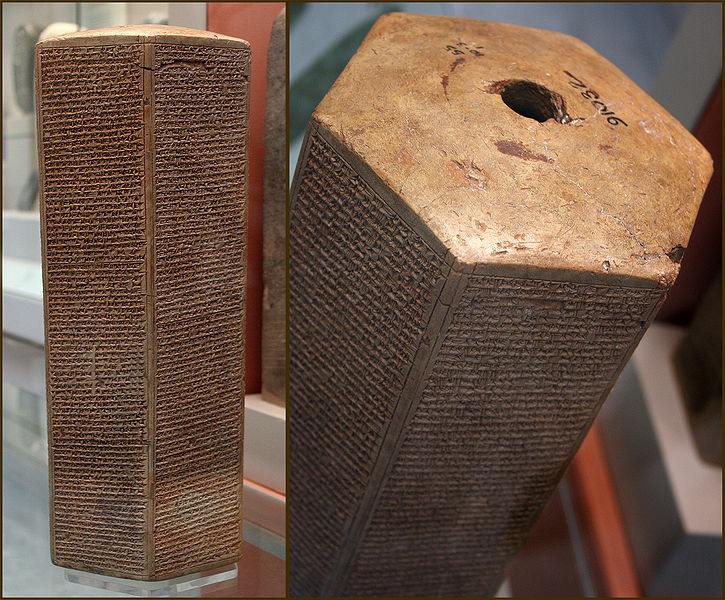
These lines from Lord Byron’s “The Destruction of Sennacherib” were recently quoted to me by one of my relatives who houses a tremendous store of memorized poetry. The poem is Byron’s vision of the siege of Jerusalem, a historical event that is now well understood because the actual annals of Sennacherib were discovered in 1830. The Akkadian version of Hezekiah’s revolt and the subsequent siege of Jerusalem in 701 BCE match the statement in 2 Kings 18 that declares Hezekiah bought off Sennacherib, thus sparing his kingdom. The biblical version then goes on to add the event eulogized by Lord Byron that an angel was sent after a prophecy of Isaiah and the Assyrian army fell decimated outside Jerusalem. The latter event is not historically accurate, but it is much more poetic. Who would write a poem about a king paying off his enemies?

Annals of Sennacherib

The Bible is comfortable with conflicting accounts of events, sometimes laying them side-by-side without comment, supposing that the reader is bright enough to see the obvious contradictions and draw the relevant conclusions. With the birth of Christian Fundamentalism in the 1920s, however, the myth of biblical inerrancy was born. In a world rendered in shades of gray, a distinct comfort lies in having answers in black and white. The Bible, considered the exact (if sometimes dodgy) words of God himself, could not be other than one hundred percent historically accurate. This version of history distorts what actually happened to what must have happened.

Lord Byron, notorious sinner that he was, seems to have been closer to the biblical spirit when he penned his famous poem. Glorying in the bravado of a warrior God who lays waste an entire army without lifting a sword or spear is fanciful, if breath-taking, poetic license.

For the Angel of Death spread his wings on the blast,
And breathed in the face of the foe as he pass’d,
And the eyes of the sleepers wax’d deadly and chill,
And their hearts but once heaved, and for ever grew still!

bears a grandeur lacking in “Hezekiah gave him all the silver which was found in the house of the LORD, and in the treasuries of the king’s house. At that time Hezekiah cut off the gold from the doors of the temple of the LORD, and from the doorposts which Hezekiah king of Judah had overlaid, and gave it to the king of Assyria.”


Floods and Fairytales

Never mind that the Bible gives only a cursory description of “Noah’s ark.” Never mind that the story in Genesis is clearly derivative from Mesopotamian originals such as the epics of Ziusudra, Atrahasis, and Gilgamesh (the Utnapishtim version). Never mind that all species of animals cannot survive within a single, extremely limited biosphere without evolving afterward into the diversity that the world currently hosts, even counting extinctions. Never mind that not enough water exists (with apologies to Kevin Costner) to cover all landforms without every mountain being pounded flat and stacked neatly on top of the ocean floor. In short, never mind reality—people will continue to build replicas of Noah’s ark. As a literary trope the ark has proved invaluable; many of my posts demonstrate how it appears and reappears in books and movies as a symbol of human irresponsibility. And yet, in order to demonstrate the veracity of an ancient myth, we continue to build fundamentalist arks.

Yesterday my wife pointed me to a msnbc story of an ark being built—and sailed—in the Netherlands. Certainly those in the “low countries” have global warming to deal with more immediately that those on higher (geologically, not morally, speaking) ground, and the engineer of this particular ark does not strike the viewer as a rabid literalist (he is a little too unkempt for that, and his shirt is not white and he wears no tie). John Huibers, however, worries about a more localized flood in the Netherlands. The ark may be overkill since polar bears, koala bears and panda bears are rare in Amsterdam, at least when one is not medicated. Arks, however, make great tourist attractions.

In Hong Kong the Kwok brothers built an ark replica in 2009. Greenpeace has one in Istanbul. A Christian theme-park featuring a full-size ark is under development in Kentucky, and just two years ago I drove past a roadside ark being built in Maryland. Most of these arks, interestingly, follow the design in the Sun Pictures’ production In Search of Noah’s Ark rather than the more traditional, mythic design in my children’s Bible. It is a natural human tendency to mistake form for substance. The story of Noah is a cautionary tale that has taken on daunting real-life implications in our treatment of our planet. Water is the signature of life, but for us land-dwellers too much is not a good thing. Thankfully, should a flood come, there will soon be enough arks around the world that would-be Noahs may find themselves in a buyers’ market.

Still my favorite ark


Iraq’s Bell

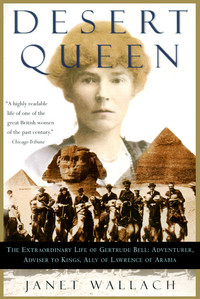
Gertrude Bell requires no introduction for students of the ancient Near East. A strong-willed, self-determining woman, her influence was arguably as great as that of her friend T. E. Lawrence (Lawrence of Arabia), but being a woman in a man’s world, movies were not framed around her life and she was not mythologized into a larger-than-life character. I have just finished Desert Queen by Janet Wallach, the life story of Gertrude Bell. Although tending towards the overly romantic in parts, this biography does a fine job highlighting the influence Gertrude Bell had on the newly formed country of Iraq at the close of the First World War.

Although Gertrude early lost her mother she was a child of a well-to-do English family. She was considered an anomaly at a still patriarchal Oxford in her day, but soon discovered the draw of the Arabian and Syrian deserts. Traveling seemed to be an antidote for being a capable woman in a man’s England. In the desert the sheiks and tribal heads came to treat her as an equal, like a man. (T. E. Lawrence, on the other hand, was famed for occasionally pretending to be a woman.) Assigned a government post in post-war Iraq, she helped draw up the borders of the present nation of Iraq and achieved a status with the desert tribes to which few of her male colleagues even aspired. Failing in health and fortunes, lonely in the desert she loved, Gertrude Bell committed suicide in Baghdad and was buried in the land she loved.

The story of Gertrude Bell is inspiring despite its sad ending. Here was a woman who refused to accept the model society cut out for her gender. Part of her loneliness resulted from her staunch unwillingness to be like other passive, subservient women of her time. After the reigns of political power slipped from her hands, Gertrude Bell founded the Baghdad Museum, collecting the initial artifacts herself and donating a substantial portion of her remaining funds to the museum in her will. Until the “Second Gulf War” it was the finest collection of ancient Mesopotamian artifacts in Iraq, where culture itself began. Gertrude Bell’s books are still read, but she is still known primarily as the associate of Sir Leonard Woolley and Lawrence of Arabia, although she was a woman on her own terms. She remains a symbol of what might be accomplished even when the standards of society declare a person unfit to lead based on gender or any other physical attribute.


Blood Lust

They emerge at night. They take your life-essence. They are very difficult to remove. In a particular political party their ruthless ways are highly praised. Yesterday I had occasion to watch the History Channel’s Vampire Secrets. Frequent readers of this blog know of my contention that horror films generally convey religious fears and certainly the vampire is prominent among such hosts of fear. Although superstition has held that actual creatures drew actual bodily fluids from their victims as far back as the Sumerians, today’s perception of the vampire has gone through several transformations. This particular documentary attempts to trace the origins of the modern vampire fascination through its major stages, beginning in ancient times. The writers and editors seem to favor a Far East origin of the concept, but linger for several minutes on the character of Lilith in Jewish folklore. Although Lilith does not really fit the profile of a classic vampire, she does contain a key to understanding the transformations: they are religious in nature.

People have believed in blood-suckers long before the GOP took on its recent transformation; there is no doubt, however, that the blood-lust of the vampire developed in the light of Christian ideas about the crucifixion. The regular imbibing of “blood” was an aspect of early Christianity that led to problems with the Roman authorities supposing this was some sort of precursor to Vampire: the Masquerade. By the time stories began to circulate about Elizabeth Bathory (ironically, at the same time the King James Version of the Bible was being translated) and her famous blood-lust, and after Bram Stoker later selected Vlad Tepes as a fictional model for his Dracula, blood-ingestion had become the singular hallmark of the vampire. In both cases, despite their historical facts, religious elements had entered in.

One of the most disturbing transformations, however, is that whereby religion itself becomes vampiristic. Originally established as a means of propitiating angry deities, religion very early assumed the aspect of blood-letting as a means of accomplishing that propitiation. With the development of religious abstractions, however, literal bloodshed has become distasteful and less common, but the deities still demand sacrifice. Even in the twenty-first century many accepting people are informed of the pecuniary sacrifice desired, commanded even, by the gods. While the occasional poverty-stricken cleric may occasionally appear, many far surpass the status quo in their crystal cathedrals while many of the faithful suffer want. The History Channel found vampire subcultures in the streets of New York City. They might also have found them in just about any town in any country of the world.

Saint or sinner?