As We Know It

The end of the world, as we know it, is really more recent than we think.  Yes, Christians of a certain stripe have been looking for the second coming since the first leaving, but that detailed map of how we’re living in the end times, courtesy Hal Lindsey, is a new thing.  Here are the fast facts.

First and second centuries, Common Era: early Christians tended to think Jesus would “be right back.”  When that didn’t happen they began to look in the Bible for reasons why and started to develop theologies to cover the bases.

Late Antiquity to the Middle Ages: settled in for the long haul, theologians developed eschatology.  Although that sounds like a disease, it’s actually a system for thinking about how the end of the world will come down.  There were conflicting theories.  The two main flavors were premillennialism and amillennialism.

Early Modernism: Protestants came along and searched the Bible for minute clues to make into a system.  In response, postmillennialism became a thing.  Now there were three options.  Various phases were discussed: tribulation, resurrection of the dead, and the already-met millennium.

1820s: William Miller, a Baptist minister, began number-crunching and figured the end of the world would take place by 1843.  His followers, “the Millerites,” continued on after what was called “the Great Disappointment.” 

1830s: John Nelson Darby, a Plymouth Brethren leader, came up with Dispensationalism, a scheme that divides history into eras, or “dispensations.”  He thought we were living near the end of that scheme about 200 years ago.  The idea of “the rapture” was added to the other phases.

1917: Cyrus I. Scofield, published the Scofield Reference Bible.  A man with little formal education (and a “colorful” background), he applied Darby’s dispensations in his Bible, giving the United States a road map to the end times.

1970: Hal Lindsey, a seminary educated evangelical, published The Late, Great Planet Earth.  It became the best selling book (classified as nonfiction) for the entire decade.  New ideas, such as “the Rapture” and “the Antichrist” began to be read back into the Bible.  The book was made into a movie.

1976: David Seltzer, a Jewish screenwriter, penned The Omen.  The movie made use of Lindsey’s adaptation of Scofield’s adaptation of Darby’s ideas.  The wider public, seeing it on the big screen, believed it was about to happen.

2000: the world still didn’t end, either with a second coming or Y2K, as many predicted.  Round numbers will do that to people.  It didn’t stop predictions of the end of the world.

2012: the Mayan calendar gave out.  A movie was made.  People believed. Apocalypse averted.

2024: you fill in the blanks.

Image credit: Albrecht Dürer

Gather Round

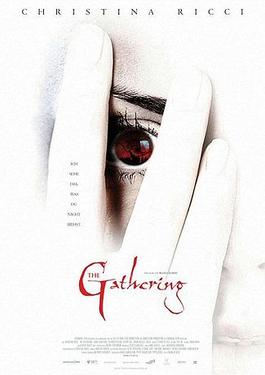
The church has been keeping secrets.  That’s the basic premise behind a fair raft of horror films.  Apart from giving those of us watching religion and horror quite a bit to talk about, it reinforces just how close the two are.  The Gathering is a film I missed when it came out, but one which has an interesting, if unlikely premise.  At times it reminded me of The Reaping, and at other times, the prequels to The Exorcist.  Cassie is a young American woman who loses her memory after being hit by a car near Glastonbury, England.  At about this time a deliberately buried church is being explored by an art history professor.  He asserts that it is the church Joseph of Arimathea built and represents, in its altarpiece, the earliest rendition of the crucifixion.  The clergy seem quite disturbed by this.

Meanwhile, Cassie recovers and is taken on as an au pair for the art historian and his wife (the one who hit her with the car).  The people of Ashby Wake stare at Cassie, as if they know her.  She has premonitions of several local people dying violent deaths.  The clergy learn that the altarpiece depicts those who came to watch Jesus’ crucifixion, not out of love or devotion, but simply for spectacle.  Since then they’ve been cursed and show up to watch various historic tragedies.  The clergy want the church, the earliest representation of the spectators, reburied.  The people of Ashby Wake include those of “the gathering,” indicating tragedy is about to unfold in that small town.  There is a twist ending I won’t reveal, but this is one of those horror films that rely on religion to make them work. 

Critics tend to dislike the film while viewers are divided on the question.  I actually enjoyed it, personally.  The concept of the watchers committed to bloodlust seemed different, particularly when put in the context of nascent Christianity.  It doesn’t handle religion as well as some horror does, but it’s a serious effort.  Why Joseph of Arimathea would want to have portrayed gawkers rather than those loyal to Jesus is one of the bigger questions left unanswered.  After the ending some of the unusual scenes earlier on make more sense.  But still no reason is given why an early church would have portrayed those not to be emulated.  As a horror film with no jump startles, but a slowly building dread, it fits the bill for some of us.  The “church keeping secrets” theme is one that should be explored further.


Showing Gratitude

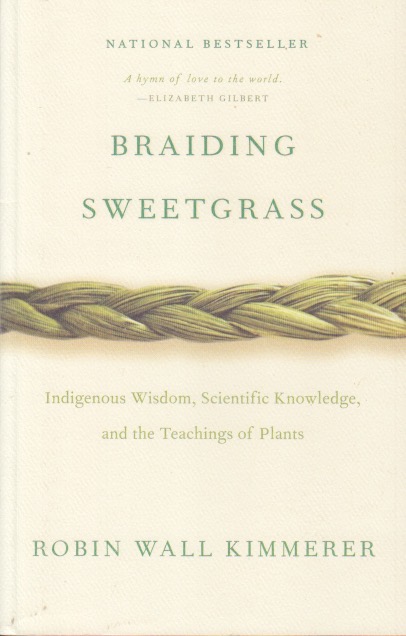
Stealing is something that we all, except some capitalists, know is wrong.  I think quite a lot about the land that was stolen to make America possible and I know that simply giving it back isn’t an option.  Nevertheless, I do believe that we should listen, and listen attentively to those who’ve been here longer than Europeans.  Robin Wall Kimmerer’s Braiding Sweetgrass is an important reflection of this dilemma.  Kimmerer is Potawatomi and she’s also a professor of Environmental Biology.  The book is a series of essays that focus mostly on plants and what we can learn from them.  It also brings in indigenous teaching, contrasting the outlook of gratitude against that of greed.  By turns sad, funny, and profound, Braiding Sweetgrass contains a message that is vital to counter climate change.  To correct our attitude before it’s too late.

There’s so much in this book that it’s difficult to know what to touch on in this brief notice.  Throughout, Kimmerer notes that the First Nations viewed life as a gift.  The earth is constantly giving and the native way was to be thankful and to accept the responsibility of being given a gift.  Seeing how the European attitude was “take until there’s no more to take,” she points out that taking what you need and leaving for others is a way out of our current dilemma.  She does this, most strikingly, by the story of the windigo.  The windigo has become popular among monster fans as a consuming beast, but Kimmerer shows how the story has a profound point.  If all you do is consume you become a monster.  You stop a windigo by showing gratitude.

Perhaps the most striking thing, to me, was how Kimmerer describes her own experience becoming a scientist.  How standard academics refused to believe they had anything to learn from Native American outlooks, especially when borne by a woman.  How she was told she couldn’t be a scientist, not with that outlook.  And how she learned the European way but didn’t give up her native understanding.  How she brings two worlds together and does so with a sense of urgency and hope.  Things have gone too far simply to turn back the calendar and say that our ancestors had it all wrong, but it’s not too late to learn from those who lived for millennia on this land and were untainted by ideas of private ownership.  Those who knew how to live sustainably with nature.  Those who knew, and still know, how to defeat monsters.


Hellish Fears

Aporripsophobia, the fear of rejection, and the fear of punishment (mastigophobia, or as I prefer, “spankophobia”) are closely related.  They define me.  Much of this comes from the fear of Hell, which I internalized early in life, along with the Calvinistic theology that backed it.  Some have thought that I’m “thin skinned” or afraid of criticism.  That’s not quite it.  I’m afraid of what criticism implies—I did something wrong and therefore may be punished for it.  What brings this on, all of a sudden?  Well, as I was getting ready to jog the other day a police car stopped in front of our house on a routine traffic violation.  My immediate thought was that I had done something wrong.  They were here for me, not the guy whose car they were attending.  Then this brought back that time in Boston.

I moved to Boston on my own, with all I had in a VW Beetle (old style).   I know now that the headache I had after that long drive was a migraine.  (I’ve had maybe a half-dozen in my lifetime, and they’re unmistakable.)  I parked the car, stumbled into my new apartment and went to bed.  The next morning I had a ticket for parking with the left tires to the curb (against the law in Boston).  I didn’t know it was illegal.  Even with a migraine I would’ve not parked that way had I known.  The receptionist at the police station actually said to me “Ignorance of the law is no excuse.”  That terrified me.  I thought it was only something Gilligan said.  If you don’t know all the laws how can you possibly avoid punishment?  And isn’t punishment rejection?

Some think I always have to be right.  They may not know the underlying cause—being wrong is to be subject to punishment.  And punishment leads to Hell.  When I was in Kindergarten the first time, I was held back partially because I was four but partially because I colored the triangle in the left corner purple instead of yellow, opposite to the verbal instructions.  It was because I don’t know my right from my left—I still don’t.  To me that first ever school correction was seared forever into my gray matter.  I’d done something wrong.  I was held back in school.  More likely than not, I was going to Hell.  I’ve known people to suggest, as does Richard Dawkins, that raising a child in a religion is child abuse.  I understand parents’ motivation, however.  You don’t want your child to go to Hell.  If they end up living in it all their lives I guess it’s a small price to pay.

Photo by Vadim Bogulov on Unsplash

Which Witch Where?

I like to think of myself as a kind critic.  I’ve been on the pointy end enough to know how it feels when those who don’t like my work are unkind.  I’ll try to find a nice way of saying Witches of Amityville, or Witches of Amityville Academy, must’ve been shot on a very modest budget.  It must’ve been written by someone who’s still working hard to master the craft.  And the actors are continuing to improve as the director gets better at that role.  Why did I watch it?  Amazon Prime gives it four stars.  The incongruity of Amityville and witches suggested it might be a bad movie, and in that regard it did not disappoint.  So what’s going on here?

There’s a witch academy in Amityville.  Although all the cars have steering wheels on the right, everyone speaks with American accents, apart from a couple of characters.  The interior shots, however, are also pretty British for the most part.  There does seem to be some awareness that Amityville is in the new world.  In any case, said academy is run by an evil coven that is seeking to release the demon Botis.  To do so they have to sacrifice college-age women (and no, it’s not that kind of movie).  One of their intended sacrifices escapes and is found by three white witch sisters who also live in Amityville.  They decide to train this young woman who, as it turns out, is a very powerful witch.  Problem is, the director of the academy can’t release the demon without sacrificing this particular victim.  So she kidnaps her back.  The three good witches burst on the scene, actually more like just walk on, and prevent the sacrifice.  The bad witch kills herself and releases the demon, but the young witch is so powerful that she destroys him.  In the end the witches must go to Salem.

What’s not to like?  Some of us, day by day, year by year, work to improve our writing skills.  We write stories that incorporate whatever ability we’ve managed to scrape together.  And we struggle to find publishers.  I like bad movies because they are a great place to find hope.  The world’s a big place.  Even the entertainment industry is large enough to absorb movies produced by Amazon, Hulu, and Netflix, among others, including the big studios.  They’ve got to be looking for content, right?  Those of us who channel our creativity towards writing, and who keep trying to get it published, have a chance, don’t we?  What’s the harm in believing in the power of magic?


Monster v. Alien

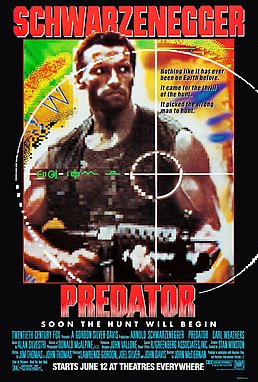
“Horror” is a faulty genre category.  Nobody quite knows where its boundaries lie.  Take Predator, for instance.  I recently watched it for the first time although I’d known about it since I was in seminary.  I am not a fan of tough-guy movies, so it took the fact that it’s sometimes coded as “horror” to get me to watch it.  Horror is often defined as a genre that has to have a monster.  Check.  We got your monster right over here.  The monster’s an alien but so is, well, Alien.  An action-adventure, sci-fish movie with a monster—is that horror?  I knew I had to see it for the sake of completion.  I’d heard of Predator vs. Alien (haven’t seen), and enough people comment on Predator that I was beginning to feel hopelessly outdated.  Or even more hopelessly outdated.

I presume the rest of the world saw it long ago, but I didn’t even know the plot.  A group of tough-guys are duped into a covert operation that allows for many explosions and bodies flying through the air.  Then they have to get out of the jungle alive because there’s an alien sportsman on the loose.  Apparently he likes earth for a good challenge since he won’t hunt somebody who’s unarmed.  He wipes out Arnold Schwarzenegger’s team—and to the film’s credit, the Black guys don’t die first.  There’s time for that, of course.  As they tromp through the jungle shirts come off because the guys are all ripped, of course.  One of the team, Billy, decides to fight without a gun so when it’s down to just Arnold and the alien the predator decides fisticuffs will settle this in a manly way.  When Schwarzenegger’s trap mortally wounds said predator, it sets off a bomb that allows for the biggest explosion of all.

So is this horror?  Hulu thinks so.  Schwarzenegger apparently thought it ended up as sci-fi horror—which is a thing.  It’s a thing because horror is a poor genre.  It’s ill-defined.  You kinda know when you’ve just seen a western or a romance.  But lots of horror films are disputed.  Critics repeatedly opine that The Shining isn’t horror.  Neither is The Exorcist.  Of course, both always wind up near the top of horror list movies.  Horror movies don’t win academy awards, as a rule.  Still, “horror” fans seek movies out that others classify as drama, or even action-adventure.  Horror is close kin with science fiction, another disputed genre.  The two are often quite distinct, however.  So, did I watch a horror movie this weekend?  I honestly can’t say.


Forewarning

The Devil’s Advocates series, as you learn from pitching and writing one, promotes alternative views on horror films.  Adrian Schober’s treatment of The Omen doesn’t disappoint.  Each time I read one of these little volumes I’m always amazed at how many ideas can be packed into such a small space.  Schober’s take on the film is that Damien’s role is left intentionally ambiguous.  There was disagreement between the screenwriter (David Seltzer) and the director (Richard Donner) on that point.  Donner wanted it to be left up to the audience whether Damien was the Antichrist or not.  Seltzer, not being a believer himself, wanted to be clear that the boy was evil.  As portrayed in the final film, however, Damien seems awfully vulnerable, in retrospect.  (I rewatched the movie before reading the book.)

I’ve seen The Omen a number of times.  It has never been my favorite movie and I actually read the book (a novelization) before I ever saw the film.  Having grown up as a fundamentalist, I believed that we were in the end times (which only really seemed likely starting in November 2016).  The movie had to wait until I was an adult (I read the novelization when the film first came out).  I can see the ambiguity now, having read this book.  There remain, however, some things difficult to explain about the presentation—how Fr. Brennan knows Katherine is pregnant and that Damien will be the cause of her miscarriage.  The extreme coincidence of both the priest and the boy having the same birthmark that looks like 666.  And that someone would go through the trouble of burying a jackal and Thorn’s actual son in an obscure Etruscan cemetery just in case the Ambassador ever got suspicious and wanted to check it out.  

Interestingly, different markets altered the ending, enhancing the ambiguity.  The final scene had originally been shot with three coffins rather than two, and that changes things, doesn’t it?  Movies are, of course, subject to interpretation.  Any form of media is.  The fact remains that many viewers flocked from theaters believing Damien was the Antichrist.  Schober’s book would give pause, however, about rushing to conclusions.  The idea for the movie was suggested initially by a marketer who was a true believer in premillennial dispensationalism (essentially the worldview of Keith Jennings in the movie), and some Catholic officials objected.  Different Christian sects have very different interpretations about the end of the world.  And this movie is subject to different interpretations.  This brief book might just change your mind.


Not a Peep

Time changes everything.  Peeping Tom, which has been on my list for some years, was castigated when it was released in 1960.  Now it’s considered a classic.  Indeed, it’s frequently discussed in books analyzing horror films, and it had a bit of influence on Alfred Hitchcock.  Films like this must be watched as period pieces, of course, but there’s so much psychology here to unpack that I wonder if it’s used in mental health courses.  Mark Lewis is a loner who inherited a spacious London house from his father.  He lets out the downstairs rooms but keeps to himself upstairs.  One of the reasons is that he realizes that he’s mentally unstable.  He’s a serial killer, in fact.  His young downstairs neighbor takes a shine to him and he reveals, via film, that his father tormented him as a child to film his fear reactions.

As an adult, Mark works in the film industry.  He also kills women while filming them to capture their fear reactions—taking his father’s work a step further.  Although shy, he is charming enough to others.  When he sees a fear reaction, however, he feels compelled to murder.  The neighbor downstairs doesn’t suspect him, but her ocularly challenged mother does.  Thinking back over it, many moments reminded me of a racier version of Hitch.  Racy because Mark picks up money on the side by taking boudoir photographs that the local news shop sells to certain customers.  This is a creepy film and perhaps the creepiest scene is where a local girl, well underage, comes into the news shop to buy a candy bar just after the owner sells an older man a pornography book.  We don’t like to admit that such things could happen.

There is so much going on in this movie that it’s clear, at least to me, why it has garnered such acclaim.  I spent the first twenty minutes or so wondering whether I should really be watching, but as I stayed with it I couldn’t look away (which is one of the very self-reflective issues that the film addresses).  The analyses I’ve read never really went into detail regarding the plot, so there were plenty of places where I wondered what would happen next.  The pacing is more in keeping with the turn of the sixties, but the mind work seems ahead of its time.  Some call it a precursor to slashers, but it doesn’t linger on the actual bloodshed (which is minimal, considering).  It does take its time to make you think while you watch.  And somehow it makes viewers complicit, it feels, with what they’ve seen.


A Different Legion

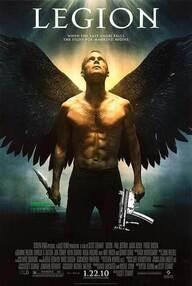
Religion and horror can play well together.  They can also be unevenly matched.  Although Legion has been on my list since shortly after it came out, my impression after having watched it is that the angels are strangely corporeal.  Their fights are physical with very little supernatural involved.  I suppose that’s why it’s generally classified as “action,” but the premise is one that suggests a bit more supernatural would’ve been welcome.  The writing suffers from any number of ailments, and the ending leaves you wondering just how good God is supposed to be in this telling.  I suppose a plot synopsis might help.

A pregnant waitress in a remote diner is nearly at term.  The Archangel Michael has come to earth in Los Angeles (get it?) and has armed himself to protect this unborn baby.  He comes to the diner where the owner and his son, his cook, and four customers are holed up against what they think is a demon attack.  Michael eventually reveals that the arriving hordes are not demons, but humans possessed by angels.  God has decided to wipe out the human race again, this time with angelic mercenaries.  If the waitress’s baby survives, however, the world will be saved.  So there’s lots of shooting, and although a white guy dies first, the only two Black characters are the next victims, of course.  To kill angels, it turns out, you have to shoot them.  Who knew?  In the end, which pits Gabriel against Michael, it’s revealed that God was testing the loyalty of his angels by giving them this task.  Mindless obedience, God thinks, is wrong.  If people have to be killed to prove it, so be it.

The theme of the messianic baby stays intact but goes nowhere.  At the end it’s unclear if the angel attacks are still going on, but the waitress and her boyfriend, along with the baby, drive around heavily armed, ready to fight.  Did the angels get the message that they are being tested by God or are they, like many Republicans, simply following the “leader”?  Seeing the title and knowing nothing of the story, I had assumed this was a movie about demons.  The “Legion,” of course, is angelic but there’s not a lot transcendent about them.  Even the use of wings (which are bulletproof), makes this feel like Dogma without the humor.  I knew religion would be involved in this horror, but I didn’t know how poorly it was played out.  Still, it would fit into Holy Sequel, if it ever happens.


Filming the Void

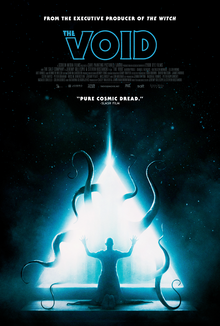
Once you move away from major studios, it turns out that Lovecraftian horror is rather prevalent.  Seeing that The Void was rated higher than many offerings on FreeVee, well, why not.  It was compared to the intellectual works of Benson and Morehead, but to me it matches more closely with Older Gods.  Like many movies in this genre, The Void isn’t easy to follow and having commercial interruptions doesn’t help.  (In movies made for television, directors know to offer cues at specified times to allow for a break.  I’m not sure that those at FreeVee, or Tubi, or Plex, or their ilk, or even Hulu, know how to do this well.)  So there are these mysterious cultists—somehow “new religionists” just doesn’t seem to cut it—who apparently want to bring about the apotheosis of their leader in a rural setting. 

Meanwhile a local sheriff finds a young man fleeing from a couple of guys who are killing people and takes him to the hospital.  This hospital, however, is being closed down and there’s only a skeleton crew there to handle emergencies until it can be decommissioned.  Once the guys trying to kill the young man arrive, the hospital is surrounded by the cultists.  By the way, there will be spoilers—just saying.  It never is adequately explained how these killing guys know who these cultists are, unless it happened so fast that I missed it.  In any case, all trapped in the hospital there’s the problem with a monster that has tentacles (Lovecraftian) that takes over the body of a nurse, then a tries to get a state policeman.  Lots of axes and gunfire, and the numbers in the hospital are reducing.

It turns out that the kindly old doctor is the leader of the cult and he’s trying to raise the old gods so that he can bring his daughter back to life.  The sheriff, who’s been the protagonist all along, knocks said doctor into the eponymous void, leaving only two people alive in the hospital.  It’s not really explained where the cultists, who made it into the hospital, went.  Nevertheless, this is a good example of horror and religion (which is ironically Lovecraftian).  The doctor’s unconventional religion is the cause behind the hospital mayhem, and, apparently the killings being conducted by the interlopers are attempts to stop it.  As a horror film it’s effective, if a bit disjointed.  It seems that there’s still a lot to unpack from films that try to bring Lovecraft’s ideas onto the silver screen, major studio or not.


Look Out Beneath

Rainy weekend afternoons were made for monster flicks.  That’s what I was thinking when I settled on The Devil Below.  I was also thinking, “this is free on Amazon Prime.”  The best word  I can think to describe it is lackluster.  Sometimes I’ll see a movie and a couple weeks later will have trouble remembering what it was about without severe prompting.  This may fall into that category.  We’ll see.  In any case, Arianne—is she Ariadne?—researches and leads groups to inaccessible locations for a fee.  She can find anywhere.  A group of “scientists” want to find a coal mine in Kentucky that caught fire (like Centralia), and explore it for possible high-grade anthracite.  What they don’t know is that monsters live in the mine and they escape from time to time.  The former mine owner has formed a ragtag group of helpers who keep the monsters at bay.  They don’t ask for help.

So far, nothing really stands out.  What makes this movie worth discussing is the dialogue about religion and science that the scientists have.  Unfortunately the writing is poor and that means the dialogue isn’t very sophisticated.  For example, one of the geologists argues that intelligent design isn’t opposed to science.  What said scientist doesn’t know is that intelligent design was intentionally invented by creationists as an alternative to science.  Its roots are clear and unambiguous.  This member of the team doesn’t believe they should really be doing this—the mine is behind an electrified fence and the locals keep trying to chase them off.  And he’s talking about God while there’s, well, devils below.

It’s never really explained why these creatures are considered devils, unless they live close to “Hell,” being underground and all.  We don’t get many clear views of these monsters but they eat what they can get, which makes you wonder what they survived on before miners showed up on the menu.  In the end, all the scientists get eaten—it turns out that their leader was actually working for big industry, not a university, as he’d claimed—and you don’t feel too bad for them.  Arianne survives and decides to stay with the locals to fight the monsters.  There’s some faith talk among them as well, which makes me wonder if the writers maybe had a hidden agenda.  Although the article does score a Wikipedia article, many of those involved, including the writer and the star, don’t have their own entries.  And who has the time to mine the internet for more answers?  There you might find the devil below, I suppose.


A Different Zone

I haven’t read Stephen King’s The Dead Zone yet, but it’s on my list.  That’s why I was a little reluctant to watch the movie.  It was free on Amazon Prime, however, and I reasoned to myself that I’d seen The Shining and Carrie before reading the books.  Indeed, my earliest introduction to Stephen King was through movies.  (Well, I did read one of his short stories in high school, but the novel side of things came later.)  When the opening credits revealed it was directed by David Cronenberg I wondered what I was in for.  I didn’t know the story, but I hadn’t heard of this as a Cronenberg body horror spectacle either.  It was quite cold outside and I was nodding off, so why not.

The thing is, it’s not always listed as horror.  That’s a faulty genre designation, as is sci-fi.  There’s one futuristic scene in the movie and it lasts for just over a minute.  Does that make it sci-fi?  Also, I  realized, it deals with clairvoyance and for similar reasons the X-Files are also listed as science fiction.  Paranormal, it seems, is permanently ruled out of the realm of possibility by assigning it an improbable genre.  Well, back to the zone.  I figure the title will be better explained by King, but there is a brief scene explaining what a dead zone is.  The story follows Johnny Smith, a schoolteacher who becomes clairvoyant, although it manifests itself only after a car accident and a coma.  The main purpose of this, at least through the movie lens, is to prevent a Trump-like populist from being elected president.  That is the horror part, I guess.  And it’s becoming clear to me that writers were warning about these things since the seventies.

Unlike many of my weekend movies, I’d actually heard of The Dead Zone before.  There are some horror tropes present.  It begins with Edgar Allan Poe’s “The Raven,” and has a few other horror references tossed in.  Still, it’s a very human story.  The movie probes the difficulties of a life with special abilities.  Johnny never gets over the woman he was going to marry before his coma, and he feels for those whose futures he sees.  The movie is fairly slowly paced and it drops a few threads, again, likely found in the novel.  In the book or movie debate I generally go for book first, but that often leads to disappointment on the silver screen.  Maybe this was the right order to go this time around.  Once I read the novel I guess I’ll know.  Or at least have an opinion.


A Little Flat

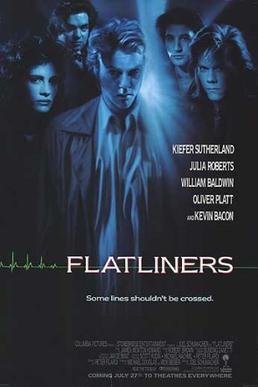
I remember hearing about Flatliners when it came out.  It was during an era when I wasn’t watching many movies and the idea of a movie all about dying bothered me.  Well, I’m older now and I watch movies because I write about them.  So I gave Flatliners a try.  It wasn’t bad—a cut above what I often end up watching on a lazy winter weekend afternoon.  In case your memory’s rusty, here’s how it goes: five med school students decide to experiment with controlled death and resuscitation.  They do this to find out what’s after death.  Confident in both science and their abilities, they one-by-one undergo the procedure to see what awaits beyond.  The experience is different for each of the four that does it.  It can be pleasant, or not.  More not.

Then the experiences from the beyond begin to break through into their alive lives.  But not the good stuff.  The word that these scientists use is, interestingly, “sin.”  The sins of their pasts come back to them.  One of them realizes that to free himself from this haunting, he has to make amends to a person he offended as a child.  The apology—and forgiveness—works.  Eventually the four pay the price and, perhaps, are a bit wiser for it.  This isn’t a great film but it does raise a number of issues that demonstrate how religion and horror relate.  Death is a religious issue, no matter how secular someone is.  As the definition of life becomes more complex, its cessation becomes more fraught.  Here medical students are grappling with their very vocation.  They ease suffering and prolong life.

I suspect one of the reasons the movie failed to make it big was that the “sins” are unevenly repaid.  An accidental death from a childhood of bullying is the worst.  A past of womanizing seems to have a relatively light, and predictable outcome.  And what is the sin in discovering a war veteran parent’s addiction to an opioid?  In a sense it’s classic Sunday school—you get punished for your wrongs.  Some suffer, however, from mistakes that others made.  Or for which others egged them on, and in which others participated.  And for us vegans, even egging someone on might be a sin.  The value of the movie seems to be less how it’s executed and more about the potential for discussion that it raises.  Death is no stranger to cinema, and it can’t fail to make the living curious.  That seems worth talking about. 


Demons Again

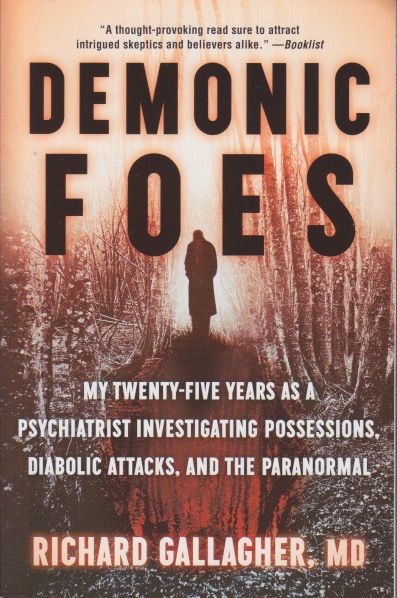
Exorcism is sexy these days.  I fully understand why $100 books on it escape attention, but I’d been looking for Richard Gallagher’s treatment since 2016 when I learned that he was writing it.  Demonic Foes is, however, a little disappointing.  As I am wont to do, I tried to find information on the author only to discover that he appears on many webpages but really has no online presence himself.  He teaches as Columbia but his page there is minimal as they come.  The book, which I suspect easily caught an agent’s eye (see my opening sentence), is a rambling tour—very roughly chronological—through the author’s experiences with and thoughts about demons.  I’m left puzzled, however, about why he maintains the secrecy around his priest mentors, although they are dead.  Believe me, I understand withholding names, but if you’re trying to convince people, we need something to go on.

There are some interesting, and scary cases here.  But Gallagher also gives nods (somewhat skeptically) to Malachi Martin, but also to Lorraine Warren, and Fr. Gabriele Amorth.  At times he easily moves between movies and actual events.  His writing style at times obfuscates, unintentionally, I expect.  Before too long it becomes clear that, as a Catholic, the author distrusts anything occult, paranormal, or parapsychological.  At one point he suggests assuming spirits are demonic until you can prove otherwise.  At the same time, he suggests possessions are rare.  I’m left wondering about a number of things.  There’s no bibliography and his knowledge of the ancient world isn’t that of a specialist.  Even his history of demons doesn’t address the nuanced issue of how Christianity came to understand demons as the New Testament seems to.  He gets some facts wrong about other religions.

I’m no stranger to cobbling books together while working full-time and trying to hold daily life together.  You can hire book coaches (if you afford them) and not all editors are willing to tamper with money.  (Trade publishers do what they do for lucre, don’t you know.)  Demons are a controversial subject.  The tired orthodoxy of demonizing other religions still holds for some, and it seems to here as well.  This rambling book raises more questions than it answers: which exorcisms did the author witness?  Why are non-Catholics said to have rosaries?  Why are verifying names kept secret?  If wanting to convince people, why are so few dates or precise places given? I appreciate what Gallagher is trying to do and I agree with him that we need to avoid dismissing demons because they don’t fit a scientific worldview.  As he admits in the epilogue, he holds a traditional view of what demons are.  I’m left wondering what we might find if science would take the paranormal seriously.


Le Fanu Fans

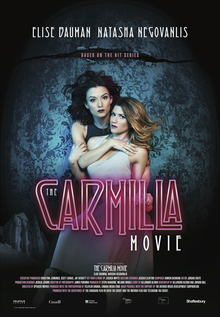
Sheridan Le Fanu is sometimes called “the Irish Poe.”  He was a contemporary of Poe but his name doesn’t bear the same cultural cachet.  He wrote a number of stories that are classified as “horror” in today’s genre settings, and one of the most famous is Carmilla, known as the lesbian vampire story.  Le Fanu didn’t use that terminology himself, that I know of, but Carmilla is a vampire and she does have fondness for other females.  I’ve watched a few lesbian vampire movies (I mentioned Theresa & Allison recently), since they give a distinctive taste to the lore.  I don’t generally research the free movies I watch beforehand, so when I saw The Carmilla Movie, I figured it was likely based on Le Fanu (it is) but I didn’t realize that it was a follow-up to a web series with the same characters.  Nevertheless, it’s a pretty good story.

Set in the modern day, with a cast of young people doing things for a living that weren’t options when I was growing up (internet content provider, starting a paranormal investigation business—I was laughed out of school for admitting I was interested in this stuff before the X-Files made it mainstream), the film updates Le Fanu’s story.   Carmilla has become human and has a girlfriend.  But then Carm starts to revert to vampire status.  (Fortunately there’s soy-based blood for her to drink—did I mention this is comedy horror?)  Although this is comedy horror, it’s not a silly story.  There are plenty of humorous asides, but you still feel for the characters and want them to overcome the evil they face.  Here that evil is a past that has to be rectified.

I found The Carmilla Movie to be intelligent and fun.  There are some genuine horror elements to it, and I suspect that being familiar with the web series might help answer a few head-scratchers for us non-initiated.  In general it seems that such independent films as this serve to raise the bar on movies as a whole.  The flip side is, however, that you can’t easily tell if a movie is a studio release or a television movie, or even a web movie without doing some research ahead of time.  Amazon Prime—my go to service—doesn’t distinguish them.  All I know is that if a movie is one I have on my watch list, I’m going to have to pay for it.  Carmilla was free and worth the time to watch.  And it’s good to see Le Fanu getting some deserved air time.