Taking It Seriously

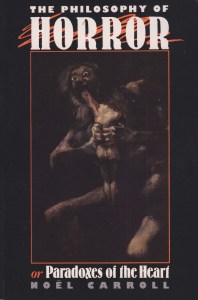
It would be incorrect to say that I choose to watch and read horror.  What would be more correct would be “Horror compels me to read and watch it.”  Those of us mesmerized by the genre tend to be a reflective lot.  We ask ourselves the question others frequently ask us—why watch it?  And yet, horror films tend to do very well at the box office.  Some even become cultural icons.  Of the many books analyzing horror, it would be difficult to suggest one more influential than Noël Carroll’s The Philosophy of Horror: or Paradoxes of the Heart.  It has been in just about every bibliography I have read in the subject.  It’s easy to see why.  There are lots of gems in this book, and it does indeed address the paradox at the heart of it all.

Philosophy, due to the very fact that there are competing schools, doesn’t attempt to provide the answer.  It offers an answer, one that hopefully makes sense of the overall question.  What question?  The one with which I began: why do people get into horror?  Carroll comes down to a deceptively simple answer, but I would make bold to suggest it does so at the cost of having undercut the religious element.  As in nearly every book on horror, Carroll does address the connection with religion.  He finds it lacking, but the reason seems to be his definition of religion.  He follows, perhaps a little too closely, Rudolf Otto’s Idea of the Holy.  No doubt, it’s a classic.  Still, it doesn’t encompass the broad scope of religion and its genetic connection to horror.

At many points of The Philosophy of Horror I felt compelled to stand up and cheer.  I didn’t, of course, since much of the reading was done on the bus.  My ebullience was based on the fact that here was an intellectual who gets it, one who understands that horror is pervasive because it is meaningful.  Sure, it’s not to everyone’s taste.  It’s not, however, simply debased imagination, or arrested development gone to seed.  There is something deeply compelling about horror because it helps us to survive in a world that is, all paranoia aside, out to get us.  Yes, it engages our curiosity, as Carroll asserts.  It satisfies more than it disgusts.  It also defies explanation.  Perhaps that’s the deep connection with religion.  It can never be fully explained.  That doesn’t mean we shouldn’t try.  And this book is a valiant effort indeed.


Carrie On

Stephen King was still a fairly new writer when I first read “Lawnmower Man” for an English class in high school.  Carrie had been published by then, but I didn’t read any more Stephen King until after my academic job ended.  (There is, for those who are curious, a correlation between that traumatic change and my interest in horror.)  Like many, I suspect, I saw some of the movies before reading the King books behind them.  With a writer as prolific as King there’s always the issue of where to start, and I’m often subject to the selections independent bookstore owners make.  I seldom buy fiction through Amazon—I have to see the book for it to grab me (a kind of King thing to happen).

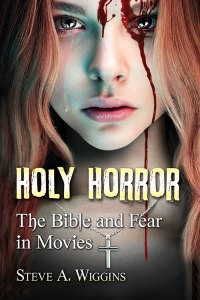
A used copy of Carrie recently came my way.  Now, I’ve seen the movie (both versions) many times; it is discussed at some length in Holy Horror.  I’d not read the novel until now.  Obviously there are differences between book and movie, but as this was Stephen King’s debut novel it struck me just how central religion was to the fearful scenario he paints.  That’s pretty clear in the film, I know, but it’s even more so in the novel.  Carrie is made into a monster by religion.  One could argue that she was born that way—telekinesis as a genetic marker is also a theme in the book, although absent from the films.  Still, it is Carrie’s rejection by others, largely because of her religion, that leads her to use her powers to destroy Chamberlain, Maine.

In a strange way, Carrie is a coming-of-age story from a girl’s perspective.  Strange because King is a man and some literary magazines won’t even accept stories written from the point-of-view of someone of the opposite gender.  Men can’t know what women go through.  Indeed, most of the male characters in the story are less than admirable, while some are downright wicked.  The real question is whether religion saves from wickedness or causes it.  There’s not much ambiguity here on the part of Mr. King.  Holy Horror, although it deals with movies and not novels,  makes the point that films based King don’t infrequently use religion as a source of horror.  Long-time readers of this blog know that I frequently make the point that this genre, more so than most, relies on religion as an engine to drive it.  And religion also has a role in repressing women.  Coincidence?  Ask Carrie.


Personal Gothic

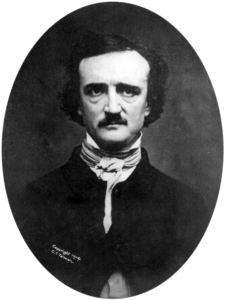
As I continue work on Nightmares with the Bible, I am reminded just how influential Edgar Allan Poe has been in my life.  It’s not that I read Poe every day, but it’s more that his stories have stayed with me since childhood.  For an English term paper in high school, the last one I recall writing, I selected Poe as the subject.  Something of the sadness of his life made me feel as though we were kindred spirits, although I could never meet him, and never let him know that he would have had a friend if he had been born a maybe a century and a half later, and if possible, in Franklin, Pennsylvania.  If his fondness for drink came with him, he would likely have met my father in such circumstances.

Even today I feel a kind of fiercely protective interest in Poe, as if his poems and stories had been written exclusively for me.  Seeing a handwritten fine copy of “The Raven” on display in the Morgan Library and Museum brought tears to my eyes.  Like Poe, I strive to make a living as a writer, but unlike Poe, I cop out.  I’m too afraid of losing everything.  Jobs necessarily interfere with writing, and some jobs actively discourage it.  Nevertheless, I still feel the shudder when I think about the first time I read many of his stories.  This was, I suspect, what fed my young interest in horror.  It wasn’t the blood and gore of the slasher film, it was the quiet, sad, disturbing atmosphere of Poe.  It has been recaptured by few, in my experience maybe only by Shirley Jackson.

Those who write are connection seekers.  Writing is a way of testing to see if we alone see the world in our own way.  Will others respond?  Poe somehow, mainly after his own lifetime, touched a responsive chord with many.  His work is now very widely known.  His visage appears on everything from bandages to socks.  His stories and poems are endlessly retold, adapted, and parodied.  When I read Poe I hear someone speaking from a life of hard knocks.  His response was to strike back, through his writing.  The life story written by one of his relatives suggests that he wasn’t as gloomy and tortured as he is generally portrayed.  Perhaps not.  Nevertheless, those of us who find gothic literature somehow redemptive know, once we close the cover, who it is we should thank.


Beneath the Exorcist

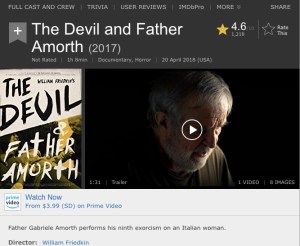
William Friedkin rose to fame as the director of The French Connection.  William Peter Blatty had written the screenplay for the Pink Panther film, A Shot in the Dark.  Now Blatty had a serious project in mind as he considered whom to pitch to direct the film of his novel, The Exorcist.  He wanted, and got, Friedkin.  The two disagreed about the final cut of the movie, with Friedkin winning out.  The movie was a tremendous success.  Several years later the cut favored by Blatty was released, again with success.  Blatty died last year.  The year before that so did Fr. Gabriele Amorth, an exorcist for the Diocese of Rome.  Last night I watched The Devil and Father Amorth, a documentary by William Friedkin about the famed exorcist.

The Exorcist made an impact on the lives of many people, not least Friedkin.  Over four decades after making this film, the director is still mulling it over.  The Devil and Father Amorth is primarily footage shot by Friedkin of an exorcism performed by Amorth.  In general the filming of exorcisms is forbidden, but given his stature as a film-maker, Friedkin was given permission to film without crew, on a small, hand-held video camera.  Although nowhere near as violent as the fictionalized film, it is disturbing to watch.  As a documentary, it includes interviews with doctors, some from Columbia University, who agree that possession is “a thing,” but one suspects they might disagree with the director as to what that thing might be.

Although Friedkin isn’t an academic, society accepts that (at least some) film-makers are intellectuals.  Perhaps lacking subject specialization, they nevertheless read a lot and possess quite a bit of street knowledge concerning psychology.  Friedkin does.  At just over an hour, this documentary isn’t long, but it is provocative.  For me it raises once again an issue that I address in Nightmares with the Bible—the curious laity, due to lack of engagement by traditional scholars, must rely on such efforts to get information about spiritual entities.  The documentary, which deals with a heavy subject, is one that Friedkin tries to lighten a bit at the end by stating that if there are demons then angels must also exist.  This goes back to the idea, discussed more fully in my book, that demons derive from fallen angels.  The “one size fits all” approach of academia has shoehorned belief in one direction.  While The Devil and Father Amorth won’t likely convince skeptics, many who watch it will be left wondering.


Where Was I?

Finally!  I have sent my proofs and the index for Holy Horror back to McFarland and I find myself in that state following intensive concentration on one thing.  Well, as much as work will allow such concentration.  Those who write books know how difficult it is to switch gears from fifth back to first while driving at highway speeds.  As soon as the email arrived stating that the proofs were ready, I dropped everything to get them read, outside work hours, of course.  With mind focused on a single goal—get the job done—I’ve managed to forget where I was before being interrupted by my own work.  I recall it had something to do with demons, though.

Perhaps the most taxing part of trying to write while employed full time is keeping track of where you are.  The luxury of spending hours outside of class doing the index, for example, is compressed into the little free time I have between writing for this blog and work—between a blog and a hard place, as it were.  Indexing, which can be quite pricey when a professional does it, is  much easier with a searchable PDF than it ever was going through a printout page-by-page to find obscure references you forgot you ever wrote.  It reminded me of the time I had Owen Chadwick over for dinner at Nashotah House.  I recalled someone asking him about something he’d once written and he looked puzzled for a moment and then replied, “One writes so many things.”  Indeed.  Millions and million of words in electrons, if not on paper, mark the status of a life.  And indexing will prove it to you somehow.

This morning I awoke with the proofs and index safely emailed back to the publisher.  What was I doing before that?  I know that work is looming just a short hour or two ahead, and I need to accomplish part of my life’s work before going to work.  I can’t afford to waste this time.  Nightmares with the Bible is coming along nicely.  A very drafty draft of the book exists.  I have some more research to do, however, and the annotated bibliography—ah, that’s where I left off!—is still a shambles.  Not only that, but I’ve got a stack of reading on the topic next to my chair.  Time to put on a pot of coffee and warm up those typing fingers.  I’ve got real work to do.


Dark Houses

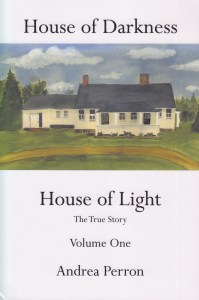
A book can be whatever an author wants it to be.  When it goes through the publication process, however, it becomes a group effort.  Granted, the other parties are motivated by money rather than by the message of the book, but they are professionals.  Editors can point out what’s irrelevant, or beside the point.  What you’ve already said, if you happen to repeat yourself.  What you’ve already said, if you happen to repeat yourself.  They change things, often, authors admit upon reflection, for the better.  The self-published book shows itself as just what an author wants it to be.  House of Darkness, House of Light: The True Story, by Andrea Perron is a case in point.  In three volumes of about 500 pages each, it is (they are) the insider story of the family portrayed in The Conjuring.  After having finished volume one, it’s clear the book needed an editor.

Don’t get me wrong; there’s some good stuff here.  The first couple hundred pages are fascinating, although there’s a slow build-up into moving into the Harrisville house.  One thing academics have always been too quick to do is dismiss the experience of non-trained observers.  We have to be skeptical, of course, to spot those who are intentionally deceitful, but a person doesn’t write 1,500 pages without cause.  People do experience strange things, and this book is a family’s recollection of events that inspired a horror movie.  There were a few points in the course of reading through that I found myself pondering new perspectives on the realm of ghosts—shifts of point of view.  There were many points, though, that I found myself muttering that an editor would’ve helped.

As a fully trained academic in the field of studies that handles issues of the soul, I am hungry for primary sources.  Sociologists and psychologists get their information from observers—ordinary people.  It’s only when the claims become extraordinary that such observations are called into doubt.  We have all heard of haunted houses.  We all know that sometimes strange things happen in them.  We can explain such happenings in different ways.  The skeptical explain them away as misperceptions, normal occurrences masquerading as paranormal.  The credulous accept everything at face value.  Truth, it seems to me, is a middle of the road phenomenon.  I’ve always sat on the fence regarding ghosts.  Too many people over too many centuries have reported them with great detail—witnesses include some very reputable and rational individuals—to dismiss them in toto.  After volume one, it seems that something worth exploring took place in the eponymous house.  For full impact, however, who you gonna call?  This time you’d better make it an editor.


Saturdays Past

Feeling somewhat between a state of self-pity and that of a salmon who couldn’t find his way upstream, I turned to horror.  The weekend before Thanksgiving has traditionally been AAR/SBL weekend for me.  I missed the Annual Meeting a few times due to unemployment, but for the most part I have been there every year since 1991.  As the representative of a publisher it is an endurance-testing event.  I had half-hour meetings scheduled all day on Saturday, Sunday, and today, and even a couple for the much neglected Tuesday morning.  Then I found myself home, awaiting a suitcase delivery.  United Airlines couldn’t say where the bag would be, and it only arrived Saturday night.  My wife had to work all that day, and so I turned to my boyhood.  Saturday afternoon was monster movie time.

For my current book project I’m discussing the components of The Conjuring diegesis.  I’m also trying to do some traditional research on the films.  Airport-lagged (I hadn’t been on a jet, but at my age being awake so late and sleeping so poorly has its own consequences), I pulled out Annabelle and Annabelle: Creation.  I wondered what it would be like to see them in the order of their plots rather than their actual chronological order.  Would the story hold together?  Would I find anything new?  The films discussed in my books are those I’ve watched many times—what I like to call “guilty pleasure research.”  Or just a boyhood Saturday afternoon revisited.  I couldn’t leave the house since I was told my bag couldn’t just be dropped on the porch.

From the beginning the story of Annabelle, the “possessed doll,” takes many twists and turns.  The demon is invited into the spooky toy by distraught parents after the tragic death of their child.  It then takes over an orphan who is adopted by a couple that she murders, as their natural daughter, in the earlier installment.  The doll is possessed in that telling because the girl Annabelle had joined a Satanic cult, like Charles Manson’s, and her blood dripped into the doll as she lay dying.  After claiming another female victim, the doll is sent to a couple of nurses as a present, where she appears at the opening of The Conjuring.  The story shifts with each sequential telling, leaving the binge viewer dissatisfied.  I haven’t had time for a double-feature since moving this summer.  Thick snow still covered the ground and the sky held that solemn haze of late November.  My colleagues were discussing erudite topics in Denver, and I was home using horror as therapy.  If you’re curious for further results, the book will be out in a couple of years.  Be sure to look for it at AAR/SBL.


Paying Troll

There was a time, should the media of my youth be believed, when a man insulted another man’s wife at his peril.  A barroom fight, or perhaps a sober brawl, would ensue.  Such chivalrous days are likely over and the internet makes nasty comments so easy to disseminate (how terribly masculine!) for all the world to see.  Hiding behind assumed names, avatars, or delusional fictions, you can feel like a big man by saying unkind things to a person you’ll never meet.  Such is the world of Trump’s America.  Although he may think himself divine, Trump didn’t invent Twitter or the internet.  Neither did Al Gore.  Still, the distasteful political rancor leading up to the midterm elections led to a man (I presume) trolling my wife behind a mask of Facebook anonymity.

It’s hard to tell how to react.  Feminism doesn’t always want a man to step in and defend, but we’re all raised with tales of princesses and those who honor them.  Having been raised by a woman with an absentee husband, I have nothing but admiration for strong women.  Although categorized as a “white man,” I can’t see my own brand as better than any other.  We are all human beings, and with some rare exceptions, we deserve respect.  Like all evolved creatures, however, I sometimes reach deeply back into my primate roots and the tropes of my childhood begin to simmer.  Who trolls another man’s wife over politics?  Who doesn’t stop to consider that every woman is a daughter and many are mothers and sisters?  If you want to pick on someone, well, you know how the saying goes.

The midterm elections brought some much-needed balance to a government way off kilter.  There are still trolls under the bridges, however.  The storybooks tell how knights vanquish trolls and even the liberated male can’t help but imagine himself on that proud steed.  What kind of man takes a keyboarded cheap-shot at another man’s wife?  The quality of his discourse speaks volumes.  Those on the left believe in equality and can’t respond in kind.  It is, ironically, a far more biblical response than trolling on the right.

I’ve lost readers of this blog due to politics.  Some of my former readers have even told me so.  I appreciate their candor.  We can’t all agree, I know.  What we can do, however, is be civil.  Those who put themselves in elected office know that they are opening themselves to criticism.  It is very hard to slander a United States president, in the words of the Good Book, “how the mighty are fallen.”  Those with thin skin should think twice (or even once) before running for the most criticized office in the world.  Most, until now, knew that what they said would set the tone for the nation.  We’re all entitled to an opinion, and, for the time being, are free to express it.  Still, I’d think twice before insulting another man’s wife.  But then, I’ve always been a hopeless idealist.


Residual Thoughts

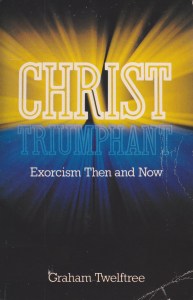
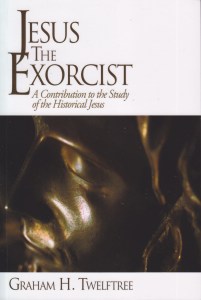
I feel compelled to say that this book was not among the overwritten tomes I mentioned in yesterday’s post.  Indeed, although the title reflects the outlook of the author, you need to get to the subtitle to find out what the book’s about.  Although I work at an academic press, I disagree with academic book pricing models.  Graham Twelftree’s previous book, Jesus the Exorcist, had to be picked up in a paperback reprint edition before it could be affordable to the likes of mere mortals.  After reading it I learned that Twelftree had written a more popular book on the topic—Christ Triumphant: Exorcism Then and Now.  Putting much of the material from the previous book in less technical terms, this version goes on to ask questions that can’t be put into a standard dissertation, such as “should exorcisms still be done?”

The academic is necessarily a skeptic.  One of the biggest problems our society faces is the open credulity of those who haven’t been taught to think critically.  Twelftree is a rare academic who keeps an open mind while approaching the material with a healthy skepticism.  Often it’s too easy to suggest that disregarding that which doesn’t fit a theory is the only way forward for an academic.  Sweeping off the table that which we don’t like.  The word Twelftree uses is “residue”—that which remains after the majority of possession cases have been explained medically.  The usual response is to disregard this small fraction of anomalous material and claim “case closed.”  In this book Twelftree dares to go further.

The supernatural has become an embarrassment for many, even in believing communities.  An interventionist god, or demons, would set off chain reactions that would distort the known laws of physics, so such things simply can’t exist.  Things which we can’t explain only exist because we haven’t got all the variables yet.  I recall how cold that made me feel when I first encountered the idea in physics class.  “Scientific determinism” it is sometimes called.  This little book rehearses the New Testament material covered in Twelftree’s dissertation, but goes on to raise the implications from that study and apply them to modern times.  It’s a brave thing to do in an academic world where brushes and brooms are very common.  Where residue is wiped up and tossed away without a second thought.  Those who stop to think through the implications are rare, which makes them so much the more interesting reading.  And not being from an academic press, such books are often  affordable.


Body or Soul?

Something’s wrong with Buddy Love.  He doesn’t act like a professor.  Meanwhile, Sherman Klump, heavyset but brilliant, feels that human companionship is passing him by.  Still, he’s a professor and has the support of a major university—at least as long as he brings the grant money in.  The Nutty Professor, a re-envisioning of the 1963 Jerry Lewis film, is instructive to watch.  One of the immediately obvious things to those of us who’ve been professors, is that movie makers don’t really understand what it’s like.  And it’s not just comedies—Indiana Jones doesn’t get it any more than Dean Richmond does.  Academics who watch these films shake their heads, if they think about the presentation of their profession.  Indeed, for being high profile, it is a job the public does not understand.

That’s not really what this post is about, however.  Although it’s been a few years, I suspect The Nutty Professor still has some currency.  In case I’m wrong, here’s the gist: it’s a modern, funny version of Dr. Jekyll and Mr. Hyde.  An overweight professor invents a formula that leads to instant weight loss.  The formula, however, also has side-effects, such as a boost in testosterone levels that leads to instability and violence.  In the climactic scene of the movie, Eddie Murphy transforms back and forth from Sherman to Buddy while on stage at the alumni ball.  Papa Klump, who has paid to attend, calls out, “Someone had better go and call the exorcist!”  

Now, this is screwball comedy.  Still, it reflects something that I’ve been struggling with in my current book—the public view of possession.  Demons aren’t generally known for changing body mass indices.  They’re after the soul, after all.  Still, there’s an element of truth, according to church teaching, about what Papa Klump says—demons are bodily afflictions.  Traditionally, they can’t impact a person’s soul.  In fact, possession is not considered a sin, and those under demonic influence aren’t held responsible for sins they commit while under that influence.  The soul is considered, unlike the physical body, something that cannot be “possessed.”  I know not to take movies like this seriously, but they do contribute to the pool of public “knowledge” about possession.  In this way, at least, it’s important to pay attention.  Such films may not really comprehend what the lives of professors are like, but they do reflect, even if in a nutty way, what people believe.


Organic Experience

Holy Horror, it looks like, has been delayed until January.  That doesn’t mean that I have to wait to find some relief in the escape to film.  Over the weekend my wife surprised me by being willing to watch The Exorcist with me.  As we settled in to see it, a few things occurred to me—watching horror with someone else isn’t nearly as frightening as watching it alone.  I know this from experience, and it seems that it has something to do with the willing suspension of disbelief.  It’s harder to do when someone is with you.  Left to one’s own devices, it’s possible to believe what you’re watching, even if intellectually you know that it is merely a movie.  That tells us something about the way brains are wired.

I object to the word “wired,” really.  As organic beings, we are not computers.  What invented consciousness would watch a scary movie for pleasure?  What is the rationale for it?  It was a gray and rainy Saturday evening in late October.  In human experience that may be all that it takes.  Seeing orange and black in the stores sets a mood that computers, I strongly suspect, simply can’t feel.  They lack the human experience of childhood trick-or-treating, or throwing on another layer as the days grow chillier, or watching the leaves turn and slowly drift down from weary trees.  No, these aren’t wired experiences—they’re very organic ones, and often those that mean something even to adults as the seasons wend their way through the calendar.

The author waiting for proofs is rather like an expectant parent.  Well, that analogy’s not quite right either, but you get the point.  I know the book is coming.  It was accepted and submitted long ago.  The publication process, however, is more complex than most people might assume.  In fact, in the publishing industry it is often the main role of the editorial assistant to assure that manuscripts make it through all of the necessary hoops to move from finished manuscript to printed book.  Johannes Gutenberg likely had a simpler process worked out, although, in the early days of book-buying you could purchase the pages and have them bound by your choice of bindery.  Now cover and content are glued or stitched together in what one hopes is a seamless way.  Still, that stitching can’t help but to recall Frankenstein’s monster.  It is, however, another gray, rainy day in October.  It’s just a shame my computer can’t share the experience with me.


Changing Times

Demons are an embarrassment.  The typical scholar of the historical Jesus can’t avoid the fact that one of Jesus’ main activities is exorcism.  You can go the whole way through seminary not hearing about that aspect even as you become very well acquainted with the two-source hypothesis.  That’s why I found Graham H. Twelftree’s Jesus the Exorcist: A Contribution to the Study of the Historical Jesus so refreshing.  Here is someone willing to address the topic generally swept off the table.  If the gospels are to be believed, then Jesus was an exorcist.  And if he was an exorcist, that must imply a thing or two about demons, no matter how embarrassing.  There’s a lot to this question, of course, and things are never as simple as they seem.

Many of those who look for the Jesus of history suggest that the Galilean sage simply accepted the framework of his era in which various diseases such as epilepsy were considered demonic.  As he healed such people—also somewhat of an embarrassment since it implies the supernatural—he understood their maladies in the same way his contemporaries did.  That tidy package, however, doesn’t sit well with narratives that assume a world full of demons.  Things have changed since the first century, of course.  After the Middle Ages demons fell out of favor.  And yet, the gospels remain pretty much unchanged, trying to fit into a new worldview.  This is the uncomfortable place in which those who seek the historical Jesus find themselves.

Twelftree approaches and analyses the text at its word.  The casting out of demons was an eschatological (end-times) act.  It was the beginning of the end for the evil spirits that torment this world.  Of course, two thousand years have come and gone and, according to some, demons are still with us.  The number of requested exorcisms has been on the rise.  The end times have lasted a lot longer than anyone anticipated.  It’s beginning to look like politicians can do what God seems reluctant to affect.  Bringing about the end of the world is no matter of clearing the house of demons, but rather letting evil take the helm.  If that’s a mixed metaphor, let’s just say demons are masters of confusion.  Since medical science has given us a great deal of comfort and relief from suffering, we’re glad to let demons go as the explanation of diseases.  But that doesn’t make things any easier for those looking at the first century when, as Twelfree demonstrates, Jesus was an exorcist.


Headline News

Some headlines just can’t be resisted.  George Knapp: Christian Fundamentalists in the Pentagon Shut Down Government Paranormal and UFO Probes Due to Demon Fears” is one such headline.  It appears on the blog of Jason Colavito, a name I recognized from the book The Cult of Alien Gods: H. P. Lovecraft and Extraterrestrial Pop Culture that I read several years back.  Skeptical of many strange claims made, Colavito criticizes journalist George Knapp for some sloppy reporting.  If you go all the way down the rabbit hole, you will end up in some very weird places indeed!  What caught my attention here, however, is the connection between demons and UFOs.  More than that, the claim that government funding was deep-sixed for fear of the Devil.  (Has anyone else noticed that it’s October?)

This isn’t the first time I’ve read about this.  Having grown up Fundamentalist, I often heard talk of the Devil’s wiles.  One of the things he had his demons do, I was told, was fly around in UFOs to deceive people into thinking demons were aliens.  If this sounds far-fetched to you, remember that God made dinosaur bones to plant in the ground to test people’s faith in Genesis 1.  That’s just the kind of universe we live in.  Better get used to it.  The real problem, and one with which Colavito concurs, is that high ranking military officers (and other government officials) believe the Fundamentalist screed.  This is a matter of documented truth—much of our government policy is dictated by the evangelical agenda.  Stranger than fiction.

In 1952 there was a UFO flap in Washington DC.  No matter how you choose to explain it, this is an incident on the public record, and the Air Force responded with its famous temperature inversion explanation.  At the same time, some Fundamentalists were thinking that demons had improved on the bat-wings they’d been using for millennia.  They now zipped around in silvery discs with the same object as they’ve always had—to dis the Almighty.  As entertaining as such a story may be, it becomes scary when it might indeed be the motivation for government action.  I don’t know about you, but when I look at just how much of my meager paycheck goes to the powers that be, I want to know that rational people are spending it wisely.  Wait.  Well, I thought some of them were rational until a couple of years ago, about this time.  In any case, we do get some entertainment value for our cash, which is some comfort I suppose.  Keep watching the swamp!


October’s Monsters

Blood and vampires go together like October and, well, vampires.  Although I don’t understand manga, I do know it’s extremely popular, and a friend has been lending me the volumes of Hellsing by Kouta Hirano.  In the past couple of weeks I’ve read numbers 4 and 5.  Hellsing sets up a world where the Catholic church destroys vampires, as does the English, Protestant organization Hellsing Organization.  The latter, however, has as its secret weapon the vampire Alucard who, in nearly every number, gets dismembered in some bloody way before pulling himself back together to overcome the enemy.  In the latest issues I’ve read the Catholics and Protestants have to cooperate against the threat of neo-Nazis (and this was before Trump was elected), who also employ werewolves.  (It’s October, remember.)

Having been pondering the vampires of Maine, I decided to read the next in my own generation’s vampire hero, Barnabas Collins.  I’ve been reading the Dark Shadows series by Marilyn Ross to try to find a lost piece of my childhood.  There was a scene in one of these poorly written Gothic novels that made a strong impression on me that I finally re-encountered in Barnabas, Quentin and the Nightmare Assassin.  Interestingly, in this installment Barnabas, the gentleman vampire, is cured of his curse while traveling back in time with Carolyn Stoddard.  The story doesn’t explain how some of the characters from the twentieth century appear a hundred years earlier, but it does bring an early encounter of the vampire against the werewolf—an idea monster fans know from its many iterations such as Hellsing or, famously, Underworld.

You might think vampires and werewolves would get along.  In both the Dark Shadows and Hellsing universes the personalities of both come through clearly.  Both monsters have deep origins in folklore and people have believed in them since ancient times.  Just because they’re not human, however, is no reason to suppose they’ll get along with each other.  As soon as Universal discovered that monsters translated well to film the idea began to develop that monster versus monster would be a great spectacle.  We had vampires and werewolves clashing on cheap budgets with fog machines.  A new orthodoxy was created that the undead just don’t get along.  It’s a idea that continued into the relatively bloodless Dark Shadows series, and on into the violent and gleefully bespattered Hellsing.  And since it’s October nobody should be surprised.


Collinsport

Nothing is ever wasted.  That’s my economy of the soul.  I spent my tween years mooning about Maine.  I’d grown up watching Dark Shadows after school and I’d begun reading the pulp fiction based on the series by Marilyn Ross.  My mother wondered how I could waste my time on vampire nonsense when there was sun shining outside and other kids to play with.  Little did she know that I was learning valuable lessons for the future.  My fascination with Maine—still intact—led me to vacation there whenever possible and over my career I’d applied to more than one or two jobs there based primarily on the potential reward of living in the same state as Collinwood and its spooky mansion  atop the cliffs overlooking the stormy Atlantic.  Once some friends in Norwalk, Connecticut took us to see the  Lockwood–Mathews Mansion, used for Collinwood in the movie House of Dark Shadows.   Such is the draw of childhood imagination.

What were these lessons I’ve mentioned?  Well, Collinwood stands outside the quaint fishing village of Collinsport.  Both are named after the family that houses some very dark secrets, as well as shadows.  Barnabas Collins is a vampire.  He has run-ins with many supernatural creatures, including ghosts, witches, and a few Scooby-Doo kinds of cases where someone’s faking the paranormal.  But Barnabas isn’t the only monstrous Collins.  His cousin Quentin, whom I kind of remembered being his ally, was an unstable werewolf.   Of course, I’m not sure there is such  a thing as a stable werewolf, but still.  Those in the family stay loyal, despite the beasts that lurk within their walls.  Some of the early Collinses were involved in the slave trade.

The Collins family has a long association with the state of Maine.  During the groovy 1970s they seemed somewhat progressive while maintaining the aloofness of the aristocracy they’d become.  Despite Tim Burton’s spin on it, they were the undisputed lords of Collinsport.  You felt you could trust them.  Unelected though they were, they possessed an innate sense of social responsibility.  I also learned as a child that, as appealing and tortured as they might be, you could never really trust a Collins.  Barnabas was not evil, but he was a vampire.  He required blood to survive, and his victims, like those of the current Collins of Maine, Susan, were female.  Any girl who trusted a Collins was in danger, unless she was their willing servant.  I was not squandering my childhood afternoons.  I was learning lessons about trust and its costs.