Addams Family Research

After having binged on Wednesday earlier this year, and wanting something lighter to watch, we finally saw The Addams Family.  Neither my wife nor I watched the television series too much when we were kids, but it’s probably no surprise that I watched it more.  As with Wednesday, if you didn’t see the television show, or read Charles Addams’ cartoons, you can still enjoy the movie.  After all, some of the salient aspects of the eponymous family are never explained.  Why are they so wealthy?  Things like that.  Although the movie, which is family friendly, can’t be called horror, it is a dark humor piece that scratches a certain itch.  For several years I’ve been pondering how horror has become such an amorphous genre that it really tells us little about a movie.  Taken literally, this one would be horror.
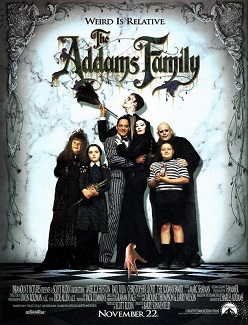
Not having grown up as a particular fan, I never really attempted to research the Addams family, but the basic idea was that they were people who lived as they liked, not caring what others thought of them.  They remain happy and cheerful in their macabre tastes.  The humor in such a situation is obvious.  The ultimate non-conformists, they are wealthy enough not to have to worry about fitting in.  Also, they tend to have some supernatural abilities.  Watching the show growing up, the character that never seemed to fit  the macabre image was Pugsley.  Often a partner in crime for Wednesday, his “monstrous” nature seldom seemed obvious to me.  Maybe it was his outfit.  In any case, not fitting in is what the show is all about.  Not fitting in and not worrying about it.

The plot of the movie is surely well known by now.  Gomez’s brother Fester is missing and a criminally minded Abigail Craven sends her lookalike son Gordon to take Fester’s place to get access to their riches.  The humor, apart from the madcap plot, often comes from subverted expectations.  A character points out a gloomy, macabre, or scary situation followed by a comment of how much they enjoy it.  As I’ve noted, taken literally such things define horror.  Horror and comedy can work well together.  In fact, I’ve reviewed many horror comedies on this blog.  I would have never thought to have watched this movie, however, without the prompting of Tim Burton’s Wednesday.  She’s an underplayed character in the series since the focus tended to be on the bizarre adults, as far as I can recall.  As Christina Ricci’s second feature film, her Wednesday laid the groundwork for the Burton series.  Maybe it’s time to do a little more research into family history.

Split Decision

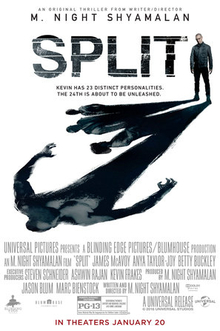
Sometimes advertising and packaging can make you ill-prepared for a movie.  I know that M. Night Shyamalan’s Unbreakable, Split, and Glass are considered a trilogy.  Without knowing the story, I saw the first film and discovered it was a superhero movie.  That’s fine, of course.  It’s not really horror much at all.  That’s maybe the reason Split caught me off guard.  It is brought into sequel territory right at the very end, but the story is tense and scary.  Kevin Crumb is a man with DID, dissociative identity disorder—what used to be called a split personality.  Quite apart from the inherently fascinating phenomenon (and the criticism the movie received for misrepresenting it), the idea that a person shifts and you don’t know who s/he is, is frightening.  A couple of those personalities have teamed up and become criminal.  Kevin abducts three teenage girls for a purpose that only becomes clear later.  Their efforts to escape create a great deal of the tension, and the quick shifting of identities that Kevin displays makes any kind of reasoning with him impossible.  

There are any number of avenues to discuss here.  One is that Kevin’s disorder stems from how his mother treated him as a child.  (Unintentionally I’ve been watching movies that trigger me that way lately.)  He developed personalities to protect himself from the pain and they continue to multiply.  Meanwhile, the kidnapped girls can’t figure out what’s going on but Casey (Anya Taylor-Joy—my first clue that this was horror instead of a superhero movie—)realizes that she has to treat the different identities in different ways.  Another avenue is to consider what “the beast” (one of the personalities) asserts: only those who’ve been broken are truly evolved.  Some children make it through difficult childhoods by becoming resilient while others don’t.  Casey, it turns out, also had an abusive relationship in her childhood.  Movies like this always make me reflect on how difficult being a good parent can be.

The person not in control of their own actions (ahem) is among the most frightening of human monsters.  Those with mental illness, however, seldom fall into this category.  I understand why mental health providers found this film problematic, but it showcases Shyamalan’s horror chops.  It was the scariest movie that I’ve seen in quite some time.  After I ejected the disc I felt bothered (and trapped) for quite a few minutes.  And I realized that if this is a trilogy then superhero and horror combined await in the third part.  We shall see.


Deadly Seven

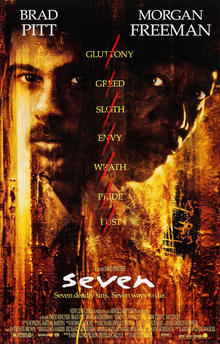
Seven, styled Se7en, shades more toward the thriller end of the stick than horror.  The two are very closely related, of course, but as a gritty cop drama, the main horror element is the gore.  And the serial killer.  Indeed, it’s often compared to The Silence of the Lambs, a card-carrying horror club member.  My main complaint is that much of the movie is shot so dark that you can’t see what’s going on.  The unnamed city is about as cheerless as Bladerunner, and even when people aren’t being stalked by the serial killer they’re being murdered anyway.  So this dark setting brings together two detectives, one retiring (played by Morgan Freeman) and one with anger issues (Brad Pitt) set to take over.  The two are only supposed to overlap seven days, but the seven in the title refers also to the seven deadly sins.  

A literate cop drama—Freeman knows his literature (Milton, Chaucer, Dante, and even Thomas Aquinas)—it is a step above the standard crime drama.  The fact that Freeman spends his nights in the library may be the reason some people consider this dark academia.  The academic part is otherwise absent.  In any case, it is Freeman who recognizes that victims are being killed for their embrace of one of the seven deadly sins.  An obese man is fed to death, a greedy lawyer has to cut off a pound of his own flesh (in a hat-tip to Shakespeare).  When Freeman’s character tells Pitt’s that it’s from the Merchant of Venice, the later says “I’ve never seen it.”  Not read it, but watched it.  It’s Freeman who recognizes the endgame that the serial killer is playing and tries to warn Pitt.  But Pitt’s wrath is also a deadly sin.

The seven deadly sins aren’t biblical.  They emerge in early Christianity, taking shape through such writers as Tertullian, Evagrius, and Pope Gregory I.  They have remained in Catholicism as  pride, greed, wrath, envy, lust, gluttony, and sloth (which sounds like the profile of some narcissists in the news).  They’ve been used in proper horror films as well as in thrillers, giving a convenient number of infractions to pursue.  Seven is one of those films that has become more highly regarded over time.  One might say that a prophet is without honor in their own time.  In any case, the movie is gripping and sad and a bit bloody.  It doesn’t unfold exactly as you might expect.  And no matter its genre, it can leave you thinking.


Not Fragile

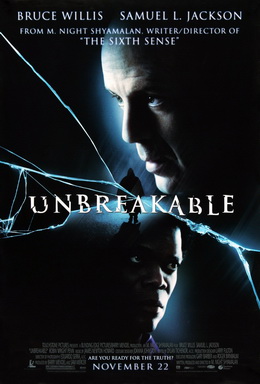
One of the problems with auteur theory is that you cast directors into an expected genre in your mind.  Or at least I do, and that is unfair to directors since they, like those of us who write, sometimes explore different genres.  My first exposure to M. Night Shyamalan was The Village.  Next was Signs.  And finally, The Sixth Sense.   (I was one of those creeped out by the “I see dead people” of the trailer for the latter, and it took several years for me to get over that.)  These were enough to solidify Shyamalan as a horror auteur in my mind.  I think the other films of his that I’ve watched, The Happening, Knock at the Cabin, have all been horror as well.  While some have classified it that way, many consider Unbreakable to be a thriller instead.  These two genres are very closely related, in any case, and I’d been wanting to see it.

Unbreakable is a movie to get you thinking.  It’s old enough that I’m not going to worry about spoilers here, so be warned.  David Dunn, after surviving a train wreck that killed everyone else, runs into Elijah Price, an art dealer and comic book aficionado, who is, literally fragile.  A rare disease renders his bones weak and since his childhood love of comic books informed his outlook, he wants to find a hero.  Dunn seems to be the man.  Never sick in his life, he survived a car crash with no injuries and his only weakness seems to be water (he nearly drowned as a child).  Price tries to convince him that he is indeed a superhuman, but his partially estranged wife disagrees.  Their son, however, believes.  The twist ending has us realize that Price has been conducting terrorist activities in order to find a hero and he “confesses” once he’s certain Dunn is real.

There are definitely some very tense moments in the film.  There aren’t any monsters, and Shyamalan wanted this to be known as a comic book hero movie (which it is).  He has directed some others in this genre as well, none of which I’ve seen.  I watch hero movies now and again, but they often lack the depth of good horror.  Unbreakable, however, does have depth.  At least it makes you think.  Is the good of convincing a hero that he can help people worth the hundreds of deaths it took to find him?  Price’s motivation seems pure, but his methods are evil.  These kinds of dilemmas are inherently thought-provoking.  But I will still probably continue to think of Shyamalan as a horror director.  Maybe that’s just wishful thinking.


Horror Time

In case anyone’s wondering (ha!), I haven’t lost interest in horror.  I’ve been discussing quite a few dark academia movies lately since that’s where I seem to be, but what’s really lost is time.  I’m no great consumer of social media.  I spend literally five minutes on Facebook daily.  Less than that on Bluesky and Twitter.  I don’t have time.  I love watching movies, but they take time.  I often discuss this with family—I’m not sure where the time goes.  In my case it’s not social media.  Much of it—the lion’s share—is work.  When a three-day weekend starts to feel like just enough time to get everything done before starting it all over again, I think there’s an elephant in the room.  If I can just squeeze past your trunk (pardon me) I would note that I spend as much time as I can writing and reading, but even that drains too quickly.

I read a lot.  And I read about writing.  Those who do it best have time to put into their craft.  If they’re working long hours, have a family, and weeds that love all the rain we get around here, they’re better than I am.  Home ownership (if you can’t afford to hire groundskeepers) is itself a full-time occupation.  As is writing.  And, of course, work.  What’s been suffering lately has been my time for watching horror.  Part of that’s money too.  I’m not sure if anybody else has noticed, but prices haven’t exactly gone down since January, and movies aren’t always free.  I have a long list of horror films I want to see (quite a long list), but tide, time, and money wait for no-one.  I even had a four-day weekend not long ago during which I had no time to watch horror.  Horrific, isn’t it?

I’m at a stage of life where the shortness of it all stares me in the face.  I was a late bloomer and my career never really took off.  It ended up taking time and not rewarding that time at the usual exchange rate.  I’m watching friends and family retire and some finding too much time on their hands.  Hey, brother, can you spare an hour?  I think of my farming ancestors where every minute was filled trying to stay alive in a world where leisure time really is a luxury.  I have no right to complain, but I do wonder where the time goes.  I suppose if I didn’t blog I’d have a little more time for horror, but I just can’t face giving up all this fame.


Bad Intensions

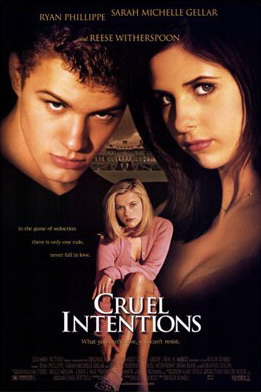
What, exactly, defines dark academia?  I ask myself that question a lot.  Looking for movies that might help answer that question sometimes brings about unexpected results.  A film that appears on several dark academia lists is Cruel Intentions.  I’d never seen it before and since it’s generally classified as a teen romantic drama, it isn’t exactly what I tend to go seeking.  Still, that definition is important to pin down, dark academia.  So I tried.  It presents itself, at least up front, as a teen sex comedy.  A rich playboy at a private school, and his scheming step-sister, enjoy destroying the innocence of new coeds.  She uses coke and he appears to be addicted to sex.  There’s not much to really like about either one.  Then the unexpected happens—he falls in love with one of his intended victims.

If the plot sounds a little familiar, it may be because it is a retelling of Dangerous Liaisons, a movie I’ve never seen based on a novel I’ve never read.  What makes it dark academia is that it takes place in a private school.  An exclusive private school (but aren’t they all?).  And it does take a dark turn toward the end.  The cad (Sebastian by name) is eventually caught in his relentless womanizing and although the woman he truly loves is a forgiving sort, it can’t save him in the end.  The movie has the fun of double-double crossing and certainly doesn’t paint a very flattering portrait of the rich.  Indeed, Dorian Gray comes to mind as well.

The movie, qua movie, is enjoyable enough.  The acting is pretty good.  I’d seen it described as a thriller as well, and there may be some junior-level thriller moments.  Dark academia, at its best, has some crossover with thrillers, or even horror.  Since the aesthetic appeals primarily to the young, it is perhaps inevitable that it goes gently into that dark night.  I’m trying to get a handle on it because it has captured my imagination.  In many ways dark academia has helped make sense of what has happened in my life.  I love the gothic aspect of the genre.  The few shots of the gothic architecture of Manchester Prep were appreciated, but the movie as a whole doesn’t have much of a gothic feel, beyond the monied privilege of kids who’ll probably never have to do a day’s work in their lives.  Dark indeed.


Finding Fossils

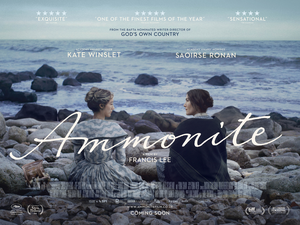
Mary Anning was a real woman.  She made valuable contributions to paleontology in the first half of the nineteenth century, although she wasn’t always credited for her work.  The movie Ammonite is a fictionalized account of her life at Lyme Regis, where she lived and discovered dinosaur fossils.  Being fiction, the movie focuses on how Mary “came out of her shell” by entering into a relationship with Charlotte Murchison (also an historical person, wife of the Scottish geologist Sir Roderick Impey Murchison) who was left in her care when she came down with a fever after trying to recover from melancholy by taking the sea air.  Mary had established a life of independence and wasn’t really seeking relationships; her mother still lived with her and, according to the movie, they had a distant but loving regard for each other.

I was anxious to see the film because it is sometimes classified as dark academia.  Since I’m trying to sharpen my sense of what that might mean, it’s helpful to watch what others think fits.  The academia part here comes from the intellectual pursuits of Anning and the academic nature of museum life (one of her fossils was displayed at the British Museum).  Anning, who had no formal academic training, tried to make a living in a “man’s world,” and in real life she did contribute significantly to paleontology.  The dark part seems to come in from her exclusion from the scientific community, and perhaps in her love for Charlotte, a forbidden relationship in that benighted time.  Of course, this relationship is entirely speculative.

Fictional movies made about factual people make me curious about the lives of those deemed movie-worthy.  Ammonite is a gentle movie and one which raises the question of why women were excluded from science for so long.  No records exist that address her sexuality—not surprisingly, since she lived during a period when such things weren’t discussed.  Indeed, she didn’t receive the acclaim that she might have, had she lived in the period of Jurassic Park.  She was noticed by Charles Dickens, who included a piece on her in his magazine All the Year Round, in 1865, several years after her death.  These days she is acknowledged and commemorated.  This movie is one such commemoration, although much of it likely never happened.  As with art house movies such as this, nonfiction isn’t to be assumed.  Nevertheless, it might still be dark academia.


What the Devil

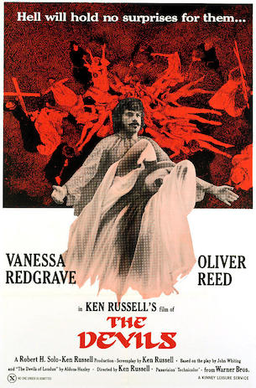
Apart from being one of the most controversial films of all time, The Devils is also devilishly difficult to locate.  For as influential as it was (you can’t tell me nobody in Monty Python saw this before making Holy Grail) it has largely been buried, at least in the United States.  It doesn’t stream and to get a viewable copy you are limited to a Spanish language import DVD and have to manually select English as the language if you want to hear it as produced.  The question is if you do want to see/hear it.  Written and directed by Ken Russell, it is over-the-top.  Chaotic and cacophonous, it’s almost distracting and somewhat boring for about half its run time.  Then it turns incredibly violent and grotesque.  So why did I watch it?  Well, for one thing, it was something I knew I could’ve included in Holy Horror, had I been able to access it then.  For another thing, I’d read about it many times and was determined to find it.

Based on historical events (but stylized to the point of abstraction), the film is about the Loudun possessions of 1634.  Nuns in an Ursuline convent began displaying the kinds of tics that girls would display in Salem some 58 years later.  A local, unconventional priest, Urbain Grandier, was accused of bewitching them and was burned at the stake.  The film makes much of the political machinations taking place, and revels a little too much in the behavior of the nuns.  It also enjoys portraying medieval torture methods and has an almost Clockwork Orangesque feel to it.  Released in 1971, it was given restrictive ratings where it was permitted to be shown, and although some horror has surpassed the excesses in recent years.

Religion’s relationship to horror is a frequent topic of discussion on this blog.  This movie is a textbook example of that.  After my nerves stopped jangling so much, I recollected that Ken Russell was also responsible for Lair of the White Worm.  Another story of debauched nuns and religion gone awry, it made me wonder what Russell’s personal interaction with religion might have been.  He apparently converted to Catholicism and then converted away again.  It certainly doesn’t get much sympathy in his movies.   Father Grandier is somewhat heroic in The Devils, but the overall institution is clearly corrupt.  In some cases religion is the means of fighting horror.  In other cases it is the cause of the horror.  Here the latter is clearly on display, and even that is, unfortunately, over the top.


Prior Memory

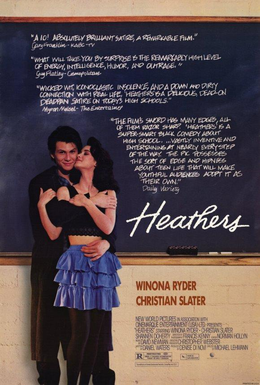
Sometimes I just don’t know where my mind is.  A few months back my wife and I decided to watch Heathers for the first time.  It got a bad rap when it came out but we finally gave in because there were so many cultural references to it that we felt we had to be informed.  Now none of that makes it worth comment.  What does, in what’s left of my mind, is that I was sure I’d written a blog post about it.  I hadn’t.  The thing is, I even thought I remembered some of what I wrote about it.  Uhn-uhn.  Didn’t happen.  So I guess I can trawl my memory and see if I can recollect what I thought I had already said.  Here goes.

The movie is a disturbing and funny look at growing up and its hard lessons.  Everyone said that it glorified suicide, but that wasn’t what I saw.  One person attempts it, and the others are all actually murdered and made to look as if they died by suicide.  Not a lighthearted topic, I know, but the students pretty much all want to live.  J. D. (read into that what you will) is the real criminal.  An outsider with a chip on his shoulder, and who has no problems being (or associating with) a criminal.  Or making others into criminals.  

As with many, perhaps most, adults, I remember the confusion of puberty quite well.  I wanted to be liked in school (I never had many friends) but I was quiet, bookish, and very religious.  Having grown up feeling generally unliked, I found acceptance, for a time, at church.   This movie captures that aspect well—the desire to fit in with a cohort that is particularly hostile (teenagers).

What brought Heathers back to mind after these few months was the fact that some classify it as a dark academia movie.  Dark academia generally has some schooling involved, sometimes directly, sometimes as implied.  There is a natural kind of darkness in high school and into college years.  This is something we may be in danger of losing with universities becoming glorified trade schools.  Not all of life is about finding a job.  The humanities suggest that being human is sometimes enough.  Heathers seems to have aged pretty well, being over thirty at this point.  Some of us took three decades to see it.  And if we feel like we’re losing our minds from time to time, at least now I’ll know I have indeed posted upon this movie.


Friendly Fear

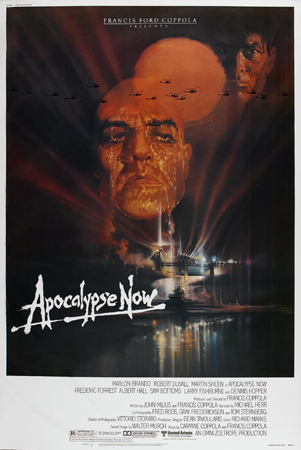
I opened my book Holy Horror with an epigraph taken from Apocalypse Now, a movie I recently watched again.  That quote was from Col. Kurtz: “It’s impossible for words to describe what is necessary to those who do not know what horror means. Horror… Horror has a face… and you must make a friend of horror. Horror and moral terror are your friends. If they are not, then they are enemies to be feared.”  I’ve been thinking quite a lot about how you can make any progress in a discussion with anyone who’s already made up his or her mind (i.e., no matter what you say to them they will not take it seriously.  Think your favorite Trump supporter).  People far smarter than I have noted that the only way to combat this unthinking adherence is to get people to think critically.  That may be correct, but to preserve democracy we need a more assured method in the short term.  That of Col. Kurtz.

Apocalypse Now was based on Joseph Conrad’s The Heart of Darkness.  Both contain a vital truth—fear motivates people.  Democrats have been forward-looking in recent decades, but Republicans run on that fear playbook and it’s very difficult to defeat.  That’s because people are afraid.  It’s important to face fears, but to win elections, you need to seed them.  I know whereof I speak when it comes to phobias.  I was so riddled with fear as a young person that at times I could not leave the house.  At other times even the house didn’t feel safe to me.  I had multiple phobias and difficulty talking to other people.  I’ve grown out of many of these fears, but if I’m honest, I know they’re still with me.  I suspect many other people are also afraid.

Strong men (even if personally weak) appeal to the afraid.  They want someone who can protect them.  I tend to think Democrats think many Americans are better adjusted than they actually are.  You want their votes?  Make them afraid.  I’ve been writing books on fear and its many cinematic manifestations for several years now.  I grew up being afraid of everything.  I don’t advocate creating fear, but when a nation decides Hitler would be better than letting young people read, it’s reached a crisis point.  I do wish progressive political leaders would consider my humble observations.  When afraid people herd together and become the mob with torches.  And just such a mob became the mindless followers of Col. Kurtz.  Just saying.


See Monsters

I have a soft spot for seventies movies, but I can’t decide if The Sailor Who Fell from Grace with the Sea is horror or not.  I found it on a horror list, and an oblique reference to Lord of the Flies got me interested.  It reminded me, in some ways, of The Wicker Man.  Although based on a Japanese novel, the movie’s set in England.  Two subplots seem unrelated except they happen to the same widowed mother and son.  The son is part of a group of five boys in a private school who have a secret society (echoes of dark academia here).  The leader, although not yet at puberty, is a sociopath who’s very bright and the others follow him.  He declares that a perfect balance (a very East Asian religious outlook) exists that adults simply cannot realize it.  Indeed, adults are bad.

At the same time, the boy’s mother meets and falls in love with a second-mate on a merchant ship.  The boy likes the mate too and feels that they have found a perfect balance.  Thus the two plots come together.  The boys in the club feel that the son has gone soft on their principles, and so to prove he hasn’t they arrange the vivisection of an anesthetized cat.  When the sailor returns, unexpectedly, to try to marry the widow, her son objects.  The perfect balance has been distorted.  The boys decide that the sailor must be treated “like the cat.”  They take him to a distant overlook on a pretense, and drug him.  In a long shot at the end, the boys gather around his unconscious body.  Now, the similarities to The Wicker Man may seem passing, but the idea of human sacrifice is there.

Is this horror or not?  Hard to say.  Most of the movie revolves around the mother’s relationship with the sailor (which the son watches, voyeuristically, through a knothole in his bedroom cupboard.  The secret society is always there, however, and when the plots come together you realize that the sailor will have to be killed.  Like Wicker Man, there’s nothing really explicit here, although Wicker Man does have a horrific ending.  The Sailor only has one by implication.  The leader of the secret society of boys is pretty scary and apart from the widow, parents are pretty scarce in the movie.  I was left wondering what it was that I’d just seen.  I can see why someone would list it as horror, but it had other echoes that I felt might fit better.  It was, however, free for the streaming.


Eye Eye

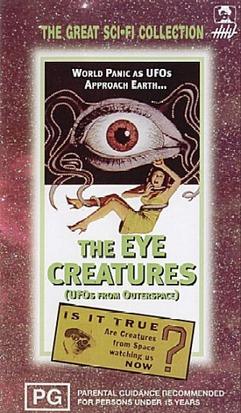
When trying to be conscientious about not spending too much money on movies there’s always the risk of seeing something cheap.  In the case of The Eye Creatures, not only was it cheap, but it was also a throw-back to childhood.  I remember seeing this one in my younger years, and, not yet old enough to be critical, loving the costumes.  Rewatching it as an adult, where some critical faculties remain, reveals it to be a bad movie.  Poorly written, poorly acted, and poorly financed, it ticks all the boxes.  It’s actually a remake of an earlier American International Pictures film, and AIP wasn’t known for its lush budgets.  To be fair, the film is supposed to be a sci-fi horror comedy, but the comedy isn’t that good.  The unintentional gaffs are.

So, the Air Force is concerned about keeping flying saucers secret.  When an “unfriendly” one lands where the teens all go parking, the Air Force investigates while the eponymous eye creatures terrorize the local kids.  Specifically, they seem bent on revenge against Stan Keyton and his girl, because they ran over one of the creatures.  Keyton gets arrested for manslaughter because the creatures substitute the body of a drifter they killed for the corpse of their own comrade.  The police don’t believe in aliens, of course, and the Air Force denies everything.  Keyton and gal decide, after discovering the the eye creatures explode when exposed to light, to round up the necking kids and wipe out the aliens with their headlights.  They figure nobody will believe them anyway.

Some movie monsters stick with you for decades.  The eye creatures are one example of this.  Simply seeing the movie title reminded me of them, although the only plot point I could remember was that they exploded in the light.  I didn’t recall all the voyeuristic watching of teens making out that the Air Force officers did.  Or the tedious revisiting of the Old Man Bailey character.  One of schlockmeister Larry Buchanan’s films, it was released the same year as his other cheap childhood favorite, Zontar, Thing from Venus.  As much as people like to make fun of makers of such cheap movies, Buchanan gained recognition in the New York Times (as have other makers of schlock such as Roger Corman and William Castle), so there is something to these movies.  For one thing, those of us who grew up in the sixties remember them.  And, if we also remain cheap, we can see them again as adults, and relive a bit of cinematic history.


Good Hearts

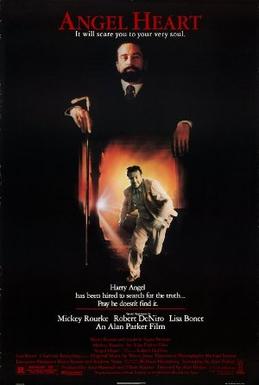
If you’re looking for more religion-based horror, you might try the 1987 film Angel Heart.  As I’m discovering quite a bit lately, I could’ve used this one in Holy Horror as well.  The religious elements are pretty hard to miss, beginning with the protagonist’s name, Harold Angel.  (Hark the, any one?)  A private detective, Angel is hired to find a missing person for a Louis Cyphre.  His search takes him from New York (where a guy keeps a pistol in a Bible (there’s maybe an entire book in this trope), down to New Orleans.  First he meets Cyphre in the back room of a black church but soon he starts getting chased out when he starts to uncover any clues.  Time to head to the Big Easy.

In New Orleans he finds all kinds of occult practices taking place.  And the folks are none-too-friendly when he starts making mention of the guy he’s after.  He ends up witnessing a voodoo ritual and complains about the bad religion he encounters.  The big reveal indicates that there’s been a case of mistaken identity.  Louis Cyphre (Lucifer) has actually been setting an elaborate trap all along.  The portrayal of the Devil as a sophisticated gentleman isn’t new, of course.  There is a scene where Angel and the Devil are in a church and Angel, being a detective, uses inappropriate language.  Lucifer (not yet revealed as such) has to remind him a couple of times to watch his tongue while in a sacred place.  Satan is more pious than Angel.

The movie has multiple issues, but it has become a cult film over the years.  Like many others that I’ve discussed on this blog, the entire plot draws its horror from religion.  Angel has a difficult time with the non-Christian worship he witnesses.  But really, it is the Christian Devil that’s the antagonist here.  Quite often in movies like this, fear of other religions is based on the supposition that Christianity is correct.  That’s been a broad American trait for centuries, and it gives horror room to run.  The idea of a generic Christianity (which is probably what most Christians hold to) overlooks the doctrinal differences, often quite significant, between denominations.  This particular avenue isn’t much pursued in horror films, at least in my experience.  Interestingly, like Cat People (1982), it places this religion-based horror in New Orleans.  There’s plenty to explore in that connection as well.  Angel Heart is not a great movie, but it can lead in some interesting directions; a holy sequel may be necessary.


Remembering Winter

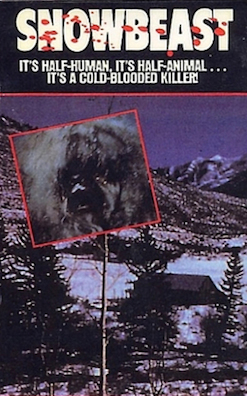
There’s a deep satisfaction at attaining a goal, no matter how low the bar.  Having rediscovered the “Beast Collection” after looking to see if Snowbeast was on it—it was missing from another DVD collection I have—I determined to watch my way through.  It took two or three months, maybe four, but I finally finished it out with Snowbeast itself.  One of a spate of Bigfoot films from the seventies, this was a made-for-television movie.  Many retrospectives show a movie going up in critical estimation over the years, but this one seems to have sunk down into the “bad movie” category.  But still, of the seven (!) Sasquatch films in the pack, it is clearly the best.  A low bar, as I say, but still, it has the advantage of being relatively well written.  Joseph Stefano, who wrote the screenplay, was one of the minds responsible for The Outer Limits.  He also had credit for writing the screenplay for Psycho

Decent writing can help redeem bad movies.  But more than that, you can actually care for the characters.  In some bad movies you have a difficult time raising any feeling for the people portrayed—that’s true for more than one of the other films in this collection.  Here are people that doubt themselves, but have good hearts.  The story isn’t complex (one of the reason modern critics scorn it).  A ski resort in Colorado—much of the movie shows people either skiing or snowmobiling—a young woman is killed by the eponymous snowbeast.  When the owner of the lodge insists on keeping it open for a festival, the current manager (her grandson) is reluctant to kill something that’s so human.  There’s a bit of a moral quandary here, which provides some traction on a slippery slope.

The beast then kills a member of the search and rescue team, and they know they have to destroy it.  The principal characters track it down, and after the beast gets the sheriff, they shoot it.  As I say, not much of a plot, but the characters have some depth.  It’s not a great movie by any stretch, but it doesn’t leave you feeling as if you’d have more enjoyed doing your taxes.  And that’s saying something for a collection of movies that cost less than most single DVDs.  Now if that makes me sound old, keep in mind that this movie was from the seventies.  And even if most re-appraisers think it has grown worse over time, I’m willing to disagree.  After all, I just accomplished something by watching it.


Step Far

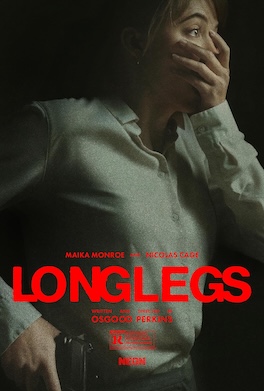
It made a bit of a splash when it came out, Longlegs did.  It took a while to get to a streaming service I can access, but I can say that it’s a movie with considerable thought behind it.  And religion through and through it.  I would’ve been able to have used it in Holy Horror, and it is one of the very few movies where a character corrects another, saying “Revelations” is singular, not plural.  Somebody did their homework.  Although the plot revolves around Satanism, you won’t be spoon-fed anything.  The connection’s not entirely clear, but it does seem to involve some form of possession.  The plot involves ESP and a literal deal with the Devil.  Things start off with a future FBI agent encountering Longlegs just before her ninth birthday.

As an adult, she’s forgotten the childhood encounter but a set of murders with a similar MO indicates that a serial killer, called Longlegs, is on the loose.  The murders are all inside jobs, and it turns out that a doll with some kind of possessing ability is responsible for inspiring fathers to murder their families.  No details of the connection between the dolls, Satan, and the reason for the killings ever emerges.  The movie unnerves by its consistent mood of threat and menace.  Satan, the guy “downstairs,” appears more properly to be chaos rather than a kind of literal Devil.  Satanic symbols are used and there are plenty of triple sixes throughout.  The Bible has a role in breaking the killer’s code, but talk of prayer and protection also find their way in the dialogue.  Longlegs uses a ruse of a church to get the dolls into his victims’ houses.

I’ll need to see it again to try to piece more of the story together, but Longlegs is another example of religion-based horror tout court.  Serial killers are scary enough on their own, but when their motivation is religious they become even more so.  Nicholas Cage plays Longlegs in a convincingly disturbing way, but there’s definitely some diegetic supernatural goings on here.  The art-house trappings make the plot a little difficult to follow, particularly early on.  Religion, however, shines through clearly.  The FBI agent, although psychic, has ceased believing in religion while trusting the supernatural.  Even as the credits rolled I had the feeling that I’d missed some important clues.  And those clues would be important, particularly if I ever do decide to write a follow-up to Holy Horror.