Sixes and Sevens

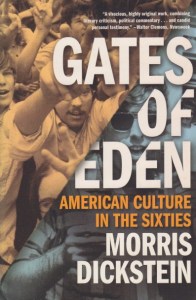
Few eras conjure mental images as readily as the sixties.  As the first decade of my life, I idealize them a bit, I suppose.  I wasn’t old enough to appreciate the truly wonderful and troubling things going on around me, and being raised in a Fundamentalist family I probably couldn’t have enjoyed many of them in any case.  Morris Dickstein’s Gates of Eden: American Culture in the Sixties was written in the seventies.  Since he’s a literary scholar much of the culture he analyzes is print culture, emphasizing the works of Jewish novelists and African-American writers.  That fits the sixties image pretty well.  He also looks at the music, but not as much as I had anticipated he might.  For me the music of the decade conveys what it really was about.

At one point Dickstein describes the political situation in the fifties that led to this incredible decade.  I had to remind myself that this was written forty years ago, for he seemed to be describing, with eerie prescience, the world of Trump and his followers.  Repressive conformity and the superiority complex of that era led to a breaking point where individual expression tumbled long-held rules and regulations that had tried to repress women and those that didn’t fit the WASP mold.  Most of us thought those controlling, catatonic days were over for good.  It seems we underestimated the will of those who lack imagination of where things might go if freedom were allowed to be free.  Some people, it seems, believed the sixties were a disease to be cured.

Historians who have a wider grasp than I do say that time has to pass before accurate pictures can emerge.  Instant potted histories tend to miss much of what becomes clear only with the slow passing of further decades.  To me the music defines them.  I only started to become culturally aware in the seventies, and that was in a small town.  When I learned to look back, largely in the eighties, I could see, and hear, that I’d lived through an extraordinary time.  The nineties, largely spent at Nashotah House, were again isolated from culture.  Who knows how this new millennium will be assessed?  Has a new music emerged that will help define us?  Or will it be, as Dickstein unwittingly projects, a new era of acceptance, love, and peace?  Or did the world really end at the millennium?   It could be, we might dare to dream, that a new decade as remarkable as the sixties is waiting to usher in Eden again.


January 2019

When January starts grinding you down you have to find something to hang onto.  See, I even ended a sentence with a preposition.  January.  If I’m not careful I can find myself getting quite depressed, so a bit of self-induced music therapy helps.  Although I hate to admit it, I am a bit of a fussy person when it comes to my likes.  My music tastes are quite personal and I mourn when a performer I like retires or dies.  There’s not a ton of stuff that I enjoy and I don’t listen to music as often as I should.  I work from home most days so I could have music on, but I find it hard to read (which is much of my job) with music playing.  Like I said, fussy.

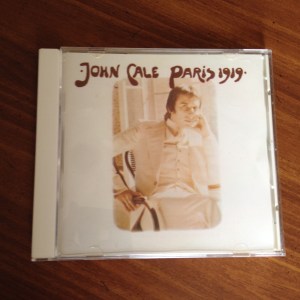
The other day—a weekend—I pulled out John Cale’s Paris 1919.  John Cale is an underrated member of the Velvet Underground.  Okay, with Lou Reed in the lead it’s gonna be tough to stand out.  Cale, who suffers from competing with J. J. Cale (who was actually John Cale too; I empathize!), is a very thoughtful lyricist.  Despite having been abused by a priest in his youth, he sprinkles his songs with religious references.  “Andalucia” is a haunting single with the words “castles and Christians” hanging there for anyone to interpret.  And “Hanky Panky Nohow” has an intriguing line about nothing being more frightening than religion at one’s door.  There’s something profound here.

I grew up listening to The Velvet Underground & Nico when my older brother played it and the curtain door between our rooms didn’t block any sound.  The only performer I could name was Reed.  Years later, when the music of my young, virginal ears started in with a longing I couldn’t explain, I bought the album and learned of John Cale.  I have to confess that I first encountered his name as the performer of Leonard Cohen’s “Hallelujah” in Shrek.  It drove me nuts when ill-informed students used to say it was Rufus Wainwright; yes, he performed it on the CD, but not in the movie.  John Cale is one of those somewhat offbeat singers, who, like Nick Cave, salts his songs with images of a Christian upbringing that show a grown man clinging to something to which he somehow can’t fully commit.  It makes us who we are and then leaves us wondering.  It must be January.


October Devotee

Here it is October and I have hardly written about monsters.  Apart from the US government, that is.  I suspect that I could use a little escapism right about now, and most of the boxes are unpacked from the move.  Perhaps it’s time to watch a little horror and feel better about the world.  Monsters, you see, crop up in the most unexpected places.  Yes, in October we expect them to be crouching in dark corners and in dismal swamps as the light begins to fail.  Yet the trees are still mostly green around here and I think I might be in need of some new material.  As with most people my age, I get lost on the internet—someone needs to offer a roadmap to it.  Preferably on paper. 

I admit being stuck in the past.  As any music therapist will tell you, a person’s musical tastes often reflect the sounds of their youth, and some of us believe that rock hit its high point in the 1980s.  My work doesn’t lend itself to background music, so I seldom listen to the radio, and I wouldn’t even know what station to try to hear contemporary offerings.  Fortunately I know some people half my age who find their tunes on the internet, and I was recently introduced to Panic! At the Disco via YouTube.  I’m old enough to remember when music videos first appeared, although I never saw them.  We lived in a small town and, besides, we couldn’t afford cable.  Kids at school, however, talked about MTV and other places—there was no world-wide web then, kids!—that they had seen the latest, coolest video that I could only imagine.  When my contemporary young friends showed me “LA Devotee” by Panic! I was stunned.

If you haven’t seen it, just look up the official video on YouTube.  You’ve got the whole internet at your fingertips!  While the lyrics seem innocent enough—young person wants to make it big and so imitates the Los Angeles lifestyle—the video is horror show.  Literally.  Borrowing from M. Night Shyamalan the opening sequence is a cross between The Village and Signs.  Then it becomes a torture chamber for a young boy (from Stranger Things, no less, a show I binge-watched when it came out on DVD).  And Satanism.  Yes, taking on the LA lifestyle is compared to selling your soul to the Devil.  The stunning visuals kept me clicking the replay button.  Even as I felt my age, I also felt October growing.  And I was glad to see the monsters are still there.  Too bad we can’t banish them from DC, however.


Jericho’s Folly

The sound was compellingly familiar although it had been years since I’d heard it.  We were visiting the Quakertown farmer’s market for the first time—this weekend event is widely advertised and we were curious.  Part fresh produce, but mostly flea market, it was a tribute to my generation.  You could find stuff from my childhood years here, making it a species of time travel.  We stepped out of the car on a gray morning when I heard it.  I was drawn to it.  I’m at the age where I recognize things before I can name them.  “Where are you going?” my wife asked.  “Toward Pink Floyd,” I replied.  Music has a way of doing that to you.  It took another minute for me to place the song.  It was from the album The Wall.

After we returned home I had to hear it again, uninterrupted by the distractions of a flea market to new home owners.  It was a frightening experience in the age of Trump.  Although they’d never been my favorite band, I had a long history with Pink Floyd.  My older brother used to listen to them, and when I was working as a church intern (yes, there is such a thing) while in college, the kids in a family I was staying with took me to see The Wall on laser disc—an affluent family in the neighborhood had just bought a player, and I was curious both about the technology and the film.  The Wall is one of those concept albums that requires attention—you kind of need to listen to the whole thing.  The accusations against those who are different being sent “up against the wall” chilled me with thoughts of Trump and American fascism.  I can only listen to the album within prescribed headspace.

Even those who’ve never been sent to boarding school can imagine how it lends itself to abuses and horror.  At Nashotah House the album was almost as frequently cited as Hotel California.  When the religious isolate themselves odd things begin to happen.  On one of the occasions when I was left home alone in our New Jersey apartment, I pulled out my DVD of The Wall and began to watch it.  As the years melted away, I suddenly felt young and intensely vulnerable.  The visuals, like a little pin-prick, were jabbing at nerves a little too close to the surface.  I had to turn it off and watch a horror film instead.  It’s even scarier to listen to the album when democracy has failed its constituents.  The wall, after all, is a most protean of metaphors.


Forever Jung

A funny thing about aging is that you recollect your youth, but you find yourself less able to do the things that seemed so easy when you were more spry.  We live in a world where the elderly are coming to outnumber the young, and that means a lot of memories of “the time when.”  This thought confronted me when reading a story about two missing patients from a nursing home in Germany.  Authorities were frantic to find them until they were spotted at Wacken Open Air, the largest heavy metal fest in the world.  The news stories seemed bemused—it was cute, in a way, wasn’t it?  Two old guys trying to recapture their youth, like salmon swimming upstream where they were born.  I’ve got to wonder if there’s more to it than that.

Music has a way of touching us deeply.  While I prefer my rock on the harder side, I’m not exactly a metal-head.  There’s something, however, in the rage of metal that resonates with some of us when we get older.  It’s almost religious.  You see, I recall hearing the music from my brother’s room when I was growing up.  As a naive fundamentalist, I sometimes went downstairs shaken, as if my virginal soul had seen some image it shouldn’t have.  Some teens reach a level of maturity before others, and metal speaks to them.  Let’s face it—life is unfair.  We see that every single day.  Music can help us cope with such unfairness and there are times when John Denver and James Taylor seem downright gullible.  Ask the elderly.

Our society harbors many myths.  One of them is that evolution doesn’t occur.  Not only is it a biological fact among species, but it’s also, on a macro-level, something that happens as we age.  Perspectives shift.  We come to see the wisdom of Heraclitus—no one steps into the same river twice.  Especially when it’s Styx.  Technology keeps us alive longer now, and sometimes it seems that it does so just to tell us what we can no longer do.  I’ve got, I hope, a number of miles left on the odometer, but my focus is on the car’s stereo system.  When driving to Wacken Open Air to pick up two men trying to plug into either the rage or the euphoria that heavy metal means to the elderly what comes through your speakers?  What would the “sweet Psalmist of Israel” have wanted to hear when not even Abishag could keep him warm?  Yes, Herman, there is a wisdom that is woe.  And banging your head may not be the worst option at such times as these.


Call It What You Will

I didn’t even know the House of Representatives had a chaplain. Then Paul Ryan fired him. I wondered once again if evangelicals were interested in religion at all. We all have labels we’d like to claim but lack of legitimacy prevents us from keeping them. My secret wannabe title is rock star, but given that I can’t sing and can’t play any instruments, I have trouble retaining it. Evangelicals, however, have no challengers. They are so flexible they’d make Proteus blush. Such theological promiscuity, traditional religion teaches, will have its comeuppance. If 45 has accomplished nothing else, he’s forced the religious right to show its true, secular colors. Of all the great ironies of the situation none is greater than the fact that “nones” of whatever description hold up the weightier matters of morality better than those most vocal about their faith. Evangelicals, however, control the narrative and claim to do so with God’s own authority. They have few challengers.

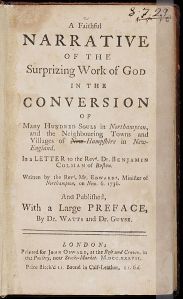
Source: Beinecke Rare Book & Manuscript Library, Yale University via Wikimedia Commons

Then, mere days latter, Rev. Patrick J. Conroy was reinstated by the whiplash GOP. Did somebody warn the religious right that “religious” was part of their name? “Hypocrisy” comes from a Greek root meaning to play a theatrical part. As my stepfather used to tell us, “do as I say, not as I do.” He was a secular man, so his hypocrisy could be overlooked. Noble, even, at times. When those who stake their entire identity on WWJD promote, vocally and enthusiastically, an unrepentant candidate for sinner of the year, you’ve got to wonder if even hypocrisy has lost its punch. How can you reason with people who refuse to reason? We used to lock them away in asylums. Now we throw them into the swamp.

Double standards are the new normal, I guess. Nobody really paid any heed when the fall of the towering televangelists showed, decades ago, that the idol they proclaimed as true religion was rotten to the core. Oh, they made the headlines for a while, but their tumble did nothing to dissuade their true followers. Evangelicals control their own narrative. For many decades now higher education and the media have pretty much ignored religion as a force for social change. Once upon a time Evangelicalism meant change based on ideals that more or less fit the recorded words of the carpenter from Nazareth. Now that its inspiration is the ninth circle below, those who have access to the funds of higher education prefer to put their money elsewhere. Why study something that threatens democracy on a daily basis? Why bother trying to understand Evangelicals? Call it what you will—there’s no way to object to anyone claiming whatever name they want. I should know; I’m a rock star, after all.


Original Sinner

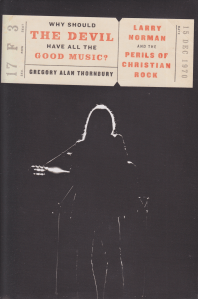
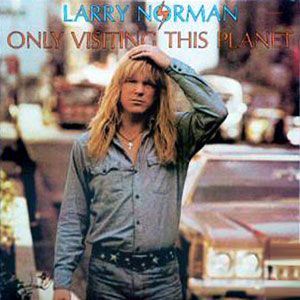
Musical preferences are a personal matter. In the case of the kind that loudly thunders from open car windows, often they should be more so. Still, music is a deeply moving phenomenon. When a musician is paired with a compelling personal story, it can be quite a gripping narrative. Gregory Alan Thornbury’s Why Should the Devil Have All the Good Music?: Larry Norman and the Perils of Christian Rock is one such account. Although Larry Norman was never popularly famous—many people today have never heard of him—he was a tremendously influential person. Like most true innovators he was, as Thornbury shows, a difficult person. He often had more enemies than friends, but there can be no doubt that he lived, at least in his own mind, by his convictions. And on his own terms.

I didn’t know until reading this brief biography that it was common for Larry Norman to wait around after concerts and talk with fans. When a friend invited me to see Larry in concert I was, as is generally the case, so wrapped up in my own issues that I hadn’t done much research. I was thrilled to see the artist that I, like Thornbury, had discovered during college. It was my friend’s idea to go backstage to talk to him. To this day those few minutes remain some of the most thrilling of my life. Norman was a name dropper, according to those who know, and I’ve met a few famous people over the years, including Jeff Bezos, but Larry was different. The breadth of his impact on rock in the 1970s and into the ’80s, was vast. Many secular artists count him among their most profound influences. And he had time to sit and chat with a seminarian from nowhere.

While my friend and I waited to see him, the guy in front of us wanted to play Larry a song. In an act of hubris I can’t fathom, he’d brought his own guitar to the concert. Larry kept saying “I don’t understand why you want to do this.” But surely he knew. Throughout his career he helped start many younger artists on their track, some to Christian stardom, others to more quiet lives. He had, however, something he couldn’t give away. Larry Norman was a true original. Despite his uneasy dalliance with fame, he was willing to sit and talk with a star-struck young man who would go on to become a lifelong admirer of an artist who remained true to himself, even if he was too Christian for some and too secular for others.


Situation Norman

It was in a locker room. I couldn’t believe I was here. First of all, at Gordon College—that bastion of conservative Christianity. Second of all, in the same room as him. A friend had offered to drive me up here from Boston, where we were both in seminary. I was a little saddened to see less than 200 chairs set up on the gym floor, carefully arranged on a tarp so as not to mar the shining wood beneath. Larry Norman came onto stage to great applause, and was remarkably intimate with his fans. He’d been a big name in the 1970s, almost single-handedly starting the Christian rock genre. After the concert was over, my friend said “Do you want to meet him?” Here he was, in the locker room, taking the time to speak with fans, individually. He refused to sign autographs, preferring to give the glory to the Lord. But he listened, he responded, and, it was clear, he loved.

While the sections of the brain that process religion and music may not be the same, we know that our gray matter is intricately interconnected. Analysts have noted that the most famous religious leaders of modern times have quite often been deeply affected by music. Religious services without some form of music are in the minority for a reason. And it really doesn’t matter what style said music takes, it moves people. Instead of apologizing for my own musical tastes, I’ll simply note that I was exposed to Larry Norman at a young age. Although his religious perspective and mine had parted ways before I had the chance to meet him, I’ve never disparaged his music. It is authentic, innovative, and above all, sincere.

Gregory Alan Thornbury has just published a biography of Larry Norman. I will surely read it. Although Christian rock has grown insipid and cloying since it began, it is still a remarkably lucrative business. Evangelicals will pay good money to get those rock rhythms with unthreatening words and praise of Jesus thrown in. Norman’s songs, however, were complex and nuanced. Equal parts love and social justice, they might not even mention Jesus. Or when they did, they might suggest he was a UFO. Unconventional. Blasphemous to some. As the ‘70s faded into the ‘80s, Larry Norman was considered old news. He had, however, started something that was bringing other people lots of money. And he looked me directly in the eyes late one night in the locker room of a conservative Christian college, and told me to keep on believing. Obscurity, he showed by his life, is no measure of a person’s actual importance. And music and religion can never be separated.


Blood Brothers

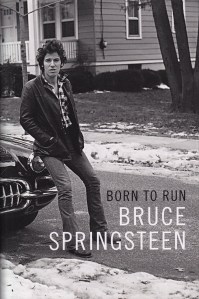
Every once in a while I take a chance and write about music. I don’t do this too often since it’s a very personal thing, and as open as I may be on this blog, I’m not as accessible as I seem. We all need a place to retreat in this world, and Bruce Springsteen’s music is one of those places for me. Late last year, just after it was published, Springsteen’s Born to Run—his philosophical and revealing memoir—sold briskly for several weeks. Since it made its way into my stocking I’d been intending to read it since then. And putting it off. There’s something disillusioning about finding out your heroes are only human. The best among mine are heroes precisely for that reason. Gods need not apply. Overcoming my fear, I dove in.

Two things stood out in this autobiographical account: religious imagery looms large, and depression mingles liberally with it. I recall reading an early review where the writer expressed surprise that the Boss suffers from depression. I responded (perhaps out loud), “have you ever listened to his songs?” I became a Bruce fan because he sang about working class people. Bruce and I share that background. He knows that your roots never let you go. Indeed, roots are what keep you grounded. Many of my academic colleagues, I learned, were simply carrying on the family business—and a privileged business it is. Those of us who had to overcome poverty to get in the door were never really welcome in the ivory tower. You can’t help where you’re born, but you can sure be punished for it. Bruce understands that.

I’ve never been to one of his concerts. I don’t even like to listen to his music when someone else is in the room. There’s something deeply personal about communing with someone you feel understands you. Of course I’ve never met Bruce Springsteen. I probably never will. He won’t know the kind of influence he’s had on my life and I feel that I’m risking an awful saying so here on this blog. There aren’t too many heroes in my life. I’m not inclined to idolize people. In this memoir, however, Bruce won’t let himself become an idol. He’s not perfect and he takes pains to make sure that you know that. We were, nevertheless, raised in situations not dissimilar from each other. Unlike Bruce, I have no musical gifts. No, I’ll never likely meet him—and if I did I wouldn’t want it to be with other people around. Some things are just too personal that way.


So Long, Marianne

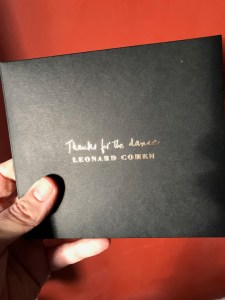
fullsizeoutput_122f“It’s a cold and it’s a broken Hallelujah.” Leonard Cohen has died. But can you blame him? This seems to be a week for losses. I came to appreciate Cohen’s work long after his best-known songs had been and gone. The interviews with and news stories about him that I’ve read convince me that he was an extraordinary man. Spiritual and sensual, he was a true contemplative. He strove to experience what it means to be human. I sometimes fear we’ve lost that as a goal. I see headlines proclaiming that we can now have chips implanted in our brains—we can become part computer. “You held on to me like I was a crucifix,” he once sang. Who believes in crucifixes anymore? Salvation doesn’t come from above. It comes from self-interest. From business and bank accounts. And that chip in my head.

My wife taught me the value of music therapy. When the forces of darkness gather, listening to music can help you through. Many artists have covered Leonard Cohen’s songs. So much so that some have forgotten who it was that wrote them. A true artist, I suspect, doesn’t mind. Those of us who delve in creativity know that we are more like receivers than gods. It takes worshipers to make a deity. The songs that Cohen wrote were messages to the world. Poetic and deeply personal, they are reminders that being human is okay. In fact, it’s what we’ve evolved to be. I have a feeling we’re going to be needing more poets in the days to come. Someone has to shine the shoes of those who work in Trump Tower. My mind is singing “Chelsea Hotel.” Everybody knows.

Cohen was a reminder that sacred and secular are not so far apart. In fact, they are often difficult to distinguish. There may be a problem when you discover that in seminary, but if you can put it into a song perhaps people will listen. Eras, it seems to me, ought to have anthems. F.D.R., one of the truly great Presidents of the century past, proposed “Happy Days Are Here Again.” I wonder what songs we’ll be associating with the presidency over the next four long years. Will there be any music at all? Far be it from me to proclaim any man a prophet, but can you listen to “First We Take Manhattan” and come to any other conclusion? Go to iTunes, or that chip in your head, and listen. You might just end up singing “Who by Fire” as well.


At the Crossroads

flood_album_cover

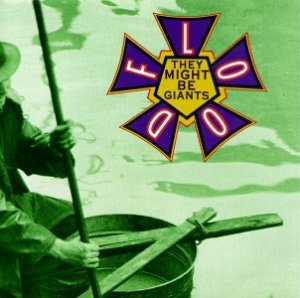
Back before there was iTunes—before Napster was even a thing—I heard a song on the radio. It was by a relatively new band, They Might Be Giants. We lived in Illinois at the time and I was being paid so poorly that we couldn’t afford luxuries like CDs. When I called the local radio station to ask them to play the song (“Birdhouse in Your Soul”) they apologized—they didn’t have the album. “We really should,” the receptionist told me. Although I was only earning a part-time salary—the fate of many a doctorate holder—and my wife was still in school, we eventually bought Flood. It quickly became one of our favorites. One of the songs that immediately struck us both was “Your Racist Friend.” It’s been going through my head lately, for some reason. “I know politics bore you, but I feel like a hypocrite talking to you and your racist friend,” the duo sings. I could quote the entire song, but let me highlight one of my favorite lines: “Can’t shake the devil’s hand and say you’re only kidding.”

I’ve been reading online that some people are saying, “Just get over it. You lost. Deal with it.” Auf Deutsch, “Komm damit klar.” After so many rounds of Kübler-Ross that Elisabeth is getting dizzy in her grave, I’ve begun to realize something. This was no ordinary loss. I’ve been alive long enough to be disappointed with election results several times. The psychological trauma from Tuesday rates somewhere between 9/11 and the Challenger explosion. To put this is perspective, when Reagan won I was depressed for a while, about as much as when the Steelers lost Super Bowl XL, and I’m not a sports fan. I’ve never spent the hours after an election glancing at the faces of others to see if they looked as damaged as I felt. “Just get over it” people?—it’s called shock. “Can’t shake the devil’s hand and say you’re only kidding.”

This was no ordinary election. Yes, I was born in the Kennedy administration. I was too young to understand Camelot, but I’m now old enough to read the writing on the wall. I saw our nation put a man on the moon. I felt the unending frustration of Vietnam. I watched Nixon resign after Watergate. God help us, I even survived two terms of W. I’ve never felt that we were bargaining our soul before. I was at the crossroads at midnight. I know what I saw. Can a man who has openly treated women as objects, insulted people for their race, and advocated thug violence to win lead a unified country? I don’t know. “If anything was broken I’m sure it could be mended,” the song says. Let’s hope so, but let me contemplate the ghost of democracy past. It’s my right.


Buying Intangibles

Perhaps it seems that I’m writing quite a bit about music these days. Being a theoretical and practical failure in the practice of music, it may seem presumptuous. If I’m honest, I’d admit that visiting the site of Woodstock was kind of a religious experience for me. That experience and the fact that popular musicians from my younger days have been in the news of late compel me to analyze a bit. My wife shared a blog post on John Pavlovitz’s website entitled “Bono Called Out Christian Musicians For a Lack of Honesty. He Didn’t Go Far Enough.” The screed is both about the Christian music industry and about current trends in evangelistic super-churches that share in the glitz and glam and leave you wondering what Jesus would do. The message of early Christianity and the sixties was similar: social justice, peace, non-judgmental attitudes, care for others, love all. Don’t worry about the bottom line.

Many churches, it has become clear in this age of nones, are struggling to compete in the spiritual marketplace. Since every institution must have “product”—not books, music, reverence, or worship, but “product”—money must change hands. If you have any doubts look at what the mega-church pastors are driving. Christian bands seem not to have a social conscience so much as a desire to feel good. It’s a thriving industry, for sure. Music that makes you feel safe is delivering false promises, though. The deity thundering on that mountain might ask you to sacrifice your own son, and there could be a good, solid backbeat to that. What is the role of religion in an entrepreneurial society? It used to be that you couldn’t buy what they were giving away. Everything now has a sale tag on it.

Back in college we used to argue about whether U2 was a “Christian band” or not. Clearly they recorded on a secular label. Amy Grant, the darling of 1980s believers, matured and seemed to fall from grace. Larry Norman, never part of the establishment, died too young. Music and religion both stand, in fact, out of the reach of sticky capitalist fingers. Anything that you have to pay for is more a cheap imitation. YouTube has made all of recorded history available for all. Even mainstream churches are experimenting with tablet hymnals and virtual communion. Grace mediated through a touch screen. Debit cards accepted. The only thing that seems to be missing is that human touch. That down in the mud reality of it all. Music that had a message and that message wasn’t about supporting convention. “Upon this rock,” you can almost here the man say, “I will build my church.”

IMG_2833


Simon Says

Music preserves your youth. When my wife was studying music therapy, one of the pieces of information she received is that those whose brains have begun to shut down the speaking faculties can still sing. People respond best, in such states, to the music of their youth. Anyone who lives long enough will decry the noise that the younger generation calls music. I’m thinking about this not just because of my recent visit to Bethel Woods, but also because of a New York Times story that Paul Simon is planning to leave the musical stage. Simon and Garfunkel was among the music of my youth. Accessible music with profound lyrics and, for the most part, a muted sadness. I grew up a long way from New York City, but listing to this music I felt like I was wandering the streets of the Village, soaking in a reality I would otherwise never experience.

It strikes me as no surprise that among the earliest manufactured artifacts discovered are musical instruments. While I seem to have missed nature’s boon in offering musical gifts, I nevertheless inherited the appreciator’s side. I don’t often listen to background music. I listen to music to listen. It carries its own meaning, akin to what we tend to think of as a religious experience. No doubt, for many, Woodstock felt like such an encounter. Music that could take you away from the troubles of a war-torn, prejudicial, jaded society. Even if only for a few moments. “I am a Rock,” was, for much of my youth, a kind of personal anthem.

IMG_2836

During a commencement address in not too distant months past, Simon told the graduates that ours was becoming a society at war with art. Music is money. College isn’t about becoming who you are; it’s career training. We don’t allow our young any time to explore any more. Few are willing to admit that capitalism, unrestrained, is just as bad as communism. Music used to be about the soul. The artists I know tell me it’s now about the cash. The man calls the shots. So as I stood on the hill overlooking the former Max Yasgur’s farm a few days ago, the lack of sound was poignant. There used to be, it seemed, different ways of existing in the world. Today the tempo is set and the music composed by those who prefer marching tunes that lead straight to the bank. Standing on that windswept hill I’m sure I can hear the sound of silence.


Things Remembered

IMG_2839 copy

Freedom. Independence Day is our celebration of liberty. Yesterday I happened to find myself at Bethel Woods, the out-of-the-way location in New York where Woodstock was held. Probably no one in 1969 realized just how formative Woodstock and its message of peace, love, and music would become for American culture. Those of us who came of age in the ‘70s learned about it as recent history (I was only seven at the time and, I’m sure, would’ve found the whole thing somewhat unChristian had I been here then). Much has changed in the intervening years. Not many peaceful events get so much airtime any more. Upwards of 400,000, basically unpoliced, youth, gathered in Bethel, New York, for three days of music, chaos, and peace. The Vietnam War was still draining our nation of its youth and murdering its idealism. Fear of the other, racial inequality, and male superiority were part of the context that led to the need for Woodstock. Freedom was free.

Often on this blog I reflect on the sacredness of place. Events that take place in a location leave their impression on the land. Bethel Woods Center for the Arts, the current administrators of the property, have left the field largely intact. As my wife and I stood at the top of the hill and tried to imagine almost half-a-million people here, it was strangely quiet. The nearby museum had plenty of music playing, but standing where it actually happened, there were only ghosts of an event studied in school and which, even today, kids can generally identify. I couldn’t have named every act that played the concert and, although the music was clearly important, it was the gathering that is most remembered. Self-governing youth getting along in an area so remote that still today you have to drive a couple miles to find even basic necessities, sent a powerful message. It was an event that, I fear, can never be replicated. The snake has spoken.

Nearing fifty years later, we’ve become so paranoid that anyone who looks Middle Eastern is under suspicion. Guns, which children of the sixties shunned, have proliferated and may now be carried, wild-west style, in many states. A fear-mongering candidate bellows fascism before the Grand Old Party. Remember, Nixon was president during Woodstock. I may have lived hundreds of miles from here, occupying myself with the matters that seven-year-olds find so pressing. But Woodstock happened. By the time I got to Woodstock, everybody else had gone. I see others milling about the museum, slightly older than me. Perhaps some of them were here for the event itself. We all seem to be searching for something here. The festival had its problems, for sure, but with a sincere belief in freedom, it makes the pre-seventies United States feel like a strangely foreign county. How do we get back to the garden?


Man’s Best Fiend

While reading the Hull Daily Mail (don’t ask), I came across an article entitled “Rock legend Alice Cooper ask questions about the Beast of Barmston Drain.” Apart from that lovable Britishism of making groups into grammatical plurals, this brief article gave me much to wonder about. After all, Paul Simon’s most recent album features a song entitled “The Werewolf,” (about which I recently wrote) and here is another rock performer from my youth raising the question about a similar beastie. According to the piece by Amy Nicholson, the Beast of Barmston Drain is a new urban legend about a creature half-man and half-dog. No doubt, werewolf reported sightings have been in the ascendent over the past few years, but how such an insignificant beast drew the attention of Alice remains unknown.

800px-Lycaon_Transformed_into_a_Wolf_LACMA_M.71.76.9

Many who know me—and those are few—are shocked to learn that I grew up listening to Alice Cooper. A fundie kid listening religiously to the father of shock rock? Songs about monsters, spiders, female maturation, and necrophilia? Perhaps it was because Welcome to My Nightmare just summed my childhood up rather nicely. Whatever the reason, to this day Alice Cooper is the only big name rock act I’ve even seen in concert. And that was only about six years ago, when I was still teaching at Rutgers. I had trouble hearing student’s questions in class on the next Monday night. Alice and werewolves in the same headline feels so much like yesteryear that it makes me want to believe in shapeshifters all over again. No wonder Hull is set to be the City of Culture. (Hey, Glasgow had it’s turn, so fair’s fair.)

To me, werewolves reveal much about a culture that strives to be far too civilized. We suppress our inner animal to become tie-wearing, wine-swilling sophisticates only to wonder where the wonder’s gone. And we start seeing werewolves lurking in culverts and drainage ditches. At least people are getting out at night. I’ve followed American tales of the dogman for years now, reading all of Linda Godfrey’s books on the subject. Even if it doesn’t exist, we stand to learn much of the creature that just won’t go away. Of all the transformations people talk about, that to the wolf is the most compelling, and among the most ancient. It may only be a dogman that people are seeing at the moment, but given some time it will evolve back into the wolf from which the story had its very beginnings. The answers, as always, probably lie in our childhood.