Hurricane Warming

Image credit: NOAA, public domain via Wikimedia Commons

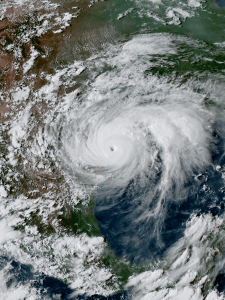
My heart goes out to those suffering from Hurricane Harvey in Texas and Louisiana. Natural disasters like this are often tied to the “wrath of God” model, and outdated though it is, it still captures how it feels. The sheer amount of rain dumped by this one storm is literally inconceivable. Trillions of gallons. Coupled with a completely ineffectual president, the disaster is even greater. Like many others, I’ve been watching since the weekend as the numbers and statistics of woe rise. Lives lost. Property washed away. Once more it reminds us just how small we are in the face of the weather. Some of this same awe was in my mind as I wrote Weathering the Psalms. Ancient Israel did not experience hurricanes—the bodies of water nearby aren’t large enough to generate them. A single thunderstorm, however, is enough to put the fear of God into a person. In ancient times, with an under-developed meteorology, all of this was the provenance of providence. How else could you begin to explain such tragedy?

One of the books that got me started on my meteorotheological quest was Erik Larson’s Isaac’s Storm, about the Galveston hurricane of 1900. Thousands died in that storm, and it remains the most deadly natural disaster in US history. Although Hurricane Harvey developed quickly, there was warning. The death toll is remarkably small (at least at the moment) compared to the fury of the storm. The natural tendency of human psychology is to look to supernatural explanations for such devastation. What have I done to deserve this? How could God do this? Are we being punished? Questions such as these come to mind, although we know that hurricanes are entirely normal features of this planet. Somewhere in the back of our minds, though, we probably are aware that global warming causes more radical weather.

Even as Trump continues to surround himself with climate change deniers, we see what global warming looks like. The weather is an intricate mechanism. Small things effect it. Large-scale changes throw it into chaos. Those who see climate change as a pain in the pocketbook will do anything they can to deny its reality. More powerful than a freight train or battleship, the weather can’t slam on the brakes and suddenly resume a more milder form. No, we’ve already started the process, no matter how many billionaires disagree. My heart goes out to those who continue to suffer from the hurricane. We need strong leadership and clear thinking at such times as this. We will need more of that in years to come. But we must also keep in mind this isn’t the anger of God. Unfortunately the wrath of human greed can be just as devastating as the wrath of the Almighty.

Ode to Hubris

One-hundred-five years ago today, one of modernity’s great achievements sank alone in the icy waters of the chilled North Atlantic. While the ultimate cause of Titanic’s demise may have been an iceberg, the proximate cause was surely much more common. Human arrogance, we’re reminded daily, never learns its lesson. Despite what elected officials tell us, arrogance at the top will always lead according to its surfeit of self-confidence. After all, there are no icebergs this far south so late in the year. It seems that we’ll never forget Titanic and the hundreds of needless deaths, but somehow we’re not very good at transferring the lesson to other media. Let me give just a small example.

Yesterday I was in New York City. My family came during the day to celebrate my wife’s birthday. One of the benefits of New Jersey Transit is that after 7 p.m. on a Friday, a monthly bus pass also works on the train. I can meet up with my family after work and we can ride home in comfort instead of taking the bus, such as I usually do. We didn’t know that at 3:30 that afternoon a train had broken down in one of the limited number of tunnels under the Hudson. (Governor Chris Christie had famously stopped work on another set of tunnels to ease the commute.) About twelve-hundred passengers sat for an amazing three hours with no lights, air conditioning, or announcements. No trains could make it into New York’s Penn Station. When we arrived, oblivious, just before 7 p.m. there were people pouring out of the station. Coats and clothing were strewn all over the steps, as if the homeless had been raptured. The police told my wife and daughter not to go down. A few minutes later they said, “Definitely no shots were fired.” When we got to the platform all the monitors read about half-past five. Discarded clothing was everywhere. It was only when we finally got on a train that we learned that in the anxious terminal where crowds were restless, Amtrak police had tazed a man. People thought shots had been fired, and panicked. The video taken by those in the station shows people running, dropping clothes, luggage, and shoes in their haste to flee. Just after this, we’d arrived.

Titanic, it seems to me, is about building something so massive that it can’t be controlled. Human arrogance is like that. This week we heard about United Airlines security beating up a passenger to make room for company employees who needed to be on an oversold flight. Just a couple weeks back another New Jersey Transit train derailed in Penn Station, disrupting for days the insane commute some of us undertake daily. Who’s the captain of this ship? Oh. But we don’t have to worry. There are no icebergs this far south this late in the year.


Interior Theodicy

Photo credit: Richard from Canton, Wikipedia Commons

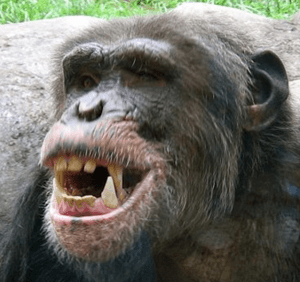
Speaking of theodicy, I have a dentist appointment today. Now, if you were raised with the Protestant guilt that used to be so pervasive in this nation, you’ll understand. I do brush my teeth twice a day. I even use floss and that mouthwash that burns away a layer of mouth lining every night. But there’s always more you could do. I’m not particularly good about visiting the dentist, though. Partially it’s a memory thing, partially it’s a pain thing, but mostly it’s a time thing. No matter how far back I jam the toothbrush, well beyond my gaging threshold, cavities seem to appear. And I don’t even have a sweet-tooth. What kind of deity allows cavities in a person who eats very little sugar and brushes so assiduously that last time the dentist told him to ease up a bit since he was scraping away the enamel? (People tell me I’m too intense.)

One of the real ironies of all this is that for all the trouble teeth give us during our lifetimes, they are our most durable parts after we die. Archaeologists find mostly teeth. In fact, it seems that Neanderthals might have practiced some primitive dentistry. I wonder what they thought of their neanderthal deity? So teeth are pretty useful, no matter whether the gray matter above them is dead or alive. I can explain this to my dentist, but he only seems interested in me as a specimen of carnassial curiosity. Maybe it all goes back to my belief that fillings were meant to last forever. Or all those root canals that seem to come in pairs that cost as much as a semester at a public university. Mostly it’s the memories.

In Edinburgh I had a tooth go bad. The Scottish dentist was surprised. “You’ve got a twelve-year molar erupting,” he said (you’ll have to imagine the accent). I asked if that was unusual. He owned that it was as I was a post-graduate student in his late twenties and the twelve-year molar was so precise in its timing that child labor laws used to be built around its presence. Years later in Wisconsin a different dentist asked about one of my fillings. I told him it was from Edinburgh. He called all the other dentists in announcing, “You wanna see a real Scottish filling?” Or maybe the fears go back to my earliest dental nightmares where the cheap doctor seemed unaware that teeth actually had nerves in them. I always left with a guilt trip. “You should brush —“ (more, better, longer, with a more gentle touch) you fill in the blank. I’m afraid of another kind of filling. And I know as it is with Protestant guilt, so it is with teeth. There’s always more you could be doing.


Blizzard Warning

The dangers of prognostication were well known in antiquity. Most prophets, who didn’t so much tell the future as warn about probable outcomes, weren’t the most popular of people. They knew that feeling of walking into a crowded room and announcing their career had something to do with religion only to have the place fall silent. Cricket chirps. We all have our secret sins we’d rather not have some stranger judge. So it is with the weather. Something like this must’ve been in the back of my mind as I was trying to write Weathering the Psalms. I lived in Wisconsin in the days before Paul Ryan and, like said Ryan, tornados could strike at any time, unannounced. My family and I spent an anxious afternoon or two in the spider-infested basement based on the inherently uncertain predictions of how a nearby tornado might move.

Those of us in the northwest are sitting here wondering about this monster nor’easter. It’s been in the making for several days and the forecasters, unlike the prophets of old, have been hedging their bets. If this massive cold front from the midwest fails to meet up with the intense storm off the east coast we could end up with only a smattering of snow. If the two collide, well, Isaiah, Jeremiah, and Ezekiel together can’t help us. It’ll be like the book of Revelation. Only colder and with far more snow. Oh to be able to predict the future! It would certainly help when it comes to deciding whether to climb onto that bus or not. I mean a simple rainstorm can add two hours to the homeward commute without the threat of a meteorological Trump coming our way. I thought Punxsutawney Phil didn’t see his shadow.

Although predicting the future wasn’t really what prophets did, it didn’t take long before people thought that’s what they were up to. People have always wanted to have the advantage of being able to see disasters before they arrived. Wouldn’t it have been helpful to know the results of 11/9 before Thurston Howell the President was elected? We could’ve bought our Russian grammars and dictionaries before there was a run on the local Barnes and Noble. At the same time I politely dispute the saying that hindsight is 20/20. If we could see anything that clearly we would be such Untied States at the moment. Right now the glass seems to be falling and the wind’s picking up from the northeast. What does it mean? Nobody really knows.


Stand Up

dscn4678

At first glance, we had little in common. In fact, of all the people in the room the only one I knew was my wife. We were gathered together to find ways to defend ourselves against our government. Those who normalize Trump and claim that his nearly 3 million vote loss qualifies as a mandate are blind. Those of us who have been complacent, believing that our government—even with obviously inferior candidates such as the Bush family offerings—was in the process of self-balancing have found the bar of the scales of justice broken. Founded as a democracy, we’ve “elected” our first dictator, who, if unchallenged, has already indicated that our civil and human rights are just chattels to be bargained away around the boardroom table. Once those of us who survive the next four years stagger out, I wonder if it won’t be time to establish a test to be president. A basic competency test.

For my job, I’m evaluated on basic competencies. An editor, for example, has to understand both the language in which the job is undertaken and possess a fair amount of skill in a variety of administrative tasks to perform adequately. Why doesn’t the most powerful job in the nation require a set of basic competencies? Things such as a basic vocabulary test and being able to point to foreign nations on a map? It may sound elitist, but I grew up in a working class family and although I’ve never run for political office, even I knew the value of legitimate education. Watching a politician surrounding himself by fact-deniers in a cabinet of untruth should demonstrate to even those who voted for him that we’ve put an incompetent politician in power. We’ve batted our eyes at a man we don’t know and have asked him to dance.

I’ve made it more than half a century without needing to be political. We now all have to become political. It’s distressing to see others my age saying “what can you do?” with a shrug of the shoulders. We can organize. We can resist. We can insist that the values that 3 million more voters showed in an historic win of the popular vote be represented by our government. This is not status quo ante. This is not just another political snafu. We all face a challenge to basic democracy and a level of untruth unprecedented even by politicians in the past two centuries. Don’t sit still. Get involved. Stand up for human rights, because your government elect has made it clear that it won’t.


Dinosaurs, Old and New

T._rex_old_posture

Tyrannosaurus rex, aside from being a photogenic movie star, was one of the top predators of its day. Ironically, in the Jurassic Park original trilogy (which would have been, more appropriately Triassic Park) tyrannosaurus rex becomes the ultimate protagonist, while unfeelingly killing to meet its own instincts. Since saying “tyrannosaurus rex” wears you out, we’ve become accustomed to calling the great carnivore t-rex. Everyone knows t-rex when they see it. Its a sign of danger, aggression, and unthinking acquisition. In one of nature’s great ironies, however, t-rex had tiny arms, nearly vestigial. What it wanted it had to get with its mouth. To live like that you have to grow pretty big, so big that nobody else can really challenge you. Punching is out of the question.

I’m often struck as how appropriate dinosaur evolution is to the human situation. Dinos (because “dinosaurs” is also too long) grew to be the top life-forms of their day. (We like to think of being the top. The perspective from down here in mammal land, in those days, was pretty different.) If you’re big enough, who’s going to stop you from taking what you want? Endless rows of teeth and a constant hunger can do wonders for evolutionary development. But then, extinction. Recent analyses have shown that it wasn’t as simple as an asteroid strike. It seems that many features of nature conspired against the dinosaurs, including the tyrant lizard king. T-rex had evolved into the monster featured in many pre-teen nightmares, only to be replaced by birds and mammals. Maybe it grew too big to be supported by the planet that allowed it to crawl out of the slime eons before.

In a recent photo of a Trump rally, one of the signs of a supporter had flopped over leaving just the word “rump” visible. I had to ponder this. T-rump. “Dinosaur” is a word used today to mean something that has outlived its time. Ideas, as well as such practices as, say, claiming that one race is superior to others, have rightfully gone extinct. There are those who say that t-rex was less a fierce carnivore than a scavenger. A vulture rather than an eagle. They claim that such a large snout and such small arms better suit one who picks at that which is already dead instead of working hard to bring down the more challenging beasts, often with horns. I’ve always thought dinosaurs were very appropriate metaphors for the human situation. Even Jurassic Park was superseded by Jurassic World, after all.


Moving Mountains

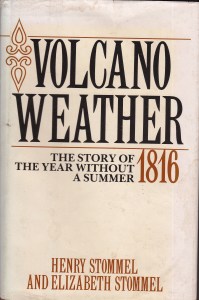
VolcanoWeatherJust 200 years ago, there was a “year without a summer.”  Well, that’s an exaggeration, but the name has stuck and is familiar to those of us with an undue interest in weather.  Although the coldness of that summer was far from universal, frosts came in New England in June, July, and August, killing off the staple corn crop for much of the region.  Snow fell even later than it usually does in the northeast, including a measurable fall in July.  My interest in this particular cooling episode was spurned by reading about the eruption of Krakatoa in 1883.  The connection?  Mount Tambora, a relative neighbor of Krakatoa, erupted in 1815 with an ejected debris volume of about ten times that of its later colleague.  The dust cloud from Tambora has long been a culprit for the dismal summer the following year.  Henry and Elizabeth Stommel researched and wrote a little book on this event entitled, Volcano Weather: The Story of 1816, the Year Without a Summer.  Although the book shows its age (it was written in the early 1980s), it remains a fascinating exploration of the many things that weather can do.  And has done.  Two of my favorites from this book were Napoleon’s adventures and the writing of Frankenstein by Mary Shelley during a rainy summer in Switzerland.
 
I should note, however, that the Stommels do not declare that Tambora was the reason for the year without a summer.  They tend to think the volcano had something to do with it, but the weather, that most protean of phenomena, can be impacted by the very small as well as the very large.  In fact, their description of the eruption includes the recognition that locals felt volcanic eruptions to be normal acts of the gods.  Many island cultures recognize the divine power of the molten earth.  The weather getting out of whack, we can be sure, leads to much prayer even today, thousands of miles from any eruption.  Something that hasn’t changed since the 1980s is that natural phenomena—especially powerful ones—evoke the divine.  Huge, impressive volcanoes, or even the very immensity and complexity of the atmosphere, suggest something we can’t comprehend.  Global warming will soon, however, bring this point home.
 

One of my takeaways from this book is the fact that the weather’s lack of uniformity emphasizes just how little we know.  The year without a summer mainly affected the northern hemisphere, and that only piecemeal.  Parts of northern Europe and North America felt it more intensely than other places.  It was not “the coldest year ever” and anyhow, is it even possible to know whether the coldest year would feel unnecessarily chilly where you are?  I’m pretty sure it’s snowing in some part of the world right now.  Human arrogance when it comes to global warming can be put into perspective by such acts of nature as Tambora.  From a human perspective, we live on a time bomb.  Volcanoes care not a whit for our bidding and wishes and dreams.  They can impact climate more instantly than our trite human efforts and thinking we alone are gods. To prepare for the future sometimes we need to look two centuries back.


Do the Twist

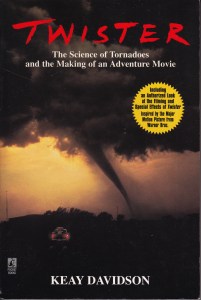
TwisterA used book sale is like a box of chocolates, if I may abscond with a simile that fits many scenarios. After all, you are there to buy books that others have discarded. Some of them show their age rather blatantly. Keay Davidson’s Twister: The Science of Tornadoes and the Making of an Adventure Movie is one such title. Those who know me well know of my fascination with weather—I wrote a little book on the subject based on that obsession. Although the weather informed and formed me long before I was ever near a tornado, these particular terrors were so exquisite that I couldn’t help but look. Although I grew up in Pennsylvania—not exactly tornado alley—one night when I was away from home a tornado swept by less than ten miles from where my family was. It toppled trees down one side of a hill and up another. It was eerie and uncanny and in many ways shook me out of the feeling that I never had to worry about them. Then when I went to Ann Arbor for a weekend with my fiancee the sky turned bronze. Rain was whipping past horizontally. Later we learned that a tornado had passed maybe four miles from where we were. Living in Illinois and Wisconsin, we experienced many tornado warnings. I never saw a tornado, but somehow thought I should.

It goes without saying that if I see a book on tornadoes that is reputable and cheap, I can’t pass it up. Davidson is a journalist whose work appears (as of the two decades ago when the book came out) in National Geographic. Some of you may not have been living in tornado alley twenty years ago, and therefore may not have felt the excitement that Twister, the movie, promised. By the time it came out I had already been thinking about Weathering the Psalms, at some level. I was a bit disappointed in the film itself, but it does mention that an F5 tornado is “the finger of God.” Davidson’s book picks up on this as well. At several points witnesses, and even scientists, lapse into divine language to describe tornadoes. One person even says that a tornado is an image of God, or that the storm is God. That’s a very natural way for people to think. The power of a Midwest storm has to be experienced to be believed.

The divine represents the highest echelon of language. The tornado fits because it is the most powerful wind on the planet. Concentrated, raging, and fickle. One can’t help but think: I was raised Protestant, what if the Catholics are right? Substitute any religion in either half of the equation. The weather simply does not do what we want it to do. It reminds us that humans can’t comprehend our own atmosphere that we so blithely pollute. The book may look dated—who remembers Twister anymore?—but it is a forceful reminder. When you need a metaphor for the most intense experience the weather will always be waiting.


Fast One Flood

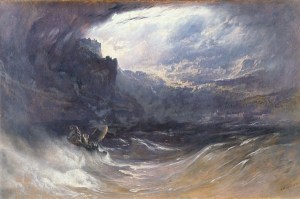
I’m not sure what to believe anymore. This crisis of faith revolves not around religion, but around media. Pundits have been saying for some time that the internet has meant the slow death of journalism, and there are so many websites that redistribute news that its like the whole world is involved in a constant, perpetual game of “telephone.” All of this is preface to a story a friend sent me that appeared on the website God. I’m not sure I trust God. The story is too good to be true. At least in a schadenfreude sort of way. God is hosted on thegoodlordabove.com, and, well, we all know about dot coms. The article concerns the destruction of Answers in Genesis’ Noah’s Ark theme park by a flood. That is believable. Floods do occur, as Noah knew. What becomes unbelievable is that the National Weather Service forecaster stated that there were no storm clouds in the area at the time. That qualifies as a miracle.

Martin,_John_-_The_Deluge_-_1834

Did this really happen? I don’t know. I wasn’t there. Plenty of times when I was there (wherever there happened to be at the time) I wasn’t even sure what happened. Can I find the truth? One of the police sites for internet rumors is Snopes (also a dot com). I remember when Snopes began as a place to quell fears of urban legends. Back when the worldwide web was young, there was a verisimilitude to stories gleaned from the net. Living in the sparsely populated Midwest, it was easy to believe that some of these things could happen to you. At times I held onto Snopes like a crucifix, especially if I had to go out alone at night. Snopes tells me that thegoodlordabove is not to be trusted. The story is false, like others that have originated on the site. Answers in Genesis, unfortunately, is still going strong with its theme park.

Authoritative texts aren’t what they used to be. There was a day when all you had to do was pull a black leather book off the shelf to find the definitive answers. In Genesis or any other of the books. Now we rely on the worldwide consensus of the web. You can’t trust God on a website. Snopes, however, is pretty reliable. It’s the Scully to our natural Mulder. That’s why the web will never have the same impact as print media. Even the website for your bank or government can be cleverly faked. I might’ve looked no further had the purported flood not fallen from a cloudless sky. I guess I’d better be a wary believer. For the internet tells me so.


Meaningful Fear

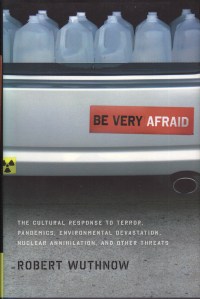
BeVeryAfraidReading about the things that wrong, like terrorist attacks, may not be the best way to occupy your time on a bus heading to New York City. Robert Wuthnow’s Be Very Afraid is appropriately titled, in any case. I had been warned. Discussing sociological reactions to nuclear war, terrorism, pandemics, and global warming, Wuthnow suggests, sensibly, that action is the best response. He also points out that, statistically, people tend not to panic. What I’d like to focus on is his repeated assertion that humans need to find meaning. Disasters only bring this into clearer view.

We live in an age when religion and philosophy have been relegated to the children’s table of academic pursuits. They are, however, the traditional intellectual ways of finding meaning . Economists may be paid much more, and scientists receive more respect, but when the bombs fall or avian flu really strikes, even they sometimes turn to their beleaguered colleagues for answers. Money is notoriously poverty-ridden when it comes to purchasing meaning. Reductionistic materialism may allow a final shrug as the curtain falls, but plenty of scientists hope for a little something more. Not everyone, of course, finds meaning in religion or deep reflection, but we are all human and we want to know what it’s all about. We need to have somewhere to look.

Even as a child I was preoccupied with meaning. I wanted to be the usual things when I grew up—scientist, firefighter, G.I. Joe—but when it came time to make actual choices I moved in the direction of careers that would allow me to find meaning. I swiftly learned they didn’t pay well. Money is not meaning, however. I was teaching in a seminary when 9/11—a major topic of Wuthnow’s study—occurred. I saw people desperately seeking meaning, but not knowing where to look. This was just my fear, growing up; what does it profit someone to gain the whole world if s/he is groping about in the dark for meaning? We’ve created a world where even greater causes of fear are likely to arise. In our emergency kits, it seems, we should leave a little room for meaning.


The Philosophical Neanderthal

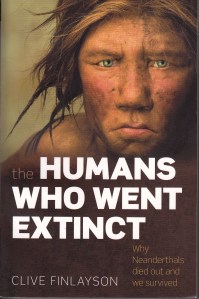
HumansExtinctExtinction. It’s a depression concept, but one that nevertheless constitutes a reality in evolution’s world. When applied to members of our own species we term it genocide and declare it an evil. Our perspective—not to dispute the value judgment—is hopelessly foreshortened. Our brains have evolved to promote individual survival, not to see the longue durée. How often do we worry about the extinction of Homo erectus? Or the australopithecines? Without them we wouldn’t be here, and yet, they’re gone. The case of the Neanderthals is perhaps closer to home. We now know that Homo sapiens overlapped with Neanderthals. Some of the questions raised by Neanderthal extinction are given serious consideration by Clive Finlayson in his study, The Humans Who Went Extinct: Why Neanderthals Died out and We Survived. To get a sense of how this works out, and how it applies with our current contribution to global warming, we must be prepared to view the extreme longue durée. Duration beyond comprehension.

One thing that becomes clear from the very beginning here is that climate has driven evolution perhaps more than we often think. Species, which tend not to live through the relatively long reach of climate change timescales, adapt to the circumstances of their environment. They either do, or they go extinct. Climate, however, is a balancing act teetering toward equilibrium. Hot and cold, evening each other out. Over an even longer duration, our sun will run out of metaphorical steam and things will get quite a bit chillier out there. For the meantime, however, shifts between ice ages and periods of warming will continue to seesaw across time and our race, among many, will need to adjust to survive. Perhaps acknowledging our own role in the current global warming might be a way to start. Our species tends to be short-sighted.

There is an irony here. History and prehistory have shown that, as Finlayson points out, that those best equipped to survive radical changes are the poor. Extinctions—some of them quite dramatic—have occurred before. They will surely come again. When times get tough, it seems, the comfortable get going. Going extinct, that is. Those who climb the corporate ladder the highest have the longest distance to fall when things go bad. The poor, who have to struggle every day to survive, are the ones who know how to get along in circumstances that turn sour. I have called this an irony for what might seem obvious reasons. There is another as well; here we have science pointing again in the direction of the Bible. There it was noted long ago that the meek would inherit the earth. And that’s a bit, it seems, that should be taken literally.


Can of Worms

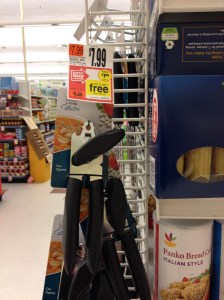
A great variety of food comes in cans. My mind naturally turns to vegetables and beans, but “tinned meat” was a staple of my childhood, including the now derided Spam. When I see octopus and squid in cans I’m glad I’m now a vegetarian. Once—it may have been in Canada—I even saw bread in a can. My wife and I used to can vegetables at home when we had a garden and commuting didn’t eat up every spare second of the day. For the store-bought can, however, a can opener is essential. The idea is to seal the outside world out, to avoid contamination. To get to the goodies inside you need a tool. A can opener. In these days of emergency preparedness, a can opener can be a matter of life and death, or so we’re led to believe. Dry goods can survive without special preservation, but most require cooking and if the power’s out, well, cans can be much easier. I’m writing about cans because our can opener doesn’t work. We don’t have one of the electric machines that takes up counter space and would be useless in an emergency, but the basic hand-held device that’s designed to remove the lid from a can. I hope there are no hurricanes before we can get another.

A little context is in order here; after all, this blog is about profound things. We’ve gone through four can openers in the past six months or so. (Similar statistics apply to rotary cheese graters and garlic presses, but they are less crucial in an emergency.) The underlying issue is ethics: when you buy something durable, you expect it to last. Now you’re probably thinking, “don’t buy cheap merchandise, then.” We tried getting all of these devices from kitchen stores (not outlets!) and for a price that edged us beyond the comfort zone for a basic tool. These were the ones that went defunct the quickest. Our economy is built on the premise that people have to spend. When I was a kid, we had a can opener that remained the same through my childhood and college years. And we were poor. Now that we’re warned of terror on every side, you’d better have access to a store when that emergency comes because your can opener can fail you.

I know how to use a pocket-knife can opener. In fact, over the holidays I had to resort to one since stores weren’t open and our most recent addition to the can opener family had died. I made sure to show my daughter how to use the pocket knife device. When we lived in Wisconsin we learned how to make our own candles too. During Hurricane Sandy, a decade after they were dipped, these candles proved their worth. With no electricity for three days, we did rely on a can opener. Since then we have not found one that lasts. It seems that our economic plan as a nation is at odds with our national emergency preparedness. Even in the event of a war, we’re told, companies won’t produce weaponry unless they can make a profit. In days like these it seems that a pocket knife might be the wisest investment of all.

Why would anyone need two?  Now I get it!

Why would anyone need two? Now I get it!


Storm Watch

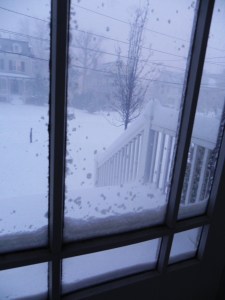
Nothing encourages sleeping in like a blizzard. Although it’s a talent I’ve largely lost over the years, hearing the bellows of the wind and seeing the white reflecting through the blinds, and being a Saturday morning form the perfect recipe for letting my brain relax enough to fall back asleep after I’ve awoken. It’s a guilty pleasure that I had, quite honestly, nearly forgotten. Unlike several winter storms predicted last year, this one has actually come to pass. Prediction of the future may be one of those “God-of-the-gap” things, but meteorologists are modern-day prophets. In a society driven by work uniformity, days off are unwelcome, so a weekend blizzard might just seem to come from God. The highly anticipated list of school closings simply doesn’t apply. Many businesses still recognize the sanctity of the weekend, and we can just roll over and go back to sleep.

In ancient times the weather was anything but natural. The sky—so large and so far away—was purely the realm of the divine. The only way to impact it from down here was to pray and sacrifice and hope that it would behave. Getting back to that view of the world is nearly impossible here in the twenty-first century. We are so accustomed to natural causation that it is just one of those “butterfly effect” things. In truth, though, we know that human activity also has to share some blame with the butterfly.

Winter storms in January are not uncommon in the northern hemisphere, of course. January hurricanes, however, are. And as political rhetoric heats up and we once again ponder what it would be like to have another clown in the White House, global warming is dismissed as just another bad joke. As a nation we’ve been enamored of those who can provide the most entertaining gaffs and still claim they know enough to lead the nation. I have a hard time believing those who voted for Reagan had any success at separating fiction from fact. I still can’t convince myself that W was legitimately elected. The second term of both of these actors freezes me as much as the chill draft making its way through my apartment. The meteorologists nailed this one with their predictions. I’ll stay inside and huddle under my blankets until the all clear. And that may not be until well after November.

DSCN6166


Death by Molasses

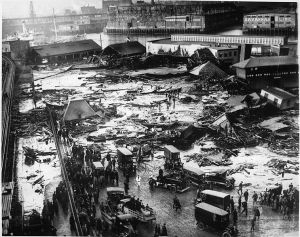
Ninety-seven years ago today, 21 people were killed by molasses. Even having lived in Boston, I had never heard of the Boston Molasses Disaster. Credit for my awareness has to go to my wife, who read me the story from the Oxford Companion to Sugar and Sweets. I had no idea that molasses had been weaponized. The sweet sap, apart from making cookies, can be fermented into ethanol, used for munitions manufacture. In the North End of Boston a hastily constructed tank holding about 2 million gallons of molasses burst on this date in 1919, creating a sticky, 25-foot-high wall that raced through the North End at 35 m.p.h., killing those unfortunate enough to have been in the way. According to the Companion, 150 others were injured.

BostonMolassesDisaster

We’ve all heard about the slowness of sap in January. Apparently the temperature had risen to above freezing this particular day, after several days of seasonal chill. The tank containing the heavy fluid burst under the strain. I have to admit that visions of walls of water have always frightened me. The images of the Boxing Day Tsunami back in 2004 were horrifying. I’d read of pilgrims to Petra (if you’re not familiar with Jordan, think of the crevasse through which Indiana Jones and company ride at the end of Last Crusade—that’s Petra) being drowned by sudden meltwater from distant mountains suddenly filling the canyon without warning, and shuttered. Having walked Hezekiah’s Tunnel without a flashlight, such images can be all too real at times. Would the offending wall made of molasses have made it any better or worse?

The tragedy is that the event is so little remembered today. I’m sure long-time residents of Boston still tell the tale of death by confection, but why don’t we hear of such things in the natural course of things? I suppose there are too many disasters to follow them all. Millions had just died in the nightmare of the First World War. The strange fate of those individuals killed by molasses might easily be overlooked, despite the fact that the goo had more victims than the Boston Massacre and the Boston Strangler combined. Maybe it’s just that things seem to move a little more slowly in January, but I feel as though I’d missed a part of history about which I might have been informed if I had more of a sweet-tooth.


Social Security

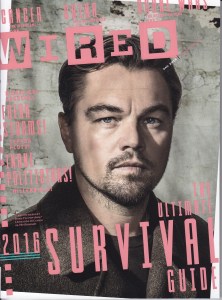
Security. If there’s one thing we can never get enough of, this is it. We look at the future with a mix of perspectives: it’s going to get better, or it’s going to get worse. We want to be prepared for any eventuality. The most recent issue of Wired landed at my door and the cover, apart from Leonardo DiCaprio, features the survival guide. Tongue-in-cheek, along with actual statistics, this feature article gives tips on surviving all kinds of potential disasters. From domestic terrorism to zombies. The zombie advice caught my eye. You can make a pretty effective club, it seems, from rolling up newspaper the right way, with a judicious application of duct tape. It may not help much in instance of domestic terrorism, but who can expect to survive everything?

DecWiredSecurity is fine and good, until it becomes an obsession. Here in the United States, we’ve lived with the belief that two oceans separate us from our most hostile enemies. For sure, we have our fair share of natural disasters: tornadoes, hurricanes, earthquakes, wildfires, floods, even a volcano or two, but these are “acts of God” and we like to think that we can handle those. Our greatest fear, it seems, is our fellow human beings. Isolationism is convenient when we want to direct our own destiny, but when other nations get in the way, we like to extend the borders of democracy a bit. And globalization has opened the doors to all kinds of scenarios where security is at risk. Just try flying as a man with a beard traveling alone. I’m not so sure that facial hair is the greatest threat to the future that it seems to be. (Unless, of course, it is trendy stubble, as the picture of Leonardo DiCaprio shows.)

Security isn’t attainable. The future is always uncertain. There’s a rabbinic saying that a person can’t be satisfied today without knowing that tomorrow’s been taken care of. We don’t know what tomorrow might bring. Or even later today. We fear those who take their faith seriously, and yet the world grows more densely interconnected all the time. Some turn to their holy books to ensure that they are ready for tomorrow. Some even claim that those books tell them in detail what will be coming down the road. Others, I suspect, are gathering newspapers and rolls of duct tape. The future is, after all, what we make it.