Easter Gathering

On Easter I’m thinking of Conclave.  My wife had been wanting to see it and we watched it on Good Friday—a work day, of course, in this “Christian” nation.  In any case, it’s fascinating for a couple of reasons.  One is that, as a drama surrounding the election of a new pope, it draws you in.  The politics and intrigue are, I assure you, quite real within in the church.  People are, in seems, incurably political.  Conclave is fiction, of course.  And in reality, very few people are ever admitted to the chambers where a world leader is elected by those priests who’ve risen to the highest levels of church hierarchy.  This fictional reconstruction may give a window into that.  The other reason that I found it so fascinating is that it was quite a box office success for being a movie about a religious subject that isn’t biblical.  Appropriate viewing for Easter weekend.
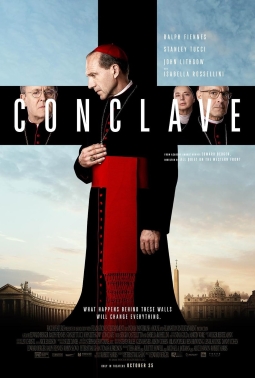
There were a few striking scenes.  Here’s the outline, though: a pope has died and Cardinal Lawrence is the deacon in charge of the conclave to elect a new one.  Four main candidates exist—one a staunch traditionalist, one a liberal, one an African who is conservative, and the last a moderate American who has a past.  The pope had appointed a new cardinal shortly before his death and some people think he’d make a good pope, despite his relative youth.  One of the striking scenes is Cardinal Lawrence’s homily to open the conclave.  He preaches against certainty.  Not only is this a powerful scene, for some of us watching he is absolutely correct.  Certainty is the death of faith.  That scene alone is worth watching the movie for.  Go ahead, it’s Easter.

The other striking scene is the twist ending, which I won’t reveal here.  Anyone who’s honest and who’s lived long enough to become a pope has secrets.  Not all of them reach to the level of scandal, but the movie also emphasizes that the pope is also a sinner but must be willing to seek forgiveness.  Indeed and amen.  The problem we face today is that, even and perhaps especially in Protestantism, many people look to condemn sinners without realizing their own faults.  The movie points out that even the holiest acknowledged person within Christendom can’t make any claims to perfection.  If we’d all admit that we’re doing the best we can not to offend deity or fellow human being, perhaps there really would be cause to celebrate this Easter.  Even without a conclave.

Unusual Autopsy

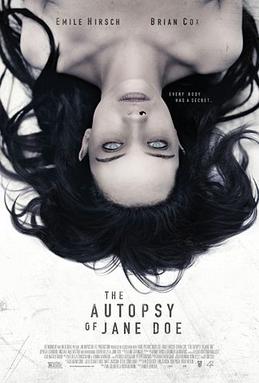
I avoided The Autopsy of Jane Doe for some time because, well, autopsy movies just aren’t my thing.  Besides, I thought it might be a “true crime” sort of movie and those aren’t my favs either.  That didn’t stop the recommendations, so I gave in.  I’m glad I did.  It’s a cut above a lot of what’s out there, and although it does rely on a few more jump-scares than I like, it isn’t all about them.  And it turns out that it’s Holy Sequel material.  Here’s how the story goes: a father and son mortician team, who have the morgue in their basement, specialize in determining cause of death for the local sheriff.  When four bodies are found in one house and none of it makes sense, the sheriff brings the most suspicious body, Jane Doe, to the morticians for their assessment.  Externally the body has no marks, so what killed her?

The majority of the movie is the attempt to solve this mystery.  The father and son find impossible things—evidence that the woman had been tortured, but there were markings on internal organs without any damage to the skin.  They soon determine this is bad juju and when lights begin shattering and corpses get up and walk around they know they were right.  They’re trapped, however, in their basement.  It’s clear that this Jane Doe isn’t quite through with them.  I’ll try not to spoil the ending here, but I did mention that the Bible comes into it.  How so?  Well, it turns out that one of the impossible things in the body is a charm that has Leviticus 20.27 written on it (the passage about not allowing witches to live).  And although it invokes Salem, it does so in a way that suggests the witch hunters were to blame.

This movie was actually out before Holy Horror was finished, but as I point out in that book, there is no website or repository listing horror films that use the Bible.  To write a book like that, you have to do a lot of watching.  I love watching movies, but it takes both time and money, items in constant short supply in my life.  When I do watch, I try to make connections.  It would also be interesting to write a book on how Salem is portrayed in horror movies.  What with the work-a-day world in which I live, I’m not sure how many more books I can crank out.  Especially when they don’t sell.  The important thing is not to let the title of a movie put you off, for autopsies can reveal much.


Horror Adjacent

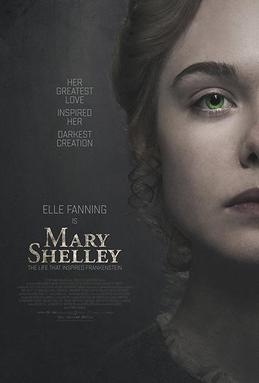
We have the basic facts, but still, it takes a good bit of imagination.  We simply don’t know what the life of Mary Shelley was like, as experienced by the woman herself.  The movie Mary Shelley isn’t a horror film but it’s horror adjacent.  How could a movie about the woman who invented Frankenstein be anything but?  The handling of Haifaa al-Mansour’s film is generally as a drama, or a romance.  The story takes the angle that it was her stormy relationship with both Percy Shelley and her own father that led Mary to express her feelings of abandonment in her novel.  And while we have to acknowledge the liberties all movie-makers take, it does seem interested in keeping fairly near the known details of Mary Shelley’s life.  Although other women were also writing then, it was still a “man’s world” she tried to break into.

I confess that one of my reasons for wanting to see this film was that Ken Russell’s Gothic had a powerful impact on my younger mind.  That movie, which is over-the-top, being the first I’d seen telling the tale, had become canonical in my mind.  I know the dangers of literalism, and I wanted to see someone else’s take on the story.  Al-Mansour’s treatment takes a female perspective to the narrative.  It seems that Percy Shelley and Lord Byron were both advocates of what might now be termed a playboy lifestyle, and that Mary, daughter of forward thinking Mary Wollstonecraft and William Godwin, was fairly liberal herself.  Although Percy Shelley, like Lord Byron, was quite famous in his time, that didn’t always equate to financial solvency.  I could relate to parts of that quite well—full of creative ideas and shy on cash flow.

Mary Shelley didn’t rock the critics, but many felt it was a thoughtful treatment.  It is dark and gothic, but with no real monsters.  It did explain a bit of inside baseball about Ken Russell’s film.  Both movies make use of Henry Fuseli’s painting The Nightmare to explore the famous meeting of Byron and the Shelleys that led to the writing of Frankenstein.  Indeed, Gothic makes a good deal of it.  Mary Shelley explains that Mary’s mother, Mary Wollstonecraft, had an affair with Fuseli.  I was unaware of that connection.  Something was clearly circulating among the Romantics, many of whom knew each other and, in their own ways, became formative of culture centuries down the road.  And although many critics weren’t impressed, I think it’s about time that a woman’s point of view was brought to Mary Shelley’s life in a world not kind to women.  Even if a woman gave the world one of the most influential books of the nineteenth century.


More Rats

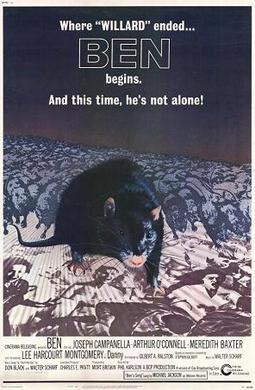
I’ve asked other survivors of the 1970s if they knew that the Michael Jackson hit “Ben” (his first solo number one recording) was written about a rat.  Most had no idea.  The song is the theme for the sequel to Willard, namely, Ben.  Now, I have a soft spot for seventies horror movies.  Before the days of streaming I repeatedly looked for Willard in DVD stores and never did find it.  I eventually found it on a streaming service and even wrote a Horror Homeroom piece on it.  One winter’s weekend with not much going on, I finally got around to seeing Ben.  Neither are great movies, but I’ll give them this—people in my small hometown knew about them.  Everyone I grew up around knew that “Ben” was a song from a horror movie.  In case you’re part of the majority, Ben is the chief of the intelligent rats who turns on Willard at the end of his movie.

An incompetent police department and other civil authorities can’t seem to figure out how to exterminate rats when they begin attacking people.  A little boy, Danny, has no friends.  He is apparently from an upper-middle class family, and he has a heart condition.  Ben finds him and the two become friends.  Danny tries to get Ben to lead his “millions” of rats away from a coming onslaught, but for some reason Ben decides to stick around and nearly get killed.  In the end, badly injured, Ben finds his way back to Danny.  Cue Michael Jackson.  It really isn’t that great of a movie—the number of scenes reused during the tedious combat scene alone belies the pacing of a good horror flick.  I felt that I should see it for the sake of completion.  Check that box off.

It’s a strange movie that ends up with viewers feeling bad for the rats.  They’re not evil, just hungry.  They do kill a few people (poor actors, mostly) but it’s often in self defense.  The best part is really the song, and the premise behind it—boy meets rat, boy falls in love with rat; you know how it goes.  Michael Jackson famously loved horror movies, and as many of us have come to realize there’s not much not to like.  This movie is pretty cheesy (with the rats attacking a cheese shop, but only after an unintentionally hilarious spa scene) but it has heart.  And it has a fair bit of nostalgia for those of us who grew up in the seventies.


Not Yet Illegal

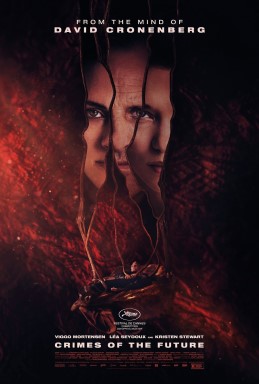
David Cronenberg’s name suggests a certain kind of body horror as unique as it is unsettling.  Crimes of the Future (2022) immediately reminded me of Existenz, which I watched many years ago.  Crimes of the Future is more difficult to understand, however, in part because it is shot dark and quite a lot of the dialogue is indistinct.  I happen to be reading a hard-to-follow book and my overwhelmed brain was hoping for a more straightforward narrative.  In any case, in the eponymous future, human evolution is such that it has to be regulated.  A performance artist couple puts on shows of surgery since he (Tenser) is constantly growing new organs.  They’re harvested as part of the performance.  Humans have evolved out of pain by this point, so surgery is done as art.

Meanwhile, a group has evolved to the point that they can eat plastic and toxic waste.  They demonstrate that physical modifications can be inherited, which puts them on the government’s wanted list.  Tenser and his partner, Caprice, own an automated autopsy table (who doesn’t?) that performs the autopsy while letting others watch.  The radical group wants to use this device to autopsy, as art, the child born with the ability to eat plastic (he’s killed at the beginning of the movie).  Also in the mix are a couple of crooked bureaucrats and a detective who seems sincere, but who has been working with an insider among the criminal group.  Eventually the autopsy occurs but it seems the boy’s insides had been surgically altered.  The leader of the radical group is assassinated and Tenser eats a toxic waste bar and dies.

If you’re saying “How’s that make sense?” you’re not alone.  Body horror isn’t my favorite.  Many of Cronenberg’s favorite themes are present here, but the film lacks a strong narrative.  Or at least one that I could follow.  Art house cinema often requires quite a bit of work from the viewer.  The atmosphere of this film, like Existenz, isn’t really horror, but it breezes into that territory.  Just when the horror—the surgeries—appears the social commentary kicks in.  That’s often true of body horror, a genre Cronenberg is credited with developing.  But I watch for the story as well as the mood.  Some movies are more about the images, I know.  And the future orientation makes some classify the film as science fiction.  It has more of a Blade Runner, dystopian feeling atmosphere, but without replicants.  Crimes of the Future, it seems, may require a better detective than yours truly to solve them.


To the Maxxx

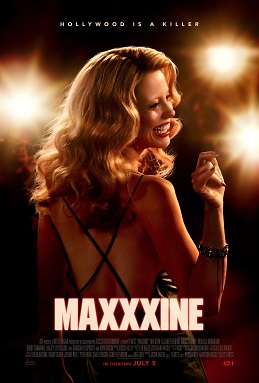
Okay, so Maxxxine will be difficult to discuss in my usual format here, but I’ll give it the old college try.  Ti West is quite a stylist when it comes to horror movies.  Friends recommended X a couple years back, and then it was revealed that it would be part of a trilogy, with Pearl coming next.  I’d seen these two and knew that I would watch Maxxxine when it came out.  More than just closure, these films all make heavy and obvious use of religion.  So much so that an extended piece could be written on that aspect alone.  I’ll try to restrain myself here.  Maxxxine is a direct sequel to X (Pearl was a prequel), following Maxine as an actress trying to break through in Hollywood.  Following the death of her X-rated film colleagues, she found an agent and has been trying to be cast in a horror film.  The movie starts with a home movie shot by her evangelist father advising her never to give up.

Just as Maxine wins the horror film role, a number of her friends in the adult entertainment industry are murdered.  Maxine refuses to assist the police, even when her best friend, who runs a video store, becomes a victim.  A private investigator is following her and she has him killed.  Those who saw X know she killed Pearl, and she’s willing to do as her daddy said, whatever it takes.  She decides to go to the PI’s client to try to stop the murders.  She discovers the man behind the violence is her father, who has learned about her X-rated work and believes she has a demon.  He has been killing her friends to lure her in and is about to brand her as a follower of Satan when the police arrive and a shootout occurs.

The publicity doesn’t hurt Maxine’s career prospects, even though she ends up killing her own father.  The movie is commentary on movie-making, fame, and Hollywood, as well as the potential evils wrought by religion.  My usual critique of the portrayal of religion applies.  Although Maxine’s father is made out to be a fundamentalist, when his plot is revealed it actually portrays him wearing a cassock.  He’s also shooting a snuff film to demonstrate the Devil’s doings.  A real fundamentalist wouldn’t wear such Catholic getup.  Many films that portray fundamentalists clearly don’t understand what separates them from other Christian denominations.  The entire X-trilogy is based on religion and how its constraints lead to horror.  There’s a lot to unpack here, even with the occasional gaff.


Going Viral

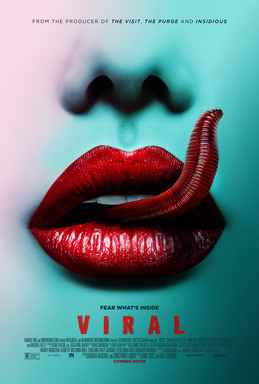
Okay, so there are some pretty big plot holes, but Viral is nevertheless an effective horror film.  The “virus” is actually a parasite spread by blood, which carriers cough in your face, if they don’t kill you first in a fit of parasite-induced rage.  The really scary thing is that this movie was produced before Covid-19 and the government response, as presented in the movie, is somewhat believable.  Nevertheless, it retains its ability to be a story about family and loyalty.  There are some missed opportunities in that regard, but overall it’s fairly well done.  It certainly keeps the tension going and I feel some spoilers coming on so I’ll warn you here.  A Blumhouse production, it seems to have had a reasonable budget.  And there’s a solid attempt to have a storyline with characters you care about.

Sisters Stacy and Emma are trying to adjust to a new school system as news reports increasingly focus on a new, and lethal, virus.  Their California community is the site of the first U.S. outbreak and the initial panic isn’t unlike what happened in 2019.  I’m a little surprised that, given that development, the movie didn’t gain more residual watching.  In any case, a quarantine and curfew are set up, but the teens of the housing development decide to have a party.  Kids will be kids, after all.  Of course, an infected guy is there and Stacy, the older sister, gets infected.  Their parents were caught outside the quarantine zone, so they have to try to survive on their own.  Emma has a new boyfriend—the guy next door—and he urges Emma to leave her sister, but she won’t.  Martial law is declared and “nests” of the infected are being bombed by the government.  Emma and boyfriend manage to survive, but the rest of the town’s a wasteland.

As I say, the implications are the really scary part.  Governments have the mandate to protect the greatest number of people—isn’t that utilitarianism, by default?—and decide to cut their losses and destroy infected communities because there’s no stopping the disease.  Even as the gaps in the story kept coming up, I was asking myself would our government do such a thing.  I could find nothing to dissuade me that it would.  Self-preservation is human nature.  As is might makes right.  Our government, for my entire life, has consisted of the wealthy and one thing we know about those with money is that they’ll do whatever they can to protect their interests.  Oh, and there are a number of effective jump startles as well. But they’re not as scary as the government.


Dark Smile

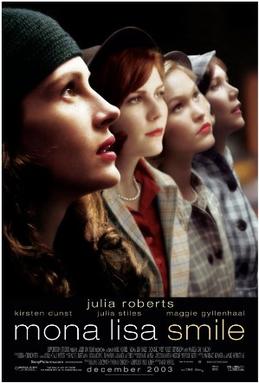
Romance.  It’s not the same thing as Romanticism, but it’s often part of drama.  It can, and often does, feature in horror.  Tender feelings toward someone we really love seem to be a human universal, even if social structures don’t always support such feelings.  Maybe I’m trying to make excuses for why I watched Mona Lisa Smile, but there is an underlying reason.  More than one expert considers it an example of dark academia.  I was curious, and honestly, it’s easier to get my wife to watch dark academia than it is horror (for that I’m on my own).  This was a film I’d heard about many times, but hadn’t watched any trailers for, so I wondered what it was all about.  In short, Wellesley.  One of the seven sisters.  But more than that—women struggling for equality in the 1950s.

A fictional Katherine Ann Watson takes up a post teaching art history at Wellesley, back in the day when a doctorate wasn’t required.  In order to demonstrate her expertise to her very well prepared students (I never, in nearly 20 years teaching, had students show that level of eagerness for any subject) she introduces them to modern art.  Traditional Wellesley isn’t prepared for that.  Moreover, she encourages them to develop careers of their own in a period when the MRS degree was still a main reason for women to attend college.  Watson’s own life isn’t without romance; a boyfriend back home in California and another professor at Wellesley both vie for her affections.  Some powerful students, however, make her life difficult and despite her popularity as a teacher, the administration allows her to remain, but with severely clipped wings.  She decides to fly instead.

Amid all the social commentary, a darkness remains.  A large part of it is patriarchy, but academic politics—driven by money—is the main culprit.  As Watson is essentially forced out, her students see her off with a display of camaraderie, making this, in some ways, quite similar to Dead Poets Society.  There were a few triggers for me.  Years ago I was indeed called into the Dean’s office and handed a letter to read.  While not nearly as dramatic as either Dead Poets Society or Mona Lisa Smile, I had students demonstrate their support for me as I was forced out.  Katherine Ann Watson seems to have had better prospects than John Keating, but both movies remind us that academic politics are dark indeed.  Even if it’s couched in the genre of romance.


Unholy Conception

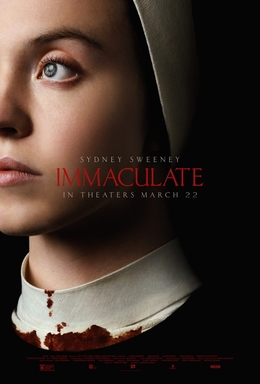
Religious horror is difficult to get right.  Immaculate received reasonably positive reviews, and did well enough at the box office.  Its message of women being forced into reproductive roles unwillingly is certainly timely.  Viewers with religious training, as well as experience viewing quite a lot of horror, might be less impressed.  The basic premise isn’t bad: a convent in Italy, which has one of the nails from Jesus’ crucifixion, is using the biological material on the nail to genetically engineer a new messiah.  The movie follows the novice/nun Sister Cecilia, a virgin, as she joins the convent and discovers that she’s pregnant.  The entire community—apart from a jealous nun and a friend trying to warn Cecilia—welcomes the news, presenting Cecilia as the new Mary.

The convent, which has a history of torture, realizes that Cecilia might be reluctant.  Past sisters have, and she isn’t the first immaculate conception the resident priest (a former biologist) has engineered.  Realizing, by the second trimester, that something sinister is going on, Cecilia tries to escape but is caught and confined, and her soles are branded to prevent her from running away.  After killing the Mother Superior, a Cardinal, and the resident priest, she does escape, gives birth, and kills the baby.  It’s not difficult to see the social commentary involved, but this is body horror and it’s not about gross outs.  It is pretty tense and has several scary moments, but the plot leaves some rather large holes that might following it difficult.  It’s never explained, for example, how the genetic material ends up inside Cecilia without her knowing it.  For those who’ve spent years reading about Marian devotion, this is not an unexpected question.

Although this would be a candidate for Holy Sequel, there’s just something off about the religious elements of the film.  Having never been a nun, I can’t say for sure, but the convent life (apart from the engineering a messiah) seems inaccurate.  And although the Bible is quoted, it’s presented in an almost Protestant way.  The underlying religious imagery feels slightly askew.  Judging from what critics have said, that doesn’t seem to bother many viewers.  If you’re going to make a religious horror movie, it is possible to get away without doing your homework.  In the end, however, it shows.  The acting is quite good and the theological message is worth arguing over, but like many other religious horror films, it has been weighed in the scales and found wanting.


A Different Village

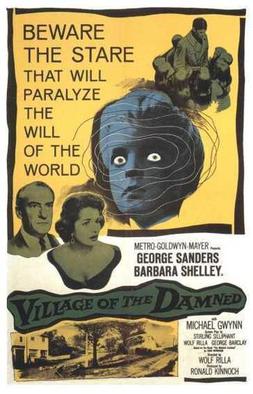
If I’m honest I’ll admit that I first found out about John Wyndham’s The Midwich Cuckoos from The Simpsons.  In one of the episodes, “Wild Barts Can’t Be Broken,” a “clip” is shown of a horror movie called The Bloodening.  A spoof on Village of the Damned, the scene caught my imagination and I was able to learn that it’d been taken from this movie.  This was many years ago, of course.  In any case, I went out and found a DVD of Village and found it less frightening than anticipated, but it left me curious.  It was easy enough to find out the book it was based on (it’s in the credits).  Now, well over a decade later I finally read it, but I’d forgotten nearly everything about the movie but the glowing eyes.  Having read the novel, I had to see the movie again.

Interestingly, the book is generally considered science fiction and the movie horror.  The two genres are closely related, of course.  The explanation for the children in the movie is a little sci-fi, but the framing is horror.  So much so that in Britain in 1960 it was nearly given an X rating (the censors didn’t like the glowing eyes).  As typical, when compared to today’s fare this is a tame little piece about some unruly children.  Of course they do get blown up at the end.  That may have been a spoiler.  I guess I can be unruly too.  In any case, sequences of self-harm, and even suicide, make this a reasonably scary movie.  The film has the same stiff upper lip that the book does, but otherwise it’s a modern horror classic.  I haven’t seen the 1995 remake, but it didn’t get very good reviews.

The movie doesn’t have as much moralizing as the novel does, but it raises the very real issue of how we socialize children.  I do suspect, however, that blowing them up when they’re all together is probably not the message they wanted us to take home.  Although far from a flawless film, this is quite intelligent for horror of the period.  Consensus is that horror “grew up” in 1968, but there were some premies, it seems.  Night of the Demon is another one from the period.  Horror has, I would argue, been intelligent from the start.  Dracula, although not a perfect story, has become a bona fide classic, and Frankenstein before it, had already been a literary touchstone for decades by the time the former was published.  Not bad for watching an episode of The Simpsons.


Special Delivery

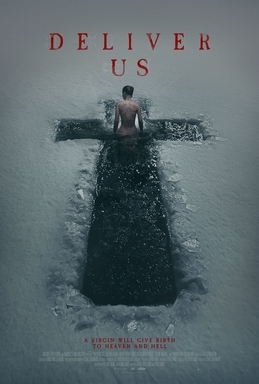
Deliver Us is a horror movie intentionally built around religion.  It hasn’t been discussed much on the sites I frequent, but I suspect that it should be more.  Yes, it gets aspects of religion wrong, but then most religious horror does.  And it leaves a lot unexplained.   Again, most religious horror also does.  The cinematography is bleak and beautiful, evoking a winter chill.  The story is built around a made up prophecy, but do I really need to say it a third time?  Fr. Fox is a Catholic priest in Russia and a former exorcist.  Like Fr. Karras, he doesn’t believe in demons, but his bishop really wants him to go to a convent to check out a possible genuine miracle.  Fr. Fox is about to become Mr. so he can marry his pregnant girlfriend.  Since she has to go to Estonia for a while, she encourages him to do this one last thing for the church.

Meanwhile, signs are occurring that the end times are arriving.  In the convent a secret society called Vox Dei is harvesting prophecies from people’s backs.  What sways Fox to go is that a renowned cuneiformist, Cardinal Russo, is there.  Fox wrote his dissertation on “alphabetic cuneiform”—that’d be Ugaritic, folks.  Not explaining where they got the human-skin scrolls, Russo needs Fox’s help in figuring out the language (it turns out to be cuneiform Zoroastrian).  The miracle is a weeping Madonna statue, but there’s also an immaculately pregnant nun.  She has twins in her, one the Messiah and the other the Antichrist.  Fox doesn’t believe any of this but when he learns that the Cardinal is going to kill the babies to prevent the end of the world, Fox convinces him to give up the wicked plan and they escape with the nun.

This is enough to give you a flavor of the movie.  I won’t give up the resolution but I will say it ends up revolving around the end of the world.  In general this is a pretty intelligent movie.  It borrows quite a lot from other films, including The Omen and The Shining, but it is fun to watch (if you don’t mind a bit of gore).  The tension mounts as Vox Dei tries to find the escaped priest, Cardinal, and nun and there are some legitimately scary scenes.  It was written and directed by Lee Roy Kunz, who also plays Fox.  I do think this deserves more in-depth consideration and had it been out in time, and had I known of it, I would’ve included it in Holy Horror.


Bad Taste

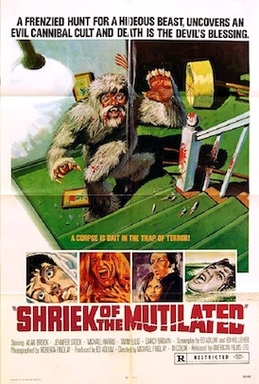
There is a reason for watching bad movies, apart from the fact that they’re often found streaming for free.  Sometimes that reason is that they’re so bizarre that they’re almost surreal.  And sometimes the circumstances surrounding them are equally strange.  Michael Findlay’s Shriek of the Mutilated was included in the set of movies I bought for Zontar: Thing from Venus.  Not one to be wasteful, I’m finally dutifully watching these before allowing myself to purchase new fare.  Given the fact that this had a theatrical release, I’m surprised that it’s not compared more often with Ed Wood’s oeuvre.  In any case, this is a very convoluted story and spoilers will follow.  You’ve been warned.

An international group of demon worshipping cannibals have a member who’s a professor that takes students on a “yeti hunting” expedition every few years.  The students are all killed but one, so that the yeti story can continue.  Viewers (if any) aren’t clued in to this until the last few minutes of the film but early on you can spot the cannibal theme.  So four students in the professor’s Mystery-Machine-like van, go on a hunt while staying with a “colleague.”  Naturally the students start getting killed.

Using some of the worst dialogue ever written, the clueless coeds keep allowing themselves to be led into situations no sane person would.  The chosen “survivor” discovers the plot and is amazed that the creature was (blindingly obviously) a guy in a suit trying to scare them to death.  The cannibals prefer their meat with no bruises.  Much more could be said about the ineptitude of the movie but it ends up having an interesting, if tragic, coda.

Michael Findlay, who made exploitation films with his wife Roberta, was actually sliced to death in a helicopter accident on top of the (then) Pan Am Building in Manhattan.  This happened three years after this movie was released.  In those three years he’d directed eight more films, so his last movie before being mutilated was not the one in my Beast collection.  Quite often when I watch bad movies I have trouble finding any discussion of them at all.  Shriek of the Mutilated is discussed at some length in two books—not surprisingly published by McFarland (they have great pop culture titles).  Until I discovered this movie, in with ten others in a collection, I’d never heard about it.  Of course, the theatrical release was for drive-ins and was limited to Texas, Florida and California.  There can be a lot of information to dig out when people stoop to talking about bad movies.


Release Date

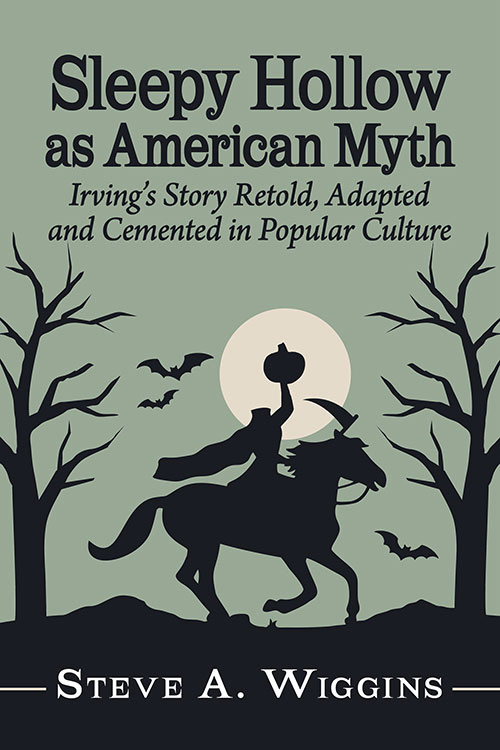
July 16.  That’s the release date for Sleepy Hollow as American Myth.  If you’re so inclined, preordering helps to earn a book attention.  (I know it’s pricey, but thanks for considering it for a second.)  This book has been, like most books, a long time in the making.  As my wife will attest, reading the proofs nearly sent me into a spiral this time around.  It wasn’t because they were bad (I only found 7 mistakes) but it was because of my own doubt about how well I’d done this one.  I found myself between elation at some parts, and dread at others.  I really like this book but I spent my proofreading journey anticipating what critics would say.  I do take a few chances in this one and it has what I believe to be an important message.

Writing books is like walking into a library naked.  There may not be many people there, but those who are can see more than you want them to.  I love the Legend of Sleepy Hollow.  I learned a lot about Washington Irving doing this research.  I learned a lot about Halloween—that’s one of my favorite chapters.  I also like the conceit I applied to the book itself as a labyrinth.  And I’m already looking forward to reading more renditions of the myth once the dust settles a little.  Reading the proofs took a good portion of the weekend, as well as after-work time the previous week.  I could focus on little else.  Books, you see, are parts of their authors.  I feel a little bit crazy for even writing them in the first place.

That having been said, I’m chuffed with a July publication date.  The best time for Halloween books to be available is the summer.  My last two Halloween titles (Holy Horror and Nightmares with the Bible) both came out in November or December.  Not that there were angry mobs at Barnes & Noble demanding them at the end of October.  The other deadline I’d set myself was to have this published before Lindsey Beer’s reboot of Sleepy Hollow hit theaters.  I seem to have managed that one by quite a margin; there’s still been no release date announced.  For her, that is.  I just received mine yesterday.  I guess it’s time to start touching base with those good folks in the Hudson Valley who expressed an interest in the project when I first told them about it.  I’m anticipating Halloween already.


The Talk

Sex.  It’s the great forbidden topic.  This extends to the truly staggering number of words that have been coopted, either as slang or circumlocutions, to discuss anything related to sex.  The other day I wanted to use the phrase, “finger in the dike.”  I was thinking of that illustration of a little Dutch boy preventing a flood from some of my childhood reading, but I quickly realized that it could be construed as insensitive.  When I was a child I wasn’t like other kids.  Some referred to my interests as “queer,” although I am not a homosexual and am not afraid to admit that I have many friends who are.  That word, though, can’t be used without being thought to refer to sex.  While this is true of many words that were once slurs, such as “gay” and the whole arsenal of derogatory words associated with denigrating our sisters and brothers, other—more neutral—words also fall into this category.

The sheer number of words we use to refer to our genital organs would stun alien (off-world) linguists, perhaps confirming, in their own minds, the advantages of telepathy.  Who isn’t slightly embarrassed when someone introduces himself as “Dick”?  I remember a good friend, who happened to be a bishop (now, sadly, departed), who introduced himself to me as “Dick.”  (I was a seminary professor at the time.)  I had trouble calling him that, although we met on many informal occasions and he even wrote me letters of reference.  Sometimes I ponder how sex has become the most talked about stigma there is.  I’ve been on a private campaign against stigmas lately.  I know this is a fight I cannot win, but still, isn’t it worth talking about?

Probably the most frequently used adjective, among many subcultures, is the f-bomb.  No matter how many times we hear it used (and books have been written on it), it always manages to shock.  Even the word itself has spun a whole effing set of circumlocutions to refer to the word itself.  This is truly a remarkable state of affairs.  I’ve studied linguistics enough to know that some topics are like this, but I’m hard pressed to think of any others that reach the level of sex.  Many are the times when I want to use a phrase I was taught as a kid that I now have to resist.  I had a colleague once respond with open-mouthed shock as I used a word in public that remains perfectly innocent (which is how I was using it) but which could be construed the wrong way. Such is our world.  Ironically, you can see sex in the media quite easily.  Movies, television, the internet.  Just don’t talk about it.

Photo by Gama. Films on Unsplash

Late Night

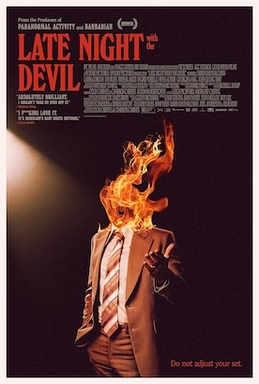
If you lived through the seventies, Late Night with the Devil will take you back a bit.  It’s one of the more creative possession movies I’ve seen, but what really makes it stand out is the insider winks plentifully on offer.  Jack Delroy is a late-night variety show host wanting to top Carson.  His ratings have been up and down, and he decides to make his 1977 Halloween episode his ticket back into the game.  His guests that night include a psychic, a James Randi-like debunker, and a parapsychologist and her demonically possessed charge, Lilly.  A character resembling Anton LaVey, Lilly’s father, had raised her to be a child sacrifice to the demon Abraxas.  The broadcast even mentions Ed and Lorraine Warren, as well as The Exorcist.  Someone knows what the paranormal scene was like in the seventies.

The psychic has authentic contact with what he believes is Delroy’s deceased wife and while the debunker, well, debunks him, the psychic nevertheless dies after a mysterious attack.  Delroy insists that the parapsychologist summon Lilly’s demon, while on stage.  The debunker claims that what the audience saw was a case of group hypnosis, but the demon finally attacks, killing everyone but Delroy and Lilly.  Toward the end the layers of claimed deception become so deep that it’s difficult to know, at first, how to interpret the ending.  Or whether you are supposed to “believe” the climatic demonic attack, of if you’re supposed to conclude that it was part of the mass hypnosis.  What is certain is that religion is front and center in this horror, but the demon ensures that in any case.

The taped pieces between segments of the show make it clear that this is all about ratings.  Indeed, Delroy sacrificed his wife’s health and life to try to break into the lead.  The real demon here is capitalism.  The desire to be on top has outweighed every other and hints are given throughout that Delroy isn’t as innocent as he pretends to be.  Still, the main thing is that the movie gets the paranormal seventies in America just about right.  The disturbing implication is that people are suggestible to the point of not being able to distinguish reality from manipulation.  That pall hangs over the entire movie plot as well as the ending.  This kind of meta critique isn’t intended to detract from what is really quite a good horror movie.  It is believable in the context of the world it devises, and that world includes demons.