Where is it?

When I step outside to pick up the morning newspaper, I always look at the sky. I think this is a very early evolutionary trick. It may be because there was a time when primates were smaller and birds of prey larger, or it may be because some big cats like to drop on prey from trees. It may be simply that we don’t like to get wet, especially unexpectedly. For whatever reason, the sky is a source of endless fascination. Helen T. Gray, in a piece written for the Kansas City Star yesterday, ponders the place of Heaven in the space age. 80 percent of Americans report believing in Heaven, she points out, and she describes how Heaven has shifted from an improbably physical place to a transdimensional or neurologically embedded place. We, as a people, believe that there must be a better place than this. No matter where we locate it, Heaven is always a decided improvement on this place where too many people suffer too much and all of us suffer some of the time.

I once considered astronomy for a career. My high school, built in the fretful days of the Cold War, had an actual planetarium as the space race was burning over the red line. I took a high school class in astronomy and when I got to college I followed it up with an undergraduate course in the same. While I enjoyed learning about all the strangeness of space, it soon became clear that astronomy was simply another word for mathematics; the class involved intensive equations stressing a regularity that Metamucil would be proud to claim. And, of course, since we live on a sphere every direction is up. The belief in a better place is nothing if not resilient. It survived the knowledge that “up there” is either nowhere or everywhere, depending on your point of view. Most theologians after Galileo’s day finally admitted that. When I go for the paper, I still look to the sky, however.
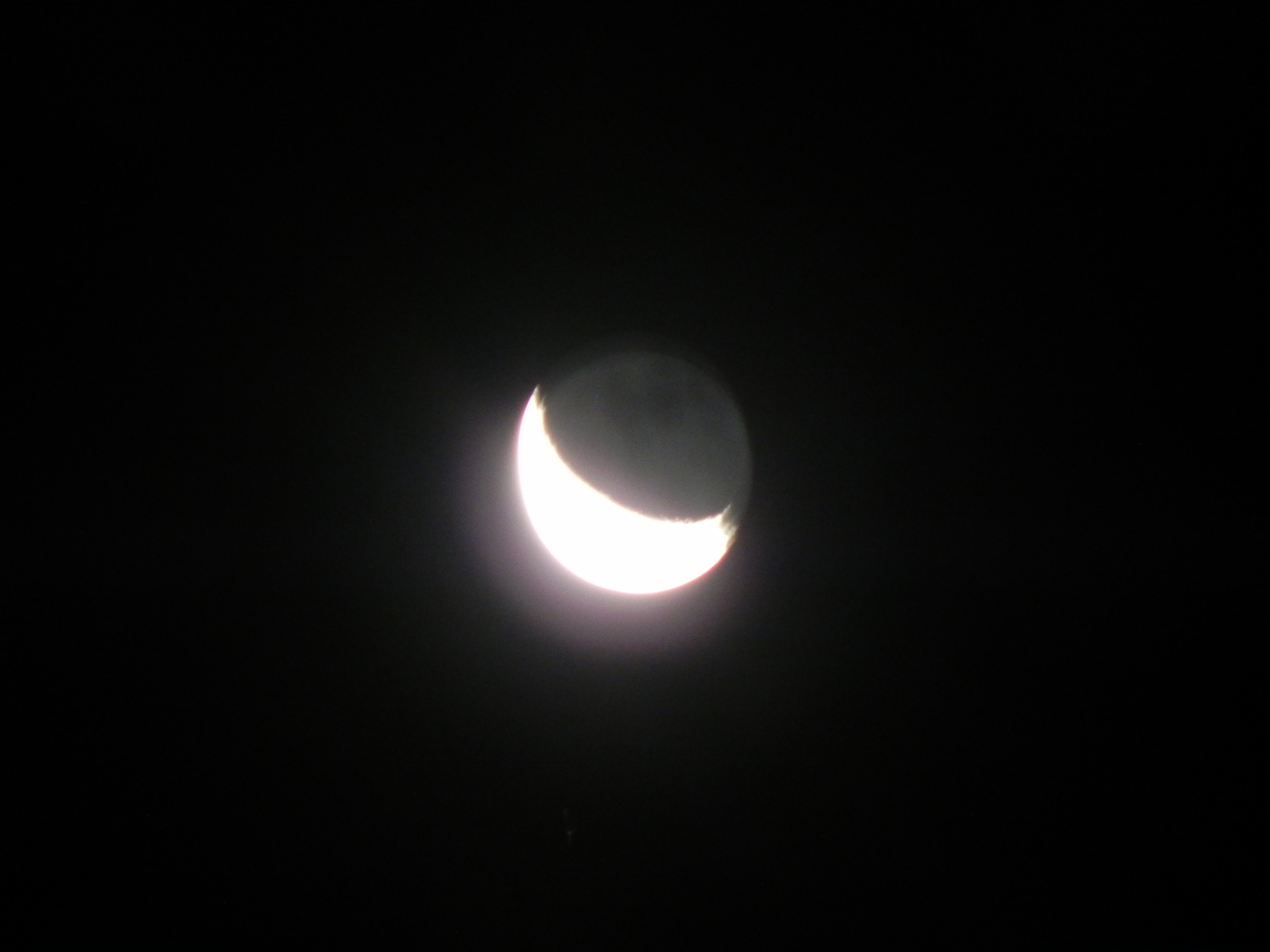
In Hebrew the word translated “heaven” is the same word that is translated as “sky.” The Hebrew Bible knows no separate place called Heaven, but the latest parts do indicate a life restored after death. I wonder if Rick Nowels and Ellen Shipley might not have gotten it right when they wrote the song that would help solidify Belinda Carlisle’s solo career. Maybe Heaven is a place where love prevails. Not just the erotic love of pop music, but the love that sees not a Muslim, an African, a Hindu, or an Oriental, but human beings. That stranger experiences those same feelings, hopes, aspirations that all of us do. He or she should not be left shivering, hungry on the street corner begging for quarters to buy his or her next meal. If it’s clear outside I linger as I gaze at early morning stars and planets, feeling deep yearnings I can’t hope to express. No, Heaven may not be a Mormon planet where you get to become God after you die (ahem). Heaven is not a mansion in the clouds (I’m sure some satellite would’ve picked it up by now). Heaven is not where I get to go and you don’t. Heaven is here and now, but we all have to work for it.
Seeing the Dark

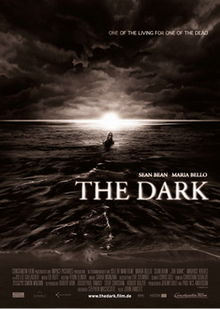
The Dark may be a movie that tries to do too much, but it does illustrate an idea that has been lurking around my head for a few years. That which we fear and that which we worship are never far apart. Since The Dark was pretty much panned, in brief it goes like this—a separated couple gets back together in Wales to draw their troubled teen daughter back. While there she drowns and the ghost of a girl from the past shows her mother how to get her daughter back. The film is notable as being the first I’ve seen that could make sheep scary. Skulking in the back story is a minister, “the shepherd,” the father of the ghostly girl, who started a new religion over the ocean cliffs of Wales half a century ago. When his daughter died, he convinced his flock to leap off the cliff to reach a place that is a combination of Heaven and a Welsh mythical afterlife called Annwyn. The shepherd, however, is really using their sacrificial deaths to bring his daughter back from the dead. The story is complex and the darkness of the narrative is at times overwhelming, nevertheless, it is a showcase of how religious conviction can be more frightening than consoling at times.

Some years back I researched the Welsh mythology of the Mabinogion. Having been a student of ancient religions, however, I knew there was only so far I could go without the lexical support of learning Celtic languages. (This is a fact of mythological study often overlooked by popular treatments; if you really want to get what is going on there is no substitute for reading texts in their original language. I was too busy learning Ugaritic and the time, and struggling with Akkadian, to pick up Gaelic as well.) Nevertheless, the mythology struck me as particularly compelling. Some of the roots of the Arthurian legend lie deep within this lore, and although often uncredited, it still influences our society today. Mythology is simply religion dressed to go out for the evening. The concepts form the basis of much that we still believe and that which still has the power to terrify.

Although the critics didn’t care for the film, the dense interweaving of misplaced religious devotion, Welsh mythology, and basic human longing make The Dark in many ways a classic horror movie. It may be hard to find the characters sympathetic, but they are in some ways archetypal. With a sinister minister driven by personal loss turning to pagan folklore to bring his daughter back, we have a secondary character who curses the fate of an all-too-human condition. The concept of sacrifice becomes a tool for selfish gain rather than a means of helping others. Possibly those who panned the movie did so without an appreciation of the mythology that pulses just beneath the surface here. And while sometimes horror films are simply puerile escapism, at other times they should give us pause to think, and maybe even learn.


Hallowed Eve

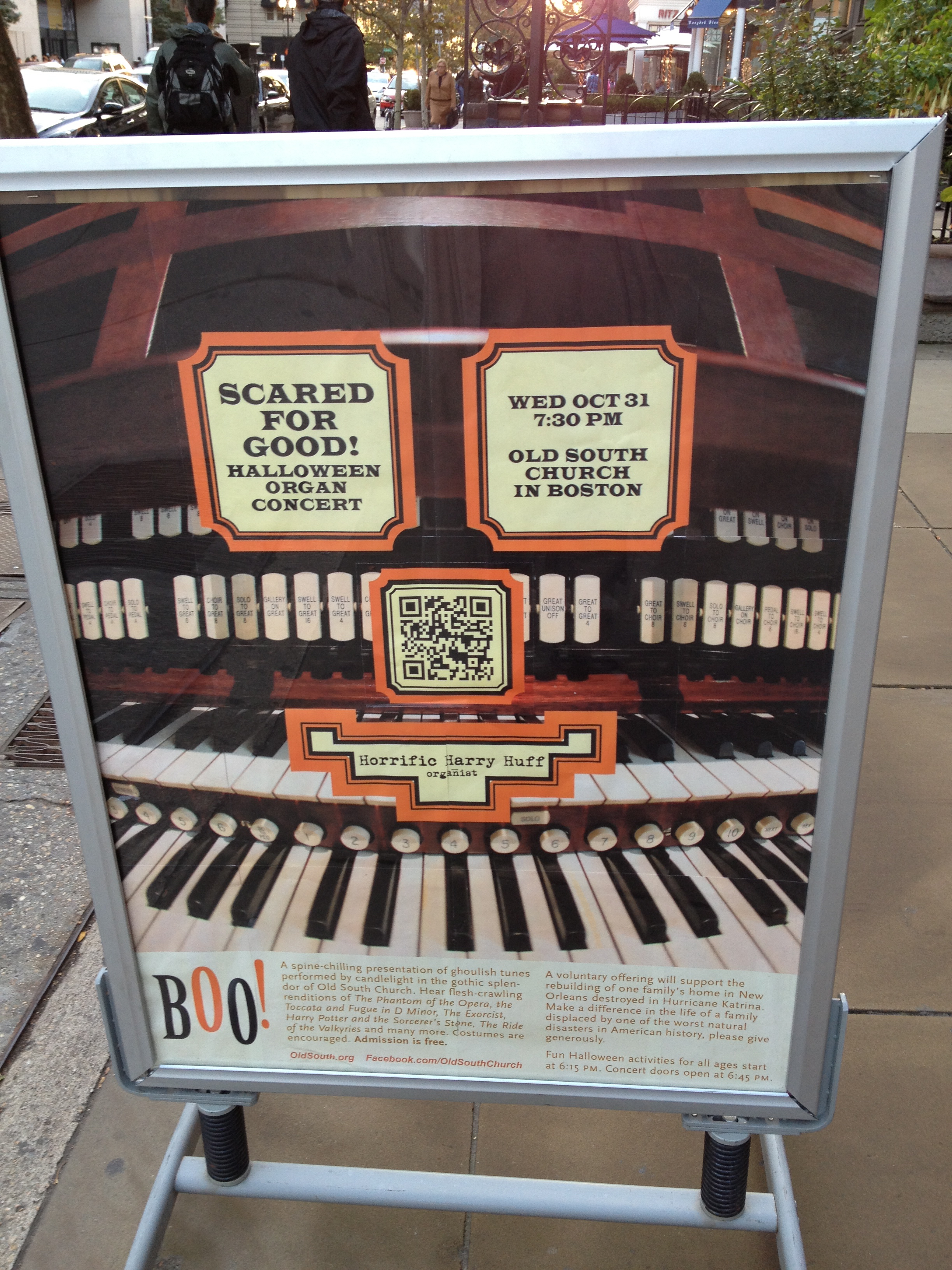
My last night in Boston found me in Copley Square. This has always been one of my iconic Boston locations; something in the juxtaposition of squat, solid, dual-toned Trinity Church with its wide, open plaza, the blue glass razor of the Hancock Tower, and the classical facade of the Boston Public Library where Sophia broods over the world, arrests my wondering gaze. Across Boylston Street stands the gothic Old South Church like a guardian for straying souls. As I walked through the square a local band of street musicians jammed and the first neons of an October evening were awaking. As I strolled past Old South I had to back up a step or two to see if I’d read the sign right.

Scared for Good, a Halloween organ concert featuring spooky music, will soon be on offer. Business-types have long noted that Halloween is a great potential selling holiday. With kids who want to dress up and parents stressed for time, the selling of costumes has grown into an increasingly substantial accessory item holiday. People want their houses to look scary, knocking down real cobwebs to make way for the artificial ones, hanging out orange and purple lights, and ordering pre-carved, artificial pumpkins. All the fear is, of course, a charade, and we laugh at ourselves for taking it too seriously. Some churches object vociferously to the very holiday itself, claiming it is devil worship and evil.

While Halloween does have some serious pagan influences, it is, in its present form, a good Catholic holiday. The night before All Saints, aka All Hallows, begins a period of reflection on mortality. I’ve celebrated “Protestant” Halloween from my youngest days and have never been in any way tempted toward devil worship. It is fun to be scared when you know it’s not real and it won’t last long. That’s why I applaud Old South Church’s Scared for Good concert. Reading the list of pieces included, it sounds like it should be a grand time. Too bad I won’t be in Boston for the occasion. As I walk back to my hotel in the chill of the evening,the only fear i feel is that moments like this evening come at insufferably long intervals for those who feel about the city as must the denizens of Copley Square.


Year of Poe

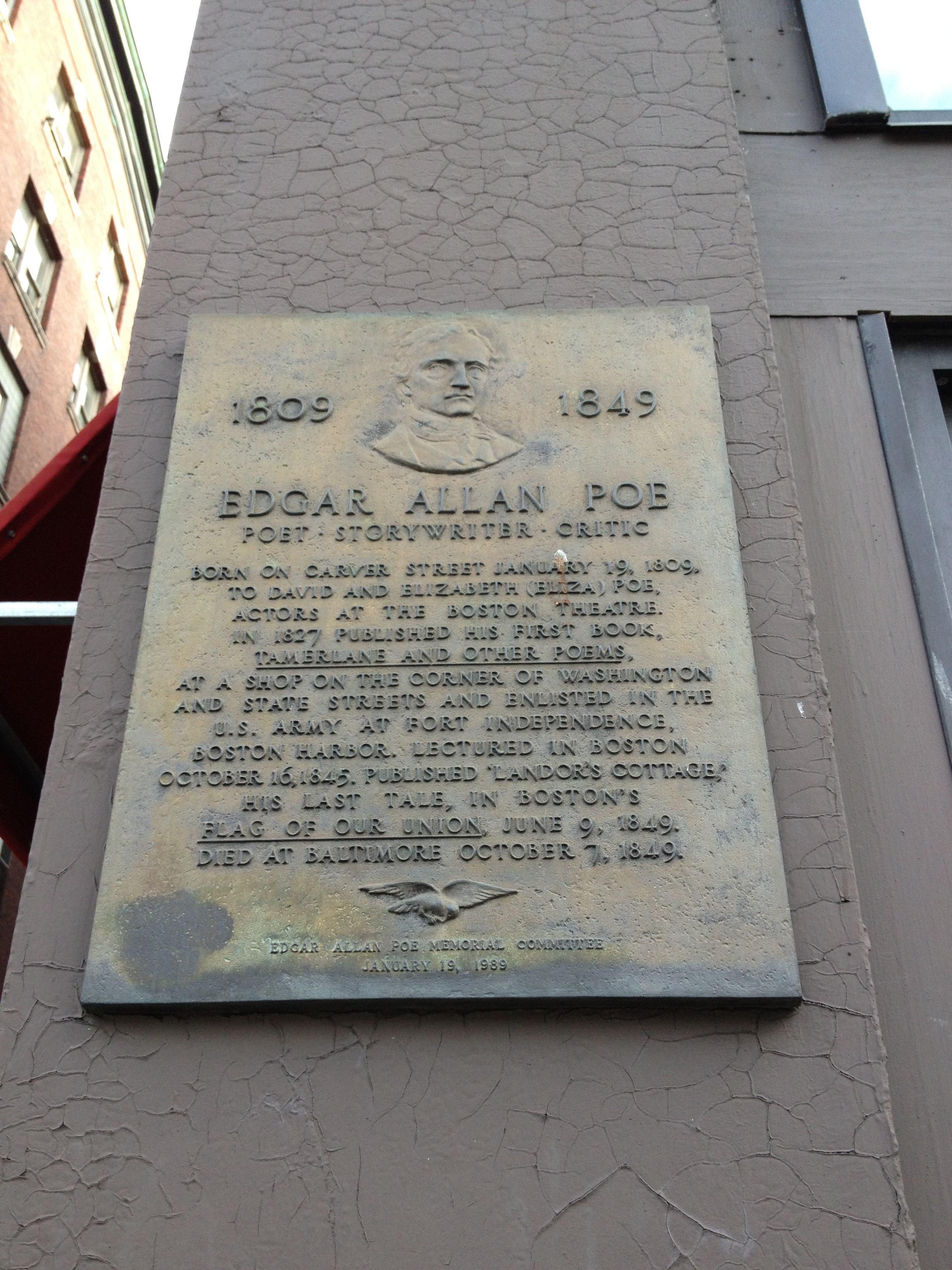
Apart from sharing a “middle” name, I would never dare compare myself to Edgar Allan Poe. Yes, I dabble in the literary arts, but every acolyte recognizes a true priest when he sees one. So as my train pulled into Boston, a city that has deep emotional resonances for me, I decided to stop and see where Edgar Allan Poe was born. The actual site is now a parking structure, an unexpected parallel between our emerging universes. All of my childhood homes, with one exception, are now parking lots. Standing at the foot of the memorial plaque near Emerson College, I reflected on my Poe year. I visited his college room at the University of Virginia in February, his one-time apartment in Philadelphia in March, his burial site in Baltimore in August, and now his birthplace. Not in any chronological order, but a voyage of discovery nevertheless.

This is the essence of pilgrimage. It is not rational and not really practical, but it is something people do. With religious intensity. I am in Boston as part of my secular job, but the city has sacred associations for me. I met my wife here, and that single event has changed my entire life. Boston will always be the place where something extraordinary happened to me. Poe did not like Boston, but for me it is the eternal city. Even the places with negative associations stake claims upon us. Over the weekend a friend posted a picture online taken before combat forced his evacuation from Vietnam many years ago. I kept coming back to that picture throughout the day. Lingering. Staring. Even though I’d never been there, it was like place had the ability to haunt those who’d even dared to look.

Poe and my friend are both writers who’ve drawn me into their worlds. What better way is there to learn that the universe is indeed infinite? Looking out my window at a Kenmore Square I recognize only by the giant Citgo sign that shed its garish light on many an evocative student night, I realize even eternal cities change. The last time I was in South Station I was saying goodbye to the woman I hoped, but did not know, would become my wife. Almost as if on cue, ” Lola” by the Kinks spills out of a local store as the Citgo sign flickers to life over the scene of my coming of age. In Boston I will always be twenty-three, wars will be long over, and Poe will remain alive forever.


Beyond Science

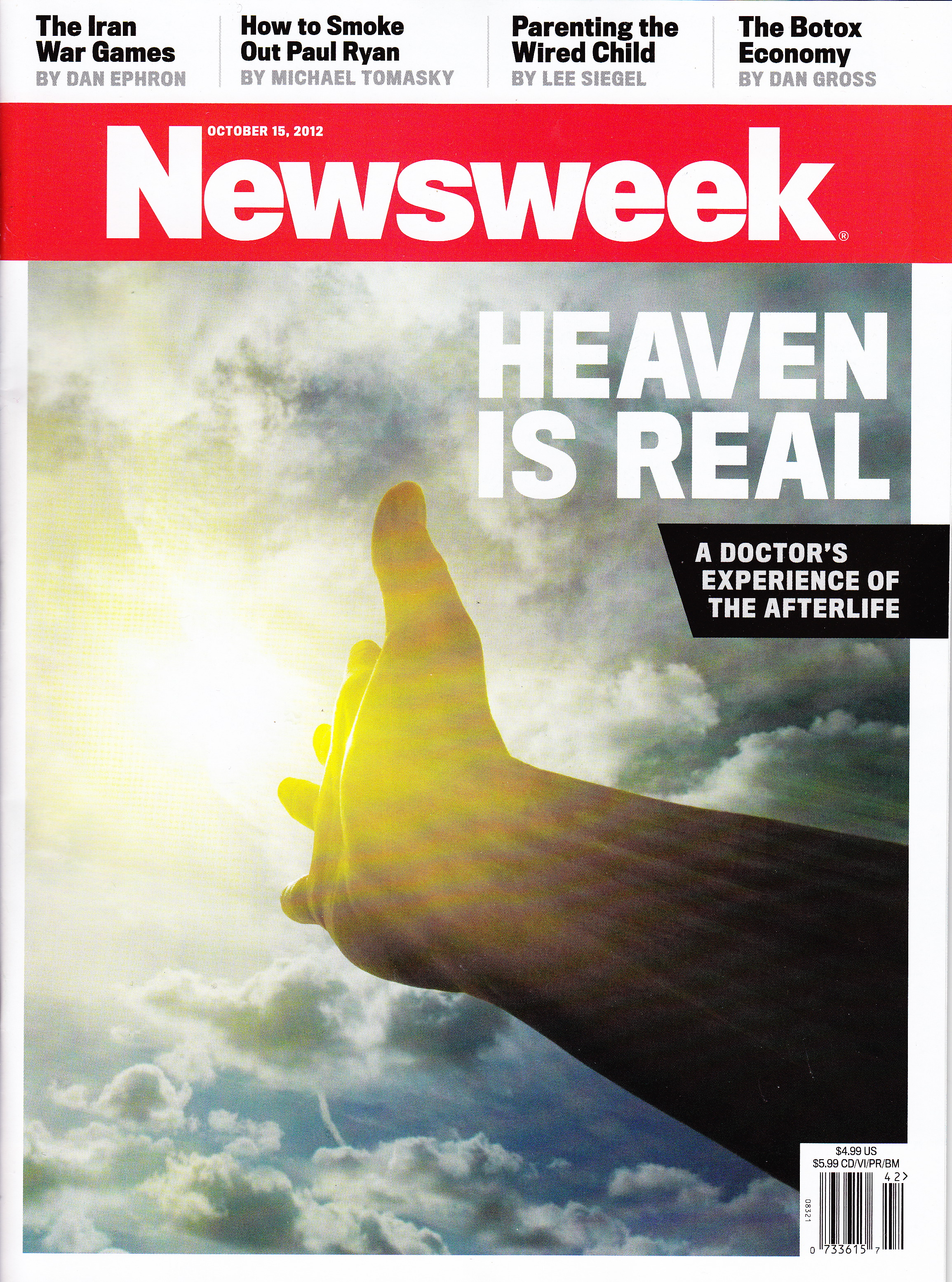
The nature of reality is not easily parsed. As a society we are still under the spell of rationalism, that wonderful left-brain system that seems to explain everything. Until we break down in tears and don’t know why. Like the proverbial chicken-and-egg, reductionists say it all comes down to electro-chemical reactions in the brain, to which non-reductionists reply “believe that if you want to.” Knowledge and belief, belief and knowledge. The truth is nobody knows. So when I see Heaven on the cover of Newsweek, I can’t resist wondering what’s inside. Dr. Eben Alexander, a Harvard-educated neurosurgeon, has just written a book called Proof of Heaven. In the Newsweek article he explains how during a week-long coma he had the most vivid experience of his life. While his brain was shut down. It might be more accurate to say he had the most vivid experience of his afterlife.

The classic debate for Near Death Experiences—so common they have their own acronym, NDEs—revolves around timing. Reductionists say the thought could have happened very, very quickly, just as the brain was shutting down. We all know how dreams can feel like they last far longer than we’re asleep, and how vivid they are. Those who accept the reality of an afterlife argue that many of the classic symptoms such as seeing your own body from above, or being able to describe in detail what was happening in another room at the time, count as evidence. It is the problem of the occasional phenomenon again. This is something no lab can measure, but it happens just often enough to make you wonder. The shaman might say, along with Inception, that the dream is the reality. That might explain why so much of “real life” is unpleasant.

As comfortable as the belief that reality is solid, material, quantifiable, may be, it does not count for the totality of human experience. Alexander’s heaven may not be the same as mine. Reality may not be one. Maybe Occam was wrong. Reading about shamans over the past couple of weeks, it became clear that some believe humans have more than one soul. (I can hear the reductionists rumbling—one soul is already too many!) Some cultures recognize as many as seven souls in a single individual. These, they suggest, account for the uncanny experiences of human life. Why do some people see ghosts and why are dreams so vivid and how does faith healing work? Reductionism calls them all illusions, tricks of the brain. Until his coma Dr. Alexander would have agreed. Now the newsstands suggest a different paradigm may be emerging. Dare we believe that the truth is out there?


Shaman on Us

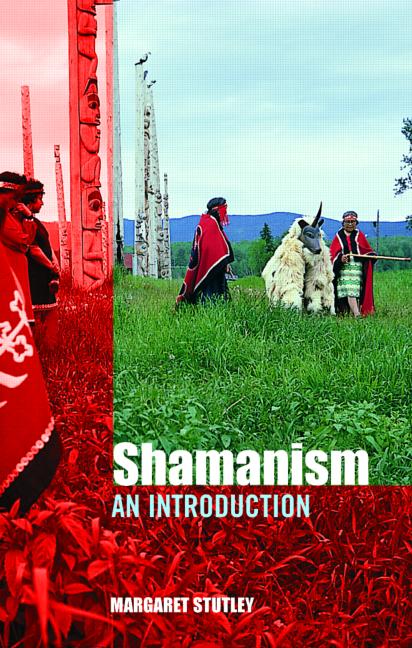
My reading habits are unorthodox. I don’t follow a fixed plan, but hope for something that will keep me engaged for the fifteen or so hours I spend commuting each week. I began October with a book about werewolves and followed it up with a book on the Hmong. Apropos of neither and both, I turned next to Shamanism: An Introduction, by Margaret Stutley. While not the best organized book, it does provide a smorgasbord of shamanistic traditions, principally from Siberia, where Shamanism was first recognized. Before I’d finished, I’d read about both epilepsy and werewolves.

Shamanism is not a “religion” per se. There is little agreement among scholars about what a religion is at all. Shamanism is very much a local set of beliefs and practices that have only very basic elements in common (shamans being one of them). It is a good example, however, of how moral heathens can be. Shamans often accompany egalitarian societies who do not require governments and religious leaders telling them to be nice to each other. No, this is not the noble savage myth, but it is a clear indication that major religions are not required for morality. It evolves on its own. Often shamanism is not constrained by overly left-brain influence, and sees connections science can only deny. The plight of Lia Lee was explained here in a way physicians could access—epilepsy and other diseases are problems of the soul as much as the body—if only they read books about religion. Healing involves calling the soul back. Treatment of the body misses the point. And sometimes the dead become werewolves.

We live in a world where real suffering is caused by lack of understanding about religion. Assuming a cultural hegemony of Christianity, or Islam, and sometimes even other religions, we discount those who believe differently than we do. The New Atheists frequently overlook just how seriously people take the world of the emotions and belief. That realm is a large part of what makes us human and it plays by no logical rules. Nor does it care to. In a country, such as the United States, where money is believed to be the very warp and woof of the good life, shamans sometimes secretly cut the thread. Still, don’t ask universities to expand the study of something as insignificant as religion because all intelligent people know that nobody really believes that stuff any more.


Holy Wolves

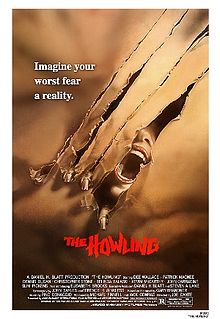
Nothing creates the mood for a werewolf movie like reading a book about real werewolves. The Howling was released the year I was finishing high school. At that time my humble circumstances allowed for very few visits to the movie theater, and certainly never to see horror films. I grew up watching B-films in black-and-white on television, but paying extra to see what was slightly unseemly in a theater stretched the limits for a good Christian just a bit. College was on my mind, and it was while in college that my horror film interest blossomed. All of which is to say, I’ve never seen The Howling before. I remember the movie posters, but the film had to wait until werewolves clawed their way back into my mind. Most of the classic movie monsters have their basis in religion, but The Howling doesn’t really delve into the origin of werewolves as much as it wonders what to do about when their numbers start to become a problem. Those who know about such things note that the special effects were cutting edge for the time, but CGI has spoiled us all.

Although the film doesn’t inquire into werewolf origins, it still gives a nod to the religious. The film’s werewolf population lives in a colony that has a “ritual center,” and since the cover for the colony is a retreat center for a psychologist’s patients, we find seekers amid the crowd. One of the inmates, Donna, explains that before joining the colony she had tried all the new religious movements, without success. And the one character who knows how to dispatch werewolves runs an occult bookstore in Los Angeles that is visited, in a shock-comic moment, but a pair of nuns. The message, so typical of the early 1980’s, is that all religions are just about the same. People are seekers, and any religion will do in a pinch.

In a way, this downplaying of the religious element in werewolves is not unexpected. As society was becoming more obviously secularized in the sixties and seventies, religion was becoming just one of many options available on the path toward self-fulfillment. In The Howling, becoming a werewolf was another. Ironically one of the old-timer werewolves laments the loss of “the old ways.” The werewolf colony lives on cattle that are farmed as politically correct sheep for the wolves, and it just doesn’t satisfy. The same might be said for religions. Accommodations, so necessary to survival in an evolving society, inevitably change the old ways of religion. Religions themselves transform over time. The Howling may not be scary, or believable, but it does serve as a kind of paradigm for worldviews that are undergoing transformation. Shifting shape, after all, is a sure symbol that one is still alive.


Science Friction

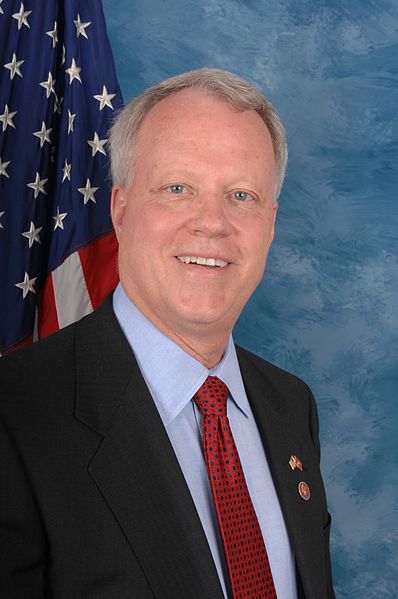
What hath CERN to do with Jerusalem? It might seem that the House Committee on Science, Space and Technology would be a reasonable place to look for members of Congress with a grip on science. But then, I often live in a fantasy world where things make sense. It is with some sadness, but no real surprise, that I read about the words of Georgia Representative Paul Broun, lambasting evolution and the Big Bang as theories from the Devil. Broun is a medical doctor who, under conviction of his Fundamentalist faith, has rejected the basic tenets of science. According to the Associated Press, he told a Baptist church congregation, “All that stuff I was taught about evolution and embryology and Big Bang theory, all that is lies straight from the pit of hell. And it’s lies to try to keep me and all the folks who are taught that from understanding that they need a savior.” Sounds like Satan had a very busy pre-history.

Anyone who knows me knows that I begrudge no one their personal religious beliefs. Someone who does not believe in embryology, however, might have selected a career more commensurate with his religion than medicine. Election year does tend to bring out the shock value statements in politicians. Having to convince their constituencies that they are just simple folk, they deny what their faith belies every time they accept an inoculation. If evolution is a lie, so is vaccination—something most medical doctors would have to have understood before facing medical school examinations. In the United States, however, such wrong belief is a generally apt qualifier for Congress. Especially among the Tea Party. Broun hails from the ironically named Athens, Georgia.

Over the weekend I watched the Star Trek (original series—please, I’m a connoisseur) episode, “The Mark of Gideon.” It is one of the episodes I don’t recall from childhood, but then, with Kirk and all that “mushy stuff” of being alone on the Enterprise with a woman, well, maybe it just didn’t stick when I was in my tender years. In any case, the symbolically named Gideonites have overpopulated their planet to the point of disaster by good clean living. They attempt to hijack themselves a disease “inadvertently” to reintroduce population control. Captain Kirk asks why they don’t use safe methods of birth control, even volunteering the Enterprise to be a kind of inner-galactic condom-dispenser. The Gideonites explain that they believe all life is sacred, and that preventing life is a great crime—regardless of the misery it causes. I had to smile to myself. Sounds like the people of Gideon may have had been lectured by a Georgia medical doctor who had gone off on a peculiar flight of fancy.


Where? Wolves?

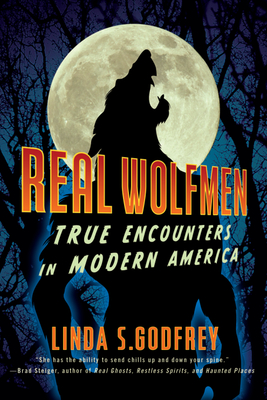
The problem with occasional phenomena is that they are seldom empirically verified. Try as we might, no one has managed to be in the exact place at the exact time on Loch Ness to capture definitive evidence that Nessie exists. Of course, it is very difficult to prove that something doesn’t exist. I have a creeping suspicion that not all of reality can be quantified. I’m very glad for the parts that can be, but a little mystery never hurt anyone. I’ve just finished reading Linda Godfrey’s Real Wolfmen: True Encounters in Modern America. There—I’ve already lost some of you! We all grow up to learn that there are no such things as werewolves and I’ve experienced many a peaceful night in that knowledge. Nevertheless, many people do report seeing upright wolf-like creatures, and many of the people interviewed by Godfrey appear to be entirely sincere. What makes this intriguing to me is that many of these episodes are reported in a circumscribed area (near which I used to live). While reports come from across the country, it is easier to dismiss one person who saw something odd once than it is to discount many people who see a similar thing over many years in the same general vicinity. That’s why I keep coming back to Godfrey’s books.

Being an open-minded writer, Godfrey also considers possible spiritual explanations for what people see. Shamanistic traditions, in this case particularly Native American ones, do not dismiss transformations from human to animal. It is difficult for most of us to accept that a person could bend the laws of physics and biology—for which we suffered through so many tests in our education—to mutate or mix human DNA into or with lupine stock. Indeed, it takes the faith of the world of religion to believe that. And yet, people see beasts.

We have been in the process of sealing the borders to our universe since the Enlightenment. The vaster our universe becomes the smaller the realm of possibilities grows. But we haven’t even explored all of our own little planet yet. The deep-sea trenches remain largely out of our reach, and the sheer volume of the oceans boggles the imagination. Even on land, we can’t watch every place all the time. The possibility of getting to somewhere truly remote is frequently an optimistic illusion. At times with my wife’s family I’ve ventured to places so far from civilization that freedom truly feels palpable. And as we hike down some neglected trail, talking to alert the grizzlies to our presence, nearly always we end up encountering others out here to escape from the likes of us. Yet a whole lot of the woods remain off-trail. It’s not a small world after all. And it’s October. Who’s to say there’s not the occasional werewolf out tonight?


Bart’s Gospel

One of the near constants of the entertainment world is the social commentary on The Simpsons. The morality issues that get frequent play had led to a book entitled The Gospel According to the Simpsons some years back. And since Americans like their morality straight from the popular media, The Simpsons is not a bad place to look. The episode “My-Pods and Boomsticks,” although a few years old now, raises issues that are still current in our culture. I watched it with my daughter recently and she commented, “It’s just like Zeitoun.” My family read Zeitoun this summer (some high school reading programs have a way of involving more than just the student) and the revelation of just how deeply suspicious the nation is of Muslims disturbed us all. This particular Simpsons episode involves a Muslim family from Jordan moving into Springfield. Although Bart befriends their son, Homer just can’t get over the assumption that Muslim equals terrorist. In the end, however, it is Homer who ends up dynamiting a bridge rather than believing Muslims can be good citizens.

Apart from being the longest running primetime animated feature in history, The Simpsons bucks the convention of veering away from religious topics. Indeed, many episodes foreground religion and feature Hinduism, Judaism, and Buddhism as well as Christianity and now Islam. The religions may be gently chided, but they are not mocked, and we are given a glimpse into our own religious biases. Islam, as a religion, is not evil or bent on destruction. Like Christianity, it has many varieties and believers range from the sacred to the profane. It is not the religion that is a problem, but the society that gives the lie to true equality. Believe what you will; harm no one.

At work the other day I received an office memo about lunchtime Yoga. Whenever I see such notices I consider how this religious practice, in American minds, has become completely secular. The same may be said of some of the martial arts which, in original contexts, have a deep base in eastern spiritualities. These things do not bother us because we do not bother to learn about them as religious activities. Even Kung Fu Panda has a spiritual undertone. Religions display a wide variety of expressions throughout the world. Going to church one day a week and condemning those who believe differently all seven, many people do not stop to think of the contributions that other religions have made to our society as it exists today. American culture, while predominantly evolving from a Christian base, has strong elements of most of the major religions that go unrecognized or packaged as secular self-helps. We could still stand to learn a thing or two from Springfield.


Country Roads

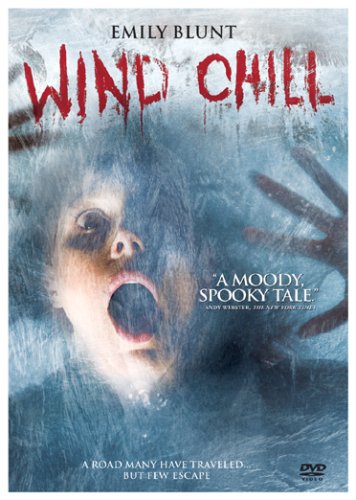
It may be a little too early for winter, but scary movie season has begun in my personal calendar. This weekend I watched Wind Chill. Although critics weren’t always kind to the movie, and the ending is somewhat predictable, it is one of the more decidedly creepy films I’ve seen recently. Since it is set in Pennsylvania there was a bit of a homey touch to the terror. I have driven on similar roads to that in the movie, during snowstorms, and that is one of life’s true terrors. What makes the movie so frightening is its ambiguity. Put a teenage girl alone with a guy in a car on an isolated road and you’ve already got enough elements to make your spine tingle. It becomes clear that the guy hasn’t been honest with the girl all along (the characters are never given names in the movie) and as they spend the night in the broken-down car reality and nightmare become increasingly difficult to parse. Of course, religion plays a role in the show.

The guy is giving the girl a ride home for the holiday break. He’s been watching her, a little too closely, for some time although she doesn’t know that until it’s too late to turn back. As they fumble for conversation it turns out that he is an “Eastern Religions” major and they met in a philosophy class. This just keeps getting scarier and scarier! After they break down (spoiler alert!) and the ghosts start showing up, we learn that some of them are priests. They had come to this haunted road to give the last rites to some accident victims before freezing to death in the poorly insulated cells in a strange little monastery on the hill (this is Pennsylvania, remember). As the night wears on we find the priests condemning the bad cop to a fiery death before light dawns and the girl finally finds salvation.

Of course, this is a variation of the old urban legend of the teenage couple out parking when something scary happens. Having everything in half-light and through smeary, foggy windows makes it more difficult to perceive what is actually going on. A lying religion major, priests complicit in a deserved fatality accident, and Nietzsche’s eternal recurrence give the film a little intellectual heft among the muted special effects and bleary-eyed confusion as the night goes on. Morality is on trial here. Although not the most profound of films, Wind Chill deserves some credit for bringing religion and horror to the same remote location and having them trade cards in the dark of night.


Shopping for Fear

So I decided to visit a Halloween store. These have been showing up with metronomic regularity in September for several years now and are usually good for a cheap thrill. My personal preference for Halloween is more somber than garish, but the affirmation that other people enjoy a safe scare has a way of drawing me in. Those who read this blog on a regular basis know that I frequently point out commonalities between fear and religion. They both seem to hover around the same orbit in the brain, and, in some accidentals are very similar. Horror films therefore often indulge in religious imagery, and monsters do not infrequently partake of the divine. So it is no surprise to see my thesis borne out in shops intending to capitalize on fear.

I will freely admit that there may be cultural references that I’m missing here. A movie that I’ve neglected, or some television show or graphic novel may be informing some of the images in ways I can’t comprehend. Nevertheless, we all know of the power of the crucifix when it comes to vampires. I wasn’t aware that the cross had horrific effects on other species of monsters as well. Take this guy here. I’m not sure what he’s supposed to be—perhaps a zombie? It seems a little too corporeal to be a demon. The teeth just don’t look right for a vampire. In any case, he seems to have an extreme reaction to religion, with the cross melting right into his skull. Is there a conversion message hidden here somewhere? Of course it could be just a chinzy attempt to scare a real religiophobe. The cross has become the backup weapon against all supernatural evil.

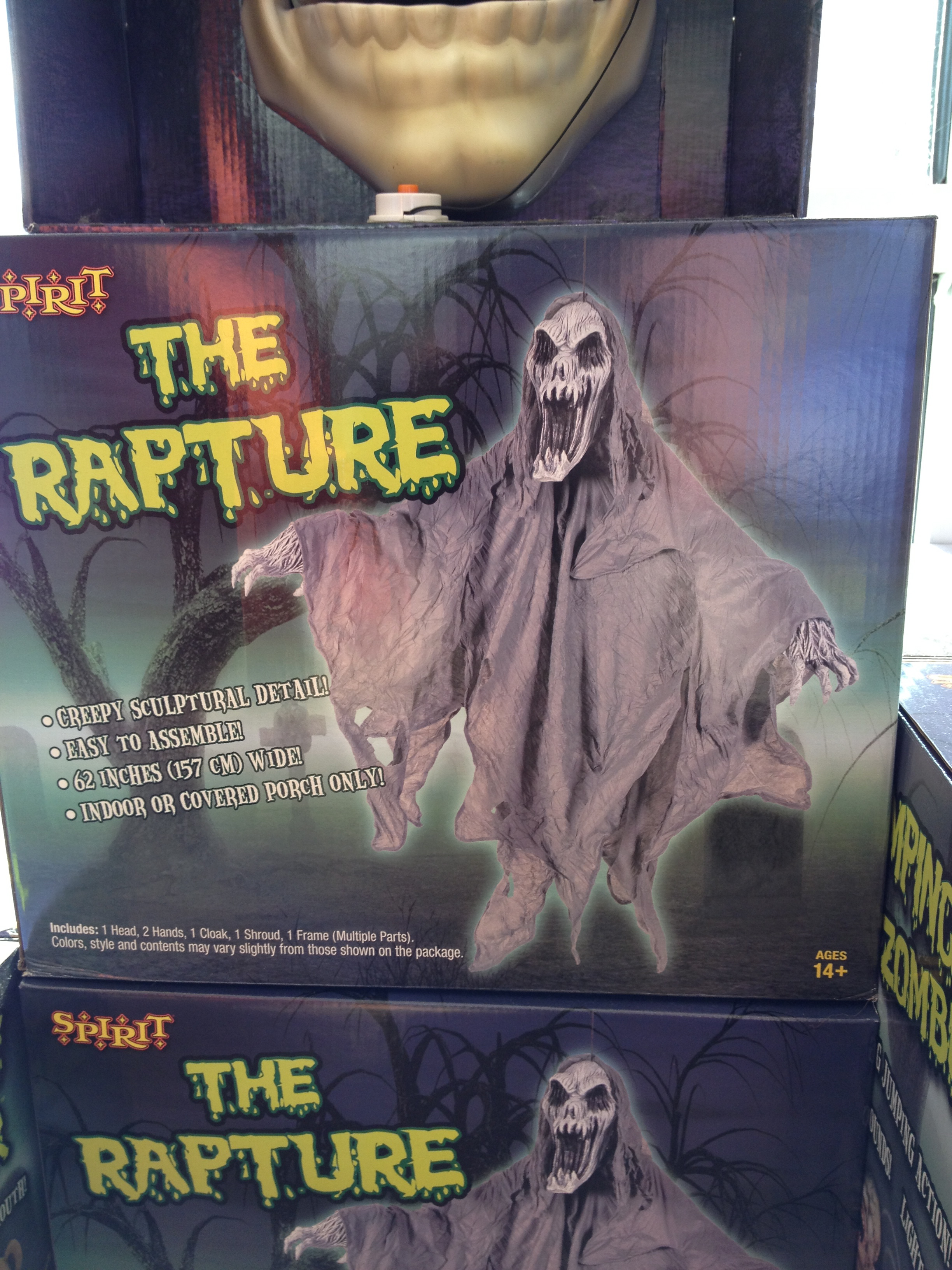
The use of a grim-reaperish ghoul rising from the grave to illustrate The Rapture was a new one on me. Last I heard only the squeaky clean and friends of the Tea Party got to go on the Rapture. (Well, the latter category might explain it.) The idea of the Rapture, as it was fabricated late in the nineteenth century, involved the chance for all the good Christians to escape before things really got rough down here for us normal folk. I would’ve thought that scary guys like this joining the heavenly crusade might take a little bit of the joy out of the occasion. Or maybe they’re being left here to haunt the rest of us. In either case it is clear that consumers respond to religious sounding language and symbolism when looking for a scare. Obviously there is plenty in the store with no religious significance at all, but finding hints of religion scattered in with the plastic scares does show a kind of Frankenstein’s monster of human sentiments and emotions. It’s only appropriate when the nights are now longer than the days.


Deadly Morass

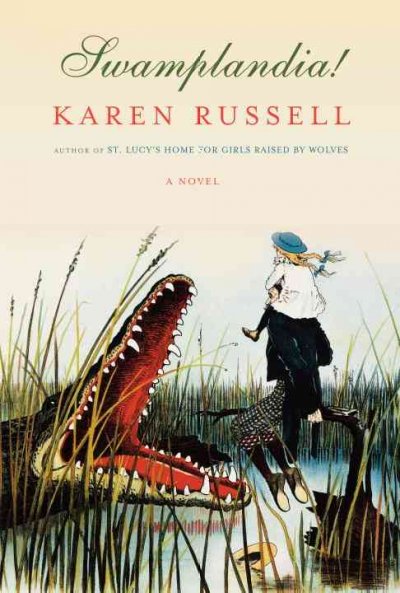
Swamplandia! is a novel ensconced in the reality of death. It is one of those books that I knew I would need to read as soon as I heard about it.  Alligator wrestlers, ghosts, and even a biblical-sounding Leviathan theme park based on hellish imagery create an eerie, almost supernatural feel to the narrative.  At the same time, it is a very human story of loss, assimilation, growing up, and more loss that might be gain.  I’ve read many novels where the characters and events faded relatively rapidly after I closed the back cover.  The cast of Karen Russell’s Swamplandia! has stayed with me, wraith-like, for several days.  As I’ve tried to work out why the story sticks so close at hand, and I think it may be because so many of the characters—the entire protagonistic family—are outsiders.  The loss of the mother spirals a carefree, largely off-the-grid family in a Floridian swamp into a forced confrontation with the mainland.  In these times of economic hardship, the loss of a dream is something too many people can understand.  I certainly can.
 
Death, in whatever form it may appear, is a religious issue because it deals with ultimates.  Paul Tillich, a theologian of the last century, famously declared that God was that on which a person staked their ultimate concern.  For many people today, by this rough definition, death has become a kind of god.  In the ancient world s/he was literally so. Of course, death is entirely natural.  Consciousness is the factor that makes it seem foreboding and dreary.  Swamplandia! deftly ties death and love, hope, and a kind of diminished redemption together in a tale where a young girl travels through an unlikely underworld to rescue a sister who saved her own life by her doubt.  It may not be the most profound novel, but it is certainly a moody one.
 
On my campus visits I’m increasingly hearing that novels are favored by some instructors to get at deep truths that textbooks miss.  Indeed, the analytical urge is strong, but not omnipotent.  Sometimes the truth can best be experienced by letting yourself go and just feeling what is happening rather than thinking it through.  Swamplandia! does a bit of that. Thinking back over my own long, academic tenure, I realize that the teachers I enjoyed most were those who had me read what were, at the time, unexpected things. In a world where education has become nothing but job training to produce satisfied cogs in the corporate machine, death as a character in our own stories can’t be far from the truth. Sometimes even alligators and ghosts aren’t the scariest features of our non-fictional landscape.


The King’s Bible

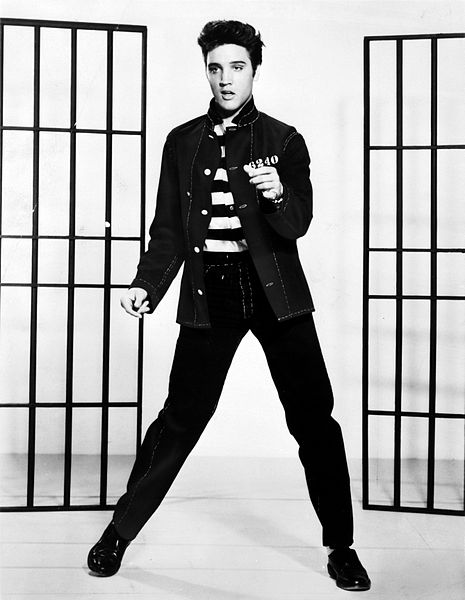
Thumbing through last week’s Time, I found a Bible. Actually, stories of religious interest appear frequently in Time, but this was one of those small blurbs of human interest. It appears that Elvis Presley’s Bible just sold for $94,600 in the UK. Of course, Elvis was known for his gospel recordings as well as his formative role in rock-n-roll. A boy from the south in those days would have known his Bible. What struck me as worthy of comment is the reason the artifact was priced so high—not because it is a religious book, or the putatively divine content, but because of who once owned it. The Bible is a common enough item—billions have been printed—and in our world of value based on rarity, it is hardly a specialty item. In fact, they are often given away.

We have all felt the draw of fame now and again. We wonder what the lives of the rich and famous are like. Sotheby’s and Christie’s thrive on people wanting to possess articles from their deceased heroes. Studies have been conducted to demonstrate just how much laundering devalues clothes worn by both the famous (bad) and infamous (good). In the case of a Bible, perhaps one is put in touch with the spiritual residue of the owner. According to Time, Presley scribbled many notes in his Bible. Perhaps there is some eternal message there? A message untainted by years of study. A message from Graceland.

The King (of kings?)

Elvis Presley was not acclaimed for his great intellect. He had a singing voice and swinging hips that changed an entire culture, but his was not the world of the library and study. Naturally it is the more flamboyant that capture the imagination of the largest numbers. I can imagine the (a) Bible of Rudolf Bultmann, Charles Briggs, or William F. Albright on the auction block. There would be a flurry among some scholars, for sure, perhaps to pool their money enough to make a bid some order of magnitude less than Presley’s sequined presence of the auction table demands. Probably it would not even be worth the effort of the auctioneer. After all, no matter what doggerel he might have scribbled in the margins, the King always outranks the mere pawns.


Longer Nights

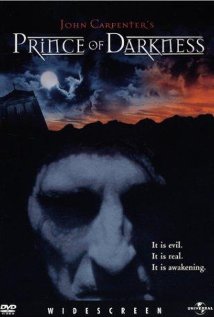
Nothing accompanies the slow decent into winter like scary movies. Now that autumn is officially here, it is time to look for the religious motifs in frightening movies again. Perhaps it is time to join Netflicks, because when it comes to my own movies I have mainly choices among bargain basement films I’ve picked up over the years. Over the weekend I watched one of them. John Carpenter’s Prince of Darkness is the second of his apocalyptic-themed movies, following on the remarkably creepy The Thing. (This is one of the few remakes that manages to outdo the original in just about every way.) Prince of Darkness, however falters almost from the beginning. I do appreciate a movie that is straightforward about using religion as the source of fear, and one that even has a character who is a graduate student in theology! Apart from the priest and street people, all the ill-fated characters are academics—professors and grad students of theoretical physics, the sciences, and our one, lone theologian. The plot revolves, literally, around a swirling green liquid in a decrepit church, which is the Anti-Christ.

Although the trappings are all here for a truly frightening experience, Christianity doesn’t really lend itself to a frightening mythology. To get to something truly tremendous, Prince of Darkness posits a kind of gnostic anti-God who is the father of Satan. The persona is evil writ so large that it is simply not believable that a corroded screw-top jar is able to contain him. For anyone who’s studied history or anthropology, placing the date of the Ball Mason jar back seven million years ago sounds like random guesswork. Homo sapiens sapiens weren’t even around then, making one wonder why God thought of a jar to trap the viscous Anti-Christ millions of years before the “fall” necessitated a regular Christ. The Bible appears, in transmogrified form, as an ancient book of spells that when translated sound suspiciously like the good old King James.

The movie does have its creepy moments—abandoned churches are scary; even fully functional ones can be remarkably spooky at night. It is difficult to accept that a priest would go to a physics professor before consulting his bishop, but then we have to prevent this movie from becoming just a watered-down Exorcist flick. Having Alice Cooper appear as the leader of the homeless minions was a nice touch, in any case. Since we are all still here, the movie ends predictably enough, with Satan’s Dad being stopped before entering the world. It does, in a de rigueur metanarrative, involve a self-sacrifice, albeit not a virginal one. And for the surviving handful of academics, life goes on as normal the morning after. Perhaps evil was blown too large to be believable here. Enough human-sized diabolism exists to frighten any reasonable person. And autumn is only just starting.