Connecting Many Leagues

Much of movie viewing life is about making connections.  Many, many films have been made and I’m not the first to suggest that cinema is a form of modern mythology.  But those connections!  Pressed for time one busy weekend, I found the brief, low-budget The Phantom from 10,000 Leagues.  It was included with Amazon Prime and I had an obligation in about 90 minutes.  I could just squeeze it in.  As I’d anticipated, it was another of those poorly written, cheeky teen-magnets from the fifties.  The monster created by radiation, the threat to the world that the government sends only two guys to handle, and lots of lingering shots of men in business suits walking on the beach, it’s about what you’d expect.  It did well at the 1955 box office, though.
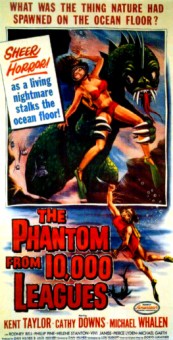
My first thought was that it was an attempted marriage between The Creature from the Black Lagoon and The Beast from 20,000 Fathoms.  Indeed, Black Lagoon had been released the year before, opening the realm of underwater filming for monster movies.  It, however, had a believable monster that wasn’t so monstrous.  The “phantom”—the name is never explained—is obviously a person in a cheap monster suit that can barely open its mouth.  It kills by holding people under water, or getting them into a radioactive beam, or preventing them from getting away from dynamite.  Oops, that last one’s a spoiler, I guess.  The Beast from 20,000 Fathoms came out a year before Black Lagoon.  The title of The Phantom from 10,000 Leagues title was obviously ripped off from it, and the atomic connection and undersea beast are common to both.  Connections.

The Beast had the benefit of a monster by the master, Ray Harryhausen.  And it was based on a story by Ray Bradbury.  That was a winning combination.  The Phantom claims to be based on a story by Dorys Lukather.  This movie is all she’s known for writing, God rest her soul.  Produced by the subtly named American Releasing Corporation, the production company would go on to become the respectable American International Pictures.  Interestingly, given the sexism of the era—reflected fairly clearly in the writing—the monster was played by a woman.  Norma Hanson, like Milicent Patrick, brought a monster to life only to be largely forgotten.  Patrick was rediscovered by Mallory O’Meara, but Hanson—one time a diving world-record holder—seems to have faded.  Had I but more time, I would enjoy diving those 10,000 leagues to bring another forgotten Hollywood monster woman to life.  And if I had the connections.

People of Slime

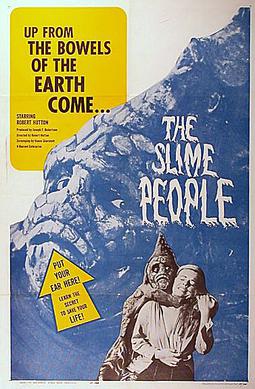
An old saying advises not to speak ill of the dead.  And I suspect this also applies to the living dead.  Night of the Living Dead (1968) is a classic horror film that represents the maturing of the genre.  Of course, it’s not the only horror film of the sixties, and I don’t mean to speak ill of it by suggesting that George Romero—who was used to working with a small budget—had seen The Slime People.  But I wonder if he had.  Directed by and starring Robert Hutton, The Slime People was released in 1963 and although it’s really bad, some of the scenes from this black-and-white groaner seem to have been borrowed five years later by the more able director.  The interviews by the newscasters and the driving country roads, and even the chasing of the angry mob could’ve served as direct inspirations.

The slime people are from subterranean earth, forced into action by underground nuclear testing.  Building a solid fog wall around Los Angeles, they take over the city while a pilot, a scientist and his two lovely daughters, and a marine, save the day.  Although the military had been fighting the monsters, they just couldn’t win.  The scientist really doesn’t help solve the issue but the pilot (Hutton) finds the creatures’ wall machine and the scientist is able to blow it up with a spear, saving the day.  This is one of those films so bad that it’s good.  The writing is poor and the plot makes little sense overall.  It doesn’t quite have the style of an Ed Wood film, but it participates in the aesthetic of watching bad movies.

Hutton isn’t a bad actor.  Hampered by a too-low budget (one of the signs that a movie might be one of the good bad ones), he couldn’t film the story he envisioned.  Much of the budget was reputedly spent on the slime people costumes, ensuring that Hutton drew no salary for his own role in his movie.  A couple of the other stars were veteran actors, and this prevents the movie from being a mere hack job.  I take some hope from the fact that many films like this eventually become cult classics.  Yes, sometimes it’s so that we can laugh at them, but I think there may be something deeper involved.  Those of us who watch bad movies might recognize something of ourselves in them.  We too struggle to tell our story, without big budgets and without studio support.  And yet we persist.


Wicker Wondering

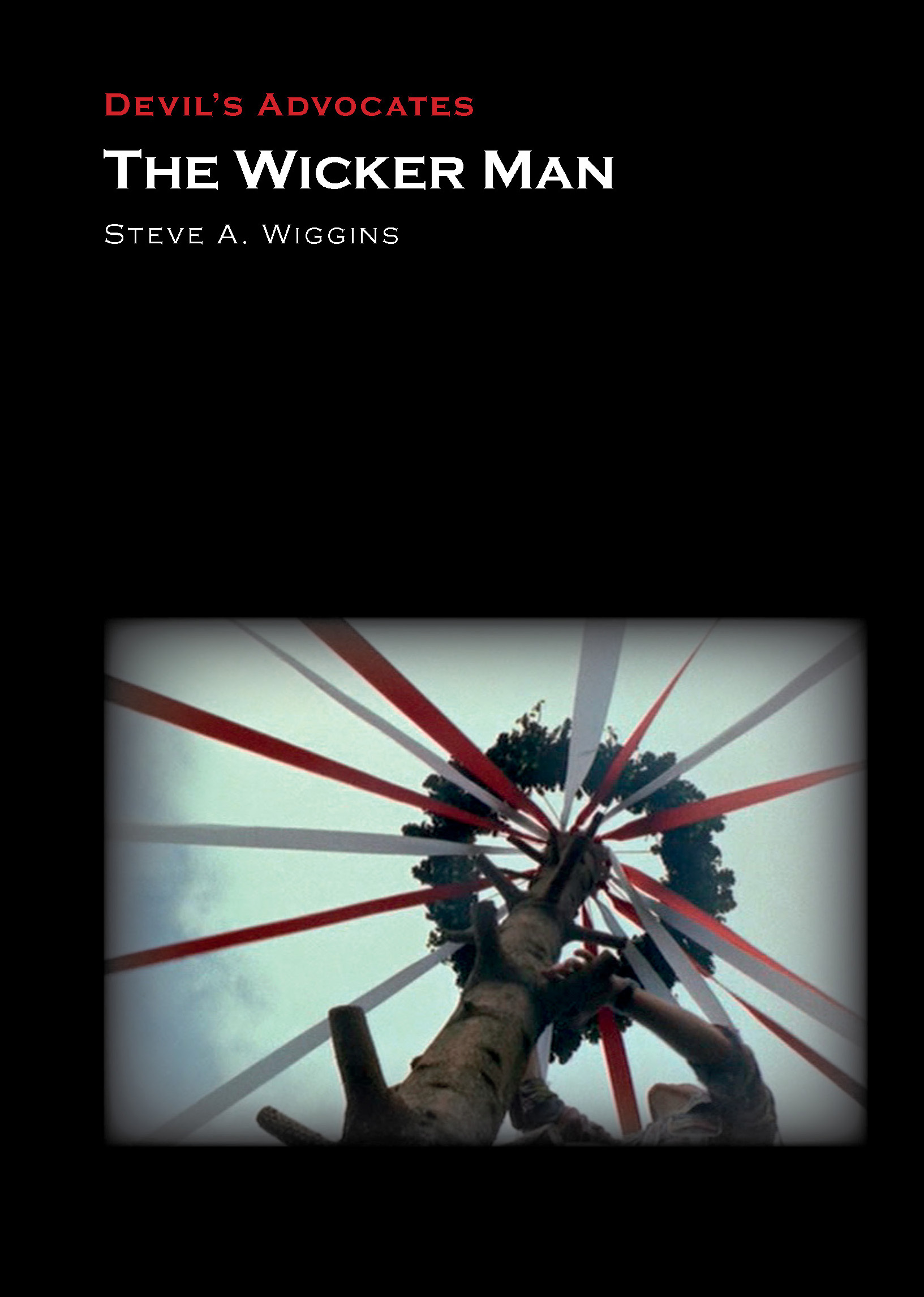
Why The Wicker Man?  It’s a fair question.  My book is now starting to appear on Amazon and other venues (it’s on Goodreads!), so it’s time to try to get the word out.  The BBC ran a recent story, “Why The Wicker Man has divided opinion for 50 years,” and that offers a springboard into the “why” question.  I’m not Scottish, but my wife and I lived in Scotland for a little over three years.  That’s one reason.  While there I did some research into Scottish folklore—historians of religion are curious people—and traveled widely, and that’s another.  As one of those writers who’s never been able to break out of the academic market, the third and most direct reason is that I’d begun a book on holiday horror.  A friend pointed the series Devil’s Advocates out to me.  Back then the series books were priced in the twenty-dollar range, but the pandemic put an end to that!

I’ve always thought The Wicker Man derived its fear from the strangeness of the holiday.  I’ve also often wondered why Anthony Shaffer and Robin Hardy didn’t make more use of “Beltane” in the dialogue.  Maybe the unfamiliar was too unfamiliar?  I suggest a different reason in my book, but I won’t reveal that here.  Writing a book on The Wicker Man would allow me the opportunity to share my thoughts about holiday horror without trying to convince an agent that people actually do like to read about horror as well as reading horror itself.  Come on, agents!  It’s called pop culture because it’s popular!

I pitched the idea and the series editor liked it.  So did the reviewers.  They were tired of hearing/reading about The Wicker Man as folk horror, as if there was nothing more to the movie.  Like most films that grow an afterlife, this one is complex and can be approached from many angles.  In fact, there’s another book, one by John Walsh, coming out on the movie just weeks after mine.  I wasn’t the only one who knew the fiftieth anniversary was on the horizon like a Beltane sunset on Summerisle.  For those who prefer a more television-like explanation, I’ve posted a video on The Wicker Man on my YouTube channel.  This blog, I realize, doesn’t get enough hits to drive traffic that way, but it’s nevertheless part of the package.  Why The Wicker Man?  The answers likely lie in several posts on this blog, a few years in Scotland, and a love of strange movies.


Coronation Bible

The scene from The King’s Speech doesn’t show it at all, but there was even more drama around the coronation of George VI than the movie reveals.  It may not be obvious, especially to Americans, but there is a great deal of prestige in being the supplier of a coronation Bible.  The two ancient presses in the United Kingdom, Cambridge and Oxford, vie for that honor.  In 1937 Oxford had won out.  Coronation Bibles are works of art and are extremely rare.  You’ll never find one at your local library’s used book sale.  As a recent Oxford University Press blog post indicates, the Bible at George VI’s ceremony was a last-minute replacement.  What could possibly go wrong with a ceremonial Bible, of all things?  Quite a lot, but this one had to do with an aging cleric.

Despite being the eve of war time, an elaborate Bible had been designed and manufactured.  Symbolism is important.  Britain faced not only the aggression of Hitler, but also the abdication of Edward VIII.  Instability was in the air.  In such times, as we’ve seen in American politics, leaders look to the Bible for support.  Printed on special paper, chased with gold on its cover, the coronation Bible was a work of art.  However, the Bishop of Norwich, Bertram Pollock, couldn’t lift it.  At 73 he wasn’t in the best of health, and he had a role in the ceremony.  At the last minute a lighter, replacement Bible was sent.  According to the OUP blog post, the Archbishop of Canterbury issued a rare apology to the press, but also noted “I cannot but wish that you had given some more consideration to the physical infirmities of those who would have to carry it.”

A big Bible

Swearing on the Bible is an archaism that seems likely to persist into the foreseeable future.  The future of the British monarchy (which I do not follow) itself seems in doubt, but to quote the Good Book, “The grass withereth, the flower fadeth: but the word of our God shall stand for ever.”  As long as many people believe this, such swearing will persist.  Even if such belief fades, the solemnity of swearing on a Bible is likely to continue.  The Bible has, in its tangible way, become a stand-in for God.  And as another archaism, a king, is sworn in today, it is to be hoped that the bishops involved have kept their muscle tone intact.  At least to heft, for a little while, a ceremonial Bible.


Insane Illusionist

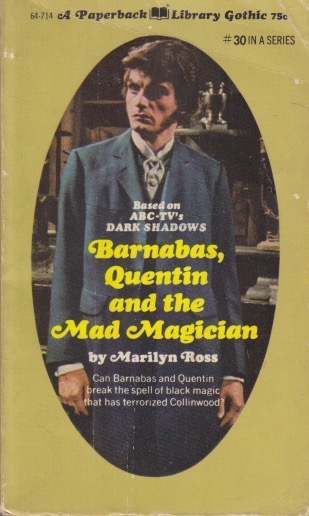
The Dark Shadows novels supplemented my early watching of the television series.  It’s funny, but when I remember watching the show, in my mind I watched it alone.  During a conversation with one of my brothers recently, he assured me that he had watched the show too, pointing to the selectiveness of memory.  What I do know is that I was the only one who read the novels.  I bought them when I could find them used, and I kept them in an old pasteboard suitcase (we had no bookshelves and my parents didn’t read).  I didn’t have the entire collection by a long shot and I can honestly say I don’t know which ones I read back then.  I am now, however, two novels from finishing the entire series—a project I began around 2006.

Barnabas, Quentin and the Mad Magician follows the usual formula, although this time around Barnabas is temporarily cured of his vampire curse and Quentin doesn’t turn into a werewolf at all.  They are on friendly terms and both are being set up by the rather obvious antagonist, the mad magician.  I guess you can begin to see the series winding down.  Most of the thirty-two stories are broadly similar and the writing is that rushed, breathless kind that seems characteristic of those who make a living delivering pulp fiction.  There have always been people like me who will buy it.  That’s the reason I typically use the phrase “guilty pleasure” when describing these novels.

As I note in my YouTube video on the phenomenon, Dark Shadows was quite popular in its day.  It’s what we might now call a cultural meme.  Television series, novels, two movies, comic books, lunch boxes—the whole coffin.  The monsters were likable.  That was true of some of the greats—you felt sympathetic toward them.  As horror began to “grow up” the monsters often became entirely reprehensible, with no redeeming qualities.  So as Barnabas and Quentin do their best to expose the true monster, their supernatural powers currently on hold, they have to rely on their money and connections.  Even at the end the “confession” is made suspect by the longer tacked on ending.  If you’ve read enough of these, you grow suspicious when there are ten pages left after the antagonist dies.  Stories such as this aren’t great literature, but they do fill a gap in the world of monsters that nostalgia leaves for those who knew Dark Shadows in the late sixties.


Spiritual Alterations

I’d been meaning to watch Altered States for quite a few years.  I suspect the reason (it’s been long enough that I can’t recall for sure) is that I knew it had a story line tied in with religion.  The tale follows Edward Jessup, a psychopathologist, who is attempting to understand schizophrenia.  He’s particularly taken by the religious nature of some schizophrenic delusions, and he uses sensory deprivation on himself to trigger something similar.  A trip among tribal Mexicans leads him to a psychoactive substance that he decides to combine with sensory deprivation to enhance the effects.  Along the way he explains to his girlfriend, and eventual wife, that his father was religious but died a horrible death.  He therefore became irreligious but his altered states of consciousness are often full of images from Revelation.

While the Bible theme eventually gives way to biological regression to pre-Homo sapiens, one of Jessup’s experiences has him coming to his dying father again and dropping a Bible on him which turns into the veil of St. Veronica on his face, which he then rips off and throws, flaming, to the floor.  Another instance of the Bible in horror, the film also uses crucifixes and hellish images to demonstrate the religious nature of these alternative states.  Jessup’s goal is to regress to the original thought, to encounter, as he puts it “God.”  This desire, combined with the potent Mexican drug, transforms him physically, and, in the end, emotionally.  Instead of being dissociated from his wife (whom he is planning to divorce), he realizes that love is the only thing that can save him from the terror of his experiences.

This is some profound stuff.  Paced like a movie from 1980, it has a quality not unlike 2001: A Space Odyssey.  The message seems to be sound—the need for encountering the “divine” ends up convincing Jessup (that may autocorrect keeps changing to “Jesus”) that love is really what it’s all about.  The transformation scenes, while not shown in the detail of An American Werewolf in London, are nevertheless convincing enough.  It’s a rare movie that treats religion respectfully.  Here Ivy-League scientists are motivated to understand it.  In real life, alternative states of consciousness are quite real, if poorly understood.  They’ve been part of religious practice from the beginning and are a far cry from sitting in the pew and singing anodyne hymns week after week.  The more movies I see, the more it seems that a sequel to Holy Horror will be necessary some day.  


50 Years Ago on May Day

Word is starting to get out about The Wicker Man.  One of the most intelligent of horror movies, it turns fifty this year.  Aware of the coming anniversary, I pitched a volume in the series Devil’s Advocates on the movie a few years back.  I was delighted that my take on the film was unique enough to qualify and my volume has now appeared on Liverpool University Press’ website.  And, as an added bonus, a blog post I guest wrote on the book will also appear shortly.  And it’s May Day.  The Wicker Man is the third person of the unholy trinity of folk horror.  The other two films are Witchfinder General and The Blood on Satan’s Claw, both of which I’ve reviewed here.  But 1973 was also the year another person of another unholy trinity, The Exorcist, was released.  This other trinity began with Rosemary’s Baby and concluded with The Omen.  If you’re curious about it, I wrote quite a bit about it in Holy Horror.

Fiftieth-year anniversaries are significant, given how young the film industry is.  Depending on the publisher, it may be difficult to get advance notice out.  My colleague Joseph Laycock, along with Eric Harrelson, wrote The Exorcist Effect.  This is a book I’m very excited for, although it’s not yet on its publisher’s website.  Academic publishing can be slow that way.  Another fiftieth anniversary Wicker Man book is coming out in October—John Walsh’s The Wicker Man: The Official Story of the Film.  The publisher, Titan books, not hampered by university press processes, had the book well advertised a couple of months back.  I’m looking forward to reading that one as well.  These fiftieth anniversary books are a boon for those who watch intelligent horror.

Academic publishers, you see, classify books in different ways than trade publishers do.  If you’re not sure what a trade publisher is, it is essentially anyone whose books you see in actual bookstores.  Academic publishers tend to focus on library sales and sales to academics who are willing to shell out fifty, a hundred, or sometimes more, bucks for a book.  (In my teaching days, although we had no expense budgets at Nashotah House, I would occasionally (very rarely), after careful family consultation, shell out the academic press price for a book I needed for research and the library wouldn’t buy.)  My last three books have been written for wider readerships, but have been published by academic presses.  On this fiftieth anniversary year, I’m planning on reading a couple of good books.  And thinking about May Day fifty years ago.


Lilith Be Gone?

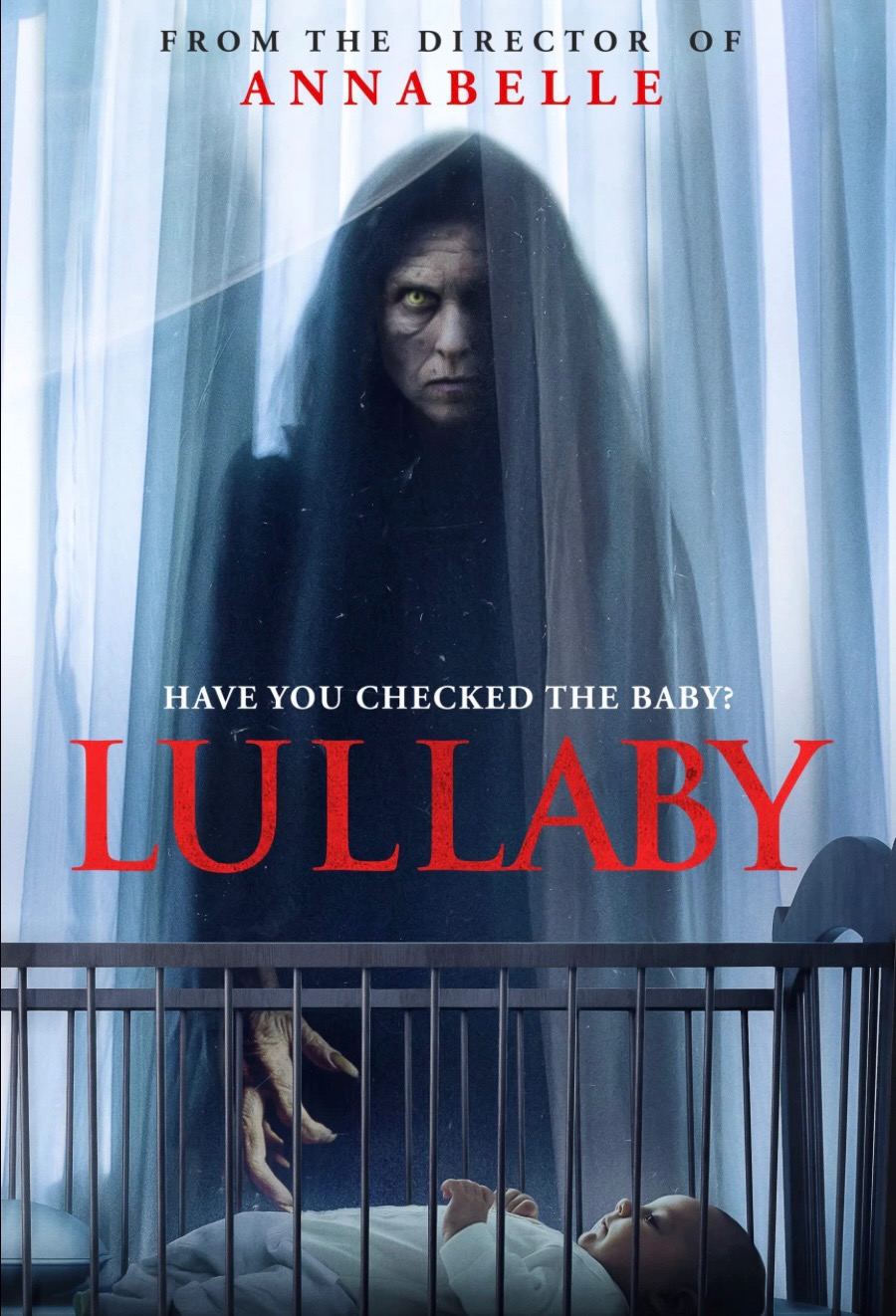
One of those questions it isn’t politic to ask is “Are you Jewish?”  I get asked that once in a while but mainly by Jews.  I’m not Jewish but some people tell me I look like I am.  In any case, as a Bible editor at an academic press, the question of someone’s ethnic affiliation sometimes comes up.  The dilemma is that we can’t ask that.  And it is very difficult to know the answer if someone doesn’t tell you.  The reason that this is on my mind is that I recently watched John R. Leonetti’s horror film Lullaby.  The film was one of at least two that came out with that title in 2022.  And since it deals with Jewish themes, that question naturally comes to mind: is the director, or are the writers, Jewish?  I suspect, from the way all of this plays out that the answer is “No.” Or, if they are, they didn’t do their homework.

Lullaby is a Lilith story.  A young couple—she’s Jewish, he’s a convert for her—have a newborn.  The woman’s sister has sent to them, among other things, a book in Hebrew that contains a Lilith-summoning lullaby.  Lilith shows up and steals the baby but a tattooed rabbi gives the husband some Jewish rituals to combat Lilith.  Apart from the spurious etymology of “lullaby” as “Lilith be gone,” this rabbi doesn’t seem convincing.  His Hebrew handwriting looks as if he might be a first-year student.  And keeping a menorah lit all night is supposed to keep a demon at bay?  Not only that, his assistant can be bribed to regain the cursed book.  All of this begins to look like a gentile trying to direct a horror film in a religion he doesn’t understand.

Religion and horror go naturally together.  I’ve written several posts about Jewish horror that really works.  In those instances, it’s clear that the writers and directors understand what Judaism is.  The solution here is that the convert husband must “really believe” in order to conquer Lilith.  The rabbi tells him to have faith.  The thing is, Judaism isn’t a religion based on having faith—Christianity is.  And taking that aspect of Christianity and using it to try to make other religions faith-based is one of the most common mistakes of those who don’t study religions professionally.  Horror works well with religion when those doing it actually understand the religion they’re trying to portray.  When they don’t, it can end up looking like appropriation of the worst kind.  I watched the movie because it was about Lilith.  What I found was a basic misunderstanding of how religions work.


Finding Family

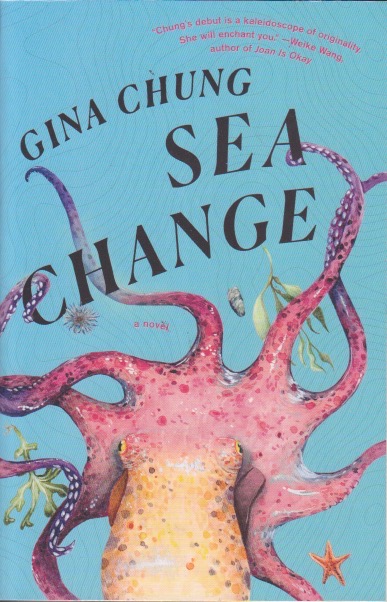
Sea Change is a probing story of learning to live with loss.  Of learning how to say goodbye.  I’m sure that I didn’t catch all that was being offered in this novel, but for those of us who did grow up without a father there’s a kind of therapy here.  I know that I eagerly awaited the end of work each day so that I could pick it up and read a bit more.  Framed as the story of the only child of Korean immigrants, the novel features Aurora (Ro), a young woman who has had to find her way ever since her father has gone missing.  And even before that, actually.  Her father, as a marine biologist, had captured an octopus (Dolores) who now lives in the aquarium where he once worked.  Ro, whose relationship with her mother is strained, takes a job in the aquarium after her father goes missing and befriends the remaining part of him—Dolores.

At the same time Ro’s boyfriend is accepted into a mission being launched to Mars.  (This isn’t science fiction, just to say.)  The loss is another deep cut to a woman who had to deal with the earlier significant loss of her father.  I won’t say much more about the plot since I think you should read the book, but it is a thoughtful, and from my experience, realistic journey through the mental states of those who cope with abandonment issues early in life.  Of course, I can’t speak to the experience of being a child of immigrants, but the novel shows we all deal with the same kinds of issues, no matter where we’re from.  At least we do in modern civilization.

Sea Change made me ponder, however, whether children raised communally would feel the same kind of loss if a parent they didn’t know was theirs left.  The mother-and-child bond is a deep one, so I guess it could be that fathers, after conception, would be expendable in such a situation.  It’s difficult to project how such a society would work.  The family unit is so deeply engrained into our experience that, unless a situation is truly dire, we know we can rely on our parents not to try to harm us, but rather to protect and love us.  Those of us who grew up without fathers (I’m not sure if that’s the case with Gina Chung or not) deal with insecurity issues that never quite go away.  This beautifully written novel was, for me, a healing kind of experience.


Monsters of Mystery

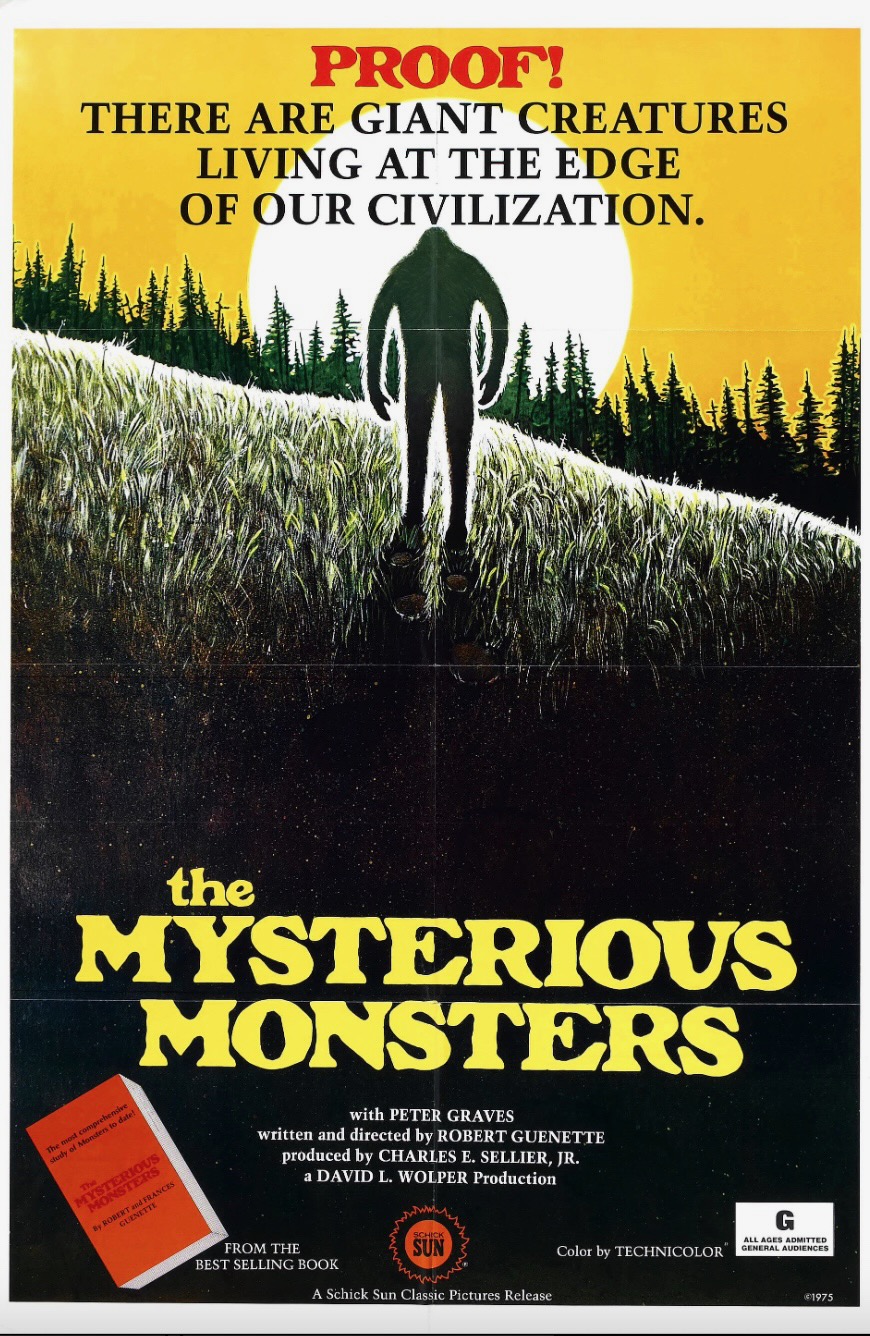
Sunn Classic Pictures was responsible for much of my young movie viewing.  Or at least a reasonable portion of it.  As I predicted, I ended up watching The Mysterious Monsters in the wake of Boggy Creek, and that got me curious about this unusual production company.  As a film distributor, the company began in 1971.  One of its early films was the aforesaid Mysterious Monsters.  Unlike other film distributors, their practice was to rent out a theater (this was before multiplexes) and take all the profits for the run of their film.  This was no risk to a theater owner and apparently it worked for Sunn.  They sponsored documentaries on unusual topics, likely because of the tastes of one of the founders, Charles Edward Sellier Jr.  

In addition to cryptids, the company also made films of the Bermuda Triangle and Noah’s Ark.  They even had a hand in a television version of “The Legend of Sleepy Hollow.”  Ever since my college days, I’ve tried to figure out whether they had a religious motivation.  I suppose it was In Search of Noah’s Ark that made me wonder.  They even distributed work by Alan Landsburg, who would go on to initiate the series In Search of…, which claimed many of my childhood viewing hours.  Sunn lasted only a decade before being bought out by Taft International Pictures, but what a formative decade it was!  As I’ve noted in a couple of my books, the bestselling nonfiction book of the seventies was Hal Lindsey’s Late Great Planet Earth.  That level of interest firmly fixed the Apocalypse in the American imagination.  I even saw the 1978 film (not Sunn Pictures)  in the same theater that’d housed Mysterious Monsters.

Come to think of it, the Drake Theater in Oil City had an outsized influence on my thinking.  The Drake is now gone.  It served the Oil City area for many years.  I saw Star Wars there for the first time, as well as Clash of the Titans.  We didn’t have much money, which may be why the escapism of movies was so important to my young self.  Now that I’ve finished my third book about movies it seems that perhaps I missed my calling.  Life is all about finding something someone will pay you to do.  The most fortunate find meaning in it as well.  The rest of us generally have to wait for the weekend to have the time to watch movies.  But like the Drake, Sunn Classic Pictures is gone, leaving memories of formative ideas behind.


Golem Events

Public domain, via Wikimedia Commons

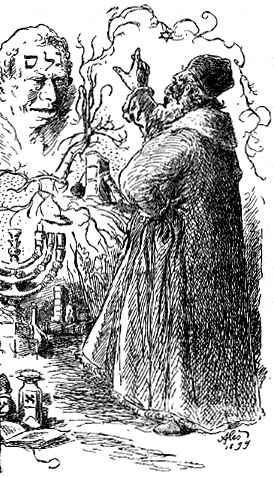
It doesn’t have a title yet.  At least not one that’s announced.  Still, when a friend pointed out this article that Daniel Handler, better known as Lemony Snicket, is writing a horror film about a golem, I sat up straight in my chair.  Since I don’t tend to dwell on children’s topics here, it may not be obvious that I was a real fan of A Series of Unfortunate Events, by Lemony Snicket, back when they came out.  Alerted to this series by a cousin who was my daughter’s age, we made this bed-time reading for a few years.  Handler, in the early days, did a pretty good job of keeping his identity secret.  He’s written some adult fiction, and those of us who write know that readers want more of the same thing from a writer—if you want to survive you do what they ask.

I’m a very eclectic reader—that may be one reason I don’t have many followers on this blog.  People like the same thing time and again.  (I’ve always been suspicious of genres.  One of the reasons, I suspect, that my students found my lectures interesting is that I drew from my eclectic reading, but that’s ancient history now.)  In any case, A Series of Unfortunate Events was formative in my own writing.  The movie remains one of the most gothic available, but it pales next to the novels.  Yes, they’re written for young readers, but they’re also very well written for young readers.  I discovered Snicket, or Handler, was Jewish when he wrote The Latke Who Couldn’t Stop Screaming.  And now he’s turned his attention to one of my favorite monsters.  The golem has been part of horror from the earliest days of the genre (that word!).

Paul Wegener and Henrik Galeen’s The Golem, part of a trilogy, came out in 1915.  Before the Universal monsters.  Even before Nosferatu.  The legend of the golem—which may have inspired Frankenstein—has a long history.  While not biblical, the golem does go back many centuries.  Unfortunately these early horror films are lost, or mostly lost.  The Golem and the Dancing Girl, from 1917, is a lost comedy horror.  The third film, The Golem, How He Came into the World, from 1920, survives and is sometimes called “The Golem.”  I wrote earlier about the excellent 2018 film The Golem by Doron and Yoav Paz, sensitive to Jewish issues in the seventeenth century.  This sub-genre of golem movies may be starting to come into its own.  It remains to be seen what Handler will do with it, but if his previous work is anything to go by, we may be in for a real treat.


Boggy Down

Okay, so after watching The Creature of Black Lake I realized that I’d never seen The Legend of Boggy Creek.  I did watch The Mysterious Monsters, a documentary that came out in 1975, in the Drake Theater in Oil City.  I was struck by Peter Graves’ serious tone and the information the film conveyed.  I’d not knowingly heard of Boggy Creek then (Graves does list “the Fouke monster” as another name for sasquatch), and besides, Arkansas was far, far away.  Well, to make an honest man of myself, I decided I’d better see it.  The opening of Boggy Creek is clearly the inspiration for the opening of Black Lake.  Their opening shots are very similar.  (I guess I watched them in the wrong order.)

Although Boggy Creek does have a guy in a costume (better makeup than Black Lake), many of those in the film are the actual eyewitnesses to the events it portrays.  They’re clearly not professional actors.  Interestingly, the narrator constantly insists that there’s only one such creature and that it acts out of loneliness.  If there are sasquatch they, out of biological necessity, must have a breeding population.  There had to be a Mrs. Boggy Creek somewhere in the picture—at least on a national scale.  In any case, this movie has become a cult classic, but I can’t help but think it’s so that people can laugh at it.  The acting’s not great and the long, long shots of hunters getting their dogs out of the truck  show the problems with the pacing.  Then there’s that folksy song (also echoed in Black Lake) about the lonely monster.

Boggy Creek came out in 1972, making it one of the earliest Bigfoot documentaries.  Given that sasquatch has gone mainstream (lawn art and Christmas ornaments featuring Bigfoot are common), the movie perhaps started a new cultural meme.  In the movie the poor critter gets shot several times, engaging viewer sympathy (but maybe not enough to write a song about it).  The narrator reflects if this particular southern hospitality might not’ve been overkill.  After all, some of the armed witnesses said they couldn’t shoot it because it looked too human.  The pacing was slow enough to make keeping my weekend weary eyes open a challenging prospect a time or two, but overall it’s a film worth watching.  I have the feeling, however, that this chain of events might lead me back to The Mysterious Monsters.


Black Lagoon, er, Lake

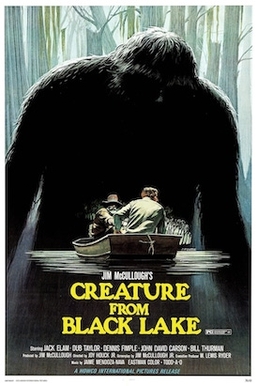
There’s value in watching bad movies.  For one thing, it’s a learning opportunity.  (For another, they’re more likely to be found for free on streaming services.)  The Creature from Black Lake drew me in with its title similar to The Creature from the Black Lagoon, and its very low price tag.  It kept me watching with its poor dialogue and obviously low budget.  One of the spate of “Bigfoot movies” that came out in the seventies, this one is the story of two (unintentionally) inept college students looking into a Louisiana swamp creature, based on the beast of Boggy Creek legend.  They end up in Oil City (I had to keep watching now), Louisiana where the local sheriff warns them off and where his daughter is, naturally, attracted to them.

I won’t spoil it for you (although the creature of this creature-feature is so clearly a man with a gorilla mask) but the movie does have a cast of some recognized B-list (or C-list) actors.   And it was a very early effort by Dean Cundey, a cinematographer who went on to work with horror auteur John Carpenter on Halloween and The Thing.  (And also The Fog, although that one’s lesser known, but covered in Holy Horror.)   You’ve got to start somewhere and the premise is good enough, being “based on a true story”—something the movie doesn’t claim for itself since the events, as portrayed, never happened.

Riffing off the earlier Legend of Boggy Creek—a cryptid docudrama from three years earlier (1973), it fictionalizes the Fouke monster incident.  The Fouke monster (which my autocorrect hates) was a creature reported around Fouke (no, I don’t mean Fluke), Arkansas, starting in the 1940s.  This earlier film went on to become a cult classic.  Black Lake suffers from poor direction and even worse writing.  College students, one obviously suffering from post-traumatic Vietnam issues, try to make out with girls they know are in high school only to be saved from criminal offense by a monster attack?  They wind up in jail anyway only to be released by a tough but gullible sheriff who simply trusts them to leave Oil City since he told them to.  I grew up near the earlier and, I’m tempted to say, original Oil City, and I know of no movies set in that town with all its drama and weirdness.  Even with its issues (Jack Elam is a delight to watch, however) this film is a bit of bad movie homework that’s hard to pass up when it’s free.


Finally, Therapy

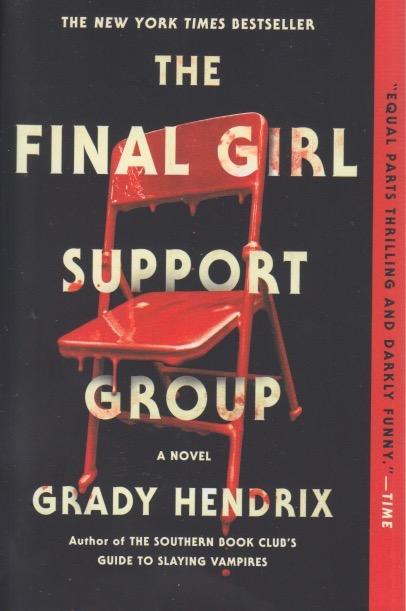
Like religion and horror, humor and horror can also get along well.  As an aesthetic, it’s not for everyone, but Grady Hendrix does it well.  It took some convincing for me to read The Final Girl Support Group.  I’d read one of Hendrix’s nonfiction books and was impressed, and that led me to his fiction.  It also demonstrates how an academic might actually be able to make a difference.  As you might guess, the novel features “final girls” from several fictional events, made into fictional movies, who get together for therapy.  It’s a funny idea and yet it’s not.  Hendrix clearly wants women to be treated fairly, but he’s also clearly a horror fan.  It’s sometimes a tricky balance to hold.  He does it pretty well in this novel.

The idea of a “final girl” comes from Carol Clover’s crossover academic book, Men, Women and Chain Saws.  This is the book that introduced the concept to the world.  As with most analytic concepts it’s only an approximation.  Clover noted the way that, in slasher films, the only survivor tends to be the virginal girl who doesn’t join in substance abuse.  Since the slasher genre is usually first credited to John Carpenter’s Halloween (Hendrix suggests in his acknowledgments that it’s Psycho), I’ve always wondered because Laurie Strode does take a toke in the car and we’re not really told much about her dating life.  I’m not a big fan of sequels, so maybe I’m missing something.  In any case, slashers have never been my favorites, and as sexist as it might sound, Poe’s observation about threats to beautiful women is something the “final girl” relies heavily upon.

The novel itself is pretty gripping.  I’m not going to put any spoilers here.  I was reluctant to read it but I’m glad that I did.  It’s classed as “horror” because of the theme but there’s definitely a lot of literary finesse as well.  It’s the kind of thing that doesn’t really seem to be deep, but upon reflection, it has more to say than you think it does.  The resolution of the novel is messy.  I suppose that’s one thing that makes it literary.  The characterization is amazing well done.  I had trouble keeping track of the back stories of all the final girls but that’s part of the fun.  While there are definitely horror moments, Hendrix never lets you forget that you are supposed to be laughing too.  It’s a fine balance and he manages to hold it together throughout while giving agency to final girls.


Curses

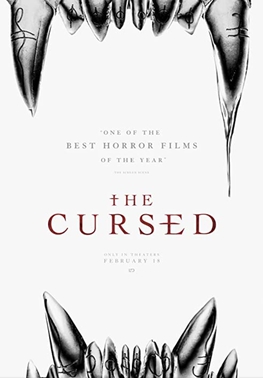
Once again I’m reminded that Holy Horror was never intended to be comprehensive.  I recently watched The Cursed (the 2021 one, directed by Sean Ellis).  This appeared after Holy Horror was published, but it’s a good example of religion (and the Bible) and horror.  It’s artfully done but rather gruesome and difficult to watch.  I suspect such aspects as gruesomeness are why many people dislike horror.  That certainly isn’t my favorite part either.  I watch for the story.  The lesson learned.  The moral delivered.  And also to get a sense of what’s going on in the wider culture.  People tell disturbing stories for a reason.  And quite a lot can be learned from them.  The Cursed has a complex story that was, I suspect, influenced by the historical incident of the Gilles Garnier killings in early modern France.

Set in France, this movie focuses on disputed land and the inappropriately extreme measures wealthy landowners will take to keep it.  A group of Romani (“gypsies”) have laid claim to some aristocratic lands.  Seamus Laurent, a local baron, decides (with the advice of the clergy) to kill them off.  Foreseeing this, one of the women had a set of silver teeth made and put a curse on them.  After she’s killed, the teeth are found by the children of the town and the teeth make monsters.  There’s some confused imagery here, but the story-line is clear.  The monster is revenge for the cruel treatment of and land theft from the Romani.  They may be dead, but betrayal leads to revenge.

That’s where the Bible comes in.  Apart from the locals fleeing to the church for safety, it turns out that the silver was from the thirty pieces given to Judas to betray Jesus.  One of the murder victims had a page torn from the Bible with Ezekiel 22.22 highlighted.  Unlike Pulp Fiction, this quote from Ezekiel isn’t made up and the “prophecy” is taken to refer to the beast conjured by the injustice done to the rightful owners of the land.  This film is subdued, moody, and gothic.  The story is sincere and well told.  It leaves enough gaps for discussion.  It also shows, once again, how religion and horror benefit from each other’s presence.  Stealing land is a biblical crime.  Although the church doesn’t ultimately protect, the absent God in this movie is on the side of those oppressed and tortured by the wealthy.  Maybe it’s time for a sequel.