Best Beasts

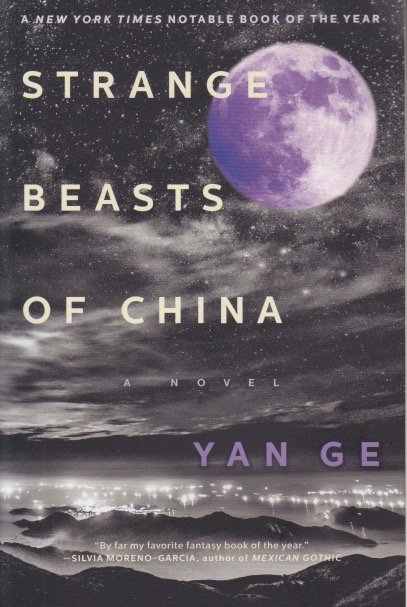
Strange Beasts of China left me strangely affected.  Yan Ge’s novel received quite a bit of acclaim for a book of speculative fiction.  Of course whether or not it is speculative fiction is open to debate.  The narrator, an unnamed former graduate student, makes her living by writing about the “strange beasts” of the fictional city of Yong’an.  Uncertain of where she fits, she’s been researching any number of creatures that resemble humans in various aspects, and who lived often hidden lives among the population of the city.  Her relationships revolve around people who, and this may be a spoiler, often turn out to be beasts.  It could almost be a parable.  I wasn’t quite sure what to expect.  The word “cryptozoologist” occurs in the copy and it was blurbed by a couple of horror writers.

It’s not really a horror novel, though.  There’s some action and even a bit of violence—not too explicit—and some well-executed twists.  I wasn’t sure where the story was going, but I found myself eagerly awaiting the opportunity to pick the book back up again.  One of the truths of our species is that we find ways of othering those who are different than we are.  Othering so that we can fear and mistreat them.  And feel superior.  That’s why this story feels so much like a parable to me.  The beasts aren’t really monsters, but then, monsters are really us.  What matters is how we treat them.  Yan Ge handles them with sensitivity—her narrator, after all, is very interested in these beasts—and our suspicions grow as the novel goes on.  We shouldn’t be judging here.

That this book should come out even as American attitudes toward China veered decidedly toward “othering” (the book was published in Chinese back in 2006, but appeared in English in 2020), is significant.  There are reasons to fear the autocratic government of China, but a significant portion of Americans seem to favor the autocratic style over democracy.  So it is that parables continue to be made.  We live on a planet with billions of other human beings, each with cultures, hopes, and dreams.  They may look a little different and thy may speak in ways that we don’t immediately understand, at least not without some effort, but they are just as human as those who speak English and who live in their own fictional cities isolated by a couple of oceans.  Strange Beasts of China really made me think.

Seasonal Sights and Sounds

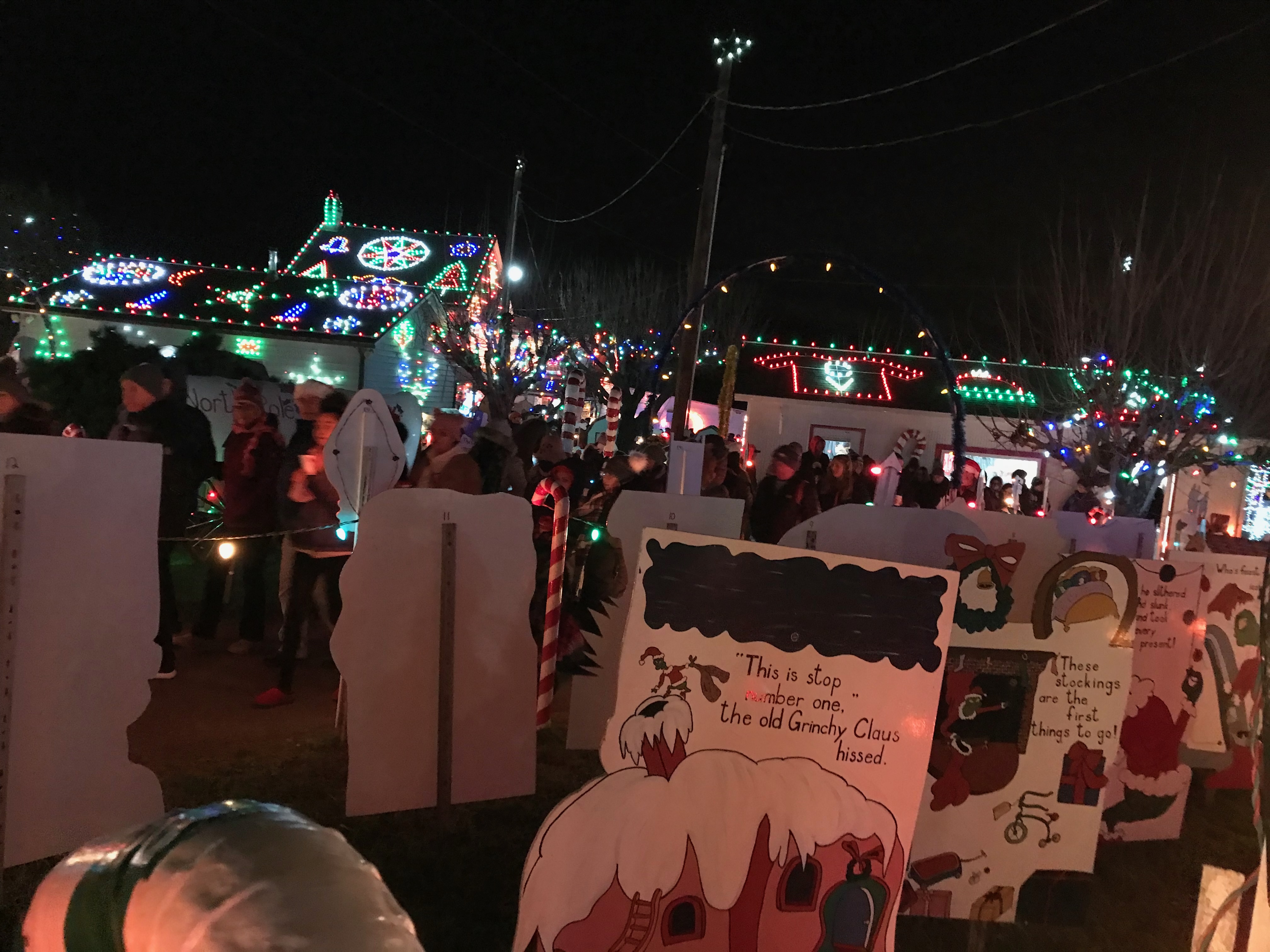
It’s listed as one of the top ten Christmas activities in Pennsylvania.  Koziar’s Christmas Village, located north of Reading and really out in the country, has been in business for 75 years.  Family owned and operated, it’s a walkthrough Christmas lights display.  I’ve been to many drive-through displays over the years, but on Saturday we went to this walk-through.  I wasn’t quite sure what to expect.  In the end, it was like many such attractions—lots of lights and painted plywood cutouts, flocked animals and dioramas with mechanically moving dolls.  What was truly impressive, however, was the number of people there.  Opening daily at 5 p.m., just as it’s getting dark, the sizable parking lot was already filling up at 4:30.  Walking through the display was essentially letting yourself by moved along by the crowds.  There were thousands of people there on Saturday night.

Getting into our car to head home, there were yet miles of cars backed up wanting to get in, and this was at 8:30.  Such sights of Christmas put us in holiday mode.  Seeing so many other people getting into the spirit of things was, in its own way, inspirational.  The next night—this being the weekend before the holiday itself—we attended the Christmas with the Celts concert at the Zollner Arts Center in Bethlehem.  Bethlehem prides itself on being “Christmas City,” founded, as it was, on Christmas Eve by the Moravians.  Christmas with the Celts is an annual show with different line-ups having in common live music, Celtic tunes, and Christmas.  The auditorium was pretty full, so I was glad for our masks.  They didn’t get in the way of the sounds of Christmas and a few stories from Ireland.

The sights and sounds of Christmas are part of what make this time of year so memorable, and something to which we look forward each year, despite the shortness of the days and the coldness of the air.  There’s a hopefulness about the holiday season, an underlying awareness that things need not always be as they are now.  Just two days away, the winter solstice—the holiday of Yule in its own right—marks the slow turning point to longer days.  It means winter is just getting started, but the cold brings with it more and more light in compensation.  Holiday sights and sounds help us through this transition.  And maybe, if things go right, they won’t be just the same as before afterwards, they may be even better.


Haunting Hudson

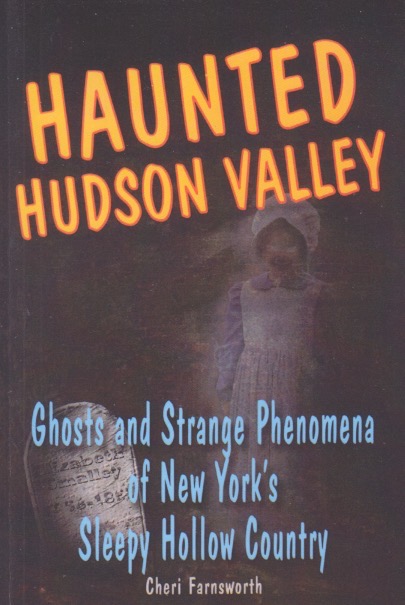
After Maine, the one place I’ve always wanted to live, but never had the opportunity, or could never afford, is upstate New York.  My ancestors were from the state but I just happen to’ve been born in Pennsylvania.  So it goes.  Perhaps it comes with professionally studying mythology, but one of my longterm interests is folklore.  I’m always fascinated by what people tell of their local setting.  Now when I approach books about the paranormal in a region, such as Cheri Farnsworth’s Haunted Hudson Valley, I know to take most of it with a grain of salt.  People love to tell stories and local people like to talk about where they’re from.  The Hudson Valley has had a long history of strangeness and several tales that reflect that are collected here.

I often think of ghosts.  They generally seem to prefer a single place that’s familiar.  And although you can’t take everything everyone says as gospel, there do seem to be regions beset with them.  I wonder if regions early settled by Europeans are particularly prone to haunting.  It’s difficult to imagine that, at the time with the unquestioned rectitude of church and empire, that they ever stopped to think “Hey, we’re stealing land that belongs to someone else.”  Did that idea ever come back to haunt them?  Perhaps such unspoken guilt leads to ghosts.  Or maybe simply dwelling in a place for a long time leaves plenty of opportunity for ghosts to gather.  And, of course, people do stretch the truth at times and misinterpret things otherwise explained.

No matter the reasons or rationale, these kinds of books are always a guilty pleasure read for me.  I don’t expect the get the truth, the whole truth, and nothing but the truth from them, but I enjoy them nevertheless.  Since I can’t afford to live in the Hudson Valley, the other result of such books—and one of the reasons locals appreciate them—is to make me want to travel to the region and see for myself.  For many years we lived not too far from the Hudson while in New Jersey.  Still, we didn’t make it up that way very often.  It’s a bit more of a hike now, but isn’t a hike worth making when you might see something unusual after you arrive?  My ancestors had settled north of the Hudson Valley and eventually migrated further south.  The end up in Pennsylvania, where I find myself.  But I’m still haunted by upstate New York.


Pods

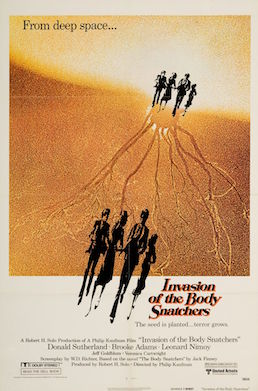
Some cultural assets (ahem) are so well known that you come to know them by association.  I knew the story behind Invasion of the Body Snatchers (1956 and 1978) long before I saw the original, within the last couple of years.  I may have been body-snatched myself since I can’t remember when it was or why I didn’t write a blog post about it.  In any case, I’d long been curious about the remake and discovered it free (for the time being) on Amazon Prime.  The fact I’m still looking for free stuff proves I’ve not been body-snatched, I guess.  If you’ve been raised with our cultural assets you know that the eponymous body snatchers are pod people who look exactly like the victims they destroy.  Their goal is a well-ordered society with no emotions.

The thing that’s so interesting about the 1978 version is that its assessment has changed over time.  When it first came out, many thought, and opined, that the 1956 black-and-white version was better and this one really added nothing.  However, over time this judgment has been questioned.  Critics taking a second look have now scored it as one of the best remakes ever made, and not only that, but it is considered one of the best science-fiction horror movies of all time.  I suspect nothing in that category will ever displace Alien, but still, my first viewing of the ’78 Body Snatchers agreed with the latter assessment.  It is quite good and it has even aged well.  You can kind of guess how it’s going to end, largely because the final scene has been played over and over, but still it’s definitely worth watching.

The social commentary in the film runs deep and strong.  Non-conformity is suppressed.  Life without emotions is better than really feeling something.  Simply go along because everyone else does.  The parable has changed actors over time—fascination with social media/virtual reality have perhaps become the modern pods—but the story is as old as our species.  Probably even older.  It’s non-conformists, generally after their demise, that are realized as visionaries.  Shooting a car into orbit requires tons of money but not much vision.  I’m not conforming, however, when I agree that the 1978 remake is good.  My taste in movies has always stood apart from others, at least from my own experience.  I also think that horror is often among the more intelligent genres of film.  But then, I tend to side with the emotional.


Not Sleepy Yet

Working on a doctorate changes the way you think.  Or at least it’s supposed to.  Easy answers have to be examined closely, and sources critically scrutinized.  One of the side-effects of this is that many Ph.D.s tend to think that only others of that status are able to do good research.  An essential piece of research, however, is passion.  This part isn’t always logical and can’t always be explained.  A recovering academic, I first resisted Gary DenisSleepy Hollow: Birth of the Legend because it was self-published.  I’ve had bad experiences with self-published books before but what I discovered here is that Denis is quite a capable researcher, driven with a passion for Washington Irving’s tale.  The execution may be a little rough, but the data-gathering is very good.  He tries to point out where accounts have problems and attempts, where possible, to resolve them.

Denis is driven by the question of what in Irving’s story is factual, if anything?  This is probably not a question an academic would ask, presuming that fiction is fiction.  Still, there is data.  The first four chapters are very good.  Here he lays out the background to the region, Irving, and stories of headless horsemen.  I learned quite a lot from it.  The final three chapters turn to the main characters of the story—Ichabod Crane, Katrina Van Tassel, and Brom Bones—asking who they might’ve been based on.  The best drawn of these is the first and there’s good reason to suppose Irving based Crane’s situation on that of his friend, Jesse Merwin.  The other two, however, are sketched rather hastily and lots of people have suggestions for who might’ve been behind them.

Clearly aware that authors borrow and make things up, Denis knows that Katrina and Brom may well be pretty much imaginary.  He also knows that Irving did indeed borrow much from previously known stories and legends.  Irving’s real genius was in the way he expressed these stories in colloquial English, making American literature a blend.  Although Irving wrote many books, his fame was largely due to two of his stories published early in his career.  One of those stories, “The Legend of Sleepy Hollow,” has left quite a paper trail and Denis leaves no rock unturned in his efforts to collect data on it.  I’ve read a fair number of self-published books over the years—they’ve been easy to produce since the internet began—and I’m wary of them.  This book, however, is one that I’m glad I found and it serves as a useful reminder that good research isn’t limited to the privileged few in the academy.


Goodbye, Linda

It’s out of the ordinary for me to post twice in one day, but I’m compelled to do so by the passing of a friend I’d never met.  I’ll already published today’s post when I learned the news.  Linda S. Godfrey was a Wisconsin journalist.  She’s known for her many books on paranormal and weird subjects.  She was the reporter who first took “the beast of Bray Road” seriously.  I only discovered her after we’d moved from Wisconsin, although we didn’t live far from her in those days.  Fascinated by her work on the beast, I contacted her with some information I’d read and we opened a very occasional exchange of stories.  She was my very first Twitter follower, and she published one of my true stories (anonymously, by request) in one of her books.

I know that academically-inclined folks are dismissive of her work, suggesting she was credulous.  I always looked at it differently—Linda was willing to listen to people.  Yes, she probably talked to some people with mental issues, but here’s a true secret—all people have mental issues.  Although I never met her in person I had the sense from her writing that she didn’t simply accept what others told her, but she was willing to consider it.  I remember visiting Rutger’s University library while I was an adjunct there, to find a difficult-to-locate reference for her.  I mailed her a photocopy of what I’d found.  As I say, we never met, and we only corresponded once in a great while.

Seeing that her blog hadn’t been updated for some time (so this is related, you see, to my earlier post), I began to wonder if she was well.  Like most of us born to write, I knew it was unusual for her not to post.  Not knowing her personally, I didn’t think it polite to ask.  I’ve read several of her books, some of them highlighted on this blog.  Often dismissed as “only a cryptozoologist,” my sense is that Linda was hounded by the need to know the truth.  Yes, the world is a mysterious place—it’s not nearly as well understood as we’re often confidently told that it is.  Some of us simply can’t rest without finding out for ourselves.  Linda earned a reputation as an expert on werewolves—many suggest the beast of Bray Road was some such creature.  She recognized the tie-in to folklore but she also knew that monsters always, always cross borders.  Linda is missed already, and it’s about time I caught up on some of her latest books, for I’m compelled to believe she now knows.


This Way

The more I get to know myself—pleased to meet you, sir—the more I realize that my childhood was cobbled together from small but repeated exposures to my favorite things.  I knew Dark Shadows from watching a limited number of episodes and reading a limited number of cheap novels.  I knew Alice Cooper from just two of his albums.  And I knew Ray Bradbury from a couple collections of his short stories.  No doubt this is in part because we weren’t exactly affluent and I found my books, by chance, at Goodwill.  I had no way of collecting Bradbury’s oeuvre, and besides, I was trying to get to know Edgar Allan Poe as well.  I knew Bradbury as a short story writer, and that’s still how I primarily think of him.

I felt compelled to read Something Wicked This Way Comes recently.  Since I’m used to Bradbury the short story author, it felt overdrawn to me.  I know this is heresy.  Great horror writers point to this novel as highly influential and inspirational.  Maybe if it were read closer to when I was born, when it was published.  Too many long paragraphs, especially early on, contain almost abstract descriptions without clear actions, leaving me confused.  Once the story got underway it was quite good.  As someone who writes, I know the dilemma of trying to freeze poetry into prose, and to make a coherent story from thousands of separate impulses.  Believe me, I know.  These days such things are edited out and stories become as thin as Bradbury’s Skeleton Man.  I guess I’m just out of practice.

The plot is great, but it feels so 1950s.  So boy/male oriented.  So American.  I suppose I attended my fair share of carnivals as a kid.  We didn’t go often, and I never knew one to settle on the edge of our small town.  And although we were free to ride our bikes or run as far as we cared to, home was never that far away and, I knew, there were scary things in the ubiquitous woods.  Ray Bradbury’s short stories were likely the main source behind my own early attempts at fiction.  Even today I’ll be scribbling along and think, “this is kind of like Bradbury.”  But I always have his short work in mind.  There are some great parts in Something Wicked, and it does build the tension toward the end.  Still, when it’s said and done I’ll be thinking of Bradbury’s short stories and how they formed my own nostalgia, even if only in little fragments.


Doppelgängers

Maybe this has happened to you.  Two names get stuck and mixed up in your mind until you consistently can’t tell them apart.  Jeff Bridges and Jeff Daniels are two very different actors.  About five years apart in age, they’re both white men, but they play very different roles from each other.  What’s worse, I’m a real fan of a Jeff Daniels movie or two (ahem), and one I watch every year.  When it’s over I inevitably think it was a Jeff Bridges movie.  I’d let this pass as aging gray matter but for one thing—I recently read a book on movies where the author made the same error.  So I tried to exegete it.  Why such a mistake?  They’re not exactly doppelgängers, after all.

Okay, so they’re about the same age.  They don’t look alike and their movie personae are very different.  I tend to think it’s the euphony of the names.  Jeff, followed by a two-syllable last name that ends in s.  As I was talking this through, I said “Both last names begin with a bilabial.”  My daughter corrected me, “D isn’t a bilabial,” she rightly pointed out.  Okay, well, they occur near each other in the alphabet—they’re both in the first four.  What I’m struggling with here is how at least three of us (I had this conversation with someone else years ago who also admitted to confusing the two), have this issue.  And it’s not just the Jeffs.

Back in seminary, the song “Bruce” got a lot of airplay.  By Rick Springfield, it was a lament that he was mistaken for Bruce Springsteen.  The two both play rock (duh) and they were both born in 1949.  Their last names begin with “Spring,” but “steen” and “field” are quite different.  Not to mention Rick and Bruce.  I sometimes think fame is just a mosh of pop culture that gets stuck in our heads and thoughts go around and around like a washing machine until those we don’t really pay attention to end up blending.  And also, famous white guys about the same age with somewhat similar names, have to put up with imperfect doppelgängers.  (Or is it doppelgängeren?)  Academia.edu seems to confuse me with the Steven Wiggins who is an Economics professor at Texas A & M. Or is it the Steve Wiggins, Agricultural Economist at the UK Overseas Development Institute? Since I can only guess from their photo, we seem about the same age.  None of us is famous, but that doesn’t prevent doppelgängers from finding you.


Katrina’s Side

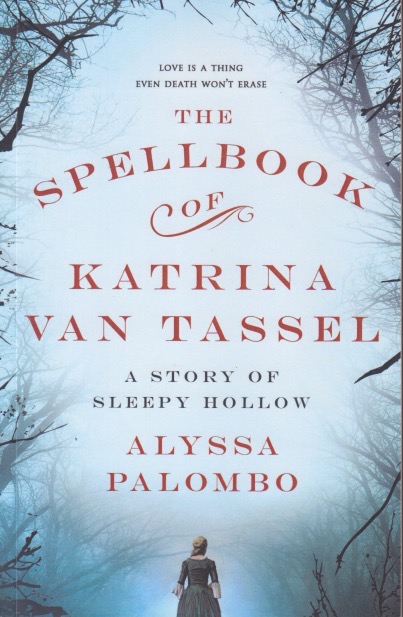
Once a story is released, and its copyright expired, it’s free to be re-interpreted.  Although there are those that deny it, any reading is a form of interpretation.  I’ve been gathering information on Washington Irving’s “Legend of Sleepy Hollow” for some time now, and I’ve just finished reading Alyssa Palumbo’s The Spellbook of Katrina Van Tassel: A Story of Sleepy Hollow.  This novel is a feminist retelling from the point of view of the titular Katrina.  In the original she’s an under-developed character.  These days we’d say that Irving didn’t write women well.  In fact, she functions largely as an object in the story, the source of tension between Brom Bones and Ichabod Crane.  Palombo spins a tale from Katrina’s perspective on all this, and thus takes the story in some new directions.

The novel itself reads like a romance, overall.  Katrina really does fall in love with Ichabod, but Brom is unable to let go, and the rivalry becomes deadly.  As the title also implies, Katrina learns witchcraft as the yarn spins out.  From a cultural point of view, this telling is clearly influenced by both the Tim Burton film Sleepy Hollow and the Fox Television series by the same name.  Both of them give us the witchery and the idea that Crane would be a romantic catch.  In Irving’s vision, it’s difficult to see Crane as any kind of love interest, but the essence of creative retelling is to make the story fit a different mold.  Katrina’s story is seconded by that of her friend Charlotte Jansen, who, like Katrina, practices white magic.  The witchcraft here isn’t malevolent.  Indeed, it is one of the few ways of expressing female power in this time frame.

A good deal of the tale revolves around solving the mystery of what happened to Ichabod on that fateful Halloween when he asked for Katrina’s hand in marriage.  Sadly, writers have, historically, tended primarily to be only male.  There have been exceptions, even from the very beginning.  The first named writer in history was a woman—Enheduanna—but the circumstances of women’s lives, particularly after the agricultural revolution, came to be relegated to roles where the leisure time for writing, and even the opportunity for education to learn it, were rare.  Early on the modern novel was dominated by female writers.  More recently re-envisioned Sleepy Hollow tales have brought women’s role to the fore, and have taken the narrative in unexpected directions.  This feminist retelling of the classic story demonstrates what could have been, had Katrina received a bit more attention, not just as an object.  This is a lesson still to be learned.


Who Bites?

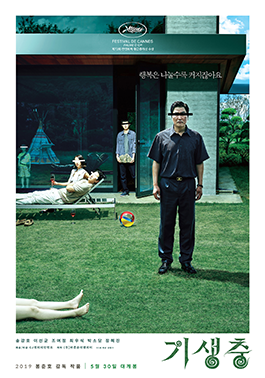
Although I use them, I find genres too constraining.  When Parasite first came out in 2019 many people said it was a horror film.  Others called it a thriller.  A comedy.  A drama.  It has elements of all these things.  As the first non-American film to win an Academy Award for best picture, it was an irresistible draw.  When it would come to a streaming service I already pay for, that is.  And having watched it, I still don’t know how I’d classify it.  And if you haven’t seen it, how would I describe it?  The word that keeps coming back to me begins with the same first couple of syllables: a parable.  In case you’re even more out of touch than I am, here’s the skinny on it.

A South Korean film, it’s the story of a poor family (Kim) that, desperate to get out of their circumstances, finds a way to infiltrate a rich family’s (Park) home.  The Kims live in a semi-basement flat prone to bugs and flooding.  The family’s son gets hired as the Park’s substitute English tutor for their daughter.  He recommends his sister (putatively as someone his cousin knows) as an art tutor for the Park’s son.  The poor siblings then arrange to have their father (presented as a stranger) hired as the chauffeur, and finally the mother as the housemaid.  They live in poverty while working for the wealthy.  Then they discover the former housekeeper kept her own family in a secret basement.  The homeowners discover none of this, then a garden party goes all wrong.

Laugh out-loud funny in parts, it’s a poignant film that, for me, explores the plight of the clever poor.  The wealthy have so much that they can easily support a second family without even noticing any financial loss.  The only reason the Parks employ all the Kims, however, is that they don’t realize the Kims are actually a family.  By pretending to be unrelated they’re able to survive.  There’s a lot to say about this movie.  I can see why some people suggest it might be horror—that’s not the usual genre assigned, though.  It has a Jordan Peelesque nature to it.  The social criticism is fairly intense throughout from trying to syphon off a neighbor’s wifi to cheap solutions to kill the bugs in the apartment.  The Parks live in a walled, gated paradise while those down lower simply have to make do.  If you haven’t seen this one, please do.  You’ll be glad you did.  And please, remember to vote.


Jason’s Javelin

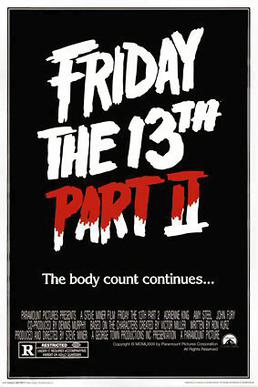
This past weekend was my third this year spent recovering from vaccinations.  The shingles jabs were worse, but this time it was a double-duty flu shot and bivalent Covid vaccine.  That’s as good an excuse as any for admitting to watching Friday the 13th, Part II.  In general I’m not a fan of sequels, but I’d read quite a bit about this one and I was curious because I hadn’t realized before watching the first installment years ago that Jason wasn’t the original killer.  I’m also not a fan of slashers, and I know that many people who dislike horror think all horror consists of such movies.  (It doesn’t.)  But still, Jason is a household name as a movie monster and I was having trouble concentrating with all those vaccines swirling around inside.

Utterly predictable, there are still a few jump startles that’ll catch a first viewing off-guard.  All I really knew about the film was Jason and Camp Crystal Lake and that generally teens get killed for having sex.  As many critics report, this kind of horror tends to have a “conservative” outlook—“sin” is brutally punished and the girl who refrains tends to be the last survivor.  That much you know just from doing your homework.  So as Jason hunts down the teens and dispatches them, along with a police officer and a crazy guy, you almost get bored.  There was one scene, however, that had unrecognized biblical roots.  Interestingly, I haven’t found anyone pointing that out.  When Jeff and Sandra go upstairs for sex, Jason takes a spear and thrusts them through, right in the act.

Analysts trace this scene to the movie Bay of Blood (which I’ve not seen), but in fact the inspiration comes from the Good Book.  In a genocidal mood in Numbers 25, Yahweh tells the Israelites to kill the Midianites among them.  Zimri is seen taking Cozbi into his tent, and Phinehas the priest grabs a javelin, rushes into Zimri’s tent and skewers the two of them in the act.  That scene stuck with my young mind as I read through the Bible, which is probably why it immediately came to mind while watching Part II.  Others may well have noticed this connection, but with the vaccine-induced lethargy I didn’t have the energy to go thumbing through my library to find it.  Besides, when I read things about movies I haven’t seen, they don’t often stay with me (which is one reason I give thorough descriptions of movies when I analyze them in my books).  This particular horror over, I know I don’t have to worry about the flu this year.


What Lurks

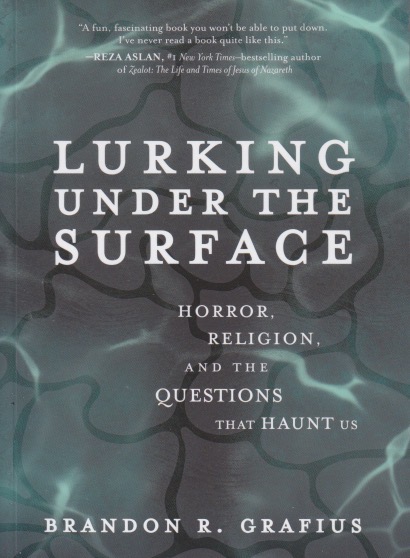
One question that I get asked by those who don’t understand is “Why horror?”  The asker is generally someone that knows I’ve been “religious” all my life, or affiliated with religion—which people think means sweet and light—and who associates horror with bitter and dark.  I know Brandon R. Grafius has been asked such things too, because I’ve just read his Lurking under the Surface: Horror, Religion, and the Questions that Haunt Us.  Like me, Grafius has been writing books on the Bible and horror—I’ve reviewed a few on this blog.  As in my former life, he teaches in a seminary.  People find this juxtaposition jarring.  This little book is Grafius’ struggle with various aspects of this question.  He’s not anti-religion, but he’s drawn to horror.

For those of us familiar with Grafius’ other work, this offers a more detailed explanation of what one religion scholar finds compelling about horror.  Specifically, he shows how various films deal with similar issues to his Christian faith.  The book deals with that for about half its running time, and the other half discusses similar themes in horror.  You get the sense that Grafius has been at this for a long time.  Scooby-Doo seems to have been his childhood gateway to horror and it raised some deeper questions as he explored further along the line.  If you read this blog, or search it, you’ll find such things as Dark Shadows and The Twilight Zone in my background, but then, I’m a bit older.  The point is, being a religious kid doesn’t discount finding monsters fascinating.

As usual with books like this, I’ve come away with several films to watch.  And more angles of approach to that tricky question of “Why horror?”.  A recent post on a panel discussion titled “Religion and Horror” led to an online exchange about religion and fear.  Grafius deals with that here as well, but from a more distinctly Christian point of view.  Although he’s an academic, this book is written (and priced) for wider consumption.  I found it quite informative to hear the story of someone else who grew up with monsters and the Bible.  He had the sense, however, to start addressing this early in his academic career.  We each have different paths to walk and for some of us it will take a jarring experience to chase us back to our childhood monsters.  And being religious is no barrier to that, as this brief book demonstrates.


Grave Robbers

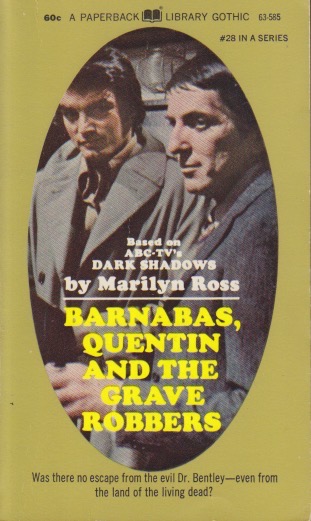
My personal reconstruction of the Dark Shadows universe was made by connecting the books by Marilyn Ross that I could find with the episodes of the television show that I saw.  I’ve always been one to try to make a logical storyline out of such things so that I could connect them when they came at irregular intervals.  (I’m still a fan of linear storytelling.)  So it’s a bit of an eye-opener to read the series of pulps in order.  There are continuities and discontinuities.  Barnabas, Quentin and the Grave Robbers again has Quentin, in 1830, portrayed as a good guy.  When he was first introduced in the series some books back, he was a satanist and very nearly evil.  And this was in a more recent era.  You get the sense that Ross was responding to fan requests.

As I noted regarding the last book in the series, the stories do seem to have grown more complex, and sophisticated over time.  The writing remains labored, but the story aspect improves.  Barnabas, Quentin and the Grave Robbers comes the closest to standard horror so far.  This is a dark story with problematic race issues thrown in.  The first two-thirds or so are set in England and are tied into the story by Barnabas Collins being there.  It is distanced from the usual moody setting of Collinwood where, despite all the haunting and troubles, you tend to think things turn out alright in the end.  Here the antagonist grave robbers kill people close to the heroine and the corpses sent to gruesome ends.  And there are zombies.

To flee the evil ringleader, Barnabas takes Paula Sullivan to Collinwood where Quentin is introduced to the story.  In 1830 he’s an unpredictable trickster, but good at heart.  He and Barnabas team up, as last time, to take on the grave robber when he moves, you guessed it, next door to Collinwood.  Then something unusual happens—Paula discovers zombies are afraid of crosses.  This leads to a strange episode of Barnabas—a vampire, remember—chasing a zombie with a cross.  In general religious imagery is scarce in these novels.  A vicar or two may be mentioned, but vampires aren’t menaced with crosses.  That does happen in one of the movies, but here it seems that because Barnabas is a good vampire he’s not bothered by a cross.  Or it could be a consistency issue.  Either way, this is a moody addition to the series, appropriate, as always, for autumnal reading.


Seasonal Viewing

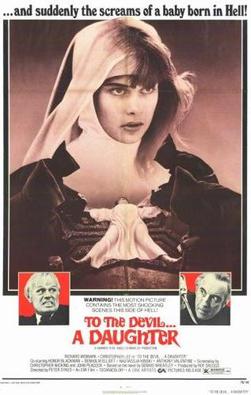
Any movie that begins with an excommunication ought to be good.  Especially with its list of stars you’d think To the Devil a Daughter might’ve turned out better.  Still, it is a good example of religion and horror mingling together.  I’ve never read any Dennis Wheatley novels, but reputedly he didn’t like this film adaptation of his book.  It certainly has a convoluted plot.  So an excommunicated priest has started a new religion that worships Ashtaroth.  He has to baptize a child, now 18 (three-times-six, don’t you see), with the blood of the demon so that she can become his (Ashtaroth’s) avatar.  This is apparently the eponymous daughter to the Devil.  She was baptized initially by her mother’s blood at her birth.

The girl’s father, who survived her birth—unlike his wife—has decided at the last moment to save his daughter.  He appears to be independently wealthy yet he talks an author of occult books into doing the saving for him.  The girl, it turns out, is a nun in this satanic religious order and is only too willing to do what she can to serve “our Lord.”  The way that all of this plays out is confusing and Byzantine, but it does raise a serious question: what if a child is reared in a bad religion?  (And there are some.)  Who has the right to decide if a religion is good or bad?  Children are easily indoctrinated and not too many question the faith in which they were raised.  Yes, we all think the religion we believe is the right one.  The problem is everyone else thinks the same thing.

One of the things this movie got right is that the “heretics” are portrayed as sincerely believing that their religion is for the improvement of the world.  Calling themselves Children of the Lord, they believe Ashtaroth is good.  And a good lord wants what is best for the world, right?  This is the dilemma of exclusive religions that teach only their own outlook can possibly be the correct one.  Otherwise you have to give adherents a choice and another religion may be more appealing.  Or worse, they may reason out that if you’re given a choice that means your own religion is also merely one of many.  Historically religions have gotten around this by valorizing true believers who never question anything.  To the Devil a Daughter isn’t a great movie.  It’s not even a very good one.  Nevertheless, it raises some questions that lie, of course, in the details.


Hallowed Tradition

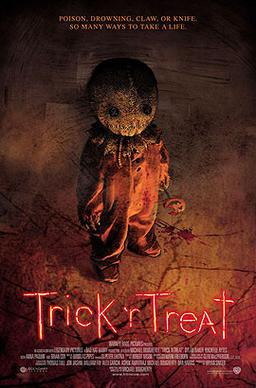
The more I learn about the movie industry the more complex I realize it is.  Take Trick ‘r Treat, for example.  It was released to some film festivals—and backed by a major studio—in 2007.  I wondered why I’d never really heard of it, and the reason seems to be that it never had a theatrical release.  Until this month.  It is now playing in theaters.  The thing is, it’s already available on streaming services because it gained a cult following when it was initially released fifteen years ago.  I came to know about it by wandering into one of those Halloween pop-up stores recently.  There were plenty of Sam costumes so I did a little research and discovered a Halloween movie I’d never seen.

I have to say, the first time watching it was confusing.  I didn’t realize it was four or five separate, but interlaced stories.  I kept waiting for a central plot to emerge, but it didn’t.  At the same time, I wasn’t aware that it was a comedy horror either.  I have no problem with comedy horror, of course.  I just like to know that before I get into it.  Once I’d figured these things out, I could see the draw.  It is fun and seasonal.  Clearly it’s holiday horror.  In fact several websites list it as being essential October viewing.  It’s certainly different from many Halloween movies in refusing to be taken seriously.  It’s like adults having fun instead of kids enjoying the holiday.

Perhaps the most self-aware Halloween film, it constantly reinforces that you need to obey Samhain etiquette.  Those who are killed (and there are many) die for having violated the rules of the holiday.  I appreciate the fact that it insists that we do these things for a reason.  Wearing costumes, handing out candy, carving and lighting jack-o-lanterns, these all serve a purpose.  The movie suggests we need to do these things to stay safe from Sam.  Sam, of course, can’t be killed which means that a sequel may be in the works.  Trick ‘r Treat gets full marks for staying focused on the holiday.  Holiday horror has been a fascination of mine for some time and this movie has it in spades.  Even if it’s a little confusing at times, it’s a fun way to celebrate the season.  And this year you have your choice of seeing it in the theater or streaming it on your most convenient device.