Taking and Giving

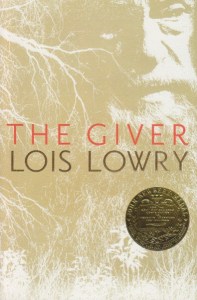
Dystopias are among my favorite kinds of literature.  Things tend to go wrong in human society, and although we’ve made great progress over the past couple of centuries, in many ways we’ve set ourselves back.  Dystopias are searching, thoughtful ways of addressing that slippage and they warn us of what me might become.  (Especially if Republicans remain in power.)  Lois Lowry’s The Giver is young adult literature, but I’ve been curious about it for some time.  Set in an undefined time and place, a highly structured society exists where things seldom go wrong.  There are no animals and people take pills to eliminate “stirrings” so that sex won’t complicate relationships.  Families are constructed by algorithm and children are assigned from a pool so they will match expectations.  In order to continue this bland lifestyle, memories have to be repressed in the person of the Receiver—the keeper of communal memories.

At first things seem pleasant enough.  Life, however, lacks color and music.  It lacks emotional engagement.  Those who, in real life, idealize the 1950s as before the madness of the sixties began, have trouble conceiving of how societies go wrong.  The dilemma is that no society is perfect and as time goes on we look for improvements.  For a very long time in American history, for example, nobody had bosses.  The majority of people were independent farmers.  They prospered by luck and hard work, but they worked for no one but themselves.  Now we mostly work for bosses who have bosses who have bosses in some kind of endless regression of power.  Our ability to change things is quite limited, even in professional positions.  Is this better than the uncertainty of farming?  With all the rain this year it might seem so.  Of such things dystopias are made.

The Giver follows a protagonist, Jonas, who when he becomes twelve is assigned to become the new Receiver.  As he gains memories of how things used to be, he’s fascinated.  Learning his society’s darkest secret, however, spurs him to try to make a change.  A lot of questions remain at the end.  (The novel is part of a series, as most young adult fiction tends to be, but it can be read as a stand-alone story.)  Those of us who’ve been around the block a time or two might be able to guess where this is going, but for younger readers to be introduced into the way of human problem solving this is a gloves-off approach.  Those accustomed to dystopias will find themselves in familiar territory.  As will those who live under Republican regimes.

Premature Burial

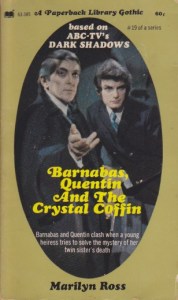
I have recently finished writing an article for a collection of essays on the Bible and horror.  Have no fear—I’ll pass along details once it’s published.  I do have to wonder, though.  All those years I was teaching and publishing regularly in ancient Near Eastern studies nobody ever approached me about contributing.  It took coming out of my monster closet for that to happen.  Monsters, you see, are a guilty pleasure topic.  They’re so much fun that they hardly seem like work to write about.  Or read about.  I was a child when Dark Shadows aired as a daily soap opera on ABC.  For reasons about which I’m beginning to speculate I found this series strangely compelling.  Marilyn Ross (W. E. D. [William Edward Daniel] Ross) based some 32 of his over 300 novels on the series.  I collected them as a kid and then got rid of them when I went to college.  I’ve been collecting them again in a fit of nostalgia over the past several years.

I just finished Barnabas, Quentin, and the Crystal Coffin.  The story was actually quite different than typical Collinwood fare.  What drew me to these novels as a child was their atmosphere and, if I’m honest, the fact that Barnabas was a vampire.  Memories of youth are fleeting things at my age, but it may be that Barnabas Collins was my introduction to vampires.  I was four when the series first aired, and I’m not sure if I discovered it before I came across Dracula or if it was the other way round.  Dracula, once I was experienced enough to have an opinion on such things, was my favorite monster.  I liked the others as well, but he was rich and immortal—the things sickly kids in poverty idealize.

In my fascination with Dark Shadows I’m not alone.  Despite Tim Burton’s movie version, Johnny Depp (who is my age) admitted growing up wanting to be Barnabas Collins.  Friends about my age have discovered PBS’s recent re-release of the original series in all its campy glory.  For whatever reason, however, it is the books that always draw me back in.  They, for me, defined the Gothic novel.  Ross’s writing is formulaic and predictable.  His adjective choices feel forced and subtleness was never his strong point.  Still I can’t stop myself from occasionally dropping into the world he manages to recreate in the woods of Maine.  Afterwards I move on to more profound writing, but then, his work is the very definition of a guilty pleasure.


Leggo My Lego

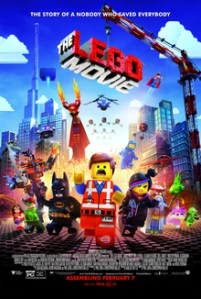
Given my proclivity to seek the profound in what is often considered the banal, I have been mulling over The Lego Movie.  Before you cast the first brick, yes, I know this movie is five years old and I know that it has sophisticated intertextuality with other movies and sly humor.  I use banal in the sense that Legos are, quite literally, plastic and they don’t work well in conveying the human form.  Our overactive psyches help here, and we give the characters their necessary humanity, but this is a movie for kids, even with its Trump-like President Business forecast some two years before the last election.  With all of that being said, and the word “forecast” already being used, my “Bible radar” zeroed in on the prophet in the movie, Vitruvius.

Vitruvius is based on a combination of Tiresias, the blind prophet, and any number of biblical characters who forecast the future.  Dressed like Moses, but named after a Roman author and architect, Vitruvius utters the prophecy at the beginning of the film and returns as a character that combines Obi-Wan Kenobi and the prophet Samuel.  (I said there was sophisticated intertextuality.)  Whether any of this is intentional is difficult to say—well the Obi-Wan part is pretty obvious—but it plays into the common view of prophets.  One of the points I make in Holy Horror (which deals with a different genre of movie) is that people understand biblical ideas through the lens of pop culture.  Prophets, through that lens, tell the future.  In the Bible itself they don’t do that very much, but since the New Testament reads itself into the Hebrew Bible (more intertextuality) the idea became pretty fixed that prophets told the future all day long.

Ironically, Vitruvius—a name that sounds like “virtue”—was famous for describing perfect proportions.  Indeed, Leonardo da Vinci’s “Vitruvian Man” sketch is based on this idea.  As ideas go, this is a false one against which many of us struggle our entire lives.  There is no perfect, Platonic human body.  Yes, certain people are attractive, but genetics and circumstances make us who we are.  And some of us grew up without Legos, but despite that deficiency we came to know the product.  The Lego characters aren’t in any sense of Vitruvian proportions.  Witty and intertextual, they’re made of plastic and they encourage us to buy for our children.  And one wonders whether Vitruvius is a prophet or a hidden symbol of that word’s homonym.  Let the building begin.


Night of the Living

The New Yorker view of the world, so the joke goes, sees the five boroughs in great details, then a very thin New Jersey across the Hudson with a vague California somewhere out west.  Having worked in New York City for nearly a decade now, I know that such a view is exaggerated, but has a small glimmer of the truth.  We can only pay attention to so much and things are constantly coming at you in Gotham.  I sometimes forget, now that I’m in Pennsylvania again, just how diverse my home state is.  I’m not from old Pennsylvania stock—neither of my parents were born here and neither of my mother’s parents were born in the same state she was.  Still, when you’re born in a place it’s natural to feel that’s where you belong.  You inherit the outlook.  I inherited Pennsylvania.

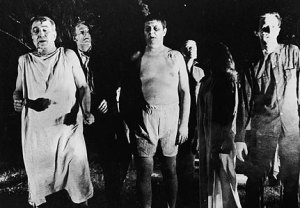
Pennsylvania is a bit unusual in being a commonwealth divided in two by a mountain range.  Laid out with an horizontal orientation, it’s about 280 miles across, and once you’re over the Appalachians, you’re into a different subculture.  On our way into Pittsburgh, signs for Evans City reminded me that among its many contributions to American culture, the Steel City also gave us zombies.  Now from a history of religions point of view, zombies came from Caribbean religions that fused indigenous African beliefs with Catholicism.  A religion that arose among people commodified as slaves.  A zombie was a body with no will.  It took George Romero, living in Pittsburgh, to give us the movie zombie with The Night of the Living Dead.  Pittsburgh, among some, is glad to claim the title of zombie capital of the world.  Its zombie walk is a thing of legend.

Ironically, the western end of the state, beyond the mountains, tends to be more conservative than the side closer to the seaboard.  (Pennsylvania is the only of the original thirteen colonies not to have direct Atlantic Ocean water frontage.)  Yet it has adopted the most egalitarian of monsters—the living dead.  Romero tapped into the universal fear of unsettled death to make what were later to appear as “zombies” the unnamed monsters of his most famous film.  Everyone has to die, and no matter our religious outlook (or lack thereof) the question of what comes after is asked on both sides of the Appalachians.  And even by those across the Hudson in New York City.  There may be even something between the two.


Linking In

Like many in the internet age, I have most of my “connections” online.  It’s somewhat of a rarity to be invited, for example, to connect on LinkedIn by someone I actually know.  I remember the early dissemination of information from that network—it was strictly for people you really did know in real life, because they could help or hurt your career.  I took that seriously for a year or two, but it became clear that this was another Facebook with a more professional cast.  I’ve been told of authors who try to build their online platform by adding thousands of connections on LinkedIn.  The website, however, is not intended as an advertising venue.  It has, however, become one.

I’m not denigrating LinkedIn.  I’ve found two jobs through it and I’ve had recruiters reach out to me because they found my profile there.  For a religionist that can be quite flattering.  Academia and society tend to tell you that such a skillset is okay but basically useless.  Having others who know the wide diversity of human employment these days can be a sign of hope.  Nevertheless, advertising has crept into LinkedIn.  I’m not talking about the frequent invitations to go professional on the site, which will only cost a small fee that will suddenly show up on your credit card bill when you least expect it and thought you were in the clear.  No, I’m talking about connections contacting you to do gratis work for them.  Advertising their book, or their services.  Letting others know, they ask, that they can provide this or that service.  (Just to be clear, I’m not referring to people who contact me personally because we have an actual connection!)

For those of us working stiffs not in a position to hire anyone—professionally or personally—this is another symbol of how any form of communication becomes commodified.  Fully over half of my email is soliciting money in one form or another.  Hearing from an actual person with an actual message for me is so rare that I’m stunned to find one in my inbox.  Capitalism just doesn’t know when to let go.  And it doesn’t have a good read on what little I actually do buy.  Underwear (and just using that word will color the tailored ads I receive for weeks) vendors seem to think I’m concerned about the fashion of garments others don’t see.  The books Amazon suggests, based on a solid track record, are generally far off from my interests.  What hope do those who don’t know me have of selling me their wares through LinkedIn?  The dream of connection without cash changing hands nevertheless remains alive.

Old school connectivity


Theofantastique Interview

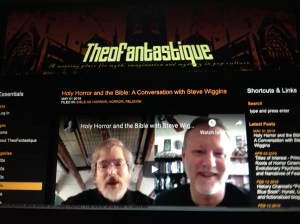
Two times.  In my “professional” life I’ve been interviewed only twice (not counting, of course, far too many job interviews).  The first time was as a talking head for Nashotah House.  This was in the days before the internet really caught on, so it was done in DVD format.  If you come over to visit I’ll dig it out and we can have a good laugh.  The second occasion was much more fun.  Although I write about horror a lot, I don’t mention Theofantastique nearly enough.  Back in the days when I started blogging, I discovered this site that featured all kinds of interesting stuff on religion and horror (and actually on all kinds of genre pop culture).  I always enjoyed the insights and got more than a few books for my own research and reading from tips I found there.

When I finally got brave enough to contact John W. Morehead, the curator of the blog, we both quickly realized we had some things in common.  John very kindly offered to post an interview with me on Theofantastique about Holy Horror.  It’s live now and it was really fun to talk to an actual person about my book.  You see, I work alone.  I knew that, leaving the classroom, I was departing my chosen career.  On those high school aptitude tests they told me that I should be an entertainer.  What professor isn’t?  I pity their students if they’re not.  I’ve been posting videos on YouTube for a few weeks now.  It’s immediately obvious how much having a live audience helps.

Unfortunately, Holy Horror isn’t exactly priced to move.  In fact, local bookstores have turned me down for free presentations based on the price alone.  It is, however, a fun book to read.  At least I intended it that way.  When life give you horror, make Bloody Marys, I guess.  By the way, John has been coming out with some interesting books also.  I posted on his The Paranormal and Popular Culture recently.  Theofantastique is often the place where I first learn of new horror films (I don’t get out much) and new books that I should read.  Of these two things there’s never a shortage—horror is a thriving genre—and talking about why you wrote a book helps to clarify things a bit.  Horror may seem a disreputable genre to many, but it has redeeming values.  To hear about them, please watch the interview.


Myth and Magic

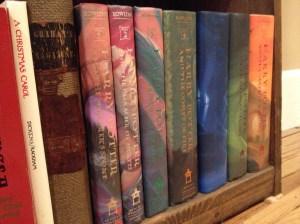
Magic and religion are difficult to tell apart.  Scholars have known this for some time, but don’t often say anything about it for fear of offending.  A few days ago Religion News Service ran a story headlined “How the ‘Harry Potter’ books are replacing the Bible as millennials’ foundational text.”  While many reacted with shock, to me the fact that a foundational text can be identified at all is a relief.  You see, reading is good for you.  Really, really good for you.  One of the most hopeful things I observed as a parent was the increased quality and volume of young adult literature available.  Of course it’s produced to make a profit, but the fact is it showed that reading is alive and thriving.  If the young make a habit of it, well, let’s hope that habit’s hard to kick.

My own reading doesn’t always keep pace with my desire to do more of it.  I go for a couple of weeks sometimes without finishing a book.  I begin to feel depleted.  There’s something spiritual about reading, and fiction can reach parts of your soul that are on guard when non-fiction’s your subject.  And that’s like magic.  It took a couple years for me to catch on to the Harry Potter craze.  Eventually my wife and I broke down and bought book one and read it together.  As millions of readers can attest, that first book was a fishhook.  We all really hope the world does contain some magic.  Many people find that solace met with religion.  Either way, fiction can enhance the experience.  We read the original series, hanging tensely until the final volume came out.

Many of those who believe in a magical religion protested the sale of magical fiction.  We were still in Wisconsin at the time, but we saw the protestors outside a local bookstore the release day for one of the later volumes.  Like Death-Eaters the protestors opposed Harry Potter.  The root of the problem seems to have been unique truth claims.  Whenever a religion declares itself the sole harbinger of “the” truth, every other way of looking at things becomes evil.  Even if it expressly declares itself to be fantasy fiction for young adults.  Years have passed, and Harry Potter, like other forms of pop culture, has grown to the status of a religion.  Even Nones want to believe in something.  Magic and religion are, after all, very difficult to tell apart.


Rise Again

Resurrection, as I argue elsewhere, is a scary thing.  Since today’s Easter, at least in the western Christian world, people are—or should be—thinking about resurrection.  In the case of Jesus, a young man who died “before his time,” resurrection seems only fair.  Indeed, in the earliest biblical hints of the concept it applied to people in precisely that category.  The story’s different for older folk who are beginning to wear out and are ready to go to a better place.  Christianity made the idea of resurrection more palatable by stating that you get a new and better body next time around.  The creeds say, after all, “the resurrection of the body.”  Heaven, it seems, is an embodied location.  Resurrection is necessary to get there.

Horror writers and film makers have used revenants to great effect.  When they do, pop culture latches on.  Think about the vampire craze of the early 2000s.  Or the ongoing fascination with zombies.  Even your basic garden-variety ghost.  They’re all revenants that attract and repel us.  We’re not quite sure what to make of life after death.  It’s okay if it’s played out beyond human senses, but as much as we want life to go on we don’t want to witness it here.  Horror films like to play on this ambiguity.  They’re closely related to religious ideas.  I’m occasionally asked why I watch horror; it’s essentially the same question as why I study religion.  Sometimes you just need to look closely enough to find the connection.  Resurrection, as I discuss in Holy Horror, is tied to some of humanity’s most basic fears.

Just two days prior to Easter, Good Friday in fact, Lorraine Warren passed away.  A fervent believer in resurrection, she was half of the dynamic paranormal investigating couple of Ed and Lorraine, about whom I’ve posted from time to time.  This coincidental occurrence illustrates once again the connection between resurrection and horror.  The Warrens were fond of declaring that haunting spirits of the human kind were those that had not passed over into the next world.  Revenants were confused spirits (not to be mistaken as demons, which were something completely different).  Resurrection, presumably, awaits just the other side of the veil.  Clearly religion shares this roadmap with horror.  Just as the Warrens will be resurrected as characters in this summer’s forthcoming Annabelle Comes Home, such returns to life may take many forms.  It’s Easter for some of us, and it can integrate horror and hope, if viewed a particular, perhaps peculiar, way.


What’s Wrong with Heroes?

There can be no doubt that under Trump conservative Christians have been flexing their muscles.  Few things corrupt so readily as political power, and evangelicalism—already an unrealistic way of looking at things—is itching to throw punches.  A story on For Reading Addicts that my wife sent to me bear the title “DC Comics cancel latest comic after backlash from conservative Christians.”  The piece by Rowan Jones notes that Second Coming was cancelled due to pressure from evangelicals with the cultural sensitivity of the Kouachi treatment of Charlie Hebdo.  Cartoons, it seems, are a real threat to true believers in a way that reason is not.  Jones notes that the comic was actually largely supportive of Christian values, but like an evangelical Brexit the reaction was taken without understanding the issue.

The anger of conservative religions—it hardly matters whether they are Christian, Muslim, or Aum Shinrikyo—often plays itself out in displays of violence.  I wonder if part of this insecurity comes from the fact that the expectations of their faith don’t work out they way they’ve been led to believe they will.  The myth of the blessed existence of the true believer is given the lie by life in a secular world.  While the evangelicals support Trump, 45’s tax plan takes money from their pockets and hand it to the ultra-wealthy.  This raises no objections, but a cartoon showing Jesus helping the poor?—now that’s offensive!  And still no second coming takes place.  It’s difficult to retain a fantasy view in the face of cold reality.

Who doesn’t like a hero?

Religious beliefs are a deeply personal matter.  It is a dicey business to try to get someone to change their outlook when they’ve been convinced that the consequences are eternal.  Although vaguely aware of other religions all along, Christianity in the “new world” was taken quite by storm at the 1893 World’s Parliament of Religions in Chicago.  Suddenly it was clear that other moral, decent religions had developed similar ethics to what had largely been supposed to have been Christian innovations.  It’s difficult to feel superior when others in the same room seem just as intent on improving the lot of humankind as you do.  Even when a particular religion holds all the political power of a nation it’s overly sensitive to cartoons.  This is a curious situation indeed.  I’m not a comic book reader—I don’t even have time for internet articles unless someone sends them to me with the suggestion that they’re worth my time.  And I, for one, think a little more humor might just make the world a better place.  Either that or we need a hero.


Which Shaman?

It’s a strange kind of vindication when you see someone argue your ideas independently.  Even if they understand those ideas in a different way.  I suppose it’s necessary to say that in academia those who have university posts are assumed to be more authoritative than those of us who don’t. That’s not sour grapes, it’s simply a fact.  Some years ago, after having first seen Christopher Nolan’s The Dark Knight, I wrote a post on this blog suggesting that the Joker functioned as a shaman in that movie.  Being a blog by a non-university academic, the post had a few readers, but it is not peer-reviewed and therefore, officially just a matter of opinion.  I have studied religion professionally for decades now, however, and I would still stand by my assessment.

Recently I came across an article that argued Batman was a shamanic figure in that same movie.  It was affirming that another academic had come to a similar conclusion, however, we differ in our interpretation of who bears shamanistic characteristics.  It doesn’t help, I suspect, that shamanism isn’t well understood, and even the name is a bit of a misnomer.  We don’t really have a word for non-major religious practitioners of indigenous populations who may have little in common, so we call them shamans.  Their religious systems are too specific—“granular” is the favored business word these days—to categorize them easily.  And the reason for this is that we think of religions in the light of the large, organized conglomerations that arose in western Asia a couple millennia ago.  It’s difficult to make room for smaller exemplars.

Something larger religions have done is distorted the idea of religion as a local phenomenon.  Communities used to reflect the religious experience those who lived in them knew.  Catholicism divided the world into parishes and even tolerated some differences between them.  Protestantism gave Europeans (and their New World descendants) a set of choices, and towns in America often sport many steeples not because religion draws a community together but rather because it generally tears it apart.  Hierarchical religions are about as opposite of shamanism as Batman is different from the Joker.  They may have similar ends in mind, but their methods are quite different.  The shaman is a figure that leads to spiritual wholeness for the community.  Their methods seem questionable to larger, highly structured religions.  And the unaffiliated trickster may accomplish more than an establishment figure in a local setting.


Croce’s Lament

So how much time is there?  I mean all together.  I suppose there’s no way to know that because we have no idea what came before the Big Bang.  Those who invent technology, however, seem not to have received the memo.  New tech requires more time and most of us don’t have enough seconds as it is.  Perhaps in the height of folly (for if you read me you know I admit to that possibility) I’ve begun uploading material to my YouTube channel  (I hope I got that link right!). These are cut-rate productions; when you’re a single-person operation you can’t fire the help.  I figured if those who don’t like reading prefer watching perhaps I could generate a little interest in Holy Horror visually.  (I like my other books too, but I know they’re not likely to sell.)

The question, as always, is where to find the time for this.  My nights are generally less than eight hours, but work is generally more.  What else is necessary in life, since there are still, averaged out, eight more left?  Writing has its reserved slot daily.  And reading.  Then there are the things you must do: pay taxes, get physical exercise, perhaps prepare a meal or two.  Soon, mow the lawn.  It may be foolishness to enter into yet another form of social media when I can’t keep up with those I already have.  What you have to do to drive interest in books these days!  I think of it as taking one for the tribe.  Readers trying to get the attention of watchers.

There’s an old academic trick I tried a time or two: double-dipping.  It works like this: you write an article, and another one, and another one.  Then you make them into a book.  I did pre-publish one chapter of a book once, but getting permission to republish convinced me that all my work should be original.  That applies to reviews on Goodreads—they’re never the same as my reviews on this blog—as well as to my YouTube videos.  There’ll be some overlap, sure.  But the content is new each time around.  So you can see why I’m wondering about time.  Who has some to spare?  Brother, can you spare some time?  I’ve been shooting footage (which really involves only electrons instead of actual linear imperial measures) for some time now.  I’ve got three pieces posted and more are planned to follow.  If only I can find the time.


Bookmark This

I haven’t forgotten about horror.  In fact, this past late winter my list of must see movies has continued to grow.  I don’t subject you, my kind readers, to endless barrages about Holy Horror since I believe the idea behind the book is novel in its own right and can stand on its own.  The other day I even ordered bookmarks to be made, for free distribution.  Thing is, days are getting longer, and warmer, and people are thinking the opposite of horror just as spring is the equinoctial opposite of fall.  Like a good monster I’m biding my time.  And doing so on an editor’s budget.  (The pay scale’s not the same as that of a professor; believe me, I know.)  Horror’s funny that way—it is seasonal, at least in most people’s minds.

I make the point in the book that fear serves a useful function.  It occurs in other genres quite frequently, although they bear the outcast label less overtly than horror.  Perhaps this gets to the root of my fascination.  Having grown up as part of the pariah social class of the poor, my sympathies are with the genre that often fails to find respectability.  Many of those who criticize horror do not watch it.  Some of these films are quite sophisticated, and the genre blends into other “speculative” categories such as science-fiction and some action, as well as into the more naturalistic thriller.  And thrillers are merely dramas with an elevated pulse rate.  This difficulty of distinguishing genres sharply is one reason Holy Horror addresses some films that aren’t strictly horror.

Work continues apace on Nightmares with the Bible.  Again, the ex-professorate never receives sabbaticals during which concentrated work might be done on books.  In the pre-dawn hours, however, I steadily make progress.  Very shortly an article I wrote for Horizons in Biblical Theology on the topic will appear.  Safely during the spring.  As the days grow longer more of my weekend time is demanded by the outdoors aspect of home ownership, cleaning up after the freezing and thawing of a long winter when infelicities were safely covered under snow.  Sometimes I fear for the progress made on my next book—it is the first advance contract I have ever had—but then I remind myself that fear does serve useful functions.  It’s not called a deadline for nothing.  So even as the darkness fades I prepare for the next round to begin.


Double the Magic

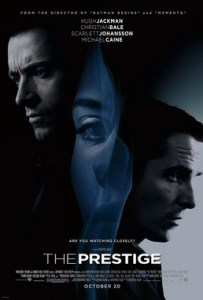
Since The Prestige came out over a decade ago I’m not going to worry too much about spoilers below.  This post also comes with another caveat: if you watch this film you’ll be left scratching your head and finding yourself strongly tempted to punch the replay button immediately.  Like most Christopher Nolan films, the movie is complex and intelligent.  It also plays on an age-old horror theme of the doppelgänger.  There be spoilers here!  

Following the rivalry of two stage magicians seeking the ultimate illusion, there’s a great deal of sleight of hand in the way this movie manipulates its viewers.  You are in the audience of a magic show and you’ve volunteered to go up on stage.  I watched this film on the recommendation of a friend without even checking the genre.  That can be a disorienting experience in itself.  One of the first questions we bring to movies as well as to texts is “what kind is it?”  I had the assurance that it was “the good kind” and that was about all.  That assessment was right.  While the credits rolled—it was already late at night, for me—I was strongly tempted to start it all over.  Sometimes people ask me why I watch horror films (and no, this is not horror) and I think the answer is related to what I find here.  Like most people I want the advice of others on what to do should things go wrong.  And in The Prestige they do go wrong.  Spoilers follow.

The crux of the film involves actual doppelgängers that result from Nikola Tesla’s experiments.  Tesla was a mysterious person in real life, and without knowing the genre you can watch this film and find it believable.  There’s a kind of faith involved in movie-going, after all.  One of the early exploiters of the doppelgänger was Edgar Allan Poe.  In “William Wilson” he narrates a tale of a double that might indeed be the real William Wilson.  The Prestige plays the same card.  Most of us live knowing that daily our senses can be fooled.  We actually enjoy it once in a while.  Stage magicians stake their livelihoods on it.  Nolan is a master of bringing complex twists to the silver screen.  In Holy Horror I briefly discuss his Memento.  I have a suspicion that I might’ve had more to say about it had I watched this film earlier, with a copy of Poe in hand.


Devil or Con?

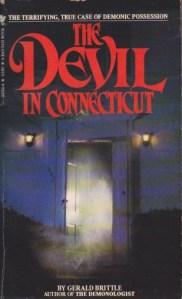
You can’t believe everything you read.  That’s one of the first tenets of critical thinking.  This whole process is about how to get to the truth, and in a materialistic world that truth can’t involve anything supernatural.  These were my thoughts upon finishing Gerald Brittle’s The Devil in Connecticut.  Controversy accompanied Ed and Lorraine Warren’s investigations and some of the people involved in these cases have later claimed the extraordinary events didn’t happen.  Others claim that the Warrens offered them to make lots of money by selling their stories.  The effect of reading a book like this is a blend of skepticism and wonder.  Among their fans the Warrens are held in the highest regard.  Anyone who begins to look into their work critically ends up frustrated.

So when I put this potboiler down—it is a compelling read—I went to the internet to find out more.  Then I realized what I was doing.  Using the internet?  To find the truth?  It’s a vast storehouse of opinion, to be sure, but what with fake news and alternative facts who knows what to believe anymore?  I found websites debunking the whole case as a hoax.  Others, naturally, claim the events really happened.  Both kinds of web pages have the backing of someone in the family involved.  It’s a pattern that follows the Warrens’ work.  In one of the many books I’ve read about them they claim to have ten books.  If my math is right this was number ten.  Even that remains open to doubt.

The word “hoax” seems a bit overblown.  Dysfunctional, maybe, but hoax?  Reading Brittle’s account it’s clear there were some issues in this family.  Having grown up in a working class setting, I’m aware such scenarios are extremely common.  Accusations were made that this was an attempt to spin gold from straw.  The nearly constant stress of blue collar families makes that seem less far-fetched than a stereotypical devil showing up in a modern house because a satanic rock band placed a curse on the family.  Lawsuits—the most avaricious of means for determining facts—apparently prevented a movie deal and have even made this book a collector’s item.  Somebody, it seems, is making money off the story.  As after reading the other nine books, the truly curious are left wondering.  My skepticism kicked in early on, but then again, I’ve always liked a good story. 


A Saint Lent

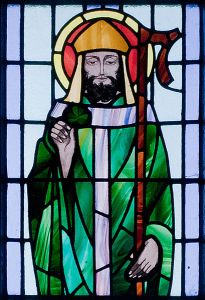
Photo credit: Andreas F. Borchert, Wikicommons

Lent, among the denominations that observe it, is intended as a time of intense reflection.  Beginning on Ash Wednesday the fact of one’s own mortality becomes a foremost consideration as the faithful are reminded that they will die.  It has always struck me as paradoxical that St. Patrick’s Day always falls in Lent.  Those who abide by the liturgical calendar readily acknowledge that Lent is a punctuated season; saints’ days and feasts can still occur, temporarily disrupting the heavy contemplation.  While at Nashotah House we never celebrated St. Patrick beyond a brief mention during a collect of the seventeenth.  His day, rich in Celtic mythology, it seems, was inappropriate to the mandated gloom so highly valued by the soul-sick.  Having some Irish ancestry, I always felt a little slighted by this aloofness regarding a saint most people can actually name.

College campuses, I later learned, tend to schedule their spring breaks to include Saint Patty’s Day because of the damage drunken students may exact.  The stereotypical besotted Irish have become an excuse for excess during Lent, although, I suspect the forty days have little to do with it.  A saint becomes a justification for sin, it seems.  And Lent continues the morning after.  There’ll always be Lent.  The tray holding the ashes of last year’s palm branches is never empty.  Two once religious observations clash in mid-March of each year.  During a brief spell the historically oppressed Irish are celebrities for a day.  Such are the vicissitudes of liturgical calendar clearing.

Today many people celebrate a saint they wouldn’t otherwise recognize.  One that mythically drove the snakes from the Emerald Isle, and who perhaps hid a pot of gold at the end of the rainbow.  A holy man who has made it possible for anyone to be Irish for a day.  Leprechauns and clovers are in fashion as the ironic luck of the Irish closes down major thoroughfares for parades in the midst of ashes and dust.  Outside there may be snow or budding trees.  Perhaps both at once.  There’s a richness to these conflicting symbols that belies the commemoration of a missionary with alcohol.  The day is part of the complex of equinox holidays, whether intentional or not.  The green man of yore begins to awaken as light starts to outstrip darkness for half a year.  We’ve had enough of dusk.  Anticipate the light.  The rules state that Lent will still be here tomorrow.  But the light is beginning to grow.