Dark Lite

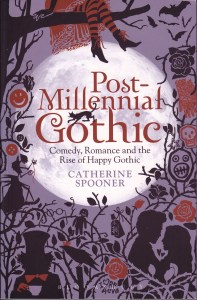
Maybe you’ve noticed it too. While certainly not universal, many forms of Gothic cultural expression (novels, movies, television, etc.) have a playfulness to them. As if taking the genre too seriously might be a misrepresentation. Even Edgar Allan Poe can be caught smirking from time to time. I’ve often wondered about this unusual combination of darkness and light. Catherine Spooner obviously has too. In Post-Millennial Gothic: Comedy, Romance, and the Rise of the Happy Goth she takes on a number of these cultural expressions—both Goth and Gothic—and tries to understand the lighter side that they often present. Sometimes it’s comedy and sometimes it’s irony, but those fascinated by darkness aren’t always as gloomy as they seem.

This book is a real hodgepodge of both British and American explorations of the smiling dismal. It’s a cultural contradiction, maybe, but it certainly feels authentic if you look closely enough. Although Spooner doesn’t discuss it directly, I couldn’t help but think of that great progenitor of the Gothic—the medieval church. Perhaps it was the very real fear of the plague and the nearly constant warfare of the time in Europe, but liturgy, when done right, has a palpable darkness to it. References to ourselves as “miserable sinners” begging God to “have mercy upon us” clearly call to mind some of the deeper elements of the Gothic sensibility. Having attended Anglo-Catholic services for years I came to know many who were compelled by this intensity. A Gothic chasuble is a thing of beauty forever.

Spooner, however, focuses on popular culture. Beginning with the Goth movement of the 1980s, a subculture formed that brought much of this darkness to light. She’s careful to point out that being Goth isn’t the same as being gloomy all the time. It is an expression of creativity, and, as Spooner notes, closely associated with Steampunk. Such things, however, require a recognition on the part of participants that in order to taken seriously, such expressions must become part of daily life. There are risks, however. Even in enlightened cultures we are not yet fully tolerant of those who are different. And really, much of the book is about this—accepting those who are not like ourselves. There is quite a bit going on here that’s beneath the surface. And depth is something the world could use a bit more of. There’s nothing wrong with having some fun while acquiring it, either.

Superstar Detective

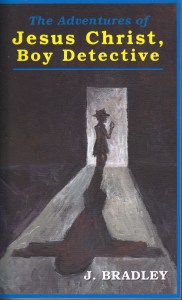
One of the reasons I accept reading challenges is that they take you places you otherwise wouldn’t go. Not all the books I read for the Modern Mrs. Darcy 2017 challenge make it onto this blog (to find the full list you need to see what I post on Goodreads.com), but some I can’t help but talk about. My wife had noticed a book that ended up in her Christmas stocking and for which I had admitted curiosity: J. Bradley’s Jesus Christ, Boy Detective. Now, Jesus is no stranger to fiction. In fact, he appears in lots of books as either the main character or as fulfilling some supporting role. In some books you have to really squint to find him. In others he’s obvious. In Bradley’s novel he’s a bit of both.

There’s a good bit of theology going on in the background of Jesus Christ, Boy Detective. As the title suggests, Jesus functions through a new incarnation in the body of a, well, boy detective. With some assistance from a criminal uncle and Saint Peter, he investigates bizarre murders and other crimes. There seems to be an ulterior motive, however, since he’s trying to get his father to own up for all the suffering he’s caused humanity. That’s right, this book is a modern theodicy.

Theodicy is a word for considering how a single deity can be both all powerful and all good. Since there’s plenty of suffering in the world we all experience, the question naturally arises: why doesn’t God do something about it? Theologians are fond of reminding us that we can’t see the bigger picture. It’s like global warming—it’s easy not to believe since we only live a few decades and the climate takes a lot longer than that to react to our pouring toxic stuff into the ecosystem. Maybe, theologians say, we have to suffer because we don’t see everything. Only God does. The boy detective disagrees. The deity in this story is truculent and culpable. A strong-willed divinity. If he doesn’t sound familiar, take another look at the Bible. I don’t know if J. Bradley has any theological training—I don’t even know his first name—but it’s clear that he’s down here with the rest of us wondering how all the pieces fit. And where there are clues it’s not a bad idea to call in a detective.


Being Boarded

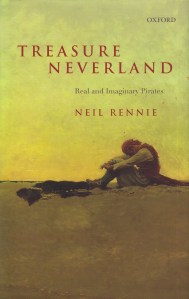
It might seem superfluous to be reading about pirates when such serious issues face us these days, but my answer to most of life’s problems is to look at the history. Besides, like many people in the early new millennium I was swept into the swashbuckling romance of the purified pirate. I suspect, given the time period, that I hadn’t really thought of pirates for a couple of decades. I knew that in reality a pirate was simply a thief on the seas, a bloke on the water who had looking out for number one down to a capitalist science. I thought maybe Treasure Neverland: Real and Imaginary Pirates, by Neil Rennie, might say a bit about the most famous fictional pirates of the modern era, but alas (or “avast”?). For a book that says in its cover copy “the long dissolve from Captain Kidd to Johnny Depp,” it has only a single paragraph about the modern Hollywood pirate from the Caribbean. That’s not to say that the historical and fictional information aren’t interesting—I especially enjoyed the chapters on Long John Silver and Captain Hook, and women pirates—but the book wasn’t quite what I was expecting.

Rennie does a good job of exploding myths that mostly trace their origins to a bottleneck of historical sources on the subject. It’s good for academics to revisit the origins of ideas, I find. Beginning with the days of Henry Every, the early material is quite interesting. I had no idea that Madagascar was such a pirate haven, being mostly aware of the Caribbean variety. But there are also contemporary swashbucklers about.

Consider, for example, that our country seems to be run by pirates. Thieves are those who claim for themselves what they have no right to take. We have a president and cabinet who are pretty much all of that description. We also have majorities in both houses of congress who seem, on many issues, willing to climb aboard a stolen vessel. In Iceland they have the probity to call themselves “the Pirate Party.” At least you know what you’re getting when you cast your vote for those who say what their intentions are so obviously. Not that Trump didn’t make clear in his words and deeds of a lifetime that he would only look out for himself. People can’t be troubled to check the facts, though. It’s better just to let your anger drive you when you’re behind the curtain. Who looks at Wanted posters anymore? Of course, I would say that. I’m the kind of person who looks at history to solve problems.


Such a Happy Place

I fear anyone named Ronald. Being named’s something a kid can’t help, I know, but associations run deep and irrational fears are the flavor of the day. When a friend sent me a link to the original Ronald McDonald clown concept, I had to look. Now, I’m not one of those people who’s afraid of clowns. I know that perhaps puts me in the minority. In college I was introduced to, and even rebooted a club for, Christian clowns. Back in the days of Jesus Christ Superstar and Godspell, many were exegeting Paul’s phrase “fool for Christ” in a new way—the way of the clown. I’ve never been a particularly smiley guy, but I do research things before getting involved. Not only did I read about Christian clowns, I read about the history of clowning itself. It helped that this was before people started dressing up like clowns to assault others in imitation of cheap horror.

Clowns, it should come as no surprise, were originally peasants. The name itself means “rustic,” or “laborer,” even in classical languages, just as it does in English. The affluent have, it seems, always liked to laugh at the poor. The clods could be expected to goof up time and again and their brainless antics would humor the bored, but entitled classes. Buffoons becoming missionaries took a somewhat tortured path through a culture that cast religion in a rather stern, harsh tone. Children of the late ‘70s and early ‘80s were trying to say “lighten up,” laugh about your beliefs. Isn’t that what Paul said? Tertullian wrote, “prorsus credibile est, quia ineptum est”—believe by all means because it’s absurd— didn’t he?

In my greasepaint and mismatched clothes I joined a troop of unspeaking clowns, acting out stories of kindness and good will. We were, after all, made from dirt (the laborer tills the soil, and the word clown comes from the same root at “clod”). We like to think things might’ve evolved since then, but when we turn on the news we see that although it’s no longer Ronald, the antics of the plutocrats haven’t changed since my college days. What d’ya think of that Star Wars defense initiative? After all, we call “Mutually Assured Destruction” a doctrine, and doctrines have their origins in church councils. Ronald McDonald is recognized by his painted face. Beneath the makeup, however, he’s just a man. A clown has no business being leader of the free world. And yes, I’ll take fries with that. Supersize it, will ya?


Terms of Interment

In an early episode of The Simpsons Marge is commissioned to paint a portrait of Montgomery Burns. Angry with him because of his constant treatment of others as beneath him and his glib superiority granted by wealth, she paints him old and feeble, naked as he climbs from the shower. The crowd present for the unveiling is appropriately shocked. Marge explains her motivations for the painting and one of the voices in the crowd affirms, “He is evil, but he will die.” That scene was brought back to mind by an article a friend sent me on Archaeodeath. As someone who’s volunteered on an archaeological dig, I understand that the past is a history of death as well as of life. We read what historians choose to preserve. And, as Professor Howard M. R. Williams points out, the tomb often tells a tale that requires some subtlety in reading.

Never a great fan of the wealthy, some years ago I visited Sleepy Hollow. It was before the television series began, back in an October when the mind begins naturally to turn to death. I’d always liked the story by Washington Irving that had made this quiet town famous and it’s really not hard to get there from New Jersey. While in town we visited the famous cemetery, in search of Irving’s grave. Others are buried there, too. High on top of a hill stands a palatial tomb to some Rockefeller. As Prof. Williams makes clear, all must die and all tombs lie. Those who insist on the most opulent tombs are those who routinely overestimate their personal importance. So it is my mind turns from Montgomery Burns to Cyrus the Great.

There was a time when world conquerors possessed a dose of humility. It may seem strange in today’s world that an Iranian (in the days before there was an Iran, designed as it was by Europeans) would be considered a benevolent dictator. Cyrus reversed the deportation rules of the Babylonians and Assyrians. Subject peoples were permitted—encouraged even—to return to their lands. He even federally funded the building of temples and, to translate, centers for the arts. Cyrus understood that grateful people make good subjects. When Cyrus died, after being king of the world, he was interred in a decidedly understated tomb outside Pasargadae where, according to one account his inscription read, “I am Cyrus, who founded the Persian Empire. Grudge me not, therefore, this little earth that covers my body.” Archaeologists uncover the dead. Those who bill themselves grandly, as the diggers understand, seldom deserve the glory bestowed by their own minds. Marge Simpson, as usual, is a voice of wisdom.

Some president’s tomb


Seeing Belief

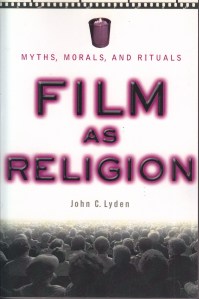
Although most of us can recognize it on sight, we have a difficult time defining religion. In the early parts of Film as Religion: Myths, Morals, and Rituals, John C. Lyden discusses this lack of definition and offers some broad categorizations since his thesis depends upon it. How can one assert that film may be understood as religion if religion isn’t identified? Lyden makes clear that this book won’t be about an ideological or theological interpretation of film. It’s more about popular culture and how elements of that culture, such as cinema, may be religion. This leads to the discussion of the topics of his subtitle: myths, rituals, and morals. These all share some conceptual territory with movies, therefore understanding them is important.

To me the most interesting part of the book is the consideration of genres (westerns, gangster movies, melodramas, romantic comedies, children’s movies, science fiction, thrillers and horror) as exemplars of various aspects of this religion. Each genre includes the discussion of a feature film, and some even have two. Of course, Lyden’s book is a few years old now and other studies have shed further light on both how religion and film interact and also on the interpretation of various genres of movie. The hope of the book—that it may be the start of a new kind of discussion about religion—has to some extent been realized, although the analysis has taken off in several directions at once. There can be no doubt that cinema taps deep spiritual needs in a way not unlike a religious ceremony.

It seems that society has come to distrust the usual purveyors of religion. Dishonesty almost as deep as that of the government has been found in it and the responses are remarkably similar—cover-ups and denials and many species of prevarication. Cinema seems downright credible in comparison. What you see is what you see. The big difference between movies and religion, however, is that we’re only too glad to acknowledge the human sources of celluloid. Many religions, especially in the monotheistic tradition, rely on direct divine revelation as their origin. Lyden isn’t suggesting that film substitutes for religion in that way, but on a more practical level it may. It meets our needs. We trust we’ll get what the poster and trailers promise us. We sit reverently in the dark awaiting illumination. And yes, there’s an exchange of money involved for any kind of worship involves an offering. No religion’s free of cost.


Signs and Portents

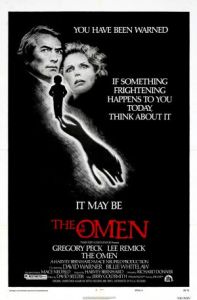
Horror movies are, of course, more than escapism. Although it’s taken many years academics are starting to pay some attention to them. Because of a conversation with a colleague this past week I felt compelled to watch The Omen again. The current political situation merits such viewing, in any case. Interestingly, the first time I saw The Omen—which was during a spate of unemployment—it didn’t scare me much. Like most classic horror, the scenes that had everybody talking in the mid-‘70s had been described so often that they failed to shock. All that was left was a dispensationalist tale of the end of the world—non-biblical, and the fright only came from belief. This time, however, I could see it as nothing but a film about a political takeover.

Omen_ver4

With the open admission on the part of Steve Bannon that his administration—let’s not kid ourselves here—intends to dismantle the government we’ve had in this country since around 1776, we can see that this election was only an excuse. Knowing that this dark side of human nature (some call it the Devil) won’t be given a chance again—they didn’t win the popular vote this time around and unless they silence the media they won’t win the next one—Bannon’s crew, like Damien, has to deconstruct quickly. The Republican establishment, unless it opens its eyes soon, will find itself locked outside as well. Ironically, it’s the public that can see this, not the elites. It’s as if George III were back from the grave. Power, as The Omen intimates, is incredibly seductive. The GOP, wrongly supposing it will share it, goes along with nominations that have now been openly declared agents of destruction. Where is Revelation when you need it?

The Omen is all about Satan getting a back-door entry to the White House. The politicians are all easily duped. Evangelical Christians have been brainwashed into thinking that only by voting Republican can they prevent abortion and gay marriage—two decidedly non-biblical issues. You see, the Devil works that way. Scripture says he can disguise himself as an angel of light. People who don’t educate themselves are very easily fooled. We’ve followed the script rather precisely. Satan’s greatest tool, it’s said, is that people don’t believe in him. So after you finish reading 1984—which we all should—watch The Omen. Ponder what inviting evil to take over the one remaining superpower might really mean.


Where Arthur?

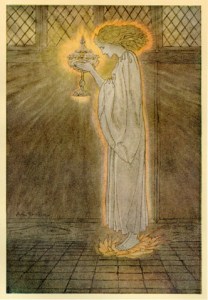
Arthur Rackham - "How at the Castle of Corbin a Maiden Bare in the Sangreal and Foretold the Achievements of Galahad," Wikimedia Commons

Arthur Rackham – “How at the Castle of Corbin a Maiden Bare in the Sangreal and Foretold the Achievements of Galahad,” Wikimedia Commons

We’re all grail hunters. It doesn’t matter what religion, if any, you claim. We want to find that grail. If I was as rich as Donald Trump I wouldn’t bother with the presidency. I’d spend all day on Atlas Obscura. A friend recently sent me one of their stories, “6 Stops on the Hunt for the Holy Grail” by Meg Neal. As the story points out, the grail may not be real, but many places claim it. We want it not because it’s real, but because it’s magical. Midas’ touch without the consequences. Blessings in this life and bliss hereafter. You can have it all.

Nobody knows where the legend of the holy grail begins. One thing’s for certain: it’s not the Bible. The Gospels merely state that at the “last supper” (not a biblical phrase) Jesus took the cup. That definite article implies a certain cup, not just any cup. While speculation has it that this meal was a Passover seder we can’t be sure even of that. If it were that wouldn’t tell us much about this cup in any case. Since the tale is especially prevalent in Celtic lore (many grail sites are in regions loaded with Gaelic influence) some have suggested that the story comes not from ancient Palestine, but from Hibernian traditions of the caldron. This would send seekers back to the mythology of Bran and his life-giving cauldron. In other words, it would share some roots with a modern kind of grail—that of Harry Potter fame. Bran, I once argued in an academic paper, has echoes of some ancient eastern tales. Scholars, of course, are not convinced.

The grail doesn’t come into prominence until the Arthurian legend. Arthur seems to have been an historical person, but facts about him are as rare as they are about Jesus. How he came to be associated with the grail is anybody’s guess. Both Arthur and the grail share a place in Celtic legend and it is perhaps here that the two were brought together. A more crass form of the cauldron is the pot of gold associated with leprechauns—those Gaelic sprites. The grail represents our wishes fulfilled. It’s seldom the spiritual journey that’s sometimes portrayed. The grail represents power. If Indiana Jones has taught us anything it’s that where there’s power, there’s also abuse of power. Then again, we don’t need fiction to know the truth of that.


In Poor Taste

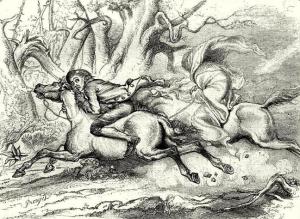
I remember seeing a television commercial once (not during the Super Bowl) where an older guy, a lawyer, complained at the camera, “It used to be that lawyers didn’t advertise.” He went on to say that he felt uncomfortable promoting himself since it was in poor taste, but since the legal profession had swung that way he was entering the game. I know how that guy felt. I grew up with the firm notion that self-promotion was in bad taste. If my career has taught me anything, it’s that unless you’re born well connected, if you don’t promote yourself nobody else will. Still, it rankles. With that hearty introduction, I would, in poor taste, point out that my latest article has been published. Those of you who keep an eye on this blog will know that I gave a paper about the Bible in Sleepy Hollow to a learned society a couple years back. That paper is now available in the Journal of Religion and Popular Culture.

ichabods_chase_crop

Doing research is difficult when you don’t have institutional support to carry it out, but doing such things as an independent scholar can be kind of liberating. I used to research, write, and get published an article a year, back in my teaching days. Nashotah House didn’t have the greatest library, but they did have interlibrary loan and, towards the end of my time there, internet access. More than that, life wasn’t measured in increments of nine-to-five. Living on campus, commuting could be measured in seconds rather than hours. Although publication didn’t bear the weight there that often pressures academics elsewhere, like that lawyer whose name I can’t remember, I wanted to be in the game. I guess I still do.

In these days of uneducated government, if you don’t do it yourself nobody’s going to do it for you. It’s what I once called “the educational imperative.” We are duty-bound, as conscious beings, to move knowledge forward. How many apocalyptic scenarios are there where, when the powers that be devolve into inanity, the monks in their cloisters have to keep knowledge alive? (The question’s rhetorical.) I’m reminded of Station Eleven by Emily St. John Mandel since there women do a good bit of keeping the culture alive when society collapses. Or, to put it another way, like Sleepy Hollow. When the forces of evil break into the world, it’s an African American woman who saves it. If your school has access to JSTOR, you’ll be able to find out more in my paper.


By Any Other Name

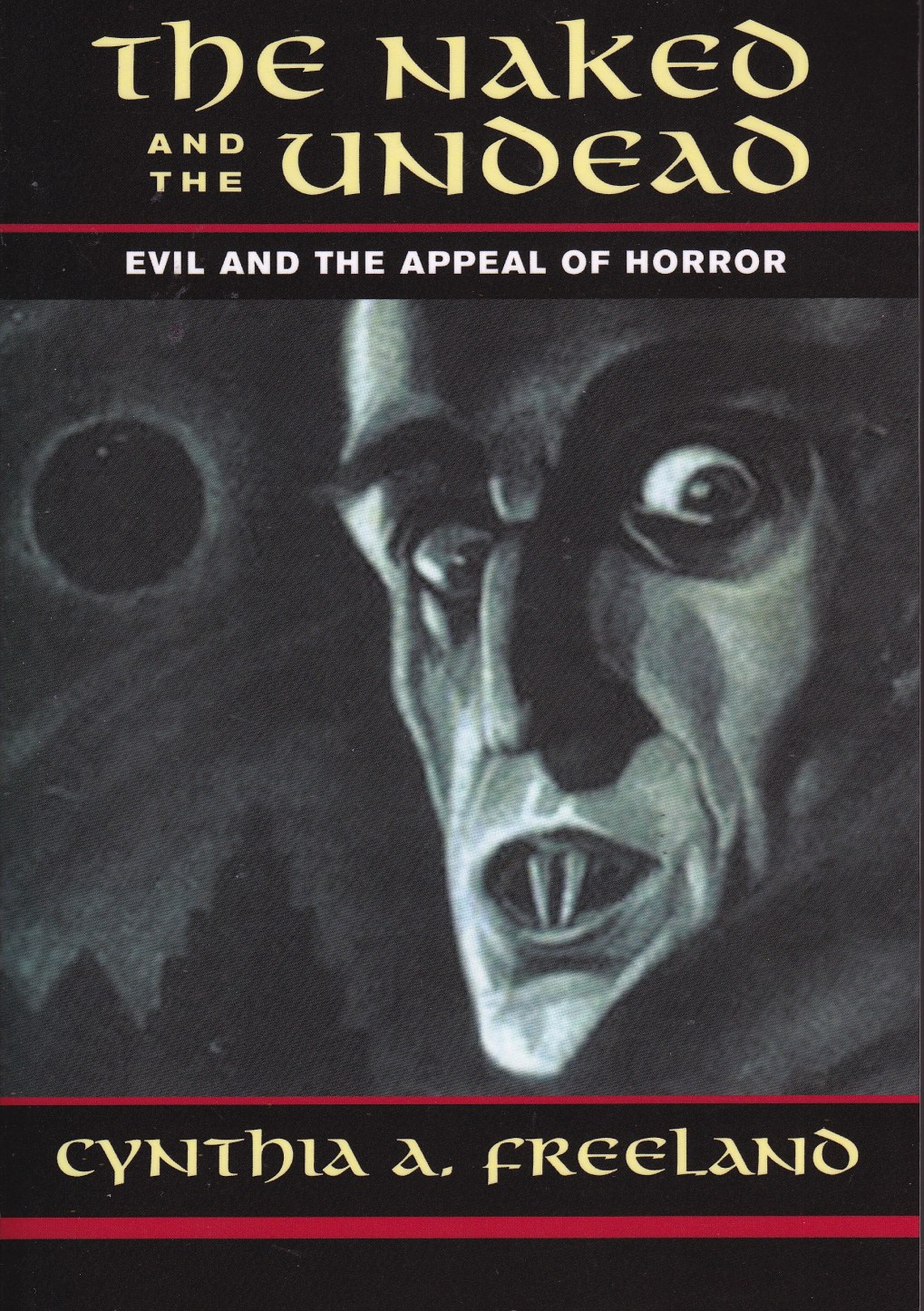
nakedundeadGood and evil. Well, mostly evil, actually. No, I’m not talking about Washington, DC, but about horror movies. Cynthia A. Freeland’s The Naked and the Undead: Evil and the Appeal of Horror is a study that brings a cognitivist approach to the dual themes of feminism and how horror presents evil. It’s not as simple as it sounds. Like many philosophers Freeland is aware that topics are seldom as straightforward as they appear. Feminists have approached horror films before, and other analysts have addressed the aspects of evil that the genre presents, but bringing them together into one place casts light on the subject from different angles. Freeland begins this process by dividing her material into three main sections: mad scientists and monstrous mothers (which allows for the Frankenstein angle), from vampires to slashers, and sublime spectacles of disaster. Already the reader can tell she’s a real fan.
One of the simplistic views of horror is that these kinds of movies—particularly slashers—are misogynistic by their very nature. Feminists, including Freeland, question that assumption. Horror is a genre with a decidedly checkered history. Some films do feature mostly female victims to male monsters. Not all do, however, and even those that do may be saying something other than the obvious. Looking for the locus of evil in these movies provides a lens that focuses the meaning somewhere other than the surface. This is one of the benefits of philosophy—probing questions may be asked and unexpected answers may result. Along the way you can have a lot of fun, too. Especially if you watch horror movies.

A large part of the criticism probably arises from the fact that film making was, for much of its earliest history, run by males. That’s not to say women couldn’t do the same thing men were doing, but the opportunities simply weren’t there. Most film makers, I expect, have trouble getting out of their heads to think about how someone of a different gender might perceive this kind of movie. Fear, we are told, is “coded” feminine. It seemed natural to such film makers to put the female in peril since both women and men would respond to it. Since then it has become clear that fear isn’t coded for gender. Indeed, one of the hallmarks of modern horror is that we all have cause to be afraid. Fear is no respecter of gender. Freeland’s analysis, now getting on in years, correctly looked ahead in many respects. Especially concerning the ongoing presence of evil.


The First Weak

“Oh, what a tangled web we weave. When first we practise to deceive!” I always thought this couplet came from Shakespeare, but in fact it’s from Sir Walter Scott’s poem “Marmion.” The quote has been in my head all this first week of the new administration as alternative facts, lies, and statistics have flooded out of the White House. Along with gag orders slapped onto federal agencies. I’ve worked for people who rely on gag orders. This obvious lack of transparency signals loud and proud that they have facts to hide. Then they will feed the public alternative facts and later claim they never did. Mission accomplished. Sir Walter Scott may not have been William Shakespeare, but he sure got that web analogy right. At times like this we need our writers. Of course, Trump bragged in pre-inauguration interviews that he didn’t like to read.

Since last weekend sales of George Orwell’s 1984 have spiked. From the first words out of Sean Spicer’s mouth (or any words out of the mouth of Kellyanne Conway}, many of us knew the only thing Orwell got wrong was the date. Frankly I’m surprised the government hasn’t tried to ban 1984 yet. It was required reading when I was in high school and that date was still in the future. The press—what still exists of it anyway—passed along stories that Trump had ordered photos of the inauguration day crowds hung in the White House in his first week. Such pressing matters of state! The photos had the wrong date on them. Facts are cheap. This should be good for the economy. You can get them in any flavor you like—true facts, false facts, alternative facts, statistics. Arachne has returned to her loom.

Although “Marmion” wasn’t written by Shakespeare, I can still say it was because I need a segue to Harold Hecuba. Hecuba was a Hollywood producer who accidentally landed on Gilligan’s Island. After he insulted Ginger the castaways put on a performance of Hamlet to showcase her acting skills. Hecuba, the unelected president of the island, awoke during rehearsal and, like other narcissists we know, took over. He says that Shakespeare was a hack and that if he were alive he’d have him working on a complete rewrite. Of course, he doesn’t know what Hamlet’s about. Or “Marmion.” Actors only mouth the words. They make us believe what is not true. We’re in for a period when we’re going to rely on the authors for the true story. I suggest we all start with 1984.

William Shakespeare

William Shakespeare


What Rapture

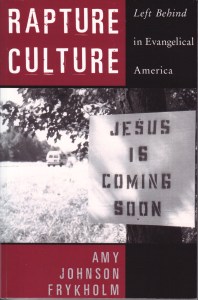
rapturecultureEvangelical culture must be an endlessly fascinating area of study for sociologists. So pervasive that many people who aren’t religious buy into aspects of it, this social movement has shaped American thought in often unexpected ways. Take the rapture, for example. Here is a non-biblical concept, invented in the late nineteenth century and so thoroughly disseminated that most people simply accept it as standard Christian belief. It’s not. Amy Johnson Frykholm pieces part of this puzzle together by focusing on the Left Behind series. Rapture Culture: Left Behind in Evangelical America is one of those books where you find plenty of food for thought as you go along. Not that the novel series itself is profound, but the impact that it has is.

The origins of the rapture go back to a way of thinking called dispensationalist premillennialism. That alone could be why so few people know about it! All this phrase means is that some Christians believe history is divided into distinct periods (dispensations), one of which is the end of the world. Among dispensationalists, there is disagreement on when the rapture will come, and those in the majority believe it will happen before the millennium (not the Y2K millennium, but the millennium of God’s reign on earth before the world ends—the next dispensation). These are the premillennialists. It’s easy to think that since this system is pure mythology it must be simple. It’s not. This is a complex mapping of the future based on an intimate knowledge of obscure verses from the Bible. The Left Behind series, written by Jerry Jenkins under the guidance of the finally departed Timothy LaHaye, brought this idea into mainstream culture. There was even a movie.

Many educated citizens don’t realize that Left Behind has a Harry Potter-like following. Sales of the series are into the millions of units and many of those who read them take them somewhat seriously. Frykholm interviewed such readers to find out what they actually thought about the series and whether it was something they believed in. As might be expected, answers differ considerably on these points. For me one of the real takeaways is that we ignore evangelical culture at our own peril. I learned about the rapture form Chick tracts—I’ve posted about them before—that I read in my childhood. By the time of Left Behind I’d been through enough courses that I knew it was all based on a fictional event. But many don’t realize that. And many of them showed up in the last presidential election.


Hopeful Horror

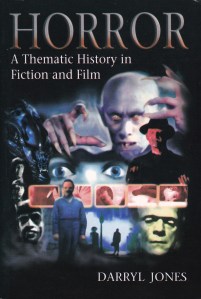
joneshorrorI don’t make New Year’s resolutions. To my way of thinking, if I’m aware I’m doing something wrong, I try to change it at that point, rather than waiting. Needless to say, then, I’m up to my old habits of reading about horror movies. Actually, Darryl Jones’ Horror: A Thematic History in Fiction and Film goes a bit broader than just the cinema. As the subtitle indicates, this charming book also addresses narrative fiction as well and the result is quite engaging. Divided thematically, Jones considers the various types of horror without delving into pretentious theorists to give him academic credibility. Here is a true fan who’s capable to sharing the excitement of the genre. Along the way, accompanying the usual observation that horror and religion share considerable conceptual space, he makes the point that in movies horror is one genre that makes use of academics as characters of authority. Sure, there are others, but in this realm to be educated is a benefit, whether the plan is to take over the world or to stop some evil force from doing the same.

I’ve been watching movies that can be broadly classified as horror since I was young. And I had admired—emulated to some extent—the professors and scientists I saw in those presentations. When a monster was on the loose, you went to find an expert to learn what to do. At the risk of contradicting myself, theorists have been suggesting that one of the problems with post-truth is the death of expertise. Anyone can be an expert these days. The question, “Why should I listen to you?” is on every self-appointed smarty’s lips. Earning a doctorate, the horror world tells us, gives you access to some kinds of knowledge that others don’t have. Problem is, zombies don’t respect such learning. They only want brains to consume.

It never seemed to me that watching horror was a means of learning. As a kid escapism is part of everyday life—taking things seriously is for adults. Growing up, however, I kept my love of scary movies in reserve. Little did I realize that it was a form of training. Now university-affiliated academics are finally able to begin admitting that they find monsters compelling. More than that, they actually learn something from them. Although not a resolution, I see myself reading further books about horror movies this year. It may be a naive hope, but it would be wonderful if they were all as insightful as this one has been.


Reel Salvation

salvationcinemaSalvation is a fraught concept. It’s one of those topics that’s been commandeered by the evangelical camp so that mainstreamers are afraid to touch it, as if it’s catching. The thing is, Christianity is built around the idea that people require saving. The question is how you go about getting “saved.” Some insist it’s being “born again,” while others take a more gradual, one might dare say “evolutionary,” approach. Either way the end result in the same—being rescued from that which threatens you. Like many people, I watch movies. Sometimes I do so with manic intensity, not really knowing why I do it. My personal rationalization is escapism. Living in a world of harsh realities such as Trump (and even before there were sources of great anxiety) one needs an escape hatch. You might say I’m seeking salvation through film.

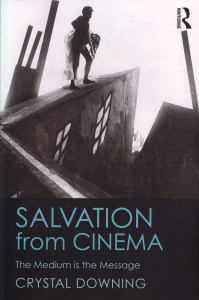
Crystal Downing suggests I may not be alone in this. Salvation from Cinema: The Medium is the Message is a book that explores the salvific function of movies. These are not just Christian or Bible movies she’s talking about. Indeed, she spends some time wrestling with that preposition “from” in the title. Is cinema something from which one might be saved, or by which one might find salvation? The latter is her focus and she sharpens it by looking at theories which might make it happen. The stories, the stars, and even nudity are put forward as ways the silver screen has been thought to bring salvation to viewers. She also includes a very interesting discussion of breaking the fourth wall. This technique brings the contents directly to the viewer. The second half of her book is more theoretically dense, engaging with modern theorists about what salvation from cinema might mean. Her selection of films to discuss is wide and intriguing.

There can be little question that cinema has a deeper significance than it’s usually supposed. Part of the reason is, as Downing discusses, the easy marriage of capitalism and celluloid in the United States. Movies make money. To counter this she also discusses foreign and art house films as well. There can be little question that those who stand in the queue are seeking something. While cheaper than many diversions, going to the movies does involve a small investment and as capitalists we expect a return on that. So it is that we sit in the dark and allow others to guide us toward the light. That’s as fine a metaphor for salvation as any that the preacher might proffer.


Undiscovered Countries

My friend Marvin always amuses me with what he’s got in his refrigerator. He likes to buy products that he considers appropriate to the season. On a recent visit he pulled out a bottle of Arrogant Bastard Ale. He said it was prophetic, in the sense that later this month we’d all be faced with someone fitting of such a moniker. I appreciate his sense of humor—I think we’re going to find that laughter, incredulous and otherwise, is going to help get us through to 2020. Once we reach that mythical date when there will be cities under the sea (unless my childhood cartoon watching has steered me wrong yet again) crewing aquagum all the way, we will have to begin undoing the damage that our government is planning even now. Of course, we were supposed to have a moonbase in 1999, and that show wasn’t even animated. Television produces the biggest liars of all, I guess.

img_3122

January always makes me think of Janus, the two-faced god. Looking forward and looking back. Even Janus seems to have taken on new meaning this year. That’s the thing about symbols—you can’t pin them down to one thing. One of the benefits to studying religion is that you get to feel comfortable around symbols. There may be no real symbology department at Harvard or anywhere else, but scholars of religion inhabit that territory. We skulk around the dark places that human beliefs may go, even allowing people to believe things that are factually false. Instead of getting too dark, maybe we can think of a joke. Two Corinthians walk into a bar…

The future is the famously undiscovered country. Maybe by the time we get there we will have realized just how silly the very idea of countries are. Seems now that citizens of foreign nations can legally take over the US election process, so why bother with borders at all? Put in another way, who wouldn’t welcome the spy who came in from the cold? It’s January out there and all people need shelter from the chill. I keep telling myself there’s no mess that’s so bad that it can’t be cleaned up. Or maybe I’m just thinking of Bruce Almighty again. My friend Marvin refuses to let reality get him down. When the days are short, it is especially important to be the light. Maybe he’s right.