Quatermass Again

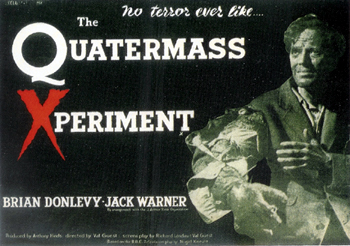
Quatermass, as I’ve noted before, is a name I knew from boyhood, but with no frame of reference.  Having watched The Quatermass Xperiment, and still seeking Quatermass and the Pit, I found a freebee of Quatermass 2 on a commercial streaming service.  Hammer films are notoriously difficult to find in the United States, unless you’re willing to pay serious money for them.  In any case, Quatermass 2 is a passible bad movie in the sci-fi-horror genre.  Quatermass is supposed to be a likable character, but for the film versions American “tough guy” Brian Donlevy played Quatermass in the first two movies.  But I need to take a step back.  Quatermass was a BBC television serial.  There were four series, each eventually made into movies.  The first three were reshot and the final one (The Quatermass Conclusion) was cobbled together from the serial rather than being refilmed.
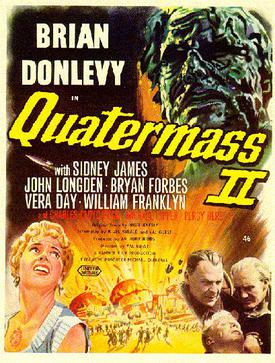
Of this set of movies, The Quatermass Xperiment and Quatermass and the Pit are considered proper horror.  Brian Donlevy doesn’t garner a ton of sympathy in Quatermass 2.  This is mainly because of poor acting and a small budget.  Reputedly suffering from alcoholism, Donlevy has trouble with his lines and often appears curt and short-tempered (he was replaced in Quatermass and the Pit).  Even so, Quatermass 2 has monsters and some reasonably scary moments.  Here’s the story: alien invaders are taking over a secret government plant preparing for moon colonization.  Quatermass discovers the base and finds that everyone acts odd.  Interestingly, they’ve stolen his plans for the base.  The aliens take over people, body-snatcher style.  Quatermass and an angry mob manage to get into the base where the alien-infected fight them.  Eventually the huge monsters break loose and Quatermass has his own rocket converted to a bomb to destroy the mothership in geosynchronous orbit.  The infected people return to normal.

It’s fairly easy to see why few people comment on Quatermass 2.  I wouldn’t have watched it had I not stumbled across a clip showing some of its horror chops.  I’m glad, in a strange way, that I saw it.  I knew Quatermass was a telinema [link to Fire Walking]  product, but I wasn’t quite sure how the television serial fit together with the movies.  Quatermass 2 was bad enough to make me look it up.  From all my reading about horror movies, Quatermass and the Pit is the scariest of the four.  At least at this historical moment it’s not available on streaming services.  And that, I submit, is why we still need DVDs.  Digital rights management is rather like an alien invader…

Missing the Rose

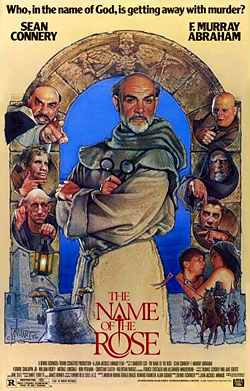
It was Edinburgh, my wife and I concluded.  That’s where we’d seen The Name of the Rose.  Edinburgh was over three decades ago now, and since the movie is sometimes called dark academia we decided to give it another go.  A rather prominent scene that we both remembered, however, had been cut.  If you read the novel (I had for Medieval Church History in seminary), you knew that scene was not only crucial to the plot, but the very reason for the title.  In case you’re unfamiliar, the story is of a detective-like monk, William of Baskerville, solving a suicide and murders at an abbey even as the inquisition arrives and takes over.  It isn’t the greatest movie, but it does have a kind of dark academic feel to it.  But that missing scene.

Of course, it’s the sex scene between Adso, the novice, and the unnamed “rose.”  Sex scenes are fairly common in R-rated films, often gratuitous.  But since this one is what makes sense of the plot, why was it cut in its entirety?  Now the internet only gives half truths, so any research is only ever partial.  According to IMDb (owned by Amazon; and we’d watched it on Amazon Prime) the scene was cut to comply with local laws.  More to the point, can we trust movies that we stream haven’t been altered?  I watch quite a few on Tubi or Pluto and I sometimes have the sneaking suspicion that I’m missing something.  How would I know, unless I’d seen it before, or if I had a disc against which to compare it?  There was no indication on Amazon that the movie wasn’t the full version before we rented it.

The movie business is complex.  Digital formats, with their rights management, mean it’s quite simple to change the version of record.  Presumably, those who’ve pointed out the editing (quite clumsy, I’d say) in reviews had likely seen the movie before.  Curious, I glanced at the DVDs and Blu-ray discs on offer.  The playing time indicated they were the edited version.  Still, none of the advertising copy on the “hard copy” discs indicates that it is not the original.  Perhaps I’m paranoid, but Amazon does run IMDb, and the original version is now listed as “alternate.”  Now that I’ve refreshed my memory from over three decades ago, it’s unlikely that I’ll be watching the film again.  I’ll leave it to William of Baskerville to figure out why a crucial scene was silently cut and is now being touted as the way the story was originally released.


Experimenting with Quatermass

Hammer films are coy.  In these days of digital rights management, they’re often difficult to locate in the United States.  Even on streaming services.  I’d known about Quatermass since I was a kid.  I’d heard about Quatermass and the Pit as a pretty scary early science fiction-horror offering.  I’ve still never seen it.  Quatermass was a BBC television character, a kind of mad scientist figure.  The Quatermass Xperiment was the first of a set of four Hammer films based on him.  Also known as The Creeping Unknown, it was cast with an American Quatermass (ironically, it turns out) to appeal to American viewers (who can now seldom access the film).  In any case, one of the streaming services finally acquired rights to the 1955 movie.  The special effects were naturally primitive, but that doesn’t stop this from becoming a scary film.

Watching these early movies is like studying history.  Other films were influenced by The Quatermass Xperiment, most notably Lifeforce.  I couldn’t help but think of Night of the Living Dead as well.  Quatermass, a rogue scientist, sends a rocket into space with three astronauts.  Since this was before we had any kind of conception of how this might actually be done, the idea seems implausible, of course.  The rocket returns with only one of the three crew members, and he’s morphing into something else.  Despite his arrogance, Quatermass realizes he has to cooperate with the police to contain the menace.  Inspector Lomax describes himself as a “Bible man,” unacquainted with science, and Quatermass considers his work superior to that or mere police.  When the hybrid is finally located and destroyed, however, it is in Westminster Abbey.

Although the runtime is just over an hour and some of the acting is quite wooden, this is an affecting story.  The scene where the transforming man encounters the little girl’s tea party bears elements of the pathos of Frankenstein.  Without the budget, science, and even acting resources of modern productions, The Quatermass Xperiment manages to fall squarely into horror with a monster I’d been waiting since childhood to see.  In those days you were at the mercy of your local television offerings.  Now that we have worldwide content on the worldwide web, we still restrict viewing so that the most money can be made from a movie that’s seven decades old, and its cohort.  In any case, this experiment has left me determined to find what Quatermass discovers in the pit.  Once that becomes available on a service I use.


Rabbit Hole Crawl

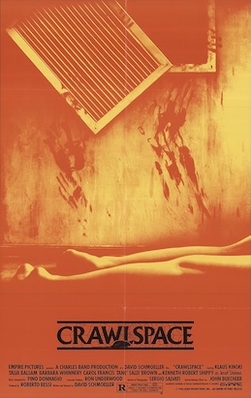
Rabbit holes can be fun.  They can also leave you scratching your head.  David Schmoeller directed some third or fourth drawer horror films, among which is Crawlspace.  Having fallen down the Schmoeller rabbit hole, I found it streaming at the cost of frequent commercials.  Hey, that’s how I watched movies as a kid, so why not?  I was drawn to the movie by Klaus Kinski.  He is arresting on camera and directors knew it.  He was also famously difficult to work with.  Schmoeller apparently tried to get Kinski fired from Crawlspace, but without him it would’ve been a nearly complete waste of time.  That’s because Schmoeller’s story (he also wrote it) doesn’t make a ton of sense, even if it introduces some fascinating themes.  So Gunther (Kinski’s character) is a landlord.  He rents rooms in his house to young women that he murders, after spying on them through the eponymous crawl space.

Why does he murder?  Because his father was a literal Nazi and Gunther has tendencies in that direction.  He’s conflicted, though.  A medical doctor, he saved lives.  He also killed.  Caught up with the God-like power of determining life and death, he explores it at the expense of young women.  And their erstwhile lovers.  And occasional visitors.  Kinski pulls off this double life persona, making him believable.  Even so, the story doesn’t have much other depth.  There’s a lot of crawling around HVAC vents and inventing of insidious ways of murdering and tormenting people.  When Gunther finally loses it and puts on make-up and dresses as a Nazi it’s clear that this is the endgame.  I won’t spoil the ending, but I can say there’s a bit of irony there.

I first became aware of Klaus Kinski through his mesmerizing performance in Werner Herzog’s Nosferatu the Vampyre.  His is one of the best vampire portrayals in all of cinema, in my opinion.  I wonder at the confidence of someone so difficult to work with and yet who appeared in more than 130 films.  I’ve been fired for doing a good job at least three times.  But then, I’m not a professional actor.  At least two of the directors Kinski worked with (Herzog and Schmoeller) made documentaries about how difficult he was.  There were rumors that both wanted him killed.  And yet he made a living acting.  (He was also married, and divorced, thrice.)  I’ve seen him in a handful of films and he does, in what makes it through to the final cut, command attention.  Without him Crawlspace would simply be a hole in the ground.


Philadelphia Story

I’m guilty of a little home-state pride when I consider Philadelphia as a seedbed for diverse filmmakers.  Perhaps the most famous is M. Night Shyamalan, but I recently watched Tayarisha Poe’s first feature, Selah and the Spades.  Poe (and Edgar Allan also lived in Philly) is an African-American woman, and like Shyamalan, writes and directs her own movies.  Selah and the Spades came out in 2019, just as we were settling into pandemic life, but it is a gentle kind of dark academia.  A coming of age story set in a fictional Haldwell Boarding School, it features three African-American leads.  The violence is mostly offscreen, but there is a darker story here.  Selah heads the Spades, one of five factions of student-led extracurricular life on the elite campus.  She’s a senior who doesn’t want to face college—she enjoys her power and doesn’t want to appoint a successor.

The factions plan communal pranks, and each has its own specialization.  The Spades supply the alcohol and drugs to the student body.  This involves some violence, as is to be expected.  Selah has a record of ruining her protégés before they can become her successor.  The movie focuses on Selah’s relationship with Paloma, a transfer to the school who seems a promising new leader.  But Selah has difficulty letting go and the drama plays itself out in a student-led prom after the administration cancels the official prom due to the factions’ actions.  There are lingering shots and some art house elements to the film, making it a drama rather than a thriller.  Dark academia encompasses several genres and this is, as I say, a tamer one.

Philadelphia is a city with a generational history for me.  My mother, who was born in New Jersey, lived in Philly for some time as a child.  She found the city a scary place and unwittingly passed that fear onto me.  I’ve been to Philly several times, of course.  My main concern is driving there—the traffic is always intense and I don’t know my way around very well.  It is a diverse city.  While it’s too early to tell if Tayarisha Poe’s work will center around eastern Pennsylvania (I can’t find a summary of her second movie, The Young Wife, that states outright where it is set), it does underscore that the cinematic world is reaping some benefits from the city of sibling-like love.  And such things happen best when diversity is given a place to shine.


Scientific Monsters

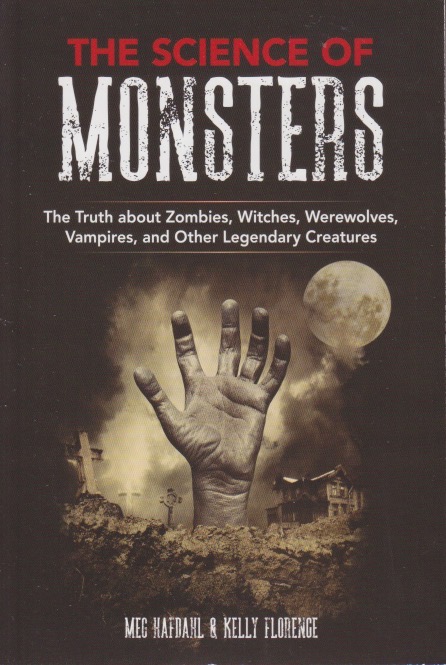
The rule is simple.  If you buy something in the gift shop, you can get into A Nightmare in New Hope for free.  So I naturally gravitated towards the books.  I picked up Meg Hafdahl and Kelly Florence’s The Science of Monsters: The Truth about Zombies, Witches, Werewolves, Vampires, and Other Legendary Creatures.  I noticed that the authors weren’t scientists, so I wasn’t expecting anything hard core.  In fact, I mostly wanted it for fun.  And also, I’m fascinated by anyone who can manage to get published by a trade press, the kind that publish books for under twenty bucks.  (Lest you think that’s a random amount, I’ve been invited to events where I was told $22—the then price of Weathering the Psalms, my least expensive book—was too much for most of the audience.)  The science in this particular book is akin to the science of various ghost hunters—the use of science as a framework, but not really being actual science.

Still, it’s a fun read.  Divided into ten sections of three chapters each, it covers a range of horror movies and asks various questions about aspects of “could it happen?”  Of course, in the sections featuring serial killers, we already know the answer.  Sometimes the authors shift to the “why” question when something obviously does happen in real life.  Now, I bought this book as a horror consumer and I have to say that it made me feel a sense of accomplishment that of the thirty chapters I’d seen all but one of the featured films.  The one I haven’t seen is Cujo, but I’ve read the book.  What I’ve noticed about other horror aficionados is that seldom have we all seen all the same movies.  Since the advent of VHS and watching movies at home, and the various technologies that came after, those of us with an appetite can be starved for choice.

While I wouldn’t turn to this book for any actual science, I did get a few ideas for horror stories from reading it.  One of them I’ve been working on since the chapter on The Tingler.  Both for fiction and non, I often think about publishers and how to break into that below twenty market.  This book is classified, in its BISAC code (the topic on the back of a book that tells you its genre) as science.  The publisher doesn’t publish in pop culture, which is what horror movies are.  There must be a science to getting publishers to buy into a good book idea like this.  Maybe there’s a science to it.


Fear of Puppets

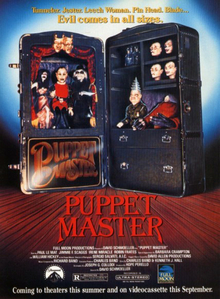
David Schmoeller is a horror director I discovered only in the last several months.  I watched his first film, Tourist Trap, after having found Netherworld streaming for free.  Perhaps his most famous film is Puppet Master.  Although intended for a theatrical release, it was ultimately shifted to direct to video.  That didn’t stop it from becoming a cult film and from spawning sequels and spin offs.  Like other Schmoeller films, it’s a bit disjointed.  But it’s also fun to watch.  Since this is a film from the eighties, I won’t be too worried about spoilers—fair warning.  So, the puppet master lives in a hotel and brings puppets to life, literally.  He does this using ancient Egyptian magic.  About half a century after his death, four colleagues of Neil Gallagher receive a psychic message from him.  They travel to the hotel only to find he’s dead.

The puppets, released from their hiding place, begin killing the guests.  This is one of the many things never explained.  The puppets don’t appear to be evil, but they are murderous.  Three of the four colleagues become their victims in typical horror fashion.  The last surviving friend, an anthropology professor from Yale, and Gallagher’s widow, discover Neil has brought himself back to life, using the puppet master’s Egyptian magic.  He plans to live forever, but apparently he has to kill his former friends to do so.  As he explains this, and beats the professor and his wife, the puppets realize that he’s a bad man.  They attack and kill Neil when he’s trapped in an old elevator.  The ending reveals that his widow can also reanimate the dead.

Child’s Play had been released the previous year, but the trope of haunted or cursed puppets had been in the horror tradition already for decades.  Dolls and puppets are often residents of the uncanny valley and yet people can’t stop making them.  We often learn to draw by representing our families with crayons.  The fascination of replicating ourselves artistically provides low hanging fruit for horror films.  Fabricated things that look human—and we can add mannikins here—starting to move, or coming to life, scares us.  So much so that even less-than-great movies such as Puppet Master can become their own franchise.  As a horror movie, it isn’t terrible.  It’s also not likely to keep you up at night.  At least one other David Schmoeller film is on my to see list, and I have a fair idea of what to expect.  I watch them duly warned.


Zoning In

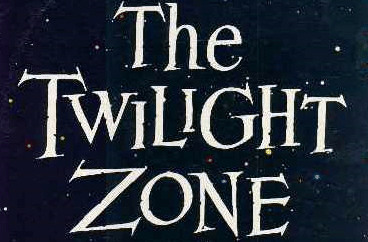
Born Jewish, and Unitarian by choice, Rod Serling believed in the inherent worth and dignity of all human beings.  Like many people, even Serling believed that season four of The Twilight Zone, which went to an hour format from the usual half, didn’t really work.  Nevertheless, the fourth episode of that season,“He’s Alive,” really should be required watching of every person in the United States.  This episode was written by Serling and it focuses on a young American fascist who’s having trouble gaining a following.  A shadowy figure then reads to him from what sounds exactly like Trump’s playbook, and soon decent people are raging along with him about foreigners and those who are different.  When the shadowy figure is finally revealed, we’re not surprised to learn it is Hitler.

The young man obeys without question, and soon it looks like he could be elected.  He has one of his best friends killed as a martyr to the cause.  He murders an old Jewish man who has cared for him since his youth.  He declares himself made of steel, with no feelings.  And when he ends up dead (everyone knows how Hitler’s career culminated), the spirit of Hitler rises from his body as Serling warns that wherever hatred exists, Hitler still lives.  Now this episode aired in 1963 but it could’ve been 2016, or 2024.  Prescient people, like Rod Serling, knew that mob thinking could be easily exploited.  Even in the first segment after the introduction the instructions are laid out.  Play on people’s fear of those who are different.  No matter how good things may be, people will be unsatisfied.  Add any power-hungry individual and you’ve got the recipe for a fascist overtaking.

The episode made me wonder if we could ever become a just society.  Ironically, that which calls itself “Christianity” these days stands in the way.  In its day, The Twilight Zone was amazingly influential.  It had a great impact on what was to follow and it’s still regularly referred to, even by those who’ve never seen an episode.  If only we’d pay attention to its message.  I’ve been making my way through the entire series, slowly, over the years.  Now and again an episode will really hit home.  I have to admit that I was physically squirming during “He’s Alive.”  It’s not that it is the greatest episode of the series, but its message is extremely timely.  The requirement for a better world is simple, but seemingly impossible to reach.  Treat others as you wish to be treated.


Fighting over Chocolate

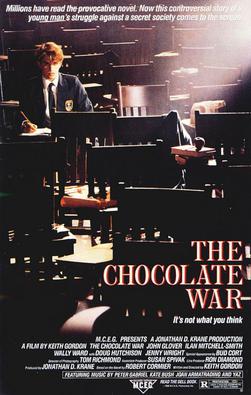
It’s really a teen movie, The Chocolate War is.  That may be the sweet spot for dark academia.  I’m maybe a bit old for such things, but being old tends to mean remembering how it was.  Not exactly how it was, though.  Chocolate War takes place in a Catholic boys school, Trinity by name.  Perpetually underfunded, the students have to sell chocolate (now we’re in territory I recall—remember me, Gertrude?) to help keep it running.  Meanwhile, the Vigils, a secret society, have a considerable amount of pull on campus.  Led by a prescient and overly mature boy for his age, Archie, the Vigils assign select students difficult tasks in a kind of high school hazing.  Jerry, a freshman whose mother recently died, is assigned to refuse to sell chocolates for ten days.  He then decides (for reasons never explained) not to sell them at all.

The refusal leads to a financial crisis for the school.  The Vigils try to force Jerry to sell, engaging in harassment tactics.  Nothing works.  Then Archie coerces him into a “boxing” assembly where students pay to have their specific punches thrown by one of the boys (a bully or Jerry) at the other, who simply has to take it.  Before the match begins, Archie, the Vigils’ leader, is tricked into taking the bully’s place.  Jerry, who’s on the football team, knocks him out, sending some teeth flying (probably why the film got an R rating).  In the end, Archie is demoted, but Jerry realizes that with his refusal to comply, he led to the result he was protesting against (the harassment and boxing match led to selling all the chocolate despite his refusal to participate).

Dated, yes (1988), Dead Poets Society, no.  Still, there’s much to ponder here.  Bullying—used by very high offices in this land—seems to be a growing problem.  And yes, when you get a bunch of adolescent boys together, trouble can arise.  It’s believable.  Although considered a flop, critics were kinder than the box office.  There are dark messages to decode here.  The price of nonconformity—an issue that doesn’t disappear with adulthood—and, perhaps looming larger, its effectiveness.  The teacher temporarily running the school, Brother Leon, is part of the problem, as is often the case in dark academia.  He’s not evil, however.  The film places the abuse of power on Archie, although he doesn’t condone violence.  Ultimately violence is used to unseat him.  With the result that the system (Trinity) prevails nonetheless.  Worth considering.


X-Rayed

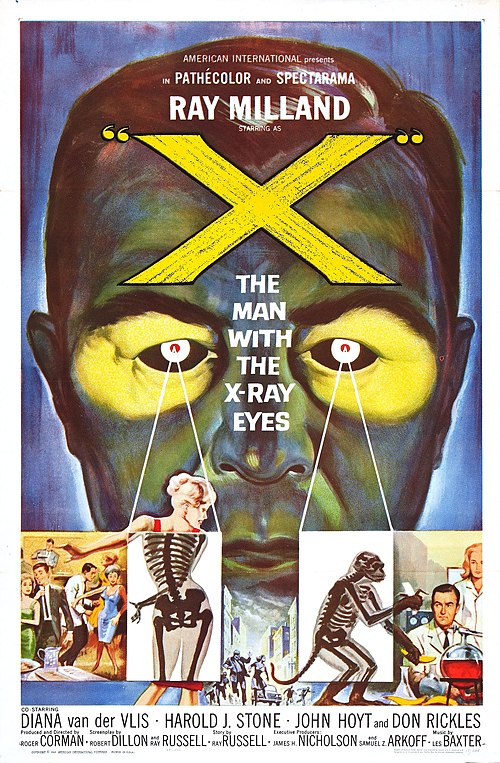
If you’re of a certain age, you’ll remember the comic book ads for x-ray specs.  That’s the idea behind a Roger Corman film that Stephen King thought one of the scariest he’d seen.  X, subtitled The Man with X-Ray Eyes, came out in 1963.  Not to be confused with the X of the modern trilogy, this X follows a Doctor Xavier who develops a formula that allows him to see inside people so that he can accurately diagnose and cure them.  This formula may affect his sanity, however, and he kills a friend who is trying to take the ability from him.  A wanted man, he finds a carnival barker who exploits his gift as a trick.  It was a bit jarring to see Don Rickles in a horror movie, but stranger things have happened.  In the midst of this exploitation, an old friend finds him and drives him to safety.

Then to Las Vegas, where his sight allows him to win unabated.  When the police are called he steals a car and increasingly sees through the fabric of the universe.  He stumbles into a road-side revival where the preacher encourages him to take Matthew 5 literally and he does so as the congregation chants “pluck it out!”  What makes this final scene so arresting, apart from qualifying it for Holy Sequel, is that before the minister tells him to mutilate himself, the doctor says he sees through the darkness to the eye that “sees us all.”  He sees God.  The minister interprets this as the Devil, confusing the most elemental entities that exist one for the other.

The movie has some lighthearted moments, some even apart from Don Rickles.  When the doctor begins to see through everybody’s clothes, it’s presented in a humorous way.  But for the most part, the film is played straight and it manages to raise some serious issues for those who think through the implications.  Our senses evolved to help us survive.  Accessing abilities beyond that is a catalyst for disaster.  Indeed, Dr. Xavier early on notes that he’s approaching godhood because of this newly won ability.  It also means that an individual might know too much.  It seems that at the end he does.  The movie is remarkable even today in several ways.  Technology has made special effects more believable, but the human side of this story remains unaltered.  A doctor wanting to help patients becomes more of a monster than a man, in some respects.  And perhaps the most remarkable aspect is that this is a serious horror film made by Roger Corman for AIP. Scary even to a young Stephen King.


And Bones

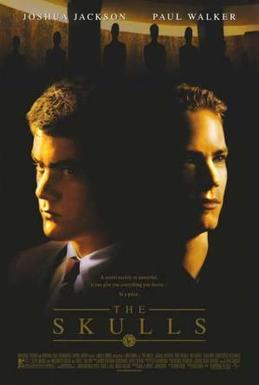
Often making lists of dark academia movies, The Skulls plays right into that territory.  A secret society, an elite college, and something’s definitely gone wrong.  It’s not a great movie, feeling somewhat contrived, but it fits the mold pretty well.  Things are a little too pat in the film, and the writing isn’t the best.  It’s entertaining, if overblown.  The story begins at an unnamed Yale (actually University of Toronto) with working-class Luke being invited to join the Skulls after an impressive rowing competition victory.  From the first, the Skulls meetings seem to lack gravitas.  Rich and powerful, they are above and beyond the law.  The problem for Luke is that his friends, Will and Chloe, are being edged out of his life.  Will, who writes for the school paper, breaks into the Skulls headquarters but is caught by Caleb, Luke’s “soul mate.”

Will is killed in what follows, and Luke wants to get out but it’s too late. Caleb’s father is the head-honcho for the Skulls and decides to have Luke committed to an asylum when he refuses to cooperate over his friend’s death.  Chloe and the second-in-command of the Skulls, Senator Levritt, rescue Luke and he challenges Caleb to a duel.  I’ll leave it off there so as not to spoil too much.  That gives you a sense of the darkness, in any case.  But the film doesn’t feel that dark.  Yes there is a murder, and there are bad guys, but something I can’t define prevents it from having the tone that you might expect from a grim tale.  As I say, things are a little too pat.  The characters’ emotions are a little too close to the surface.

The movie did well at the box office, but the sequels were released direct to video.  As far as the academia side goes, there are, no doubt, secret societies.  Privilege doesn’t let go once it gets a grip.  But the above-ground “Yale” sees a bit too light and airy.  Maybe more classroom and library scenes might’ve helped.  Likely it would’ve been better had it been based on a novel.  Films that are based on books have a solid development on which to stand and it’s often a matter of figuring out what to omit.  The writer and director had gone to Yale and Harvard, respectively, and wanted to portray what secret society life is like.  But that’s the thing about secret societies—you can’t really know, can you?  It’s a matter of imagination.  And dark academia is where such things fit.


Breakage

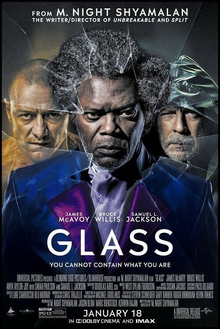
Glass makes me wonder; can any member of a trilogy really stand alone?  As someone who consumes fiction, the question always arises as to who really controls the meaning of individual units.  Scholars have given us reader-response theory that posits meaning rests with the reader (viewer, listener, etc.) rather than with the creator.  Being on an M. Night Shyamalan kick—I was brought in through his horror movies—I watched Unbreakable.  I vaguely knew it was a trilogy, but when I saw Split I was caught off guard.  Unbreakable was a super-hero movie.  Split was a horror film.  I knew Glass brought them together, but I wasn’t sure which way it would break.  It turns out the trilogy is a horror sandwich on super-hero bread.  It’s also surprisingly thoughtful.  And over two hours long.  There are horror elements, but it made me wonder since Split is horror, could it stand alone without the other two.

Having read about the development of this a little bit, Unbreakable could have stood alone.  It did for sixteen years.  Split could also, but for the reveal in the last few minutes.  And Glass manages to pull the whole thing off with a characteristic Shyamalan twist ending.  I’ve written about the other two movies in their own posts, but I really don’t want to give any spoilers for the last one.  I can say it ends with a message that is worthy of the Matrix.  It shows what movies can do.  Or at least it was taken that way by this viewer.

Given what movies are, and what they represent, I have to wonder if there’s not a good dose of racism in the criticism of Shyamalan’s work.  His movies are intriguing, without fail.  I haven’t seen all his films, but I have watched eleven of them now.  Some multiple times.  Here’s a guy with stories to tell.  I know, as a fiction writer who has trouble selling anyone on my vision, that a story can take over your life.  And you want to tell that story and see if it resonates with anyone else.  Those of us who make up tales generally recognize when something we write isn’t good.  My list of unfinished or unpursued stories dwarfs the stack of those I’ve had published, or tried to.  When you release a story out there in the world, you hope that others will get it.  I trust certain auteurs.  Even if not all of their films appeal to me, I like to think I see what they’re getting at.  This trilogy is well worth watching through to the end, even if it isn’t horror.


Not Just a Visit

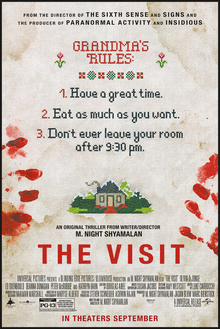
I’ve been on a bit of an M. Night Shyamalan kick lately.  When The Visit showed up on a streaming service I could access, and it was a rainy afternoon when yard work was impossible, I decided to give it a try.  I first became aware of Shyamalan as a horror auteur.  The Village was his first movie I saw, followed by Signs and The Sixth Sense.  (I knew about The Sixth Sense because of the press around the trailer accidentally being shown to underage audiences in theaters.)  I’ve seen some of his movies that aren’t that scary: The Happening, Unbreakable, The Lady in the Water, for example, and others that are.  Knock at the Cabin, Split, and now, The VisitThe Visit has a twist ending and I’m pretty sure that spoilers will make their way into paragraphs below, so if you’re holding off seeing it, you might want to wait before reading further.

The set-up is innocent enough.  A mother estranged from her parents is letting her two children, both minors, visit their grandparents while she takes a cruise with her new boyfriend.  (The children’s father had left.)  Becca, the daughter, plans to make a documentary of the trip.  The movie is found footage.  Sending the kids off by train, they make it to the grandparents’ house in Chester Springs, completely remote from wifi, to stay for a week.  Initially the stay goes great.  The grandparents, however, have some strange issues.  The grandmother’s sundowning disturbs the two kids, and the grandfather also displays elements of dementia.  As the week goes on, these things grow more intense.  Once the mother returns home, they Skype her (there is ethernet at the house) and when she sees the grandparents she realizes (spoiler follows!)

that the people watching her kids aren’t her parents.  They are a couple escaped from a mental institution.  Not only that, but they have also killed the actual grandparents and one of the visitors to the house.  The mother calls the police, but the insane couple makes their move to take care of the kids.  The youngsters are more resourceful than it seems, and are able to get out of the house just in time.  The police and their mother arrive, shuttling them to safety.  As with Split, the fear derives from a situation of mental illness.  There are some disturbing scenes in this film and it manages to bring in some legitimate scary stuff as well as a few effective jump-startles.  I guess I still see M. Night Shyamalan as a horror auteur.


Big Bites

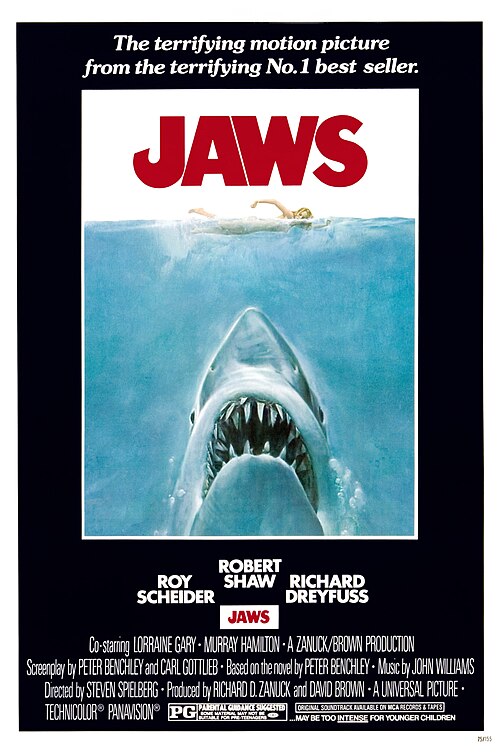
Although Jaws takes place on or near the fourth of July, it’s not holiday horror.  Holiday horror draws its source of fear from the day, and although Mayor Vaughn—like many politicians—insists holiday income is more important than a few lives lost, the fear derives from the shark.  I can’t remember when I first saw Jaws.  It couldn’t have been during its initial theatrical release (I was too young), I do know that I read the book first.  I wasn’t expecting Hooper (then my favorite character) to survive.  I was also surprised when I heard people starting to refer to Jaws as horror.  When I first saw it, whenever that was, I wouldn’t have called it horror—it’s just a movie about a shark.  Since thriller and horror bleed into each other I’m more open to the designation now.  Besides, animal attack horror is its own well-established category these days.  Jaws, half-a-century old this year, is experiencing a comeback but the shark never left.

JAWS, 1975

My wife surprised me by suggesting we watch it last weekend.  We’d seen it together on television many years ago.  A number of analyses have been appearing in the media, highlighting the importance of the movie, and I noticed a few things watching it again.  Probably the most obvious shift, for me, was finding Quint the most engaging character.  I don’t know how many times I’ve read Melville’s Moby-Dick, but it’s been at least two times since seeing Jaws the last time.  The connection was much clearer with this viewing.  Quint is after sharks because of their attacks on crewmen of USS Indianapolis in World War II.  Quint was a survivor but his life’s mission is revenge on sharks.  So much so that he smashes the radio to prevent Brody from radioing in an SOS.

So here was a confluence.  I watch horror movies.  My favorite novel is Moby-DickJaws falls somewhere between the two.  The mainstream success of the latter may have been an early contributing factor to the grudging admission that horror can be good cinema.  Just in the past two or three years standard media outlets have been valorizing some horror and in this summer’s movie season, eyes have turned back to Amity and its local Captain Ahab and great white.  The great white shark, mainly feared because of this movie, is considered a vulnerable species.  As with Moby Dick, I felt sorry for the animal, watching the movie.  Both seem to have revenge on their minds as well, whether it’s a holiday or not.


Dark Lovecraft

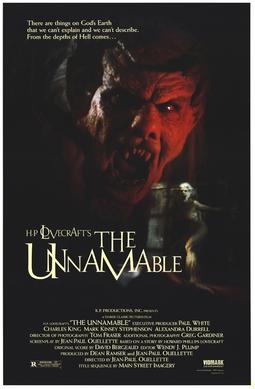
There is no shortage of Lovecraftian horror movies out there.  I watched The Unnamable because I found it on a list of dark academia movies.  And also, well, it’s horror.  I’ve most likely read Lovecraft’s original story at some point in time, but I didn’t remember it at all.  The dark academia part comes in because it involves college students and a haunted house.  A low-budget offering, this is hardly great cinema.  It’s not sloppy enough to qualify as a bad movie.  That puts it somewhere around “meh.”  The film opens with Joshua Winthrop being killed by the monstrous daughter that he keeps locked in a closet of his house.  Then, in the present day (the movie is from 1988) three college guys talk about it and the skeptic decides to spend the night in the house to disprove the monster tale.  He is, of course, killed.  Although his two companions don’t go looking for him, others end up in the house.

A couple of upperclassmen looking to score with freshmen coeds, talk two women into going to the house with them.  As they start to enact their plan, the monster kills them one-by-one, leaving the virginal final girl alive.  Meanwhile, the other two students whose friend was killed, also come to the house.  They manage to rescue the final girl and escape the creature by invoking the Necronomicon’s spells.  The music cues are often comical, suggesting that this isn’t to be taken seriously.  They also spoil the dark academia atmosphere.  For me, a horror film works best if it’s either clearly horror or clearly comedy horror.

It did, however, raise a question in my mind.  Dark academia and horror do have some crossover.  H. P. Lovecraft often had professorial types as his protagonists.  Was he writing a form of dark academia?  It’s difficult to say.  Lovecraft’s work was known as “weird fiction” in his time, and it has become its own kind of genre.  (Just try to publish in the rebooted Weird Fiction without your Lovecraft cap on and see how you fare.)  I’ve been pondering genres for quite some time, and since I watch movies because they’re free or cheap, often, I see some unconventional fare.  There’s no question that The Unnamable is horror.  When the movie ended I was sad for the monster.  She’d been living according to her nature, and really didn’t deserve the treatment she received from a bunch of trespassers.  Not a great movie, it nevertheless made me think.