Misplaced Zealotry

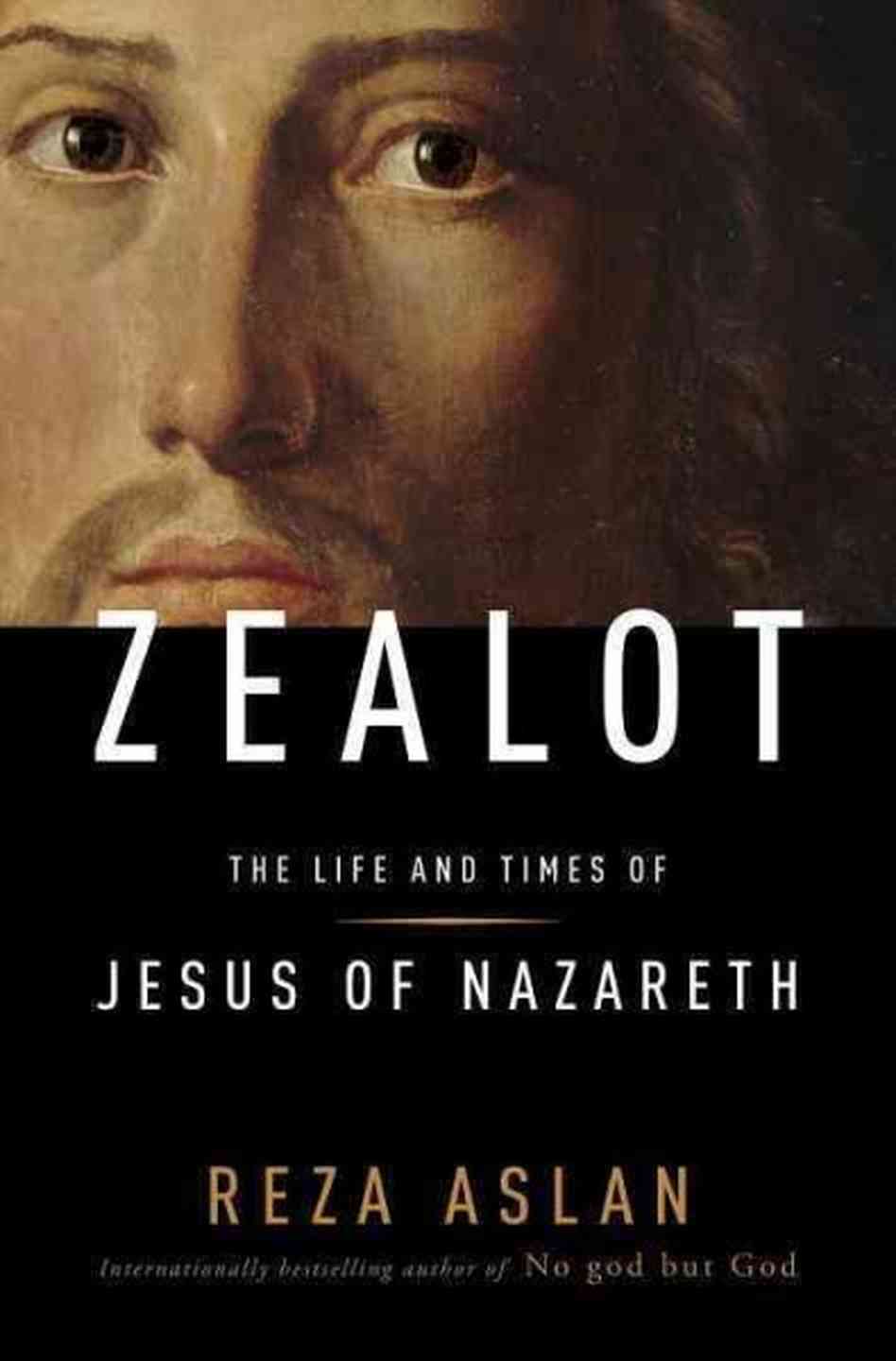
zealotReza Aslan’s book Zealot: The Life and Times of Jesus of Nazareth has brought public interest back to the only begotten, and it’s not even Easter time. A confession: I’ve not read Aslan’s book, so my thoughts here are purely academic. (In a time-honored tradition, I will comment without benefit, or liability, of having actually read.) My interest is, to be frank, less on what Aslan has to say than with how people are reacting to him. Within days of publication, the internet began to swell with news stories about public reaction to Aslan’s treatment. My interest was raised by the Chronicle of Higher Education, where an article by Peter Monaghan quotes Lauren Green of Fox challenging Aslan, “You’re a Muslim, so why did you write a book about the founder of Christianity?” I know this is Fox, and that it is poor form to abuse the idiot, but I couldn’t help but to wonder at such a misguided question.

I would ask, honestly, how many Christians have read a book on Moses or David, or any Hebrew Bible figure, that was written by a Christian. Far fewer hands would be in the air if the same question were framed with the caveat, “written by a Jew.” Every supersessionist religion reserves the right to analyze what has gone before in the light of its own theology. We all know the Moses of Cecil B. DeMille, but how many know the Jeremiah of Abraham Heschel? Do we bother to read what the believer writes about his or her own hero? Would we need to? We already know what the conclusion is going to be. I, for one, am very curious how some Muslims perceive Jesus. That’s always a fascinating question, since Islam, in many parts of the world, superseded Christianity, and has, until recent times, often peacefully coexisted.

Is it not because the author is Muslim that the challenge was issued? How quickly we forget that western civilization (which began in the “Middle East”) owes much to Islam. While Christianity plunged Europe into the Dark Ages, Islamic scholars were rediscovering Aristotle and making genuine progress in science. And yet, we are suspicious of what is discovered by those of “alternative” cultural heritages. I would be more surprised should Muslims show no interest in Jesus. During the past presidential election, many non-Mormons flocked to bookstores (okay, that’s an exaggeration; nobody flocks to bookstores any more, now that Harry Potter is done), eager for books about Latter-Day Saints. Most of them written by non-Mormons. I don’t know what Aslan has to say about Jesus. I suspect some are disconcerted because he bears C. S. Lewis’ code-name for Jesus in the Narnia chronicles, but Aslan may well have something to teach us about ourselves. I, for one, welcome it. How can we ever learn tolerance if we’re unwilling to hear how we appear to others?

And the Band Played

One of the more curvilinear sequences of numerals has taken on demonic attributes over the centuries. Even the most secular of people, at least in the United States, can identify 666 as some kind of bad juju. The more literate among them will be able to pin the origins more precisely to the book of Revelation, often likely as not misnamed “Revelations”—something sure to drive your New Testament professor as mad as a beast. Fans of true precision will surely want to add that it is Revelation 13.17-18 that makes the number infamous. The latter verse starts out with “Here is wisdom,” which already spells disaster, for who doesn’t want to think him or herself wise? 666 is said to be the number of a man, and is conflated with the “mark of the beast”—one of the quickest ways to bring evolution and economics into the discussion. In popular culture 666 is said to be effective in invoking the devil. This idea is not found in the Bible, but it sure makes for an easy way to identify the Prince of Darkness in movies and popular culture.

The other day I received a mysterious email at work from a “Dr. Strangelove” with the email username of “camus666ster.” Indeed, the topic was appropriately apocalyptic and it managed to make it through a pretty strenuous spam-filter. Here was something apparently supernatural during the work-day. I’m also conscious that a building visible from the window behind my desk is 666 Third Avenue, but I’m pretty certain that these two sexagesimal cousins have nothing to do with one another. It is only a certain religious sensibility that brings them together. Where else in the world do authorities have trouble with people stealing roadsigns for route 666? And why do I get the feeling that someone is watching me?

IMG_0696

Revelation may have had more impact on our culture than any other single book. Whether it’s checking your iPhone for the weather, or wondering what is going to happen next in the Middle East, we all want a view into the future. It is a view that some suppose old John saw while exiled on Patmos. Others recognize that Revelation was a thinly veiled contemporary account to give hope to persecuted Christians in an era of imperial violence. Either way, the book, despite some effort to keep it out, ended up having the final say in the Christian canon. In a nation where every person possesses several unique identifiers, we still look over our collective shoulders for an anonymous beast who is about to bring down society. Don’t worry, folks, I’ve got his number.


The Power of Magic Again

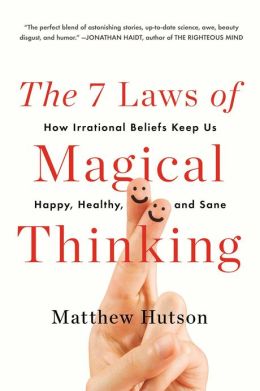
7laws Magic is everywhere. It may not be real (or it just might). There’s no doubt that Matthew Hutson believes the supernatural has nothing to do with it. The 7 Laws of Magical Thinking is a provocative book in that regard. An atheist who argues that we shouldn’t discourage magical thinking because it is so darned human, Hutson is a rare kind of treasure indeed. The 7 Laws of Magical Thinking begins by pointing out that we can’t psychologically accept what is really real. Reality always eludes us. Our brains are hardwired to accept what Hutson calls magic (including what I call religion). Those who enjoy provocation can take some satisfaction in knowing that either side can add another layer to the shell: physics explains everything, but maybe magic is responsible for making the universe conform to the laws of physics. And so it goes.

Although I enjoyed Hutson’s book–and he’s clearly a gifted writer—I couldn’t help but wonder at a very deep parity between the determinism he believes is really real and the magical view that is implied by such self-help manifestos as The Secret—the things that happen to you are meant to happen. I know, I know—Hutson’s point is that there’s no agency involved in determinism, but my point is that the end result is still the same. You end up where you are. I’m not so sure. Determinism has always left me cold. But since I’m no God I guess I can’t change that, yet I wonder if there might not be something outside this closed system after all. No one can peek and tell.

Neurology may tell us more than we want to know about the mechanics of the brain, but consciousness is reality. Science may some day lay its cold hands on consciousness, but it will always be someone else peering into my head wondering what I’m thinking. I’d have it no other way. I was strangely cheered to note that Hutson ends his whimsical study with a “stab at a secular spirituality” (a good stab, that is—not the malicious kind). I’m sure that many materialists will find such an a gesture as pandering to the masses. I think Hutson is sincere, however. Even the über-rationalists, as he points out in the book, slip into magical thinking and metaphors. It is the human condition. Those who watch Star Trek (original series, please!) know that the most tormented crew member of the Enterprise is Mr. Spock. The rationalist who can’t connect with emotion is a soul in torment. Even if that soul is a myth. The rest of the crew, I am certain, believes in the power of magic.


Resurrinception

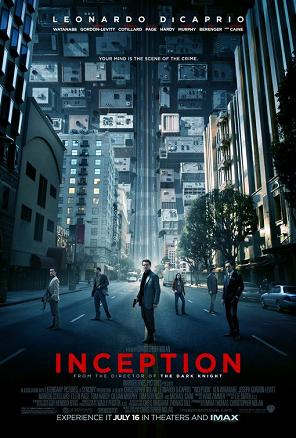
Inception_ver3Like most profound movies, Inception keeps me coming back repeatedly. I’ve already written a post on how the Theseus and minotaur myth lurk deep within the labyrinths of this film, but upon my most recent viewing a new angle caught my attention. In the first level down into Fischer’s dream, when Saito is unexpectedly shot, Eames asks Cobb, “What happens when we die?” It could be the question of a child faced with a dead pet for the first time. Of course, Eames refers to death in a dream under sedation, and limbo is the closest thing to spiritual death that a person can experience. The timing of that question, however, triggered in my head the number of resurrections that take place in the movie. I have frequently noted here that resurrection is a standard part of the tool kit for western movies, particularly American ones. We expect resurrection. So, finally, three layers down, a dream within a dream within a dream (even Poe would be proud), Saito dies. He is lost in limbo.

Limbo is a fuzzy theological construct thought up by the church for those who don’t deserve Heaven, or Hell, or even Purgatory. Some, it seems, end up in limbo. In Inception limbo is unconstructed sub-conscious, an area even Freud would fear to tread. Saito dies and goes to limbo. Fischer, meanwhile, also ends up in limbo because Mal shoots him dead in the third-level dream. Mal is already in limbo because she killed herself in real life—or was it a dream? Cobb, of course, must die to return to limbo to retrieve Saito so that he won’t be arrested when the plane lands. In limbo, three of the four escape, riding the kick back up to consciousness. Only after baptism in the first level dream, when the van plunges into the river, do the lost souls emerge. What happens after we die? Resurrection.

I’m not suggesting that Christopher Nolan planted a Christian idea in the viewers’ subconscious mind. Resurrection is part and parcel of our culture. Perhaps, however, this helps to explain the durability of some religious concepts. We long for resurrection on such a deep—maybe subconscious—level that we want to see it on the big screen. Even ghosts, we’re told, haunt because of unfinished business. It is Saito, the Japanese business mogul, however, who undergoes the most resurrections. He dies in the van underwater, in the fortified mountain hospital, and in limbo (perhaps in the elevator as well, but this is uncertain). His is a regular reincarnation of resurrections. Inception, I’m sure, will keep me coming back for more. One of the questions that none of us escapes while alive, is that uttered at the level of the dream.


Treasure Hunting

It is raining in Midtown. On my lunch hour I’m in a deserted public square down on my knees with an umbrella over my head. My free hand is reaching under a piece of outdoor furniture feeling for something. At least this one is not located in the private regions of a metallic stag. What in the world am I doing here?

One of my sometime passions is Geocaching. Many years ago we started this as a family activity but with schedules changing and families being forced apart by work and school, I’ve taken to caching alone. For those not familiar with Geocaching, you many not be aware that in millions of places around the world tiny containers are hidden from view. There is likely one not too far from you. They are listed on different websites, but Geocaching.com is the main source. You set up a free account, get ahold of a GPS device and go looking. Some of the containers have goodies for the kids, while others are very, very small and your only reward is signing your name and logging the find online. As a family we found nearly 400 caches over the years. Since I spend my days in Manhattan I’ve been urban caching. Urban caches are very small and stealth must be used because those who don’t know about Geocaching who find the containers often take them, not realizing that they have a purpose. So that’s why I’m on my knees in the rain in the middle of New York City.

I raise Geocaching as a topic because of a recent article on NBC about Scouting. Girl and Boy Scouts often know about Geocaching. This is similar to what used to be called (probably still is) orienteering—learning how to find your way around. The NBC story, however, focuses on a different kind of finding your way around. Over the past several years, non-faith-based alternatives to the Scouts have been enjoying some measure of success. Not that Girl or Boy Scouts are explicitly Christian, but they did emerge from that social context. The article specifically cites the Spiral Scouts, a Wiccan-based group, as well as several secular, and even some overtly faith-based alternatives. Yes, it looks like many groups, regardless of religion, want to get kids used to the great outdoors.

DSCN2484

Some might fear that alternative movements signal a rend in the social fabric. I think the social fabric ought to be more like a quilt. If sewn properly, a quilt is just as functional as whole cloth, but much more interesting to look at. Girls, boys, gays, straights, Christians, Pagans, Jews, Buddhists, Muslims, Hindus—what is wrong with that? I think that after being out in the rain, I might just curl up under a quilt when I get home, and I’ll be thankful for all the diversity I see comforting me under the gray skies.


God in the Shops

Over the past few weeks, as I’ve been out and about, I’ve been noticing the way that the divine has been utilized by shop-keepers. In a culture where incipient religion is so pervasive, it seems that God is treated much like the NSA in some quarters—always watching, always vigilant. I popped into a shop selling locally made items (I try to support the local economy when I’ve got a greenback or two to spare, although that is rare), where I saw a sign reading “Shoplifting & Theft Will Be Judged By God.” The sentiment gave me pause. Deeply embedded in our society is the idea that without a divine mall cop, we would all run amok with crime. Although religion is pervasive in the world, much of it is non-deistic, and yet highly moral (particularly in east Asian nations). Their cultures have advanced, even beyond western culture in many aspects of technology, and yet gods (and specifically our God) do not figure into the ethical equation. Pillage and plunder do not seem to erupt when God is not in the shop.

IMG_0903

Whimsical signs have been popular decorative items for decades now. The problem with whimsy is that it loses its effectiveness once the initial chuckle is over. Signs reading “no pain, no gain” in fitness clubs may inspire day after day (although I have my doubts), but the cute warning that “the dog is crazy” on your doormat fails to impress after the first reading. (It must be pretty obvious that I don’t entertain much.) Nevertheless, shops stock those impulse-buy signs that are clever and witty, if soon outdated. I found one the other day reading, “Don’t judge me because I sin differently than you.” Even with the strains of self-righteousness, there is valid thought here. When the woman caught in adultery was brought before Jesus, he said, “Let the one without sin throw the first stone.” This disputed passage is one of the most pertinent in all of Scripture. No stones flew.

IMG_0909

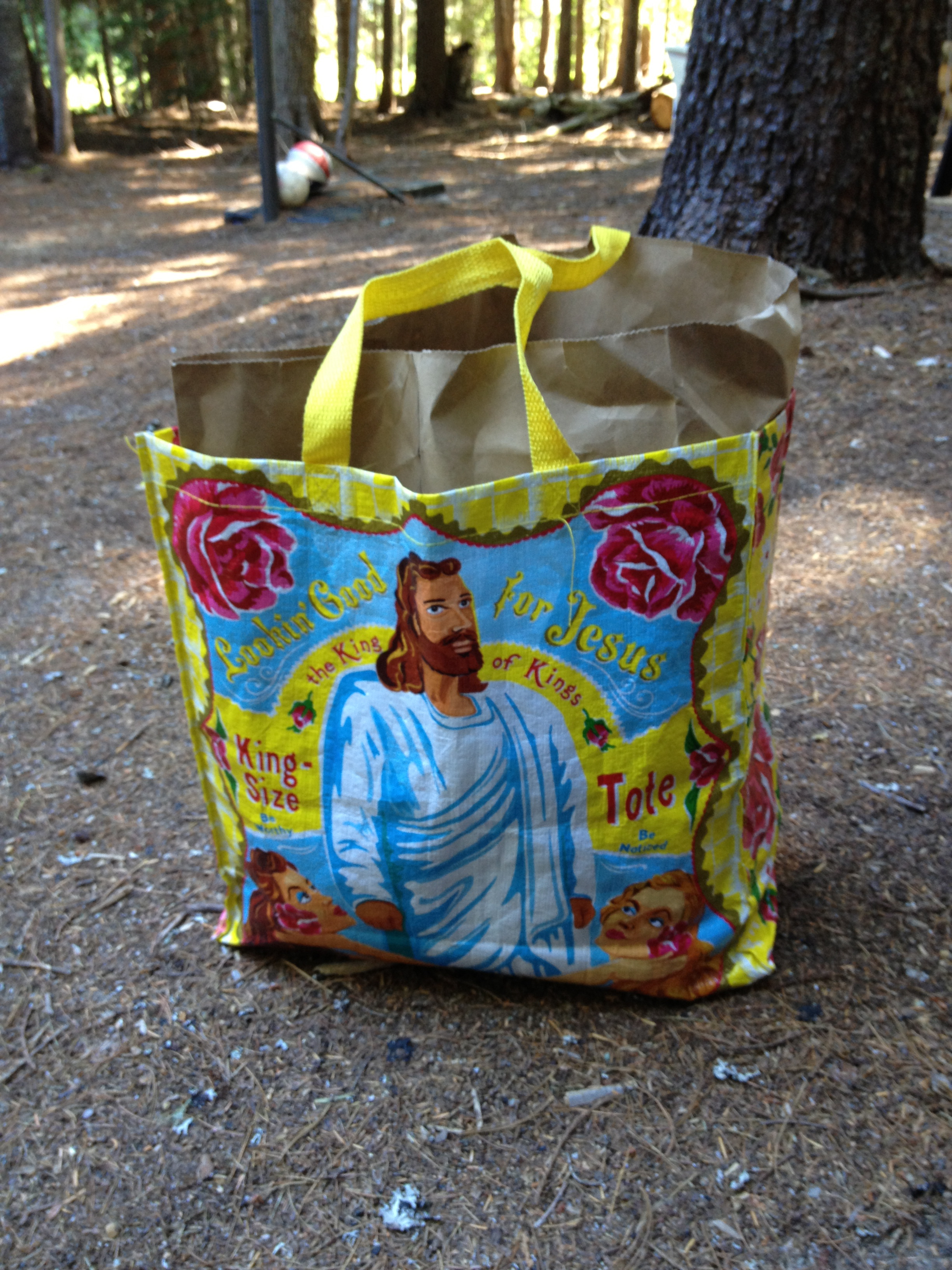
Finally, a friend came in bearing a shopping bag with Jesus on it. “Lookin’ good for Jesus, the King of Kings, King-size Tote” it read. The bag was clearly designed with a heavy dose of irony. I couldn’t help but notice that the bag was full of bottled gas. This portable version of the only begotten is a reminder of how commercial our religion has truly become. Although clearly presented with tongue distending cheek, we know that, as I tried to convince many at Gorgias Press, Sects Sells. People will buy cute knock-offs of their deities. In Wisconsin we used to visit Holy Hill, a Carmelite shrine where all manner of sacred kitsch lined the walls, from glow-in-the-dark rosaries to cheap, plastic saviors. The shop was never empty. Perhaps it is possible to worship both God and mammon after all.

IMG_0908


Firelands

BayardFirelandsPiper Bayard has been a long-time blogging buddy of mine. She’s kind enough to comment on many of my posts and even kinder to like even more. Piper recently published her novel Firelands, and she sent me a copy that I began reading right away. My schedule this entire month has been unfriendly to literacy, but I was always glad to have a few minutes to read a few more chapters of an intriguing post-apocalyptic future. What’s more, Piper is keenly aware that religion is behind much of politics—a point she boldly makes by constructing a dictatorship based around a miracle-claiming prophet-king who oppresses those who don’t believe—the Seculars, or “Secs.” Interestingly, Piper decided on the name Josephites for the religious rulers, and there are dark undertones here for those who know their religious history. As an unabashed fan of allegorical writing, I saw quite a lot here that was, well, apocalyptic, in the literal sense of the word.

In a misogynic future, the Josephites, who dwell in cities, burn many women for various heretical crimes in autos-da-fé entitled Atonements. These human sacrifices ensure fertility and also help to explain the trials of life in a post-cataclysmic world. The protagonist, Archer, has to not only survive, but to try to save her cousin, a grandchild of the eponymous Joseph, from the flames. The Josephites live in a society of thinly rooted but strongly mandated religion. There is an underground of true Christians, and Archer, although a Sec, acts with more compassion than any of the Josephites, except perhaps her cousin. In a world that has lost its bearings, religion both undergirds and undermines a dystopian society where differences of faith have come to define everyone’s role in a harsh world. (Those who have ears to hear, let them hear.)

In this world where heaven is a fiery hell, I realized that Archer was more familiar than she first seemed. A female warrior, she opens the book by tracking a large stag to feed her starving people. Nevertheless, it took me many chapters to realize that she was a hypostatic Artemis, the goddess of the hunt. No wonder she couldn’t convert to the standard religion! Her example leads the way toward a renewable and sustainable future, in touch with nature, while the “religious” in their urban environment are dying on the vine as they appear to thrive. This is a world where old gods are more authentic than an enforced religion that few believe and that only rules through fear. There is much more I could say about Piper’s fascinating book, but I want you to read it for yourself. Visit Piper’s website for more information, and support the work of an author who really has something to say!


Wars and Holy Wars

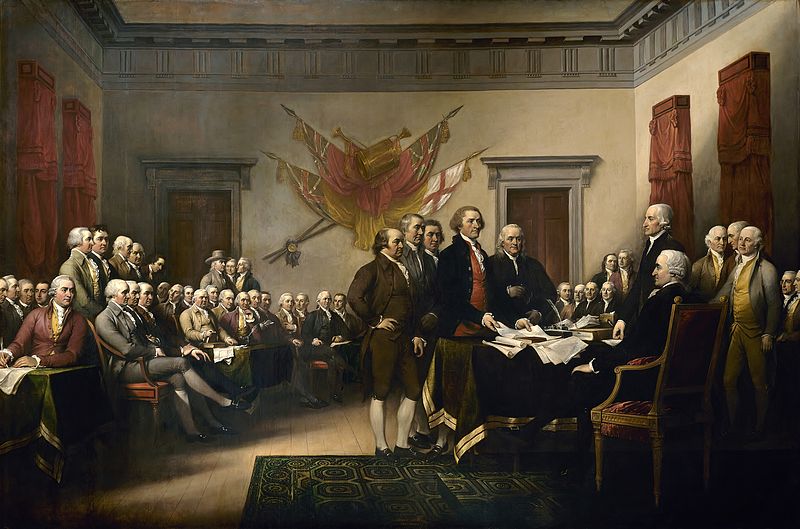
An article by James P. Byrd, promoting his new book Sacred Scripture, Sacred War: The Bible and the American Revolution recently appeared in the Washington Post. Byrd asks a very relevant question in our era: “Was the American Revolution actually a holy war?” He suggests that perhaps it should be interpreted so. The reason is straightforward enough—our nation, our culture in the United States, is so deeply steeped in scripture that even our Deist founders knew their Bibles better than many preachers today do. Byrd suggests, in his article, that people who believed in the separation of church and state could still have a deep sense of divine mission, and a belief that their war for freedom was a divine cause. Early state leaders were not anti-religious, nor über-religious. It is a balance that we would benefit from regaining.

Declaration_independence

I guess I’ve seen enough political shenanigans to realize that such posturing as the Tea Party and the Religious Right or Moral Majority present are deeply cynical. The use religion as a platform to achieve political ends while conveniently slashing and burning huge swaths of biblical reasoning leaves many questions in its wake. Were such motives sincere, I would expect a lot more turning of the other cheek, and walking the second mile uncoerced. I suspect there would be fewer hungry people and even fewer living in positions of extreme wealth and power. In short, without the agenda of political religion, I suspect we would be a more Christian nation.

War is difficult to justify from a strong ethical stance, as most ethicists know. Our founders decided to go to war against what they believed was unfair oppression by a more powerful nation. This takes on the cast of a holy war because people were being oppressed. The pre-emptive strikes were throwing crates of tea into Boston Harbor, and yet the more advanced nation refused to lessen the pressure. In the Bible, Pharaoh declared the Israelites should make bricks without straw, and we all know where that got him. Or we would know, were we as literate as our forebears were. Freedom was considered a sacred trust. We live in a time when trust is at a premium. You can’t fly or surf the internet without being watched in intimate detail. There is no talk of holy wars, it seems, since the sacred has no place in a society that does not promote the concept of liberty with all the risks and benefits it entails.


Stone Age Henge

At a hotel during a recent excursion, I saw a National Geographic (I think) special on Gobekli Tepe (this is the fate of those of us kept from a daily sustenance of academic listservs bearing the most exciting news). Gobekli Tepe is an archaeological site in Turkey, discovered several years ago by Klaus Schmidt of the German Archaeological Institute. It is an odd site, dating back to some 11,000 years ago, that consists of megalithic (big stone) constructions earlier than Stonehenge or the great pyramids of Egypt, both dating from the Bronze Age, roughly. The complex of odd buildings seems to be religious in function because they bear no practical purpose, and the implications of the site are that our earliest steps towards civilization have been misinterpreted from the beginning. We have been taught that domestication of plants and farm animals led to fixed centers of living. Gobekli Tepe suggests that religion led to settled life and farming came later.

375px-GobeklitepeHeykel

The implications of this are rather startling for those of us who’d been working on the assumption that religion developed as a way of keeping the gods happy after people had the luxury of surplus food brought on by agriculture. It turns out that hunter-gatherers learned to live in settled locations because of religion. That is, religion, instead of being just another component of culture, is what led to culture in the first place. In a climate where the most vocal intellectuals insist that religion must be shut down, chopped off at the roots, and burned in the oven of rationality, we see that none of us would be enjoying our urban lifestyles if religion hadn’t brought us together in the first place.

There is no doubt that religion may be taken to extremes, and that when it is, it becomes dangerous. Religion, however, is no foe to rational thinking. Gobekli Tepe is a site of astounding engineering for Stone-Age hunter-gatherers. Engineering is applied science, and so these people were using their understanding of the world to establish a ritual site for the practice of their religion. They needed to live nearby, although they still had to spend their days chasing animals and gathering foodstuffs along the way. Religion made them realize that life together was a necessity for humanity to thrive. We should take a more balanced view before declaring religion a source of evil only. We may never be able to coax the gods into the laboratory, but that doesn’t mean that they don’t have a very important function for human civilization. If they are taken in reasonable doses, they might even lead to astounding transformations.


Christian Rocks

ViolFemsSitting in traffic outside the Lincoln Tunnel, I see that the Violent Femmes are coming to town. The billboard sends my mind spiraling back to college, when the Violent Femmes had released their debut album. Not that I ever listened to it (then), but in the fervently evangelical atmosphere of Grove City College, many students rooted and grubbed for any whiff of esoteric Christianity in a culture on the—pardon the genre-switch—highway to Hell. Rumors abounded that the Femmes were covert Christians, just like another up-and-coming band called U2. Not only the Femmes were violent—reaction to such Christianizing assertions was as well. I remember one of the dorm-mates in my housing group getting into a shouting match that U2 was not a Christian group and slamming his door to sulk, literally for hours. This was important stuff. We were Christians in an underground world.

Of course, some of us knew that Gordon Gano clearly betrayed the influence of Larry Norman in his voicing. And there were rumors and rumors of rumors that the Violent Femmes were coming out with a Christian album, despite the popularity of “Blister in the Sun,” the homage to masturbation that raised the group to stardom. This rumor turned out to be partially true, as Hallowed Ground took on spiritual themes, a little bit country, a little bit soul. There was some tension in the group as Gano’s lyrics began to suggest something more overtly Christian. All of this was going on long before I discovered the Femmes. At Nashotah House I taught a guest lecture on Christian themes in rock music. I researched the Violent Femmes and found that I liked their sound. They made the cut for the lecture.

In a culture as deeply steeped in the Bible as ours, it is difficult to avoid Christian imagery altogether. The Femmes were from Milwaukee (not far from Nashotah House, as the raptor flies), the heartland where beats the pulse of unadulterated religiosity. Even Iron Maiden, after all, had released the platinum album The Number of the Beast. And David Buckna points out in a recent MuseMash post, that even Ozzy Osbourne has some religious aptitude. (I always thought there was more going on in “Iron Man” than meets the ear.) This may all be chalked up to cultural Christianity—there need not be too much conviction here. Those who feel oppressed, however, huddled together in their evangelical college dorms, will always suspect that there is something more beneath the surface that makes even the “Prince of Darkness” the bearer of light.


Tempting Truth

Recently I was discussing the internet with friends. Real ones, I mean, physically in the room with me. One asked if the internet made conspiracy theories more believable. My response was that the internet has changed truth. That probably seems like a bold statement, I know. Truth, however, is an abstract very difficult to pin down. Science, for starters, does not deliver truth. Science is theoretical, and since it is falsifiable, a scientific theory, while based on facts, is always contingent; it is the best explanation that we have at the moment. Scientists generally know not to conflate this with truth, deferring the latter to the realm of philosophy. The average person probably conceives of truth as that which is literally real. Reality itself is, however, a very slippery concept—quantum physics reveals realities where many are not comfortable going, and which very few truly understand. Truth is a philosophical concept that reflects what humanity collectively accepts to be reality. It is in this sense that the internet has changed truth. It is the Wikipedification of the mind.

People, for as long as they’ve had the luxury to consider abstracts, have struggled with the question of truth. For a few centuries—almost a couple of millennia—in much of the western world, the Bible was considered a source of truth. If it was in there, it was true. The source of authority here was that of a deity who oversaw the writing of the Bible, word by sacred word. When science began to demonstrate that this Weltanschuung was untenable, people realized that truth was a bit more complex. When westerners came into contact with other religions, the complexity grew. Large swaths of humanity believed things completely different from the rest of us. What was the truth? A rear-guard action was often the result. Those who had the Bible had the truth already, and since truth doesn’t change, what more was there to be said.

Truth or dare?

Truth or dare?

The internet is not yet a mature adult, but an entire generation has now grown to a kind of maturity with it. It is the first line of recourse for true information. Who has a phonebook in their house anymore? When is the last time you opened a physical dictionary? Some of us routinely look up Bible verses online, since the internet is the ultimate concordance. Instead of turning to the Bible, or any other source, we turn to the collective “wisdom” of humanity as the measure of what is true. Snopes aside, we plow ahead with what we read online, confident that with all those millions of users, we just can’t be wrong. How strange a concept to unplug and look at the actual reality behind the screen. We might be surprised to learn that there are great and terrible wizards back there after all.


Let It Shine

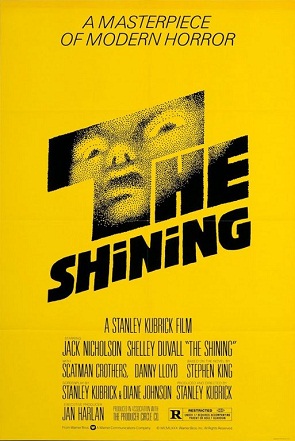
Stanley Kubrick was not the most prolific of movie makers, yet his efforts often create striking impressions. I saw 2001: A Space Odyssey at a young age, and it has remained one of my favorite films ever since. Although I’ve watched horror movies since my college years, I shied away from The Shining until about five years ago. By that point I’d seen enough clips and parodies to kind of know what to expect. Since finally viewing the original, it has become one of my most admired movies as well. Kubrick films may not be easily slotted into a genre, and The Shining is not a typical horror movie. There always seems to be something more going on in addition to the growing menace of Jack Torrance’s insanity. I’ve been hearing about Room 237 for a few months now, and I’m eager to see it. Room 237 is admittedly a movie about a movie, an exploration of how The Shining has inspired multiple interpretations of what most consider to be one of the scariest movies of all time.

The_Shining_poster

An article by Jay Kirk in the June edition of Harper’s Magazine examines this movie of a movie. Kirk is the cousin of Tim Kirk, the producer of Room 237, and offers a personal introspective of a mind under the spell of Kubrickian influence. The article, “The Shining Path: Room 237 and the Kubrick cult,” not surprisingly, keeps turning back to religion. It may be fallout from the Kirk cousins both being children of clergy, or it may be that effective horror films are, as I’ve maintained before, inherently religious. Even the meeting of the Kirk cousins takes place at Gaudi’s Sacred Family cathedral in Barcelona. It seems that there’s no way to get at The Shining without involving religion. Not that it’s a religious movie, but it may take some religion to understand it.

No doubt Stanley Kubrick was a deep man. Even those who try to interpret his movies end up adding a kind of hidden message of their own to the plethora of ideas he eloquently shot. I know nothing of Kubrick’s religious convictions, if any. Any film with the gravitas to inspire continuing hermeneutics over three decades after its release, however, will surely open itself to a kind of sanctification. The penultimate section of Kirk’s introspective focuses on Proverbs 3.5-8, a passage underlined in his grandmother’s Bible. To understand the genius behind The Shining, it seems, religion will have to be part of the discussion.


The Good Magazine

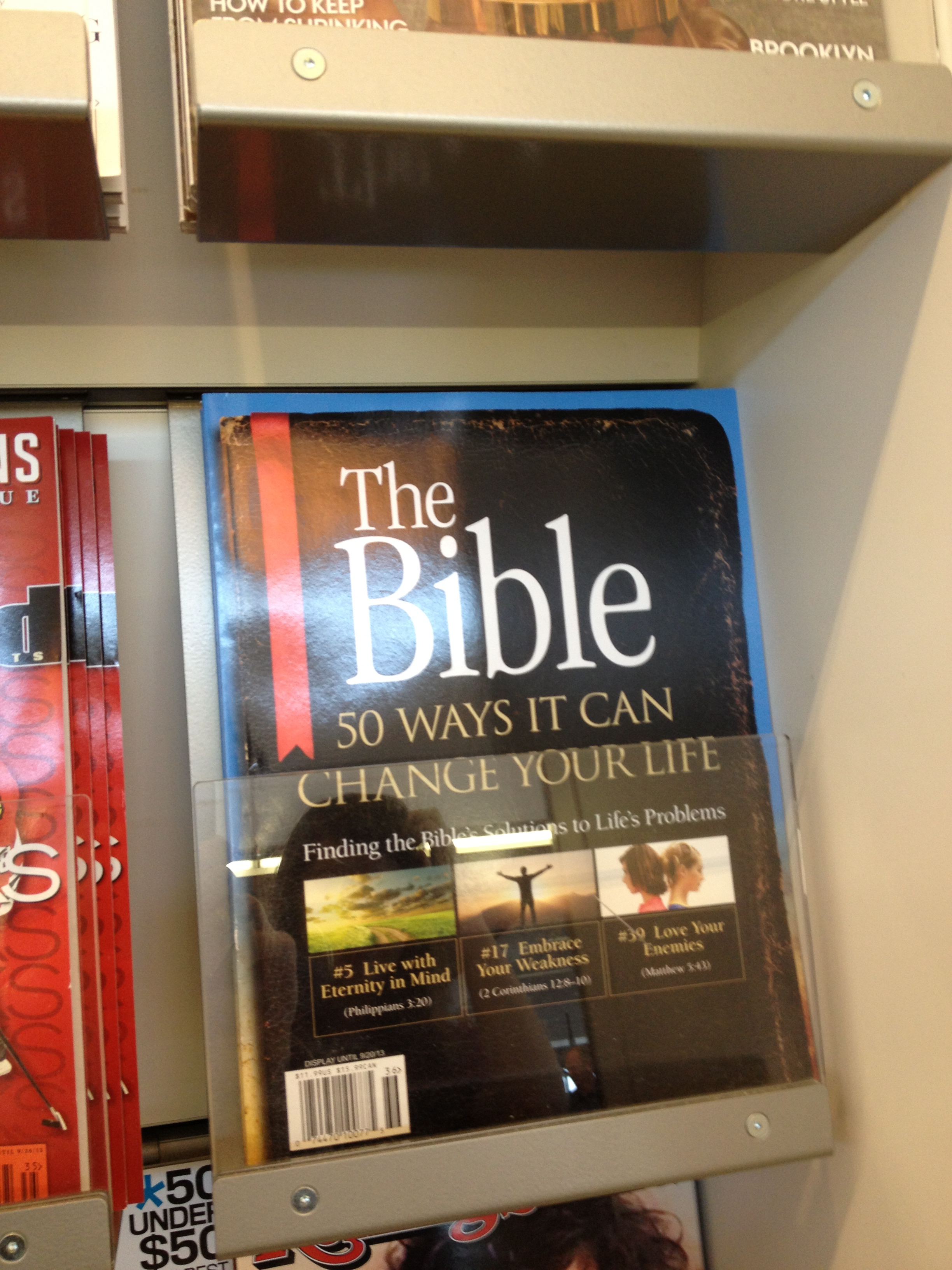
IMG_0902I saw this magazine in a store recently. The temptation to buy it was compelling, but with international trips and a child about to start college to pay for, it felt a little superfluous. Presumably what was meant by this jaunty title, “The Bible: 50 Ways it can Change Your Life,“ was that by reading and applying the Bible and its precepts respectively, your life will be transformed. The problem is that there is no expiration date. Not to be too entrepreneurial with scripture, but how long do you have to apply all this before the blessings take hold? One of the criticisms atheists frequently bring to the discussion is that in order to explain the truly difficult aspects of the universe, the faithful often resort to laying claim to the divine mystery. God works in a mysterious way. Rationality squirms with discomfort at the thought of unsolvable mysteries. In our cause-and-effect world you might expect a fairly quick turnaround with the almighty. I know the Bible has changed, indeed, shaped my life. In more than 50 ways.

Lest I be accused of being too cynical, I feel obligated to explain that I grew up utterly convinced that the Bible was literally factual. Even working around the contradictions I studiously denied, it seemed that the goal was more to make your after-life better, rather than the one here and now. Too many nasty things attended living by the word. People were dying in the Good Book, in droves. The trade-off was a better world coming. If something transformative, in the prosperity gospel sense, were going to happen, it had plenty of time to come along in my younger years. Instead, the Bible led me to a foreshortened career in teaching it and a job in which applying its principles is a sure path to getting fired. Can the Bible change your life? It sure can.

The ways listed on the cover—live with eternity in mind, embrace your weakness, and love your enemies—all fit parts of the Bible. They are all part of “the secret” that makes for best-selling self-help books. The Bible, however, isn’t a book about making your life better. Taking Holy Writ at face value, you obey because that is what is demanded of you. Commandments have no suggestion of option about them. It’s not that I take the Bible lightly; quite the opposite. Something tells me, however, that if I need a magazine to help me figure it out, I must be missing something. Instead of reading the Bible, this is reading about the Bible. The iconic book is alive and well, even in this secular society.


Weird Tales

WeirdTaleSince I first discovered H. P. Lovecraft, I believe that I have read all his published fiction. Most recently a multi-year marathon took me through the S. T. Joshi editions published by Penguin Classics. Reading those editions led to a natural curiosity about S. T. Joshi; H. P. Lovecraft is still an author struggling for respectability, although the internet has brought him great fame. The literary elite consider many genre writers as gauche, and those who read them decidedly low-brow. When I saw that Joshi had written a book entitled The Weird Tale (the genre designation preferred by Lovecraft), I decided to learn more. Joshi, I had known from his webpage, is an ardent atheist, but also a true admirer of Lovecraft’s craft. Since I’ve tried my faltering hand at fiction a time or two, generally having even less success than Providence, I wanted to see what Joshi had to say.

Few things are as inspirational as reading about writing. Those of us compelled to do it find it an endless source of fascination. What drives us to it? We don’t know. Where do the ideas come from? We can only guess. Why do we do it? We must. And so, it is clear, also felt the authors surveyed in Joshi’s fine little book. Although the names of Arthur Machen, Lord Dunsany, Algernon Blackwood, M. R. James, and Ambrose Bierce mostly just tickled some remote tendrils of synapses in my skull, this study was the first real knowledge I had of any of them. While some patterns emerge, there is a notable diversity of background to the writers of the weird. One element that Joshi doesn’t fail to notice is their religious conviction, or lack thereof. In many ways this is odd, but in others it feels perfectly natural. Many materialists count creativity as the predetermined motion of particles and energy that evolution makes inevitable. The writers, however, refuse strictly to conform.

Lovecraft was an atheist and mostly a materialist. Joshi is puzzled, however, when Lovecraft seems to call this certainty into question. I’m not. Lovecraft did not believe in God, but he invented gods. How difficult it must be for a creative mind to dabble in the divine and simply walk away at the end of the day. Lovecraft was no stranger to peculiar residues that clung to the unwary and the bizarre transformations that could occur under the aegis of misplaced belief. But like the narrator of many of his tales, at the end he too knew he’d been affected. I don’t mean anything as crass as deathbed conversion. Rather, like all those who are truly intelligent, we must admit that there are some things we just don’t know. Cthulhu may not be slumbering beneath the sea but many will not sleep easily at night with their closet doors open. To expect anything less of Lovecraft, to me, seems just too weird.


To a Fallen Goddess

One of my favorite places to visit in New Jersey is Grounds for Sculpture. Over the past several years that we’ve domiciled here, we’ve had the opportunity to take several friends and family members to see the whimsical, creative, and inspirational park over in Hamilton. When my daughter graduated from high school, she requested a visit to Grounds for Sculpture, and, since family were near at hand, we took the opportunity to see it again.

I’ve always been aware of the religious aspect of creativity. Perhaps it is because I like to flatter myself into thinking that I’m the creative sort, despite my years of academic training, or perhaps it is the kind of pipe dream for which the liberal-minded are easily accused. In either case, I have always found that the best art evokes something similar to a religious experience. There is an element of wonder, emotion, and awe here. Not every piece of art conjures it, just as a single god isn’t sufficient for the whole of humanity. As I wander the grounds, I grow convinced that this or that sculpture had a vision akin to what I’d call religion, that led to the creation of such a trenchant piece. I always leave feeling blessed.

Photo credit: Grounds for Sculpture, postcard

Photo credit: Grounds for Sculpture, postcard

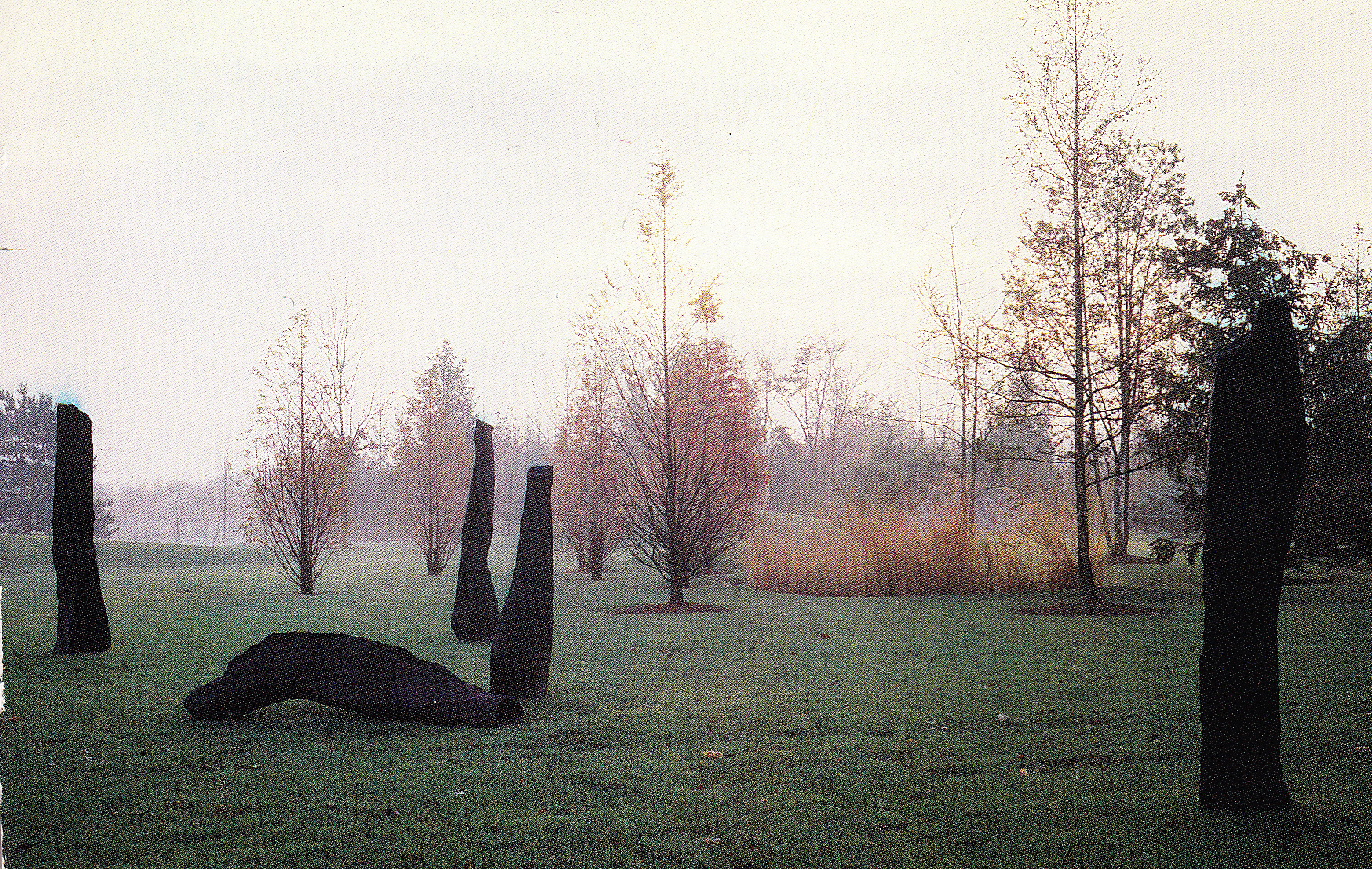
On this most recent visit, a very conscientious relative found, and later sent, a postcard of a sculpture I’d never seen. (It is possible that the sculpture is not currently on display, as the Grounds are continually evolving.) The piece is entitled “Excerpts of a Lost Forest: Homage to Ashera,” by Tova Beck-Friedman. Several of my relatives have me to blame for their awareness of Asherah; she is, after all, a relatively obscure goddess in the Hebrew Bible. The sculpture, however, speaks to me of the continuing ability of even extinct gods to inspire artists. Just as Asherah occupied several years of my academic life, I suspect she also haunts the work of sculptors who’ve come to realize that not all gods must be male, and not all gods must be real to be important. Quite the contrary, the collective deities of our heritage may still be found where art thrives.