Divine Election

Jesus, it seems, has given up appearing on tortillas and hedgerows to start endorsing political candidates. Of course, this is not really new news. Rick Santorum, Herman Cain, Rick Perry, and now Anna Pierre, candidate for mayor of North Miami, all claimed their campaigns were endorsed by the Almighty. Seems that God isn’t that great at picking winners. Anna Pierre, according to a story on NBC, came in last in the polls. Is it any surprise? Jesus always did have a soft spot for the underdog.

pierrejesus

American culture is an odd mix of secular and religious. We seem to want it both ways. Citizens like to believe that they are autonomous in their daily lives, free to choose their non-religious professions and pass-times, and on Sunday God takes over for an hour or two. Charged up on religious conviction, we want society to become more sacred, less trashy. But we still want to watch Fox at night. This disconnect has long fascinated me. No matter how many times God loses the election, a new crop of candidates will spring up with divine endorsements. The electorate, at least a significant part of it, will mindlessly follow along. Perhaps we prefer to believe in a deity whose hand is too short to save. Perhaps omnipotence is best left to boasts rather than belief.

The divine approval of a candidate has become so hackneyed that it has become almost the starting point for political contests. Where do you go after you’ve invoked the highest trump in the deck? Whose word means more than the Lord’s? In the heat of the campaign when policies and platforms just don’t sway the masses, who else can you trust? Often those who play such tactics consider those of us on the liberal side of the spectrum to be cynical. Theirs is religion in the service of the higher good, apparently. We wouldn’t want to be thought of as cynical, now, would we? Otherwise we might note that although Jesus may save, it seems that he certainly can’t vote.

Holding out for a Hero

Over at Religion Link, a story about superheroes and spirituality was posted recently. I guess it should’ve been clearer to me as a child with his head in the clouds that the superheroes buzzing around up there were really gods. Well, in an ultra-thou-shalt-have-no-other-gods setting, that wasn’t really a possibility my young mind could even comprehend. They were just guys (almost always) with super powers. In the Bible they would have been miracle workers. I dared not think of Samson in the same thought as the Incredible Hulk. Heroes, after all, are about wish-fulfillment. We all want to be more than we are—I can imagine a better me (speaking strictly for myself), so why not present that self in the form of a hero? The Greeks, and before them the Mesopotamians did it. Heracles was a Europeanized Gilgamesh, perhaps through the mediation of a Levantine Melqart, after all.

Gods or heroes?

Gods or heroes?

The brief article on Religion Link points out that young people identify with gods in popular culture more than a God in the pew. A veteran of many, many hours in church, I think I can understand that. What adults say is going on in the service is arcane and not prone to any empirical verification. What child sitting in church hasn’t wanted to be home watching real superheroes fight evil on television instead? The movies of the past decade or so have shown us flawed gods. Heroes with troubles. These are the gods for the twenty-first century. Omnipotence isn’t all that it’s cracked up to be.

Scholars of religion are beginning to pay serious attention to superheroes. Books are beginning to appear offering analyses of these god-men, and a few god-women, among us. Funnily enough, some people find them more believable than the traditional gods. Perhaps that is the draw of heroes from the very beginning. Gilgamesh, after all, is asking the very human questions we still ask today. Where can I find a true companion? Why can’t it last forever? Why must we die? To find the answer Gilgamesh is sent off on an impossible task. He has fought monsters, he has defied the very gods. And when he finds the plant that offers a kind of immortality, it is stolen away by a snake. The story clearly influenced the tale of Eve and Adam in Eden. It has also inspired the more recent incarnations of superheroes, and we are beginning to realize that they often fly in the face of the divine.


Running to Stand Still

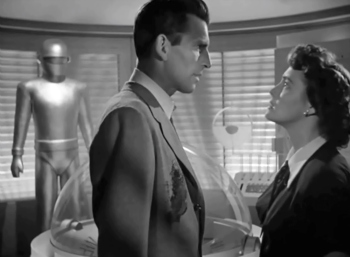
“You have faith, Professor Barnhardt?” Klaatu asks the scientist in the classic The Day the Earth Stood Still. Barnhardt demurs, stating that curiosity is what makes good science, not faith. But sometimes I wonder if the professor or if the alien is correct. Science fiction was young in 1951, and Robert Wise would go on to give us such diverse fare as West Side Story, The Haunting, The Sound of Music, and the first Star Trek movie. Still, The Day the Earth Stood Still has always been my favorite movie that he directed. In 1951 quite a bit could be assumed about America’s religious sensibilities. Yes, diversity had been part of the mix from the very beginning, but the view of America as a “Christian nation,” although not in any way official, was not seriously challenged in those days. This shows through clearly in the movie. Although the opening sequence is intended to be a Klaatu eye-view of descending to earth in his space ship, it is reminiscent of the stock “creation” imagery that would become so familiar to those of us who watched Bible movies. It is a God’s eye-view as well.

Christ-like, Klaatu descends to earth to bring a message of peace, but also an apocalyptic threat, from the powers beyond. He is capable of miracles, such as the eponymous day the earth stood still—the ultimate in non-violent protest because hospitals and airplanes still have power and nobody is harmed. In his human incarnation Klaatu not so subtly takes the name Carpenter, making the corollary clear. In case you missed that, however, he is killed, resurrected and in the end ascends to heaven. Klaatu becomes the prototype of the messianic alien, a figure we would see in guises from ET to Starman. Believers in ancient astronauts or not, the makers of our space movies know that God is an alien.

daytheearthstoodstill

The Day the Earth Stood Still came early on in the Cold War. The obviousness of distrust in the Soviet Union is placed in the mouths and knowing glances of various characters. Some even suspect that Klaatu is a Russian rather than a spaceman. Sputnik was still six years in the future, but the atomic bomb was already in the past. We had learned to destroy ourselves before we had learned how to escape the only planet we have. Klaatu delivers his final homily not to politicians, but to scientists of all races (and, unspoken, creeds). Seated on folding chairs in the outdoors, as if at a revival meeting, they listen as Klaatu tells them the decision of how to live is up to us, but Gort, a kind of avenging angel, is always overhead. The invocation that can save humanity, however, is given to the female lead Helen Benson. She alone knows the sacred words “Klaatu barada nikto.” Amen.


Duck and Cover

Although it is the twenty-first century, I’ve never had cable television. From my youngest days watching muddy black-and-white that sometimes revolved in a dizzying array up and down the screen, I’ve always considered television as a basic, constitutional right. You shouldn’t have to pay for it. Not far from New York City, even before digital boxes were required, analogue signals were so weak and unreliable that I just gave up on television all together. Except when I stay in a hotel. After a day out doing whatever a family does when not at home, we’ll stumble into a hotel room and flip on the TV. I am amazed at home many uncouth, self-made individual reality shows are on. Last hotel stay, I watched a show about heavily bearded guys in the Yukon trying to catch some lampreys so the dogs wouldn’t starve that winter. When they were about to shoot a moose, I switched channels to watch a family of over-fed, heavily bearded bayou store owners making turtle soup and sipping it from the very shell of the martyred terrapin. Manhattan felt like a slap in the face Monday morning.

200px-Duck_Dynasty_Promo

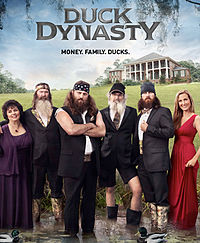
All of this is preamble to the fact that I’ve never watched Duck Dynasty, a show featured in this week’s Time magazine. Another heavily bearded family (I’ve had a beard since 1988 and it hasn’t landed me a reality show yet; how about Unemployed PhDs in the Land of Prayer?), now rich off of making duck calls and a reality show, are apparently one of the highest rated programs on the binary airwaves. The article, by Belinda Luscombe, makes the point that the Robertson family is a born-again clan whose religion is almost as important to them as shooting ducks. She notes that patriarch Phil grew up in extremely humble circumstances, and that his faith in the Lord doesn’t waver. People across the country are fascinated. The ducks, I presume, are nervous.

I am fascinated by this national obsession with hard-time, simple folk. From Ice Road Truckers to Dirty Jobs (not done dirt cheap), this country of sitting-behind-a-desk-staring-at-a-numbing-computer-screen culture is hungry for the authentic. The lived existence of those who face difficult times and get out of them with homespun ingenuity. The duck hunters whistle all the way to the bank. I grew up in humble circumstances, and to my recollection it was anything but glamorous. I’ve never seen Duck Dynasty, but Luscombe’s article reveals the hidden demon in the room as Phil Robertson laments his children building bigger houses and moving away from the Sears and Roebuck-toilet paper ways of his youth. The internet doesn’t help you much when you’re in the outhouse and the last catalogue arrived a decade ago. I wonder what would happen if more of us led meaningful lives. Would we still need the television to remind us that out there, far from the urban centers that define our civilization, godly duck hunters haunt the swamps of Louisiana? Would we even need television at all?


Lovecraft in the Woods

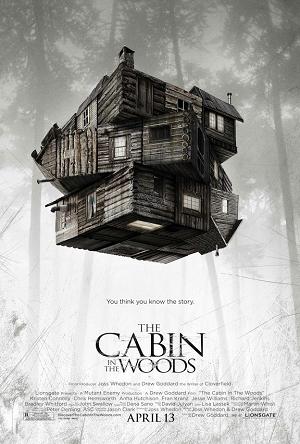
CabinintheWoodsYou know the basic plot: five college students—always an uneven mix of genders—travel to a remote cabin in the woods during a break. Extreme bloodshed ensues. The Evil Dead? Cabin Fever? Blair Witch Project 2? This time it was The Cabin in the Woods. With the exception of Cabin Fever, all of these films have a religious origin for the horror unleashed on our protagonists, with varying degrees of seriousness. The premise of getting away into the woods is overtly sexual in nature, often with the added vice of drinking or drug use far from the eyes of watchful society. Something inevitably goes terribly wrong. Were they a tad less graphic, most of these movies could pass for morality plays in their adherence to the convention, made obvious in The Cabin in the Woods, that the virgin is the sole survivor. Of course, this is done with tongue deeply embedded in cheek. Joss Whedon, who brought us Thor and The Avengers, knows all about gods, and they are the driving motivation behind the evil lurking in this contrived cabin in an artificial wood.

In this parody of the splatter film, the blood of the archetypal teens is collected to appease a Lovecraftian pantheon of unseen “ancient ones.” These are the gods of old, hidden deep beneath the earth in a slumber, placated by the ritual sacrifice of the whore, the athlete, the scholar, the fool, and the virgin. The sacrifice is orchestrated by techie priests who wear white shirts and lab coats, in a hermetically sealed laboratory under the cabin where they are set to unleash any variety of monsters on the kids, leading to their gruesome demise. First the protagonists must “sin”—not a difficult prospect, given the arrangements—and be punished. If the ritual fails, the world ends when the “evil, giant gods” are released; echoes of Cthulhu are rife.

Horror movies offer more than scares. If done well, they provide catharsis as well—a kind of celluloid redemption. Writers and directors, however, have moved toward self-parody to distort the horror film into a kind of comedy. Even as early as The Evil Dead, the humor is evident. Joss Whedon, however, effectively wields the evil gods, just as in The Avengers. Deities are revered less for their goodness than for their sheer power. H. P. Lovecraft, an atheist, gave us the old gods. Hollywood has run with them. Instead of catharsis, viewers are left with an undefined unease—something is not quite right with this universe that has been created. Gods, whether holy or horribly profane, demand much of humanity. The response may be abject devotion or laughter. The sins remain the same as human vices of old. It is the gods that have been transformed.


Heavy Metal

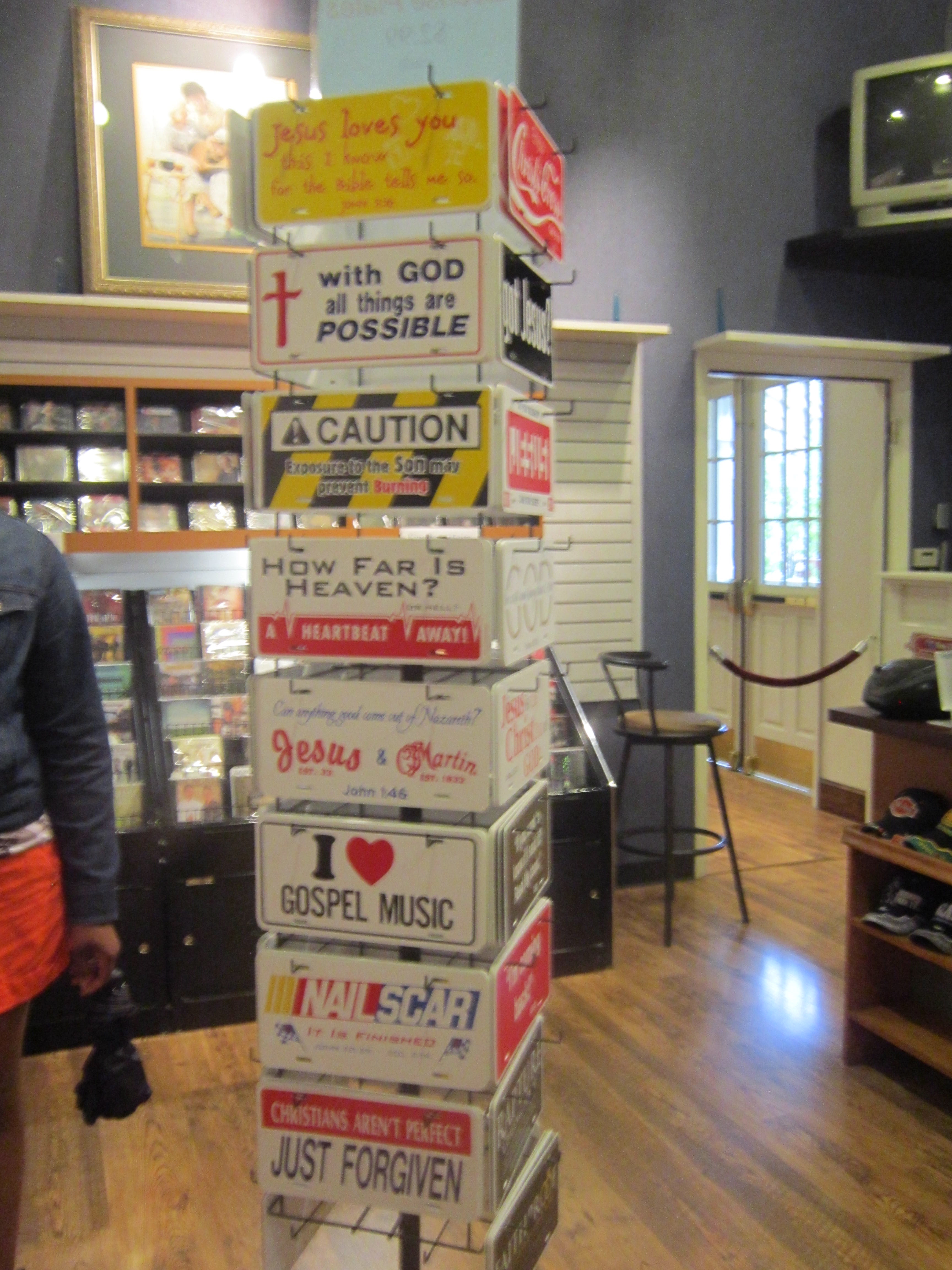
“I drive my car, it is a witness. My license plate, it states my business.” Only the hardcore may be able to place this quote from Daniel Amos’s impressive 1984 album Vox Humana. Even when I moved away from Christian rock after college, I kept Daniel Amos in my head—this is truly inspired artistry. Pop culture and religion courses have become a standard offering in religion departments over the past few years. We are, even as secular as we may be, a very religious society. When my daughter’s high school music program went off on its biannual concert tour, this year they headed south. On the itinerary: Dollywood. I came near to Gatlinburg, Tennessee on the trip I made to South Carolina to see my father for the final time, but I did not stop. I am told, however, that Dollywood is something to see. In one of the gift shops, my daughter snapped a couple of photos for my blog that draw all these disparate thoughts together.

IMG_1213

What we put on our cars is what we want the world to know about us without ever seeing us. This makes cars a perfect evangelistic tool for both the shy and the aggressive. The car becomes a tract. A statement that this vehicle is driven by an evangelical. I’m not sure it makes me feel any safer on the road. How many times have I been rudely cut off in traffic only to find a Jesus fish winking at me from the bumper of the offending car? Sometimes swallowing a Darwin amphibian. Religion speaks more loudly behind the wheel than it does from the pew. In the stress of traffic, what do we really believe?

IMG_1215

Cars are also the ultimate tools of self-assertion. Human beings, with little natural armor or predatory equipment, surround themselves with metal and accelerate themselves at velocities that nature never intended. We feel godlike behind the wheel. That metal box in front of us, driving too slowly, or having just pulled some stupid maneuver, is not a person. It is a thing. And those who choose to declare their faith on that object are under constant judgment. Well I know the evangelistic pressure to witness—fundamentalists are expert at manipulating guilt. Put these plates on your car and the world will know what you really are. But be careful. It’s not how you say, but how you play that will express what you truly believe.


Paranormal Academy

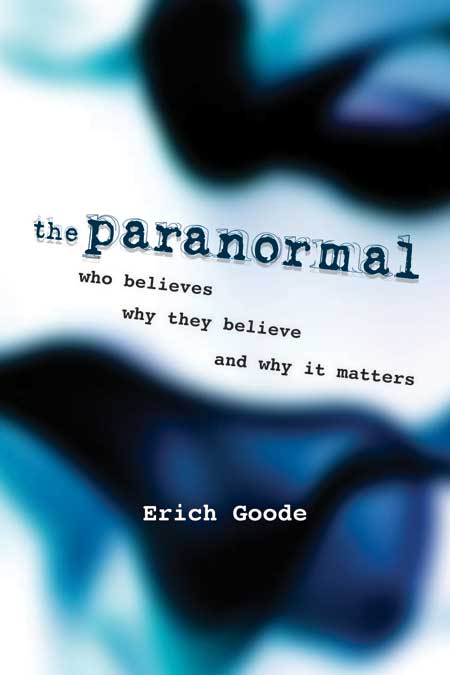
ParanormalA recurrent theme on this blog (as my faithful few will doubtless know) is that religion draws from the same stream of cultural energies as do other phenomena such as horror movies and the paranormal. Religion and fear and curiosity seem to share some common parameters, and every now and again serious academics tackle these connections as well. Erich Goode, a sociologist, has taken on unconventional beliefs in his The Paranormal: Who Believes, Why They Believe, and Why it Matters. Unlike many academic writers on the topic, Goode does not attempt to debunk, but it is also clear that he does not ascribe to the unconventional viewpoints he examines either. In what must be an important realization among sociologists, Goode, like some of his colleagues who also consider the paranormal, finds that belief is widespread. Large segments of the US population allow for some validity toward ghosts, psychics, aliens, and yes, even creationism.

That last one stopped me for a second. Several seconds, actually. Creationism paranormal? When Goode’s delineations are considered, this is not completely inappropriate, but creationism is pure-blood religion. Not that it is necessary for religion, but its birth and considerable growth has been among the conventicle of true Bible believers. It is clear that in Goode’s line of reasoning there is only a fuzzy line between religion and the paranormal. I’ve asserted that same fuzzy line, but I’d never considered biblical literalism as paranormal. Maybe because I was raised in that environment it seemed normal and natural to me. Maybe because it is in the Bible it feels weird to hear it classed as paranormal. Maybe because believers in ghosts, aliens, and undiscovered forces have at least some viable evidence to indicate their beliefs are valid; the creationist distortion appears not to belong in the same camp.

Creationism is a complex psychological phenomenon, to be sure. How people who know the obvious practicalities of science (such as television and the internet, where creationism can be expounded) have demonstrated that its overall methodology is sound, how such people can accept a fairy tale beginning to a Grimm tales world is difficult to fathom. And creationists, in general, would reject belief in what most of society considers paranormal. Can these coexist in the same category? While Goode constructs his paradigm as those who accept and reject empirical reductionism, I’m not convinced that religious belief is the same as paranormal belief. The parsing is a bit too coarse here. Creationism, which began life as a religious belief, has become a political agenda all about domination. It is not so much naiveté as it is need to rule. Somehow I doubt the ghost hunter with her or his night vision camera and digital voice recorder has any real designs on textbook distortion or having women keep silent on Sunday morning.


Rorschach Test

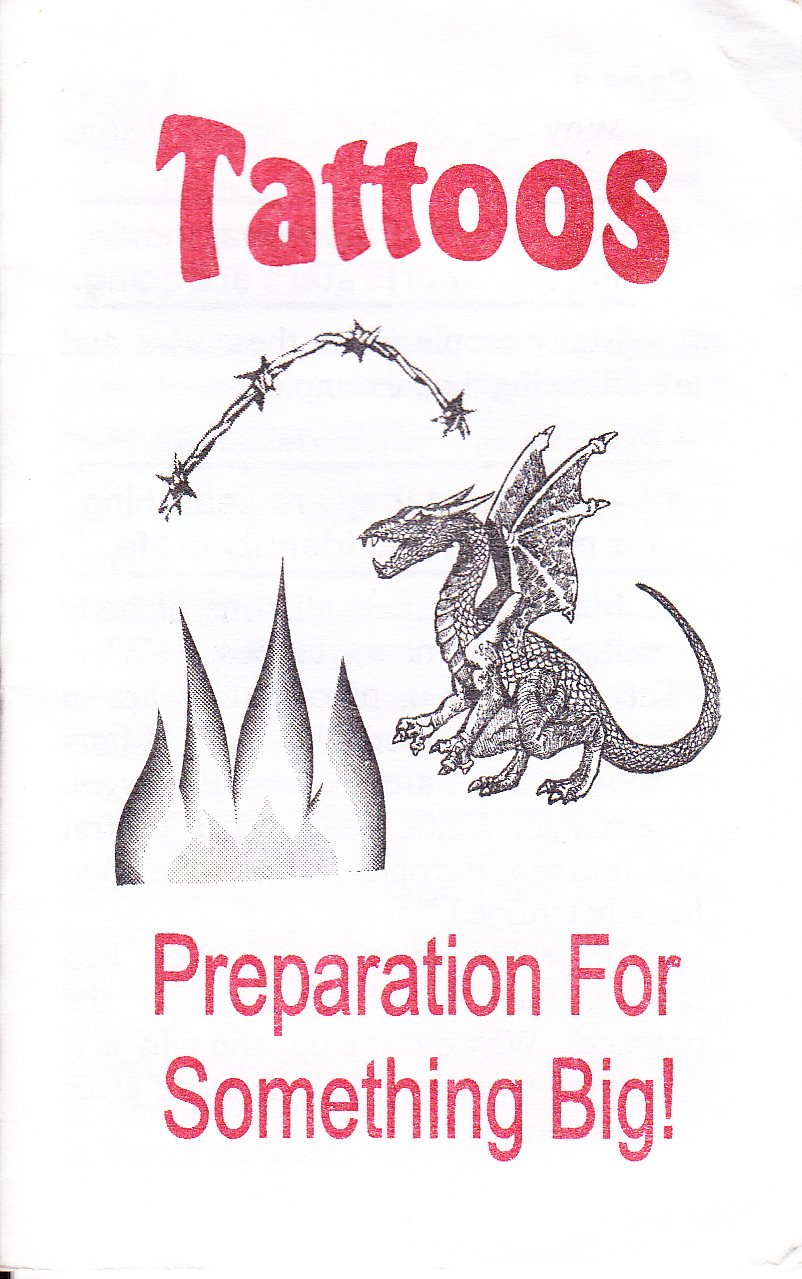
Rutgers University, College Avenue Campus. I recall coming out on a sweltering night once in a while during a summer term, only to find a street evangelist inveighing against undergraduate evils. He, and it was invariably a he, may have delved into the darker sins of graduate students, but I didn’t stay around to find out. Colleges attempt to educate while street preachers try to halt the process. Shall we go forward or retreat? I occasionally run into off-campus preachers on my university visits. I still look like a professor, I suppose, so I am treated to their version of salvation along with the people less than half my age, facing all the temptations of adulthood. The last evangelists I saw were handing out tracts about the evils of tattoos. I know tattoos are very popular, although I’ve personally never seen the draw. With one eye cast warily ahead, I think of what happens when that firm bit of skin starts to sag and the bold decoration begins to shrivel to make us look less like rebels and more like crepe paper left too long in the rain. Besides, I could never think of a picture that I’d want attached to me for the rest of my life. Too many changes come along, best leaving tattoos for those who appreciate a strong dose of irony.

Tattoo

Our evangelist friends, of course, object because tattoos are expressly forbidden in the Hebrew Bible. “Ye shall not make any cuttings in your flesh for the dead, nor print any marks upon you. I am the Lord,” so the Lord declares in Leviticus 19. I resisted the urge to ask my ersatz savior if his clothing contained any blends of materials, forbidden earlier in the same chapter. Or if he trimmed the hair on the sides of his head. Or rotated his crops. The problem, according to the tract, is that tattooing was considered a heathen or pagan activity as Christianity spread to new lands. Presumably the very popular cross or crucifix tattoo design had not yet evolved. The tattoo is a tribal mark, indicating loyalty to a (presumably unChristian) group. My tract sets itself out on a history of tattooing, and suggests that it became popular as a form of entertainment, suggestively knocking on the door of that devil, idleness. They even cite Rick Warren as making church too entertaining. This isn’t supposed to be fun, people!

The real problem is that tattooing is getting society prepared to receive the mark of the beast. With echoes of Hal Lindsey’s Late, Great Planet Earth (now severely dated), the tract tells us that the mark is a tattoo and that among the most popular designs is the dragon. China, which venerates the dragon, is hostile to Christians—coincidence?! And, it should be noted, “Studies have shown that WOMEN who get DRAGON tattoos become more SELF CONFIDENT and ASSERTIVE” (emphasis in the original). And that, they want us to believe, is a bad thing. At least with Fundamentalists, agendas are rarely hidden. Too many assertive women and scheming foreigners are trying to lead us to the very tattoo parlor of the beast. Who knew that so much could be unpacked from half a verse in Leviticus? The name Levi, by the way, some suggest, comes from the same root as leviathan, the dragon.


Sterling Serling

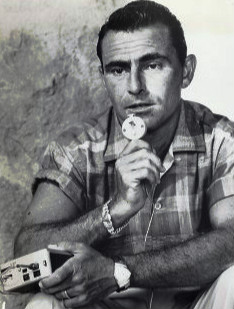
“There is a fifth dimension beyond that which is known to man. It is a dimension as vast as space and as timeless as infinity. It is the middle ground between light and shadow, between science and superstition, and it lies between the pit of man’s fears and the summit of his knowledge. This is the dimension of imagination. It is an area which we call the Twilight Zone.” The words are those of Rod Serling, native of Syracuse and Binghamton, and creator of The Twilight Zone. When I travel to a new place, I like to honor the writers and creators of the region. Yes, there always have been many creators. By my age, Rod Serling was dead, but he had, before that time, created a cultural phenomenon that would stay with the world forever after. It would be difficult to quantify the effect The Twilight Zone had upon me as a child. That opening took ahold of my young mind and convinced me that there was more to life than what appeared on the surface. It is the power of creation.

Rod_Serling_dictating_script_1959

Serling was a fighter. “The angry young man of Hollywood” who used his fiction to protest war and racism, Serling took on many issues in The Twilight Zone that would have been censored had they been presented as fact. Fiction is the vehicle in which truth rides. The bizarre world Serling envisioned captured the imagination to such a point that if I write, “do-do-DO-do, do-do-DO-do” many of you will be able to conjure the theme of The Twilight Zone in your heads. We all know that this is a sign that something strange is about to happen.

There is something about place. I’ve written about sacred geography before, and it is one of the more fascinating aspects of human subconscious life. Something about Syracuse-Binghamton still says “Rod Serling.” Maybe it’s in the low, glowering clouds or the ancient Native American names and traditions that can still be found in this region. Although I’ve never lived in New York, my ancestors did, in the region just east of here. A lifelong wanderer, I sometimes wonder what it is to belong to a place. I have often felt the persistent call of upstate New York, the salmon wisdom whispering me home, perhaps. I’ve never lived here, but maybe I belong here. New York is now proud to claim Rod Serling, and I drive from Syracuse to Binghamton delving deeply into the sacred geography of the region and ponder how such a mind came to be. Even creators, it turns out, have to be created.


The Triumph of Lovecraft

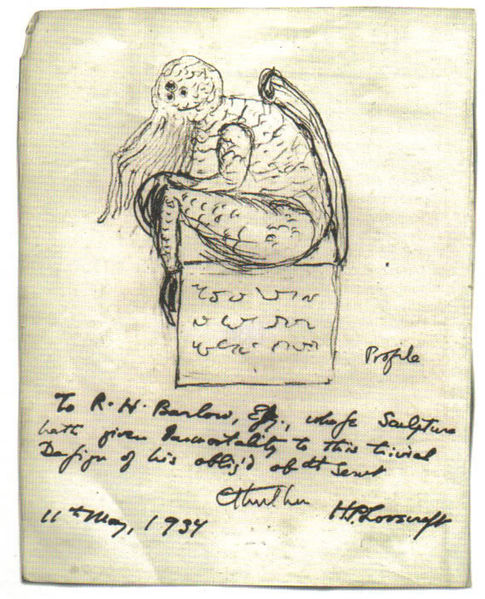
The deeper you peer into the mouth of nature, the more Lovecraftian the world becomes. Just days after I had posted a little meditation on Cthulhu, the great old god of H. P. Lovecraft’s unholy pantheon broke into the mainstream news. No less a source than NBC ran the headline “Tiny Cthulhu ‘monsters’ discovered in termite guts” only a few days ago. The microbe with the scientific name Cthulhu macrofasciculumque lives in the digestive system of termites, helping them in their destructive work. True, Lovecraft described Cthulhu as a bit bigger than that, but the first appearance of the microbes, according to Megan Gannon, reminded the discoverers of the eponymous terror of the Cthulhu mythos.

From microbes to the major football leagues such as the Baltimore Ravens, writers of the macabre have left their mark on our culture. The darkness they describe so richly is something we all feel at some level, but that we sublimate most of the time so that we can get on with our lives. Cthulhu macrofasciculumque may be very, very small, but the super-viruses and bacteria that we are encountering have the ability to destroy us just as surely as the chimerical colossus of Lovecraft’s nightmares. When we look for a way to describe these terrors, we have brave literary heroes from whom we might draw. We would be lost without them. They make it safe for us to venture into that darkened room, for they have been there before us. Lovecraft gave the world its first scientific description of Cthulhu, and although that description defies adequate reconstruction, we recognize it when we see it.

As Lovecraft saw him.

As Lovecraft saw him.

Science has brought us so very far. We can now see to almost the brink of an infinite universe and delve into the guts of termites. We have the ability to prolong life and increase physical comfort for those who can afford it, and we can annihilate entire nations at the press of a button. Drones can fly overhead and do the dirty work, and we don’t even have to step outdoors. Yet when we meet something that shivers our scientific spines, we turn back to the old gods to name it. Yes, religion may be the bête noire of science, but the dark night of the soul is not illuminated by LED’s or lasers. To see in this dark you need to have the night vision of literary perception. And those lenses, according to Lovecraft, reveal that the old gods are dead but still dreaming.


Human Show

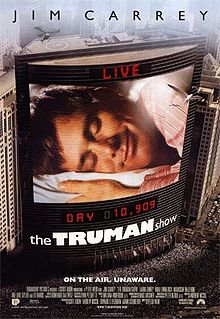
TrumanshowAt least a decade had passed since I watched The Truman Show. Jim Carrey has gone on to achieve an over-the-top kind of fame, but Truman is a thoughtful movie that raises several troubling questions. It is also one of the films of the 1990s that shamelessly cast an uncaring god (the not so subtly named Christof) against the goofy, but serious Truman Burbank. The movie is old enough not to worry about spoilers, so a quick run-down might refresh other hazy memories. Truman is the star of a show where a massive set that includes an entire island has been built around him. The vision of Christof, an unwanted baby is recorded from birth in an artificial, “perfect” world that revolves around him. Until he begins to notice events that, in the real world, would be paranormal. Objects falling from a clear sky, dead people reappearing, fake sets under construction. Determined to learn the truth, he faces his fear to escape by literally walking through a door in the sky.

Christof is “the creator.” From his base in the sky, he looks down on Truman as his star “son” grows to a Christ-like 30 years of age. He is protected from all harm, yet terrified of anything that might aid his escape from the ante-world he inhabits. When he slips the cameras and begins to make his way across the water, Christof, still not wanting to relinquish the ruse, throws a storm at Truman’s sailboat, striking it repeatedly with lightning. “Hit him again,” he growls to his crew. “Again!” It is difficult to watch as the loving god is angered to the point of destroying his only son. When Truman literally reaches the end of his world, he walks on the water to reach the stairway to heaven. Metaphors are flying thick and fast. Christof breaks in as a voice from the sky to convince Truman that his life will be perfect if he continues to pretend that reality is only what it seems to be. His devoted fans cheer as Truman ascends and walks through that door into another reality.

Many books on the theology of film have appeared over the past decade as it has become clear that people are very much affected by what they see on the screen. Our brains resonate with what we are seeing to such a degree that movies participate in our perceptions of reality. In an increasingly secular world, we have come to distrust our gods. This truth has echoed through many movies in the past several years. Although not living up to the hype, The Clash of the Titans—the remake—had classical heroes disputing the power of the gods. Truman doesn’t go that far. We are never informed about what life after the delusion is like. The hole in the sky is black. We know that on the other side, our world, there will be terrible disappointments and tremendous sadness. It may be that there will be no gods at all on this side of the studio. Although showing its age a little, The Truman Show still speaks volumes about the religious experience.


A Weird Resurrection

Driving through an unfamiliar city doesn’t allow for much time to appreciate what you’re seeing. Back in February when I was visiting Austin, Texas for the first time, it was 65 degrees outside. Given the irascible temperatures in New Jersey this year, that felt like summer. Of course, the locals were bundled up since it was, for Texans, unseasonably cool. The weather has been off this year. Of course, we know who to blame. Cthulhu. As I was trying to find the University of Texas with an impatient GPS as my co-pilot, I spied someone walking down the street wearing a Cthulhu ski mask. I can’t express how badly I wanted to pull aside and snap a photo, but pulling aside in a strange city can lead to unwanted adventures. Especially when your co-pilot is an opinionated GPS. I’ve been to north Philly and the south side of Chicago. I didn’t want to take any chances that Austin might hide such districts.

Cthulhu mask

H. P. Lovecraft, like most original thinkers before the computer age, was ignored in his lifetime. I wonder what he would have felt if he had divined that the internet would one day bring him world-wide fame. His writings, of course, had been appreciated before the computer was invented, but the web has nearly as much Cthulhu as it does LOL Cats. Even those who’ve never spent a dark night curled up with the Necronomicon recognize Cthulhu’s octopoid visage when they see it. Davy Jones of the Pirates of the Caribbean fame borrowed his unforgettable face from the Old Gods discovered by Lovecraft. Cthulhu has become a cultural icon of the chaotic, the cosmic, and the somewhat comic.

In a strange way Cthulhu stands for resurrection. In Lovecraft’s mythological world Cthulhu lies under the sea, dead but dreaming. A dying and rising god of utter terror. Lovecraft, an atheist, built his fiction nevertheless around a series of gods. Today his stories are noted for their moody portrayal of improbable worlds, and his storytelling has had an incredible influence on many of those who attempt to generate worlds that are fantastic but somehow still believable. Cthulhu’s resurrection, however, is not to be desired. Even if these he represents life anew, it is a life humans could not bear. In a deeper sense yet it is Lovecraft himself who has experienced a kind of resurrection. A writer forgotten in his lifetime, but rediscovered when it was too late for him to realize just what he’d created, the true master of Cthulhu, I like to believe, lies dead but dreaming, and he has already revealed that he will rise and the masses will tremble.


OMG, MOMA!

New York City can wear you out, spiritually. I suppose that’s why so many people go there, to face the challenge. Thanks to Target, Friday evenings the Museum of Modern Art gives out free tickets for its world-class collection. We knew that Vincent van Gogh’s The Starry Night was there, and had planned on seeing it sometime. Well, Friday of spring break offered an opportunity, so last night, with several hundred, maybe a few thousand, others, we made our way to MOMA. We arrived around 5 p.m. and found the line literally around the block. It wasn’t as cold as it had been, so we braved the hour to wait our turn. Yes, it was worth it. As my wife noted, it was very good to see so many people wanting to see art. Manhattan offers many, many other diversions for a Friday night, but hundreds opted for art. I had long anticipated this. Since my school days I’d seen replications of many of the paintings in the museum, and it was inspiring to be packed in so close with so many people wanting to be close to art. Hoping, somehow, to commune with the emotion in us all seeking such profound expression.

IMG_0602

It was a little difficult to commune, however, with so many other religious seekers. This is a religious experience, to touch the soul of another. Standing inches away from The Starry Night, I could almost feel the desperate, longing hands of van Gogh stroking out a manic sky, surreal and ethereal. I could almost hear the echo of his spirit. Were it not for the many crowding next to the painting to be photographed with it. Fellow spiritual seekers, I hope. Van Gogh was a troubled soul, as we all know. How many artists take their own lives after reaching out to touch what so few of us even dare. A sadness so profound as he climbed down that mountain. The starry night is the photograph of a suffering soul.

IMG_0614

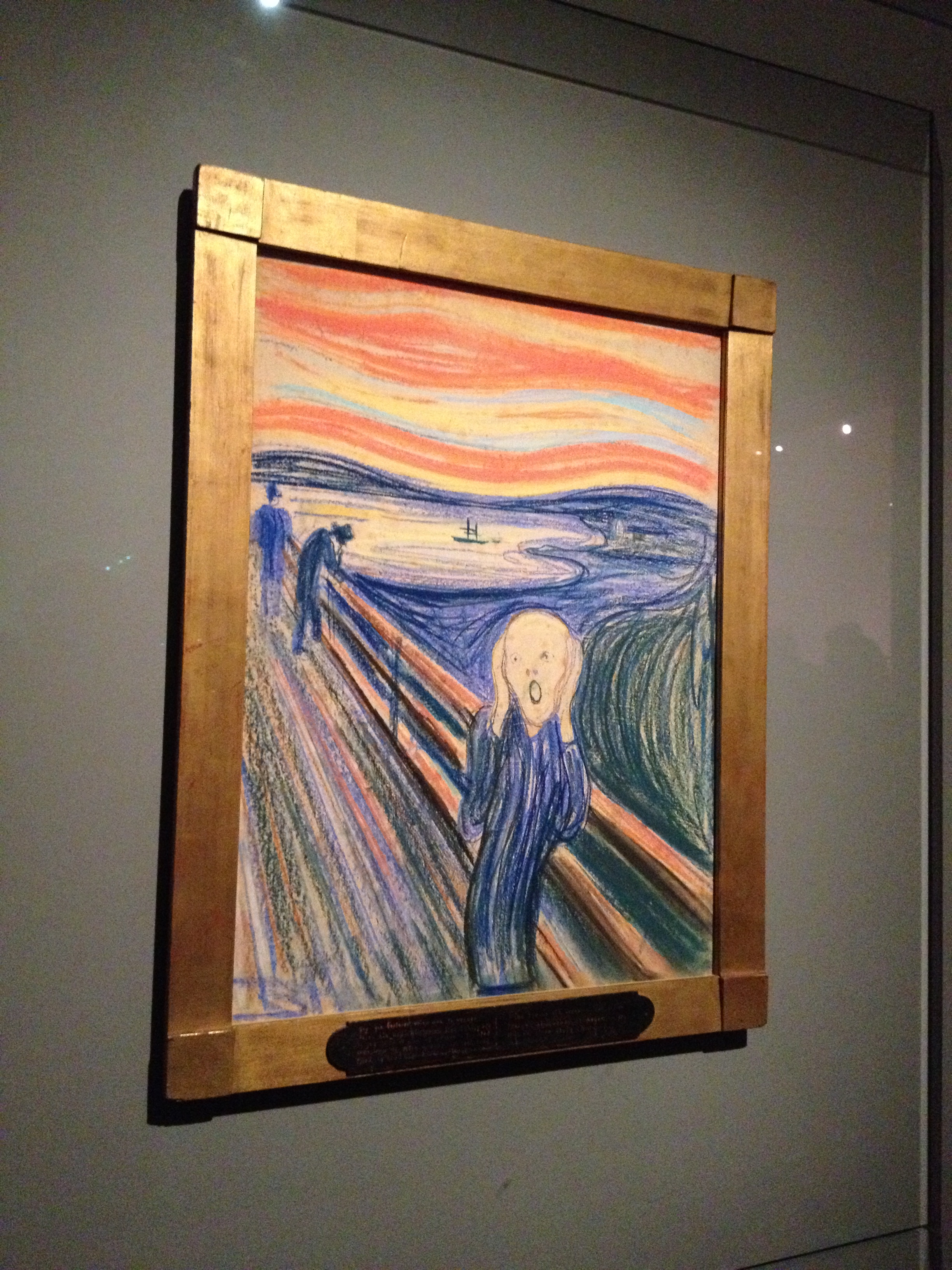
Then there was Edvard Munch’s classic, The Scream. On a limited engagement at MOMA, facing, just across the hall, van Gogh’s Starry Night. Was there ever such depth of soul in such close proximity? It was there that I began to question the faith that I had hoped impelled the countless masses yearning to observe free. MOMA allows photographs, and cameras, cell phones, and iPads were ubiquitous. To reach The Scream was to endure a crunch of strangers’ bodies pressing you forward, cell phones held aloft, illicit flashes popping, worried looking docents. I was anticipating another spiritual moment when I heard a woman say that she had to get close for a picture. “This is going to be my status!” she cried. So this is modern spiritually, the life splayed on Facebook, bragging about bagging Munch. Yes, Edvard, I am screaming too.

IMG_0610


A Scream or Two

Scream2A few weeks back, for my weekend fix, I watched Scream. I hadn’t seen the movie when it came out in 1996, but having seen so many references to Ghost Face I felt I was missing out on something. I was disappointed, however, at the relative lack of religious imagery or dialogue in the film. Such motifs are so common in horror films that I’ve come to depend on them. In fact, there was nothing supernatural in the movie at all. This weekend I decided to follow it up with the sequel that many claim is better than the original, Scream 2. It is the same self-aware exposé of horror gimmicks and tropes, providing several clever frights along the way. But this time there was more religion. Not that it was overt or central, but it was clearly there. My thesis was bolstered a little bit since the storyline felt the need to come back and pick up what was mostly lacking from the first film.

Sidney draws first blood in the sequel by comparing a sorority to a religion. Not much, but a start. We find out that Sid has taken up drama in college, where she has been cast in the role of Cassandra, the prophet of Troy cursed with never being believed, although always being right. In the truly disturbing scene from the play we’re shown, Zeus himself comes down and points a godly finger at the frightened girl. The real religious imagery, however, comes toward the end of the movie when Derek is tied up, cruciform style, by his frat brothers for giving away his letters. He plays the role of the sacrificial lamb as Sid comes face-to-face with the Ghost Face duo, and when his dead body is lifted up on the stage prop, the camera angle reveals either an angel or an ascending deity, arms spread out as if on a cross. Life has been laid down for life, a distinctly religious theme.

What would horror be without resurrection? The villain always comes back from the dead, having easy access to that which is denied the regular mortal. This factor alone suggests that most horror films are transmuted religious fulfillment wishes. We live in a time when religion seems to have lost its transcendent power, and yet we long for resurrection. Horror movies tell us it is available, but at a very steep price. Perhaps it is an unintentional motif, but it is a pattern that occurs so often that it feels integral to the very conception of the scary movie. That which we long for the most is the most terrifying. Horror films aren’t for everyone, but their popularity shows, on some level, that our society hasn’t given up on religion just yet. Scream 2, the resurrection of a wry, witty, and somewhat gory original, brings fear and religion together once more. Religion, like the horror villain, never really goes away.


A Goy in the City

Getting across Midtown Manhattan quickly during rush hour involves a kind of algorithm. That means my route to and from work each day changes depending on whether I catch that light at Eighth Avenue or Third Avenue. This past week my algorithm took me down 42nd Street on the way home. As I walked past a group of Orthodox Jews handing out leaflets, they singled me out and stopped me to ask if I was Jewish. I said “No,” but took their literature anyway. At first blush, it may seem odd to be mistaken as Jewish by some local experts (New York City has its fair share), but then again, maybe not. My brother tells me he gets asked the same question. Our great-great-grandparents left Germany in the 1820s and bore the ambiguous surname Tauberschmidt. By my great-grandparent’s generation they seemed to have been Lutheran, but before that? Hey, maybe this could explain a lot. Not to stereotype, but I do have the incessant angst that many Jewish characters exhibit in Woody Allen movies. Probably it’s my imagination. I thought it was cool to be mistaken for a “minority.” I felt, for a moment, like I belonged.

Reflecting on this incident (which made my day, by the way), I ask myself what it means to be part of a religion that has become a culture. The academic lingo for this is “cultural Jews” (in this case), but there are definitely “cultural Christians” as well. I suspect most religions have their cultural commandos. Part of the dynamic at work here is that although the world is very religious, it’s not really that religious. Most religious folks have an emotional connection to their tradition that may be, in fact, cultural rather than, for lack of a better word, spiritual. A person who is deeply religious often runs afoul of life in the everyday world. There is a sinful plethora of distractions. Those truly concerned about their religions often find themselves employed by them.

Cultural religions give the world a great deal of color. People flock to St Patrick’s Day parades when rivers are dyed green and everyone wants to be part Irish (and there is a genetic bit of this in my personal mix as well). Where would December be without Christmas and its attendant holidays? Even bunnies like colorful eggs in the springtime, so I’m told. Do any of these things make people religious Christians? I suspect few would argue that they do. I’m stretching Rousseau‘s concept of civil religion a bit tight here, but degrees of religiousness fall along a continuous spectrum rather than appearing in sharply distinguished colors. Cultural faiths are generally accidents of birth. It’s up to the individual how seriously to take it. And sometimes even the faithful misidentify one of their own.

Happy Passover to my Jewish siblings!

Happy Passover to my Jewish siblings!