No Ordinary Picnic

I will be including spoilers in this review, so please be advised!  Joan Lindsay’s Picnic at Hanging Rock is a novel that began as speculative but then turned naturalistic.  Mostly, anyway.  Born in 1896, Lindsay published the novel just after she turned 70.  Since she was Australian, it stands to reason that the story is set there.  Hanging Rock is an actual place and, according to multiple sources, Lindsay ended the book with a speculative chapter that explained the mystery.  What is the mystery?  On Valentines Day 1900, the girls at Appleyard College set out for a picnic at, well, Hanging Rock.  While there, three of the girls and one of their chaperones disappear.  Since everyone travels by literal horse power, getting back and forth from the scene of the mystery takes hours.  The head mistress of the college is frantic, mostly because she’ll be losing tuition because of this.

Eventually one of the girls is found, somewhat mystically, by a young Englishman with whom a romance starts and seems to end abruptly.  The found girl remembers nothing of what happened that day.  Further investigations are held, but the mystery is never solved.  Meanwhile, Mrs. Appleyard, the mistress of the college, takes a strong dislike to one of the girls who was devoted to one of the missing.  After one of the girls’ governesses, recently dismissed, burns to death, the headmistress appears to have murdered the girl she disliked (or she fell/jumped from a window; the novel isn’t explicit on the point).  Mrs. Appleyard, realizing she is ruined, goes to Hanging Rock where she dies by suicide, throwing herself down the rocky side of the outcropping.  The speculative ending—no longer part of the novel—had the missing girls disappear into a kind of time warp.  Lindsay’s editor had her remove that chapter.

The novel became quite well known in Australia, and to the wider world when a movie was made from it.  The interesting thing is that the novel presents itself as describing factual events, like the Blair Witch Project.  This is so much the case that the rumor grew that the events really did happen.  A book was even written, suggesting a solution regarding what happened to the missing girls.  Had the excised chapter been published with the book, it would’ve been clear that this was a fictional tale.  Lindsay had a savvy editor, however.  Nothing sells like a dramatic story that readers believe to be true.  Witness The Amityville Horror.  Even though naturalistic, a bit of the speculative still hangs about the story, making for a good gothic novel without a firm resolution.


Hunting Vampires

Many years ago some friends took us to the Mercer Museum in Doylestown, Pennsylvania.  Bucks County is one of those places where oddities persist, and I was very impressed by the fact that the museum had an actual vampire-hunting kit.  Now this was before the days of sophisticated cell-phone cameras and my snapshot, through glass, wasn’t very good.  There was no way to know, at the time, that a few years later Vampa: Vampire and Paranormal Museum would open up just a few miles down the road.  And that the latter would have a whole room full of actual vampire-hunting equipment (advertised as “Largest collection of vampire killing items ever in one location”).  A very real fear of vampires existed in Europe up until the technologies of the last century showed that humans don’t need the undead to create fear.  In any case, many chests of vampire-banishing implements line the first room.

And stakes.  As my wife noted, in the movies they just grab a stake and mallet and get to work.  These were stakes made by craftsmen.  Many of them intricately carved, and, one suspects, officially blessed.  Matching sets of stakes and mallets seem like they were for display, rather like some firearm collectors these days proudly show off their guns.  The odd thing, to my mind, is that most of these artifacts weren’t medieval, but from the early modern period.  The earliest I saw was from the seventeenth century.  I had to remind myself that Europe was undergoing a very real vampire scare the decades before Bram Stoker wrote Dracula.  John Polidori, Lord Byron’s associate, had written a vampire novel in the early nineteenth century, well before Stoker’s 1897 classic.

Vampire maces were of a higher magnitude.  The spiked mace, with crucifix, shown here, is an impressive piece of woodworking, as well as enough to make any vampire think twice before biting any necks in this house.  The idea of the Prince of Peace adorning such an instrument of violence encapsulates the contradiction of being human.  And the depths of our fears.  This museum is a testimony of our collective phobias.  Few people in this electronic age really believe in physical, supernatural, vampires.  There are people who do, of course, but most of us are so entranced by our phones as to completely miss a bat flitting through the room, let alone a full-fledged undead monster with fangs.  The fact is, over the centuries many people did gather what was needed to protect themselves from vampires in chests and cabinets, all in the name of fear.  

One final note: one of the vampire hunting kits was owned by Michael Jackson.  As the sign (with a typo) notes, the Jehovah’s Witnesses (to which both he and Prince belonged) convinced him not to give it as a gift.  Belief, it seems, persists even into the late twentieth century.


Dead, Not Sleeping

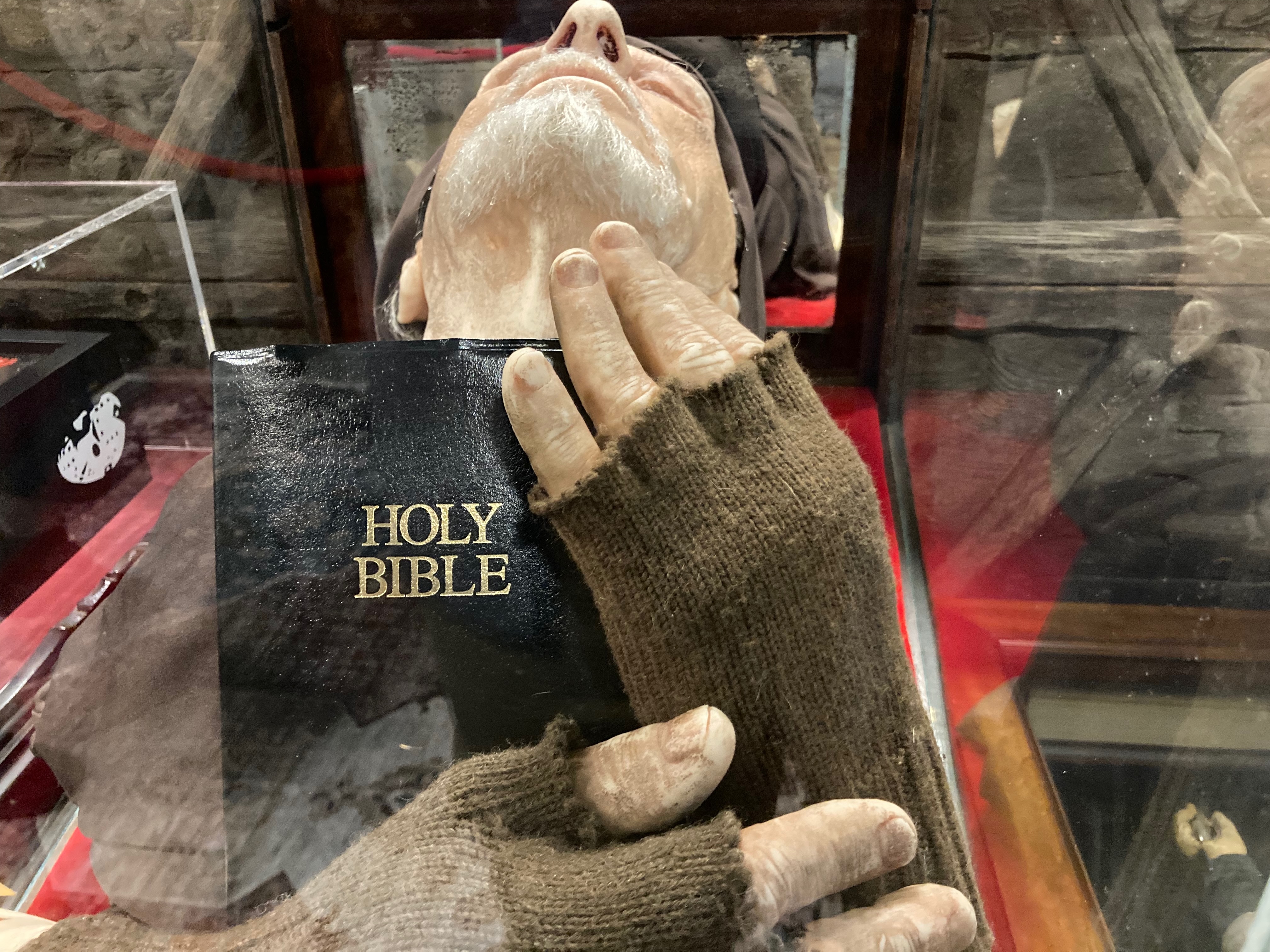
A Nightmare in New Hope is a fairly intimate space.  The owner told us that the collection will change and grow, given that he’s still collecting.  Having a particular interest in Tim Burton’s Legend of Sleepy Hollow—having a book (ahem) on the subject coming out soon (cough)—I was particularly anxious to see what props they had.  To make sense of this it helps to have seen the movie, but you’ll catch on, even if you only know the Disney version of the story.  There were three main items from the movie that they have on display.  One is the wax seal used for the Van Garrett will, used as the movie opens.  The seal is quite large.  Of course, movies substitute props from time to time, blended by celluloid magic.  CGI doesn’t leave as many tracks.

The second artifact is one that wouldn’t have occurred to me to have even existed.  This was the animatronic horse’s head for Daredevil, the Headless Horseman’s mount.  There are a couple scenes in the film involving horse acting, and I’d just assumed that trained animals were used.  Being up close and personal with this artificial head, a couple thoughts came to mind.  One is that right next to it, it’s quite obvious that it’s artificial.  The second thought was just how much thought and effort goes into a big-budget movie.  For a few seconds of a close-up horse head, this model had to be constructed and used and then set aside.  I asked the owner about how such things were acquired, and he noted that production companies don’t keep everything.  He also noted that movie artifact prices have skyrocketed.  Both because horror is now popular and because CGI, as noted, doesn’t leave tracks.

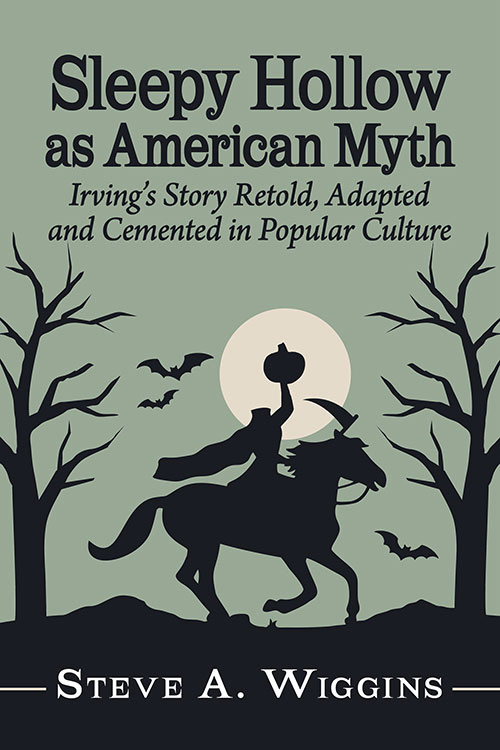
The third, and most proudly displayed Sleepy Hollow piece is the Headless Horseman’s sword.  This appears in the movie far more often than either Daredevil’s head or the wax seal.  One of the aspects of Washington Irving’s story I discuss in Sleepy Hollow as American Myth is that the Horseman’s weaponry changes over time.  I won’t say more since, like museum owners, those who write books hope that they well sell a few copies.  I’ll be revisiting A Nightmare in New Hope from time to time.  For the items on display, I’d seen probably 90 percent of the movies, and a few of them I’d discussed in some detail in either Holy Horror or Nightmares with the Bible.  Of course, the Sleepy Hollow book is forthcoming (ahem).


Scary Father’s Day

Given my circumstances, I never really celebrated Father’s Day growing up.  By the time I was old enough to get the concept, my father was long gone.  My step-father, some years later, was no real father.  Besides, we were poor and it was hard to think what such a celebration might entail.  All of which is to say that I never really expect much from the day myself.  My wife and daughter suggested we try Nightmare in New Hope again—this is the horror movie museum in New Hope, Pennsylvania, which had been closed last time we tried.  It was an appropriately rainy day, the kind we seem to specialize in around here.  I suspect that the museum will show up in a future blog post or two, but suffice it to say that it’s an impressive little collection.  It’s an odd feeling, this human desire to be in the presence of something you’ve seen in a movie.  I recommend it for any horror fans who happen to be along the mid-Delaware.

Not being large enough to take all day, we considered what we might do that afternoon.  In keeping with the theme, a visit to Vampa: Vampire and Paranormal Museum was suggested.  This museum is in Doylestown, which is only about a quarter hour from New Hope.  There’s more to it than just the museum, so it too will likely come up in future posts.  This museum contains a truly impressive array of artisanal vampire hunting equipment from Europe, dating between the seventeenth and nineteenth centuries.  I’ll try to put together a photo essay of it soon.  But that’s just the first room.  A second deals with demonic possession.  Then rooms have displays of occult and other esoteric artifacts, along with creepy suggestions to be careful of engaging too much with them.  The final room is dedicated to St. Michael the Archangel, and it warns that the struggle with evil is real.

Both places had a steady stream of visitors yesterday.  It would be fair to say that by the time we finished I was over-stimulated.  You have to understand that I personally don’t know many people interested in horror.  Going to these places was the sacrifice of a rainy Sunday afternoon for my family but will likely become one of those pleasant, lingering memories of the unusual that take on a rosy afterglow over the years.  This blog quite often ponders over why such things take on meaning for someone interested in religion and belief.  Being in the presence of artifacts, as noted above, puts you in touch with a kind of earnestness that mere electronic reading on the internet lacks.  If you happen to be along the mid-Delaware, the side trip to Doylestown is a worthy add-on, Father’s Day or not.


A Father’s Day

Some thoughts I hope I’m allowed to share on Father’s Day: I recently saw a review of The Wicker Man that pointed out (rightly) that my treatment of gender was outdated.  Similarly, the (few) readers of Nightmares with the Bible make a not dissimilar observation about my use of Poe’s formulation of women in danger.  I am very much aware that gender studies (which wasn’t even a potential major when I was in college) have done much needed work in clarifying just how complex a phenomenon it is.  I have posted several times on this blog about precisely that.  Still, we all write from a position.  My training is not in horror studies, and it’s not in gender studies.  My writing, despite the price, is intended for non-academic readers, but I too may be between categories here.  I’m trying to escape the academy that has already exiled me, but the framing of my questions is too academic.  I get that.

I also write from the perspective of a man. There’s no denying that I write as a straight, white male.  This is how I experience the world.  And how I experience horror.  Returning to Nightmares, I think my point might’ve been better expressed as noting that writers, directors, producers, and others in the film industry understand that viewers of their particular films may be more moved by a female possession than a male.  Or, in Wicker, that publicly expressed concerns about rape and sexual violence are more commonly expressed by women.  Statements can always be qualified, but that happens at the expense of readability.  There’s no such thing as a free lunch after all.

Academics can’t be blamed for doing what they do.  They critique, poke, and probe.  My books since Holy Horror have been intended as conversation starters.  But they’re conversation starters from the perspective of a man who watches horror and tries to understand why he reacts to it the way he does.  There is an incipient ageism, I fear, that sometimes discounts how people raised to use “man” when referring to mixed or indeterminate genders—taught so earnestly by women who were our teachers—sometimes take our earliest learning for granted.  Those early lessons are often the most difficult to displace.  I try.  Really I do.  I’ve had over six decades looking at the world through a straight man’s eyes.  I welcome comment/conversation from all.  Of course, my intended readership has never been reached, and they, perhaps would have fewer concerns about my view.  Romance (hardly a feminist-friendly genre), after all, is one of the best selling fiction categories, even today.  And many of the writers—generally women—express the gender-expected point of view. That’s a genre, however, outside my (very limited) male gaze.


Night Voices

So this is really why I watched The Lady in the Water.  A friend had recommended The Man Who Heard Voices: Or, How M. Night Shyamalan Risked His Career on a Fairy Tale, by Michael Bamberger.  The book was published in 2006 and I found a “very good” used copy on sale for six bucks.  It’d been on my to read list for a year or two.  The book arrived and I discovered it was about a Shyamalan movie I’d never heard of.  I have friends who refuse to even mention his The Last Airbender.  (I’ve seen the original animated version and it’d be difficult to think a movie would improve on it.)  Indeed, The Lady in the Water was a box office disappointment, and The Happening (which I kind of like) and The Last Airbender were critically castrated.  M. Night Shyamalan’s name does draw crowds, but I prefer his horror to his fantasy, but that’s just me.

In any case, reading Bamberger’s book was like cinematography 101.  It’s a nonfiction account of how this movie was made, written by a sports writer also from the Philadelphia area.  He begins by narrating how he met Shyamalan at a party.  How that meeting led to the idea of writing a book about his movie-making process.  Lady in the Water isn’t Shyamalan’s best work, but this book goes through how terribly personal the project was to the writer-director.  It’s a gripping account, especially for those who try to create any form of art.  It also gave me a renewed respect for what Shyamalan tries to do with his movies.  Early career success made him rich, and then he was in a place to follow his dreams.  Or bedtime stories.  Of course, a book written nearly a two decades ago couldn’t project where Shyamalan would be today.

His career surged again, beginning with The Visit—definitely creepy—and has continued to ride fairly high.  Although I haven’t seen all his films, I was interested enough to read about his creative process.  Although The Village wasn’t as highly regarded as The Sixth Sense or Unbreakable, it’s still my favorite among his movies.  Part of that is because it was the first of his films I saw.  It was recommended to me by my brother, which also helped.  Mainly, that movie made me trust Shyamalan as a writer-director.  I’m not sad to have seen The Lady in the Water so that I could read a book about it.  The whole thing was a lesson in creativity.


Water Lady

Being creative poses the very real threat of being misunderstood.  I can’t help but think that some of this was going on in M. Night Shyamalan’s The Lady in the Water.  Initially cudgeled by critics, it nevertheless seems to me that the perceived arrogance is overstated.  I generally like Shyamalan’s movies.  I think he does horror quite well, and I thought that maybe there’d be some horror elements here.  There were a few, but the story is kind of long and rambling, kind of like the stories I told my daughter at bedtime.  The movie begins by laying out a legend of a narf (water nymph) who will bring the world peace.  She is attacked by a scrunt, the monster in the film, but has to deliver a message to humans and has to be protected by the maintenance man at an apartment complex in Philadelphia.  And complex is right.

Since this isn’t a widely-known story, we have to be told, in pieces, by a number of the ensemble cast.  A lot of it is unbelievable, even for a fantasy movie.  At the same time, it contains a good message and I get the sense that this is why Shyamalan made it.  He does have an important role in his own movie (which is why it is said to be arrogant), but the style is reminiscent of his other movies.  The scrunt seems like a good idea for a monster and a couple of the attack scenes veer briefly into horror territory.  There’s even an element of Scream when Bob Balaban’s character explains (incorrectly) why he will survive an encounter with the scrunt.  The story has some likable elements but when so much of a fantasy world is being revealed piecemeal it’s sometimes hard to keep your focus.

Based on a bedtime story Shyamalan told his own children, it does resemble that genre of story.  Personal.  When my daughter was small, I made up nighttime stories for her pretty much on a daily basis.  They had a kind of rambling, plodding nature to them.  I made up creatures, as in this movie, and, as Balaban says, kept it family-friendly.  Classic stories do tend to follow a trajectory that is well known to literary scholars.  Something entirely new thrown into that area will sometimes emerge  beaten up.  It wasn’t a waste of time to watch The Lady in the Water.  Not one of Shyamalan’s best, it is nevertheless a film that makes you think a little while afterwards.  And that seems to be what it was intended to do.


Parson’s Poe

Some things just don’t mix: oil and water, cats and dogs, intelligence and Republican policy.  That’s the way of nature.  I don’t have a lot of time to listen to music—unlike some authors, I can’t write with music playing.  I end up paying attention to the music rather than what I’m trying to do.  So the other day when I had the opportunity, I went through our CDs to see what I hadn’t heard for a while.  I’d completely forgotten about the concept album Tales of Mystery and Imagination Edgar Allan Poe by The Alan Parsons Project.  Now, I’m not the biggest fan of Alan Parsons, but some of their songs are among my absolute favorites.  One of them can almost invariably make me tear up and my throat clench.  And I think Ammonia Avenue is one of the great albums of all time.

You’d think their mix of alternative rock would be favorable to Poe.  Poe is extremely personal to me.  I’ve read probing biographies and put them down thinking how much my perspective is similar to that of Poe.  I mention him in my books because he’s my writing companion.  APP just doesn’t get it.  Neither did Lou Reed.  Like Black Francis, I like Lou Reed.  But I like Poe more.  Not even Poe (sorry Anne Decatur Danielewski) comes close.   I have heard rock adaptations of Poe that I do like, so why didn’t Alan Parson, Lou Reed, or Poe (Danielewski) do it for me?  It’s difficult to say.  Music is very personal to me.  It stays in my head for a very long time, so I have to be careful what I let in there.  I don’t write much about music on this blog because I just don’t know you well enough.

I got the Alan Parson’s album long after it was published.  I can’t remember how I found out about it, but I had great hopes for it.  I guess Poe (the man) has a certain sound profile in my head.  It’s likely because, to me, Poe is more than the author of tales I read when I was young.  He is a symbol, coming to represent more than just another writer who struggled and was likely never understood in his lifetime (if ever).  As those who write and attempt publication know, this is a hostile business.  It’s difficult to get published in the traditional way and then it’s difficult to get your work noticed after it’s published.  These days a “like” and a “share” can go a long way (click “like” if you do), but even so my Poe music will be mine alone.


Addams Family Research

After having binged on Wednesday earlier this year, and wanting something lighter to watch, we finally saw The Addams Family.  Neither my wife nor I watched the television series too much when we were kids, but it’s probably no surprise that I watched it more.  As with Wednesday, if you didn’t see the television show, or read Charles Addams’ cartoons, you can still enjoy the movie.  After all, some of the salient aspects of the eponymous family are never explained.  Why are they so wealthy?  Things like that.  Although the movie, which is family friendly, can’t be called horror, it is a dark humor piece that scratches a certain itch.  For several years I’ve been pondering how horror has become such an amorphous genre that it really tells us little about a movie.  Taken literally, this one would be horror.

Not having grown up as a particular fan, I never really attempted to research the Addams family, but the basic idea was that they were people who lived as they liked, not caring what others thought of them.  They remain happy and cheerful in their macabre tastes.  The humor in such a situation is obvious.  The ultimate non-conformists, they are wealthy enough not to have to worry about fitting in.  Also, they tend to have some supernatural abilities.  Watching the show growing up, the character that never seemed to fit  the macabre image was Pugsley.  Often a partner in crime for Wednesday, his “monstrous” nature seldom seemed obvious to me.  Maybe it was his outfit.  In any case, not fitting in is what the show is all about.  Not fitting in and not worrying about it.

The plot of the movie is surely well known by now.  Gomez’s brother Fester is missing and a criminally minded Abigail Craven sends her lookalike son Gordon to take Fester’s place to get access to their riches.  The humor, apart from the madcap plot, often comes from subverted expectations.  A character points out a gloomy, macabre, or scary situation followed by a comment of how much they enjoy it.  As I’ve noted, taken literally such things define horror.  Horror and comedy can work well together.  In fact, I’ve reviewed many horror comedies on this blog.  I would have never thought to have watched this movie, however, without the prompting of Tim Burton’s Wednesday.  She’s an underplayed character in the series since the focus tended to be on the bizarre adults, as far as I can recall.  As Christina Ricci’s second feature film, her Wednesday laid the groundwork for the Burton series.  Maybe it’s time to do a little more research into family history.


Dream Machine

I’ve reached the age where, instead of how well you slept, it’s the nature of my dreams that is more reliable projector of productivity.  You see, after a night of bad dreams I often wake up drained, lacking energy.  Entire days can be cast into this state of lassitude.  The only thing for it is to sleep again and reset.  The next day I can wake up after positive dreams, bursting with ideas and creativity.  New ideas come so fast that I can’t get them down in time.  Dreams. 

My entire life I’ve been subject to nightmares (no, it’s not the movies).  I still wake up scared at least once or twice a week.  More positive dreams have been struggling with these nighttime frights, and when they win, I have a better day.  I know, I know.  I should be in regular therapy.  The problem is time.  I see notes in papers and elsewhere of people younger than me dying.  On a daily basis.  The problem is I’ve got so much that I want to accomplish that I don’t have time to locate, pay for, and drive to see a therapist every week.  (The bad dreams come that frequently, so it stands to reason that weekly appointments should be on the script, right?)

The thing is, there’s no predicting these dreams or their timing.  My wife and I live a life of routine.  I awake early (anywhere from 1 a.m. To 4 a.m. these days) and begin writing and reading.  I jog as soon as it’s light and start work when I get back.  The 9-2-5 insists that you answer emails until 5 p.m., which can make for some very long days, depending.  After that we have dinner while watching some show we missed when it first aired, and then I go to bed.  That’s been the pattern ever since we bought this house nearly seven years ago.  Before that, we didn’t always watch things in the evening, but that doesn’t seem to make a difference in the dreams.

So I get up early and write down my thoughts for this blog, work on the books I happen to be scrawling at the moment (both fiction and non) and anxiously watch for sunrise, that ever shifting foundation.  And then work.  Always work.  But how well I work will depend largely on what was in my subconscious mind before I wake.  I have no idea if this is normal.  Knowing myself, it probably isn’t.  But I’ve reached the age where it at least starts to make sense.


Split Decision

Sometimes advertising and packaging can make you ill-prepared for a movie.  I know that M. Night Shyamalan’s Unbreakable, Split, and Glass are considered a trilogy.  Without knowing the story, I saw the first film and discovered it was a superhero movie.  That’s fine, of course.  It’s not really horror much at all.  That’s maybe the reason Split caught me off guard.  It is brought into sequel territory right at the very end, but the story is tense and scary.  Kevin Crumb is a man with DID, dissociative identity disorder—what used to be called a split personality.  Quite apart from the inherently fascinating phenomenon (and the criticism the movie received for misrepresenting it), the idea that a person shifts and you don’t know who s/he is, is frightening.  A couple of those personalities have teamed up and become criminal.  Kevin abducts three teenage girls for a purpose that only becomes clear later.  Their efforts to escape create a great deal of the tension, and the quick shifting of identities that Kevin displays makes any kind of reasoning with him impossible.  

There are any number of avenues to discuss here.  One is that Kevin’s disorder stems from how his mother treated him as a child.  (Unintentionally I’ve been watching movies that trigger me that way lately.)  He developed personalities to protect himself from the pain and they continue to multiply.  Meanwhile, the kidnapped girls can’t figure out what’s going on but Casey (Anya Taylor-Joy—my first clue that this was horror instead of a superhero movie—)realizes that she has to treat the different identities in different ways.  Another avenue is to consider what “the beast” (one of the personalities) asserts: only those who’ve been broken are truly evolved.  Some children make it through difficult childhoods by becoming resilient while others don’t.  Casey, it turns out, also had an abusive relationship in her childhood.  Movies like this always make me reflect on how difficult being a good parent can be.

The person not in control of their own actions (ahem) is among the most frightening of human monsters.  Those with mental illness, however, seldom fall into this category.  I understand why mental health providers found this film problematic, but it showcases Shyamalan’s horror chops.  It was the scariest movie that I’ve seen in quite some time.  After I ejected the disc I felt bothered (and trapped) for quite a few minutes.  And I realized that if this is a trilogy then superhero and horror combined await in the third part.  We shall see.


World History

I don’t doomscroll, but I occasionally fall down a virtual rabbit hole.  One of the truly interesting things about being an editor is reading proposals from other editors.  China’s been a hot topic for the past several years and so I hopped on over to Wikipedia to find out who this Chiang Kai-shek was, after reading a proposal.  I’d heard his name from childhood on, but I’d never read any history of China.  For my entire life it has been a communist country, often with frosty relations to the United States.  One thing led to another and I landed on the page titled Warlord Era.  This sounded like something out of a fantasy novel, so I thought I’d see what that was all about.  When you scroll down to the Warlord profiles section, you find some really interesting stuff.  One of these warlords was a real eclectic guy known as the “model governor.”  Another was a strict Methodist who banned alcohol and dressed like a common infantryman.  Yet another was known as the “most well endowed man in China,” in the southern regions, that is.

Beiyang Army; image credit—unknown photographer. Public domain via Wikimedia Commons.

Now, I’ve never read any Chinese history, but these guys sound a lot less threatening than anyone you’d find in a Mario Puzo novel.  They may have been terrifying in real life; Fidel Castro wore a common soldier’s uniform, but I’d have been frightened had I found him lurking under the bed.  Of course, I’ve never read any histories of Cuba either.  There’s a lot to learn in this world.  I enjoy reading history, but my writing projects tend to direct my non-work reading these days.  I’ve been acutely aware that my time on this fascinating planet is limited and that none of us can learn everything.  It saddens me that world leaders show so little interest in the planet they “govern.”  Even a little reading on Wikipedia should be enough to grease those wheels.

One of the strange ideas that occurred to me once while reading a different proposal was that China conducts business deals with, for example, nations in Africa, in which the United States is not involved at all.  When this thought launched I realized just how parochial the outlook of many of us is.  I lived overseas for three years, but still, the United States, in better and in worse, is my home.  It’s the place I know (or thought I knew).  Where some of my ancestors lived for over two-and-a-half centuries.  As appealing as Canada often seems, my fate appears to be here, along with my heart.  So I don’t doomscroll.  But I do read about China and realize how little I know.


Deadly Seven

Seven, styled Se7en, shades more toward the thriller end of the stick than horror.  The two are very closely related, of course, but as a gritty cop drama, the main horror element is the gore.  And the serial killer.  Indeed, it’s often compared to The Silence of the Lambs, a card-carrying horror club member.  My main complaint is that much of the movie is shot so dark that you can’t see what’s going on.  The unnamed city is about as cheerless as Bladerunner, and even when people aren’t being stalked by the serial killer they’re being murdered anyway.  So this dark setting brings together two detectives, one retiring (played by Morgan Freeman) and one with anger issues (Brad Pitt) set to take over.  The two are only supposed to overlap seven days, but the seven in the title refers also to the seven deadly sins.  

A literate cop drama—Freeman knows his literature (Milton, Chaucer, Dante, and even Thomas Aquinas)—it is a step above the standard crime drama.  The fact that Freeman spends his nights in the library may be the reason some people consider this dark academia.  The academic part is otherwise absent.  In any case, it is Freeman who recognizes that victims are being killed for their embrace of one of the seven deadly sins.  An obese man is fed to death, a greedy lawyer has to cut off a pound of his own flesh (in a hat-tip to Shakespeare).  When Freeman’s character tells Pitt’s that it’s from the Merchant of Venice, the later says “I’ve never seen it.”  Not read it, but watched it.  It’s Freeman who recognizes the endgame that the serial killer is playing and tries to warn Pitt.  But Pitt’s wrath is also a deadly sin.

The seven deadly sins aren’t biblical.  They emerge in early Christianity, taking shape through such writers as Tertullian, Evagrius, and Pope Gregory I.  They have remained in Catholicism as  pride, greed, wrath, envy, lust, gluttony, and sloth (which sounds like the profile of some narcissists in the news).  They’ve been used in proper horror films as well as in thrillers, giving a convenient number of infractions to pursue.  Seven is one of those films that has become more highly regarded over time.  One might say that a prophet is without honor in their own time.  In any case, the movie is gripping and sad and a bit bloody.  It doesn’t unfold exactly as you might expect.  And no matter its genre, it can leave you thinking.


Framing

Have you ever gone into one of those art museums where the frame of a painting is so lavish that you notice it almost more than the art it contains?  It certainly says something about me (or where I shop), that I prefer simple frames.  Those that ideally pick up and emphasize something in the picture.  I recently critiqued a book on this blog because the framing seemed off.  Not a week afterwards I found myself going down an internet rabbit hole (the topic isn’t important) because someone had framed a speech so that it seemed to be reading things one particular way.  With that framing, I watched the speech and was astonished.  Then I sent it to one of my brothers and he pointed out that it could be understood a different way.  At first I was embarrassed and defensive (to myself), but I went back and listened again and realized he was right.  I’d accepted the framing uncritically.

We are incapable of seeing everything.  From the shape of our eyes to the limits on our distance vision, we can only take in so much.  That’s what frames are for.  We put them around paintings, photographs, posters, windows, and mirrors.  The demarcate the limit of something.  This image goes only so far.  Televisions used to do that, although now they seem to take up a wall instead of a framed corner space.  But even so.  Movie screens too.  They provide important context.  We know, looking at that screen, that something limited to that screen will appear.  We know that what’s caught in the picture frame can’t reach beyond it, physically.  (I am excluding some modern art, of course.)  Framing is important.

I am glad for this recent object lesson.  I was letting myself get worked up over something I may have viewed the wrong way because I had been primed to do so.  It involved one of my deepest wishes, so emotion definitely played a part in it.  Critical thinking involves looking at the frame and thinking about it as well as what’s inside.  Those who excel at creating content make you forget the frame is there.  The artist isn’t painting to fill a frame, the frame contains the art.  We all know this on some level, I suspect.  Nevertheless, when someone presents us anything with the interpretation built in, we need to ask ourselves if that interpretation is inherent in the object or is it simply part of the frame.  And if it’s the frame, no matter how fancy, we need to remove it and look from a different angle.


Hop In

Especially the first part, of Mona Awad’s Bunny, is so well written I almost laid down my pen for good.  I really enjoyed this one.  Once the story gets deeper, into the second and third parts, questions begin to arise as to what’s going on.  One reason for this is the story becomes speculative in nature and Awad’s not about to give away what’s “really happening.”  Set among a set of five graduate students at the prestigious Warren University (the name is a hat-tip), the novel is often considered dark academia.  It starts out pretty light, and although Awad maintains her deft hand, it grows progressively darker as the tale goes on.  Samantha Heather Mackey is enrolled in the writing program with a cohort of four “perfect” women—the kind many guys go for.  Sam’s an outsider, though, writing dark and troubled stories while her classmates garner the professor’s praise.

The “perfect” women call each other “Bunny” and they eventually invite Sam into their clique.  This annoys Sam’s best friend and sometimes roommate, a local artist who isn’t a student.  But Sam is caught.  She learns that the Bunnies actually transform rabbits into their ideal boyfriends.  They haven’t got the process down pat, though, and the resultant hybrids often have various deformities.  Sam is the only one who can’t do this transformation.  Until she does.  But it doesn’t turn out like anyone expects.  I’d better draw my plot summation to a close there, otherwise I might hop into spoiler territory.  I wouldn’t want to do that because I recommend reading this one for yourself.  Awad’s writing is beautiful and compelling.  I did wonder if I’d interpreted everything correctly when I finally put the book down.

Dark academia comes in a rainbow of colors.  Here, although comi-tragic, there’s something seriously wrong at Warren University.  There are plenty of books and classes, as well as intrigues among ingenues.  And also some serious reflection on expectations and how they affect relationships.  Friendship and what it really means.  Loneliness, and how it creeps into the lives of creative people.  It’s also a story about writing and learning to write.  As noted above, it succeeds wildly in this.  There are definitely horror vibes about the tale, but it’s so well told that you might lose track of the fact that they’re there.  When Margaret Atwood praises a book, it’s worth paying attention.  While not dark and dreary, Bunny shows the sub-genre off as one of great potential.  It’s worth twitching your nose over.